TL;DR
- The AI maturity model maps four stages: exploration and pilots, pilot scaling in selected functions, operational integration, and embedded strategy.
- Most retailers cluster in the middle. About 45% have achieved operational integration, about 25% have AI ingrained in their strategy, and only 13% run a continuous, autonomous personalization feedback loop.
- Maturity does not scale automatically. Mid-sized retailers stall because complexity grows faster than integration, not because they lack ambition.
- The jump from operational to embedded runs on unified data, clear governance, and agentic AI that acts on insights rather than just surfacing them.
You know AI matters. What’s harder to answer is a simpler question: where does your retail business actually stand? Without a way to plot yourself, it’s tough to know whether you’re ahead, behind, or stuck.
That’s the value of an AI maturity model. New research from Voyado and Retail Economics, based on a survey of more than 300 retail leaders across the UK, DACH, and the Nordics, maps AI progress into four clear phases. It also shows where retailers really stand today and why so many mid-sized businesses stall during transition.
This guide walks you through all four phases so you can benchmark your organization’s AI maturity, identify gaps, and find the barrier to your next stage.
What is an AI maturity model?
An AI maturity model is a framework that describes how an organization’s use of artificial intelligence evolves over time. It breaks a messy AI journey into distinct, recognizable stages, each with its own AI capabilities, challenges, and next steps.
The point isn’t to score yourself and move on. It’s to see clearly where you are, understand what’s holding you back, and identify what “good” looks like at the next level. A useful maturity assessment tells you two things: your organization’s level today, and the distance between that and the target maturity level you actually need.
As Aaron Lewis, an independent retail consultant, notes, it’s “very helpful to have a framework… a maturity ladder or a model where you can plot yourself as a retailer: where am I at currently in this wave.” That’s exactly what this model gives you.
Most models look across multiple dimensions rather than a single one: data readiness, technology, people, and operating model. What makes this one useful for retail is that it grounds each phase in what 300 retailers are actually doing, not in a generic view of AI adoption.
The retail AI maturity model: 4 phases
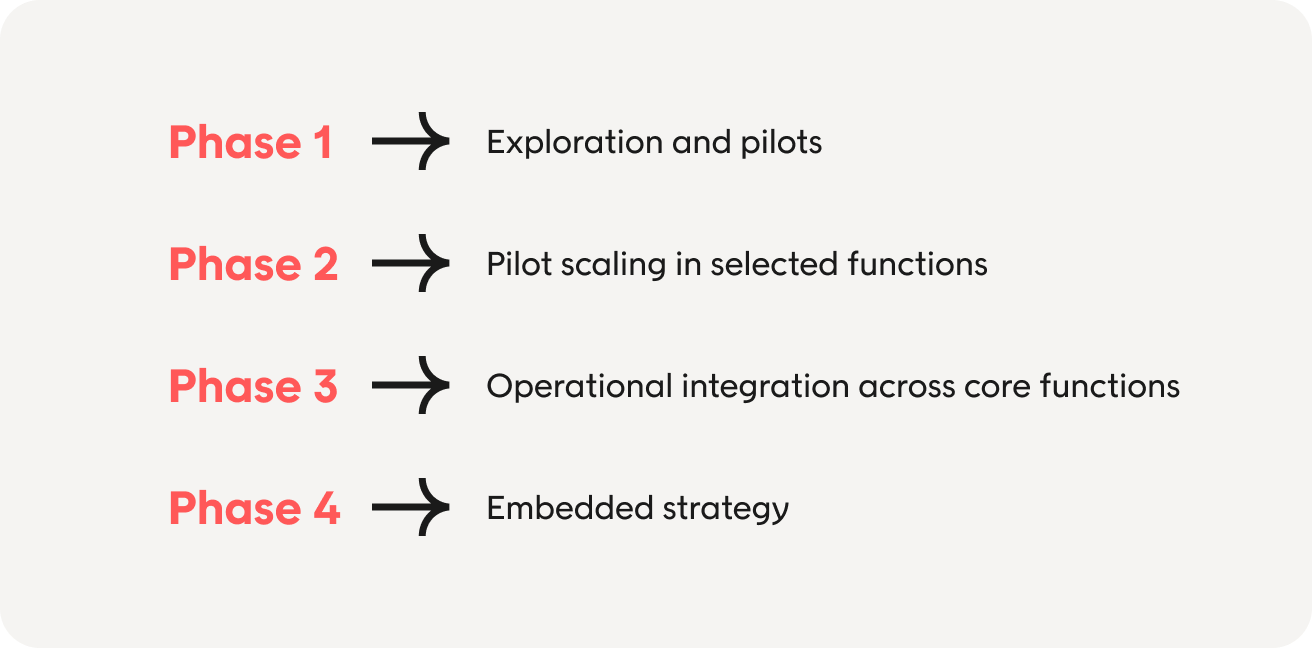
The research identifies four stages of AI maturity in retail. Each one marks a real shift in how deeply you integrate AI into the business.
| Phase | What it looks like | The barrier to the next phase |
| 1. Exploration and pilots | Isolated AI pilots, scattered AI initiatives, value still theoretical | No shared AI strategy, and no way to prioritize initiatives |
| 2. Pilot scaling | AI repeatable inside one or two functions | Siloed data sources and inconsistent data quality |
| 3. Operational integration | AI running across core functions on shared data infrastructure | Complexity outpacing governance, skills, and integration |
| 4. Embedded strategy | AI in the operating model, informing planning and execution | The work shifts to holding the advantage |
Phase 1: Exploration and pilots
You’re testing the waters. Teams run isolated AI pilots, trial AI tools, and build a case for what AI could do. Business value is potential rather than proven, and AI initiatives are scattered across the business.
You’re here if: you can still name each of your AI pilots individually, and nobody owns AI outcomes across the business.
This first stage is essential. It builds curiosity and early AI literacy and surfaces where the AI opportunity might lie. The risk is staying here too long, mistaking activity for progress. Retailers in the first stage rarely have an AI strategy yet, and that’s fine, as long as the exploration is pointed at real business problems rather than novelty.
Phase 2: Pilot scaling in selected functions
Promising AI pilots start to scale within specific functions: marketing, service, or merchandising. AI moves from one-off experiments to repeatable, applied AI in a few areas.
You’re here if: one function trusts AI in production while the rest are still watching to see how it goes.
You’re seeing early wins, but they’re contained. The data sources and processes behind each function still tend to work in isolation, which limits how far the business value spreads. This is usually where data quality stops being an IT concern and becomes a commercial one, because the same customer appears different across three systems.
Phase 3: Operational integration across core functions
At the third stage, AI is integrated across core functions and runs as part of everyday operations. It supports data-driven decisions across multiple parts of the business, resulting in more consistent outcomes.
You’re here if: AI shapes daily decisions in several functions, but every new use case still feels like a project.
This is where the largest share of retailers sit, and, as you’ll see, where many get stuck. AI technologies here run on shared data infrastructure rather than function-specific workarounds, which is real progress. Operational is good. It just isn’t the finish line.
Phase 4: Embedded strategy
At the top phase, AI is embedded in strategy and in the operating model itself. It informs planning and execution across the business, from pricing to inventory to customer experience. Data flows freely, cross-functional teams co-create with AI rather than hand work to it, and AI acts as a genuine strategic asset tied to clear strategic objectives.
You’re here if: removing AI would break how the business plans, not just how one team works.
Very few retailers have reached this stage. Those that have turn AI from a tool into a sustainable competitive advantage, because the advantage sits in how the business runs rather than in any single AI solution they’ve bought.
What are the stages of AI maturity in retail today?
Knowing the phases is one thing. Knowing where retailers actually sit is what makes the model useful for benchmarking.
Here’s how the 300+ retailers in the research break down:
- 25% are still in phases one and two, exploring or scaling their first AI pilots
- 45% have reached operational integration, the single largest group
- 25% have AI ingrained in strategy across the business
- 13% have reached a continuous, autonomous personalization feedback loop that tests, learns, and optimizes on its own
In other words, most retailers cluster in the middle. The move from operational to embedded is the hardest jump, and it’s the one that separates the high performers from everyone else.
Adoption isn’t the problem. The same research found that 95% of retailers are already using AI in some form, while only 5% report a clear, scalable return on that investment. Being busy with AI and being mature in AI are not the same thing.
“It’s easy to confuse adoption for impact.”
Katarina Norden, CMO, Voyado
The pace of change makes that jump urgent. The research found that 71% of retailers expect meaningful AI deployment within two years, and that by 2030, AI will reshape around 39% of marketing and e-commerce spend, amounting to roughly €15bn across the UK, DACH, and the Nordics.
Standing still in the operational middle isn’t neutral. As peers advance, the gap between phase three and phase four widens into real competitive advantage for the retailers who move. For listed businesses, that gap increasingly shows up in financial performance and in how capital markets read a retailer’s digital transformation story.
Why do retailers get stuck at the operational stage?
Reaching operational integration feels like arrival. It’s often where momentum quietly stalls, and the reason is structural rather than a lack of effort.
“It’s not that AI is failing through lack of ambition. There’s certainly lots of ambition across the industry. It’s failing because structure, data, and culture are not keeping up with those ambitions.”
Richard Lim, CEO, Retail Economics
As Richard puts it, “maturity does not scale automatically.” As retailers expand their AI footprint, complexity outpaces integration. More AI tools, more data sources, and more use cases pile up before the connective tissue can catch up:
- Unified data across channels, systems, and customer records
- Governance that settles who decides when AI is allowed to act
- Cross-functional skills, from basic AI literacy to real AI fluency in the teams closest to the customer
Mid-sized retailers feel this most acutely. They have enough scale to hit real complexity but not always the resources to absorb it, so they stall in transition. Larger firms often regain momentum once their governance and AI fluency catch up with their ambition.
The lesson is clear: advancing takes deliberate AI investments in structure, not just more AI models. Capability gaps at this stage are rarely about technology alone. They’re about whether your AI infrastructure, your people, and your decision rights have moved at the same speed.
How agentic AI moves you from operational to embedded
The jump to embedded maturity increasingly runs through agentic AI. It’s the capability that lets AI move from analysis to action.
Generic AI tools stop at insight. They tell you what’s happening and leave the doing to you. Agentic AI executes the next best action across the customer journey while your teams stay in control. In retail, that might mean acting on a shopper’s intent in real time or automating profit-maximizing merchandising decisions.
“What the companies that are getting it right are doing is really making sure that AI can make decisions, that AI is allowed to act. That’s where you get the real scalability and that bigger effect.”
Katarina Norden, CMO, Voyado
This is the model behind Voyado, the customer experience suite built only for retail. Voyado’s retail-trained AI models work on unified data and act, with a human-in-the-loop approach so your teams set the guardrails. That’s responsible AI in practice: the system acts at speed, and people stay accountable for the outcome.
Voyado’s product discovery engine combines deep product intelligence with agentic merchandising to display the most relevant products based on a shopper’s intent.
This article covers the four phases. The full panel goes further into why mid-sized retailers stall and what separates the 5% seeing real returns. Watch the on-demand webinar.
How to assess your company’s AI maturity
Use the four phases as an AI maturity assessment. Be honest about where the majority of your AI work actually lives, not where your most advanced pilot sits.
Start with three questions:
- How deeply is AI integrated into core decisions? Or is it still bolted onto the edges?
- How unified is your data across channels? One customer, one view, or three versions of the truth?
- Do your teams and governance structures allow AI to act? Or does everything wait for a manual handoff?
Your answers point to your phase and your next barrier. For most retailers, the path forward runs through unified data, clear governance, and AI that can act; the same foundations that move you from operational to embedded.
If you can only fix one thing first, the panel behind the research was unanimous about which one:
“If I would have to choose one, I would really focus on the data question. This needs to be right before you can expect outcome.”
Aaron Lewis, independent retail consultant
What an AI maturity assessment should cover
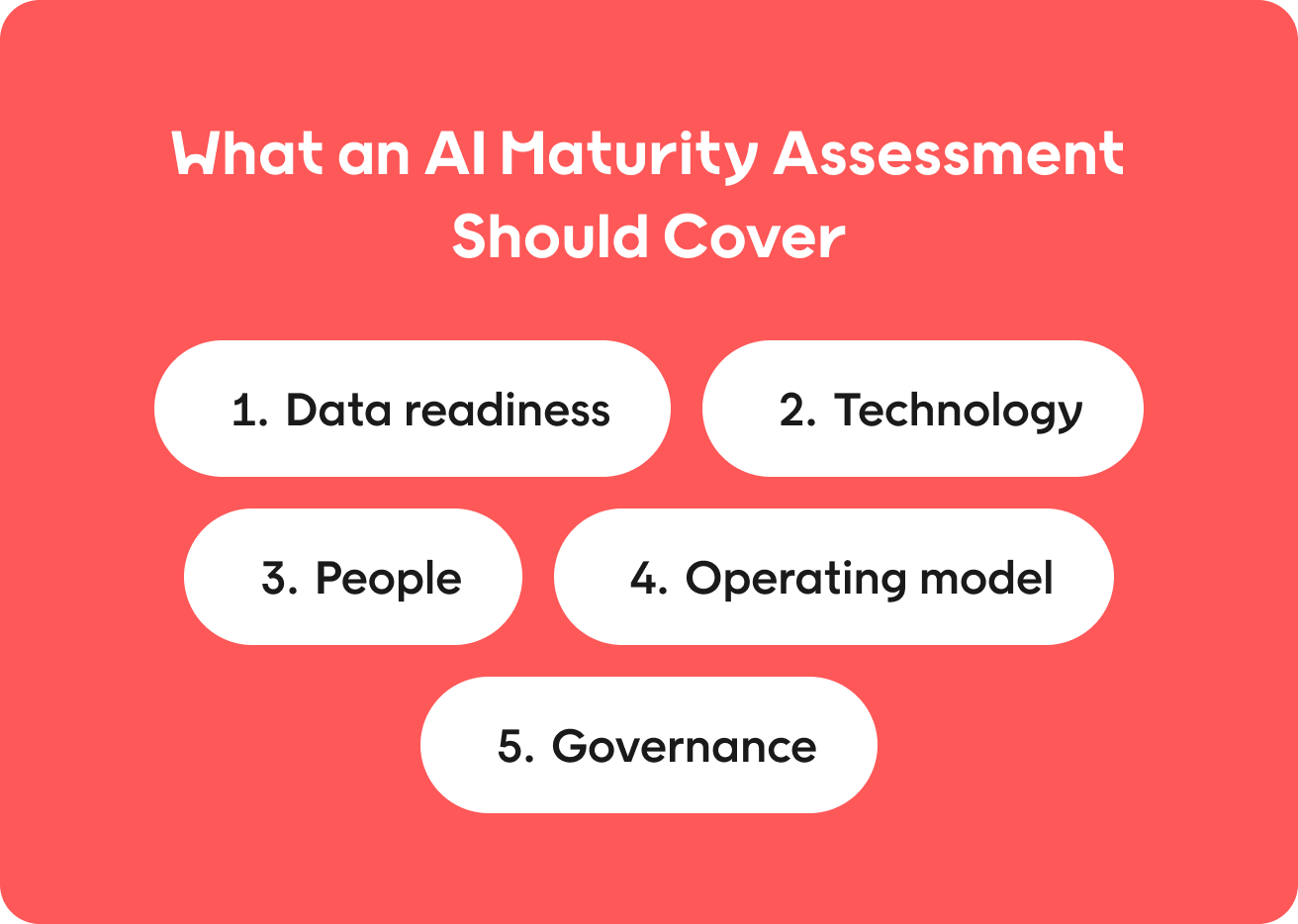
Any assessment tool worth using looks beyond the technology. A comprehensive evaluation covers five dimensions:
- Data readiness. Data quality, the number of data sources you’ve genuinely unified, and whether your data infrastructure supports data-driven decision-making in real time or overnight at best.
- Technology. Which AI solutions are in production versus stuck in proof of concept, and whether your AI development depends on a single vendor or a single team.
- People. AI literacy across the business, and deeper AI fluency in the functions closest to the customer.
- Operating model. Who owns AI initiatives, how you prioritize initiatives against business goals, and whether key stakeholders, from the chief digital officer to store operations, are working from the same roadmap.
- Governance. The guardrails that make responsible AI possible, so that deploying AI at scale doesn’t outrun your ability to explain what it did.
Scoring these different dimensions separately gives a truer picture of your current AI capabilities than a single number does. Most retailers are further ahead on technology than on data readiness or operating model, and an AI maturity assessment tool that averages everything into one score will hide exactly the capability gaps you need to see.
Resist the urge to grade yourself generously. It’s tempting to point to your most advanced pilot and call it your maturity level. Real progress comes from lifting the whole business, not from a single showcase project, and maturity isn’t measured by the product features you’ve bought. The gap between your best experiment and your everyday operations is often the exact distance you still have to travel.
It’s also worth saying that not every organization needs to reach phase four across the board. A fashion pure-play and a multi-format grocer face different business problems and will set a different target maturity for each function. Benchmark against industry best practices by all means, but set your target maturity level against your own business strategy, not against someone else’s scoreboard.
Moving up the AI maturity model with Voyado
An AI maturity model is only valuable if it drives action. The retailers pulling ahead aren’t the ones running the most AI initiatives. They’re the ones who assessed their current capabilities honestly, named the single barrier to their next phase, and invested in the structure that closes it.
For most, that structure looks the same: unified data across channels, governance that makes it clear when AI is allowed to act, and teams confident enough to let it. Treat the four phases as a working tool rather than a report. Revisit them each quarter, track progress against your target maturity level, and measure progress in business impact rather than in the number of pilots underway. The goal is systematic innovation, where each step compounds, rather than a run of disconnected experiments.
The step that trips up most retailers is the last one. Moving from AI that advises to AI that acts is where a generic tech stack tends to run out of road, because acting on retail decisions requires context that generic AI models don’t have: margin, stock, product lifecycles, and shopper intent in the moment.
That’s the gap Voyado was built to close. It’s a customer experience suite made only for retail, with retail-trained AI that works on unified data and acts on it while your teams set the guardrails.

FAQs
What is an AI maturity model?
An AI maturity model is a framework describing how an organization’s use of artificial intelligence evolves through distinct stages. In retail, the Voyado and Retail Economics research defines four stages: exploration and pilots, pilot scaling, operational integration, and embedded strategy. It helps you plot your organization’s current level and identify gaps that are holding you back from the next phase.
What are the stages of AI maturity in retail?
The research identifies four phases: exploration and pilots; pilot scaling in selected functions; operational integration across core functions; and embedded strategy. Roughly 25% of retailers sit in phases one and two, about 45% are operational, and around 25% have AI ingrained in business strategy across the organization.
Why do retailers get stuck at the operational stage?
Because maturity does not scale automatically. As AI adoption grows, complexity outpaces integration, and more AI tools and data sources pile up before unified data, governance, and skills catch up. Mid-sized retailers feel this most, stalling in transition, while larger firms regain momentum once their capability matches their ambition.
How do I assess my company's AI maturity?
Ask where most of your AI work actually lives, not where your best pilot sits. A useful maturity assessment covers data readiness, technology, AI literacy, operating model, and governance, so you can see your current AI capabilities and capability gaps separately rather than as a single blended score.
What is agentic AI in retail?
Agentic AI moves beyond analysis to action. Instead of only surfacing insights, it executes the next-best action across the customer journey while keeping teams in control. In retail, that includes acting on shopper intent in real time or automating merchandising decisions, as Voyado Elevate does with agentic merchandising.
About Author