TL;DR
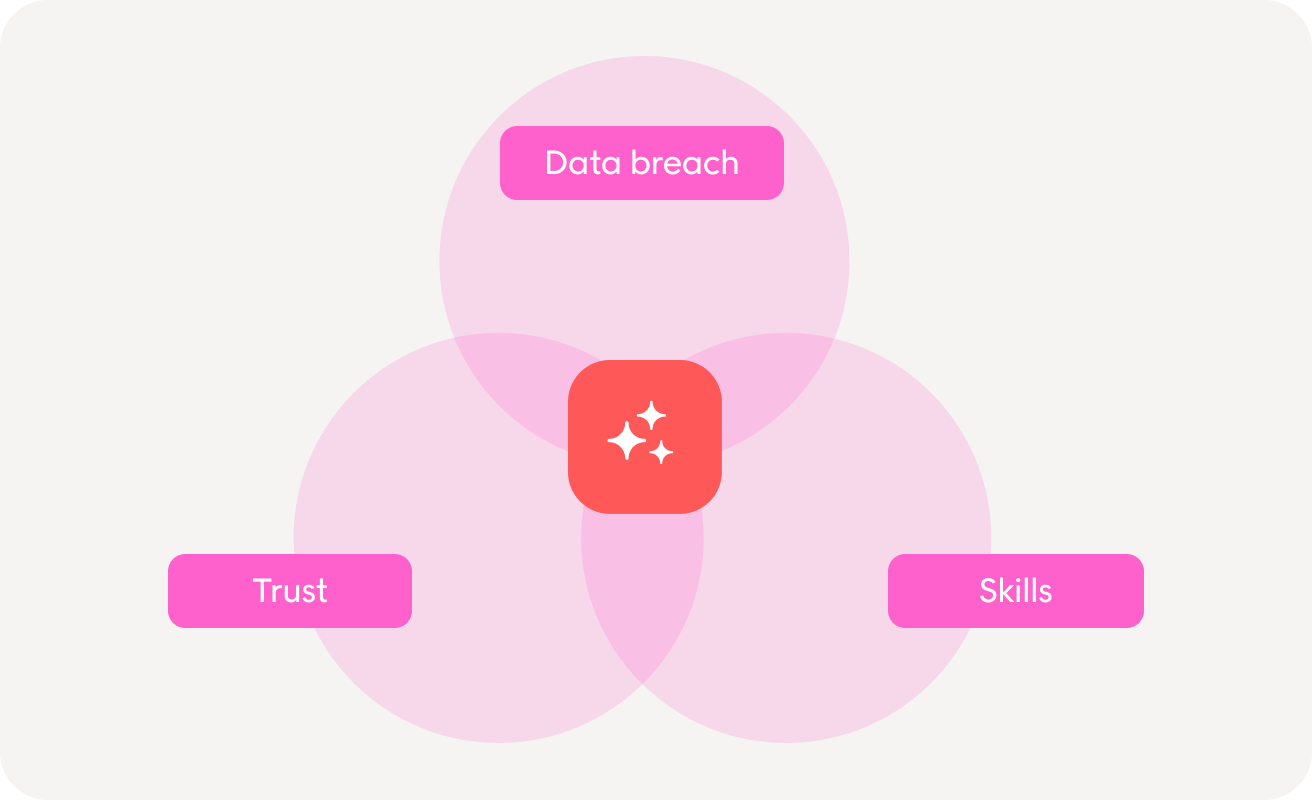
- Two structural barriers block AI scale in retail — skills gaps and cultural resistance rooted in a lack of trust — compounded by insufficient data breadth that limits what AI can learn.
- 58% of retailers cite skills gaps as their primary barrier to AI adoption, according to Voyado and Retail Economics research surveying 300 European retail leaders.
- 57% cite internal resistance and cultural hesitation. Compliance concerns amplify both — 54% cite data privacy regulations as a barrier, making trust a systemic issue.
- Advanced retailers use nearly 2x as many data sources as mid-stage peers. Data breadth — not data volume — is what gives AI models the context they need to perform.
- These barriers are interconnected. Without skills, trust erodes — and without trust, organizations never build the governance needed to unify data and scale AI.
- Practical solutions exist for each barrier, but they require organizational change, not just technology investment.

Why AI stalls after the pilot
You’ve run the pilot. Your recommendation engine improved click-through rates, and automated campaigns lifted open rates. Despite these early wins, Voyado’s State of AI in Retail report found that 45% of retailers have reached operational AI — but very few convert that into scalable, measurable returns. The reason isn’t that the technology stops working at scale. It’s that three structural barriers become more significant as ambition grows.
Barrier 1: Data breadth — not volume, breadth
The stat: Advanced retailers draw on nearly twice as many data sources as mid-stage peers.
This is not about having more data. It is about having more dimensions of data. A retailer with massive email engagement data but no connection to in-store purchase behavior, loyalty status, or product inventory is making AI decisions with a partial view of the customer.
Where data breadth breaks down
- CRM and website data are disconnected. Your email platform knows who opened a campaign. Your website knows who browsed. But do they agree on who the customer is?
- Offline data stays offline. POS transactions, in-store interactions, and returns data often sit in separate systems that never feed into your AI models.
- Product and customer data are siloed. Your merchandising team manages product data. Your marketing team manages customer data. AI needs both — in real time — to personalize effectively.
- Third-party signals are missing. Advertising performance, competitive pricing, weather, and local events all influence customer behavior. Advanced retailers feed these signals into their models.
What to do about it
Map every customer data source you have. List CRM, website analytics, POS, loyalty program, app, advertising platforms, and any external data feeds. Identify which are connected and which are not.
Prioritize unification over collection. You probably don’t need more data. You need the data you already have to flow into a single customer view that your AI can access in real time.
Start with the highest-impact connection. For most retailers, connecting CRM and browse data delivers the biggest immediate improvement in personalization quality.
Barrier 2: Skills — the gap between tools and capability
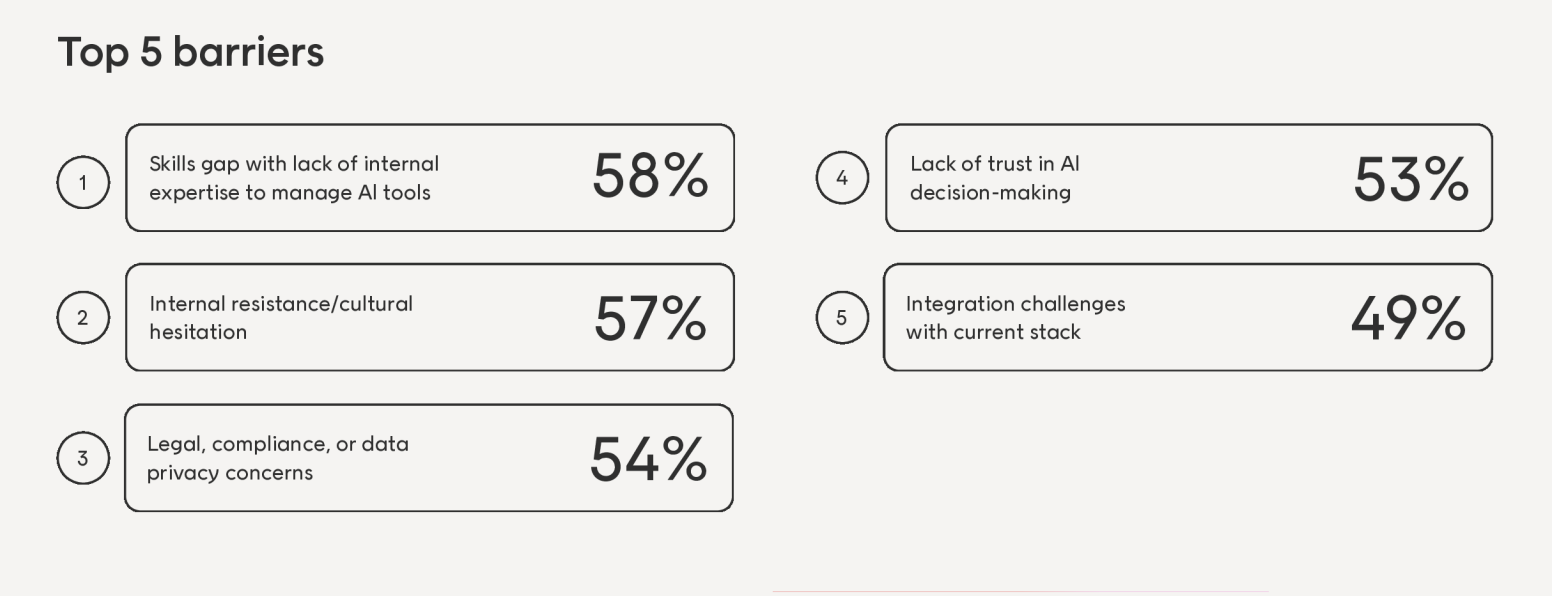
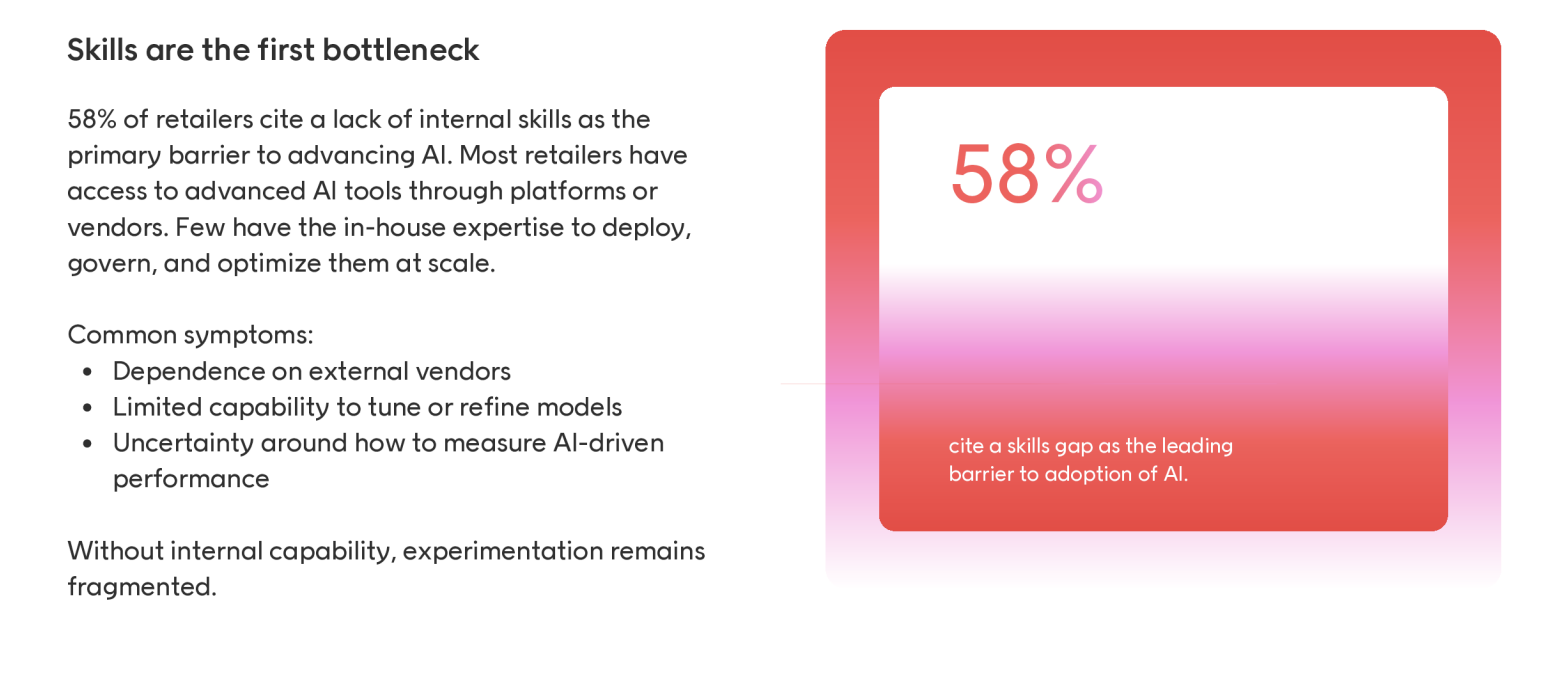
The stat: 58% of retailers cite lack of internal expertise as their primary barrier to AI adoption.
This is the most-cited barrier in the report, and it extends well beyond technical skills. Yes, retailers need people who can manage AI models and interpret outputs. But they also need marketers who understand how to brief AI, campaign managers who can evaluate AI-driven recommendations, and leaders who can set strategic guardrails.
Where the skills gap shows up
- Teams don’t trust AI outputs because they don’t understand them. When a recommendation engine surfaces unexpected results, marketers override it — not because the AI was wrong, but because they cannot evaluate whether it was right.
- AI tools are underused. Retailers purchase platforms with enterprise-level capabilities, but teams only use basic features because they lack the training to go further.
- Measurement falls back to manual. Without skills in AI-specific metrics (model confidence, uplift attribution, feedback loop performance), teams default to vanity metrics that don’t capture AI’s true impact.
What to do about it
Pair every technology rollout with training. Don’t launch a new AI capability without a structured upskilling program for the teams who will use it. This is not a one-time workshop — it is an ongoing investment.
Create AI champions within marketing and CRM teams. You don’t need every marketer to become a data scientist. You need a few people on each team who understand how AI makes decisions and can bridge the gap between technical and commercial teams.
Define clear ownership of AI outcomes. When nobody owns the results, nobody learns from them. Assign accountability for AI-driven metrics to specific roles, and build reporting that makes performance visible.
Barrier 3: Trust — the cultural root of resistance
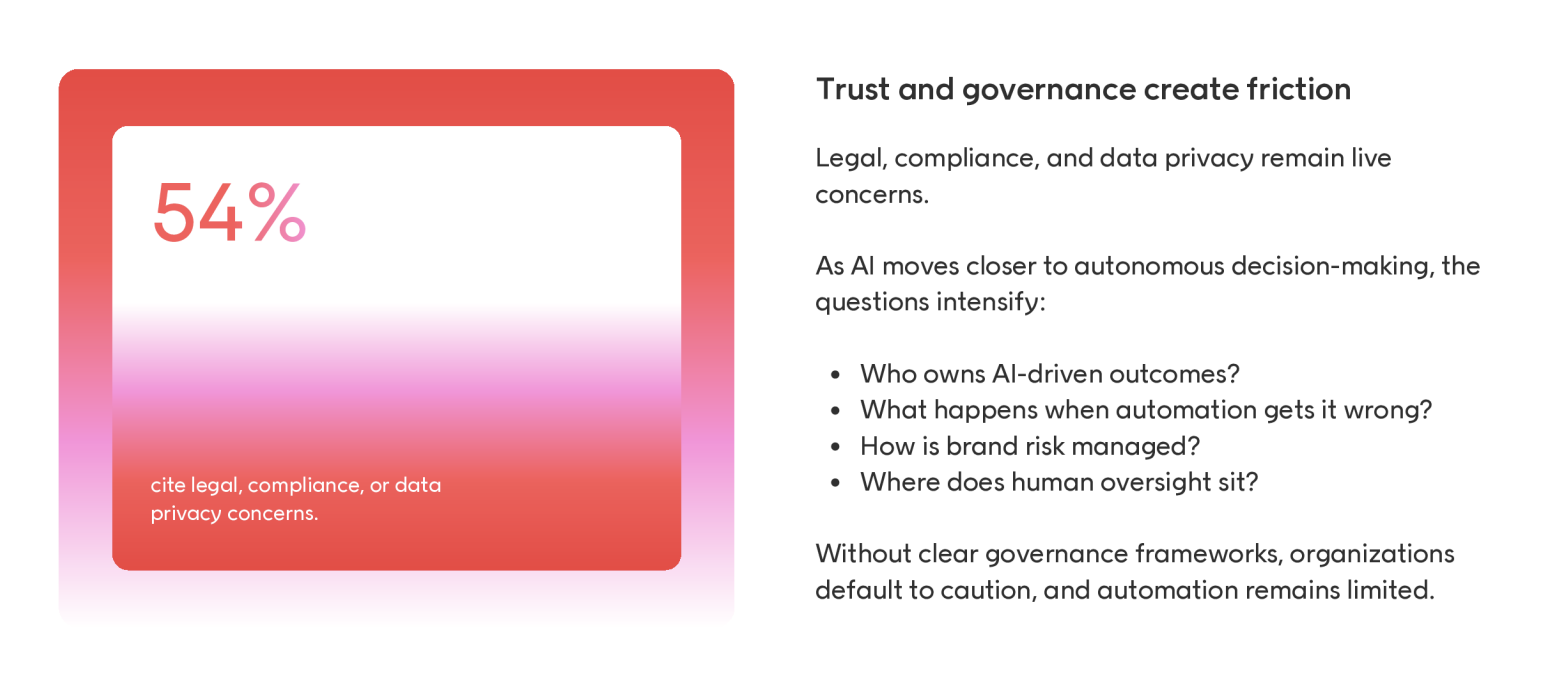
The stats: 57% of retailers cite internal resistance and cultural hesitation — and compliance concerns amplify the problem, with 54% citing data privacy regulations and 53% reporting a lack of trust in AI-generated decisions.
Trust is the barrier that amplifies every other barrier. When teams don’t trust AI, they work around it. When leadership does not trust AI, they underfund it. When customers don’t trust how their data is used, compliance concerns grow.
Where trust breaks down
- Black-box outputs. If your team cannot see why an AI model made a particular recommendation, they will not trust it — and they should not. Transparency is a prerequisite for trust.
- No feedback loops. When AI makes a decision and nobody measures the outcome, trust cannot build. Trust is earned through evidence, and evidence requires measurement.
- Compliance paralysis. GDPR and other data regulations are not obstacles to AI — they are guardrails. But when legal teams and marketing teams don’t have shared frameworks for compliant AI use, caution becomes inaction.
- Leadership skepticism. When senior leaders see AI as a cost center rather than a strategic capability, investment stays at the pilot level. Trust must be built from the top down.
What to do about it
Make AI decisions visible. Use dashboards and reporting that show what the AI recommended, what happened, and what it learned. Transparency builds trust faster than any training program.
Start with low-risk, high-visibility wins. Don’t ask your team to trust AI with your biggest campaign first. Start with automated subject line testing, or AI-driven product sorting on a single category page. Let results speak.
Build a compliance framework collaboratively. Bring legal, marketing, and data teams together to define what compliant AI use looks like. Next best action platforms can help by making AI decision logic visible and auditable. When everyone agrees on the rules, caution becomes confidence.
Invest in governance, not just technology. Clear ownership, defined escalation paths, and regular review cycles give teams the structure they need to trust AI-driven decisions.
Why these barriers are one problem, not three
The report makes clear that these barriers reinforce each other:
Without data breadth, AI models underperform and erode trust. That lost trust makes teams reluctant to invest in the skills and governance needed to fix the underlying data problems. The cycle reinforces itself until you break it deliberately.
Breaking the cycle requires addressing all three simultaneously. The retailers in the top 5% of AI maturity did not take a sequential approach — fixing data first, then addressing capability. They built readiness across all dimensions in parallel, treating structural readiness as a single strategic initiative.
Frequently asked questions
What are the main barriers to AI in retail?
Voyado and Retail Economics research identifies skills gaps (58%), internal cultural resistance (57%), and compliance or trust concerns (54%) as the three primary barriers. Integration challenges (49%) and lack of trust in AI decisions (53%) also feature prominently.
Why do retailers struggle to scale AI?
Most retailers can run successful AI pilots but stall when scaling because of structural issues: disconnected data, insufficient team capability, and organizational resistance. These barriers compound — without data breadth, AI underperforms, which erodes trust, which blocks investment.
What skills do retailers need for AI?
Beyond technical data science skills, retailers need marketers who can interpret AI outputs, campaign managers who can evaluate AI-driven recommendations, and leaders who can set strategic guardrails. AI champions within each team help bridge the gap.
How do data silos limit AI performance in retail?
Advanced retailers use nearly twice as many data sources as mid-stage peers. When CRM, website, POS, loyalty, and advertising data are siloed, AI models make decisions based on incomplete information — leading to generic personalization and lower ROI.
About Author