TL;DR
- 39% of European retail marketing and e-commerce spend will be exposed to AI by 2030 — approximately 14.9 billion euros annually, according to Voyado and Retail Economics research.
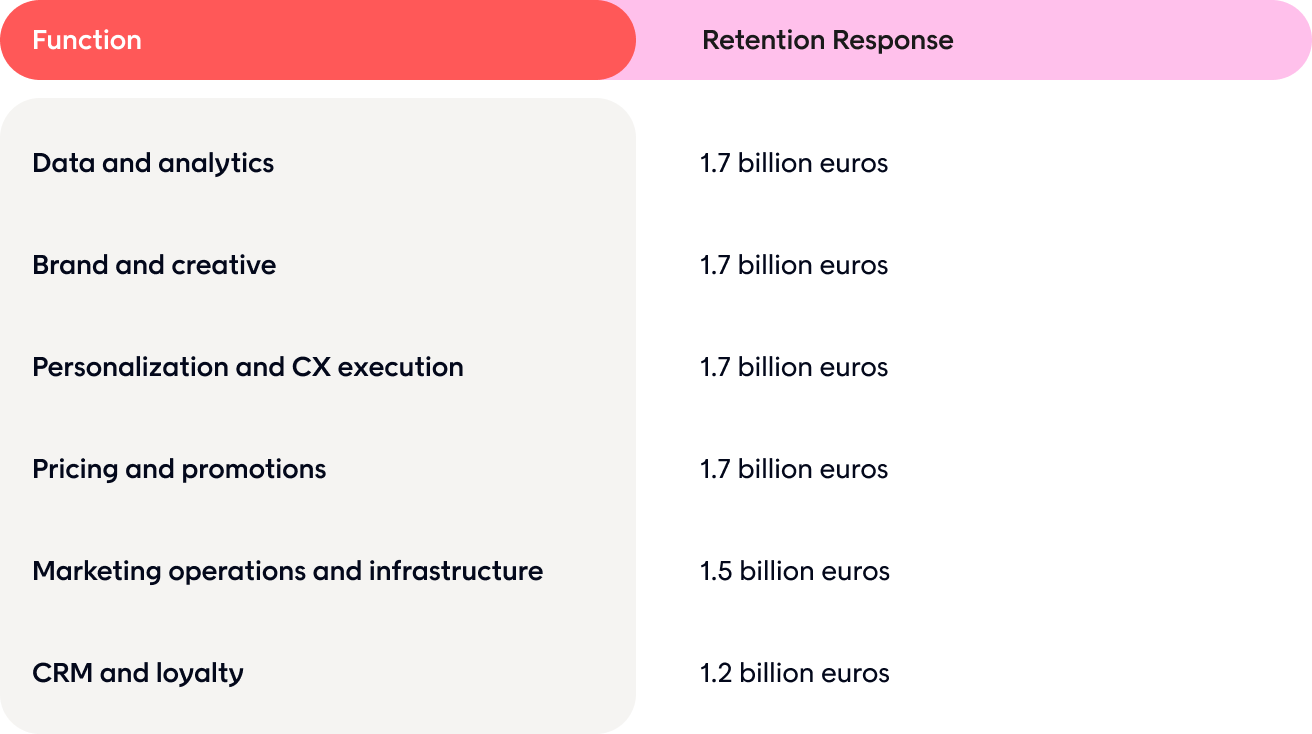
- Six marketing functions are most exposed: data and analytics, brand and creative, personalization and CX execution, pricing and promotions, marketing operations, and CRM and loyalty — each facing 1.2 to 1.7 billion euros of AI-influenced spend.
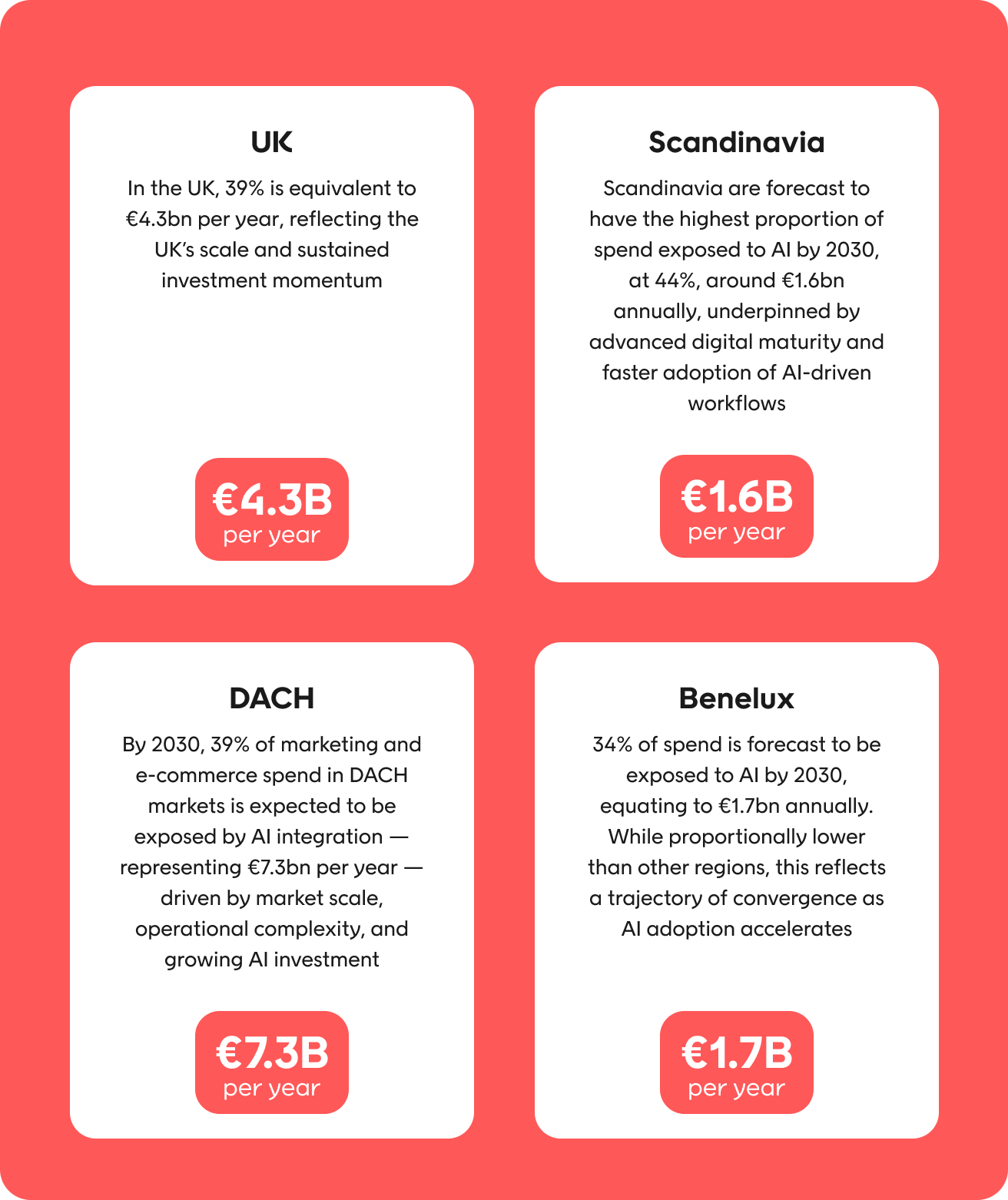
- DACH leads in absolute exposure at 7.3 billion euros, followed by UK (4.3 billion euros), Benelux (1.7 billion euros), and Scandinavia (1.6 billion euros).
- Scandinavia leads in maturity — 35% of Scandinavian retailers have reached advanced AI maturity, compared to 32% in the UK, 30% in DACH, and 29% in Benelux.
- The real divide is structural, not geographic. The gap between retailers that build integrated, scalable AI and those operating through isolated use cases determines outcomes more than market size.

The 14.9 billion euro question
Voyado and Retail Economics modeled what happens as AI reshapes European retail marketing spend through 2030. Their finding: approximately 14.9 billion euros — 39% of total spend — will be exposed to AI by 2030. What does that mean for how you plan your budget today?
This shift is reshaping how leadership allocates budgets and structures teams — with real implications for which functions gain or lose investment.
This isn’t a prediction about AI replacing marketers. It is an economic analysis of which spending categories will be most influenced by AI-driven automation and optimization.
Download: The state of AI in European retail marketing and e-commerce
Which marketing functions are most exposed?
The report breaks down AI exposure across six core marketing functions. The distribution is remarkably even, which tells you something important: AI is not a single-function tool. It touches everything.
What this means in practice
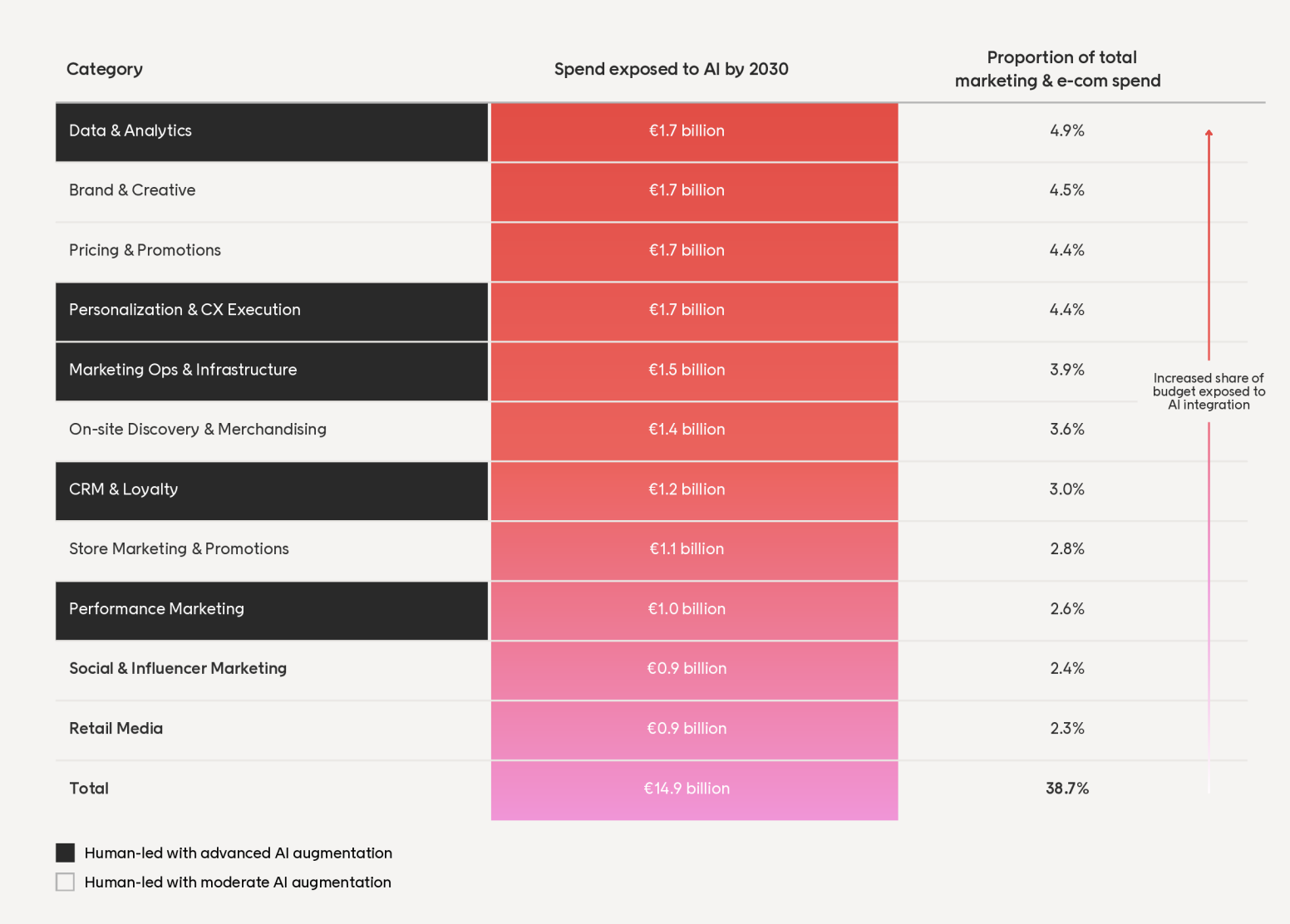
Data and analytics (1.7 billion euros): AI is already transforming how retailers collect, unify, and act on customer data. The shift here is from manual analysis to automated insight generation — models that surface patterns, predict churn, and identify opportunities without waiting for a quarterly review.
Brand and creative (1.7 billion euros): Generative AI is changing how creative assets are produced, tested, and iterated. Think AI-generated product descriptions at scale, automated A/B testing of visual assets, and dynamic creative that adapts to audience segments in real time.
Personalization and CX execution (1.7 billion euros): This is where AI has the most direct impact on customer experience — from product recommendations to dynamic pricing to individualized journey orchestration. The report found that retailers with advanced personalization use nearly twice as many data sources as mid-stage peers.
Pricing and promotions (1.7 billion euros): AI-driven pricing optimization, markdown management, and promotion targeting represent some of the highest-ROI applications in retail. The economic model suggests this category will see fast adoption because the feedback loop between action and outcome is measurable and immediate.
Marketing operations and infrastructure (1.5 billion euros): Campaign automation, workflow orchestration, and marketing tech stack consolidation are all areas where AI reduces manual effort and increases throughput. The opportunity here is efficiency — doing more with the same team.
CRM and loyalty (1.2 billion euros): AI is reshaping loyalty from static programs to dynamic, individualized retention strategies. Instead of one-size-fits-all point systems, AI enables tailored rewards, personalized win-back campaigns, and predictive lifetime value modeling.
How AI exposure varies by region
The total 14.9 billion euros is distributed unevenly across European markets, reflecting differences in market size, digital maturity, and retail spend patterns.
Why scale does not predict success
The regional data reveals an important pattern: market size does not determine AI maturity. Scandinavia, the smallest market by spend, leads in advanced adoption. DACH, the largest, lags slightly behind the UK and Scandinavia in maturity percentage.
The real divide, as the report emphasizes, is structural. It is between retailers that build integrated, scalable AI infrastructure and those operating through isolated use cases — regardless of geography.
This has a direct implication for your budget planning. Investing more in AI tools does not guarantee better outcomes. Investing in unified data and team capability — the structural foundations that make AI effective — does.
What this means for your 2026-2027 budget
If you are planning marketing and e-commerce budgets for the next two years, the data points to three priorities:
Audit your current AI spend by function. Map where you are already investing in AI-driven capabilities (data, personalization, creative, pricing, CRM) and where you are still operating manually. The functions with the highest exposure are the ones where ROI from AI investment is most likely — but only if the foundations are in place.
Prioritize integration over expansion. Adding a new AI tool to a disconnected tech stack will not move the needle. Connecting the tools you already have — so they share data and coordinate decisions — will.
Benchmark against maturity, not spend. The report found that 71% of retailers anticipate meaningful AI deployment within two years, and 45% expect measurable returns. If your competitors are investing in structural readiness while you are investing in point solutions, the gap will widen.
Richard Lim, CEO at Retail Economics, puts it plainly: “The next two years represent an inflection point as AI shifts from experimentation to competitive necessity.”
Frequently asked questions
How much will AI impact retail marketing spend?
Voyado and Retail Economics estimate that 14.9 billion euros of European retail marketing and e-commerce spend — 39% of the total — will be exposed to AI by 2030. This covers data, creative, personalization, pricing, operations, and CRM functions.
Which retail marketing functions are most exposed to AI?
Data and analytics, brand and creative, personalization and CX execution, and pricing and promotions each face approximately 1.7 billion euros of AI-influenced spend by 2030. CRM and loyalty follows at 1.2 billion euros.
How does AI adoption vary across European markets?
Scandinavia leads in AI maturity at 35% advanced adoption, followed by the UK (32%), DACH (30%), and Benelux (29%). DACH has the highest absolute AI-exposed spend at 7.3 billion euros due to its larger market size.
What should retailers budget for AI in marketing?
Focus budgets on structural foundations — unified data, team skills, and governance — rather than adding more standalone AI tools. The report found that integration depth, not technology access, determines whether AI spend translates to returns.
About Author