
TL;DR
Retail customer data is usually scattered across POS systems, e-commerce platforms, loyalty tools, email platforms, mobile apps, and customer service systems. That makes it challenging to build accurate shopper profiles or deliver consistent experiences across channels.
The best retail data consolidation software helps you unify customer data into one profile your teams can actually use. Not just for reporting, but for segmentation, loyalty, personalization, marketing automation, and product recommendations.
In this guide, we’ll compare 10 platforms that help retailers consolidate customer data across online and in-store touchpoints. We’ll look at:
- Identity resolution
- POS and loyalty integrations
- Activation capabilities
- Retail-specific data models
- Time-to-value and integration complexity
You’ll also see why platforms that combine consolidation and activation in one system are often faster and easier for retail teams to scale.
How retail data consolidation software creates unified shopper profiles
Retail data consolidation software connects customer data from disconnected systems into one profile your teams can actually use.
That includes data from:
- POS systems
- E-commerce platforms
- Loyalty programs
- Email and SMS tools
- Mobile apps
- Customer service platforms
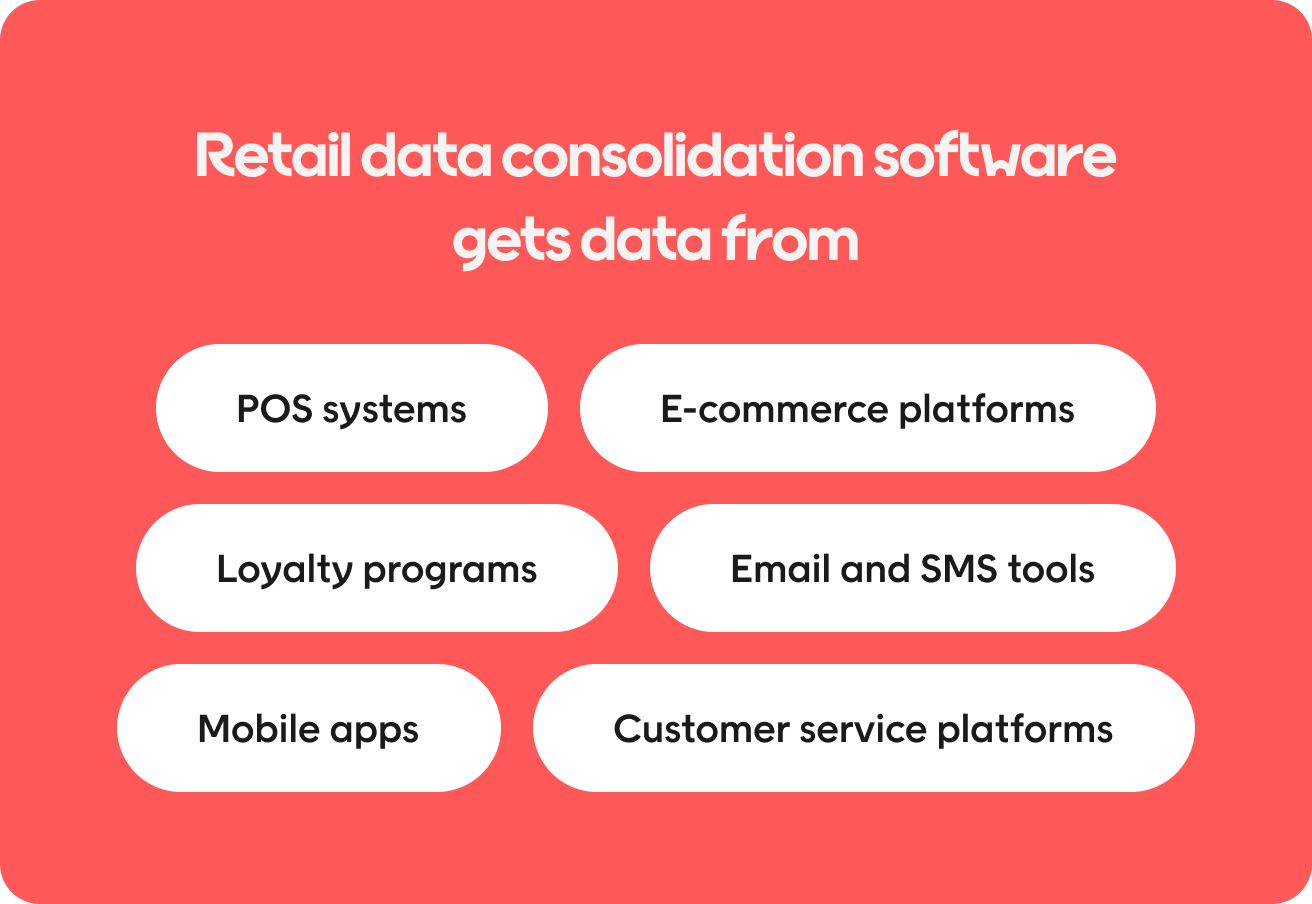
The goal is not just storage. The best retail data unification platform helps your teams use unified shopper profiles for segmentation, reporting, loyalty, and personalization in retail.
This is what separates retail customer data consolidation from a traditional data warehouse. A warehouse stores data. Retail data consolidation software helps your teams activate it.
Why retail has a bigger consolidation problem than most industries
Retail customer data lives across more systems than most businesses.
A single shopper might browse online, buy in-store, open an email campaign, use loyalty rewards, and contact support. Without consolidation, every system can end up with a different version of the same customer.
The hardest part is connecting anonymous online behavior with known in-store purchases. That requires strong identity resolution across channels, devices, and touchpoints.
Without proper customer data consolidation, retail teams often struggle with:
- Duplicate customer profiles
- Inconsistent segmentation
- Broken personalization
- Incomplete reporting
That’s why many retailers now invest in retail data consolidation software alongside stronger retail omnichannel analytics and customer engagement strategies.
Unified shopper profiles only work when every team sees the same customer picture.
We know the biggest challenge for your team isn’t just consolidating retail data. It’s finding a platform that helps you turn that data into usable shopper profiles without creating even more complexity in your stack.
Here are 10 retail data consolidation software platforms worth evaluating in 2026.
The 10 best retail data consolidation software platforms
Not every platform handles retail customer data the same way. Some focus on storage and infrastructure, while others help your teams activate unified shopper profiles across loyalty, marketing, and personalization.
#1 Voyado – Best for retail-native data consolidation with built-in activation, loyalty, and product discovery

Best for:
Omnichannel retailers that want unified shopper profiles, loyalty, and marketing automation in one platform without assembling a stack of separate tools.
Why it’s here:
Voyado is not a standalone CDP or generic data consolidation tool. It’s a retail-native customer experience platform where retail customer data consolidation and activation happen in the same system.
Customer data from POS, e-commerce, loyalty, email, and apps flows into unified shopper profiles your teams can immediately use for segmentation, triggered journeys, loyalty management, and omnichannel personalization.
Unlike generic CDPs that often require separate activation tools, Voyado combines customer profiles, loyalty, marketing automation, and product discovery in one retail-focused platform. That reduces integration overhead and helps retail teams move faster.
Standouts:
- Unified shopper profiles across POS, e-commerce, loyalty, email, apps, and in-store transactions
- POS Accelerator connects in-store purchases to the customer profile in real time
- Native customer loyalty platform with points, rewards, and tier management built into the same system
- Built-in marketing automation and customer engagement tools without needing separate activation platforms
- Product discovery engine Elevate uses consolidated shopper data for personalized search and recommendations
Watch-outs / limitations:
- Best fit for retail and e-commerce businesses rather than general enterprise use cases
- Less flexible for teams looking for a neutral warehouse-only architecture
- Combines consolidation and activation by design, which may not suit composable-first strategies
Ideal retailer profile:
Mid-market to enterprise retailers in fashion, beauty, home, and specialty retail that want to consolidate customer data and activate unified shopper profiles in the same platform.
If your team is struggling with fragmented retail customer data, book a demo to see how Voyado unifies and activates shopper profiles in one platform.
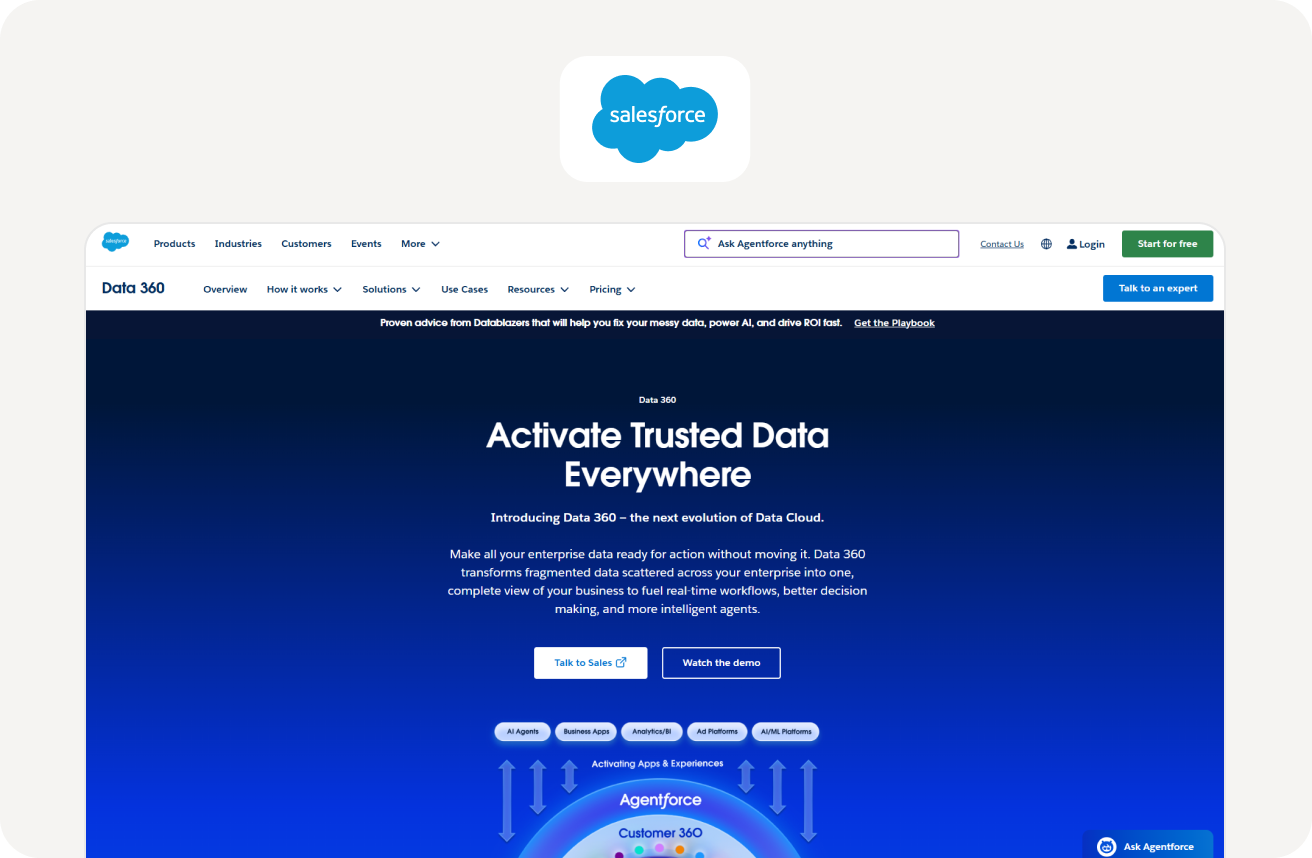
#2 Salesforce Data Cloud – Best for large enterprise consolidation within the Salesforce ecosystem
Best for:
Enterprise retailers already using Salesforce Commerce Cloud, Service Cloud, and Marketing Cloud that want a unified customer data layer across the Salesforce ecosystem.
Why it’s here:
Salesforce Data Cloud focuses on customer data unification across Salesforce products, with identity resolution, segmentation, and activation inside the Salesforce stack. It’s strongest for retailers already committed to Salesforce infrastructure and looking for a stronger customer 360 view across marketing, commerce, and service teams.
Standouts:
- Real-time customer profile unification across Salesforce products
- Strong identity resolution and audience segmentation
- Native activation into Salesforce marketing and service workflows
Watch-outs / limitations:
- Can become expensive and complex at enterprise scale
- Best experience depends heavily on broader Salesforce adoption
- Often requires significant implementation support
Ideal retailer profile:
Large omnichannel retailers already invested in Salesforce products that want stronger retail customer data consolidation across the Salesforce ecosystem.
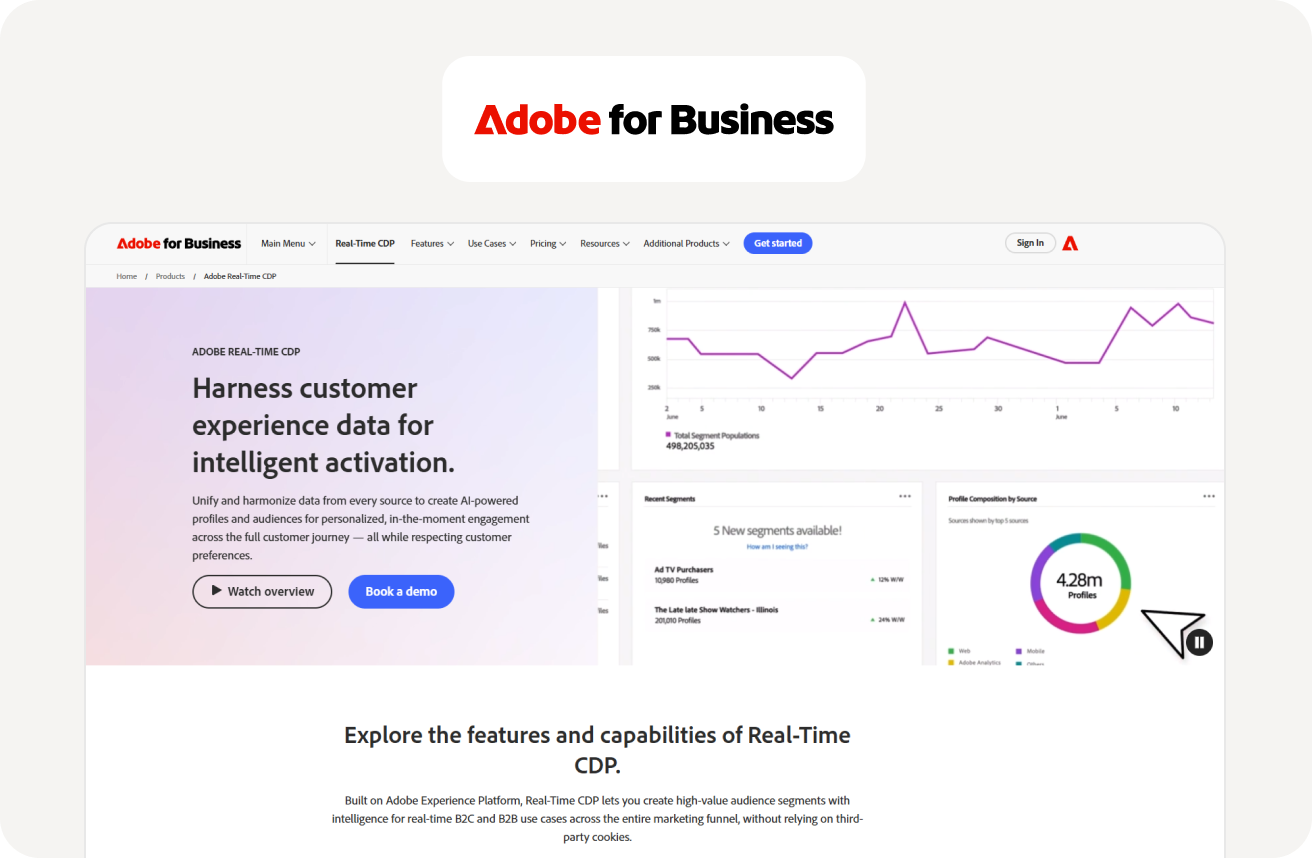
#3 Adobe Real-Time CDP – Best for enterprise real-time profile unification with Experience Cloud activation
Best for:
Large retailers using Adobe Commerce, Analytics, and Experience Cloud that need real-time unified shopper profiles for personalization and audience targeting.
Why it’s here:
Adobe Real-Time CDP helps enterprise retailers consolidate customer data across Adobe products and external sources into real-time profiles. It’s particularly strong for businesses already running Adobe Experience Cloud and building a broader single customer view strategy across channels.
Standouts:
- Real-time unified shopper profiles software
- Tight integration with Adobe Experience Cloud
- Strong audience segmentation and activation capabilities
Watch-outs / limitations:
- Enterprise-focused pricing and implementation complexity
- Less approachable for lean retail teams
- Activation works best inside the Adobe ecosystem
Ideal retailer profile:
Enterprise retailers with established Adobe infrastructure and large personalization programs across multiple channels.
#4 Treasure Data – Best for scalable data consolidation with data lake flexibility
Best for:
Enterprise retailers that want flexible customer data consolidation retail architecture alongside warehouse and analytics integrations.
Why it’s here:
Treasure Data combines customer data unification, identity resolution, and analytics with strong data lake and warehouse flexibility. It’s a good fit for retailers that already have mature data engineering teams and want more control over how retail data consolidation software fits into their existing infrastructure.
Standouts:
- Flexible integration with existing warehouses and data lakes
- Strong identity resolution capabilities
- Enterprise-scale customer data infrastructure
Watch-outs / limitations:
- More technical than retail-native platforms
- Activation often depends on external tools
- Longer implementation timelines for many teams
Ideal retailer profile:
Large retailers with mature internal data teams and complex multi-system environments.
#5 Twilio Segment – Best for event-based data collection and real-time routing
Best for:
Digital-first retailers and DTC brands that need real-time event collection, identity stitching, and downstream data routing.
Why it’s here:
Twilio Segment is widely used for collecting and routing customer event data across apps, websites, and marketing tools. It’s particularly strong for retailers building modern customer data stacks or working through a larger CDP implementation guide process.
Standouts:
- Real-time customer event collection
- Flexible integrations across marketing and analytics tools
- Strong developer ecosystem and APIs
Watch-outs / limitations:
- Less retail-specific than some competitors
- Activation often requires separate platforms
- Can become complex across large stacks
Ideal retailer profile:
DTC and digital-first retailers with strong internal technical teams and heavy event-tracking needs.
#6 Bloomreach Engagement – Best for e-commerce data consolidation with built-in personalization
Best for:
E-commerce-led retailers that want unified profiles, segmentation, and personalization in the same platform.
Why it’s here:
Bloomreach Engagement combines customer data unification with campaign execution, personalization, and product discovery tools. It’s especially relevant for those of you focused on digital commerce experiences and trying to more effectively measure and use your retail data across channels.
Standouts:
- Built-in personalization and campaign activation
- Unified customer profiles across digital channels
- Strong product discovery and merchandising capabilities
Watch-outs / limitations:
- More e-commerce-focused than store-focused
- Retail data consolidation outside digital channels may require extra integration work
- Less focused on loyalty-heavy retail models
Ideal retailer profile:
Mid-market and enterprise e-commerce retailers focused on personalization and digital growth.
#7 Amperity – Best for AI-powered identity resolution across fragmented retail data
Best for:
Large retailers with messy, fragmented customer data spread across many systems and brands.
Why it’s here:
Amperity is heavily focused on identity resolution and unified customer profiles. Its AI-driven matching capabilities are designed to help retailers connect customer records across disconnected systems, channels, and devices. It’s often evaluated alongside other platforms that help retailers choose a single customer view platform.
Standouts:
- Advanced probabilistic and deterministic identity resolution
- Strong retail customer unification focus
- Built for complex enterprise data environments
Watch-outs / limitations:
- Primarily focused on the data layer rather than activation
- May require additional tools for orchestration and engagement
- Enterprise implementation can be resource-intensive
Ideal retailer profile:
Large multi-brand or multi-market retailers struggling with duplicate or fragmented customer records.
#8 mParticle – Best for mobile-first and event-heavy retail data consolidation
Best for:
Retailers with strong mobile app usage and high-volume event tracking requirements.
Why it’s here:
mParticle specializes in customer data collection, identity management, and event streaming across mobile and digital channels. It’s particularly strong for mobile-first retail environments with large volumes of behavioral data.
Standouts:
- Strong mobile SDKs and event collection
- Real-time customer identity management
- Flexible integrations with downstream platforms
Watch-outs / limitations:
- More infrastructure-focused than retail activation-focused
- Less retail-native than platforms like Voyado
- Often requires additional activation tools
Ideal retailer profile:
Retailers with mobile-heavy customer journeys and complex app ecosystems.
#9 Hightouch – Best for warehouse-native data activation without moving data
Best for:
Retailers with existing Snowflake or BigQuery environments that want to activate consolidated customer data without duplicating it.
Why it’s here:
Hightouch focuses on reverse ETL and warehouse-native activation. Instead of storing customer data itself, it helps retailers activate existing unified data in downstream marketing, CRM, and engagement tools. Retailers comparing warehouse-first approaches often also evaluate broader Salesforce Data Cloud competitors during the buying process.
Standouts:
- Warehouse-native architecture
- Reverse ETL activation into downstream tools
- Strong compatibility with modern data stacks
Watch-outs / limitations:
- Requires an existing warehouse strategy
- Not a standalone unified shopper profiles software platform
- Less retail-specific than dedicated retail platforms
Ideal retailer profile:
Retailers with mature data warehouse infrastructure and internal data engineering resources.
#10 Microsoft Dynamics 365 Customer Insights – Best for retailers in the Microsoft ecosystem
Best for:
Retailers already using Microsoft Dynamics 365 for ERP, CRM, or commerce operations.
Why it’s here:
Microsoft Dynamics 365 Customer Insights helps businesses unify customer data across Microsoft systems and external sources. It combines profile unification, segmentation, and analytics inside the broader Microsoft ecosystem.
Standouts:
- Native integration with Microsoft Dynamics products
- Unified customer profiles and audience segmentation
- Strong enterprise governance and compliance features
Watch-outs / limitations:
- Best suited for Microsoft-centric environments
- Retail-specific activation often requires additional tooling
- Implementation complexity increases across larger stacks
Ideal retailer profile:
Enterprise retailers standardized on Microsoft infrastructure and looking for customer data consolidation retail capabilities inside that ecosystem.
You’ve now seen how differently these platforms handle retail customer data consolidation, identity resolution, and activation. Before choosing one, it helps to understand the criteria that actually separate flexible retail platforms from expensive data projects.
Questions we used to evaluate these retail data consolidation platforms: A checklist for your team
Not every retail data consolidation software platform solves the same problems. These are the questions we used to evaluate each tool in this list.
Retail data source coverage
Can the platform connect data from:
- POS systems
- E-commerce platforms
- Loyalty programs
- Email and SMS tools
- Mobile apps
- In-store systems
Retail-specific connectors matter more than a massive generic integration library.
Identity resolution
Can the platform match customer records across channels, devices, and systems?
Strong identity resolution is what turns fragmented customer records into accurate unified shopper profiles software teams can actually trust.
Unified profile depth
What does the customer profile actually contain?
We looked at whether platforms support:
- Purchase history
- Browsing behavior
- Loyalty status
- Communication preferences
- Lifecycle stages
- Consent and privacy data
A shallow profile limits personalization and reporting later on.
Activation capability
Can your teams act on consolidated profiles directly?
We evaluated whether each retail data unification platform supports:
- Segmentation
- Triggered journeys
- Campaign targeting
- Personalization
- Customer engagement
Platforms that require multiple extra activation tools often increase complexity and implementation time.
Retail fit
Is the platform actually designed for retail?
We looked at whether each platform understands retail-specific structures like:
- Transactions
- Products
- Orders
- Returns
- Stores
- Loyalty tiers
That matters because generic customer data consolidation retail platforms often require much heavier customization.
Time-to-value and integration complexity
How long does implementation realistically take?
Some platforms can unify retail customer data quickly. Others require months of integration work, system integrators, and additional infrastructure before teams see value.
If your team is still defining requirements, this CDP implementation guide can help clarify the biggest architectural decisions early.
Privacy, consent, and governance
Can the platform handle consent management, governance, and regional compliance requirements?
That includes:
- GDPR compliance
- Consent tracking
- Regional data handling
- Cross-channel governance controls
These requirements become even more important as retailers scale across markets and channels.
The best platform is usually the one that fits your retail operations with the least complexity.
Evaluation checklist for your team before choosing a platform
Before committing to a retail data consolidation software platform, make sure your team can answer these questions clearly.
| Checklist question | Why it matters |
| ✅ Can the platform connect POS, e-commerce, loyalty, email, app, and in-store data? | Missing data sources create incomplete shopper profiles and weaker personalization. |
| ✅ Does it support strong identity resolution across channels and devices? | This determines whether customer profiles stay accurate or become fragmented. |
| ✅ Can your teams activate unified profiles directly? | Exporting data into separate tools adds complexity and slows execution. |
| ✅ Is the platform designed for retail data structures? | Retail-specific models reduce customization and improve time-to-value. |
| ✅ How much implementation and integration work is required? | Long projects increase cost and delay results. |
| ✅ Does it support consent, governance, and GDPR requirements? | Retail customer data needs strong privacy and compliance controls across channels. |
| ✅ Will your teams actually use it day to day? | The best platform is the one your marketing, CRM, loyalty, and e-commerce teams can work with easily. |
You don’t just want cleaner data. Your teams should have usable shopper profiles they can act on quickly and consistently.
With those evaluation criteria in mind, let’s look at how Voyado approaches retail data consolidation differently from generic CDPs and warehouse-first platforms.
Why retailers choose Voyado instead of stitching together separate tools
After evaluating retail data consolidation software platforms, many teams realize the hard part is not collecting data. It’s turning fragmented data into usable shopper profiles without adding more systems and integration work.
Stop switching between disconnected customer records
Customer data often lives across POS, e-commerce, loyalty, email, apps, and customer service tools.
With Voyado, that data flows into one unified shopper profile so your teams can see purchases, loyalty activity, engagement, and online behavior in one place.
At JACK & JONES, connecting customer data across channels helped the retailer build a complete customer view across stores and digital touchpoints, contributing to a 33% higher average order value for loyalty members.
Remove the gap between data and activation
Many platforms consolidate data but still require separate tools for campaigns, loyalty, personalization, or recommendations.
Voyado combines consolidation and activation in one platform. Your teams can immediately use unified profiles for:
- Audience segmentation
- Triggered journeys
- Loyalty campaigns
- Personalized offers
- Product recommendations
That means less integration overhead and faster execution.
Avoid months of retail-specific customization
Generic platforms often require retailers to adapt their data to a generic model.
Voyado is built around retail structures from the start:
- Transactions
- Products
- Orders
- Stores
- Returns
- Loyalty tiers
Its built-in customer loyalty platform also keeps loyalty data connected to the shopper profile instead of siloed in another system.
Get value faster
Retail teams usually do not want another long infrastructure project. They want cleaner profiles, better visibility, and activation that works across channels.
Because Voyado combines consolidation, loyalty, personalization, and activation in one retail-native platform, teams can move faster with fewer systems to maintain.
If your team is struggling with fragmented customer data, book a demo to see how Voyado unifies and activates shopper profiles in one platform.
Final take
Retail data consolidation software should make it easier for your teams to build and use unified shopper profiles, not create another long infrastructure project.
Before choosing a platform, make sure your team can answer these questions:
- Does it connect your POS, e-commerce, loyalty, and in-store data?
- Can your teams activate profiles directly without extra tools?
- Is it built for retail workflows and data structures?
The retailers seeing the fastest results are usually the ones using retail-native platforms where consolidation and activation already work together.
FAQs
What is retail data consolidation software?
Retail data consolidation software brings customer data from systems like POS, e-commerce, loyalty, email, apps, and customer service into one unified shopper profile that teams can use for personalization, marketing, and analytics.
How is retail data consolidation different from a CDP?
Many CDPs focus on collecting and organizing customer data. Retail data consolidation software focuses specifically on unifying retail data sources and making those profiles usable for retail use cases like loyalty, personalization, and customer engagement.
Why is consolidating in-store and online data so hard?
Customers often interact anonymously online and identify themselves later through purchases or loyalty programs. Connecting those interactions across channels requires strong identity resolution and consistent customer identifiers.
Do I need a separate CDP if I already have a CRM?
Not always. A CRM manages customer relationships, while retail data consolidation software unifies data across multiple systems. Some platforms combine both capabilities, reducing the need for separate tools.
What is identity resolution and why does it matter?
Identity resolution is the process of matching customer records across channels, devices, and systems. It helps ensure each shopper has a single, accurate profile instead of multiple disconnected records.
How does Voyado consolidate retail data?
Voyado connects data from POS, e-commerce, loyalty, email, apps, and customer service into unified shopper profiles. Those profiles can then be used directly for segmentation, loyalty management, personalization, and customer engagement.
How long does retail data consolidation take to implement?
Implementation timelines vary based on data sources, integrations, and platform complexity. Retail-native platforms are often faster to deploy than solutions that require extensive customization and separate activation tools.