TL;DR
- Voyado and Retail Economics identified five stages of AI-driven personalization maturity, from basic data foundations to fully autonomous, self-optimizing systems.
- 3 in 5 retailers operate in the middle stages — delivering dynamic experiences but without full automation or feedback-driven optimization.
- Only 13% have reached the most advanced stage, where personalization runs autonomously and continuously improves through real-time feedback loops.
- The biggest jump is from stage 3 to stage 4. Most retailers stall at journey orchestration because moving to a true personalization engine requires unified data, cross-channel coordination, and organizational readiness.
- Advanced retailers use nearly 2x as many data sources as mid-stage peers, giving their personalization models richer, more accurate customer context.
- This article includes a self-assessment guide so you can identify your current stage and what it takes to progress.
Why personalization maturity matters more than personalization tools
You are almost certainly doing some form of personalization already. Maybe it is product recommendations based on browse history, segmented email campaigns triggered by purchase behavior, or dynamic homepage content for returning visitors.
But are those efforts actually coordinated — and are they improving over time?
Voyado’s State of AI in Retail report, based on a survey of 300 marketing and e-commerce leaders across Europe, found that most retailers have invested in personalization technology — but few have built the structural foundations that turn those tools into a compounding advantage.
The difference isn’t which platform you use. It is how mature your approach to personalization actually is.
The 5-stage personalization maturity model
The research identifies five distinct stages of AI-driven personalization. Each stage builds on the one before it, and each requires different capabilities to reach.
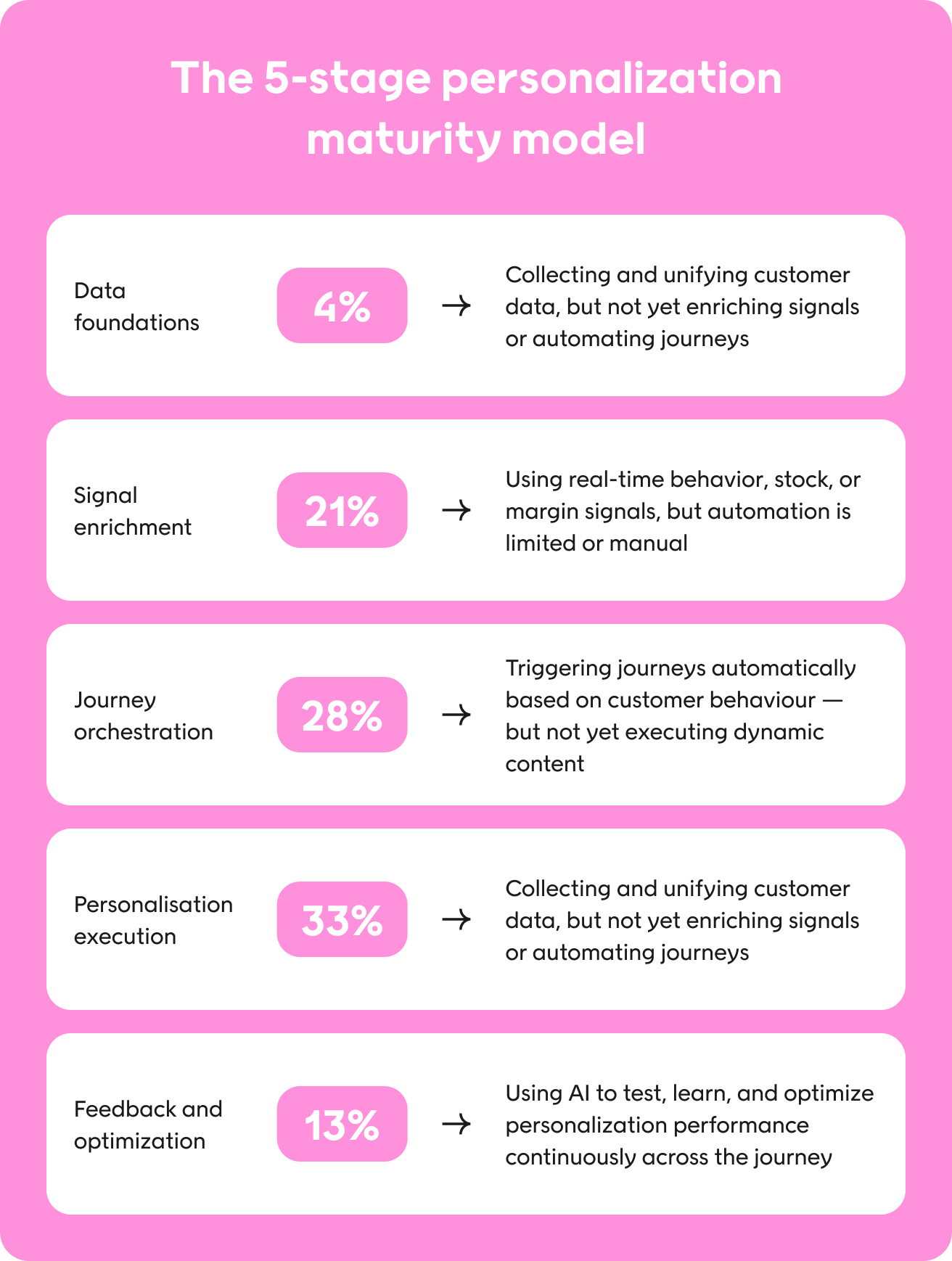
Stage 1: Data foundations (4% of retailers)
What it looks like: You are collecting customer data, but it lives in silos. CRM data, website analytics, POS transactions, and loyalty data are stored in separate systems. Personalization, if it exists, is based on broad segments like “new vs. returning” or “high spender vs. low spender.”
What holds you back: Without a unified customer profile, every personalization decision is based on partial information. Your email tool sees one version of the customer; your website sees another.
What you need to progress: A single customer data layer that connects identity across channels — online, offline, email, app, and in-store. Retail data consolidation platforms can help unify these sources.
Stage 2: Signal activation (21% of retailers)
What it looks like: You have connected some data sources and can act on basic behavioral signals. You might trigger abandoned cart emails, show recently viewed products, or personalize based on purchase history. The signals are real, but the responses are largely rule-based.
What holds you back: Rules don’t scale. As your customer base grows and your product catalog expands, manually defining “if X then Y” logic for every scenario becomes impossible. You also miss signals you have not explicitly programmed for.
What you need to progress: Machine learning models that can identify patterns across your data without manual rule creation — and enough data breadth to feed them.
Stage 3: Journey orchestration (28% of retailers)
What it looks like: You are coordinating personalization across multiple touchpoints. A customer who browses on mobile, receives an email, and visits in-store gets a connected experience. You are using dynamic content, automated journeys, and some AI-driven recommendations.
What holds you back: The orchestration is often channel-by-channel rather than truly cross-channel. Email, web, and in-store personalization may each perform well, but they are not sharing learnings or optimizing together. You are delivering dynamic experiences, but not yet a personalization engine.
What you need to progress: Cross-channel data unification, a single decision layer that coordinates across touchpoints, and clear measurement of personalization impact on revenue and retention.
Stage 4: Personalization engine (33% of retailers)
What it looks like: AI drives personalization decisions across channels in real time. Product recommendations, content, offers, and timing are all algorithmically determined based on a unified customer view. Your team is focused on strategy and governance, not manual campaign configuration.
What holds you back: Even at this stage, most retailers rely on batch-updated models rather than real-time feedback loops. The system performs well but does not autonomously learn and improve from every interaction.
What you need to progress: real-time feedback mechanisms that allow models to self-correct and continuous testing infrastructure. You also need organizational trust in AI-driven decisions — and that only comes when teams can see how the model performs.
Stage 5: Feedback and optimization (13% of retailers)
What it looks like: Personalization is fully autonomous and self-optimizing. AI models learn from every customer interaction in real time, adjusting recommendations, timing, channel selection, and offers without manual intervention. The system continuously improves its own performance.
Why so few reach this stage: It requires not just technology but organizational maturity. Your team must trust AI outputs and operate with unified data across every customer touchpoint. That requires clear governance frameworks that give teams visibility without requiring manual intervention. According to the research, advanced retailers draw on nearly twice as many data sources as mid-stage peers.
Where most retailers get stuck
The data tells a clear story: 3 in 5 retailers are in the middle stages (journey orchestration and personalization engine), delivering dynamic experiences but without full automation.
The jump from stage 3 to stage 4 is the hardest. It requires:
- Unified data. Not just connected systems, but a single customer view that updates in real time across every channel.
- Algorithmic decision-making. Moving from rule-based triggers to AI models that make personalization decisions without manual configuration.
- Organizational trust. Teams need to be comfortable letting AI drive decisions — which means they need visibility into how those decisions are made and evidence that they work.
The jump from stage 4 to stage 5 is rare because it demands a fundamentally different operating model. At stage 5, AI isn’t a tool your team uses — it is a system your team governs.
Self-assessment: identify your stage
Ask yourself these five questions:
- Can you see a single customer across every channel? If your CRM, website, app, and in-store systems show different versions of the same customer, you are at stage 1 or 2.
- Does your personalization extend beyond one channel? If you personalize email well but your website and in-store experience are generic, you are likely at stage 2 or 3.
- Are personalization decisions made by AI or by rules? If your team manually configures most triggers and segments, you are at stage 2 or 3. If AI drives decisions with minimal manual setup, you are at stage 4.
- Do your models learn from outcomes? If campaign results feed back into your models and improve future performance automatically, you are approaching stage 5. If results are analyzed manually and adjustments are made by hand, you are at stage 3 or 4.
- How many data sources feed your personalization? Advanced retailers use nearly 2x as many data sources. If you are working with fewer than four connected sources (CRM, browse, purchase, loyalty, inventory, advertising), you have a data breadth gap.
How to move forward from your current stage
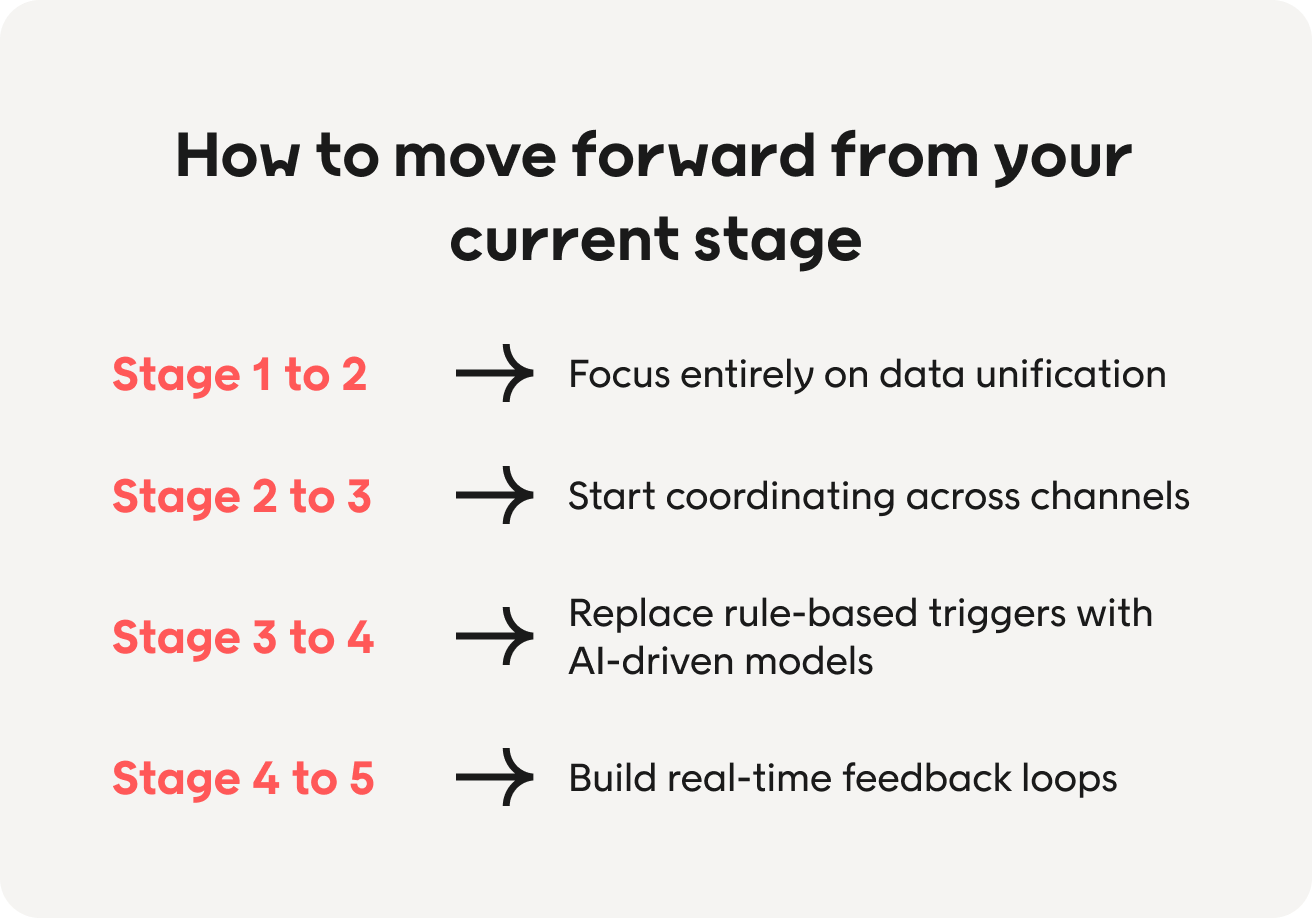
From stage 1 to 2: Focus entirely on data unification. Connect your CRM, website, and POS into a single customer profile. Don’t invest in advanced personalization tools until your data foundation is solid.
From stage 2 to 3: Start coordinating across channels. Your email, web, and in-store personalization should share the same customer data and work toward the same outcomes.
From stage 3 to 4: Replace rule-based triggers with AI-driven models. This requires both technology — such as agentic AI for product discovery — and organizational change (teams willing to shift from manual configuration to strategic oversight).
From stage 4 to 5: Build real-time feedback loops. Invest in testing infrastructure that allows models to self-correct, and create governance frameworks that give your team visibility and control without requiring manual intervention.
The retailers who reach stage 5 don’t just have better tools. They have built an organizational capability around AI — one where connected omnichannel experiences and unified data work together to drive compounding performance.
Frequently asked questions
What are the stages of AI personalization in retail?
Voyado and Retail Economics identify five stages: data foundations (4%), signal activation (21%), journey orchestration (28%), personalization engine (33%), and feedback and optimization (13%). Each requires progressively more unified data and organizational capability.
How mature is AI personalization in retail?
Most retailers are in the middle stages. 3 in 5 deliver dynamic personalized experiences but lack full automation. Only 13% have reached fully embedded, self-optimizing personalization systems.
What percentage of retailers use AI for personalization?
Nearly all (95%) have experimented with AI, but maturity varies widely. 33% operate a true personalization engine, while only 13% have reached autonomous, feedback-driven optimization.
How do you move from basic to advanced AI personalization?
Start by unifying customer data across all channels and shifting from rule-based triggers to AI-driven decision-making. Build organizational trust by giving teams visibility into how AI decisions are made and measured.
About Author