TL;DR
Learning how to create an omnichannel experience starts with connecting customer data, loyalty, product discovery, and communication across channels. The most successful retailers unify customer profiles, personalize consistently, make loyalty work online and in store, coordinate journeys across touchpoints, and measure customer outcomes rather than channel metrics. When every interaction builds on the last one, customers enjoy a seamless omnichannel experience that drives loyalty, retention, and long-term growth.
A great omnichannel customer experience feels effortless. Customers can move between online and in-store channels without repeating themselves, losing rewards, or starting over.
You may understand why omnichannel is important, but turning that vision into reality is often the hard part. This guide shows you how to create an omnichannel experience customers love in seven practical steps.
What customers expect from a modern omnichannel experience
Customers don’t think in channels. They think in experiences.
Whether they’re browsing on a mobile app, visiting one of your physical stores, opening an email, or contacting customer support, they expect every interaction to feel connected. A strong omnichannel customer experience makes moving between online and offline channels feel natural, not disruptive.
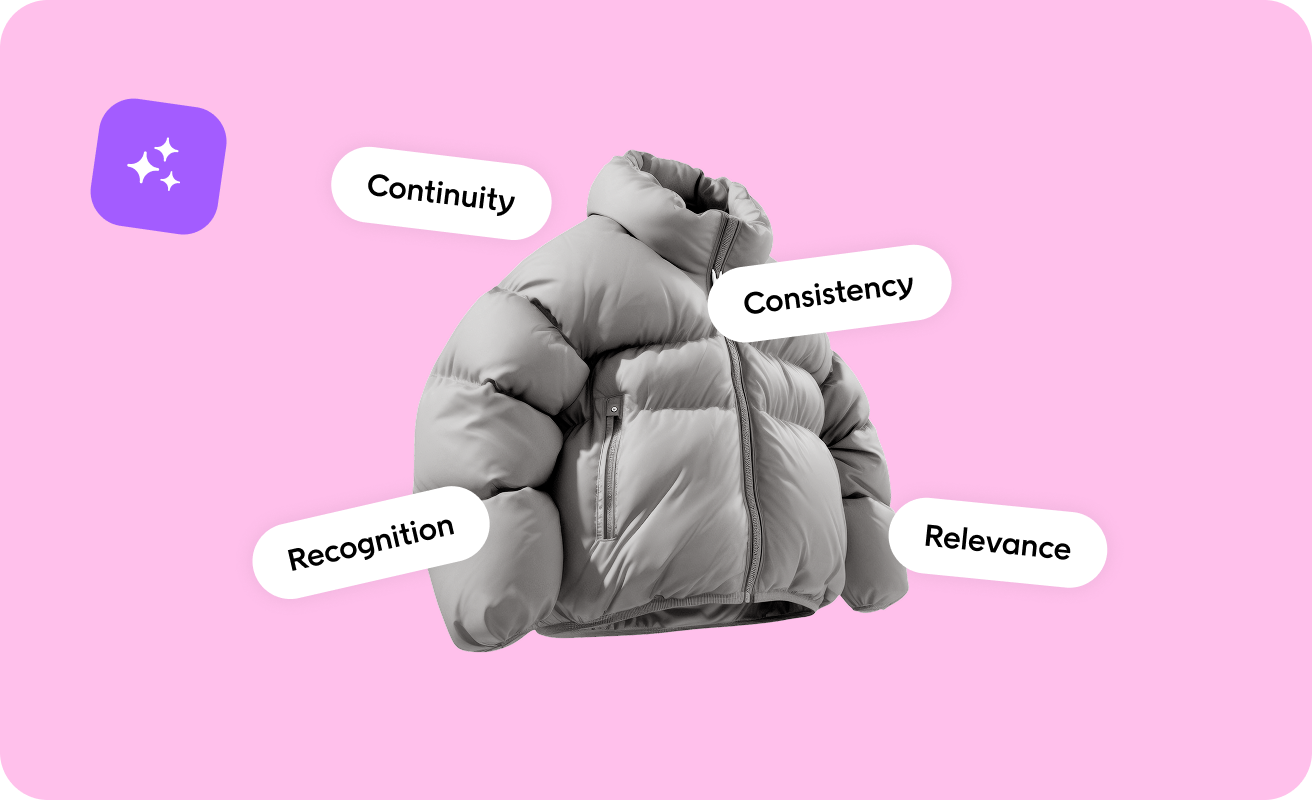
| Customers expect | What it means in practice |
| Recognition | Your business knows who they are across channels |
| Consistency | Prices, rewards, messaging, and support stay aligned |
| Relevance | Offers and recommendations reflect customer preferences |
| Continuity | The customer journey continues when they switch channels |
A seamless customer experience happens when channels work together.
For example:
- A wishlist follows the customer across devices
- Loyalty benefits work online and in store
- Customer support has access to previous interactions
This is what separates a true omnichannel approach from disconnected experiences. Successful omnichannel strategies connect channels into one journey.
The result is higher customer satisfaction, stronger customer loyalty, and a more consistent customer experience.
Many retailers already understand the principles behind omnichannel retailing. The challenge is making every touchpoint feel connected.
When customers feel recognized everywhere they engage, omnichannel starts working the way it should.
How to create an omnichannel experience customers love in 7 steps
Creating a seamless omnichannel experience isn’t about adding more channels. It’s about making every channel feel connected from the customer’s perspective.
The seven steps below give your team a practical framework for building an omnichannel experience strategy that works across online and offline channels.
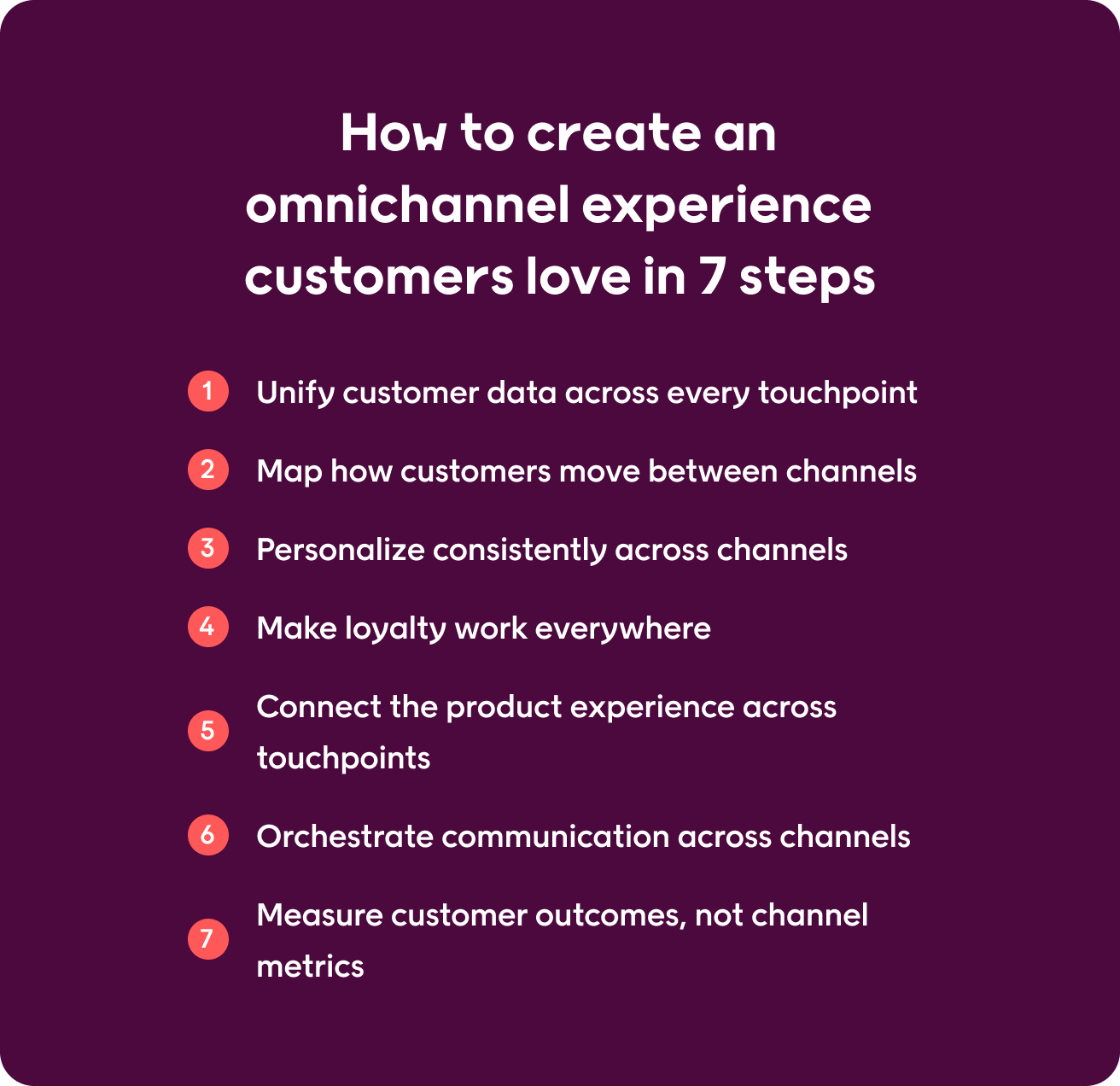
Step 1: Unify customer data across every touchpoint
Everything starts with customer data.
If your e-commerce platform, loyalty program, customer relationship management system, POS, and customer support tools all store information separately, your customers will feel those gaps whenever they move between channels.
Your goal isn’t to collect more customer data. It’s to create a single view of each customer that updates as new customer interactions happen across every touchpoint.
That means connecting:
- E-commerce behavior
- In-store purchases
- Loyalty activity
- Email engagement
- Mobile app activity
- Customer support interactions
When a customer browses online, purchases in store, or contacts support, those actions should enrich the same profile.
A connected profile helps your teams understand customer behavior, personalize engagement, and create better experiences across channels.
Some key capabilities include:
- Identity resolution between anonymous and known visitors
- POS-to-CRM synchronization
- Progressive profiling
- Consent management
- Real-time profile updates
A strong customer loyalty platform becomes even more valuable when loyalty activity is connected to the rest of the customer relationship.
Without unified customer data, every other omnichannel initiative becomes harder to execute.
Step 2: Map how customers move between channels
Customers don’t follow the journeys your teams imagine. They create their own.
Someone might discover a product on social media, research it on your website, visit a store to see it in person, and complete the purchase later on their phone. Another customer might start in the store and finish online.
Your team needs to understand how customers actually move between digital channels and offline channels and where pain points appear along the customer journey.
Start by mapping the journeys that matter most:
| Journey | Common breakdown point |
| Browse online → buy in store | Store teams can’t see browsing behavior |
| First purchase → repeat purchase | No follow-up engagement |
| Loyalty member → store visit | Loyalty status isn’t recognized |
| Product research → support inquiry | Customer context gets lost |
Pay special attention to handoff points. These are often where seamless customer journeys break down.
Customer journey mapping shouldn’t be a one-time workshop. It should evolve as customer preferences, customer behavior, and channel usage change.
The better you understand how customers interact across channels, the easier it becomes to improve the experience.
Step 3: Personalize consistently across channels
Many retailers personalize well in one place. Few personalize consistently everywhere.
Customers expect personalized experiences to follow them across channels. If someone browses products online, your follow-up email should reflect that interest. If they make a purchase in store, future recommendations should adapt accordingly.
Good personalization creates continuity throughout the customer journey and helps build a stronger omnichannel customer experience.
For example:
| Customer action | Expected response |
| Browses running shoes | Relevant follow-up recommendations |
| Purchases in store | Online recommendations update |
| Reaches VIP status | Benefits appear across all touchpoints |
This applies to:
- Personalized recommendations
- Promotional offers
- Loyalty rewards
- Lifecycle messaging
- Customer engagement campaigns
Strong personalization in retail reflects customer preferences wherever customers engage with your brand.
Every interaction should build on the last one.
Step 4: Make loyalty work everywhere
Loyalty is one of the strongest connectors in a seamless omnichannel experience.
When customers can earn, track, and redeem rewards across online and offline channels, they’re more likely to identify themselves throughout the journey. That creates better customer data while strengthening customer loyalty.
A connected loyalty program should support:
- Enrollment online and in store
- Points visibility across channels
- Redemption anywhere customers shop
- Consistent tier status
- Loyalty-driven personalization
A disconnected loyalty experience damages trust.
If customers earn points in store but can’t see them online or receive different benefits depending on where they shop, the experience immediately feels fragmented.
That’s why retailers that focus on customer lifetime value often use loyalty as a driver of customer retention, customer lifetime growth, and repeat business.
The best loyalty programs make channel switching feel invisible.
Step 5: Connect the product experience across touchpoints
Customers don’t think of product discovery as separate experiences.
They expect products, wishlists, recommendations, and availability information to follow them across devices and channels.
A connected product experience means customers can:
- Save products on one device and access them elsewhere
- See local inventory before visiting physical stores
- Receive recommendations informed by online and offline behavior
- Continue browsing where they left off
This is where a connected product discovery engine, like Voyado Elevate, becomes important.
Search, recommendations, and merchandising should reflect both customer intent and business context.
For any omnichannel experience in retail, product discovery should feel like one unified experience rather than a collection of disconnected tools.
Customers shouldn’t have to start over every time they switch devices or channels.
Step 6: Orchestrate communication across channels
Sending the same message through multiple channels isn’t omnichannel marketing.
Effective communication coordinates messages based on customer behavior, preferred channels, and timing.
For example:
Browse abandonment → Email reminder → SMS follow-up → Personalized website experience → Relevant in-store interaction
The goal isn’t more communication. It’s more relevant communication.
Focus on:
- Behavior-triggered journeys
- Channel preference detection
- Frequency management
- Cross-channel sequencing
- Consistent messaging
Customers expect brands to understand when they’ve already received a message. They don’t want duplicate communications across email, social media, a mobile app, or other channels.
Whether customers engage through email, in-store visits, customer support, or phone support, the experience should feel coordinated and helpful.
The best communication strategies support the journey instead of interrupting it.
Step 7: Measure customer outcomes, not channel metrics
Many teams measure channels. Great teams measure experiences.
Traditional channel metrics still matter, but they don’t tell the whole story.
| Channel metrics | Customer metrics |
| Email opens | Repeat purchases |
| App downloads | Loyalty participation |
| Website traffic | Customer lifetime value |
| Store visits | Cross-channel engagement |
| Campaign clicks | Customer satisfaction |
Customer-level outcomes provide a clearer view of whether your omnichannel approach is working.
Track metrics such as:
- Customer satisfaction scores
- Customer retention
- Cross-channel engagement
- Loyalty participation
- Repeat business
- Customer lifetime value
Customer feedback also plays an important role.
Use surveys, reviews, customer support conversations, and social media listening to analyze customer feedback and uncover pain points that may not appear in reporting dashboards.
These customer-centric metrics are often better key performance indicators than channel-specific numbers alone.
When you measure the full experience instead of individual channels, you can make better decisions about where to invest next.
The strongest omnichannel strategies focus on customer outcomes, not channel performance alone.
Why most omnichannel initiatives struggle
Customers expect one connected experience. Most retailers still operate as a collection of separate channels.
Data fragmentation creates disconnected experiences
Your website, loyalty platform, customer support tools, and store systems may all collect valuable information. But if those systems don’t share data, the experience breaks whenever customers move between channels.
Common symptoms include:
- Loyalty status isn’t visible everywhere
- Customer interactions are trapped in separate systems
- Store teams can’t access online activity
- Customer support lacks purchase history
- Personalization stops when customers switch channels
This is why many retailers invest in omnichannel orchestration. Connected journeys require connected data.
Without a shared customer view, seamless customer journeys become difficult to deliver.
Teams optimize channels instead of journeys
Many teams are organized around channels rather than the customer journey.
| Team | Primary focus |
| Email team | Opens and clicks |
| E-commerce team | Website conversion |
| Store team | In-store sales |
| Customer service team | Case resolution |
Each team improves its own metrics.
Customers experience all the interactions as one journey.
When teams work in isolation:
- Messaging becomes inconsistent
- Handoffs feel disconnected
- Customer expectations aren’t met
- Experiences vary across different channels
When comparing omnichannel vs. multichannel retailing, it often comes down to coordination. Multiple channels exist in both models. The difference is whether those channels work together.
Great omnichannel requires coordination, not just technology
Technology matters, but software alone won’t create a seamless experience.
The strongest omnichannel retail brands align teams, processes, and customer data around the customer rather than the channel.
That means connecting:
- Online shopping and in-store experiences
- Loyalty and customer engagement
- Marketing and customer support
- Digital channels and offline channels
Many of the best omnichannel CX examples succeed because they create a consistent experience across every customer touchpoint.
When your teams focus on the journey instead of the channel, delivering connected omnichannel experiences becomes much easier.
Customers don’t notice your internal structure. They only notice whether the experience feels connected.
What separates good omnichannel from great omnichannel
Building connected channels is a great start. Creating a seamless omnichannel experience that customers genuinely notice takes a little more.
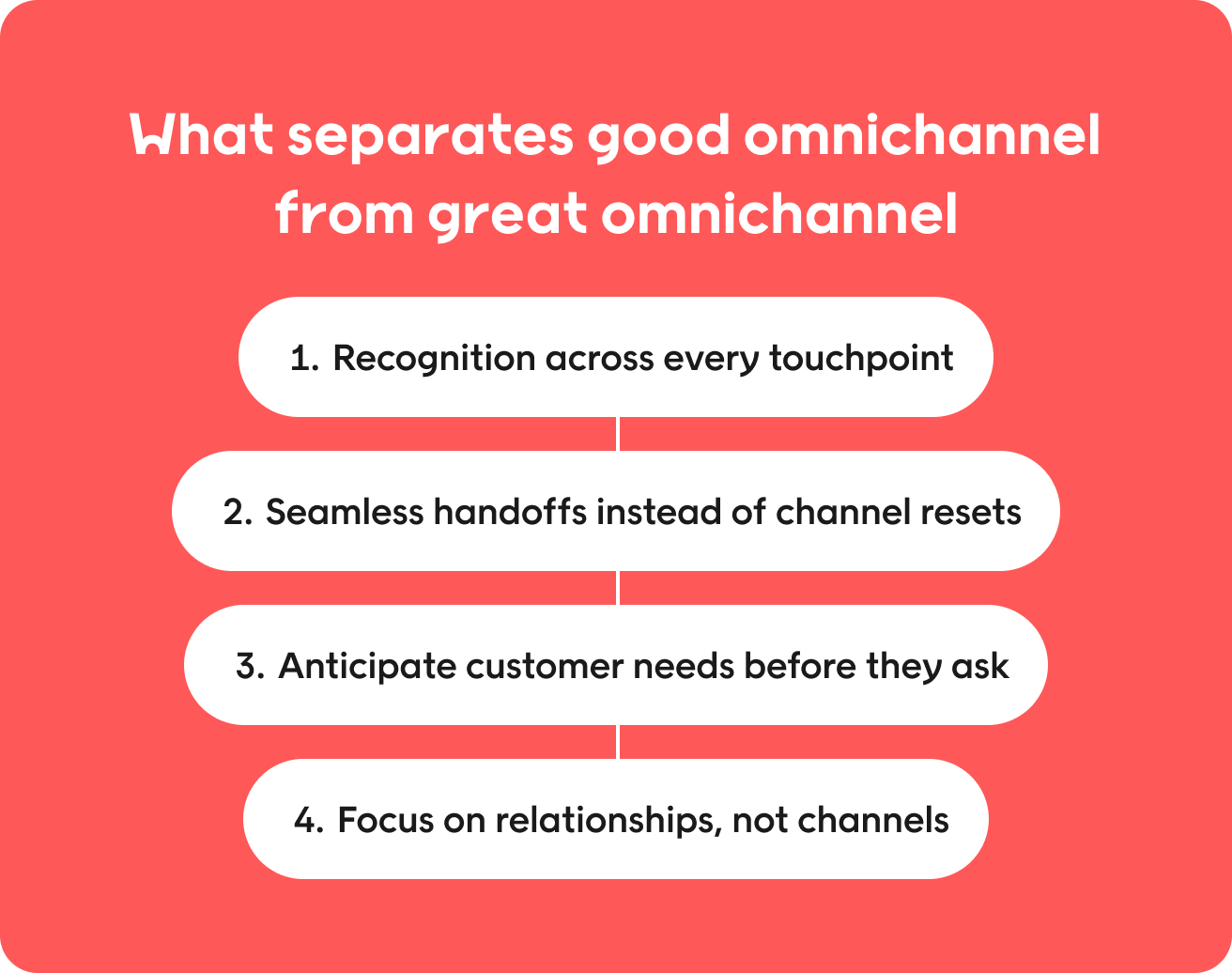
Recognition across every touchpoint
Great experiences make customers feel recognized wherever they engage.
Their preferences, purchase history, and loyalty status should follow them across customer touchpoints. That creates a stronger omnichannel customer experience with less friction.
Seamless handoffs instead of channel resets
One of the easiest ways to improve the omnichannel customer experience is to remove unnecessary resets.
Customers shouldn’t have to:
- Rebuild shopping carts
- Search for saved products again
- Repeat information to customer support
- Re-enter loyalty details
Many strong customer retention strategies focus on helping customers continue where they left off.
Anticipate customer needs before they ask
The best brands don’t just react to customer behavior. They anticipate customer needs.
Examples include:
- Back-in-stock notifications
- Replenishment reminders
- Loyalty milestone rewards
- Personalized recommendations
These moments help exceed customer expectations and create a competitive advantage.
If you’re exploring how to build an omnichannel experience, proactive engagement often separates average experiences from memorable ones.
Focus on relationships, not channels
Customers don’t care which team owns the channel. They care whether the experience feels connected.
A strong customer loyalty program helps create continuity across channels. The strongest retailers understand that omnichannel strategies integrate loyalty, engagement, and customer data into one consistent experience with the same tone online and during in-store experiences.
Great omnichannel isn’t about managing channels better. It’s about making the relationship feel connected.
How Voyado helps retailers create omnichannel experiences customers love
Creating a connected customer experience is much easier when your data, loyalty program, product discovery, and communication channels work together.
| If you’re struggling with… | Voyado helps by… |
| Disconnected customer data | Creating one customer profile |
| Loyalty that works differently by channel | Connecting rewards across online and in-store |
| Generic product discovery | Personalizing search and recommendations |
| Disconnected campaigns | Orchestrating journeys across channels |
| Too many point solutions | Bringing key capabilities together in one platform |
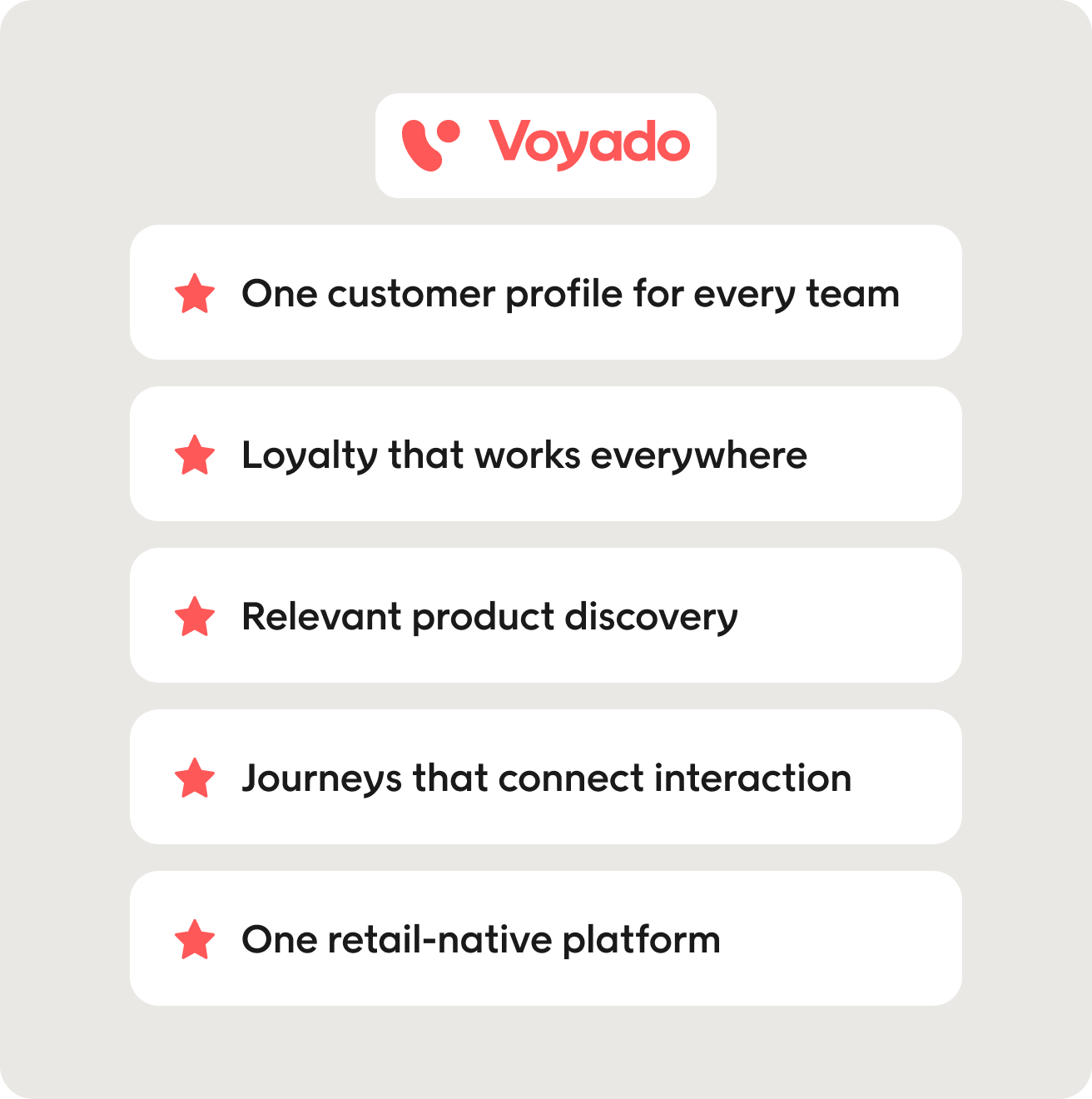
One customer profile for every team
When customer data lives in separate systems, delivering a consistent customer experience becomes difficult.
Voyado combines data from e-commerce, loyalty, POS, and customer interactions into a single profile. That gives every team access to the same customer view and helps eliminate disconnected experiences.
Loyalty that works everywhere
Customers shouldn’t have different loyalty experiences depending on where they shop.
With connected loyalty, customers can:
- Join online or in store
- Earn rewards across channels
- Track points in one place
- Redeem benefits wherever they shop
The same loyalty experience follows the customer throughout the journey. That’s a key part of how to implement a customer loyalty program that supports long-term growth.
Product discovery that stays relevant
Search, recommendations, and merchandising work best when they’re connected to customer data.
Voyado helps your teams deliver personalized recommendations based on customer behavior, loyalty signals, and shopping history so customers see more relevant products throughout their journey.
Journeys that connect every interaction
Customers expect every interaction to build on the last one.
Voyado helps coordinate communication across email, SMS, websites, apps, and stores so journeys respond to real behavior instead of operating as disconnected campaigns.
This is where effective omnichannel orchestration turns separate touchpoints into connected experiences.
One retail-native platform
Many retailers rely on separate systems for customer engagement, loyalty, product discovery, and customer data.
Voyado brings these capabilities together in one platform built specifically for retail. That reduces complexity, improves collaboration, and helps teams focus on creating better experiences rather than managing integrations.
If your channels still operate in silos, book a demo to see how Voyado helps retailers create connected customer experiences.
The easier it is for your teams to work together, the easier it becomes to create experiences customers love.
FAQs
How do you create an omnichannel experience?
Start by unifying customer data across channels. Then connect loyalty, personalization, product discovery, and communication so every customer interaction builds on the last one.
How to improve omnichannel customer experience?
Focus on removing friction between channels. Customers should be recognized everywhere they engage, with consistent messaging, loyalty benefits, and personalized experiences across online and offline touchpoints.
What is the difference between omnichannel and multichannel?
Multichannel means customers can interact through multiple channels. Omnichannel connects those channels into one seamless customer experience where data, journeys, and interactions continue across touchpoints.
What does a great omnichannel experience look like for retail customers?
Customers can move between online shopping, mobile apps, customer support, and physical stores without starting over. Loyalty, preferences, and purchase history stay connected throughout the customer journey.
What technology do retailers need for omnichannel?
Most retailers need unified customer profiles, customer relationship management tools, loyalty capabilities, journey orchestration, product discovery, and POS integrations that connect customer data across channels.
How does Voyado support omnichannel experiences?
Voyado connects customer engagement, loyalty, product discovery, and customer data in one retail-native platform. This helps retailers create a seamless omnichannel experience across online and in-store channels.
How do I measure whether my omnichannel experience is working?
Track customer-focused metrics such as customer satisfaction, customer retention, customer lifetime value, loyalty participation, and cross-channel engagement. Customer feedback can also reveal friction points that traditional channel metrics may miss.
About Author