TL;DR
Most retailers use separate tools for messaging, loyalty, personalization, and product discovery. Even when each system works well, the customer experience still feels disconnected.
Experience orchestration connects messaging, merchandising, loyalty, product discovery, and in-store experiences in one system using shared customer data and real-time signals.
Unlike omnichannel orchestration, which focuses on communication across channels, customer experience orchestration connects every interaction shaping the customer journey.
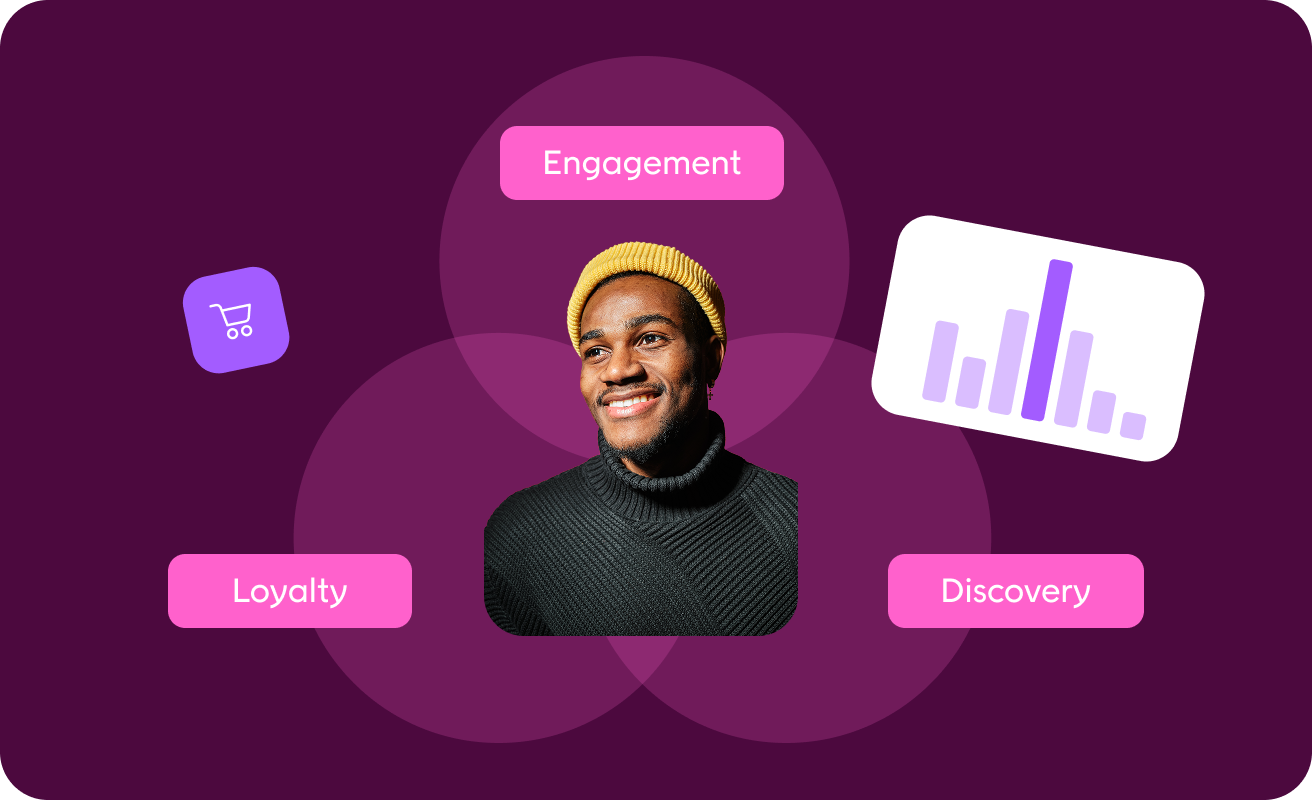
Voyado brings engagement, loyalty, product discovery, and retail-trained AI together in one platform built for retail.
What experience orchestration actually means in retail
Most retailers already coordinate channels and campaigns. The bigger challenge is coordinating the entire experience customers move through before, during, and after a purchase.
More than messaging, more than channels
Most customer experience orchestration strategies focus on messaging: who gets a message, through which channel, and when.
Experience orchestration retail strategies go further. They coordinate everything customers interact with, including a product discovery engine, merchandising, loyalty, service, and communication across channels.
When these systems operate separately, the experience feels fragmented. Customers might receive personalized messages while seeing irrelevant products or inconsistent offers.
That’s why experience orchestration goes beyond omnichannel orchestration. It coordinates the full customer experience using shared context, customer intent, and real-time behavior.
Experience orchestration vs. omnichannel orchestration vs. journey orchestration
These terms are often used interchangeably, but they solve different problems inside the customer journey.
| Area | Journey orchestration | Omnichannel orchestration | Experience orchestration |
| Scope | A specific customer journey | Cross-channel communication | The full retail customer experience |
| Focus | Flow logic and triggers | Channel timing and consistency | Coordinating every interaction and capability |
| What it coordinates | Messages within a journey | Email, SMS, app, on-site, and in-store messaging | Product discovery, merchandising, loyalty, service, and communication |
| Data inputs | Journey behavior and triggers | Channel engagement and customer data | Customer data, product data, loyalty context, behavioral signals, and business rules |
| Best suited for | Welcome flows, cart abandonment, reactivation | Consistent communication across channels | Connected customer journeys across the entire business |
The key difference is simple. Experience orchestration includes journey orchestration and omnichannel coordination, but also connects merchandising, loyalty, service, and product discovery into the same orchestration layer.
Why retailers need experience orchestration in 2026
Retailers don’t have a channel problem anymore. They have a coordination problem. Most enterprise teams already have strong tools in place, but the customer experience still feels fragmented because those systems don’t operate together in real time.
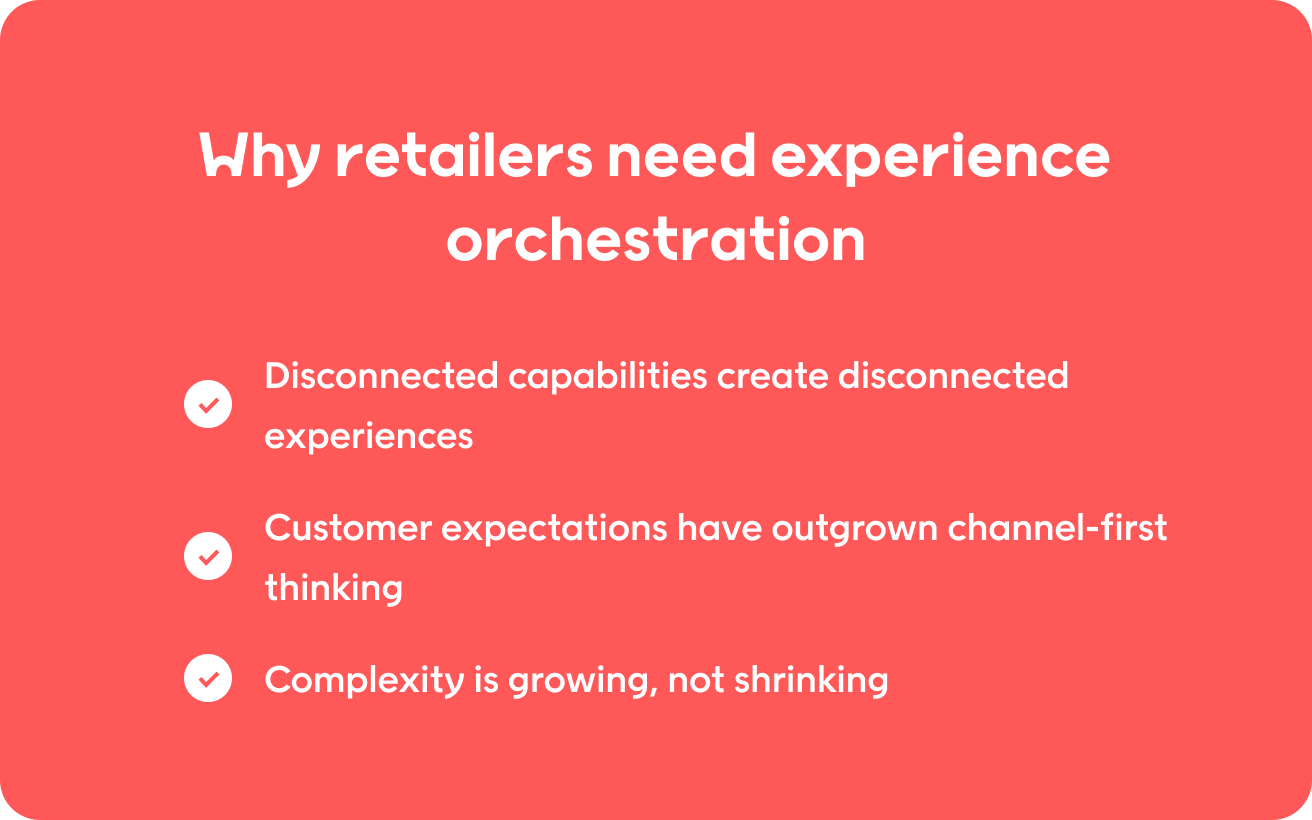
Disconnected capabilities create disconnected experiences
Most retailers already have the building blocks for retail experience orchestration. Your teams likely use separate systems for marketing, loyalty, analytics, in-store operations, and merchandising.
The problem is that each system runs on its orchestration logic, customer data, and decision-making processes. One team controls marketing automation. Another manages loyalty. Another handles product discovery.
What fragmentation actually looks like
- A customer receives an email promoting an out-of-stock product.
- A VIP shopper still sees generic personalization in retail experiences despite years of loyalty.
- Loyalty points earned in-store don’t appear online until hours later.
- Customer service teams lack context about recent purchases or engagement.
- Different channels push conflicting offers at the same moment.
Each tool is technically working. But from the customer’s perspective, the brand feels disconnected.
That disconnect affects customer satisfaction, engagement, and business outcomes. Customers notice when brands fail to understand context across journeys and interactions.
Customer expectations have outgrown channel-first thinking
Customers don’t think in channels. They think in moments, convenience, and relevance.
They expect the website, loyalty program, in-store service, and communication to feel like one continuous conversation. They expect every customer interaction to reflect their preferences, purchase history, and intent in real time.
What customers expect today
Customers expect brands to:
- Recognize them across all channels.
- Adapt experiences using real-time signals.
- Deliver relevant recommendations and offers.
- Connect loyalty, service, and engagement into one seamless experience.
Leading brands are shifting from channel-first orchestration customer experience strategies toward full experience orchestration that coordinates the entire customer journey.
When your customer loyalty platform and engagement systems work together, customers feel recognized instead of targeted. The experience becomes more seamless, more relevant, and easier to trust.
Complexity is growing, not shrinking
Retail complexity keeps expanding. More channels, data, customer touchpoints, and personalization possibilities.
At the same time, customers expect brands to adapt instantly to every customer moment.
What teams are dealing with today
- Marketing teams managing growing automation workflows.
- Loyalty teams coordinating rewards and customer engagement.
- Merchandising teams optimizing product visibility and recommendations.
- Service teams trying to understand customer context across systems.
- Operational teams handling disconnected data and processes.
Without journey experience orchestration, teams work in silos, making seamless personalization harder to scale.
Experience orchestration connects customer intent, AI-driven decision-making, and customer interaction in one system.
Retailers investing in stronger customer lifetime value strategies often see higher loyalty, engagement, and retention.
The retailers winning in 2026 will connect data, insights, and engagement across every interaction.
The building blocks of retail experience orchestration
Experience orchestration only works when the core retail experience works together. That means coordinating the systems, decisions, and interactions that shape how customers move across journeys.
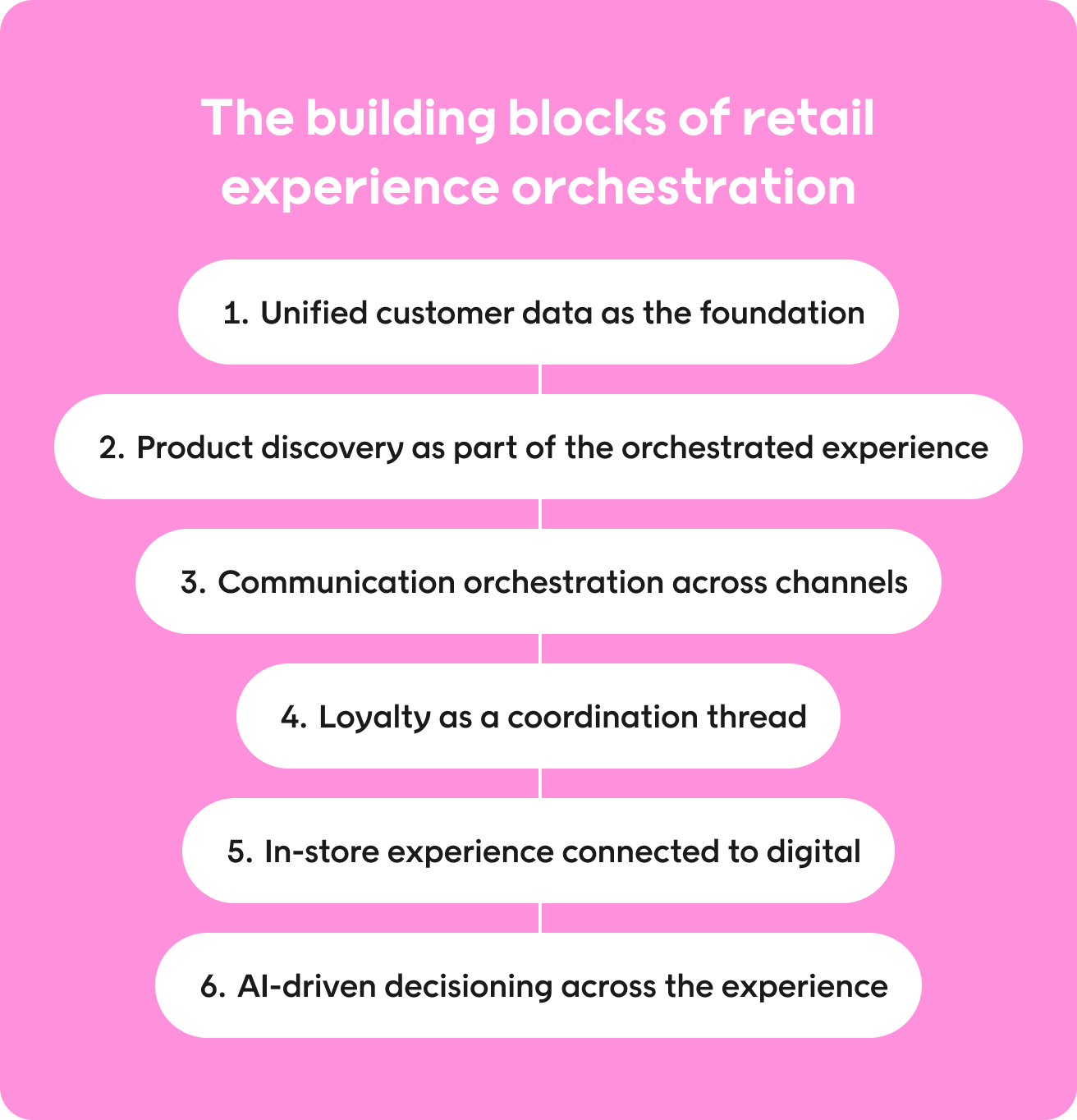
Unified customer data as the foundation
Everything starts with shared customer data.
Your teams need one view of every customer across purchases, browsing behavior, loyalty activity, and in-store interactions. Without that, systems make decisions in isolation.
Strong omnichannel strategies rely on connected data. Experience orchestration extends that same data across merchandising, product discovery, and loyalty, not just messaging.
Shared context helps teams understand customer needs, adapt faster in real time, and create more relevant journeys.
Product discovery as part of the orchestrated experience
What customers see on-site shapes the customer experience. Search, merchandising, and recommendation blocks all influence how customers interact with your brand.
This is where many brands break the journey. A customer clicks an email about a new collection and lands on generic bestsellers instead.
That’s why product recommendations and on-site discovery need to connect to the same customer context driving engagement and communication.
Strong retail experience orchestration keeps the on-site experience aligned with the conversation happening across channels.
Communication orchestration across channels
This is the layer most people associate with orchestration.
It coordinates:
- Email campaigns.
- SMS and push notifications.
- On-site messages.
- In-store communication.
- Social media engagement.
The goal is to deliver the right interaction at the right moment across all channels.
But communication alone isn’t enough. If the message feels personalized while the experience around it feels generic, customers notice the disconnect immediately.
Modern agentic AI in digital customer engagement is moving beyond simple automation. It connects messaging to customer intent, preferences, and behavior in real time.
Loyalty as a coordination thread
Loyalty should connect the experience, not sit beside it.
Points earned in-store should appear online instantly. Tier status should influence offers, recommendations, service, and engagement across journeys.
When loyalty operates separately from the rest of the experience, customers feel like they’re interacting with disconnected systems instead of one company.
When it’s connected, loyalty becomes the thread tying every interaction together.
That’s why leading brands use loyalty to:
- Encourage customers to identify themselves across channels.
- Deliver a more personalized experience.
- Increase customer satisfaction and long-term engagement.
- Create more consistent customer journeys.
In-store experience connected to digital
For omnichannel retailers, the store is part of the customer journey, not a separate world.
In-store purchases should enrich customer profiles. Store employees should understand customer preferences and loyalty status. Post-purchase engagement should reflect what happened during the visit.
Without that coordination, digital and physical experiences drift apart.
Strong experience orchestration connects POS systems, service interactions, loyalty activity, and digital engagement into one continuous customer conversation.
AI-driven decisioning across the experience
Retail complexity is too large for disconnected rule-based systems.
Experience orchestration at scale requires AI-driven decision-making across the entire experience. That includes:
- Which product to surface.
- Which channel to use.
- Which message to deliver.
- Which loyalty treatment to apply.
- Which next best action creates the strongest business outcomes.
This is where agentic AI in customer experience becomes essential.
Instead of separate systems making disconnected decisions, one intelligence layer helps coordinate journeys, engagement, support, and personalization across the business.
That’s what allows enterprise organizations to scale experience orchestration without overwhelming operational teams or creating fragmented customer moments.
What experience orchestration looks like in practice
Retailers usually don’t notice fragmented experiences inside their systems. Customers do.
| Retail scenario | Before connected experience management | After connected experience management |
| Fashion retailer | Marketing teams send personalized campaigns, but the website follows separate recommendation logic. Customers interact with different products, offers, and journeys across channels. | The customer receives a campaign featuring products matching their preferences. After clicking through, the same collection appears in search, merchandising, and recommendations. Loyalty rewards and the next best action adapt in real time based on behavior and intent. |
| Beauty retailer | Loyalty points appear in-app but not at checkout. Replenishment reminders ignore purchase cycles. Store employees lack customer data and customer feedback history during service interactions. | Points balances stay updated across all channels. Replenishment reminders match real purchase behavior. Store employees can understand context, see loyalty status, and deliver more relevant support during every customer moment. |
For modern retail brands, connected customer experience management is no longer optional. It has become a strategic imperative as customer expectations, artificial intelligence, and personalization demands continue to grow.
How Voyado enables experience orchestration for retail
Most retailers already have capable systems. The challenge is getting those systems to work together in a way that feels seamless to customers and manageable for your teams.
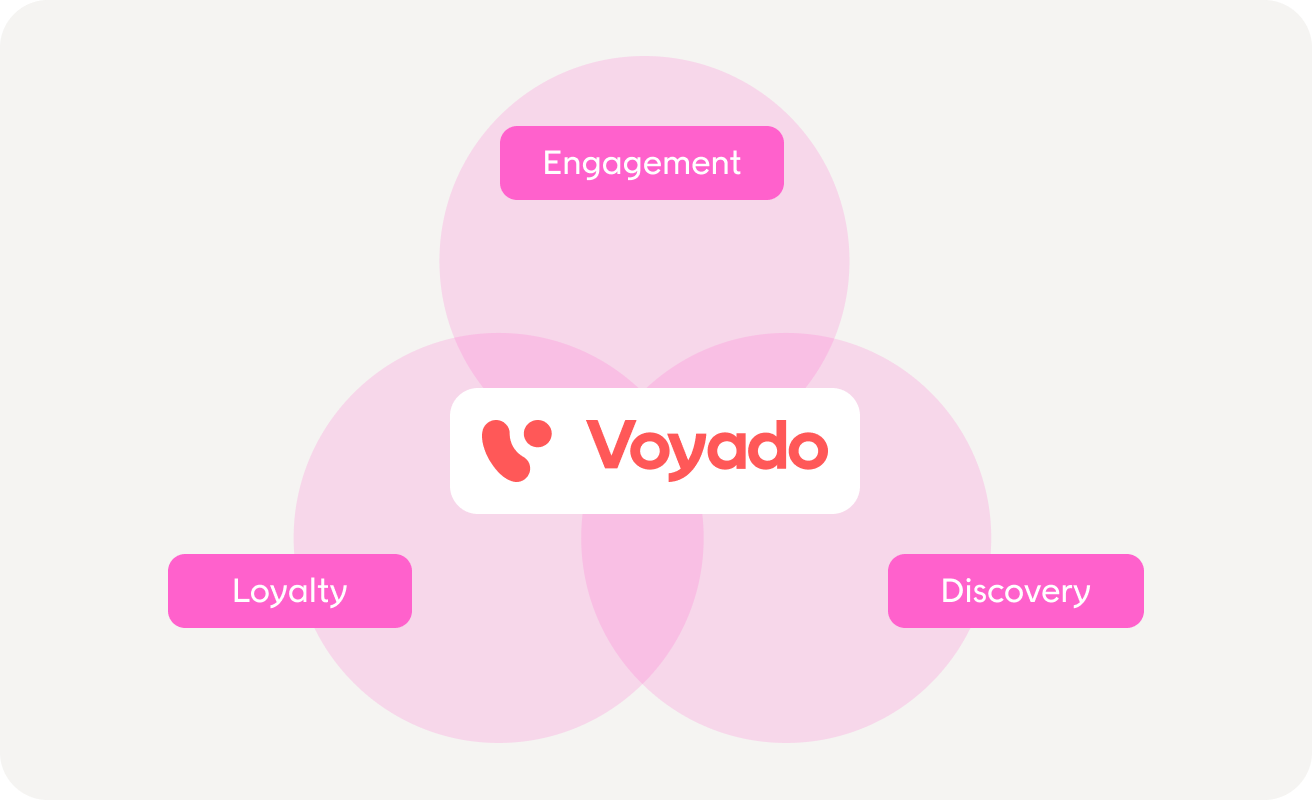
One platform that connects engagement, discovery, and loyalty
Voyado connects customer engagement, product discovery, loyalty, and in-store data in one platform.
- Engage coordinates email, SMS, app, and on-site communication.
- Elevate powers search, recommendations, and merchandising.
- Loyalty is built into the platform, not added separately.
- POS Accelerator connects in-store activity to the same customer profiles.
That means the products customers see, the offers they receive, and the loyalty experiences they get all come from the same understanding of the customer, not disconnected systems.
For your company, that creates more consistency across journeys while giving teams more control over the full experience.
Unified customer profiles that power every capability
Every capability pulls from the same customer profile.
That includes:
- Purchase history.
- Browsing behavior.
- Loyalty status.
- Engagement history.
- In-store activity.
Instead of separate tools creating separate versions of the customer, Voyado gives your business one shared understanding across teams and systems.
The result is faster decision-making, stronger personalization, and fewer disconnected experiences across customer journeys.
Retail-trained agentic AI for cross-experience decisioning
Voyado’s retail-trained AI works across the full experience, not just one channel or capability.
It helps deliver:
- More relevant products.
- Smarter channel selection.
- Better timing for communication.
- Loyalty experiences shaped by real customer behavior.
The observe → decide → act → learn framework helps teams scale personalization without losing control or creating more manual processes.
Product discovery connected to engagement
Many retailers treat product discovery and marketing as separate functions. Customers experience them as one interaction.
With Voyado Elevate, search, recommendations, and merchandising respond to the same customer data driving engagement and campaigns.
If a campaign promotes a collection, the on-site experience reflects it immediately. Customers see consistent recommendations, relevant products, and a more seamless path to purchase.
That alignment helps brands deliver stronger sales outcomes while reducing friction across the customer journey.
Loyalty that ties the experience together
Loyalty works best when it shapes the full experience, not just rewards.
In Voyado, loyalty status can influence:
- Product visibility.
- Offer eligibility.
- Communication priority.
- Customer treatment across channels.
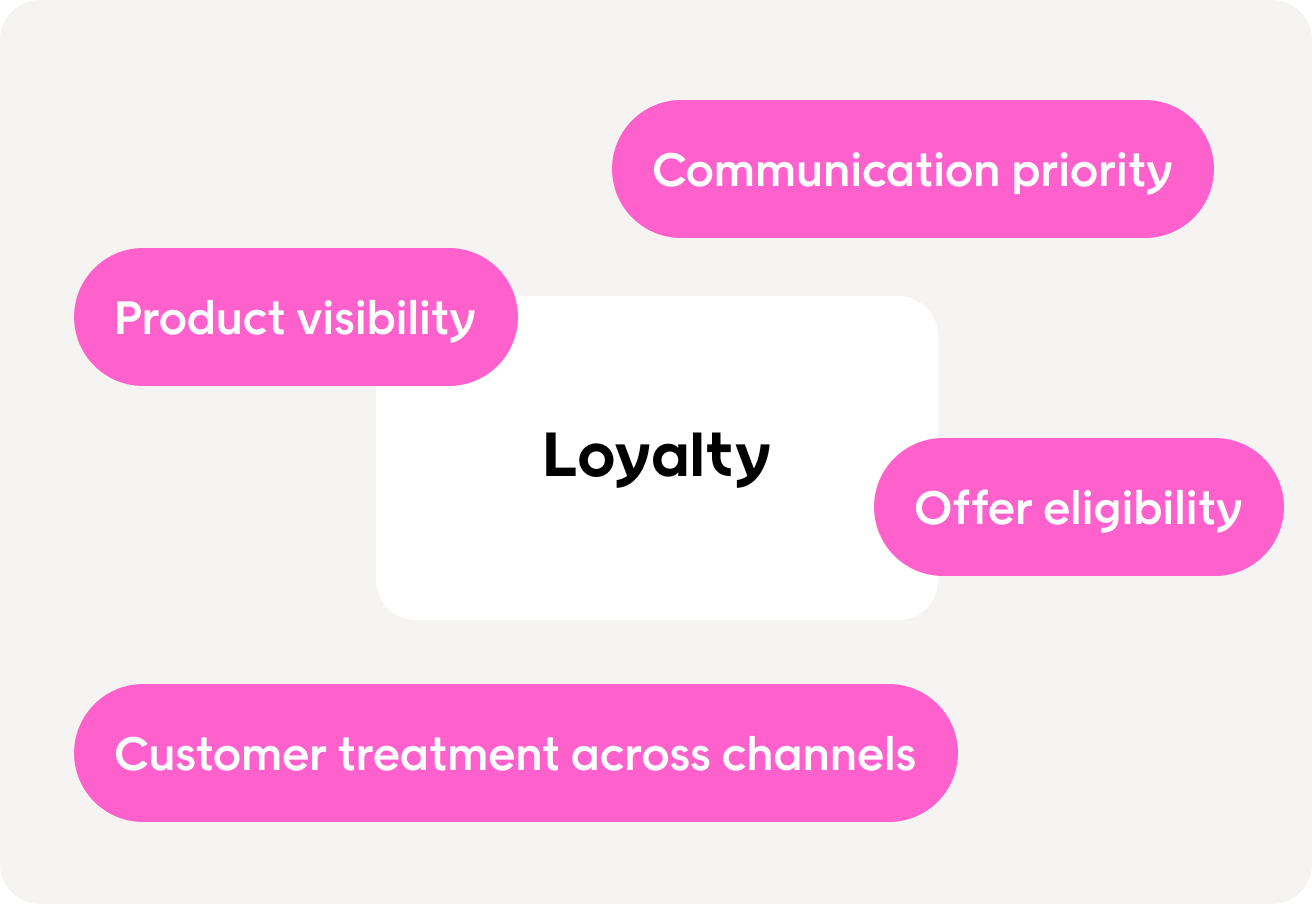
That creates a more connected experience every time customers interact with the brand.
If your teams already have strong tools but still struggle to deliver a connected customer experience, book a demo to see how Voyado makes retail experience management practical at scale.
Final thoughts
Customers don’t care which internal systems your teams use. They only notice whether the experience feels connected, relevant, and easy to navigate. When product discovery, loyalty, communication, support, and service work together, customers engage more and trust the brand faster.
Most retailers already have strong individual capabilities. The challenge is connecting them in a way that adapts to customer behavior in real time and turns analytics, feedback, and engagement into coordinated action.
That’s why experience orchestration matters. It gives retail teams a practical way to deliver more connected journeys without stitching together disconnected tools for months just to make the experience work.
FAQs
What is experience orchestration?
Experience orchestration is the practice of connecting every part of the customer experience into one coordinated system. That includes product discovery, communication, loyalty, service, and in-store interactions. The goal is to deliver more relevant and seamless journeys across all channels.
How is experience orchestration different from omnichannel orchestration?
Omnichannel orchestration focuses on coordinating communication across channels like email, SMS, apps, and in-store messaging. Experience orchestration goes further by connecting merchandising, loyalty, support, customer data, and product discovery into the same decision-making layer.
Why does experience orchestration matter for retail?
Retailers now manage more channels, systems, and customer touchpoints than ever before. Without connected coordination, customers receive fragmented experiences that reduce customer satisfaction, sales, and long-term engagement.
What capabilities does experience orchestration include?
Experience orchestration can include:
- Product recommendations and merchandising.
- Marketing and communication automation.
- Loyalty and rewards.
- In-store experiences.
- Analytics and customer feedback.
- AI-driven personalization and decisioning.
Together, these capabilities help brands better understand customer behavior and adapt experiences in real time.
Do I need a single platform for experience orchestration?
Not always, but connected systems are critical. Many organizations struggle because separate tools operate with different logic, processes, and customer understanding. A unified platform makes it easier to scale connected experiences without adding operational complexity.
How does Voyado support experience orchestration?
Voyado connects engagement, loyalty, product discovery, and in-store data in one platform. That helps retail teams deliver more seamless journeys while keeping communication, merchandising, and customer experiences aligned across channels.
What is the difference between experience orchestration and customer journey orchestration?
Customer journey orchestration usually focuses on managing a specific journey, like onboarding or cart abandonment. Experience orchestration is broader. It coordinates every interaction, shaping the customer experience, including loyalty, service, product discovery, and in-store experiences.
About Author