TL;DR
Agentic AI in digital customer engagement replaces static journeys with real-time decision-making. AI agents use customer data, past interactions, and context to trigger next-best actions across the customer journey.
This helps teams improve customer experience and operational efficiency at the same time. Customer interactions become more relevant, and businesses can respond to rising customer expectations without adding manual work.
The result is higher customer satisfaction, stronger customer engagement, and better business outcomes, with AI systems and human teams working together where it matters most.
Why digital customer engagement needs a new model
You already have customer data, channels, and automation in place. You can track customer interactions and understand the customer journey across touchpoints. So, your teams don’t have a data problem and may already invest in retail customer engagement strategies to bring this together.
Where things break down
In most setups, action lags behind insight. Teams see signals but can’t respond fast enough or consistently across channels.
Journeys are mapped, but they stay static. Campaigns are scheduled in advance. Even when intent is clear, the response often comes too late to matter.
That’s where customer engagement starts to feel disconnected, even when the data is strong.
Why personalization isn’t enough anymore
Personalization made customer experience more relevant, but it still relies on predefined logic.
It helps answer who the customer is. It doesn’t solve for timing, context, or what should happen next.
Customer expectations have shifted. People expect interactions that reflect what they’re doing right now, not what they did days ago. As conversational AI and other AI systems become more common, that gap becomes more visible.
The pivot to next-best action
This is where the model needs to change.
Instead of planning journeys in advance, teams need systems that can interpret behavior, support decision-making, and act in the moment with minimal human intervention.
You can see the shift clearly:
- From static journeys to adaptive customer engagement
- From scheduled campaigns to continuous decision-making
- From delayed reactions to real-time responses
This is what next-best action looks like in practice. It’s also the foundation for agentic AI in digital customer engagement, where systems move from insight to action without waiting on manual steps.
So what actually changes when you move to agentic AI?
What is agentic AI in digital customer engagement?
Agentic AI in digital customer engagement means your systems can make decisions and take action in real time, not just analyze customer data.
Instead of relying on predefined rules or static journeys, AI agents interpret customer behavior, use context, and trigger next-best actions across the customer journey as it unfolds.
How agentic AI compares to traditional AI
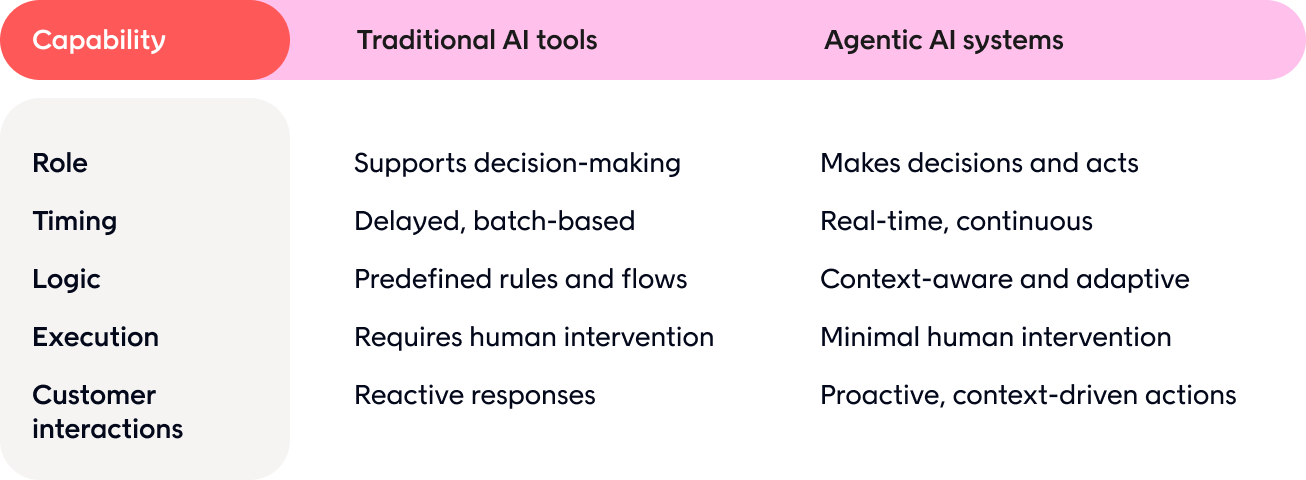
This shift is already shaping how retailers apply agentic AI in retail and rethink digital customer engagement.
So what does this actually change in practice? Let’s look at how teams move from personalization to next-best action.
From personalization to next-best action in customer engagement
Personalization changed how teams approach customer engagement. It made communication more relevant and improved how brands respond to customer preferences.
But it still relies on predefined logic.
Journeys are planned. Campaigns are scheduled. And even with strong customer data, action often comes too late to match what the customer actually needs in the moment.
Where personalization falls short
Personalization focuses on who the customer is. It doesn’t fully account for what’s happening right now.
That creates a gap:
- Customer interactions are based on segments, not real-time context
- Customer needs shift, but journeys don’t adapt fast enough
- Teams rely on traditional AI tools that support decisions, but don’t act
As customer expectations continue to rise, this gap becomes harder to ignore.
What next-best action changes
Next-best action shifts the model from planning to continuous decision-making.
Instead of asking, “Which journey should this customer enter?” the system asks:
What should we do right now?
Agentic AI systems answer that question in real time. They interpret behavior, evaluate context, and trigger actions across the customer journey with minimal human intervention.
This is how agentic AI in customer experience is reshaping how teams approach engagement, moving from static flows to adaptive, moment-based decisions.
How the model evolves in practice
You can see the shift clearly when you compare the two approaches:
- From segments to real-time context and customer needs
- From predefined journeys to adaptive, responsive flows
- From campaign execution to continuous decision-making
- From insight-first systems to action-driven AI systems
This is where enabling AI agents becomes critical. Instead of supporting workflows, AI agents actively drive them, helping teams transform customer service operations and respond faster across channels.
Retailers already exploring the best AI agents in retail are starting to apply this model across marketing, service, and loyalty use cases.
Why this matters for engagement and outcomes
This shift doesn’t just improve timing. It changes how customer relationships are built.
When systems can act in the moment, you can:
- enhance customer satisfaction through more relevant interactions
- deliver more consistent customer experience across channels
- support human teams by reducing manual decision-making
- create deeper customer relationships that drive customer lifetime value
It also gives businesses a clear competitive advantage, especially as more brands invest in agentic AI for customer engagement.
All of that sounds great in theory, but what’s actually happening behind the scenes?
How agentic AI works in customer experience
Agentic AI in digital customer engagement works as a continuous loop. It connects customer data, decision-making, and action so your systems can respond as customer interactions happen.
Instead of waiting for human input, agentic AI systems evaluate signals and act in real time across the customer journey.
The core loop behind agentic AI
At a high level, the flow looks like this:
- Signals: Customer data, past interactions, and real-time behavior
- Decision-making: AI systems evaluate context and determine the next-best action
- Action: The system triggers responses across channels and service workflows
- Learning: Outcomes feed back into the system through continuous learning
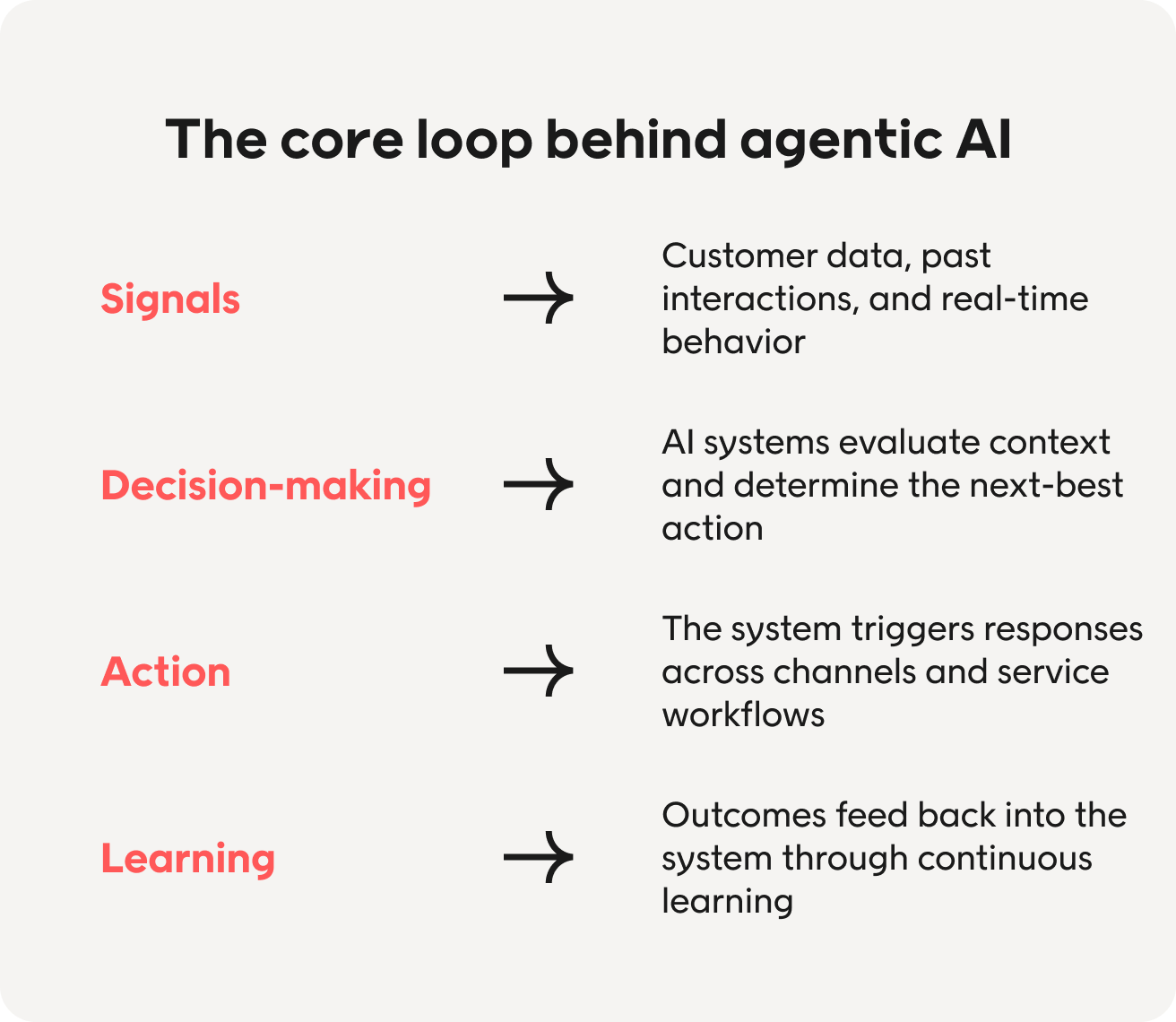
This loop runs constantly, which is what allows teams to move from reactive workflows to adaptive customer engagement.
What makes this different in practice
Traditional AI tools support decisions. They provide data-driven insights, but human teams still need to act.
By enabling AI agents to interpret context and take action, businesses can respond faster to customer needs and reduce delays across customer service operations.
This is a key part of implementing agentic AI in digital customer engagement, where systems are designed to move from insight to execution without friction.
You can see this shift in how teams approach agentic AI for marketing and broader customer engagement strategies.
How decisions turn into actions
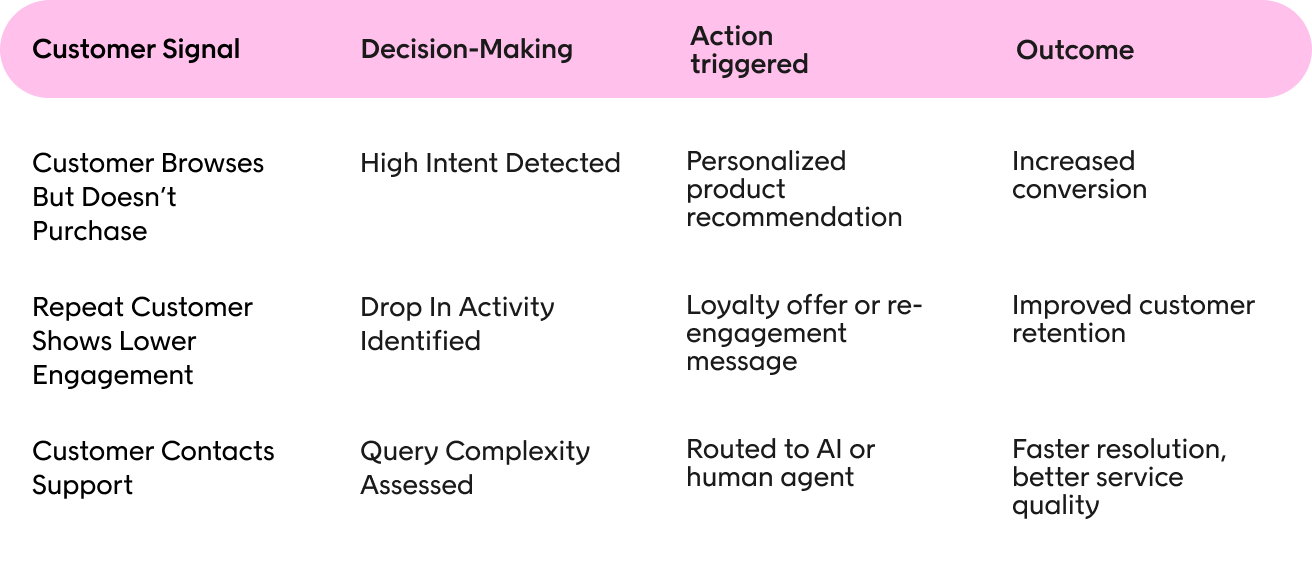
As more retailers explore the best e-commerce AI agents, this model is becoming central to how customer engagement is designed.
The role of human teams
This doesn’t remove human teams from the process.
It changes where they focus.
AI agents handle speed, scale, and repetitive decisions. Human agents step in for complex customer queries, edge cases, and situations where judgment matters.
This balance supports human AI collaboration and helps teams:
- enhance customer satisfaction
- maintain strong customer relationships
- focus on higher-value work
Once you see how the loop works, it becomes clear why static journeys can’t keep up anymore.
How AI agents power customer journeys in retail
This is where agentic AI in digital customer engagement becomes real.
Instead of static journeys, AI agents respond to customer interactions as they happen. They interpret signals, make decisions, and trigger actions across the customer journey, often with minimal human intervention.
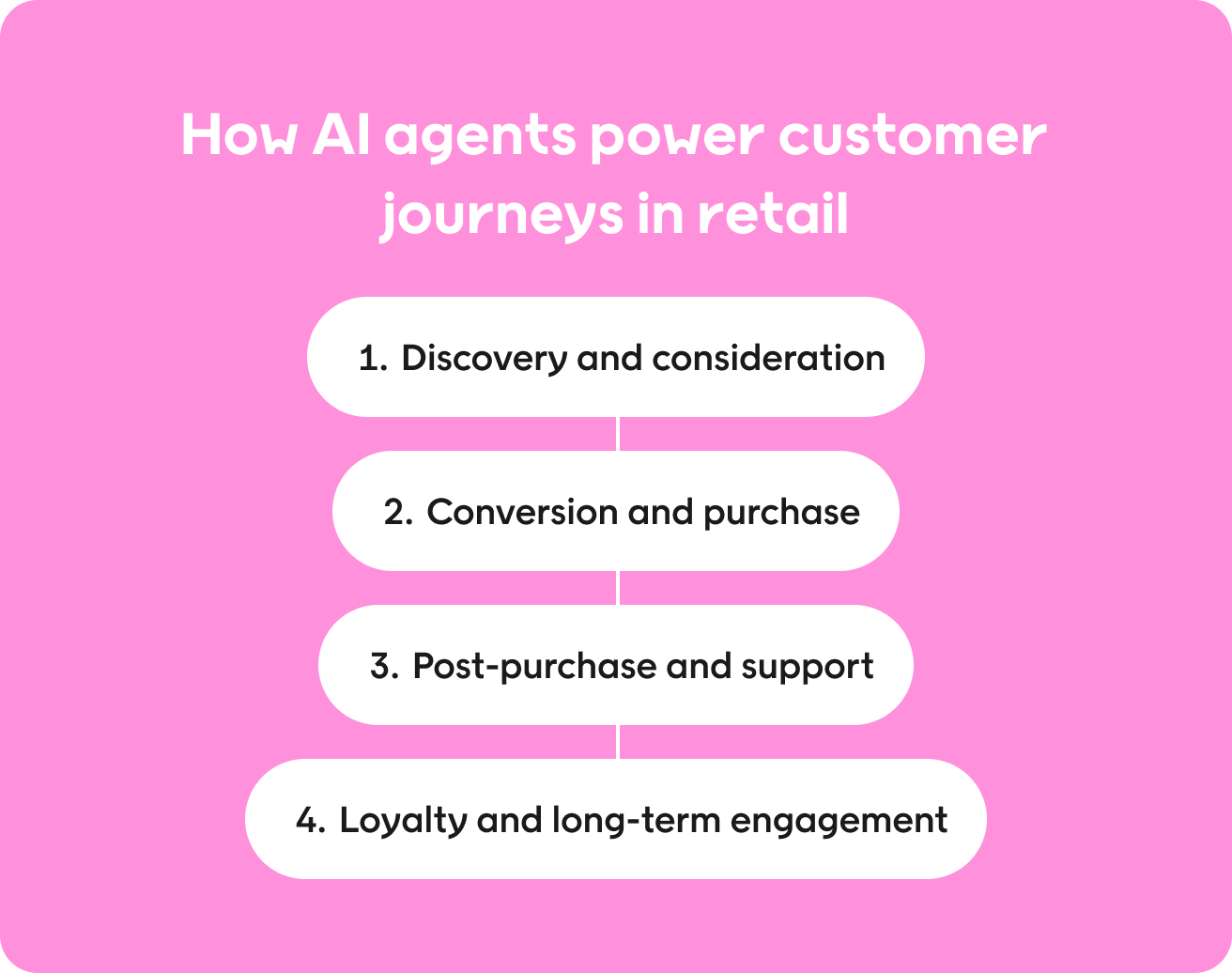
Discovery and consideration
At the start of the customer journey, timing matters more than targeting.
AI agents analyze customer data, past interactions, and customer preferences to guide discovery in real time. Instead of showing generic recommendations, they adapt based on what the customer is doing right now.
This can look like:
- adjusting product recommendations as behavior changes
- surfacing relevant content based on customer needs
- responding to customer queries during browsing
This is how teams move from static personalization to responsive customer engagement, as outlined in this framework for better customer engagement.
Conversion and purchase
During purchase, small delays or mismatches can cost revenue.
Agentic AI systems support decision-making in the moment, helping remove friction and guide customers toward conversion.
For example:
- identifying hesitation and adjusting offers in real time
- triggering timely messages based on customer behavior
- supporting customer interactions across channels without breaking context
This leads to improved customer satisfaction and helps enhance customer satisfaction during high-intent moments.
Post-purchase and support
After the purchase, consistency becomes critical.
AI agents help transform customer service operations by handling routine tasks, routing complex customer queries, and maintaining service quality across channels.
Instead of reacting late, systems can:
- resolve simple customer inquiries automatically
- escalate complex customer queries to human agents
- maintain context across service workflows
This balance between AI and human agents improves operational efficiency while keeping service quality high.
Loyalty and long-term engagement
Long-term value depends on how well you maintain customer relationships over time.
Agentic AI supports this by continuously learning from customer interactions and adapting engagement strategies. It enables more relevant follow-ups, better timing, and stronger customer loyalty.
For example, systems connected to a customer loyalty platform can:
- trigger rewards or offers based on behavior
- identify changes in engagement early
- support deeper customer relationships across the full customer lifecycle
This is where agentic AI customer engagement starts to impact customer lifetime value and create a real competitive advantage.
When you look at it this way, it’s not one use case. It’s a different way of running customer engagement.
Agentic AI challenges in customer service operations
Agentic AI in digital customer engagement can transform customer service operations, but only if it’s implemented with control and clarity. The risks aren’t new; they just show up faster when AI agents are making decisions in real time.
6 Challenges to watch out for (and how to handle them)
If you’re implementing agentic AI in customer engagement, these are the areas to get right from the start.
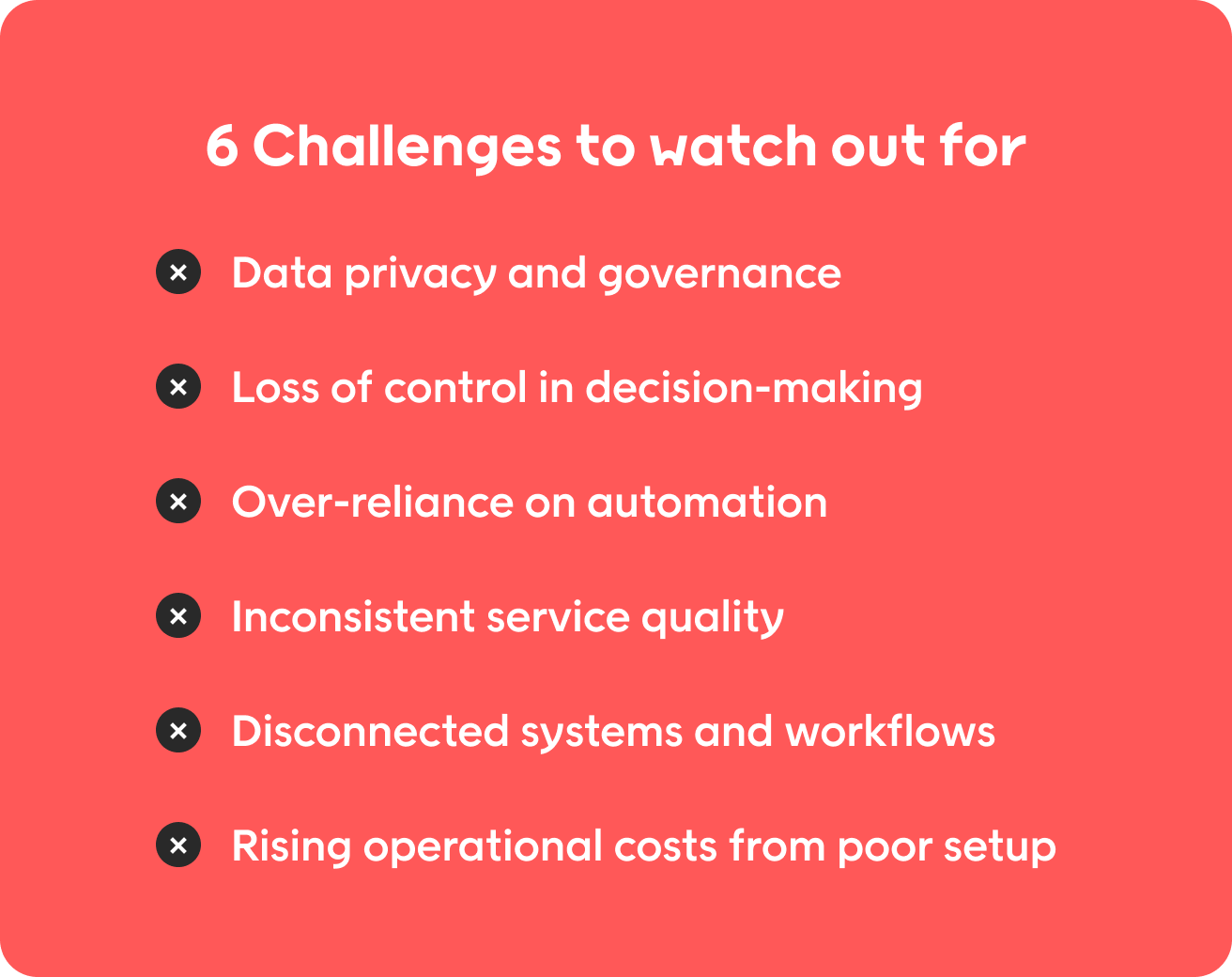
1. Data privacy and governance
AI systems rely heavily on customer data, which increases exposure if not managed properly.
→ Set clear data privacy rules, limit access, and define how artificial intelligence can use and act on customer data.
2. Loss of control in decision-making
When agentic AI systems act without boundaries, outcomes can drift away from business intent.
→ Define guardrails and escalation logic so decision-making stays aligned with business goals and customer expectations.
3. Over-reliance on automation
Not every situation should be handled with minimal human intervention, especially complex customer queries.
→ Design service workflows where AI agents handle routine tasks and human agents or human support agents step in for sensitive or complex customer inquiries.
4. Inconsistent service quality
Without monitoring, outputs can vary and affect customer experience.
→ Use continuous learning and feedback loops to improve service quality and maintain consistent customer interactions.
5. Disconnected systems and workflows
AI implementation often fails when systems aren’t connected across the customer journey.
→ Integrate AI into existing service workflows early so it can respond across channels and support real customer interactions.
6. Rising operational costs from poor setup
If AI is layered on top of inefficient processes, operational costs can increase instead of decrease.
→ Focus on improving workflows first, then use AI to improve operational efficiency and scale customer engagement effectively.
Handled well, these challenges don’t limit agentic AI. They’re what make it reliable, scalable, and capable of delivering better business outcomes over time.
Getting started with agentic AI for better business outcomes
You don’t need a full transformation to start with agentic AI in customer engagement.
What you do need is a clear starting point and a way to turn customer data into action.
A practical way to get started
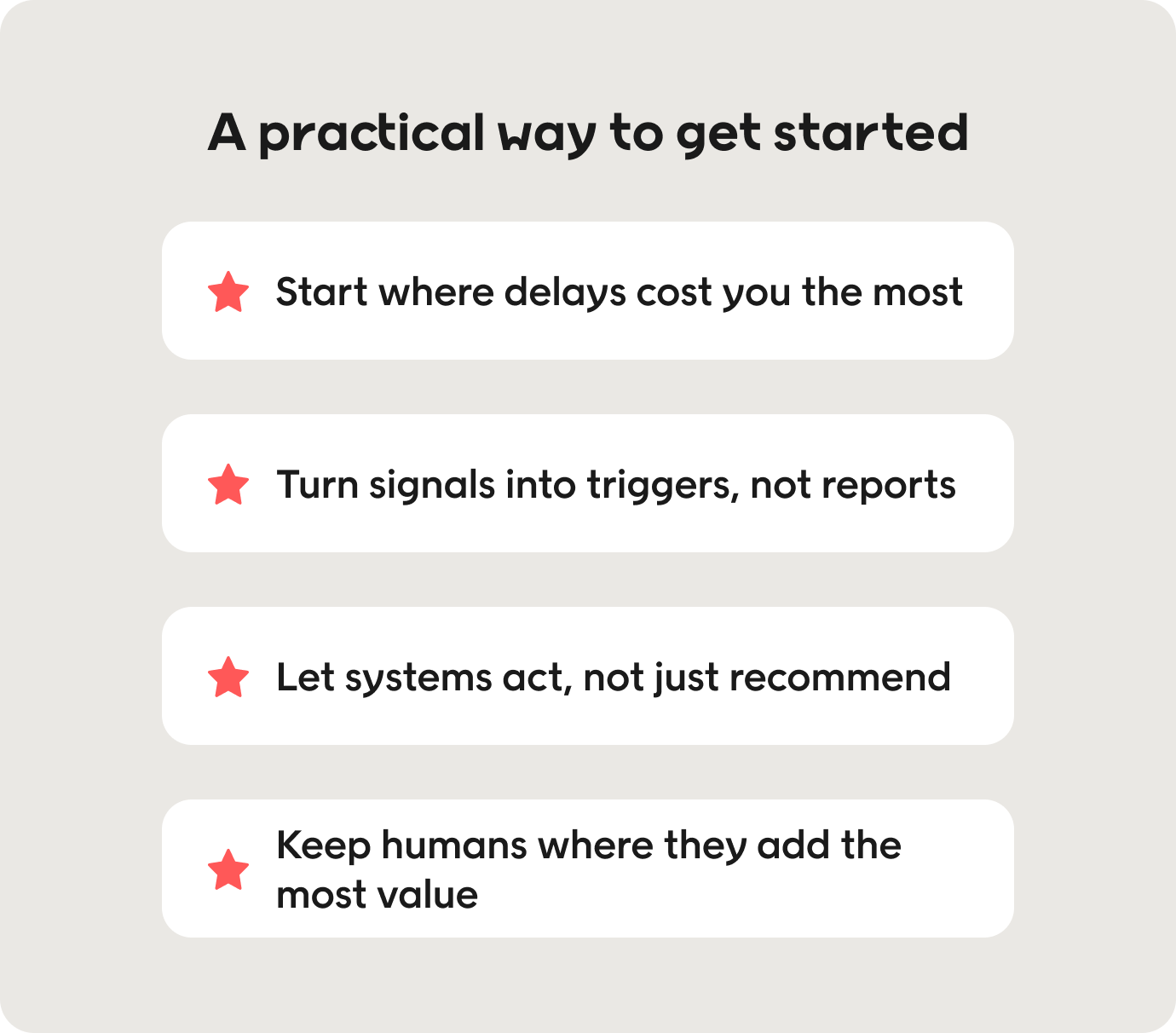
1. Start where delays cost you the most
Look for points in the customer journey where slow responses hurt performance, like abandoned carts, delayed follow-ups, or support queues.
Action item: Pick one use case where faster decision-making would clearly improve customer experience and customer satisfaction.
2. Turn signals into triggers, not reports
Most teams already collect customer data. The problem is it sits in dashboards instead of driving action.
Action item: Identify key signals, like a drop in engagement or repeat visits, and connect them directly to actions across customer engagement channels.
3. Let systems act, not just recommend
This is where many teams get stuck. Traditional AI tools suggest what to do but don’t execute.
Action item: Start enabling AI agents to act on decisions in real time, whether that’s triggering messages, adjusting offers, or supporting customer interactions with minimal human intervention.
4. Keep humans where they add the most value
Agentic AI works best when human teams don’t try to control every step.
Action item: Let AI handle routine decisions, while human agents focus on complex customer queries and edge cases that need judgment.
How teams build from there
Once one use case works, expansion becomes easier.
Teams typically move from a single use case into broader customer engagement flows, connecting marketing, service, and loyalty. For example, linking agentic AI to a customer loyalty platform allows actions to extend across the full customer lifecycle.
To structure that expansion, this guide to boosting customer engagement shows how to align data, channels, and actions without overcomplicating the setup.
You don’t need perfect systems to start. You need one place where faster decisions will actually make a difference.
How Voyado supports agentic AI in customer engagement
This is what it looks like when everything you’ve read so far actually comes together in one system.
Voyado is for retailers who want to move from insight to action. It connects customer data, AI, and execution into one continuous flow, so your team can act on customer signals as they happen, not hours or days later.
Where Voyado fits
Instead of adding another layer of tools, Voyado sits at the point where decisions are made and executed.
- It brings customer data together into a usable, real-time view
- It enables AI agents to act across customer engagement channels
- It supports decision-making without constant human intervention
- It keeps human teams focused on strategy, not routine tasks
This is what allows agentic AI systems to actually work in day-to-day customer engagement.
From signals to action, without delay
In many setups, customer data, AI systems, and execution live in separate places. Insights exist, but action is slow or manual.
Voyado turns customer signals into immediate action across channels.
Customer interactions, past interactions, and customer preferences are continuously analyzed. From there, AI agents can trigger actions across the customer journey, whether that’s adjusting messaging, supporting customer service operations, or improving service workflows.
The result is faster responses, more consistent customer interactions, and higher customer satisfaction without increasing operational costs.
Built for real customer engagement, not isolated use cases
Voyado is designed to support the full customer lifecycle.
That includes:
- attracting and engaging new customers
- supporting customer service operations with AI and human agents
- strengthening customer loyalty and deeper customer relationships
- improving customer lifetime value through continuous engagement
Because everything is connected, teams don’t have to switch between systems or manually coordinate actions across channels.
You’re not just adding AI. You’re enabling a system that can continuously respond to customer needs, support your teams, and improve customer experience at scale.
Final thoughts
Agentic AI in digital customer engagement is not about making campaigns faster. It changes how you decide, prioritize, and act across the customer journey.
What matters now is your ability to move from reacting to customer behavior to acting on it in real time. That’s where you start to see impact on customer satisfaction, customer lifetime value, and overall customer engagement.
For retailers, success comes down to combining strong customer data, clear decision-making logic, and consistent execution across channels, with human teams guiding strategy and oversight.
What to do next
- Pick one journey to improve: Start with a high-impact moment like onboarding, retention, or cart abandonment. Focus on improving how decisions are made and executed there.
- Audit how decisions actually happen today: Where are you relying on manual steps, delays, or disconnected systems? That’s where agentic AI can improve operational efficiency and service quality.
- Test where AI can act, not just recommend: Look for opportunities to let AI agents handle routine tasks and customer interactions, while your human agents focus on complex decisions and edge cases.
Voyado is built to support this way of working, helping you turn customer signals into real-time decisions and actions across the customer journey.
Book a demo today to see how retailers like you turn customer signals into better engagement decisions with Voyado.
FAQs
What is agentic AI in digital customer engagement?
Agentic AI uses autonomous AI agents to analyze customer data, make decisions, and take action across the customer journey with minimal human intervention.
How is agentic AI different from personalization?
Personalization adapts content based on past behavior. Agentic AI goes further by deciding what action to take next and executing it in real time.
What is the next-best action in customer engagement?
Next-best action is the most relevant action to take for a customer at a specific moment, based on their behavior, preferences, and context.
How can retailers implement agentic AI in digital customer engagement?
Start with one use case, connect customer data to actions, and enable AI agents to act in real time. Expand from there as results improve.
What data is needed for agentic customer engagement?
You need customer data such as behavior, transactions, preferences, and past interactions to inform decisions and trigger actions.
How does agentic AI improve customer retention and CLV?
It responds to customer needs faster and more accurately, improving customer satisfaction, increasing repeat purchases, and strengthening customer loyalty.
How does Voyado support agentic customer engagement for retail?
Voyado connects customer data, AI, and execution in one platform, enabling real-time decision-making and action across marketing, loyalty, and customer engagement channels.
About Author