
TL;DR
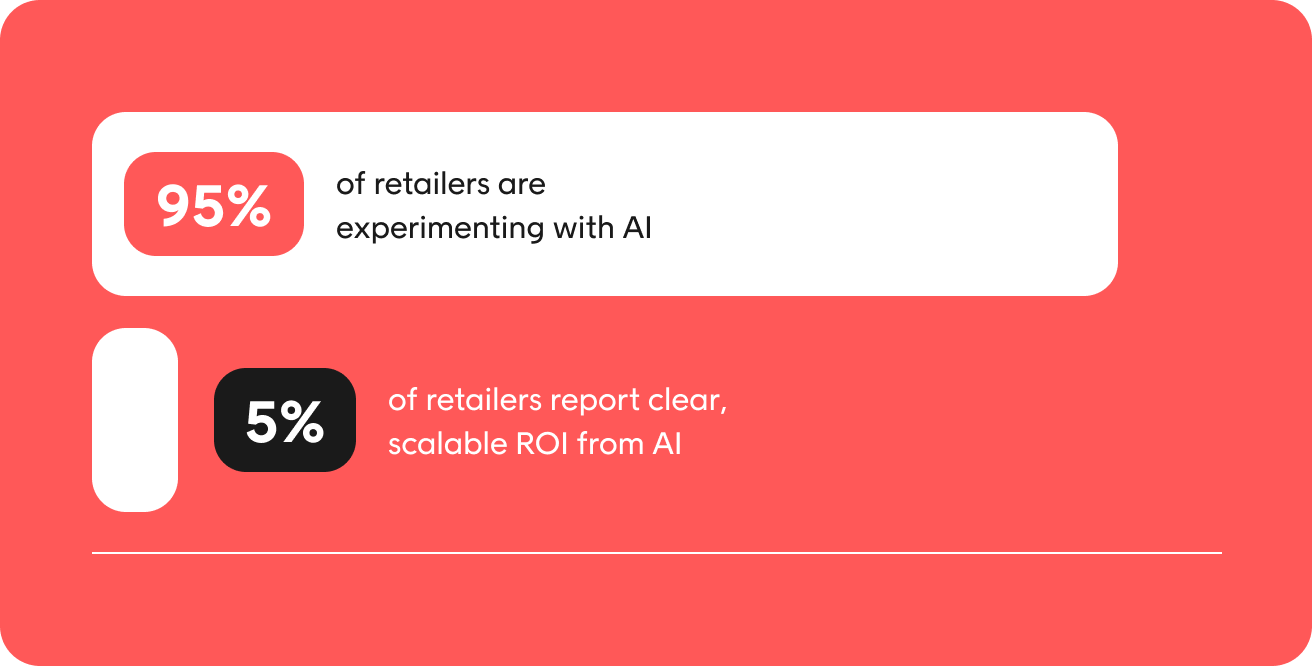
- Only 5% of European retailers achieve clear, scalable ROI from AI — despite 95% experimenting with it, according to Voyado and Retail Economics research.
- The difference is structural, not technological. It comes down to how deeply AI is integrated into decisions and how broadly data is unified — supported by organizational readiness.
- Leaders embed AI in commercial decision-making, not just marketing campaigns. AI informs pricing, assortment, inventory allocation, and lifetime value strategy.
- They operate on unified data. Customer, product, and performance data flow into a single platform, giving every AI model the same rich context. Advanced retailers use nearly 2x as many data sources as mid-stage peers.
- They invest in skills and governance alongside systems. Leaders pair technology rollout with training, clear ownership, cross-functional coordination, and trust-building frameworks.
- 71% of retailers anticipate meaningful AI deployment within two years. The leaders are already there — and the gap is widening.

The 5% question
If 95% of retailers are using AI and only 5% see scalable ROI, what are the 5% doing that everyone else isn’t?
That question drives much of Voyado’s State of AI in Retail report, co-produced with Retail Economics and based on a survey of 300 marketing and e-commerce leaders across the UK, DACH, Scandinavia, and Benelux.
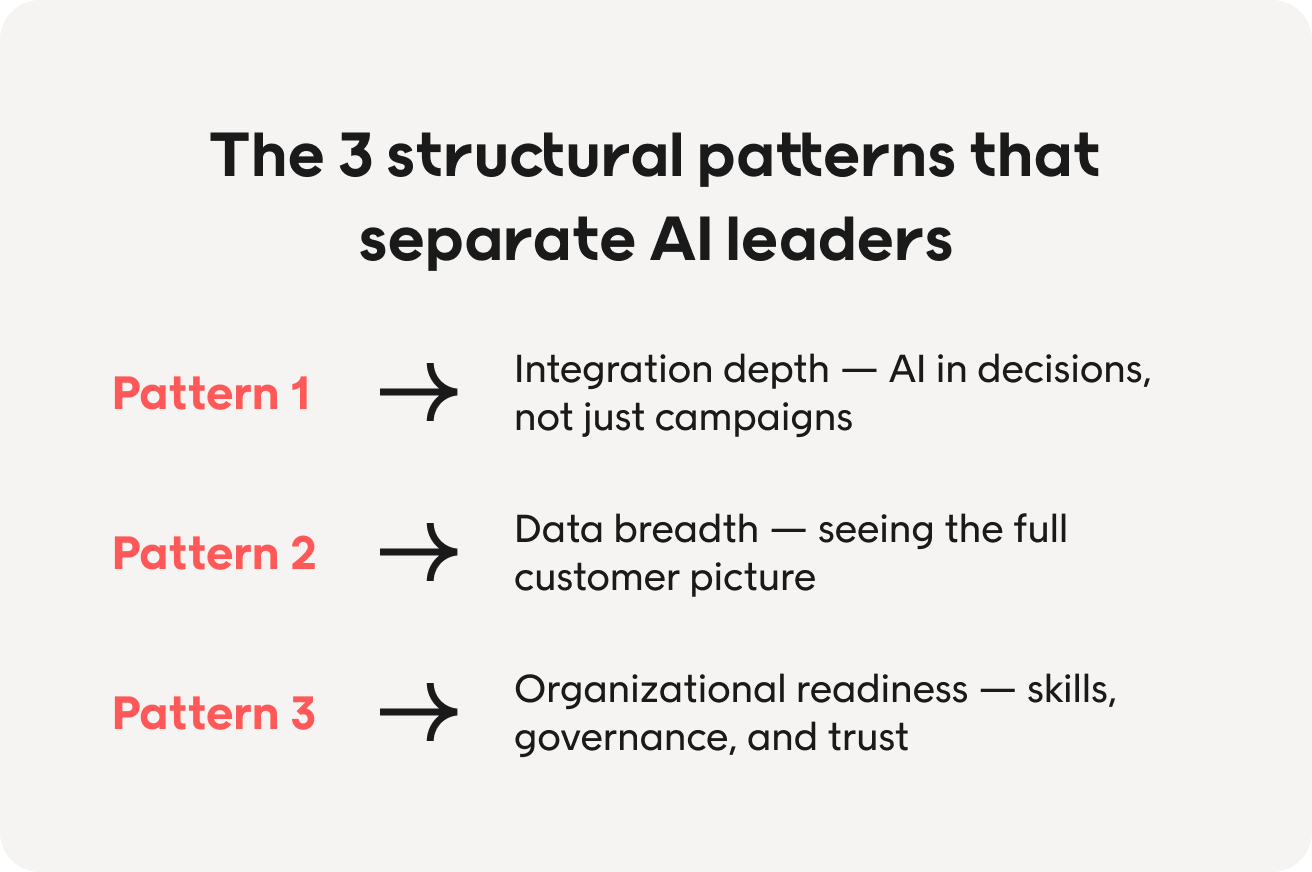
The answer isn’t a specific technology or a bigger budget. The answer is structural. The top 5% have built something fundamentally different from the rest — not more advanced AI tools, but a more advanced way of operating with AI.
Pattern 1: Integration depth — AI in decisions, not just campaigns
Leaders embed AI in commercial decision-making — not just campaign execution. Where most retailers use AI to optimize email subject lines or recommend products, the top 5% use it to inform strategic decisions across the business:
- Pricing. AI models analyze demand signals, competitor pricing, and inventory levels to set optimal prices — not just for promotions, but for everyday assortment.
- Assortment planning. AI identifies which products to stock, where, and in what quantities based on predicted demand patterns.
- Customer lifetime value. AI drives not just who gets a campaign, but which customers receive investment, what retention strategies apply, and when to shift from acquisition to loyalty.
- Budget allocation. AI informs where marketing spend goes — across channels, audiences, and time periods — based on predicted incremental returns.
The report found that 45% of retailers have AI at the operational level. But operational AI and strategically integrated AI are very different things. Operational means AI runs within existing workflows. Integrated means AI changes how you plan.
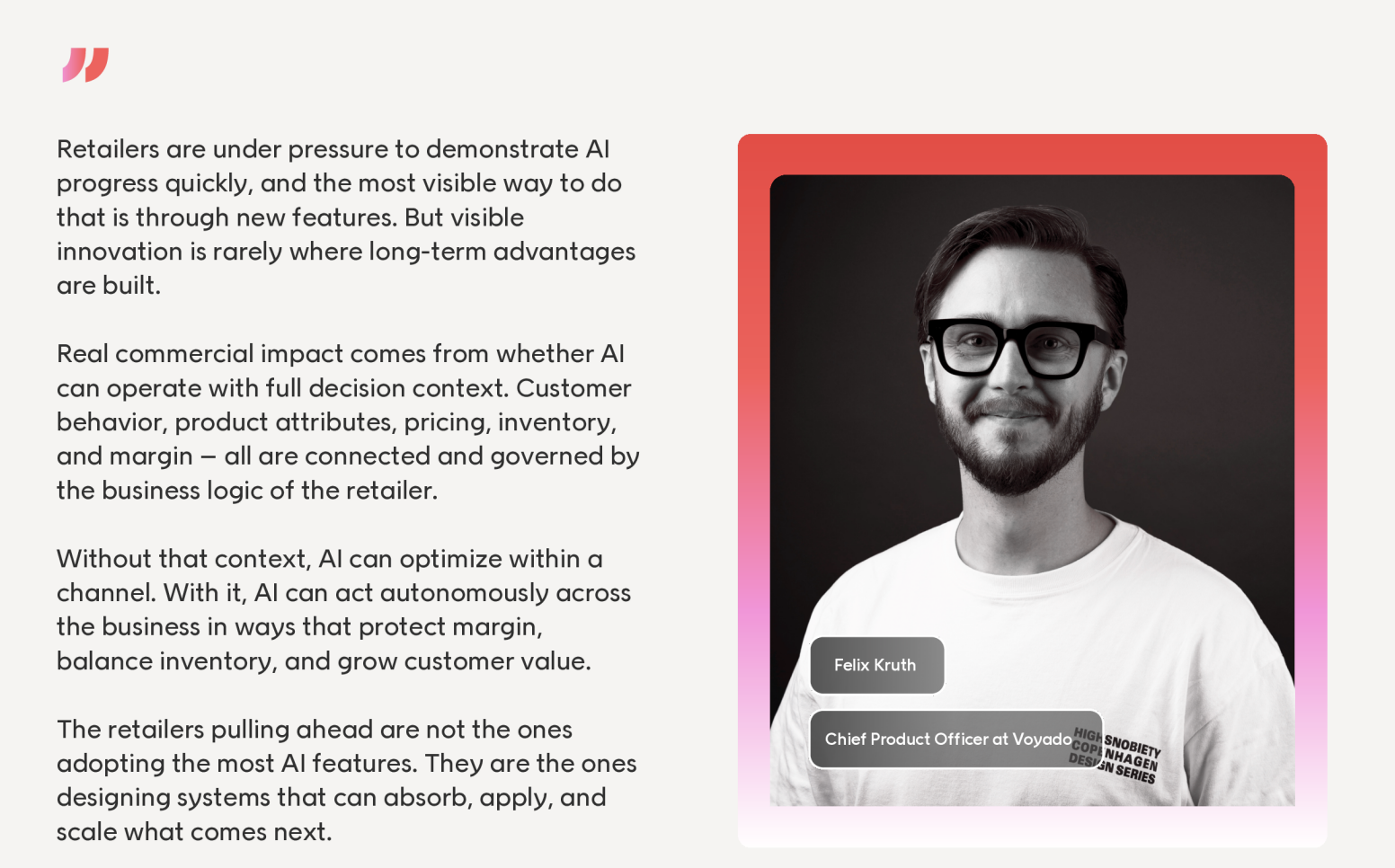
As Felix Kruth, Chief Product Officer at Voyado, notes: “Retailers are under pressure to demonstrate AI progress. But visible innovation is rarely where long-term advantages are built.”
How to assess your integration depth
Ask yourself: if you turned off every AI tool tomorrow, would your commercial strategy change? If the answer is no — if your pricing, assortment, and budget decisions would stay the same — then AI is operational but not integrated.
Pattern 2: Data breadth — seeing the full customer picture
Advanced retailers use nearly twice as many data sources as mid-stage peers. This is one of the most striking findings in the report, and it explains a significant portion of the ROI gap.
More data sources doesn’t mean more complexity for its own sake. It means more dimensions of customer understanding:
| Data dimension | Mid-stage retailers | AI leaders |
| CRM and email | Yes | Yes |
| Website browse behavior | Yes | Yes |
| Purchase history | Yes | Yes |
| Loyalty program data | Sometimes | Yes |
| In-store POS transactions | Rarely | Yes |
| Product inventory levels | Rarely | Yes |
| Advertising performance | Sometimes | Yes |
| Returns and service data | Rarely | Yes |
Why this matters for AI performance: A product recommendation engine that sees only browse behavior makes decent suggestions. One that sees browse behavior plus purchase history plus loyalty tier plus in-store visits plus inventory levels makes significantly better ones — because it understands not just what the customer looked at, but what they value, how they shop, and what is actually available.
The unification requirement is critical. Having eight data sources in eight different systems isn’t data breadth. It is data sprawl. Leaders unify these sources into a single customer view that every AI model can access — creating a shared foundation for personalization, pricing, loyalty, and reporting.
How to assess your data breadth
Count the data sources that currently feed your AI models. Not the data you collect — the data your AI can actually access in real time. If the number is below five, you have a breadth gap. If your AI tools each access different subsets of data, you have a unification gap.
Pattern 3: Organizational readiness — skills, governance, and trust
The report identified skills gaps (58%) and cultural resistance (57%) as the leading barriers, with compliance concerns (54%) compounding both. Leaders have addressed these simultaneously rather than sequentially.
Skills
Leaders don’tjust hire data scientists. They upskill existing marketing and CRM teams to work alongside AI:
- Marketers understand how to evaluate AI-driven recommendations rather than blindly accepting or overriding them.
- Campaign managers know which metrics to track for AI-driven initiatives (uplift, incrementality, model confidence) rather than relying on vanity metrics.
- Leadership understands AI well enough to set strategic direction without micromanaging implementation.
Governance
Leaders establish clear ownership of AI outcomes. Every AI-driven initiative has a defined owner responsible for results, a measurement framework, and a review cycle. This isn’t bureaucracy — it is what makes learning at scale possible.
Trust
Leaders build trust through transparency and evidence. Teams can see what the AI recommended, what happened, and what the model learned. This visibility turns skepticism into confidence — not through persuasion, but through proof.
The elements work together. Skills give teams the ability to evaluate AI, and governance gives them the structure to act on that evaluation. Together, they build the trust that lets AI drive decisions at scale.
What this means for mid-maturity retailers
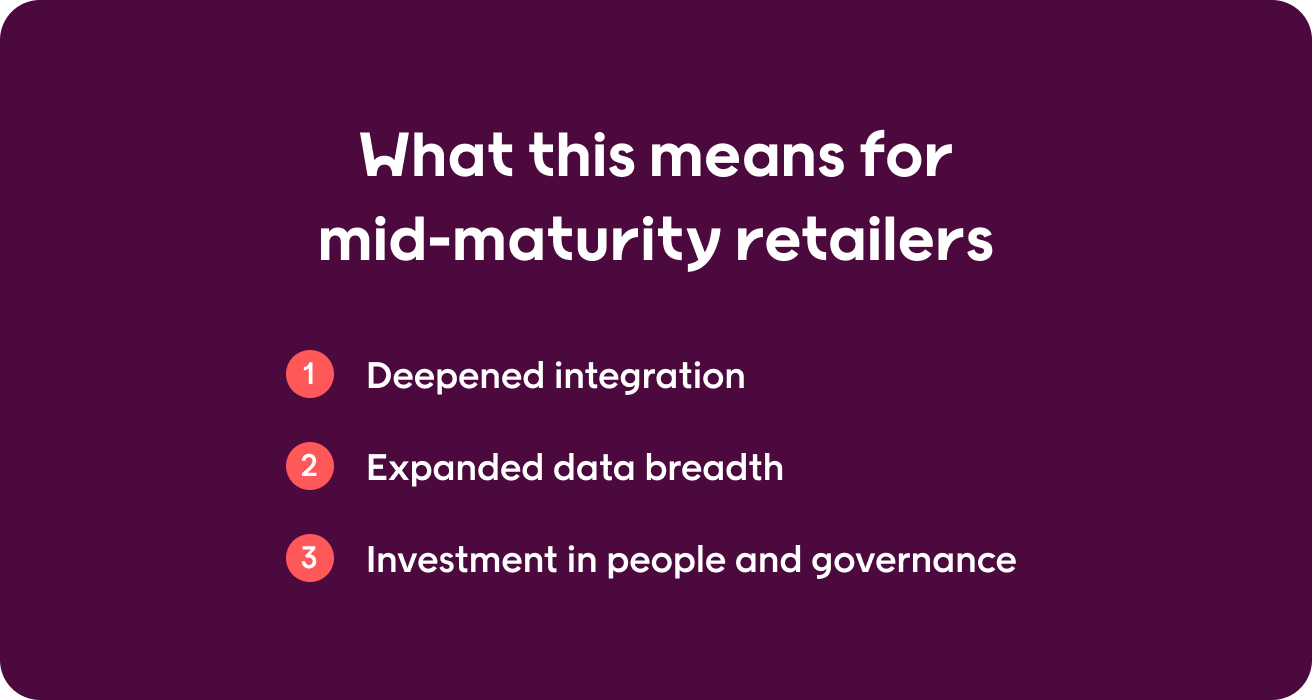
If you are among the 45% at the operational stage — AI running but not yet delivering scalable ROI — the data suggests a clear path forward. Start by deepening integration:
First, deepen integration. Pick one commercial decision (pricing, assortment, budget allocation) and explore how AI can inform it — not just execute it. Start where the feedback loop is fastest and the data is richest.
Second, expand data breadth. Identify the two or three data sources your AI cannot currently access and build the connections. Prioritize based on which data would most improve your highest-value AI use case.
Third, invest in people and governance. Pair every technology initiative with a capability initiative. Define who owns AI outcomes, how they are measured, and how learnings feed back into the system.
Richard Lim, CEO at Retail Economics, frames the urgency: “The next two years represent an inflection point as AI shifts from experimentation to competitive necessity.”
71% of retailers anticipate meaningful AI deployment within two years. But the data is clear — meaningful deployment isn’t enough. Structural readiness is what separates the 5% from the rest.
The structural advantage
The leaders profiled in this research did not get there by buying better tools. They got there by building better foundations — unified data, capable teams, clear governance, and AI embedded in how the business actually makes decisions.
That isn’t a technology story. It is an organizational one. And the good news is that every retailer can start building those foundations today. Explore how Voyado’s agentic AI approach helps retail teams move from insights to action.
Frequently asked questions
What do AI leaders in retail do differently?
They embed AI in commercial decision-making (not just campaigns), unify customer data across all channels, and invest in team skills and governance alongside technology. Advanced retailers use nearly twice as many data sources as mid-stage peers.
How do advanced retailers use AI?
Beyond marketing campaigns, leaders use AI for pricing optimization, assortment planning, lifetime value modeling, and budget allocation. AI informs strategic decisions, not just operational execution.
What is the difference between AI experimentation and AI integration in retail?
Experimentation means running AI-powered tools within existing workflows. Integration means AI changes how you plan, price, merchandise, and allocate resources. The report found that 45% have reached operational AI, but far fewer have achieved strategic integration.
How do retailers achieve ROI from AI?
The 5% achieving scalable ROI embed AI deeply into business decisions and operate on broad, unified data foundations — supported by organizational readiness including skills, governance, and trust. These are structural advantages, not technology advantages.
About Author