TL;DR — what you need to know
- Retailers hold a major competitive advantage for advertising: deep first-party shopper data covering purchases, loyalty behaviour, and browsing intent — across online and in-store channels.
- First-party data delivers higher relevance, better performance, and greater advertiser confidence than third-party signals, especially as cookie-based targeting loses ground.
- Three audience types form your targeting foundation: purchase-based, loyalty-driven, and behavioural segments.
- Activate these segments for targeted Sponsored Brand Ads and compare performance against a general population baseline to prove value.
- Privacy and GDPR compliance are not phase-two considerations. Build legal guardrails into your targeting taxonomy from day one.
- The retailers who win at retail media are the ones who treat their data as a product, not a byproduct.

Your data is the product
Every time a customer searches your site, adds an item to their basket, scans a loyalty card in-store, or completes a purchase, they generate a signal. Most retailers already collect this data. The question is whether you are using it to power advertising — or leaving it dormant in a CRM while third-party ad platforms monetise weaker signals about your own customers.
First-party data advertising flips the model. Instead of relying on third-party cookies, probabilistic matching, or walled-garden audience estimates, you target shoppers based on what they have actually done: what they bought, how often they buy, what they browse, and where they sit in your loyalty programme.
For brand partners, this precision is transformative. For you as the retailer, it is the single biggest differentiator your retail media network can offer.
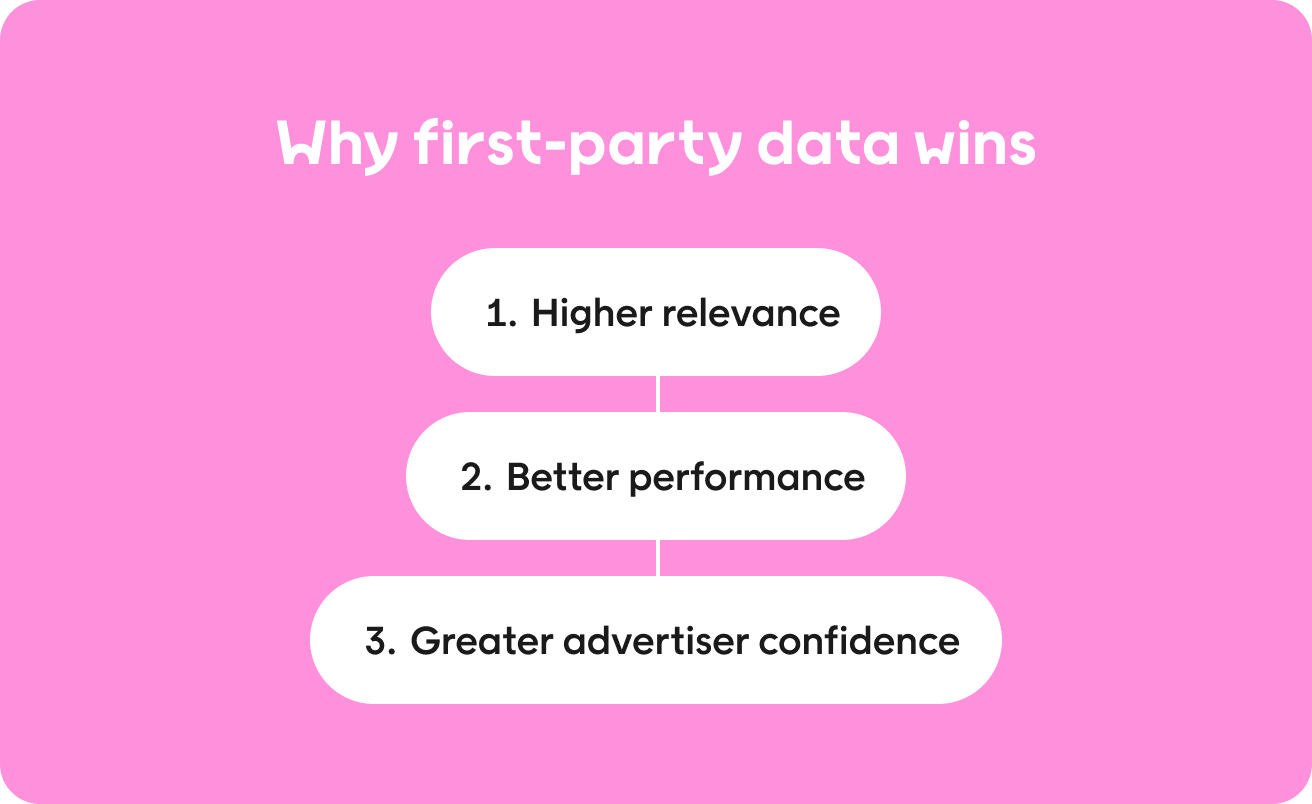
Why first-party data wins for retail media
Higher relevance
Third-party audience segments are broad approximations — “likely interested in running shoes” based on browsing patterns across unrelated sites. First-party data tells you this customer bought running shoes 90 days ago, browses performance gear weekly, and redeems loyalty points in your sportswear category. The targeting is specific, current, and grounded in real purchase behaviour.
Better performance
When a brand partner reaches customers who have already purchased from their category, the path from impression to purchase is shorter — driving stronger click-through and conversion outcomes than broad, modelled audience targeting. When a brand partner can reach customers who have already purchased from their category, the path from impression to purchase is shorter.
Greater advertiser confidence
Advertisers are increasingly sceptical of third-party data quality. First-party data, sourced from your own customers and transactions, is verifiable, privacy-compliant, and directly tied to purchase outcomes. That credibility translates into higher willingness to pay — and longer-term partnerships.
Three audience types to build your targeting on
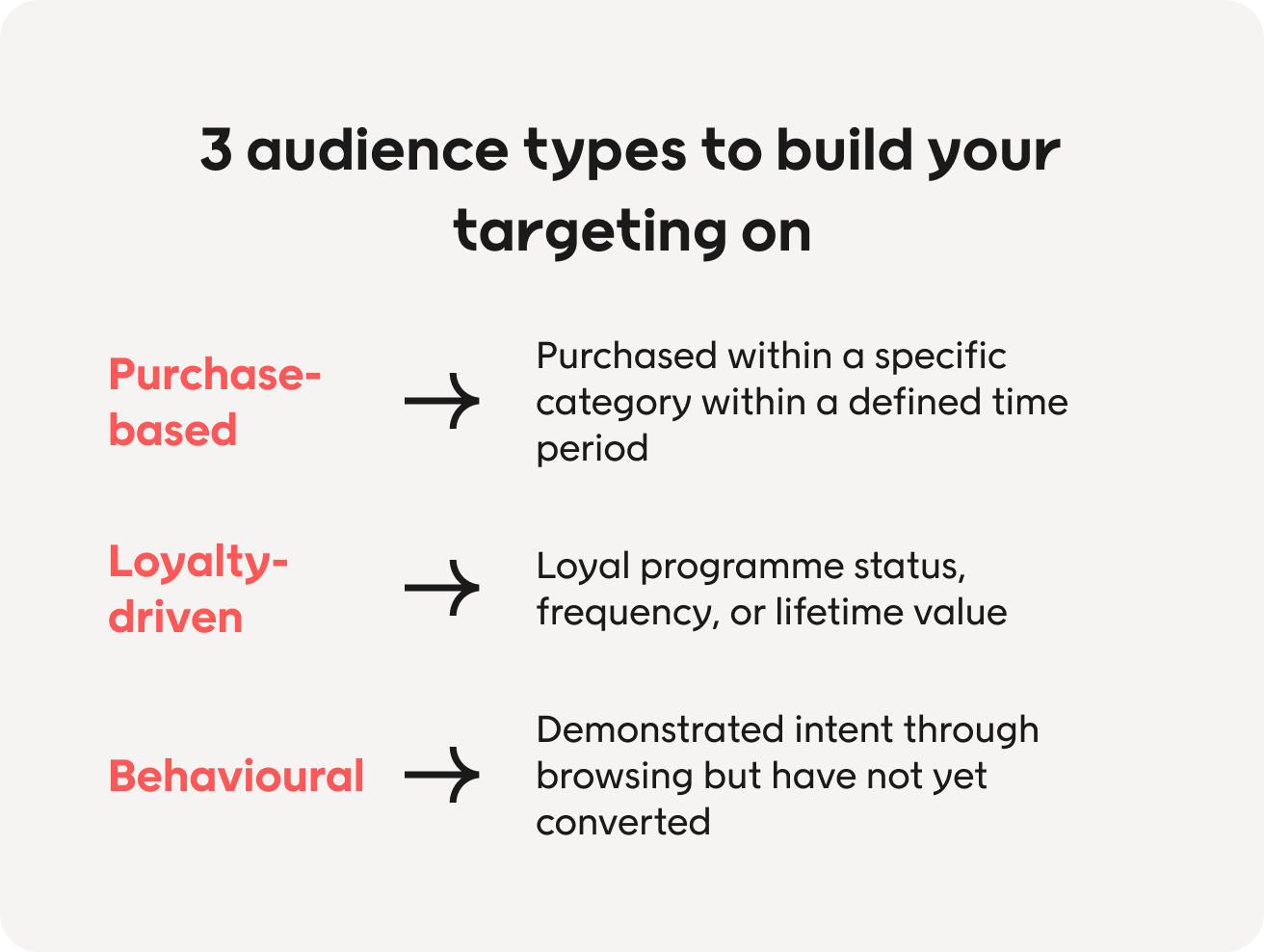
Your first-party data supports three core audience types. Each serves a different advertising objective, and together they cover the full spectrum of retail media targeting.
1. Purchase-based audiences
Definition: Customers who have purchased within a specific category or from a specific brand within a defined time period (e.g., “bought from Category X in the last 90 days” or “purchased Brand Y in the last 6 months”).
Use cases:
- Upsell — target buyers of a base product with premium alternatives
- Cross-sell — reach customers in adjacent categories (e.g., show pet food brands to customers who buy pet accessories)
- Repeat purchase — re-engage lapsed buyers before they switch to a competitor
Purchase-based audiences are the foundation of retail media targeting because they are grounded in actual transaction data — not inferred intent.
Example: A home electronics retailer creates a “bought a smartphone in the last 30 days” segment and offers it to phone-case and screen-protector brands for cross-sell campaigns. Because the audience has confirmed purchase intent, the resulting Sponsored Brand Ads outperform the same ads shown to the general site population.
2. Loyalty-driven audiences
Definition: Customers segmented by their loyalty programme status, frequency, or lifetime value — for example, high-value members, frequent purchasers, or customers who actively redeem offers.
Use cases:
- Exclusive access — give brand partners the ability to reach your most engaged customers with early product launches or limited-edition offers
- Brand building — loyalty-driven audiences span online and in-store behaviour, giving advertisers a unified view of their most valuable shoppers
- Retention campaigns — target customers whose purchase frequency is declining before they lapse entirely
Loyalty-driven audiences are particularly powerful because they capture behaviour across channels — online purchases, in-store scans, app engagement, reward redemption — creating segments that no third-party dataset can replicate.
3. Behavioural audiences
Definition: Customers who have demonstrated intent through browsing or search behaviour but have not yet converted — for example, “browsed Category X three or more times in the last 14 days without purchasing.”
Use cases:
- Retargeting — serve personalized Sponsored Brand Ads to in-market shoppers who are still deciding
- Nudge campaigns — use personalized banners or onsite messaging to move browsers toward conversion
- Category awareness — help brand partners reach shoppers who are actively exploring their category
Behavioural audiences capture the “consideration” phase of the purchase journey. They are high-intent, time-sensitive, and ideal for performance-driven campaigns.
Activating segments for targeted retail media
Defining segments is step one. Activation is where value is created.
Test against a general population baseline
When you launch a targeted Sponsored Brand Ad campaign, run it alongside a control group — the same ad served to a general, untargeted site population. Compare click-through rates, conversion rates, and ROAS between the targeted segment and the baseline.
This A/B testing approach does two things:
- Proves the value of your data — if targeted campaigns consistently outperform, you have a quantifiable premium to charge advertisers
- Identifies which segments matter — not all audiences will outperform equally. Purchase-based segments typically outperform behavioural segments on conversion for many categories, while loyalty-driven segments deliver better lifetime value outcomes
Start with Sponsored Brand Ads
SBAs are the ideal format for segment-level testing because they support richer creative and messaging. A brand partner can tailor their SBA creative to a loyalty segment (e.g., “exclusive offer for members”) in a way that is not possible with a standard Sponsored Product Ad listing.
Scale with data
As you accumulate performance data across segments, you can build tiered pricing — charge a premium for high-performing segments like “high-value loyalty members in Category X” and offer standard pricing for broader behavioural segments. Your data becomes a pricing lever, not just a targeting tool.
Privacy and GDPR compliance: build it in from day one
First-party data is powerful, but it comes with obligations. Treating compliance as an afterthought exposes you to legal risk and erodes the trust that makes your data valuable in the first place.
Non-negotiables for compliant targeting
- Consent is the foundation. Ensure your data collection practices include clear, informed consent for advertising use. Your privacy policy must specify that customer data may be used to serve personalised sponsored content.
- Clear ad disclosure. Every targeted ad placement must be labelled as sponsored. Do not obscure the distinction between organic and paid content.
- Data minimisation. Share segment-level insights with advertisers, not individual customer records. Brand partners should know they can target “high-value loyalty members in sportswear” — they should not receive a list of customer emails.
- Legal review of your targeting taxonomy. Before sharing your audience segments with brand partners, have your legal team review the taxonomy to ensure it complies with GDPR, CCPA, and any other applicable regulations.
- Advertiser contracts. Include data usage clauses in every advertiser agreement — specifying what data is shared, how it can be used, and what happens to it after a campaign ends.
Measuring targeting effectiveness
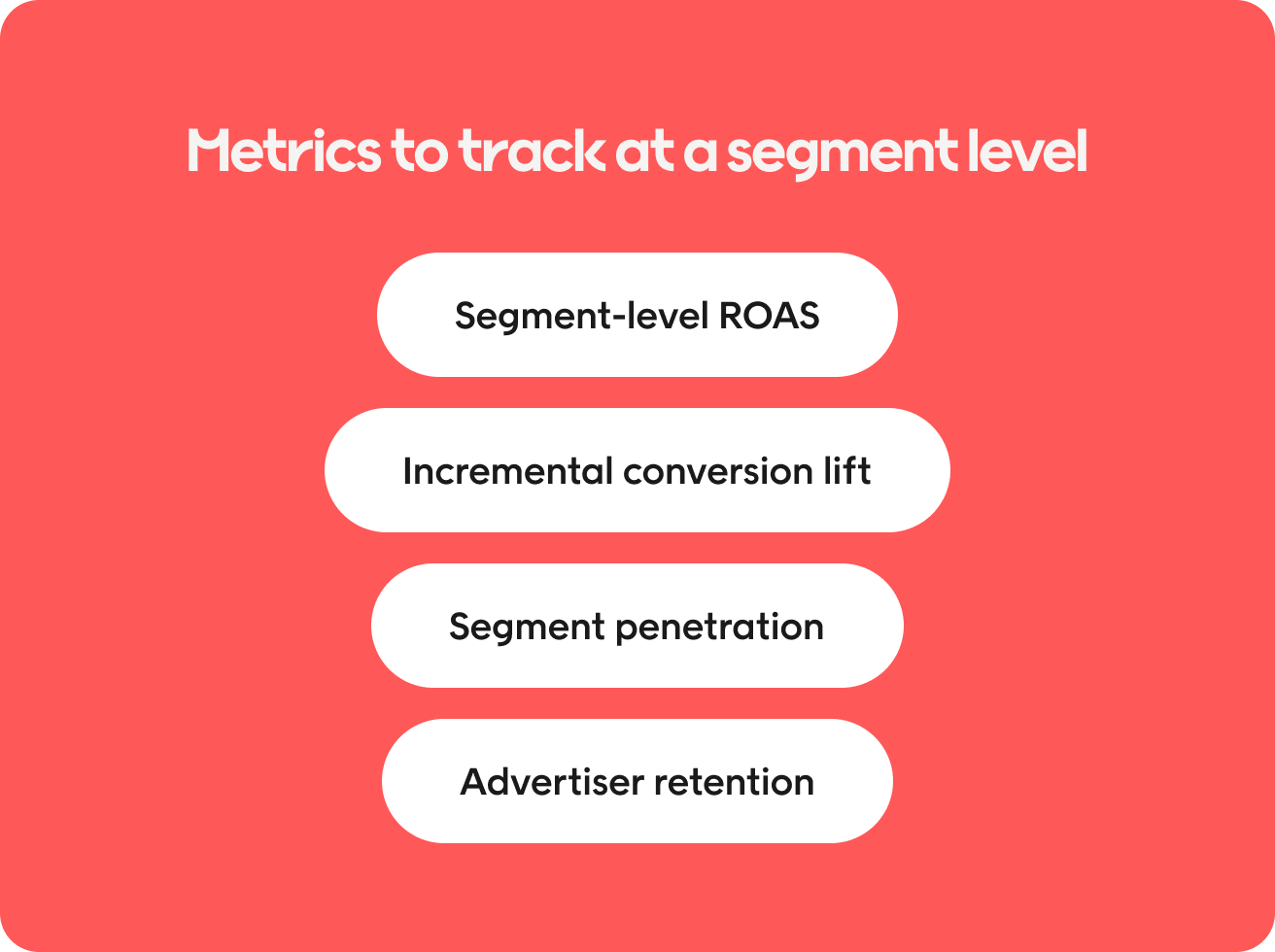
Track these metrics at the segment level, not just the campaign level:
- Segment-level ROAS — which audience types drive the highest return for each advertiser category?
- Incremental conversion lift — how much better does a targeted campaign perform compared to an untargeted baseline?
- Segment penetration — what percentage of your total audience falls into each targetable segment? Low penetration may indicate data gaps.
- Advertiser retention — are brand partners who use targeted segments renewing at higher rates?
Platforms like Voyado Retail Media connect advertising directly with first-party loyalty and customer data, so you can activate segments without building a custom data pipeline — and measure the impact across the full customer journey.
Conclusion
Your customers generate data every day — purchases, loyalty interactions, browsing patterns, search queries. That data is the asset that makes your retail media network more valuable than any third-party advertising platform.
Build three core audience types: purchase-based, loyalty-driven, and behavioural. Test targeted campaigns against a general baseline. Measure at the segment level. And treat compliance as a feature, not a constraint.
The retailers who monetise their first-party data effectively will not just build a new revenue stream — they will build a competitive moat that third-party ad networks cannot replicate.
FAQs
What is first-party data in retail media?
First-party data is the information a retailer collects directly from its customers — purchase history, loyalty programme activity, browsing behaviour, search queries, and in-store interactions. In retail media, this data powers audience targeting for sponsored ad placements, giving advertisers access to verified, high-intent shoppers.
How do retailers use first-party data for advertising?
Retailers build audience segments from their own customer data — such as recent category buyers, high-value loyalty members, or in-market browsers — and offer these segments to brand partners for targeted sponsored ad campaigns. Advertisers bid to reach specific segments, and the retailer earns revenue while delivering more relevant ad experiences.
What audience segments can you create with first-party data?
Three foundational types: purchase-based (customers who bought in a specific category or from a specific brand), loyalty-driven (segmented by programme status, frequency, or lifetime value), and behavioural (customers who browsed or searched without purchasing). Each serves different campaign objectives, from retargeting to brand building.
Why is first-party data better than third-party data for retail media?
First-party data is collected directly from your customers, making it more accurate, current, and privacy-compliant than third-party signals. It reflects actual purchase behaviour — not inferred interest — which drives higher relevance, better campaign performance, and greater advertiser confidence. As cookies phase out, first-party data becomes even more critical.
How do you ensure GDPR compliance in retail media targeting?
Start with informed consent for advertising use in your privacy policy. Label all sponsored content clearly. Share segment-level insights with advertisers — never individual customer records. Have your legal team review your targeting taxonomy before sharing it externally, and include data usage clauses in every advertiser contract.
About Author