TL;DR — what you need to know
- A retail media network turns your existing e-commerce traffic into a high-margin revenue stream by selling sponsored placements to your brand partners.
- You do not need a large team to start — five cross-functional roles can get a network off the ground, then scale as demand grows.
- Launch with a managed-service model, layer in self-service as your advertiser base matures, and use a hybrid approach for your long-term operating structure.
- Two foundational ad formats — Sponsored Product Ads and Sponsored Brand Ads — cover the majority of on-site retail media use cases.
- Set a CPM-based pricing model with a target CPC and a floor price. Start conservative, then raise your floor as performance data accumulates.
- Measure from day one: eCPM, total ad revenue, ROAS, conversion rates, and advertiser feedback are the KPIs that prove value and calibrate your strategy.
- Build an internal playbook so that every team — from merchandising to legal — speaks the same retail media language.

What is retail media — and why does it matter now?
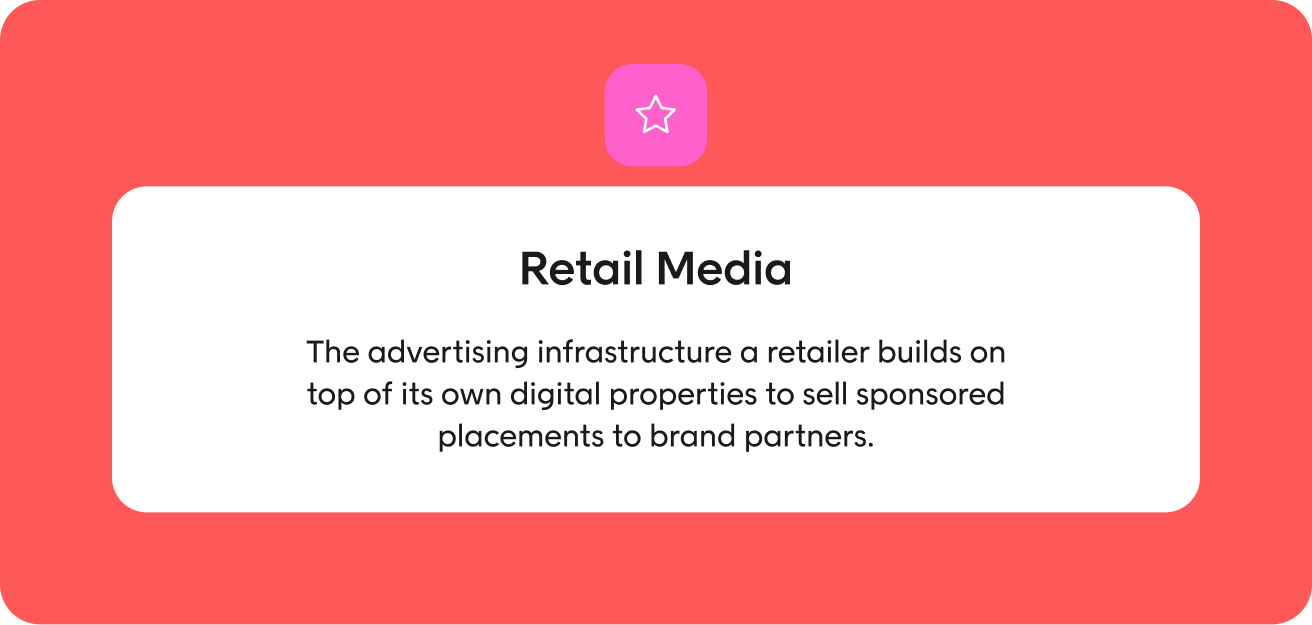
A retail media network is the advertising infrastructure a retailer builds on top of its own digital properties — website, app, email, and loyalty channels — to sell sponsored placements to brand partners. Instead of handing your traffic data to third-party ad networks, you monetise it directly: your first-party shopper data, your product catalogue, your audience.
The economics are hard to ignore. Retail media programmes typically deliver 70–90% margins and can add 1–5% of incremental revenue on top of existing e-commerce sales. That combination of margin and incremental growth explains why retail media has attracted significant investment from retailers across every category.
But launching a retail media network is not just about plugging in an ad server. It requires cross-functional alignment, a clear operational model, the right ad formats, a pricing strategy grounded in performance data, and measurement discipline from day one.
This guide walks you through each step — from assembling your team to calibrating your floor price — so you can launch with confidence and scale with control.
Step 1: build your retail media team (start lean)
You do not need a 20-person department to launch. Start with five core roles, then expand as your network matures.
Executive sponsor / strategy lead
This is typically your CMO, Head of E-commerce, or a senior commercial leader. Their job: secure internal buy-in, set revenue targets, and keep the retail media programme aligned with broader customer experience goals. Without executive sponsorship, retail media initiatives stall in committee.
Retail media manager
Your day-to-day lead. This person owns the roadmap, manages supplier relationships, coordinates across teams, and makes the operational calls on inventory, pricing, and campaign quality.
Sales and vendor partnerships
Someone needs to sell the inventory. This role builds relationships with brand partners, communicates the value proposition (your first-party data, your traffic, your audience segments), and manages onboarding for new advertisers.
Ad operations and campaign manager
This role handles campaign setup, trafficking, pacing, reporting, and optimisation. In the early stages, one person can cover this. As your network scales and you move toward self-service, this role shifts from executing campaigns to overseeing quality and performance.
Technical support
You need someone who understands your e-commerce stack — product feeds, search and browse infrastructure, and data pipelines. This does not have to be a full-time hire. A technical lead embedded part-time can handle integration, troubleshoot issues, and liaise with your retail media platform provider.
The principle: start lean, prove value, then invest. Most retailers begin with two to three of these roles filled by existing team members before hiring dedicated retail media staff.
Example: A mid-size fashion retailer launching its first retail media programme assigned the Retail Media Manager role to its existing Head of E-commerce, paired with a merchandiser handling ad operations. After six months of managed-service campaigns proved the revenue model, the retailer hired a dedicated Retail Media Manager and a sales lead for vendor partnerships.
Step 2: choose your operational model
Your operational model determines who builds, runs, and optimises campaigns. There is no single right answer — the best approach depends on your maturity stage.
Managed service (launch phase)
When you are starting out, your team runs everything on behalf of brand partners. You control campaign setup, creative, targeting, and reporting. This gives you full quality control while you learn what works, and it lowers the barrier for advertisers who are new to your network.
Self-service (scale phase)
As your advertiser base grows, a managed-only model becomes a bottleneck. Self-service lets brand partners create and manage their own Sponsored Product Ad campaigns through a supplier portal. You set the rules — budget minimums, ad density limits, creative guidelines — and advertisers execute within those guardrails.
Hybrid approach (mature networks)
The model most successful retail media networks land on: managed service for your top 10–20% of brand partners (who need bespoke campaigns and strategic support) and self-service for the long tail (who want speed and autonomy). Sponsored Brand Ads often stay managed because they require more creative oversight, while Sponsored Product Ads are well-suited to self-service.
Step 3: set up your ad inventory
Two ad formats cover the majority of on-site retail media use cases. Start with these before adding complexity.
Sponsored product ads
These elevate an already-listed product to a more prominent position — a reserved slot in a primary product list or a standalone carousel module. They are performance-focused, contextually relevant (the shopper is already browsing that category), and easy to scale because they draw from your existing product catalogue.
Sponsored brand ads
These are banner-like units that promote a brand’s identity alongside a curated product selection. Typical placements include homepage modules, category headers, and search-result banners. They offer stronger creative flexibility and brand storytelling, but they require more oversight to maintain design consistency.
Ad density and design governance
Start conservative. A page cluttered with sponsored content erodes trust, triggers banner blindness, and damages your own brand equity. Define how many sponsored placements can appear per page, per category, and per search result. Measure the impact on engagement and conversion before increasing density.
Three non-negotiables for design governance:
- Label all sponsored content clearly. Transparency protects you legally and preserves shopper trust.
- Maintain visual consistency. Sponsored placements should feel native to your site, not like foreign ads dropped onto your pages.
- Review creative quality. Especially for Sponsored Brand Ads, set guidelines for imagery, copy length, and brand alignment.
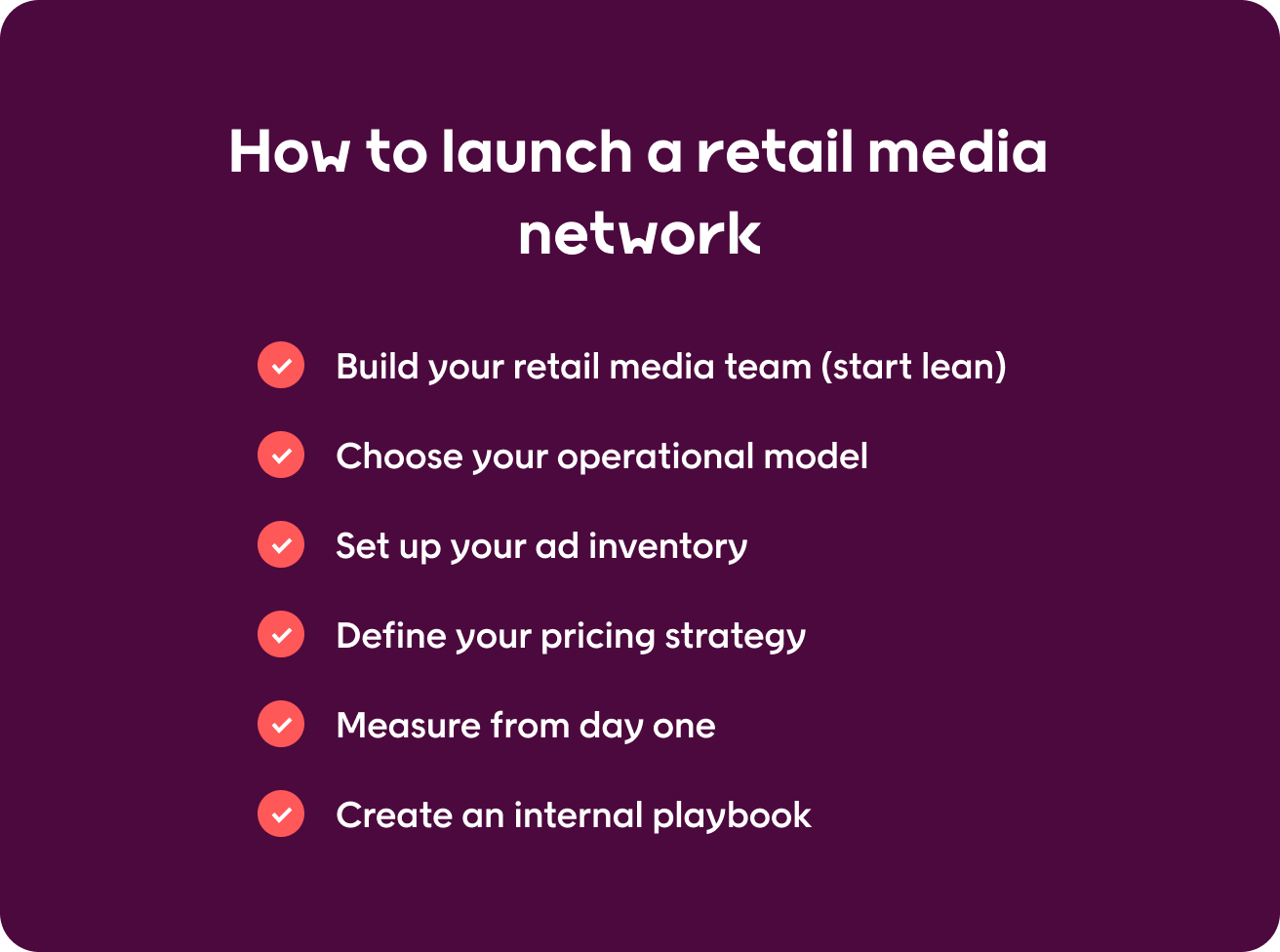
Step 4: define your pricing strategy
Most retail media networks use a CPM-based model (cost per thousand impressions) with a target CPC (cost per click) that reflects the expected conversion value.
Floor pricing
Your floor price is the minimum bid you accept. It protects your revenue and signals to advertisers that your inventory has value. The key: start lower, then raise as your market matures.
If you set your floor too high before you have the performance data to justify it, you will scare off early adopters. If you set it too low, you leave money on the table and devalue your inventory. Calibrate based on category-level performance data — high-intent categories (e.g., electronics) can support a higher floor than broad categories (e.g., home and garden).
How to calibrate
Track average revenue per page view across your key categories. Compare that to your floor price. If your floor is significantly below the revenue your organic placements generate, you have room to raise it. Monitor advertiser feedback — if partners consistently say they see strong ROAS, your floor is probably too low.
Step 5: measure from day one
Early data is not optional — it is how you calibrate pricing and prove value to brand partners. Without it, your inventory segmentation is guesswork. Track these five KPIs:
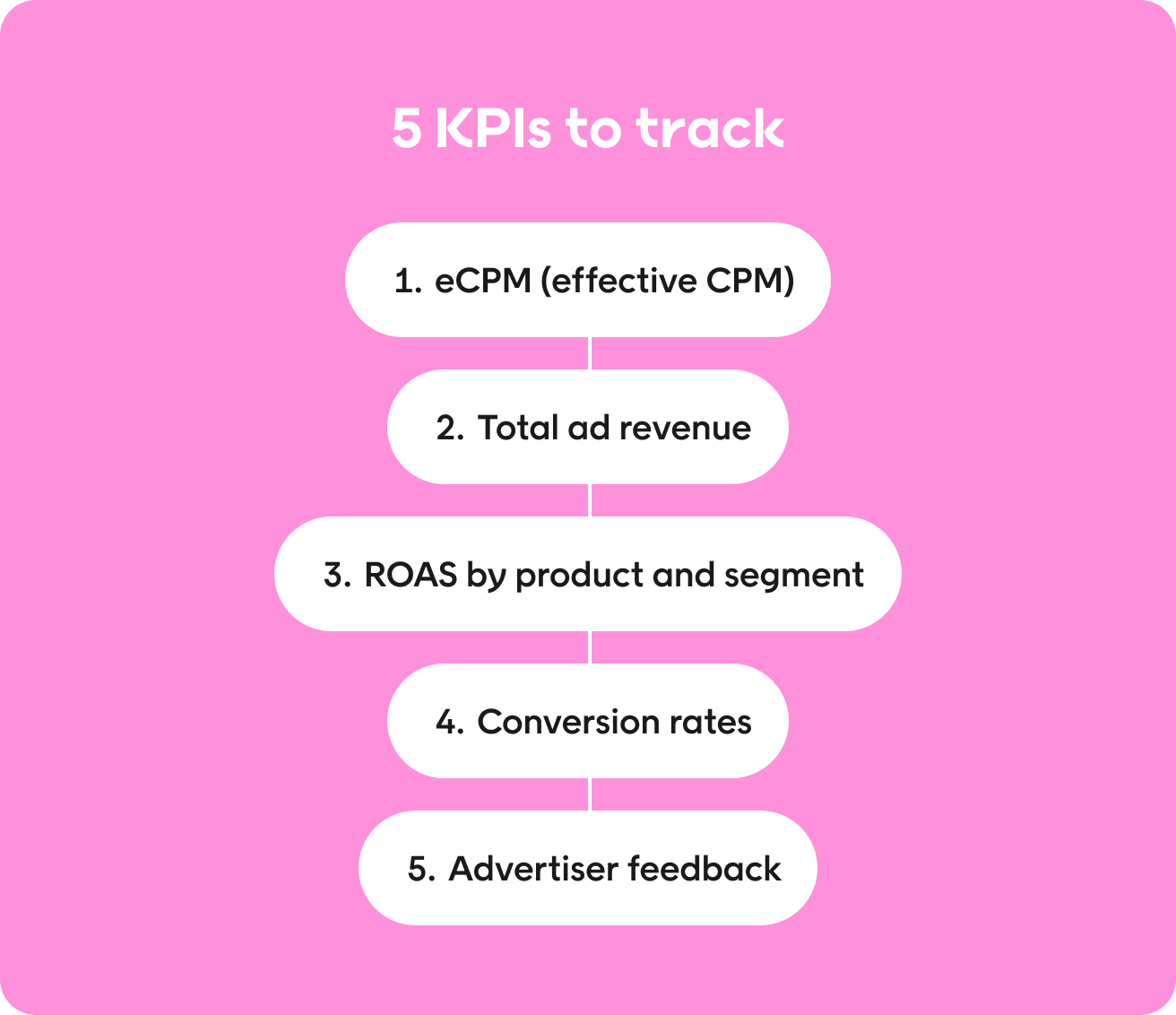
eCPM (effective CPM)
Takes into account varying bid amounts and actual spending. Gives you a more nuanced view of revenue efficiency than raw CPM, because it reflects what advertisers actually paid, not just what they bid.
Total ad revenue
Compare actual revenue against your targets and forecasts. Track at the network level and by category/format to understand where your inventory is over- or under-performing.
ROAS by product and segment
Understand which sponsored products drive the most value for advertisers. This data lets you reallocate inventory to higher-performing channels and make a compelling case to new brand partners.
Conversion rates
Confirms that your ads drive meaningful outcomes, not just impressions. Use A/B tests to isolate the impact of sponsored products on overall conversion — run a portion of traffic without sponsored placements and compare.
Advertiser feedback
A qualitative but essential signal. Regular check-ins with your brand partners reveal perceived value, frustration points, and whether your floor price is calibrated correctly. If feedback is consistently positive but you are losing advertisers at renewal, your pricing may have outpaced the value you deliver.
Step 6: create an internal playbook
A retail media network touches multiple teams — merchandising, marketing, legal, e-commerce, finance, brand partnerships. Without a shared internal playbook, you get siloed definitions, conflicting priorities, and slow decision-making.
Your internal playbook should include:
- Purpose and goals — why the network exists, what success looks like, and how it aligns with your customer experience strategy
- Roles and responsibilities — who owns what (reference the team structure from Step 1)
- Shared vocabulary — define “sponsored product,” “floor price,” “eCPM,” and other terms so everyone uses the same language
- Creative guidelines — ad specs, labelling requirements, and design standards
- FAQs for suppliers — onboarding guides, self-service instructions, and common questions from brand partners
- Cross-team training — schedule regular sessions so new hires and adjacent teams understand the programme
Legal and GDPR compliance from day one
Do not treat compliance as a phase-two problem. Build it in from the start:
- All sponsored content must be clearly labelled
- Data usage for targeting must comply with your privacy policy and local regulations (GDPR, CCPA, etc.)
- Advertiser contracts should specify data rights, reporting obligations, and creative approval processes
- Your legal team should review your targeting taxonomy before you share it with brand partners
Conclusion
Launching a retail media network is a commercial decision, not a technology project. The retailers who succeed start lean, launch with a managed-service model, measure relentlessly, and scale only when the data supports it.
The steps are straightforward: assemble a cross-functional team, choose your operational model, define your ad formats and density rules, set a calibrated pricing strategy, track the right KPIs, and build an internal playbook that keeps everyone aligned.
If your e-commerce platform already integrates product discovery and customer data — the way Voyado Retail Media connects advertising with first-party data and product intelligence — you can accelerate time-to-revenue without rebuilding your tech stack.
This guide gives you a starting point — and if your e-commerce platform already supports product discovery and customer data integration, you can move even faster.
FAQs
What is a retail media network?
A retail media network is the advertising infrastructure a retailer builds on its own digital properties — website, app, email — to sell sponsored placements to brand partners. It turns your existing traffic and first-party shopper data into a monetisable asset, giving advertisers access to high-intent audiences at the point of purchase.
How do you start a retail media network?
Start by assembling a lean cross-functional team (executive sponsor, retail media manager, sales, ad ops, and technical support). Launch with a managed-service model, two core ad formats (Sponsored Product Ads and Sponsored Brand Ads), and a conservative floor price. Measure from day one and scale based on performance data.
What team do you need for retail media?
Five core roles cover the launch phase: an executive sponsor to secure buy-in, a retail media manager to run operations, a sales lead for vendor partnerships, an ad operations manager for campaign execution, and technical support to handle integrations. Most retailers start by allocating existing team members before hiring dedicated staff.
What is the difference between managed service and self-service retail media?
In a managed-service model, your team builds and runs campaigns on behalf of brand partners — ideal for launch when you need quality control. In self-service, advertisers create and manage their own campaigns through a portal. Most mature networks use a hybrid: managed service for top-tier partners and self-service for the long tail.
How do retail media networks make money?
Retail media networks generate revenue by selling sponsored ad placements to brand partners, typically on a CPM (cost per thousand impressions) basis with a target CPC. Margins are high — typically 70–90% — because the retailer owns the inventory and the data. Revenue scales with traffic, advertiser demand, and the breadth of your ad format offering.
About Author