
TL;DR
Most retail teams know their attribution is incomplete. Customers move between online and in-store channels, loyalty programs influence purchases, and multiple touchpoints shape buying decisions long before conversion.
Effective retail attribution strategies measure more than clicks. They connect campaigns, customer behavior, and sales across channels to reveal what actually drives revenue, retention, and customer lifetime value.
We’re covering 10 practical approaches to retail attribution, including how to close the online-to-offline gap and improve retail campaign measurement. You’ll also see why unified customer data is the foundation of accurate retail marketing attribution.
Why retail attribution often misses the full picture
Most attribution models for retail were built for digital conversions. Retail works differently.
Your customers move between online and in-store channels, interact with multiple campaigns, and often make purchases weeks after their first engagement. Without connected customer data, it’s difficult to understand what truly influences revenue, retention, and customer lifetime value.
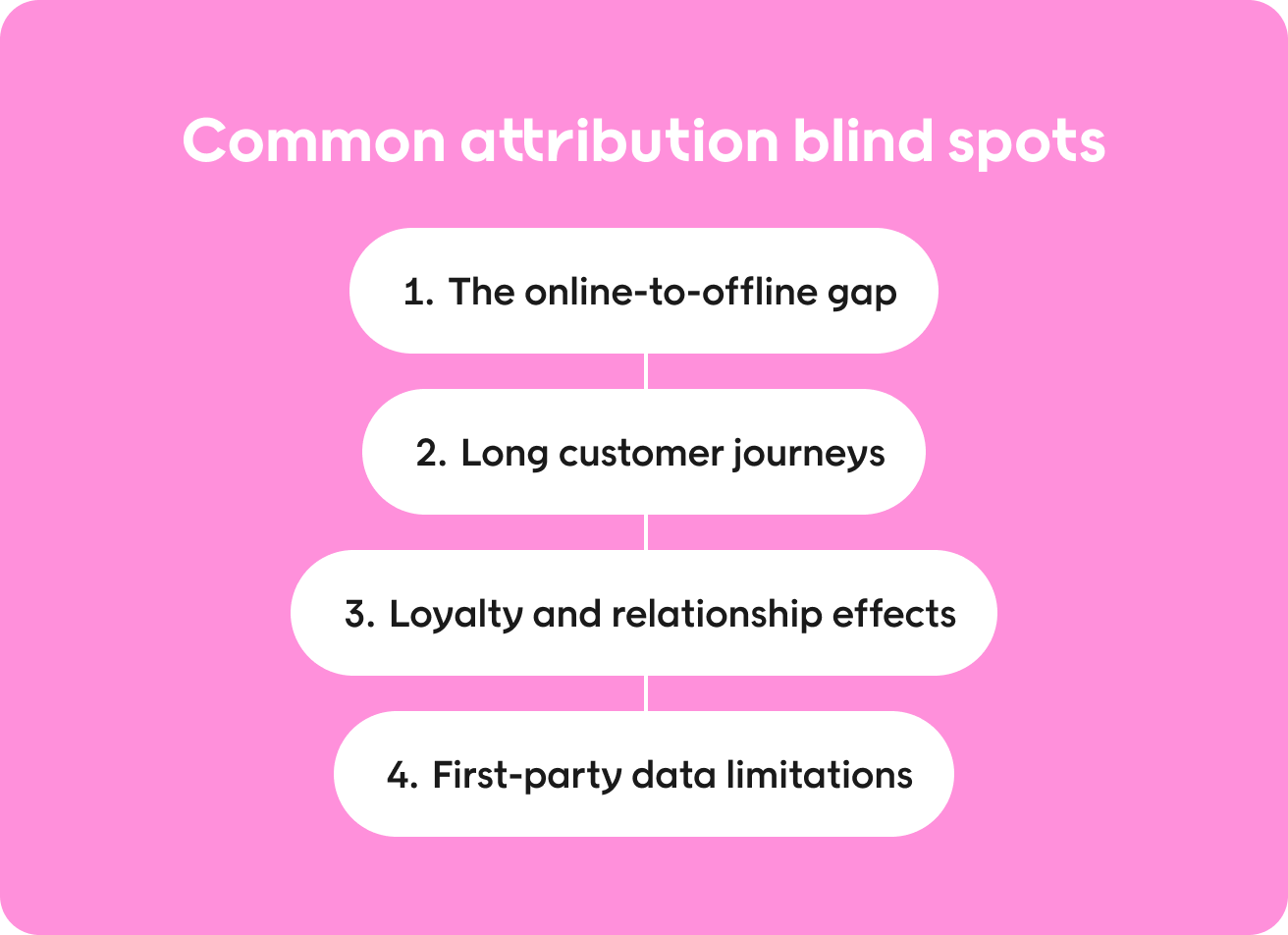
Common attribution blind spots include:
- The online-to-offline gap: Customers engage online but complete purchases in-store, making it difficult to connect marketing activity to revenue.
- Long customer journeys: Shoppers move between devices, channels, and campaigns before purchasing, making single-touch attribution unreliable.
- Loyalty and relationship effects: Loyalty programs and ongoing engagement influence purchasing decisions even when no campaign directly triggers a conversion.
- First-party data limitations: Attribution becomes less accurate when e-commerce, POS, CRM, and loyalty data remain disconnected.
Building stronger retail customer analytics capabilities is often the first step toward solving these challenges.
The following retail attribution strategies help you create a more complete picture of marketing impact.
10 retail attribution strategies that actually work
These strategies help you connect marketing activity to revenue more accurately and make better decisions about budget allocation across channels.
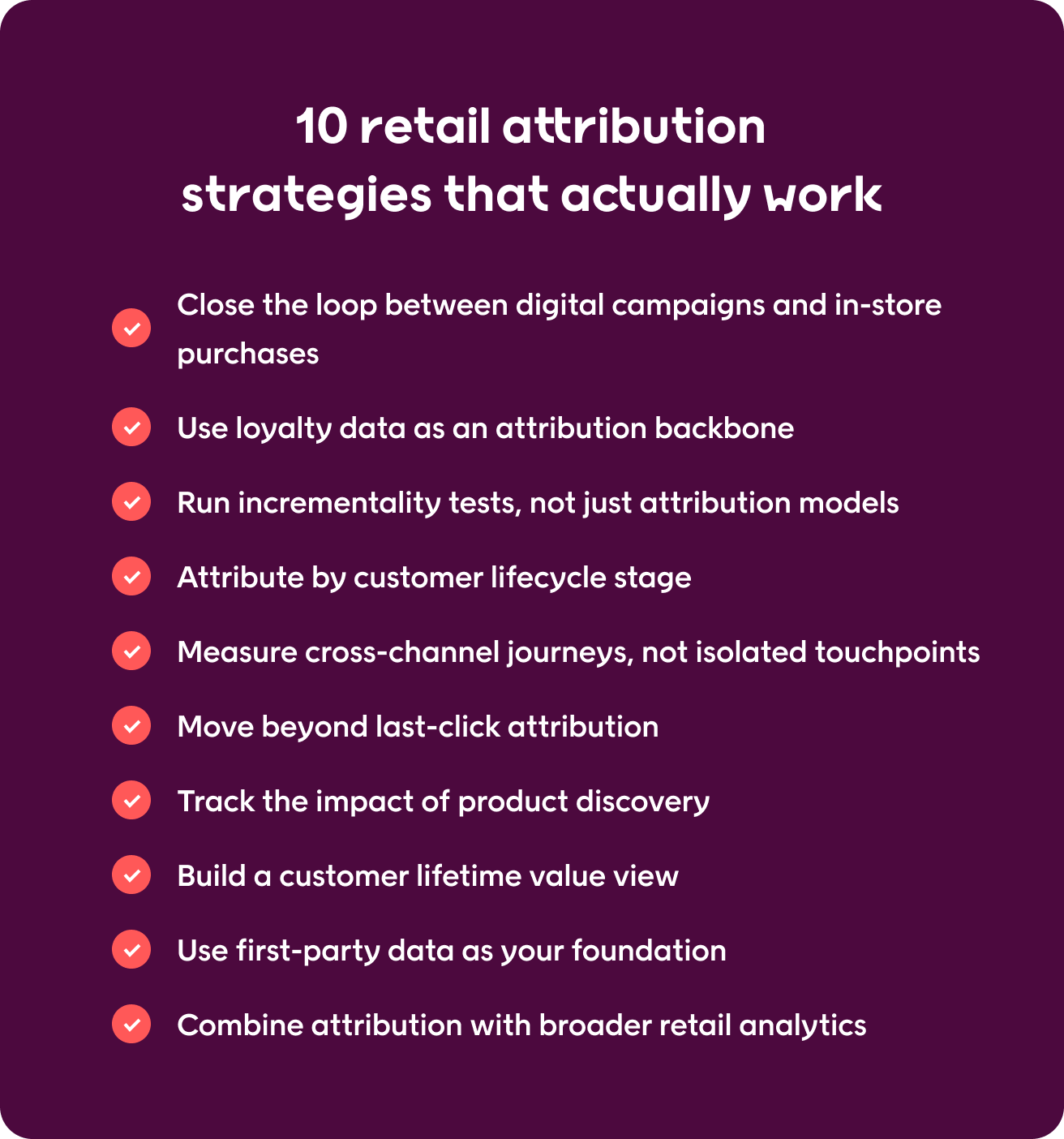
1. Close the loop between digital campaigns and in-store purchases
What to measure: Digital engagement that leads to in-store sales.
Why it matters: Many retailers can track online conversions but lose visibility when the final purchase happens in a physical store.
How to do it: Link email engagement, website activity, loyalty membership, and POS transactions to a unified customer profile. This creates a closed loop between campaigns and revenue.
2. Use loyalty data as an attribution backbone
What to measure: The impact of loyalty communications on customer behavior.
Why it matters: Loyalty members are identifiable across channels, making attribution more accurate and less dependent on anonymous tracking.
How to do it: Measure how rewards, points reminders, and membership campaigns influence purchase frequency, basket size, and customer lifetime value. A strong customer loyalty platform makes this much easier.
3. Run incrementality tests, not just attribution models
What to measure: Whether a campaign generated additional sales.
Why it matters: Attribution models assign credit. They don’t prove that a campaign caused a purchase.
How to do it: Create holdout groups. Send a campaign to one group and withhold it from another. Compare outcomes to determine true campaign impact.
4. Attribute by customer lifecycle stage
What to measure: Campaign impact at different stages of the customer lifecycle.
Why it matters: The same campaign can have very different value depending on whether it acquires a new customer or retains an existing one.
How to do it: Separate attribution reporting by acquisition, repeat purchase, growth, retention, and win-back stages.
5. Measure cross-channel journeys, not isolated touchpoints
What to measure: How multiple marketing channels work together.
Why it matters: Customers rarely convert after a single interaction. The entire customer journey influences outcomes.
How to do it: Analyze common paths such as email → website → purchase or SMS → product view → store visit. Strong omnichannel visibility is essential for omnichannel attribution in retail.
6. Move beyond last-click attribution
What to measure: The contribution of touchpoints throughout the journey.
Why it matters: Last click attribution gives full credit to the final interaction and ignores earlier influences.
How to do it: Test different attribution models, including first-touch attribution, linear attribution, position-based attribution, and multi-touch attribution models. The goal is to find the right attribution model for your business, not a perfect one.
7. Track the impact of product discovery
What to measure: Revenue influenced by search, recommendations, and merchandising.
Why it matters: Product discovery often shapes buying decisions long before conversion.
How to do it: Track search-to-purchase journeys, recommendation clicks, and engagement with category pages as part of your marketing attribution in retail.
8. Build a customer lifetime value view
What to measure: Long-term customer value generated by campaigns.
Why it matters: Campaigns that look successful in the short term don’t always create the most valuable customers.
How to do it: Connect campaign exposure to repeat purchases, retention rates, and customer lifetime value outcomes rather than focusing only on immediate sales.
9. Use first-party data as your foundation
What to measure: Customer interactions that can be tied to known identities.
Why it matters: As third-party tracking becomes less reliable, first-party data provides the strongest attribution signal.
How to do it: Use loyalty enrollment, CRM engagement, email activity, website behavior, and transaction history as the foundation for attribution in retail. Retailers that can better measure and use your retail data gain a significant advantage.
10. Combine attribution with broader retail analytics
What to measure: Attribution alongside customer behavior and sales performance.
Why it matters: Attribution alone rarely provides the full picture.
How to do it: Combine attribution insights with customer behavior, loyalty engagement, and sales data to understand what truly drives growth. Pairing attribution with retail omnichannel analytics helps reveal patterns that individual reports often miss.
The strongest retail attribution strategies don’t rely on a single model. They combine customer data, measurement methods, and business context to create a more accurate view of marketing impact.
Common retail attribution mistakes to avoid
Even strong attribution strategies can produce misleading results if the measurement approach is flawed.
Over-relying on last-click attribution
Last-click attribution gives full credit to the final interaction and ignores earlier influences.
Compare different attribution models, including first-touch attribution, linear attribution, position-based attribution, and multi-touch attribution, to get a more balanced view of campaign performance.
Ignoring in-store purchases and offline data
If your model excludes offline data and in-store transactions, you’re only measuring part of the revenue picture.
This is one of the biggest barriers to omnichannel attribution in retail. Connecting customer profiles and omnichannel retailing data helps close the gap.
Attributing loyal customer purchases to campaigns
Loyal customers regularly buy because of previous experiences, not a specific campaign.
Without incrementality testing, attribution models may over-credit campaigns and undervalue effective customer retention strategies.
Measuring campaigns instead of journeys
Customers interact with multiple touchpoints across channels before deciding.
Strong cross-channel attribution for retail focuses on the full customer journey, helping teams make more informed decisions about marketing spend and budget allocation.
Avoiding these mistakes leads to more accurate attribution and better decision-making.
How Voyado supports retail attribution
Accurate attribution depends on connected customer data. That’s where Voyado fits in.
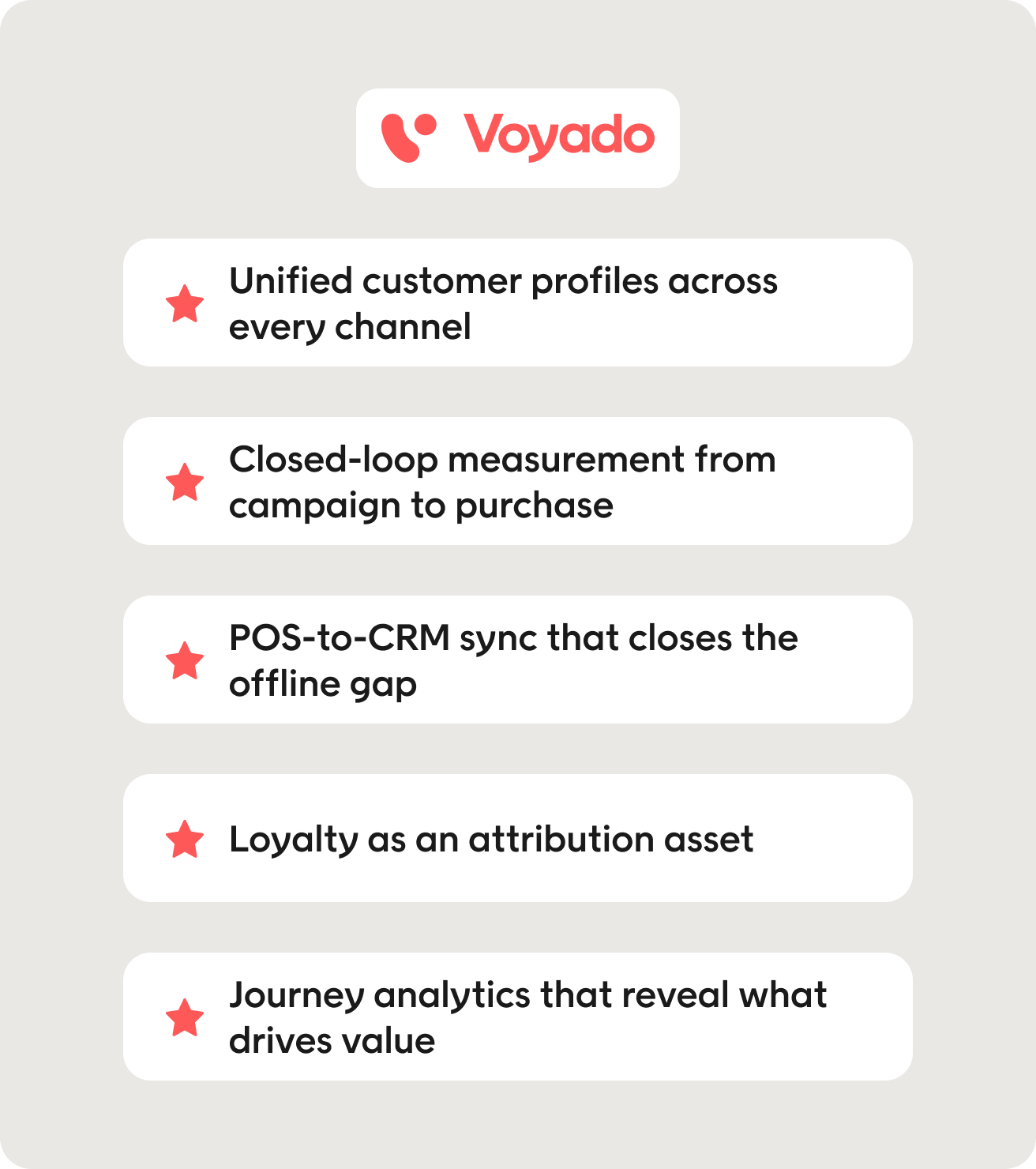
Unified customer profiles across every channel
Voyado connects e-commerce, POS, loyalty, email, app, and engagement data into a single customer profile.
This gives you the holistic view needed for attribution in retail. Instead of piecing together data collected across different platforms, you’ll be able to connect marketing channels, customer behavior, and sales outcomes in one place.
Closed-loop measurement from campaign to purchase
Voyado connects campaign engagement directly to purchase outcomes.
When a loyalty member opens an email, clicks an offer, and later buys online or in-store, you’ll be able to see that journey. This closed-loop visibility helps you evaluate campaign performance more accurately and optimize marketing spend with greater confidence.
POS-to-CRM sync that closes the offline gap
Real-time POS integration links in-store transactions to customer profiles.
This allows you to connect digital campaigns, paid search activity, and other marketing efforts to offline purchases. Instead of measuring only part of the customer journey, you’ll gain a more complete understanding of what influences revenue.
Loyalty as an attribution asset
Loyalty members provide some of the most reliable attribution signals available.
Because interactions are tied to known customers, you’ll have stronger data for retail media attribution, customer journey analysis, and multi touch attribution. That means fewer attribution blind spots and more confidence in the insights you’re using to make decisions.
Journey analytics that reveal what drives value
Voyado helps you understand how different touchpoints influence outcomes across the customer lifecycle.
For example, By Malene Birger increased full-price shoppers by 109% using a personalized onboarding automation. Connecting engagement data, transactions, and customer behavior made it easier to identify which interactions were driving value and where future marketing efforts should focus.
By connecting engagement, transactions, and customer value, you’ll gain a clearer understanding of which channels and campaigns drive conversions, retention, and long-term growth.
If you’re making spending decisions based on incomplete attribution, book a demo to see how Voyado connects online and in-store data into a complete customer view.
Final thoughts
There is no single attribution model that works for every retailer. The goal isn’t perfect attribution. It’s building a more accurate understanding of how your marketing channels, campaigns, and customer journeys influence revenue.
The retailers that succeed with marketing attribution in retail rely on strong first-party data, connected customer profiles, and a clear view of the customer journey. That foundation helps you optimize marketing spend and make more informed decisions.
Start with the strategies in this guide, test what works for your business, and focus on the desired outcome: understanding which marketing efforts create the most valuable customers over time.
FAQs
What is retail attribution?
Retail attribution is the process of determining which marketing channels, campaigns, and touchpoints influenced a purchase. It also considers attribution windows, which define how long a touchpoint can receive credit before a conversion occurs.
Why is retail attribution harder than standard digital attribution?
Retail customers move across channels, devices, and stores before purchasing. Attribution in retail must account for offline data, loyalty activity, and long customer journeys, making last touch attribution less reliable than it is in purely digital businesses.
What is closed-loop attribution in retail?
Closed-loop attribution connects marketing engagement directly to purchase outcomes. For example, if a customer opens an email and later buys in-store, the sale can be linked back to the campaign.
How do I measure in-store impact of digital marketing?
Connect POS transactions to customer profiles and marketing engagement data. This allows you to track how emails, paid search, SMS, and other marketing channels influence in-store purchases.
What is incrementality testing in retail marketing?
Incrementality testing measures whether a campaign actually caused additional sales. It typically uses test and control groups to compare outcomes and identify the true impact of marketing efforts.
How does loyalty data improve attribution?
Loyalty data provides first-party data that links purchases, engagement, and customer behavior to known individuals. This makes marketing attribution more accurate and helps measure long-term customer value.
How does Voyado support retail attribution?
Voyado supports retail attribution through unified customer profiles, POS integrations, loyalty data, and journey analytics. Unlike many retail media platforms that focus on advertising measurement, Voyado helps retailers connect customer interactions, transactions, and engagement across channels to create a more complete view of marketing impact.