There’s a paradox in retail AI right now. Adoption is near-universal: 95% of retailers are experimenting with AI in marketing and e-commerce. Yet only 5% report clear, scalable returns from it. Long story short, nearly everyone is doing AI, but almost no one is making a return on their investment. This is problematic, given that AI is increasingly expensive to use and customer attention is increasingly expensive to gain and maintain.
Personalization is a useful place to look at that gap closely.
Of all the things AI does in retail, personalization is the one that most directly requires data to be unified, workflows to be connected, and teams to trust the automation enough to act on it. If the AI is working well, personalization should be working well. If personalization is breaking down, something structural is wrong, regardless of how sophisticated the underlying technology is.
For anyone working with these systems day-to-day, the reason isn’t mysterious. The AI is running. It’s just that someone on the team is still doing the work to make it look like it’s working: checking that recommended products are in stock in the right sizes, rebuilding the same segment in a fourth tool, overriding search results because the algorithm surfaced last season’s line, waiting on a developer to push a change that should have taken an hour. The system is technically live, but it’s practically being held together by hand.
That gap between adoption and impact isn’t what most explanations of it suggest. It’s not that the tools don’t work, because if they didn’t, adoption wouldn’t be near-universal. It isn’t that retailers aren’t investing, because they clearly are. What the research shows is that the gap is structural and operational. That is, it’s about where personalization sits in how a business runs, and not how powerful the underlying AI has become.
Read our report The State of AI in European retail marketing and e-commerce to get more insights into AI in retail in 2026.
Where are most retailers now with personalization?
To understand why personalization stalls, it helps to look at the bigger picture. AI adoption in retail progresses through four stages: Exploration, where retailers are testing AI through pilots and proofs-of-concept; Pilot Scaling, where AI is used in selected functions but not embedded across workflows; Operational, where AI is integrated into core marketing and e-commerce processes; and Embedded Strategy, where AI informs decision-making at a strategic level, woven into planning, execution, and optimization across the business.
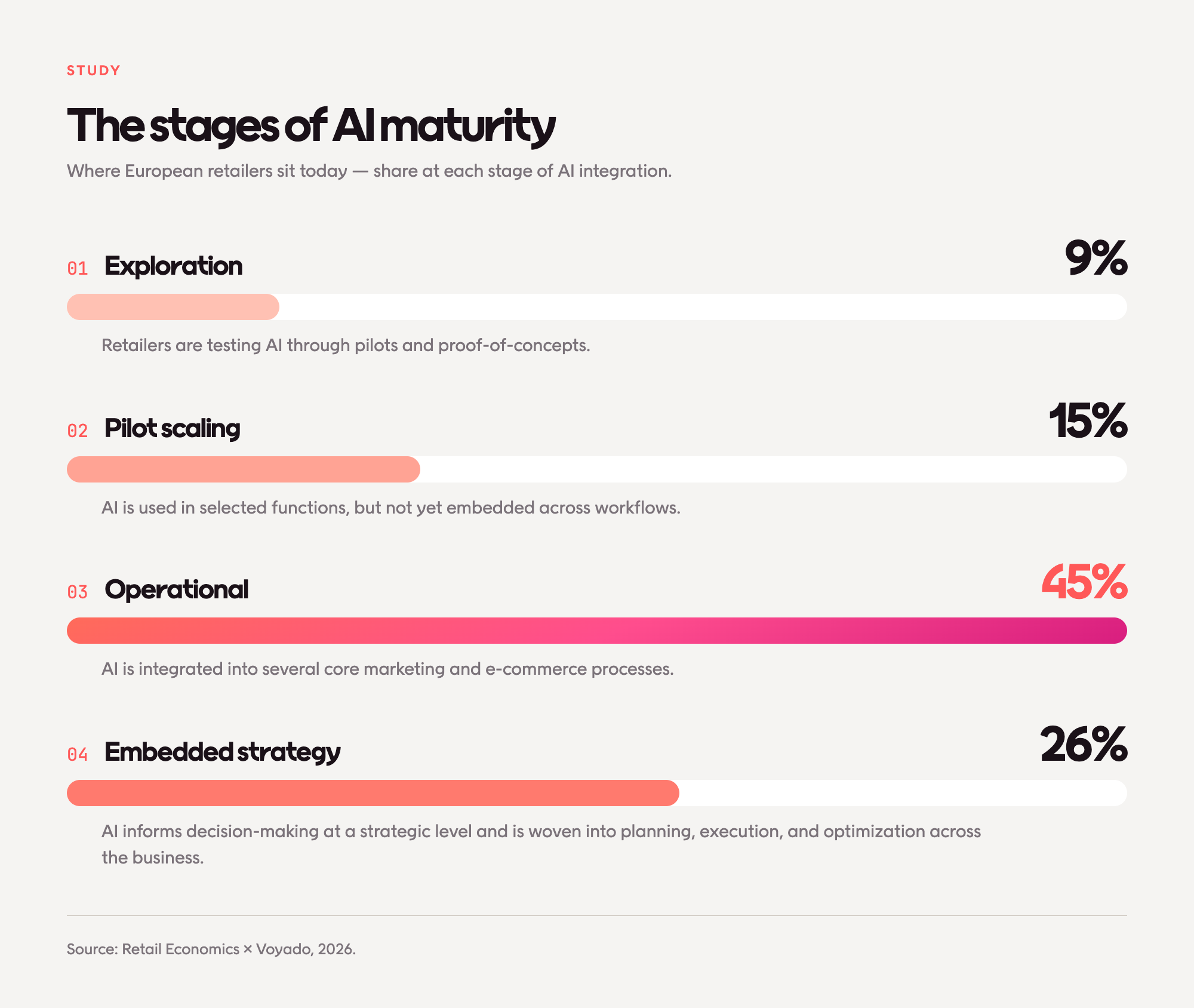
Our research places most retailers in the middle two stages, with 45% at Operational and 24% still in Exploration or Pilot Scaling. Only 26% report AI is embedded strategically. And personalization capability tracks that AI integration stage almost perfectly.
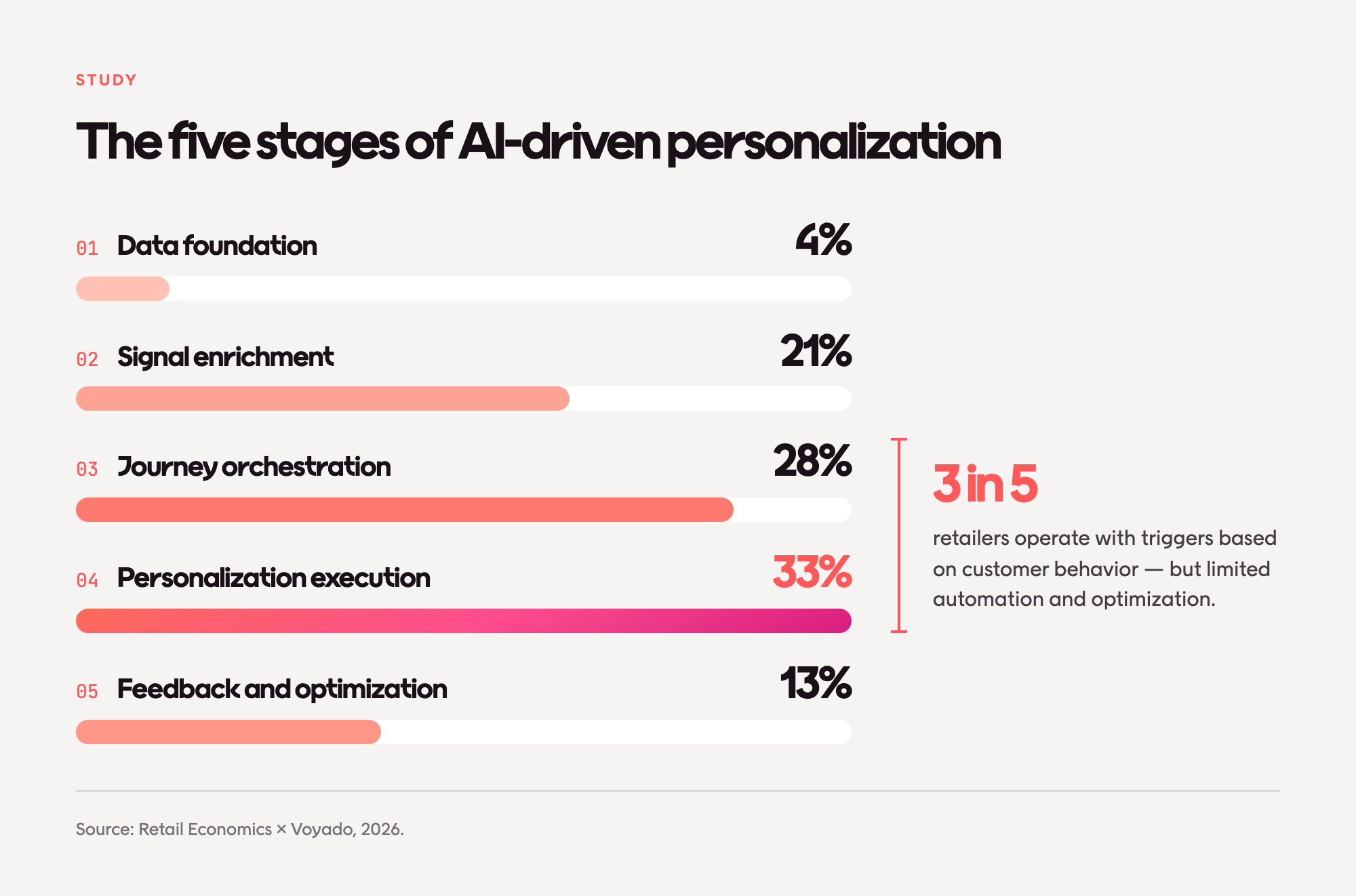
To see how, it helps to understand the second dimension: the five stages of AI-driven personalization capability. These run from the most basic to the most advanced, and each stage builds on the one before it.
The question the research then answers is which personalization stage retailers are at, and whether it maps to where they are on their AI integration journey. The matrix below shows exactly that.
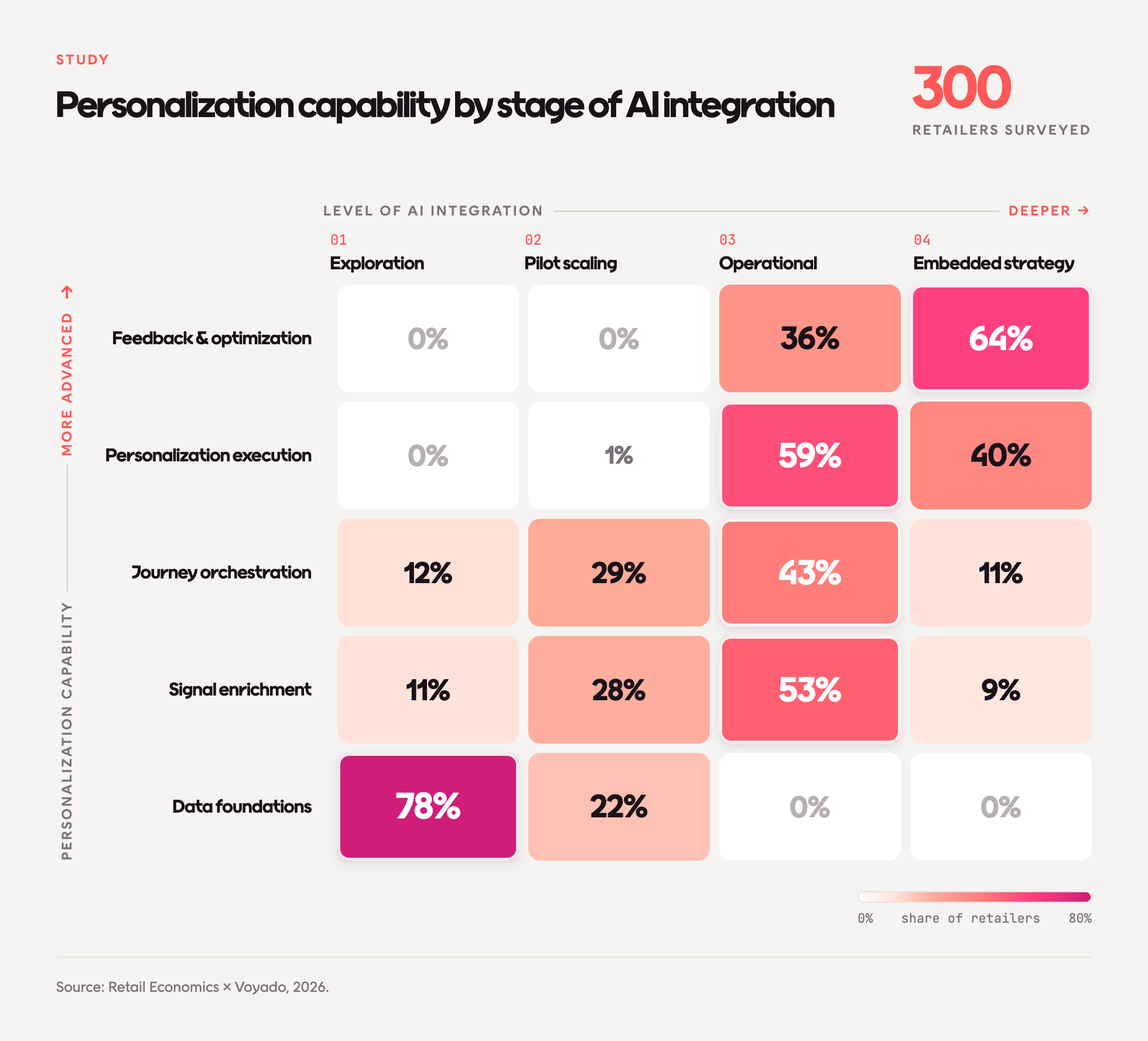
Read the table diagonally, and the pattern is unmistakable. Retailers at the Exploration stage are hovering around data foundations (78% of them). Retailers at the Pilot scaling stage are working on signal enrichment and journey orchestration. It’s only at the Operational AI stage that personalization execution becomes possible (59% of retailers at that stage are here). And continuous feedback & optimization — the self-improving personalization every AI roadmap promises — is only reached at the top: 64% of retailers there have AI at Embedded strategy level, while zero retailers at Exploration or Pilot Scaling have made it.
This is the finding underneath the 95%/5% gap.
Continuous, learning personalization is what becomes possible when AI stops being a set of isolated workflow tools and starts being embedded in how the business plans, decides, and executes. The retailers standing between the Operational and Embedded stages aren’t there because they picked the wrong AI. They’re there because the operational and organizational work to move up hasn’t happened yet.
What we mean by “continuous personalization”Personalization that keeps refining itself (using live customer, product, pricing, and loyalty signals) instead of being manually rebuilt every time a rule, segment, or campaign needs updating. It’s the self-improving, feedback-driven stage every AI roadmap promises, but only 26% of retailers currently have the AI maturity to reach it. |
Why the middle stages stall
If the leap from the Operational stage to Embedded stage is where continuous personalization is unlocked, the natural question is: what actually blocks it? The research and field observation point in the same direction, and the answer isn’t technical.
What the AI is missing is context and not capability. A generic personalization model can match a word, surface what converted before, fire a journey on a schedule. What it can’t do is understand the specific reality of the business it’s operating in. For example, that the woman searching “dress” is shopping for her daughter, that the product it’s about to surface is out of stock in her size and low margin, that the loyal customer who hasn’t bought in 90 days isn’t lapsing, it’s just summer. Those are context gaps and not AI limitations.
That distinction between capability and context is where leaders in retail personalization separate from everyone else.
More data sources isn’t a vanity metric. It’s what lets the AI evaluate customer relevance and commercial reality in the same decision. Connect customer behavior to product attributes, pricing, inventory and loyalty signals, and the AI can act with retail logic built in. Leave those systems in parallel (CRM here, e-commerce there, loyalty somewhere else) and the AI can only ever optimize inside one box while a human stitches the boxes together.
And on the ground, that context gap shows up as manual work. In conversations with hundreds of retail teams evaluating their personalization strategy, the same pattern comes up in slightly different forms:
- E-commerce teams describe merchandising and on-site personalization that’s powerful in theory but manual and time-consuming in practice. Every rule is a workaround. Every override is a small acknowledgment that the AI didn’t understand the business context (e.g. stock levels, margins, seasonality) well enough to make the right call on its own.
- CRM teams describe automation that is technically live but requires constant handholding. Recommendation blocks in emails need manual stock and sizing checks before they’re safe to send. Unsubscribes don’t sync back reliably, so customers get ignored and retargeted at the same time. On-site behaviour the CRM should be able to see, it can’t.
- Both teams describe the same underlying frustration: their e-commerce systems and their customer systems operate in silos. The AI in each one is doing its job. Neither one has the context the other has.
The biggest barriers are organizational
The tempting response to all this is to reach for a technical fix. Better integration. Cleaner data pipes. A new platform. But when retail teams are asked what’s actually blocking their progress on AI, the top answers are almost entirely organizational.
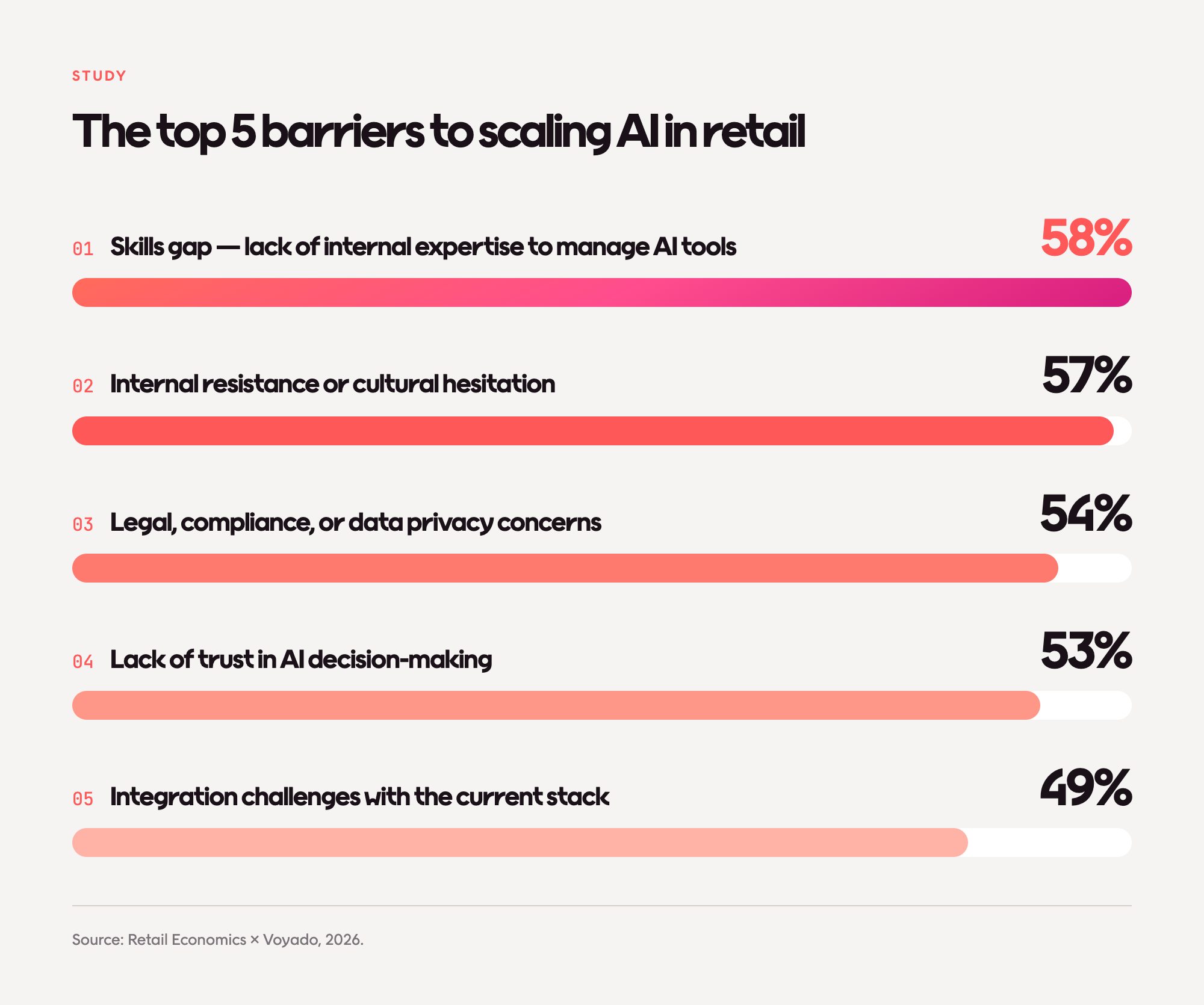
This is what “operational execution, not capability” looks like as data. The tools are rarely the thing standing in the way. What is, is that the organization isn’t set up to use the tools in the best way. The skills aren’t in-house, the teams aren’t confident enough to hand over the decisions, the governance isn’t clear about who owns the outcomes, and the operating model still treats AI as a project rather than a permanent capability.
What advanced personalization looks like in retail
The retailers moving from Operational to Embedded AI, the ones for whom continuous personalization has become possible, haven’t done it by buying more sophisticated technology. In fact, the pattern is more mundane, but also more demanding.
They stopped treating context as a feature to obtain and started treating it as a foundation to be built. That means customer, product, commercial, and loyalty data unified closely enough that the AI can evaluate all of it in the same decision. It means personalization decisions moving out of individual channel-team hands and into a shared operating layer. It means the commercial team being able to act on what the AI surfaces without raising a ticket for every change.
It also means investing in the boring, unglamorous work: building internal skills, defining governance clearly enough that teams can trust the automation, and giving personalization decisions clear ownership rather than distributing them across marketing, e-commerce, and CRM without joining them up.
None of this requires more powerful AI. The AI that retailers are running today is likely the least impressive version they’ll ever use. Capability is only going in one direction, and it’s going there fast. What compounds isn’t the model, but what the model understands about the business, and what the organization is set up to do with what it understands.
So before the next tool evaluation, the next integration project, the next “we just need better AI” conversation, the more uncomfortable question is whether the organization is actually set up to use what it already has. Because until it is, the person behind the scenes doing the work to make the AI look like it’s working IS the personalization strategy. And that was never the plan.
Methodology
This article draws on primary research conducted by Retail Economics, an independent economics research consultancy specializing in the retail and consumer sectors.
Survey of retail decision-makers Retail Economics surveyed 300 marketing and e-commerce leaders across Benelux (Belgium, Netherlands, Luxembourg), DACH (Germany, Austria, Switzerland), Scandinavia (Norway, Sweden, Denmark), and the UK in December 2025. Respondents held senior roles across marketing, e-commerce, CRM, and digital functions.
About Author