There’s a version of the retail AI conversation that focuses almost entirely on capability. Which model is smartest, which platform integrates best, which vendor’s roadmap moves fastest, etc. In that version, the challenge in front of retail is a technology challenge, and the answer is more or better technology.
But research across 300 retail marketing and e-commerce leaders in Europe tells a different story. When retailers were asked what’s actually holding back their progress on AI, the tools barely featured. Four of the top five barriers are about people, culture, trust, and governance. The technical one, integration challenges, ranks last.
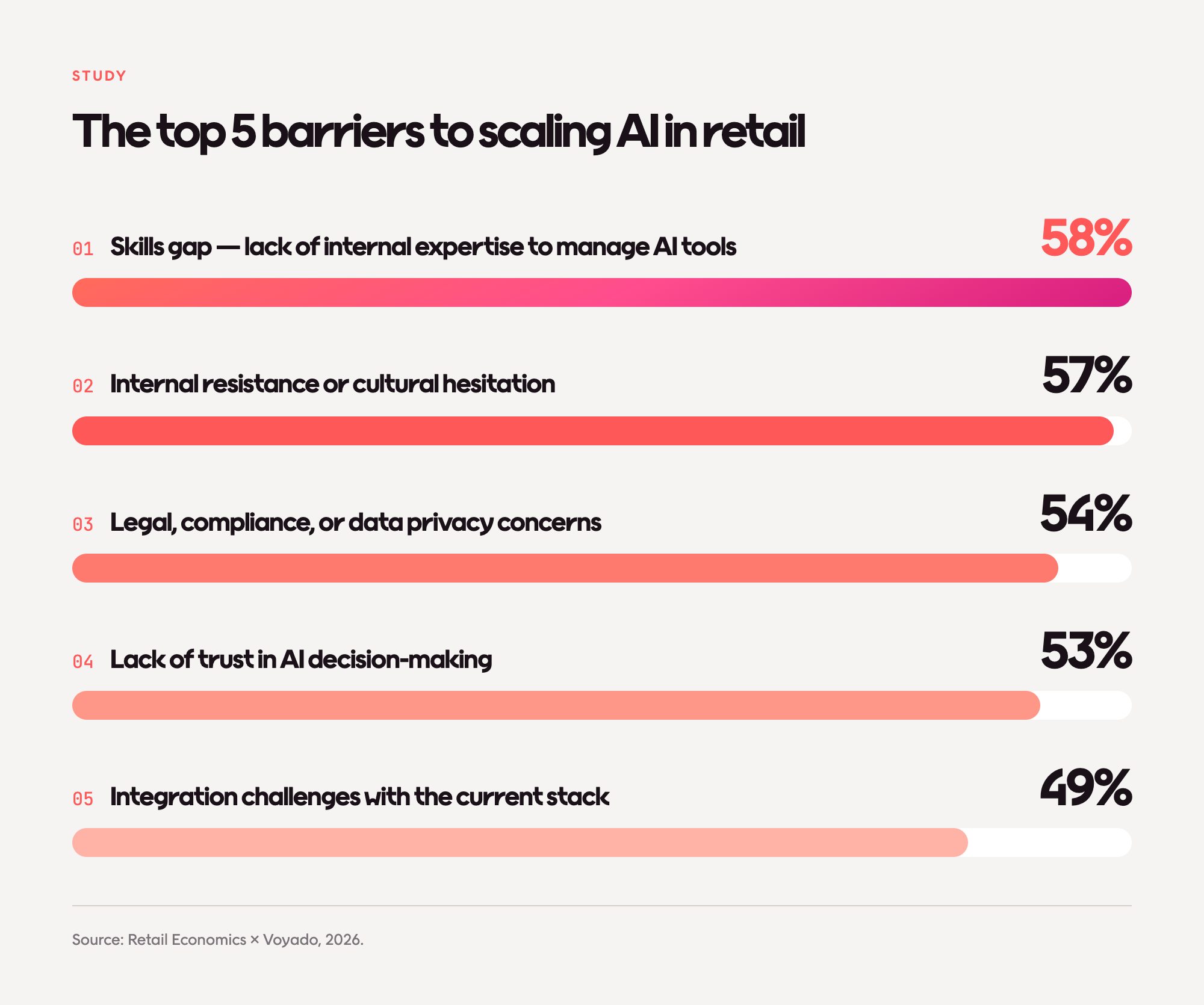
Line those five up, and something is worth pointing out. Skills gaps, cultural hesitation, compliance concerns, and lack of trust. Perhaps these aren’t really five separate problems, but four expressions of what appears to be the same underlying issue: retailers don’t yet trust the AI enough to let it work autonomously, and the conditions that would let them build that trust aren’t fully in place.
What distrust actually looks like in practice
At Voyado’s Love Generation event, Lisa Björnberg, who has worked on AI transformation at Klarna and HubSpot and now advises companies through the same shift, described what she sees inside most retail organizations:
“A lot of AI initiatives in organizations are quite fragmented and scattered. A lot of people are doing a lot of things across the board. I call it activity theater. You have a proof of concept there, you have a chatbot there. It’s very much a horizontal play.”
One could say that activity theater is what distrust looks like operationally. Teams are doing enough AI to be seen doing AI, but they aren’t going deep enough to actually embed it. And the reason isn’t ambition or capability. It’s that going deep would require handing over decisions the team currently makes by hand, and nobody trusts the AI to make those decisions well enough… Yet.
That distrust shows up in specific ways in our conversations with retail teams:
What retailers describe in these conversations is consistent. We’re not getting the sense that they’re rejecting AI. Instead, we’re hearing that they don’t yet have enough visibility into how it makes decisions, enough control to intervene when it gets something wrong, or enough evidence to justify handing over the decisions in the first place. And until those three things exist, “trust the AI” is being asked as a leap of faith. Most retail teams, some would say sensibly, aren’t willing to make it.
Why trust may be structurally hard to build in AI
There’s a possible mechanism underneath all this that would make trust in AI different from trust in earlier retail technology: you can’t easily trust what you can’t interrogate.
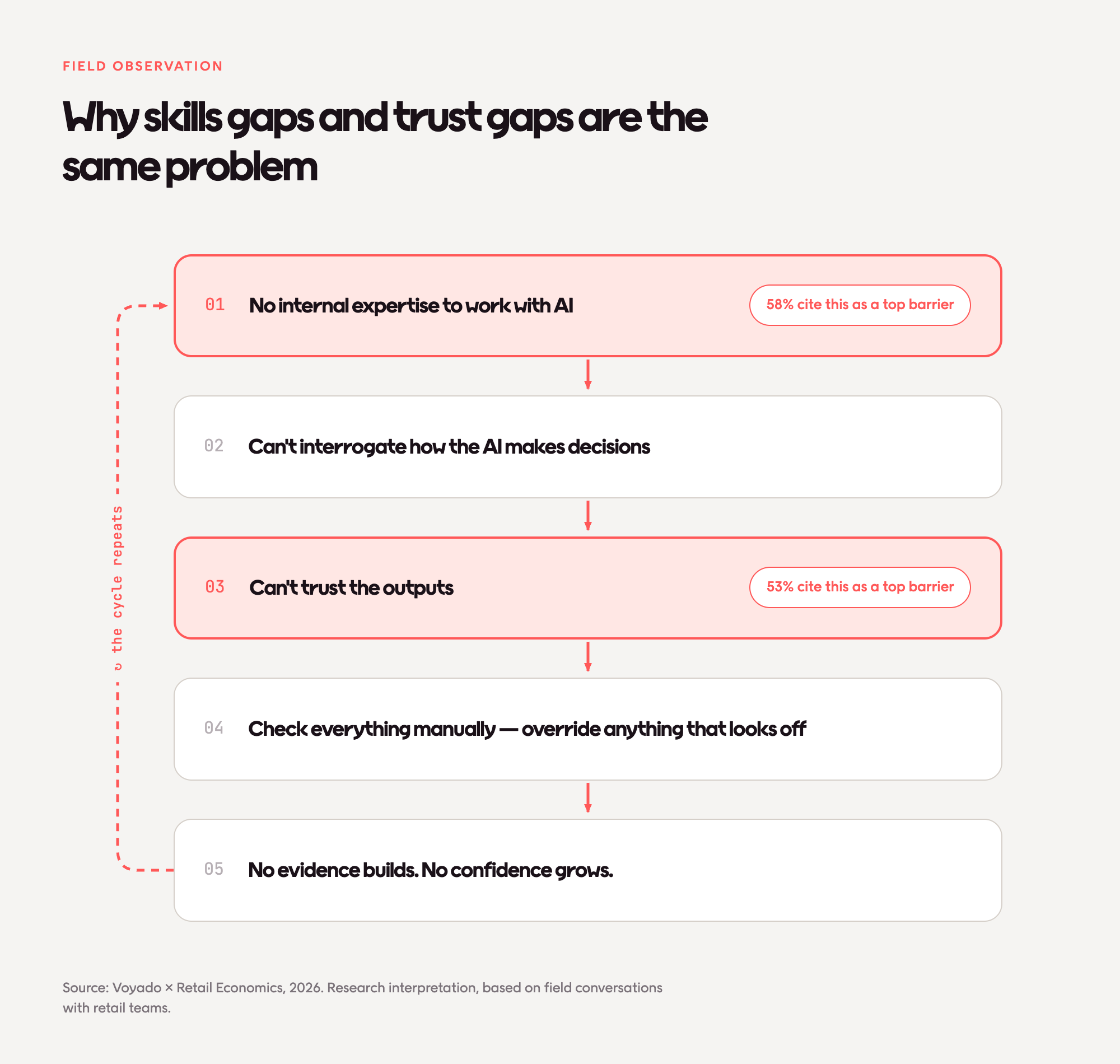
The 58% skills gap and the 53% trust gap in the barriers data are stated separately in the research, but this interpretation, based on how the two show up together in field conversations, is that they are causally connected.
When a team doesn’t have the internal expertise to understand how an AI model reached a particular decision — what data it drew on, how it weighted the signals, why it prioritized this over that — they have little basis on which to trust what it outputs. Every recommendation looks equally credible or equally suspect. So teams do something understandable in this situation: they check everything manually, override anything that looks off, and treat the AI as a suggestion engine rather than a decision-making system.
If that interpretation is right, it means the two barriers can’t be solved separately. Building trust without building skills produces false confidence. Building skills without addressing trust produces frustration. Both would have to move together.
And there’s a second dynamic that may compound this: an accountability vacuum.
The accountability vacuum
When AI makes a decision that goes wrong (e.g., a customer gets a discount they shouldn’t have, a recommendation surfaces something inappropriate, a campaign fires at the wrong moment), who owns it? The marketer approved the campaign but didn’t design the AI. The data team maintains the model but didn’t run the campaign. The vendor built the platform but doesn’t operate it.
That ambiguity is a governance question and not a technology one. And it’s part of why 54% of retailers cite compliance concerns as a top barrier: when nobody clearly owns the outcomes, everybody defaults to caution. Caution becomes inaction. Inaction can look like the technology isn’t working, when what may actually be happening is that the organization hasn’t yet decided how to work with it.
What building trust in AI looks like
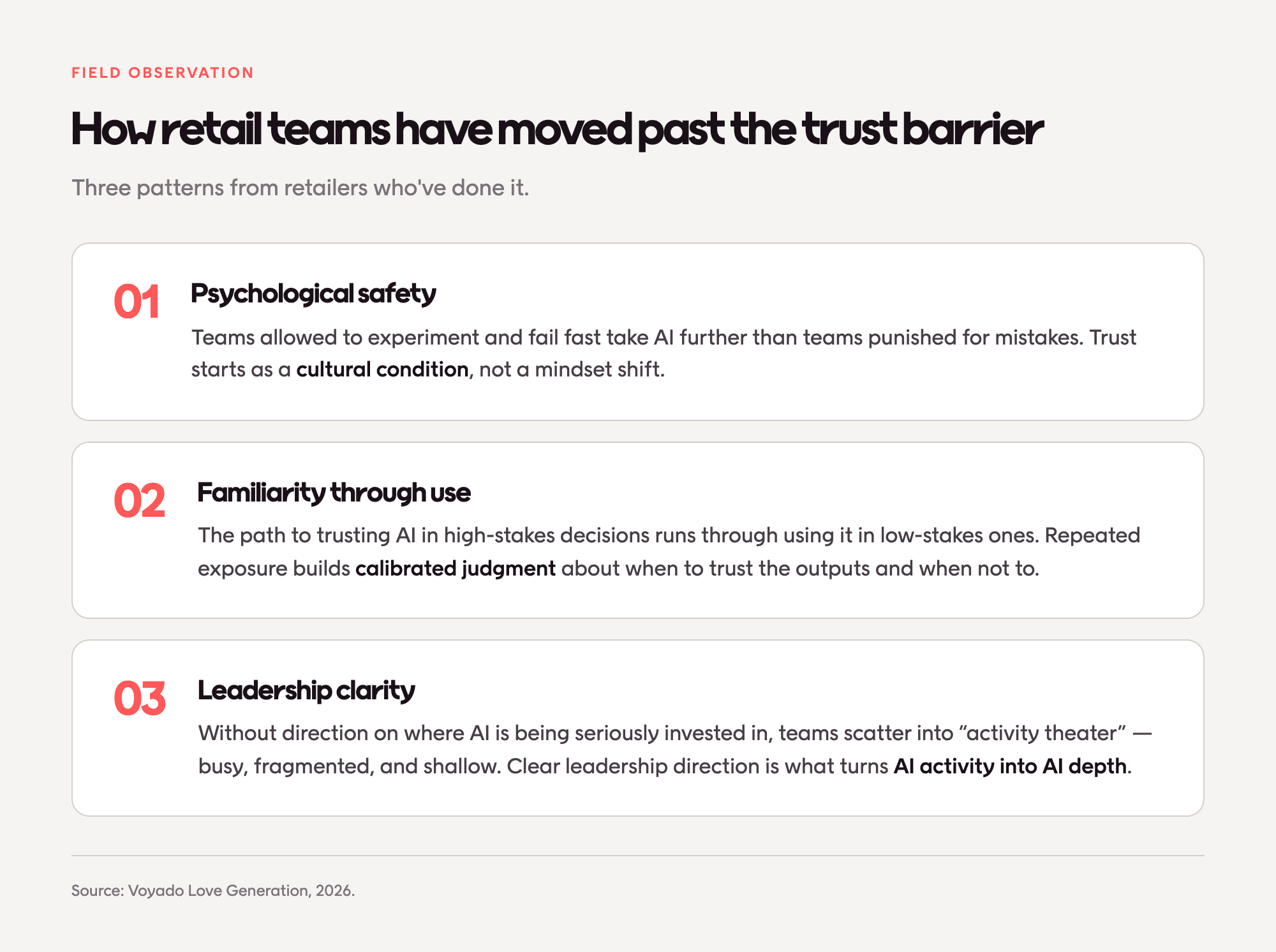
The retailers who have moved past the trust barrier haven’t done it by convincing their teams to have more faith in the AI. Instead, they’ve had to develop the conditions that make trust possible. Three patterns emerged consistently at Love Generation during the panel discussion with retail leaders who’ve genuinely moved forward:
Psychological safety comes first
Svend Mikael Hansen, whose team at Bestseller has been running AI experimentation across code, translation, and campaign work for years, described the cultural foundation that makes it work: “Nobody’s ever been fired for taking the right decision based on the information they had at hand. Would you take the same decision again? That’s probably the right decision. And that’s what we’ve allowed people to do — from apprentices to C-level.” The point isn’t that Bestseller’s culture is unusually forgiving. It’s that a team allowed to fail fast will experiment with AI. A team punished for experimentation that doesn’t work will default to manual, safer decisions, regardless of what the AI is capable of.
Familiarity is the mechanism that builds trust
Magnus Axelsson from Hemtex described how repeated, structured AI use has changed his team’s relationship with model outputs: “The common usage of AI models and the prompting and the ChatGPTs makes people kind of trust an AI model outcome even more. And that makes the other part of my job — to convince people to use the outcome of the AI models — a bit easier as well.” Trust doesn’t come from convincing teams that the AI is trustworthy in the abstract. It comes from them using AI tools in low-stakes contexts often enough that they develop a working sense of when to trust the outputs and when not to.
Leadership sets the direction, or teams scatter
Lisa Björnberg framed the leadership question directly: “You need to let your teams experiment and get to know the tools and understand. But at the end of the day, the CXOs need to be much clearer on what the expectations are and where the big bets are when it comes to AI.” Without clarity from the top on where AI is being seriously invested in — and where it isn’t — teams default to activity theater. Scattered initiatives. Duplicate work. No depth. Trust at the team level requires clarity from leadership about what AI is actually meant to be doing.
There’s also a fourth pattern that comes up in conversations with retail teams: gradual layering of automation once it’s proven itself. Trust doesn’t need to be given all at once. Retailers who move forward start with narrow, observable AI use — e.g., automated subject line testing, product sorting on a single category page, targeted recommendations for one segment — measure the results, and expand only when the evidence justifies it. Far from a leap, trust is a slow, evidence-based expansion of the perimeter.
The reframe: human-in-the-loop is a feature, not a limitation
The conversation about AI in retail often suggests human involvement is a limitation that should be engineered away. “Human-in-the-loop” gets treated as a bridging state, something you tolerate on the way to full automation. That framing turns every human check on the AI into evidence that the AI isn’t good enough yet.
Our research suggests the opposite frame is more useful. Human involvement isn’t the thing preventing AI from delivering value. It’s part of the design principle that lets AI deliver value in retail specifically: where decisions carry margin implications, brand risk, customer trust, and legal exposure that pure automation isn’t yet equipped to weigh on its own.
The retailers who are moving fastest aren’t the ones who have removed humans from the loop. They’re the ones who have deliberately defined the loop: what the AI decides autonomously, what it suggests for human approval, and what remains entirely human-owned. Strategy stays human, brand stays human, and ethical calls stay human. And then optimization within those boundaries increasingly moves to AI. With this setup, both sides do what they’re best at.
That’s the resolution the barriers data points toward. Trust isn’t a problem to be solved by convincing teams the AI is safe. It’s a design property of the system that will be built through visibility, calibrated through experience, and structured by clear ownership of what the AI does and doesn’t decide. When those conditions are in place, trust should follow. When they aren’t, no amount of better AI will produce it.
Jennifer Roebuck Stephens, a UK-based retail investor and AI developer who also spoke at Love Generation, closed her session with a framing worth carrying forward: “AI is not just a technology movement. It’s a human movement, and it’s a behavioral movement.” The 95% of retailers experimenting with AI have proved the technology side. Perhaps the 5% seeing scalable returns have started to prove the human side. The barriers data suggests that’s where most of the work still is, and where most of the value still lives.
Methodology
Survey of retail decision-makers
Retail Economics, an independent economics research consultancy, surveyed 300 marketing and e-commerce leaders across Benelux (Belgium, Netherlands, Luxembourg), DACH (Germany, Austria, Switzerland), Scandinavia (Norway, Sweden, Denmark), and the UK in December 2025. Respondents held senior roles across marketing, e-commerce, CRM, and digital functions.
Voyado Love Generation 2026
Named practitioner observations are drawn from public sessions at Voyado’s Love Generation event, held in Stockholm in 2026. Full session recordings are available here.
About Author