TL;DR
- Predictive marketing reverses the usual approach to retail engagement: instead of reacting to what customers already did, you act on what they’re likely to do next, using historical and behavioral data to forecast future outcomes.
- The shift: predictive marketing scores intent before it converts into action, moving CRM teams from campaign calendars to real-time decisioning that can predict customer behavior.
- Three requirements: unified customer profiles that update instantly, AI models that score the likelihood of engagement or purchase, and activation that fires across marketing channels (email, SMS, app, and in-store) the moment a score changes.
- Where it pays off: the sharpest use cases are churn prevention, revenue growth from high-value segments, basket size expansion, and margin protection.
- The gap is real: according to Voyado’s State of AI in Retail report, 95% of retailers have experimented with AI, but only 5% are seeing clear, scalable ROI. Execution, not adoption, is the bottleneck.
- Where Voyado fits: Voyado (the Customer Engagement Platform) turns predictive scores into next-best-action targeting and marketing automation across every touchpoint your customers actually use.
Your campaigns react to what customers already did, missing the window to influence what they’ll do next. That’s the gap predictive marketing is built to close: shifting your team from reporting on past data to shaping the next purchase, before a customer drifts away.
The trouble is, most retailers can’t make that shift because their data won’t let them. Customer behavior gets split across web, app, email, and in-store systems with no single customer profile tying it together. When you don’t link online-to-offline purchases and point-of-sale (POS) activity to CRM and campaign exposure, you misallocate marketing efforts and end up crediting the wrong channel or missing the right moment entirely.
What if you could target customers before they churn, not after? That’s the promise of predictive analytics for marketing done right: a data foundation strong enough to spot the signals early and act on them automatically.
Voyado uses predictive audiences and AI insights to unify that data and automate next-best-action targeting across marketing channels. In the sections ahead, you’ll learn how to build predictive marketing programs that deliver measurable ROI in omnichannel retail, from unifying fragmented consumer data to activating it across email, SMS, in-store, and predictive advertising on paid channels.
What is predictive marketing?
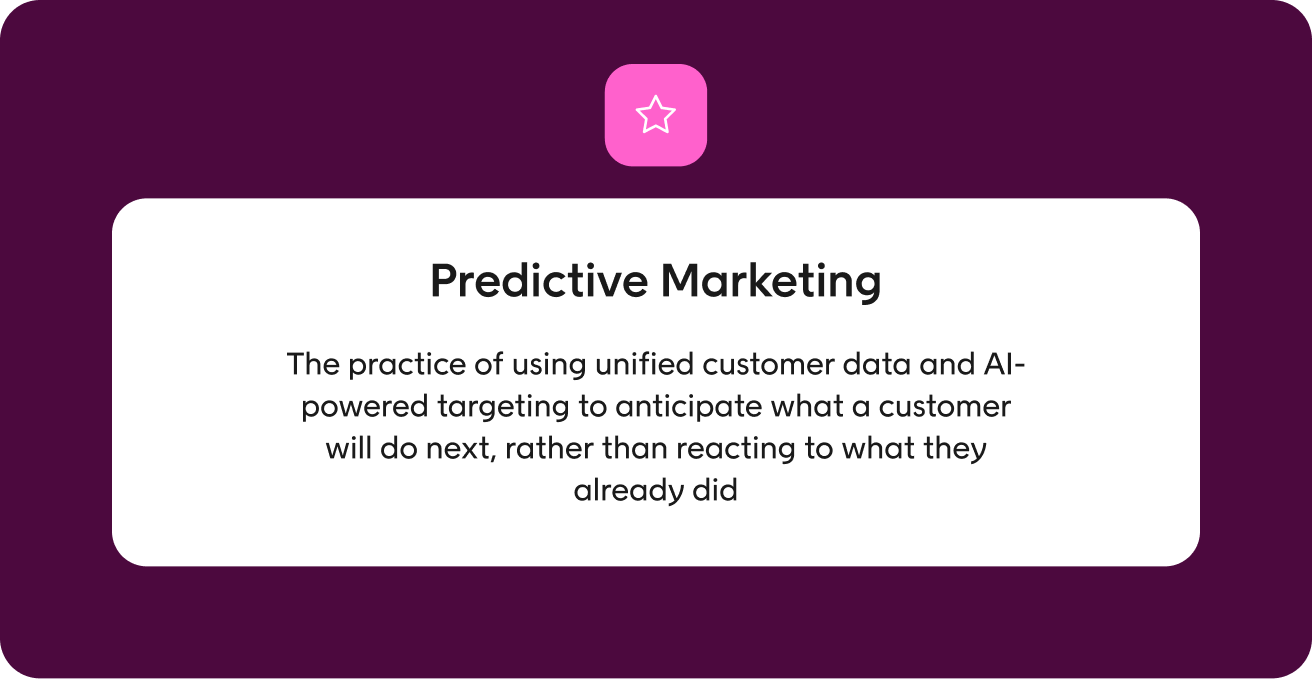
So, what is predictive marketing? It’s the practice of using unified customer data and AI-powered targeting to anticipate what a customer will do next, rather than reacting to what they already did. It sits alongside prescriptive analytics, which goes a step further by recommending a specific action. Predictive marketing tells you what’s likely to happen; prescriptive analytics tells you what to do about it.
The difference shows up fast when you compare workflows:
| Traditional marketing campaigns | Predictive campaigns | |
| Segmentation | Demographic data | Behavioral data and intent |
| Trigger | Fixed campaign calendar | Customer lifecycle stage |
| Success metric | Open rate | Incremental revenue |
Making that shift takes three components working together: unified profiles that update instantly as a customer browses, buys, or redeems a reward; AI models that score each customer’s likelihood to engage or buy based on behaviors, a customer’s preferences, and purchase history; and real-time activation that can act on those scores across email, SMS, app, and in-store, not just one channel.
The shift from guessing to knowing
Once you have scored audiences instead of static segments, guesswork drops out of the equation. You’re no longer sending the same re-engagement email to everyone who hasn’t purchased in 90 days. You’re identifying customers trending toward dormancy and reaching them before they’re lost, or spotting active buyers with strong product affinity and sending personalized upsell prompts timed to their next likely purchase, backed by accurate predictions built to predict future outcomes.
But adoption doesn’t equal ROI. Execution does.
3 reasons most predictive marketing programs fail in retail
According to Voyado’s State of AI in Retail report, 95% of retailers have experimented with AI, but only 5% are seeing clear, scalable ROI. That gap isn’t about ambition or budget. It’s about execution.
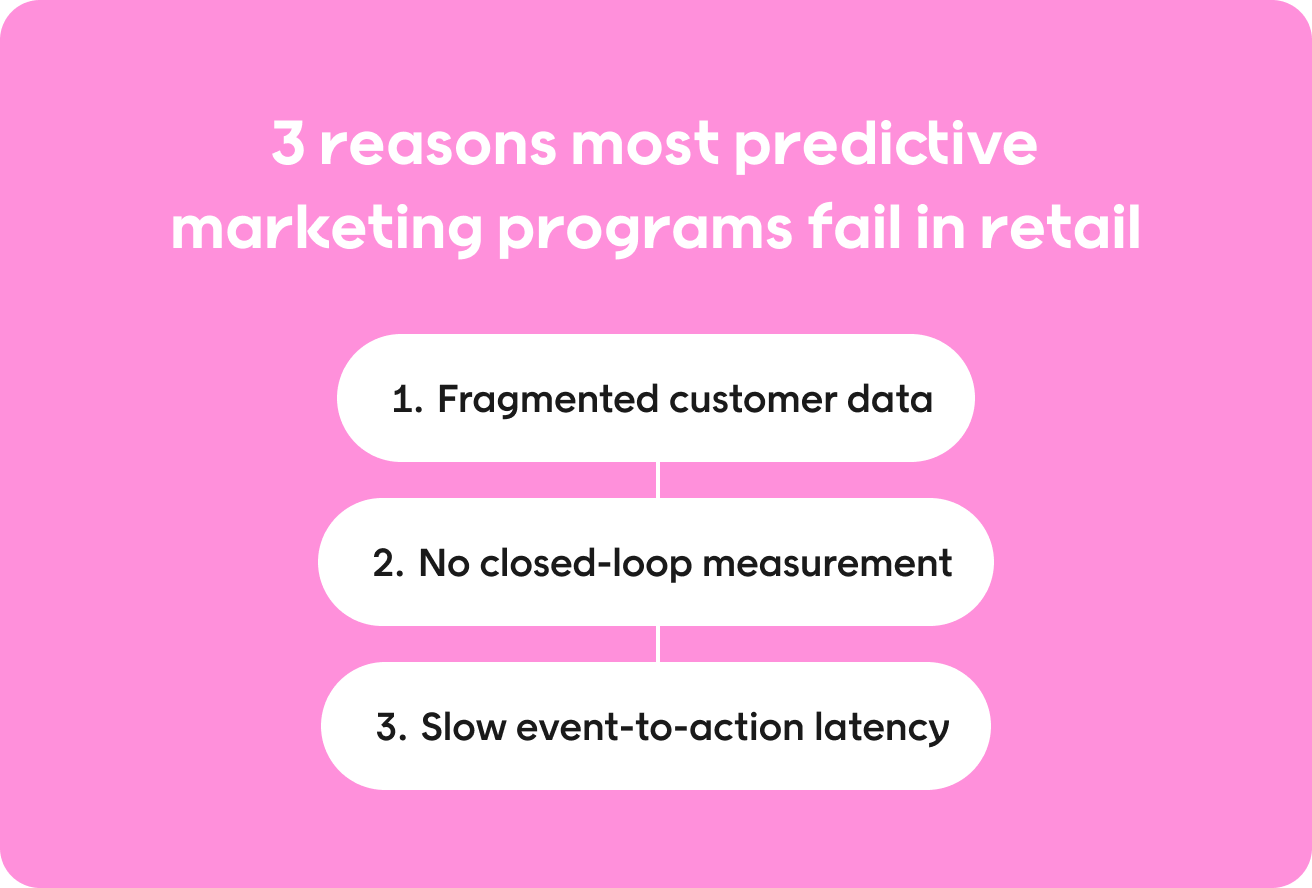
Most predictive marketing programs stall because the underlying infrastructure can’t support what predictive marketing actually requires: complete data, closed measurement, and speed. Here’s where it breaks down.
1. Fragmented customer data
When customer behavior lives in separate silos across web, app, email, and store systems, no single profile ever forms. Predictive models trained on incomplete raw data make incomplete guesses, which shows up as irrelevant targeting and wasted media spend. Fix data fragmentation by turning raw data into accurate data your models can trust, and the same model starts predicting on the full picture instead of a partial one, raising prediction accuracy.
2. No closed-loop measurement
If online-to-offline purchases and POS activity never link back to CRM records and campaign exposure, you have no visibility into results. How do you prove a predictive campaign worked if you can’t connect the email send to the in-store purchase? Without that thread linking financial data to marketing data, teams can’t measure conversion uplift, incremental revenue, or margin after discount, so every campaign result is a guess dressed up as a KPI.
3. Slow event-to-action latency
Triggers like browse, add-to-cart, store visit, and loyalty events decay fast. If your system takes minutes or hours to respond, the window to influence that customer has already closed. Acting inside that window, not after it, is what separates a relevant nudge from a missed sale.
The platforms that deliver ROI solve all three: unified data, closed-loop measurement, and real-time activation.
Predictive marketing in action: 4 retail use cases
Predictive marketing turns customer data into forward-looking action, moving your team from reacting to last week’s sales report to getting ahead of what a particular customer will do next. Instead of blasting the same campaign to everyone, you target different customer segments based on what’s likely to happen: churn, growth, or missed margin. Here’s how that plays out across four core retail scenarios.
1. Churn prevention
Predictive models flag customers drifting toward dormancy before they’re gone for good, so you can re-engage them while churn risk is still manageable. For example, send a personalized “We miss you” offer with a 15% discount to customers who haven’t purchased in 60 days.
2. Revenue growth from high-value customers
Your top-tier buyers deserve protection, not just acquisition budget spent elsewhere. Target them with exclusives and loyalty rewards that reinforce brand loyalty. For example, offer early access to a new collection for customers in the top 10% by customer lifetime value.
3. Basket size expansion
Active buyers are primed for a nudge, not a discount. Personalized recommendations and upsell prompts, powered by predictive data, lift average order value while protecting future sales. For example, recommend complementary products at checkout based on product affinity scores.
4. Margin protection
Frequency caps and cross-channel priority rules stop you from wasting margin on customers who don’t need another push, protecting customer satisfaction and customer experience. For example, suppress discount emails for customers who just purchased at full price.
Underneath all four use cases sits product affinity targeting: predicting whether a customer is a “fan,” “lookalike,” or “detractor” for a given product or brand, so you know exactly who to target, nurture, or exclude. Voyado productizes this execution layer.
How predictive audiences work in omnichannel retail
Predictive audiences take your full customer base and auto-segment it by purchase behavior, lifecycle stage, and product affinity (a form of predictive segmentation that updates static customer segments automatically) so every campaign reaches the right customer at the right moment instead of a broad, one-size-fits-all list. This happens through predictive marketing analytics, where AI models continuously score customers on likelihood to buy, churn, or respond to a specific offer. Here’s how that scoring plays out across three practical segment types.
Purchase personas
Predictive models automatically group customers into behavioral personas: high-value, at-risk, dormant, potential gems, and occasional high spenders. This means you can send top-tier customers exclusive previews, prompt active buyers with relevant upsells, and target dormant customers with re-engagement offers, all without manually building each list. A retailer running a seasonal campaign might trigger three different messages from one send-out, matched to where each persona sits in their buying pattern.
Consumer lifecycle segments
Lifecycle segments cover customers who’ve never purchased, first-time buyers, recurring shoppers, win-back candidates, defecting customers, and lost customers, with outreach timed to match each stage of the customer lifecycle. A defecting customer flagged 30 days after their last purchase can automatically receive a win-back offer before they fully churn. This timing precision is what separates lifecycle-aware messaging from generic drip campaigns.
Product affinity targeting
Affinity models predict whether a customer is a fan, lookalike, or detractor for a given product or brand, so you know who to target, nurture, or exclude. For a new product launch, you can auto-build a lookalike audience based on the purchase patterns of existing customers who are fans of similar items, skipping the guesswork of manual list-building. This same SKU (stock keeping unit)-, category-, or brand-based audience generation speeds up product launches.
None of these segment types work in isolation. Unified customer data that updates instantly is what connects purchase personas, lifecycle segments, and product affinity targeting across every channel you use.
But prediction without activation is just reporting. Here’s how to close the loop.
How to activate predictive insights across every touchpoint
Speed isn’t a nice-to-have here. It’s the whole game. A browse event picked up in website analytics, an add-to-cart, a store visit, a loyalty point earned: all of these signals start decaying the moment they happen. Wait an hour to act on a cart abandonment, and you’re often too late. The intent has cooled, and the customer has either bought elsewhere or moved on.
Acting inside that decay window is where predictive marketing earns its name. It’s the execution layer that turns a prediction into revenue, not just a dashboard insight. If your system can’t act within a few seconds of the behavior, you’re not doing predictive marketing. You’re doing reporting.
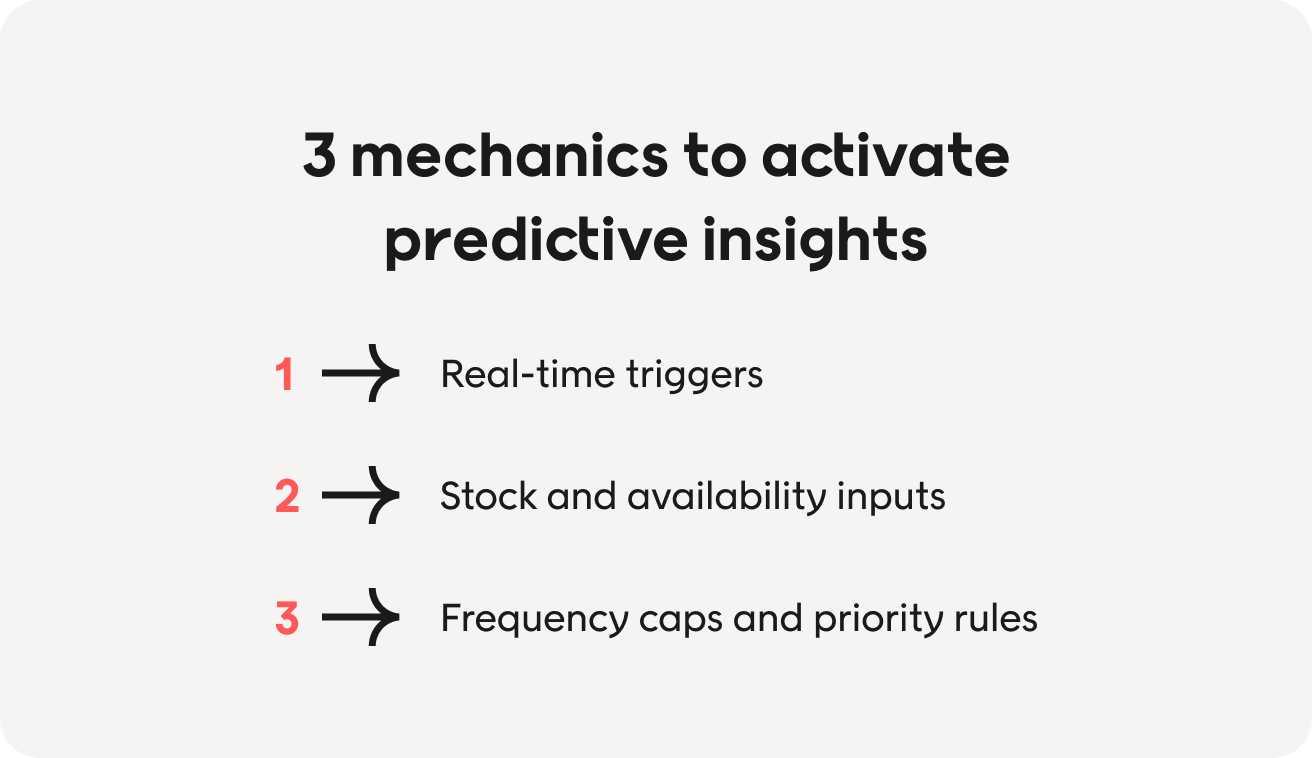
Three mechanics make that activation possible.
Real-time triggers. Fire email, SMS, app push, or in-store prompts within seconds of a qualifying behavior, not hours later. A practical example: send a cart abandonment email 10 minutes after a customer adds items but doesn’t check out, while the intent is still warm.
Stock and availability inputs. Feed real-time stock, pricing, and availability data directly into predictive targeting so recommendations never point customers toward dead ends. In practice, that means excluding out-of-stock items from personalized recommendations to avoid wasted clicks and lost margin.
Frequency caps and priority rules. Set cross-channel frequency caps and priority rules to reduce unsubscribes and stop burning margin on repetitive offers. For example, suppress promotional emails for seven days after a purchase to prevent over-messaging a customer who just converted.
Search and recommendations need this same discipline, adapting to intent, real behavior, and live stock levels so product discovery stays relevant instead of pointing shoppers toward items that are sold out or irrelevant to their session.
Activation without measurement is guesswork. Here’s how to prove ROI.
Measuring predictive marketing impact
Predictive marketing programs improve only when you measure the right things. That means building a data analytics framework around six core metrics, not just watching open rates climb.
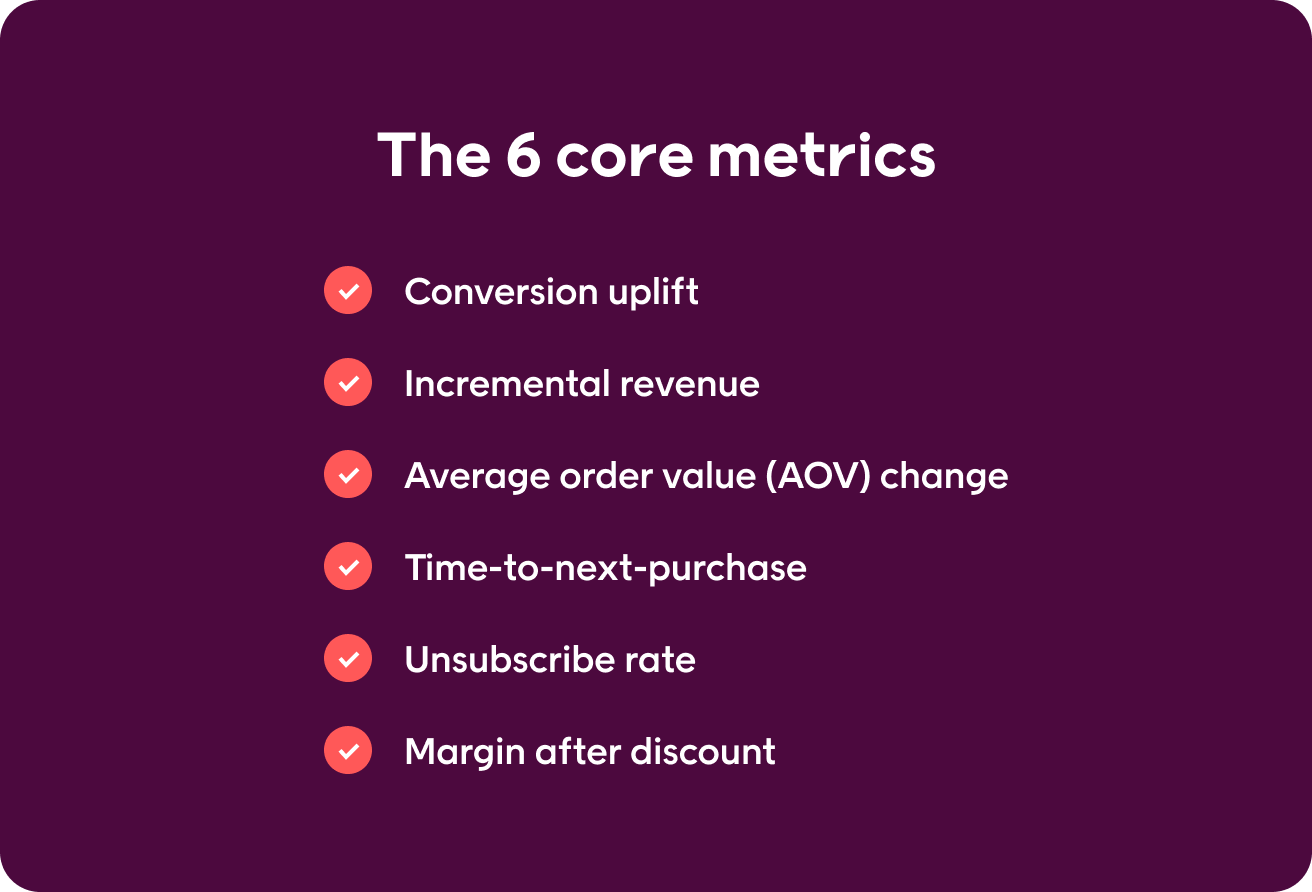
Conversion uplift: the percentage increase in purchase rate for targeted customers versus a control group.
Incremental revenue: revenue generated by predictive campaigns that wouldn’t have occurred without targeting.
Average order value (AOV) change: the shift in AOV for customers targeted with upsell or cross-sell prompts.
Time-to-next-purchase: the number of days between purchases for customers in lifecycle or win-back journeys.
Unsubscribe rate: the percentage of customers who opt out after receiving predictive campaigns (lower is better).
Margin after discount: profit retained after promotional offers, so you can catch discount leakage before it eats your gains.
None of these numbers mean much in isolation. Closed-loop measurement links online-to-offline purchases and POS activity back to CRM records and campaign exposure, so you can prove which campaign drove which dollar of revenue, in-store or online. And incrementality testing, using holdout groups who don’t receive the predictive treatment, separates true campaign impact from baseline behavior customers would have shown anyway.
How Voyado delivers predictive marketing ROI
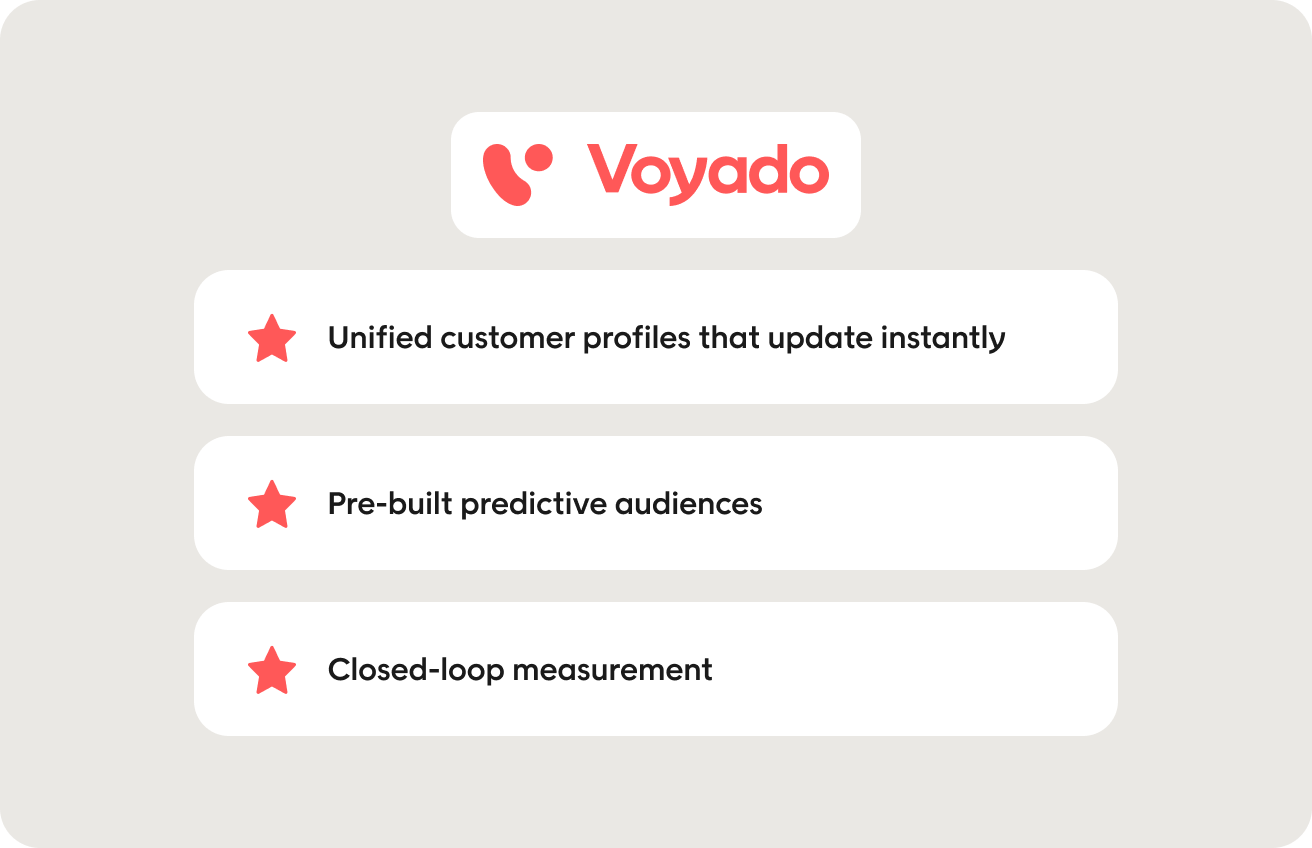
For teams choosing between platforms that report on the past and ones that act on the present, this decision point matters most. Not every predictive analytics software gets it right. Predictive marketing only works when the data feeding it is complete, current, and connected to execution. Otherwise, you’re just building smarter dashboards, not smarter, data-driven decisions. Voyado’s predictive audiences and AI insights shift you from reactive campaigns to proactive engagement by unifying data and automating next-best-action targeting across every touchpoint.
Unified customer profiles that update instantly
Connect web, app, email, and POS data into a single record so predictive models score on complete behavior, not fragmented snapshots. This eliminates the “split identity” problem that breaks targeting accuracy, where a shopper’s in-store purchase never reaches the model scoring their email engagement, letting marketing teams implement predictive analytics at scale.
Pre-built predictive audiences
Purchase personas, lifecycle segments, and product affinity targeting auto-segment the full customer base so you can launch three to five live predictive journeys in weeks, not months, with no data science team required. That’s the difference between predictive marketing as a roadmap item and predictive marketing as this quarter’s revenue driver, compounding value across the customer lifetime.
Closed-loop measurement
Link online-to-offline purchases and POS activity to CRM and campaign exposure so you can measure conversion uplift, incremental revenue, and margin after discount, proving which campaigns drove which revenue. No more crediting a sale to the last touch when three channels actually earned it.
Speed matters as much as structure: event-to-action latency under a few seconds enables real-time triggers like browse, add-to-cart, store visit, and loyalty events to fire before the window closes. And because real-time stock, pricing, and availability inputs feed every decision, you avoid irrelevant product discovery and wasted margin on items you can’t fulfill.

FAQs
What is predictive marketing?
Predictive marketing uses unified customer data and AI-powered targeting to anticipate a shopper’s next action instead of reacting to what already happened. It needs three things working together: profiles that update instantly across channels, AI models that score the likelihood of engagement or purchase, and real-time activation across email, SMS, app, and in-store. That’s the foundation of predictive marketing software built for retail.
What are predictive marketing examples?
Common examples include targeting dormant customers with re-engagement offers before they lapse for good, sending upsell prompts to active buyers based on product affinity scores, and offering top-tier customers early access to new collections based on lifetime value. Purchase personas automatically segment your full customer base by behavior, so campaigns can target high-value shoppers, flag at-risk customers, and drive higher customer satisfaction.
What is a predictive marketing strategy?
A predictive marketing strategy shifts you from reacting to past behavior toward anticipating what a customer will do next, using unified customer data and AI-powered targeting. It rests on four components: unified profiles that update instantly, lifecycle and persona-based segmentation, real-time triggers with low event-to-action latency, and closed-loop measurement of conversion uplift and incremental revenue, backed by the right analytics tools.
How do you measure predictive marketing impact?
Track conversion uplift (or conversion rates), incremental revenue, AOV change, time-to-next-purchase, unsubscribe rate, and margin after discount. Closed-loop measurement links online and in-store purchases, including POS activity and financial data, back to CRM records and campaign exposure, so you can prove which campaigns actually drove which revenue rather than guessing, for clearer marketing outcomes.
What is predictive analytics marketing?
Predictive analytics marketing uses AI models and statistical modeling to score customers based on behaviors, preferences, and purchase history, then activates those scores in real-time campaigns. The output: predictive audiences (high-value, at-risk, dormant, and product fans) that auto-update as customer behavior changes, drawing on existing customer data as much as new signals.
Why do most predictive marketing programs fail?
Most predictive marketing programs fail because they tackle one problem while ignoring the other two: fragmented customer data leaves models predicting on incomplete profiles instead of reliable consumer data, missing closed-loop measurement means teams can’t tie campaigns back to revenue, and slow event-to-action latency lets triggers decay before the system acts. Programs succeed only when they solve all three at once, which is what makes predictive marketing work.