TL;DR
Most retail businesses know they need better customer data from the in-store experience. The challenge is collecting it without slowing checkout or creating privacy concerns.
The fix is simple: make customer identification in-store feel natural, not forced.
Here’s what works best:
- Loyalty enrollment at checkout with clear loyalty rewards
- POS-linked identification that connects purchases to a customer profile
- QR codes for fast opt-ins on the shop floor
- Digital receipts that help collect customer information automatically
When these touchpoints connect to one system, every visit adds first-party data, improves customer experience, and supports stronger marketing campaigns across shopping channels.
Voyado helps you do this in real time. Transactions link instantly to unified profiles, so your in-store data collection powers email, loyalty, and online personalization without extra work for store staff.
Why in-store data collection matters more in 2026
Most retail businesses still treat the physical store as a blind spot for customer data.
If a shopper isn’t identified at checkout, the purchase stays anonymous. It can’t connect to their customer profile, loyalty status, purchase history, or online behavior. That means your CRM only sees part of the shopping journey.
The result is weaker personalization in retail, incomplete customer segments, and loyalty programs that miss real customer interactions across channels. This is precisely why understanding the importance of omnichannel has become critical for store and CRM teams.
The problem isn’t new, and the fix isn’t collecting more data. Asking shoppers to share customer information can feel intrusive. Store teams often lack simple tools. Identification slows down the checkout flow if the process isn’t well-designed.
What you should be doing is designing in-store data collection so it feels natural inside the shopping experience, not like an extra step.
What makes in-store data collection feel frictionless
Frictionless in-store data collection helps your teams collect customer data without slowing checkout or disrupting the shopping journey. When done right, it improves customer insights, supports customer retention, and turns everyday store visits into useful behavioral data your CRM can act on.
Here’s what makes it work:
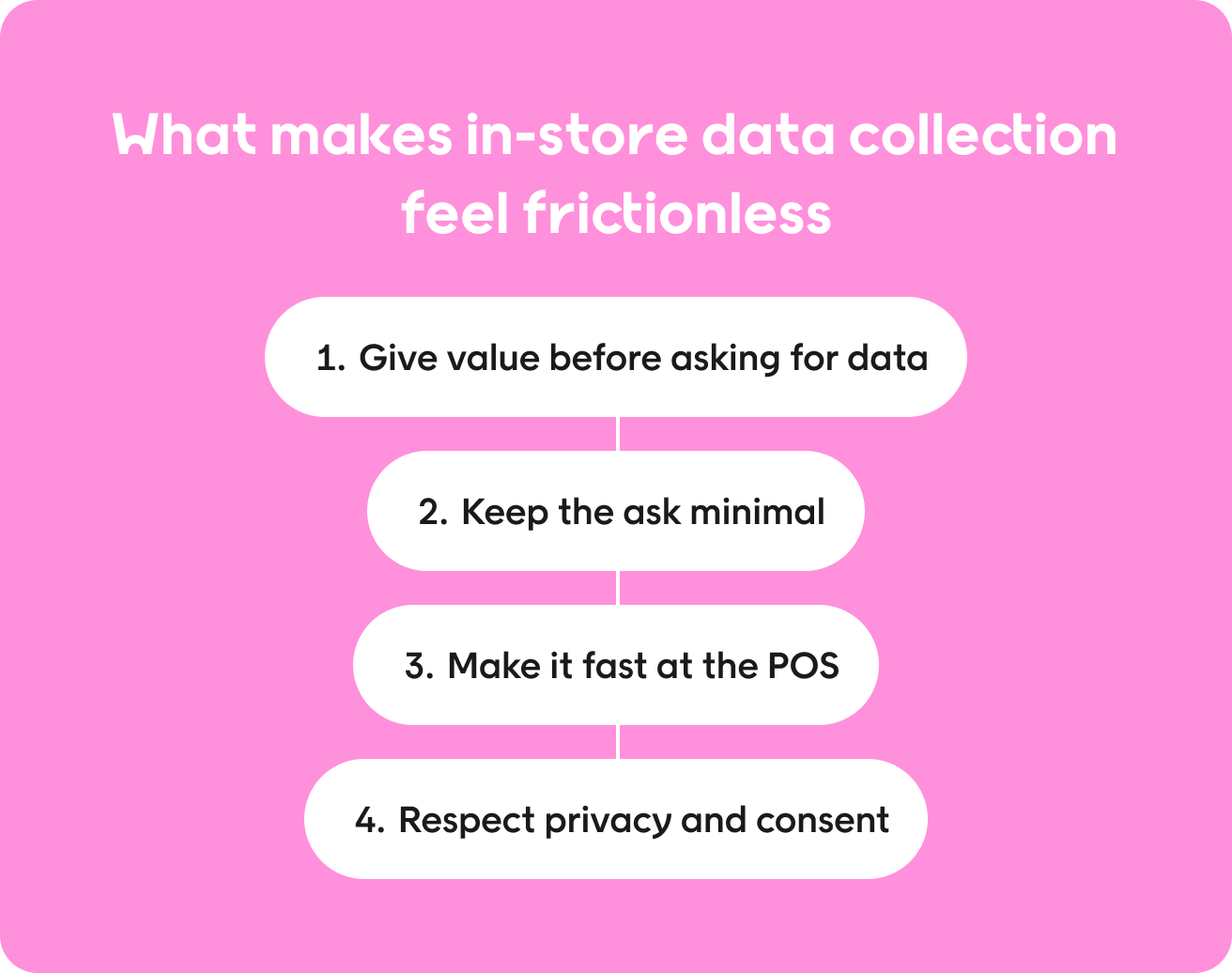
Give value before asking for data
Customers share customer data when there’s a clear benefit. Loyalty points, digital receipts, or early access to offers make identification feel useful, not intrusive. Strong incentives also support long-term customer loyalty and retention through a customer loyalty platform program.
Keep the ask minimal
At checkout, one identifier is enough. Email, phone number, or membership ID lets you connect the purchase to a customer profile. You can collect more details later through opt-ins across your own channels.
Make it fast at the POS
Identification should take seconds. If it slows the line, staff won’t do it consistently. Simple flows help teams collect customer data naturally during everyday customer interactions in-store.
Respect privacy and consent
Clear messaging builds trust. Explain what data you collect and why, and always capture proper consent. When teams handle customer privacy well, it becomes easier to measure and use your retail data responsibly across channels. Be sure to measure and use your retail data to turn it into action.
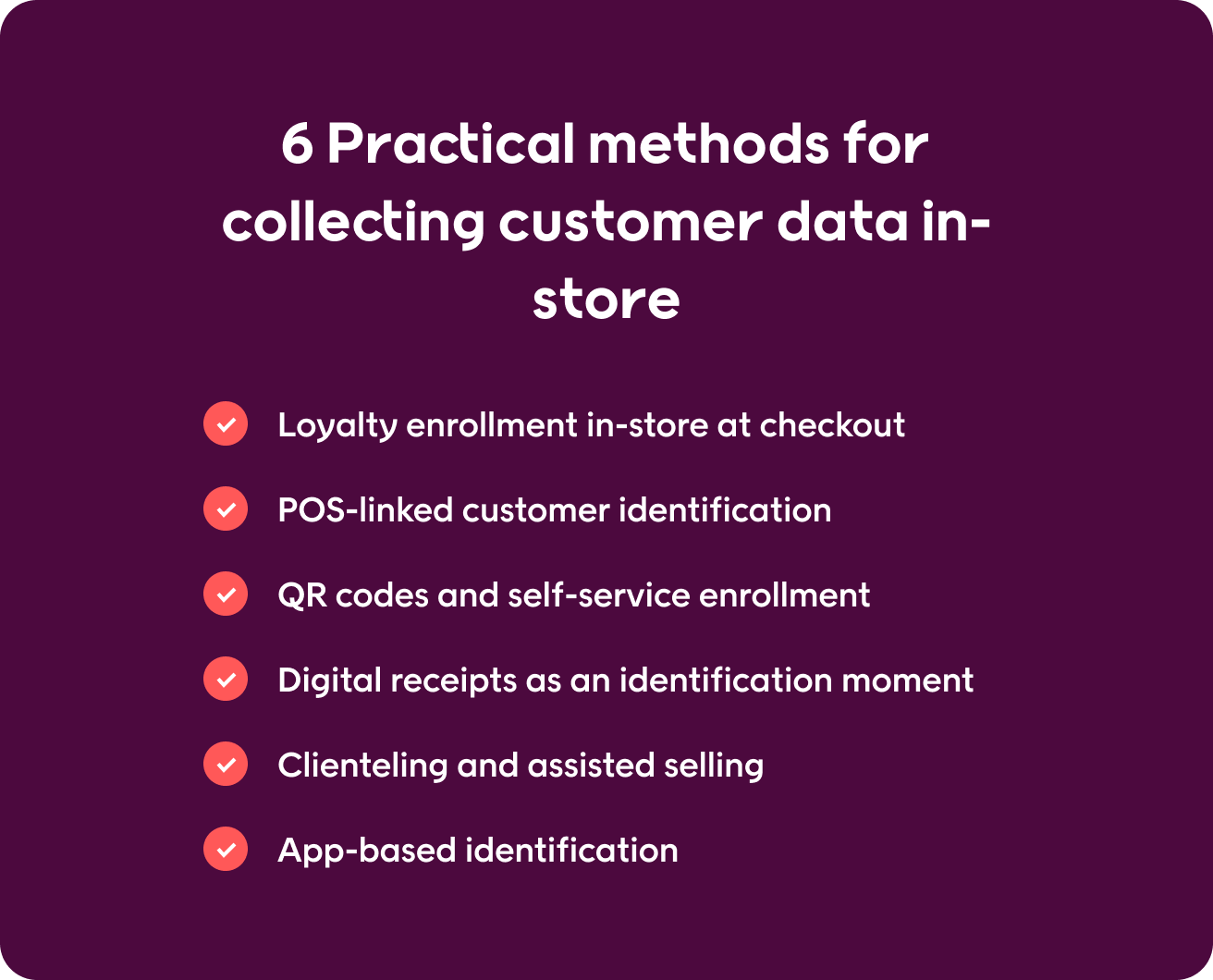
6 Practical methods for collecting customer data in-store
Use a mix of identification moments across the store. Start at checkout. Then expand to self-service and assisted interactions. Together, these methods improve retail customer data collection without slowing the shopping journey.
1. Loyalty enrollment in-store at checkout
Loyalty enrollment in-store is the fastest way to collect customer data during a purchase. A phone number or email is enough to connect the transaction to a customer profile and start building purchase history.
| What this solves | What to do | Example | How you know it’s working |
| Anonymous transactions | Ask for one identifier at checkout | “Would you like loyalty points for today’s purchase?” | More transactions linked to a customer profile |
| Low program adoption | Offer instant loyalty rewards | Give welcome loyalty points on first signup | Enrollment rate increases per store |
| Limited customer insights | Connect enrollment directly to CRM | Auto-create profiles at first purchase | Stronger customer segments over time |
| Weak customer retention | Explain the value clearly | Early access to personalized promotions | Higher repeat purchase frequency |
Keep enrollment minimal. Avoid paper forms. Collect customer preferences later through follow-up touchpoints.
If your program needs structure, start here:
Review the full list of loyalty program benefits and then implement your customer loyalty program.
2. POS-linked customer identification
Existing members should be identified automatically at checkout. A phone lookup, loyalty scan, or app barcode connects the transaction to the customer profile in seconds.
| What this solves | What to do | Example | How you know it’s working |
| Missing purchase history from store visits | Identify members directly in the POS | Scan loyalty barcode at checkout | Higher share of identified transactions |
| Fragmented customer data across channels | Sync POS and CRM in real time | Auto-attach purchases to profiles | More complete customer insights |
| Manual workflows for store teams | Keep identification inside the checkout flow | No system switching for staff | Faster identification time per transaction |
This approach strengthens in-store data collection that retail teams can rely on every day and ensures behavioral data updates immediately after each purchase.
3. QR codes and self-service enrollment
QR codes help collect customer data without requiring staff interaction. They work well in fast-moving stores or self-checkout environments.
| What this solves | What to do | Example | How you know it’s working |
| Checkout time pressure | Place QR codes near the register | “Join in seconds – scan here” signage | Higher self-service enrollment share |
| Missed identification moments | Add QR codes to receipts and displays | Scan to join after purchase | More new customers identified post-transaction |
| Limited access to first-party data | Connect QR signup directly to CRM | Instant profile creation after scan | Growth in first-party data captured in store |
Keep landing pages short. Explain the benefit clearly before asking customers to collect data.
4. Digital receipts as an identification moment
Digital receipts create a natural reason to collect customer information at checkout. Customers get a useful record of their purchase. You gain an identifier tied to the transaction.
| What this solves | What to do | Example | How you know it’s working |
| Anonymous receipt handling | Offer email receipts instead of paper forms | “Would you like a digital receipt?” | Higher share of identified purchases |
| Limited engagement after checkout | Add loyalty prompt after receipt delivery | Invite customers to join after purchase | Increased loyalty signups after receipt send |
| Weak connection between channels | Link receipts to CRM automatically | Attach receipt to customer profile | Stronger cross-channel customer interactions |
Digital receipts are one of the simplest ways to improve in-store data collection that retail teams can deploy quickly.
5. Clienteling and assisted selling
Clienteling works best in categories with higher-consideration purchases. Associates can collect qualitative data during conversations, not just at checkout.
| What this solves | What to do | Example | How you know it’s working |
| Limited visibility into customer preferences | Record notes during assisted selling | Save size, style, or product interests | Richer customer preferences in profiles |
| Missed relationship-building moments | Identify returning customers early | Look up past purchases before advising | Higher customer satisfaction scores |
| Incomplete behavioral data | Add interaction notes to CRM | Capture intent during store visits | More actionable insights for follow-up campaigns |
This approach strengthens relationships while improving retail customer data collection across the full shopping journey.
6. App-based identification
Mobile apps make identification effortless for engaged customers. A loyalty barcode or in-store check-in connects purchases automatically.
| What this solves | What to do | Example | How you know it’s working |
| Repeat manual identification steps | Let customers scan their app at checkout | Loyalty barcode in wallet view | Faster checkout identification time |
| Disconnected engagement data | Sync app activity with store visits | Link app check-in to profile updates | Stronger engagement data across shopping channels |
| Missed personalization opportunities | Trigger personalized promotions in store | App-based offer at checkout | Increased response to in-store campaigns |
App identification works best alongside loyalty enrollment in-store and POS identification. Together, they create consistent access to customer data across the physical store.
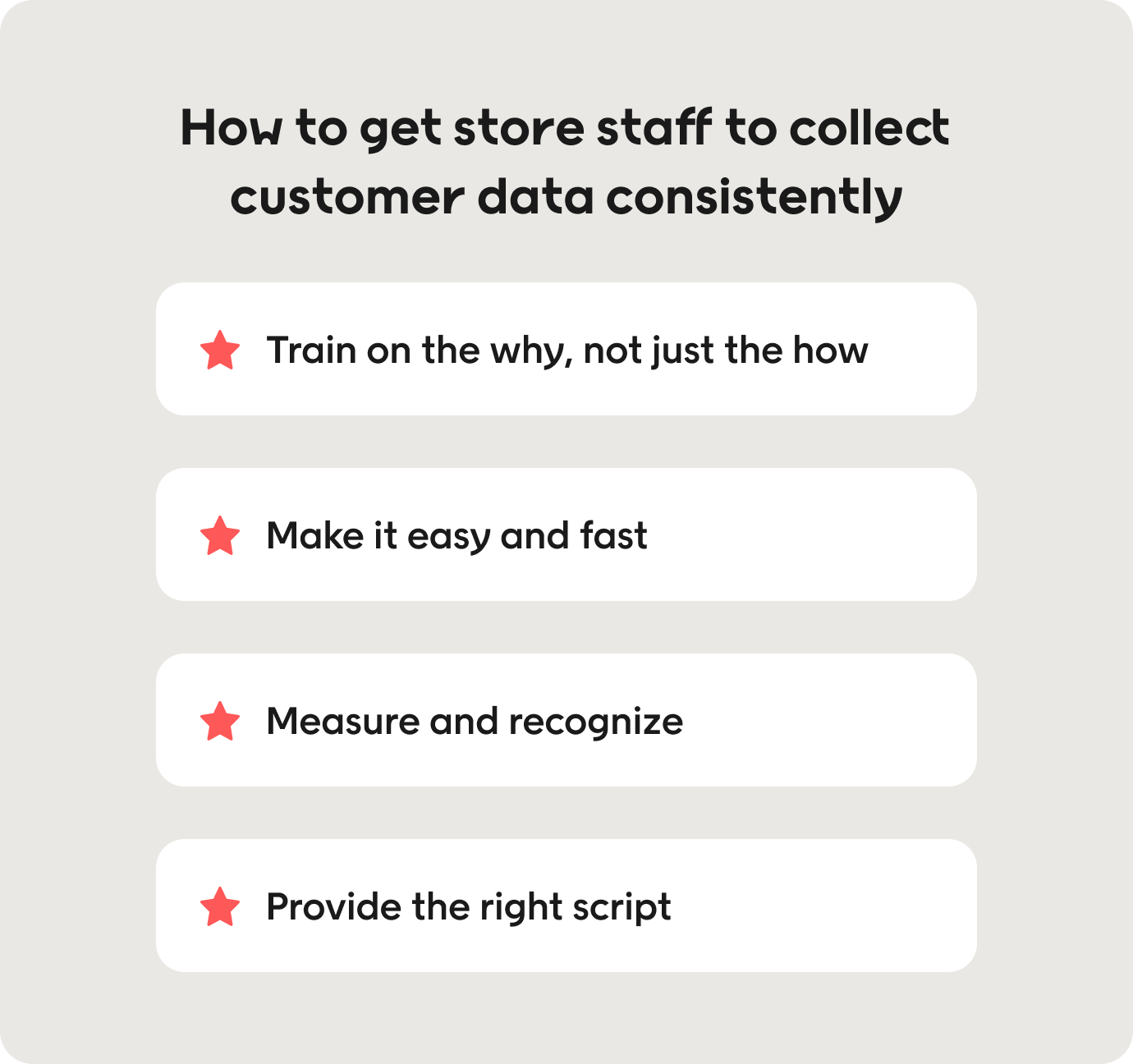
How to get store staff to collect customer data consistently
Even strong in-store data collection retail programs fail if store teams don’t use them consistently. The goal isn’t to ask more often. It’s to make identification part of everyday customer interactions.
Here’s a simple rollout sequence your teams can follow.
Train on the why, not just the how
Days 1–5: alignment
Start by explaining how identification improves the customer experience and supports customer lifetime value across the full shopping journey. When associates understand how identification connects purchases to customer profiles, they’re more likely to collect data naturally.
Show store-level identification rates. Share examples of how better data collection helps teams support returning customers with relevant service and follow-up.
This creates motivation before process.
For teams building long-term loyalty impact, connect identification to customer lifetime value so staff see how everyday actions support long-term results.
Make it easy and fast
Days 6–10: workflow simplification
Keep the process to one step. One identifier. One moment to ask.
If associates need multiple screens or steps, identification stops happening. Fast lookup tools help teams collect consumer data in seconds without interrupting the checkout flow in the physical store.
Clear workflows also reduce privacy rules uncertainty and make proper consent easier to manage during real conversations with customers.
The simpler the process, the more reliable the data collected across stores.
Measure and recognize
Days 11–20: visibility and tracking
Track identification rates by store, shift, or team. Share results weekly so progress stays visible.
This turns data collection into a shared goal instead of an individual task. Over time, performance data helps teams identify trends and improve consistency across locations.
Recognition matters. Highlight stores that improve identification rates the fastest. Small wins drive adoption quickly across retail businesses.
Provide the right script
Days 21–30: behavior reinforcement
Give associates one simple sentence they can use every time.
For example: “Are you a member? I can add your points for this purchase.”
This keeps the ask natural and value-led. It also helps teams collect customer data while supporting personalized promotions and improved shopping experiences in-store.
When identification becomes routine, it strengthens personalization in retail and creates more opportunities to understand customer needs across your omnichannel strategy.
Tip: Learn more about how this connects to personalization in retail and why consistent identification improves results across every touchpoint.
Connecting in-store data to your CRM and loyalty platform
Collecting customer data in-store only creates value when it connects to the same system your teams already use across channels. The goal isn’t to rebuild your setup. It’s to make sure store activity strengthens the customer profile you already have.
Most retail businesses don’t need to start from scratch. They need faster data flow between POS, CRM, and loyalty so data becomes usable across marketing efforts, segmentation, and customer interactions right away.
Real-time POS-to-CRM sync
Store purchases should update the customer profile immediately, not hours later.
When transactions sync in real time, your teams can gather valuable insights right after checkout. Loyalty points apply instantly. Segments update automatically. Campaign timing improves because data usage reflects what customers actually bought in the store, not what they browsed days earlier.
This is where many identification strategies fail. Teams collect customer data successfully, but can’t activate it fast enough to support the next step in the shopping journey.
Voyado’s POS Accelerator (for Voyado Engage) connects transactions directly to the customer profile as they happen. That turns store activity into usable engagement data without adding manual steps for store teams.
Unified customer profiles across channels
Store purchases shouldn’t live in a separate system from online activity.
A unified profile combines in-store behavior with browsing history and loyalty status so teams can identify shopping patterns across the full relationship. This creates deeper insights and supports a more personalized experience across touchpoints.
For example:
- Emails can reflect recent in-store purchases
- Loyalty rewards earned in-store can be used online
- Segments update based on real purchase behavior
- Campaigns stop promoting products customers already bought
This is what makes true omnichannel engagement possible and explains why strong personalization in retail depends on connected data across the entire customer journey.
Privacy-compliant data management
In-store identification should follow the same consent standards as online activity.
Customers should always understand what customer data is collected and how it’s used. Clear permissions make it easier to gather information confidently and reduce privacy concerns across stores.
Consistent consent handling also supports post-purchase surveys, feedback surveys, and other attitudinal data collection later in the relationship. When customers trust how their data is handled, they’re more willing to share valuable information that improves future interactions.
Tip: If you want to strengthen how you measure consent-driven engagement across channels, explore how to measure and use your retail data more effectively as part of your broader data strategy.
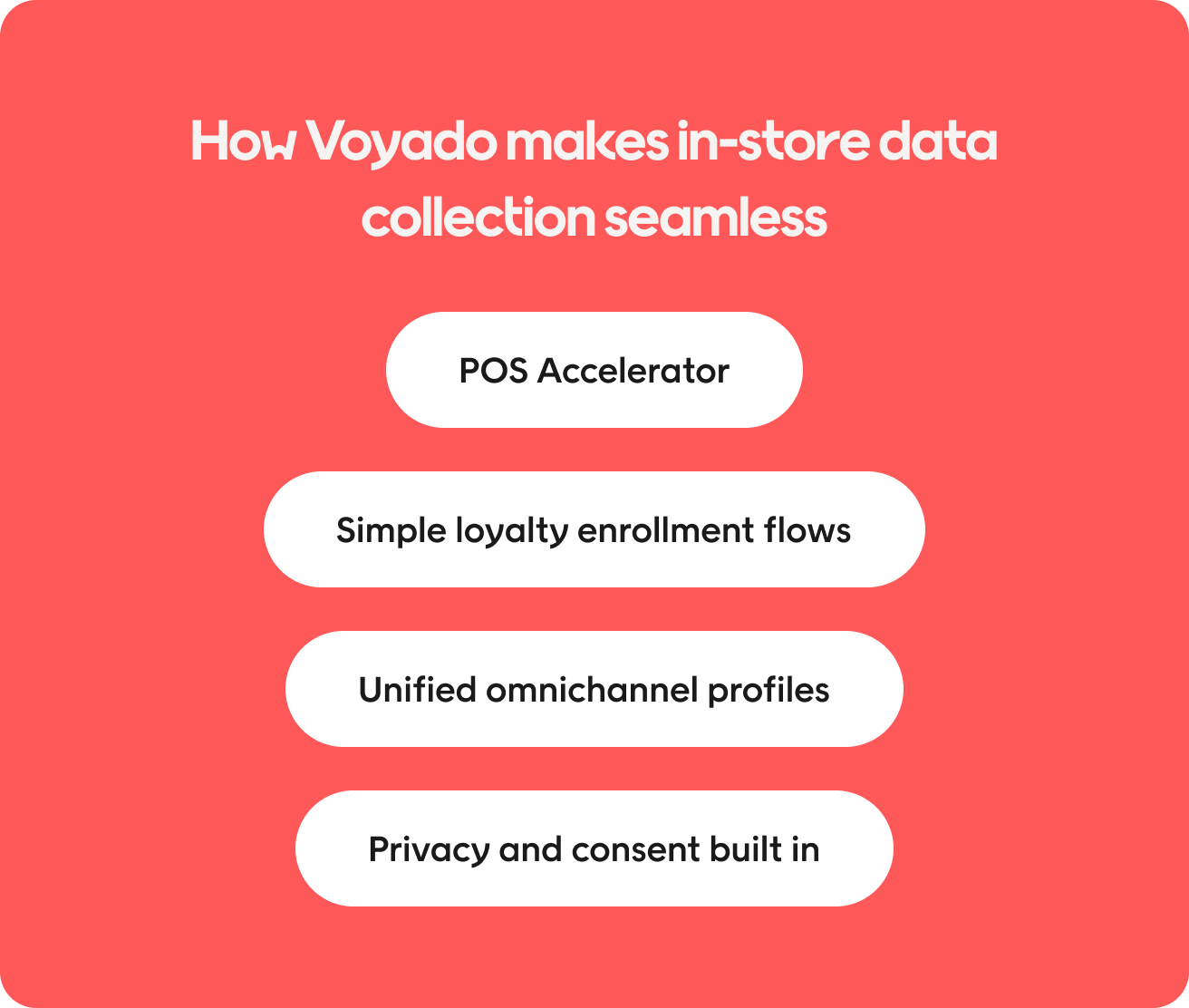
How Voyado makes in-store data collection seamless
By now, you know that your business doesn’t need more tools. You need your store identification, loyalty enrollment in-store, and CRM to work together without slowing checkout or creating extra steps for staff.
That’s what Voyado is designed to do.
POS Accelerator: Link every transaction to a customer profile
Voyado’s POS Accelerator for Voyado Engage connects directly to your POS so every purchase links to the customer profile in real time.
Associates can identify members instantly, apply loyalty rewards, and collect customer data without switching systems. Each transaction adds product-level detail that improves segmentation, engagement timing, and future recommendations.
The result: store activity becomes usable immediately instead of sitting in disconnected systems.
Simple loyalty enrollment flows
Voyado supports enrollment at the POS, through QR codes, inside your app, or online.
Signup starts with one identifier. Additional identity data builds over time through onboarding flows and follow-up interactions across your own channels. This makes it easier to scale identification without disrupting checkout, especially for teams working to implement your customer loyalty program in a way that fits everyday store routines.
Unified omnichannel profiles
Voyado brings store, email, app, and loyalty activity into one customer profile.
That means data collected in-store becomes available immediately for segmentation, engagement triggers, and marketing campaigns across channels. This is what retailers expect from a modern customer loyalty platform and why connected data is essential for true omnichannel engagement across the full customer journey.
Privacy and consent built in
Voyado is designed for first-party data collection with customer privacy and consent management across channels from the start.
Customers can update permissions at any time. Teams stay aligned with privacy rules while continuing to gather valuable insights that support stronger customer relationships and long-term business growth.
If your team needs to close the in-store data gap and build unified customer profiles, book a demo to see how Voyado connects POS, loyalty, and CRM in one retail-native platform.
Final thoughts: Make identification part of the experience
Collecting customer data in-store doesn’t have to slow checkout or interrupt the shopping experience. The retailers doing it well make identification feel natural by connecting it to loyalty rewards, better service, and a more personalized experience from the first visit.
Start with the methods that fit your store format. Use loyalty enrollment for new customers. Identify existing members at the POS. Add QR codes or digital receipts as low-friction backups. Train teams on why identification matters, keep the process fast, and make sure data flows into the customer profile in real time.
When in-store data becomes part of a unified profile, the impact shows quickly. You improve personalization, strengthen loyalty, and create an omnichannel experience that reflects the full customer relationship.
FAQs
How can I collect customer data in-store without slowing down checkout?
Ask for one identifier only, such as email or phone number. Use loyalty enrollment, POS lookup, QR codes, or digital receipts so identification fits naturally into the checkout flow.
What is the best way to identify customers at the point of sale?
The most effective method is POS-linked loyalty identification. A quick phone lookup, barcode scan, or membership ID connects the purchase to the customer profile instantly.
How do I get store associates to ask for customer data?
Explain why identification improves service and loyalty outcomes. Keep the process fast and give staff one simple script they can use consistently at checkout.
What should I do with in-store customer data once I collect it?
Sync it to the customer profile in real time. Use it to update segments, trigger campaigns, apply loyalty rewards, and improve personalization across channels.
How do I handle privacy and consent for in-store data collection?
Be transparent about what data you collect and why. Capture clear opt-ins and let customers update or withdraw consent at any time.
How does Voyado help with in-store data collection?
Voyado connects POS transactions to customer profiles instantly, supports simple loyalty enrollment flows, and keeps customer data unified across store, email, app, and online channels.
Can in-store data improve online personalization?
Yes. When store purchases update the customer profile in real time, emails, recommendations, and loyalty offers can reflect both online and in-store behavior.