TL;DR
- The AI skills gap in retail is the number one barrier to AI maturity. 58% of retailers name it, ahead of cultural resistance (57%) and legal, compliance, and data privacy concerns (54%). The technology isn’t the problem.
- Skills and culture are one barrier, not two. Capability without permission to act stalls. Permission without capability goes nowhere. Programs stall when leaders treat them as separate entities.
- Close the gap by building capability across the business. Invest in skills development for your existing workforce, hire for a growth mindset over narrow expertise, and lead from close to the actual work.
- Guardrails speed teams up. Clear rules on data privacy, ethics, and human oversight let people experiment without asking permission at every step, turning a few careful pilots into a company-wide test-and-learn culture.
Your AI initiative works, for the handful of specialists who understand it. Everyone else watches from the sidelines. If that sounds familiar, you’re facing the single biggest barrier to AI maturity in retail, and it isn’t technical.
The AI skills gap in retail tops the list of obstacles holding businesses back. A new report from Voyado and Retail Economics, based on a survey of more than 300 retail leaders across the UK, DACH, and the Nordics, found that 58% of retailers cite an internal skills gap as their primary barrier. Culture sits right behind it.
This article covers why skills and culture both matter, and gives you a practical way to move artificial intelligence beyond a few individuals and into the daily work of your wider workforce.
What is the biggest barrier to AI adoption in retail?
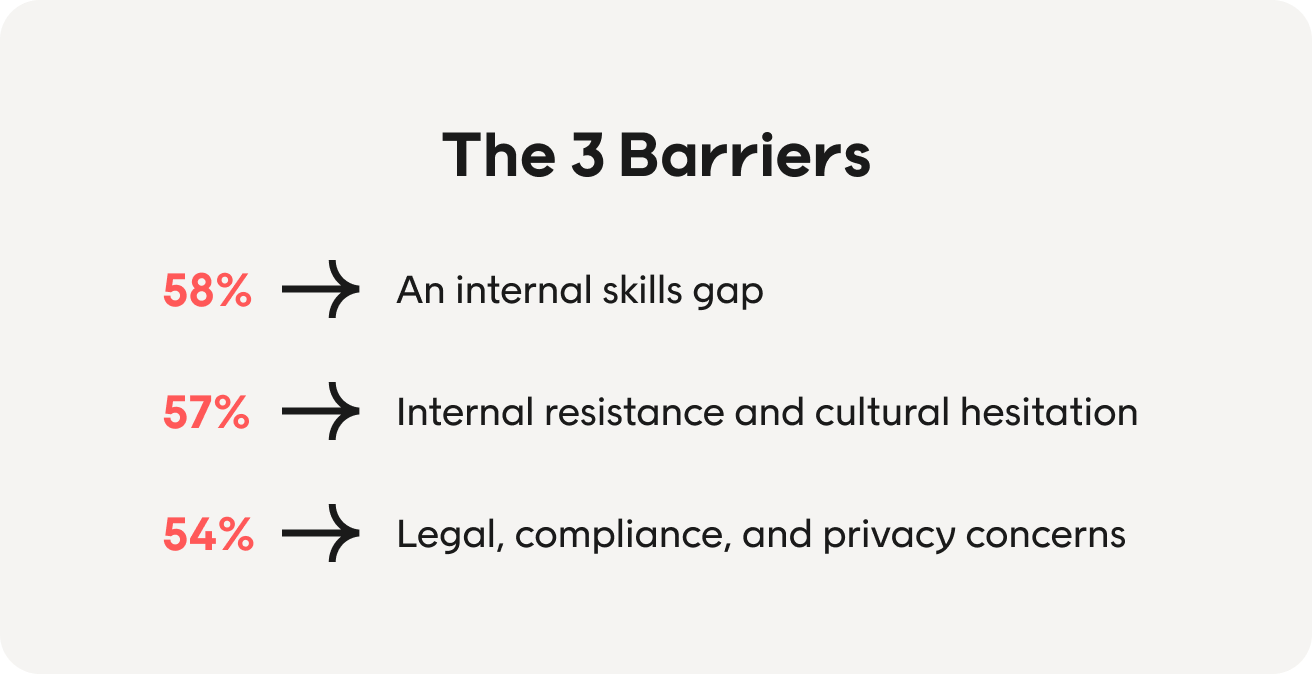
The barriers to AI maturity are organizational, not technical. The AI technology is ready. The businesses often aren’t.
The research is specific. Retailers named three barriers above all others:
- 58% – an internal skills gap. The most cited obstacle by some distance.
- 57% – internal resistance and cultural hesitation.
- 54% – legal, compliance, and privacy concerns. The regulatory requirements and data privacy questions that stall projects long before any AI system goes live.
Notice what’s missing from that list: the technology itself.
As Richard Lim, CEO of Retail Economics, explains, AI is “failing because of structure, data and culture that’s not keeping up with those ambitions.” You can’t buy your way past a people problem. You have to lead through it.
For many organizations, that’s an uncomfortable finding. It means AI readiness isn’t a procurement decision. It’s a question of whether the existing workforce has the skills needed, and whether the habits of the retail industry give them room to use them.
Is AI adoption a skills problem or a culture problem?
It’s tempting to pick one. The honest answer is both – and treating them separately is why so many programs stall.
Workforce skills without culture leaves capable people stuck in an organization that won’t let them experiment. Culture without skills creates enthusiasm with nowhere to go. The 58% skills gap and the 57% cultural resistance in the research aren’t competing explanations. They’re two halves of the same barrier.
Close the AI skills gap in retail, and you still need permission to act. Build a bold culture, and you still need the ability to deliver. Progress comes from tackling both at once.
There’s a real cost to getting this wrong. When AI stays locked with a few specialists, the rest of the business can’t act on what it surfaces, and returns stall. The barriers compound, too: a skills gap feeds cultural hesitation, and unresolved compliance worries give reluctant teams a reason to wait. Break that cycle and capability, confidence, and clear guardrails start reinforcing each other instead.
The gap also shows up at different levels:
- Store workers need sufficient understanding to trust what AI presents to them.
- Marketing and commercial teams need to use it in their daily work and judge the output.
- The C-suite needs enough fluency to set priorities and clear blockers.
Employers who treat AI training as one-size-fits-all tend to reach none of them well.
3 Ways to overcome the AI skills gap in retail
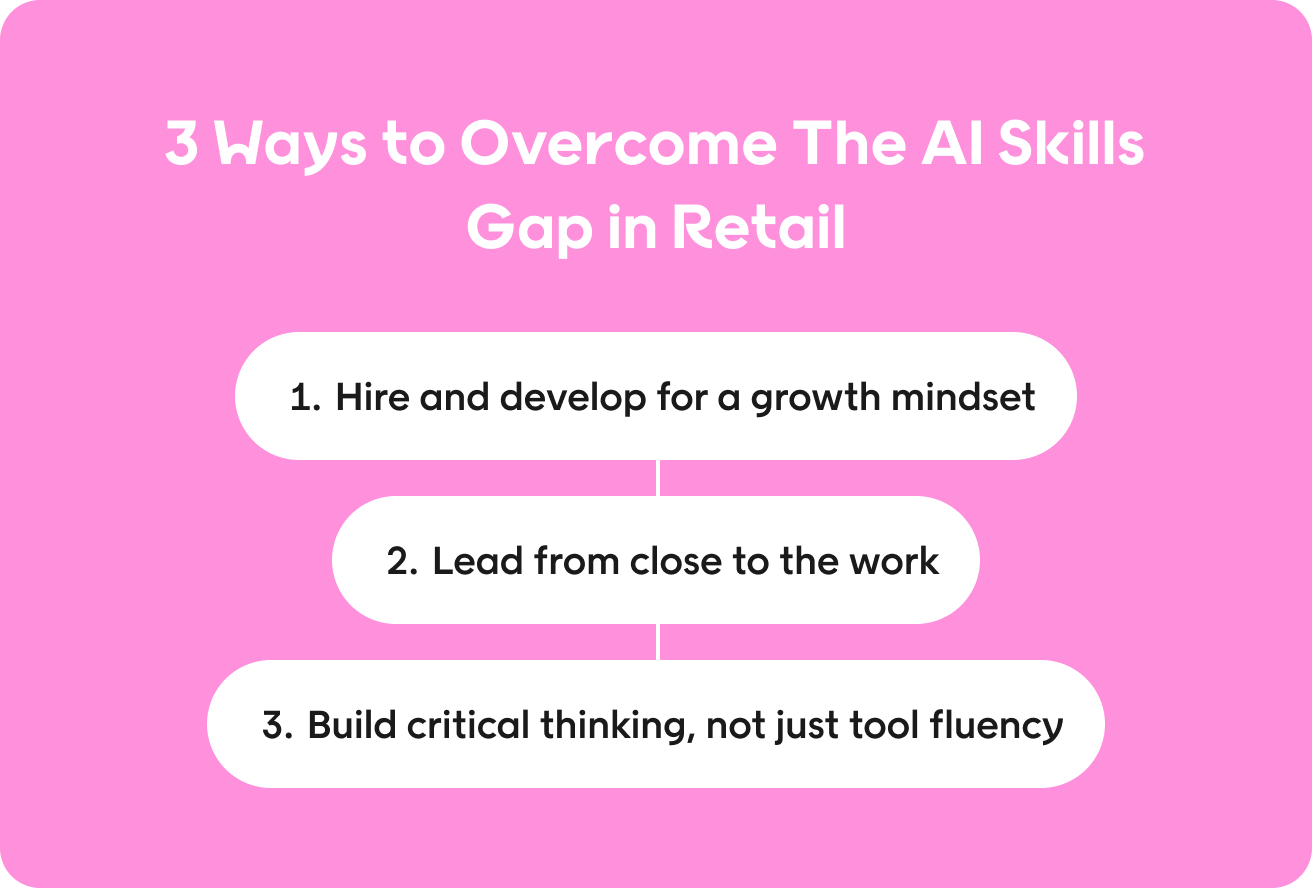
Bridging the AI skills gap isn’t only about hiring specialists. It’s about AI skills development across the organization, building AI capabilities that reach beyond a single team, and creating the conditions for people to grow into them.
1. Hire and develop for a growth mindset
The most useful trait in a fast-moving field isn’t a fixed skill set; it’s adaptability. Hire for a growth mindset and a willingness to learn, then invest in skills development for existing teams, not just recruiting new talent.
Katarina Norden, CMO of Voyado, puts it plainly: “With AI, the profile that you need to hire for is shifting. It’s not only about what you know, but it’s also about how you adapt, how you handle change.”
That shift asks something of people already in post, too. As Katarina describes it, you need people willing to “let go of how they used to do their role” – because some of what they do brilliantly today simply won’t be the best way tomorrow.
Human resources has a real part to play here. When hiring criteria, current roles, and internal training materials all point in the same direction, AI skills development stops being a side project and becomes part of how the business grows its people.
2. Lead from close to the work
AI capability spreads faster when leaders stay close to the actual work rather than delegating it entirely. When decision-makers understand what AI can and can’t do, they set better priorities, remove blockers faster, and model the curiosity they want to see.
Katarina is direct about this: “It’s difficult to guide folks through this journey if you yourself as a leader are far removed from it.” Her view is that leading well here means being “quite deep in the work and applying AI yourself to see what it can do.”
That’s also what keeps AI training grounded. Generic courses teach people how a model works; real workflows teach them what to do with it. Build training materials around the process your teams run every day – a campaign brief, a service query, a product description – and more employees become useful on day one.
3. Build critical thinking, not just tool fluency
The skills required for generative AI are less technical than most people expect. Prompt engineering matters, but the more valuable ability is critical evaluation: knowing when an output is wrong, biased, or simply off-brand.
Generative AI sounds confident even when it isn’t right. Teams that are adequately trained to evaluate AI outputs catch problems early, and error reduction is where much of the value quietly sits.
Treat this as quality control rather than gatekeeping. Human oversight is what makes responsible AI use practical, and critical thinking is the skill that makes that oversight worth having. Without it, new tools simply generate more work to check.
Want the full picture on where retailers are stuck? The Voyado and Retail Economics report benchmarks AI readiness across 300+ retail leaders in the UK, DACH, and the Nordics. Read the research.
What is a test-and-learn culture?
A test-and-learn culture is one where teams are expected to experiment, accept that some attempts will fail, and improve quickly from what they learn. It replaces fear of mistakes with disciplined curiosity.
Crucially, it isn’t chaos. The best test-and-learn cultures operate within clear guardrails, so people can move fast without acting recklessly.
Aaron Lewis, an independent retail consultant, describes the retailers pulling ahead this way: “They are not afraid to fail, to test, to learn and act quickly.” He’s also clear that this can’t be a departmental habit. A test-and-learn culture “needs to be really owned and lived by the whole organization” – purchasing, store operations, HR, not just e-commerce and digital marketing.
Katarina describes how this played out internally when Voyado’s CEO Erica addressed an all-hands: “We are going to make mistakes… Within these guardrails… we’re going to try things.” That message – permission to try, paired with clear boundaries – is what gives a team confidence to act.
Culture in this form is as much a workforce-readiness question as a mood. Employees experiment when they believe the organization will support the attempt, and that support has to be visible from the C-suite down.
How guardrails speed teams up
Guardrails sound like brakes. Done well, they’re an accelerator. When people know the boundaries, they stop hesitating and start experimenting.
That’s the thinking behind addressing the 54% who cite compliance and data privacy concerns. Rather than blocking AI use, set clear rules for it. Good guardrails answer three questions:
- What data can we use? Which data privacy and ethics questions are already settled?
- What needs a human check? Which actions require human oversight before they go live?
- Where do we go when it isn’t covered? One practical example shared on the webinar: a dedicated channel where teams can check questions with legal, turning a bottleneck into a fast lane.
The point of that channel isn’t governance for its own sake. As Katarina puts it: “you send a signal to the organization that you want to speed them up, not slow them down.”
This mirrors how retail-trained AI should work in practice. With a human-in-the-loop approach, AI systems execute the next best action while your teams stay in control – speed and governance together, not in tension. Human oversight is part of the process, not bolted on afterward, so decision-making stays with the people accountable for the outcome.
Guardrails also make experimentation safe to scale. When a marketing team knows exactly which data they can use and which actions need a human check, they stop asking permission for every step. That confidence is what turns a handful of careful pilots into a company-wide habit of testing and learning.
Regulatory requirements aren’t going away, and clear rules are what make responsible AI achievable at scale. Boundaries don’t slow a good team down – they tell it where it’s free to run.
Should retailers build or buy AI skills?
The new report points to both, in balance. Buying in a few specialists helps, but it won’t create company-wide AI capabilities on its own. Lasting maturity comes from developing the people you already have.
Aaron argues the calculation has changed. The in-house versus outsource debate is an old one, but with AI he’d “lean towards in-housing the required skills here more quickly than back in the day, simply because of the multiplier effect and the pace where things are going.”
Prioritize upskilling your existing workforce and hiring for adaptability over narrow expertise. That investment compounds: workers who understand AI in their current roles become the ones who spot the next opportunity.
Then pair that with AI tools built for your world, ones that assume a retail marketer, not a data scientist, is the person using them. Artificial intelligence only becomes part of everyone’s daily work when the tools don’t require a specialist to operate.
Closing the AI skills gap in retail starts with people
The AI skills gap in retail is real, but it’s solvable, and it’s inseparable from culture. The retailers pulling ahead build workforce skills across teams, lead from close to the actual work, and create a test-and-learn culture with clear guardrails. That combination, not a bigger tech budget, is what AI readiness actually looks like.
None of it requires waiting for the perfect hire. Start with the employees you already have and give them room to experiment safely. Then choose AI tools that meet people where they are in their skills, rather than assuming a data science team sits behind them.
That last part is the thinking behind Voyado’s retail-trained AI: the next best action arrives ready to use, with human oversight built in, so that capability spreads across the business rather than concentrating in a few hands.
Bridging the AI skills gap is essential work for workforce readiness. It starts with people, not procurement.

FAQs
What is the biggest barrier to AI adoption in retail?
An internal skills gap, cited by 58% of retailers in the Voyado and Retail Economics report as their primary barrier. Cultural resistance follows at 57%, and legal, compliance, and data privacy concerns at 54%. The biggest obstacles are organizational, not technical – the AI technology is ready before the businesses are.
Is AI adoption a skills problem or a culture problem?
Both, and they can’t be separated. Skills without a supportive culture leave capable people unable to experiment. Culture without skills creates enthusiasm with no delivery. With 58% citing skills and 57% citing cultural resistance, the two are halves of one barrier that many organizations have to tackle together.
How do retailers overcome the AI skills gap?
Build AI capabilities across the business, not just in a few specialists. Hire and develop for a growth mindset, fund skills development for the existing workforce, and have leaders stay close to the actual work. Make critical evaluation part of the job so teams can properly evaluate AI outputs, and pair it with retail-trained AI tools that let people act without deep data science expertise.
What is a test-and-learn culture?
A culture where teams are expected to experiment, accept that some attempts fail, and improve quickly from the results. It runs within clear guardrails, so people move fast without being reckless, with human oversight for decisions that need it. As Voyado’s leadership framed it internally: within the guardrails, we’re going to try things.
Should retailers build or buy AI skills?
Both, in balance. Buying in talent helps, but it won’t create company-wide capability on its own. Lasting maturity comes from AI training for existing teams and hiring for adaptability over narrow expertise – paired with retail-trained tools that let people act on real workflows without great technical skills, keeping humans in control.