
TL;DR
Conversational commerce is moving beyond support chatbots. It can now help shoppers express what they want, find relevant products, and make confident purchase decisions.
For retailers, that creates opportunities to improve conversion rates, customer engagement, and customer satisfaction. But useful conversations depend on accurate product data, real-time stock and pricing, clear governance, and human support when it matters.
Voyado connects shopper intent to product ranking in real time. This guide explains where conversational commerce creates revenue and what e-commerce leaders need to deliver it at scale.
Shoppers now expect to describe what they want and receive useful guidance straight away. In 2026, a chatbot that only deflects customer support questions won’t be enough. A strong conversational commerce strategy can help retailers guide product choices, support sales across multiple channels, and create revenue throughout the customer journey. In this article, we’ll explain what conversational commerce is, why support-only chatbots fall short, what you need to deliver accurate conversations at scale, and how to measure their commercial impact.
What is conversational commerce?
Conversational commerce uses AI-powered conversations to guide shoppers toward a purchase.
Instead of only answering support questions, it interprets what a shopper wants and surfaces relevant products. This turns the conversation into a path to buy.
Imagine a shopper looking for running shoes. Instead of choosing filters for size, surface, support, and budget, they could write:
“I need a comfortable shoe for short runs on pavement. I sometimes get knee pain, and I’d like to spend less than €150.”
A conversational AI system can turn that request into useful search criteria. It can check product attributes, live stock, customer preferences, and business rules before recommending suitable options.
That’s where conversational commerce tools move beyond the traditional chatbot.
| Support deflection | Guided selling |
| Deflects customer support tickets | Guides shoppers toward suitable products |
| Answers FAQs from prepared content | Interprets needs expressed in natural language |
| Operates as an isolated widget | Connects with the wider customer journey |
| Directs customers to existing pages | Suggests relevant products and next steps |
| Measures tickets avoided | Measures customer engagement and revenue |
| Escalates unsupported questions | Combines automation with human guidance |
A support chatbot can still play a useful role. But it rarely helps shoppers decide what to buy.
Conversational commerce works more like a knowledgeable sales associate. It asks questions, narrows the choice, and explains why a product may fit the shopper’s needs.
The market reflects this growing role. The conversational commerce market is projected to increase from $12.64 billion in 2026 to $22.56 billion by 2031.
For online retailers, the benefits of conversational commerce extend beyond automating responses to customer inquiries. The bigger opportunity is to make product discovery and the wider customer experience more useful.
How conversational commerce works
Good conversational commerce starts with understanding intent.
Natural language processing helps the system interpret the shopper’s words. Machine learning can then identify patterns in customer behavior, product performance, and previous customer interactions.
But understanding the words is only the first step.
The conversational commerce platform also needs to connect that intent with:
- Product attributes
- Stock and availability
- Current prices
- Product margin
- Ratings and reviews
- Purchase history
- Browsing behavior
- Customer preferences
- Merchandising rules
Generative AI can then turn that information into a natural response. It might explain a recommendation, compare two products, or ask a useful follow-up question.
Different conversational commerce tools handle this process in different ways.
| Technology | What it does | Main limitation |
| Traditional chatbot | Follows scripted flows and prepared answers | Struggles with requests outside the script |
| Generative chatbot | Creates natural, flexible responses | May invent details without reliable product grounding |
| AI agent | Interprets intent, checks data, and chooses a next-best action | Needs clear data access, rules, and governance |
An AI agent can observe what the shopper wants and decide what to do next. It might suggest a product, ask about budget, check inventory, or pass the conversation to a person.
This makes AI agents different from many virtual assistants and conversational commerce chatbots that rely on fixed paths.
That’s why the best AI sales agents in e-commerce are grounded in product data and designed to act on shopper intent, not just generate convincing replies.
Whichever technology you use, the same principle applies: conversational AI must be grounded in reliable retail data.
A polished answer isn’t useful if it recommends an unavailable product or gives the wrong price.
Where conversational commerce drives revenue
Conversational commerce can support the entire customer journey.
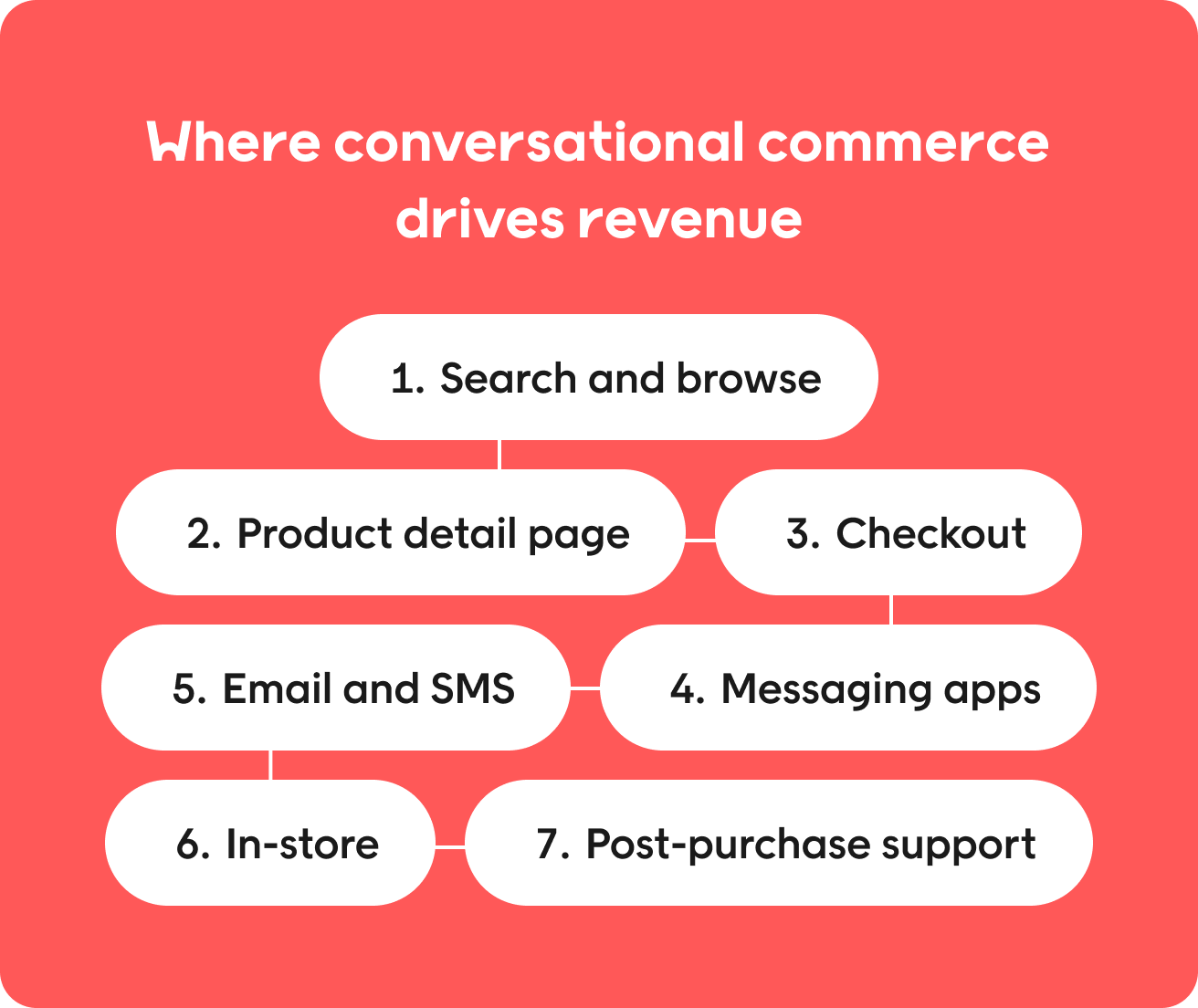
It may begin on an online store, continue through a messaging app, and end in a physical shop. What matters is that the experience stays connected.
| Touchpoint | How conversation helps | Revenue opportunity |
| Search and browse | Interprets broad or vague requests | Fewer zero-result searches |
| Product detail page | Answers questions about fit, features, and compatibility | Higher product confidence |
| Checkout | Resolves concerns about delivery, payment, or returns | Lower cart abandonment |
| Messaging apps | Supports questions and purchases outside the website | More completed transactions |
| Email and SMS | Restarts an interrupted purchase with relevant help | Cart recovery |
| In-store | Gives staff access to customer and product context | Better assisted selling |
| Post-purchase support | Handles tracking, exchanges, and repeat orders | Stronger customer loyalty |
AI chatbots can provide 24/7 customer support for routine questions. Human agents can then focus on complex requests that need judgment or empathy.
Reducing cart abandonment
Conversational commerce can also reduce cart abandonment by resolving uncertainty while the shopper is still deciding. A quick answer about sizing, delivery, payment, or returns may be enough to keep the purchase moving.
AI chatbots can also follow up with customers who leave products behind. Instead of leading with a generic discount, they can offer relevant help based on the product or stage of the customer journey.
Proactive messaging can encourage customers to complete transactions, but timing matters. The message should solve a likely problem, not create another interruption.
Conversational commerce across messaging apps and voice assistants
Messaging apps are especially important because shoppers already use them in daily life. This includes social messaging apps such as Facebook Messenger and WhatsApp. It can also include other chat apps and messaging platforms customers already trust.
Voice assistants suit different moments, such as quick searches, hands-free product questions, and repeat purchases. But voice assistants need clear confirmation before an order is placed.
Social commerce and conversational commerce often overlap, but they aren’t the same.
Social commerce refers to selling through social media platforms. Conversational commerce refers to the direct guidance that helps the shopper decide. That conversation can happen on social media platforms, in messaging apps, on a website, or through voice assistants.
Statista estimates that social commerce will generate $585.88 billion in worldwide revenue in 2026, with that figure expected to reach $928.65 billion by 2030.
The goal isn’t to appear on every channel. It’s to create a consistent online shopping experience and offer the same accurate, personalized service wherever the conversation starts.
Is your retail business ready for conversational commerce?
Before you implement conversational commerce, check the foundations.
| Readiness area | What to check | Likely owner |
| Data | Can systems share accurate information in real time? | IT and data |
| Catalog quality | Are product attributes complete and consistent? | E-commerce and merchandising |
| Inventory and price sync | Can the assistant confirm current stock and prices? | E-commerce and IT |
| Consent and PII | Are customer data permissions and boundaries clear? | CRM, legal, and IT |
| Languages and markets | Can the experience handle regional needs accurately? | E-commerce and local market teams |
| Handoff and escalation | Can complex requests reach the right person with context? | Customer experience and support |
| Ownership | Does one team own results across the full journey? | E-commerce, CRM, and CX |
You won’t need every possible capability on day one. But conversational commerce solutions can’t compensate for unreliable data or unclear ownership.
Start with one customer problem and make sure the required information is ready. That gives your conversational commerce strategy a clear purpose from the beginning.
What product data does conversational commerce need?
A useful virtual shopping assistant needs more than a product title and description.
For accurate personalized recommendations, the catalog may need:
- Category and product type
- Size, color, material, and fit
- Features and compatibility
- Price and discount information
- Stock and store availability
- Delivery options
- Ratings and reviews
- Images and product relationships
- Regional restrictions
- Suitable alternatives and complementary products
The exact fields will depend on what you sell.
A fashion retailer may need detailed fit and material data. An electronics retailer may need technical specifications and compatibility rules. A home retailer may need measurements, assembly details, and delivery restrictions.
And real-time sync matters just as much as catalog quality.
If stock or pricing changes, the conversation needs to change with it. Otherwise, personal shopping assistants may recommend an unavailable product, show an old price, or promise delivery that isn’t possible.
That’s a quick way to lose customer trust and harm customer relationships.
Connect conversation to the shopping journey
Conversational commerce shouldn’t operate as a separate widget.
It should connect with the tools shoppers already use during product discovery and the purchasing process.
A broad request such as “I need a lightweight waterproof jacket for cycling” could shape the shopper’s site search results.
The same intent could update site navigation filters, such as activity, material, price, and weather protection.
On a product page, the conversation could explain features or compare alternatives. It could also shape product recommendations based on what the shopper has already said.
At checkout, conversational commerce can answer questions about delivery, payment, and returns. Some conversational commerce platforms also support in-chat checkout, allowing customers to complete transactions inside the conversation.
This creates a more interactive online shopping experience without forcing every customer to use the conversational interface.
Some online shoppers will still prefer a search box. Others will browse categories. The right conversational commerce platform adds another route into the same experience.
How to scale across brands and markets
Retailers often manage several brands, markets, currencies, and languages.
That creates a harder challenge than simply translating conversational technology.
Product ranges may change by region. So can prices, stock, promotions, delivery options, customer expectations, consent rules, and return policies.
A scalable conversational commerce approach separates shared intelligence from local rules.
The core system can use the same product structure and intent model across markets. Local teams can then control:
- Language and terminology
- Currency and pricing
- Available products
- Delivery promises
- Promotions
- Legal and consent requirements
- Brand tone and prohibited topics
This reduces duplicated work while protecting answer accuracy.
It also makes ownership important. Local teams need control over market-specific details, while central teams need a consistent way to manage conversational commerce experiences across multiple channels.
How conversations improve search and recommendations
Customer conversations provide a direct view of what shoppers want.
They reveal needs that may never appear in a standard keyword report. A customer might ask for “a dress that works for a summer wedding but still feels comfortable after dinner.”
That request contains information about occasion, style, fit, and comfort. Conversational data can turn those details into intent signals.
Those signals can then influence:
- Onsite search ranking
- Navigation filters
- Product detail page recommendations
- Relevant product suggestions
- Merchandising decisions
- Future customer interactions
They can also reveal gaps. If shoppers keep asking whether a jacket is waterproof, that attribute may be missing or hard to find.
Chat logs can therefore inform product content, customer support, and wider marketing strategies. They may also reveal changes in customer expectations before those changes appear in sales reports.
This is where conversation becomes part of the product intelligence layer. Voyado has a product discovery engine that connects shopper intent to product ranking in real time, turning each conversation into a measurable path to purchase.
Connecting natural-language intent with product ranking makes conversational search in e-commerce more useful than a standard keyword match.
A governance playbook for conversational commerce
Conversational AI can respond quickly and at scale. That makes clear limits essential.
| Governance area | Rule to define |
| Consent | Explain what data is collected and how it will be used |
| PII boundaries | Limit access to personal information needed for the task |
| Product grounding | Build answers from approved catalog and policy data |
| Hallucination controls | Ask for clarification or escalate when reliable information isn’t available |
| Brand guardrails | Set rules for tone, claims, recommendations, and prohibited topics |
| Human handoff | Define when the conversation should move to a person |
| Review process | Monitor customer feedback, failed answers, and changing risks |
The assistant should also know when a customer needs human help.
Useful handoff triggers might include:
- Complex or unusual requests
- Complaints or emotional situations
- High-value purchases
- Conflicting account information
- Safety or compatibility concerns
- Requests outside approved policies
The customer shouldn’t need to start again after the handoff. Human agents should receive the conversation history and the relevant customer context.
That creates a satisfying customer experience while keeping AI-powered conversational commerce within safe limits.
How to measure the benefits of conversational commerce
Conversation volume is easy to measure. It’s also easy to misread.
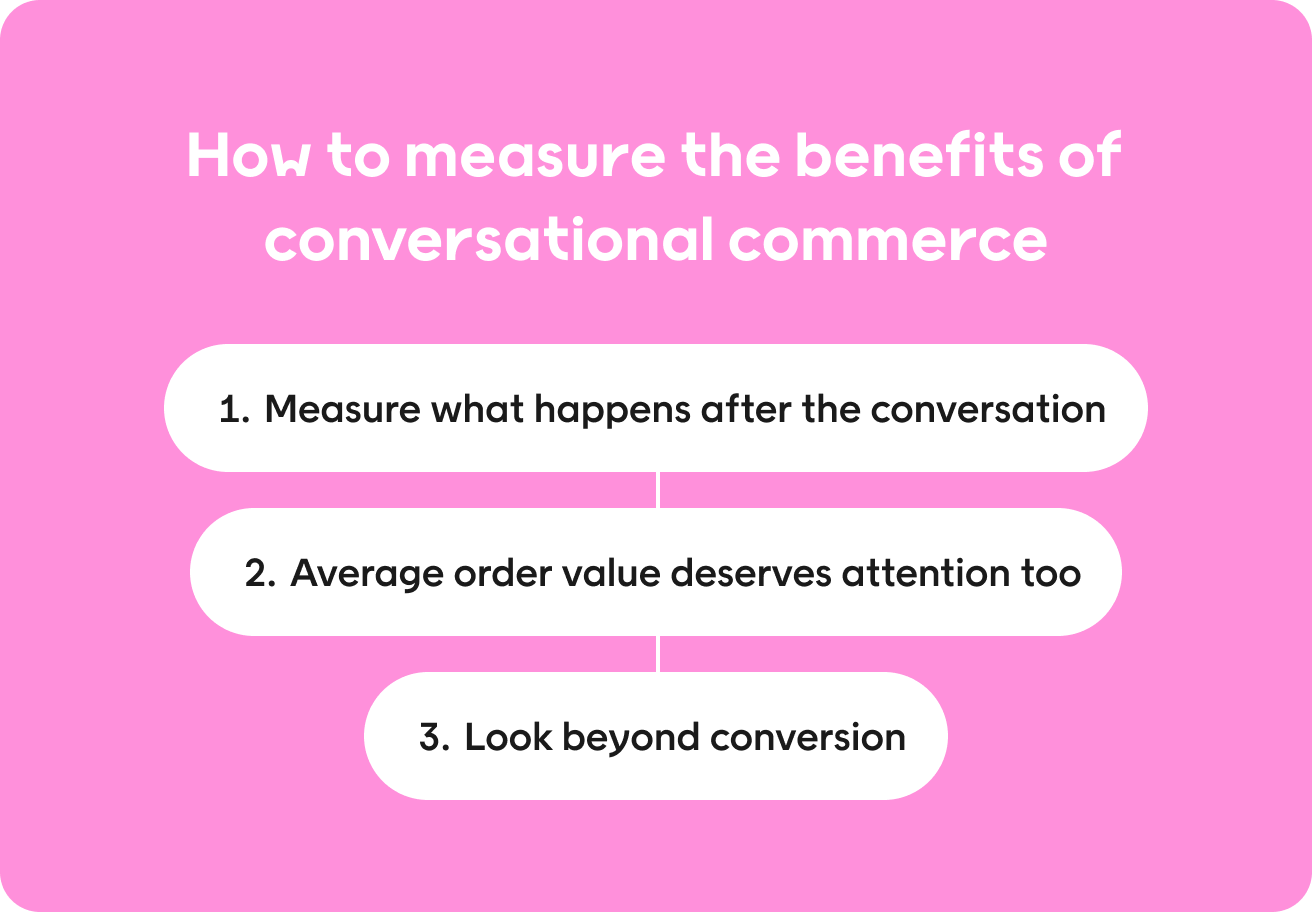
A high number of conversations doesn’t prove that the experience helped shoppers. To understand the benefits of conversational commerce, your KPI framework should connect customer interactions to commercial outcomes.
| KPI | What it shows |
| Conversion rate lift | Whether shoppers convert more often after a conversation |
| Average order value | Whether guided selling increases basket size |
| Revenue per session | How much revenue conversational sessions create |
| Zero-result searches | Whether conversational search helps with vague queries |
| Time to product selection | Whether shoppers reach suitable products faster |
| Return rate | Whether better guidance leads to better product choices |
| Assisted revenue | How much revenue was influenced by a conversation |
| Support deflection | How many customer inquiries were resolved without an agent |
| Customer satisfaction scores | How shoppers felt about the experience |
These figures give you the overview. To understand what’s driving them, you’ll need to look more closely at what shoppers do after each conversation.
Measure what happens after the conversation
Start by comparing shoppers who use conversational commerce with similar shoppers who don’t.
Track how many reach a product page, add an item to their basket, and complete a purchase. You can also measure the time between the first question and product selection.
Average order value deserves attention too. Guided selling can increase basket size by surfacing complementary products during the conversation.
AI-driven recommendations can also support upselling when a higher-priced product genuinely fits the shopper’s needs. Your merchandising rules can guide these choices by balancing customer relevance with stock, margin, and campaign priorities.
Look beyond conversion
Zero-result searches offer another useful signal. Conversational commerce can interpret vague requests that a traditional search engine might miss, then ask questions that guide the shopper toward relevant products.
Customer satisfaction levels matter alongside revenue. Useful conversations can lead to higher customer satisfaction, greater customer loyalty, and more repeat purchases.
The final distinction is between deflection and revenue. Tickets avoided show cost savings. Assisted revenue shows what the conversation helped create.
Both matter, but only one proves that conversational commerce delivers incremental revenue.
Conversational commerce examples and use cases
The strongest conversational commerce examples remove the need for clear effort.
Guided selling
A shopper says, “Help me find a dress for a summer wedding.”
The assistant asks about the setting, dress code, budget, size, and preferred colors. It then creates a shortlist and explains why each option fits.
Cart recovery
A shopper leaves an item in their basket.
Instead of sending a generic discount, proactive messaging offers help based on the likely concern. The shopper might need sizing information, delivery confirmation, or a suitable alternative.
Product questions
A shopper asks, “Is this jacket waterproof?”
The assistant checks the product attributes and gives a clear answer. If the item isn’t suitable, it can recommend an in-stock alternative.
Order tracking
A customer asks, “Where’s my package?”
The assistant checks the order and provides an update. If there’s a delivery problem, it can send the conversation to customer support with the order details attached.
Personalized recommendations
A returning customer says, “Show me something like the shoes I bought last time, but suitable for winter.”
With permission, the assistant can use purchase history and customer preferences to find relevant options. That creates personalized customer experiences without making the shopper repeat information the retailer already has.
These examples of conversational commerce cover discovery, buying, and service. The common link is that each conversation moves the customer toward a clear outcome.
Moving beyond the chatbot
Conversational commerce offers retailers a way to turn customer conversations into guided shopping journeys.
The benefits of conversational commerce can include easier product choices, stronger customer engagement, better customer satisfaction, and more measurable revenue. But those results depend on what sits behind the conversation.
You’ll need accurate catalog data, real-time stock and pricing, clear business rules, connected customer data, and strong governance.
Start with one useful conversation. Make sure it solves a genuine customer problem, then connect it to the wider retail experience. That’s how conversational commerce becomes more than a support chatbot.

FAQs
What is conversational commerce?
Conversational commerce is the use of AI-powered conversations to guide shoppers toward a purchase. It interprets what a shopper wants, surfaces relevant products, and helps them decide what to do next.
How is conversational commerce different from a traditional chatbot?
A traditional chatbot usually answers FAQs or follows scripted customer support flows. Conversational commerce uses real-time product data and behavioral signals to guide product choices and support revenue.
What does a conversational commerce platform connect to?
A conversational commerce platform connects intent understanding with your catalog, inventory, pricing, customer profile, search, recommendations, and checkout.
What are common conversational commerce use cases?
Common use cases include guided selling, cart recovery, product questions, order tracking, in-chat checkout, and personalized recommendations based on previous purchases.
Can conversational commerce work across several markets?
Yes, when the foundations are in place. Catalog quality, live stock and price sync, regional rules, language support, and clear ownership help maintain accuracy across brands and markets.
How should retailers measure conversational commerce?
Look beyond engagement. Useful KPIs include conversion rate lift, average order value, revenue per session, zero-result searches, assisted revenue, return rates, customer satisfaction scores, and time to product selection.
How does Voyado support conversational commerce?
Voyado connects shopper intent to product ranking in real time. This helps retailers turn conversations into relevant, measurable paths to purchase.