TL;DR
Shoppers have learned to describe what they want in full sentences. They type things like “warm waterproof jacket for hiking under €200” straight into ordinary retail search bars, and most site search engines still read that as a loose bag of keywords.
A conversational search engine understands the complete natural-language request and lets shoppers refine it across several turns. It is not a chatbot bolted onto your homepage. The chat window is the thin, optional layer. The value sits underneath, in an engine that can turn a sentence into constraints and resolve them against real product data.
This guide is for e-commerce, merchandising, and product leaders like you, working out whether conversational search is worth investing in now and which layer to fix first.
What a conversational search engine is
The category has been muddied by vendors selling chat widgets, so it’s worth being precise about what the term covers.
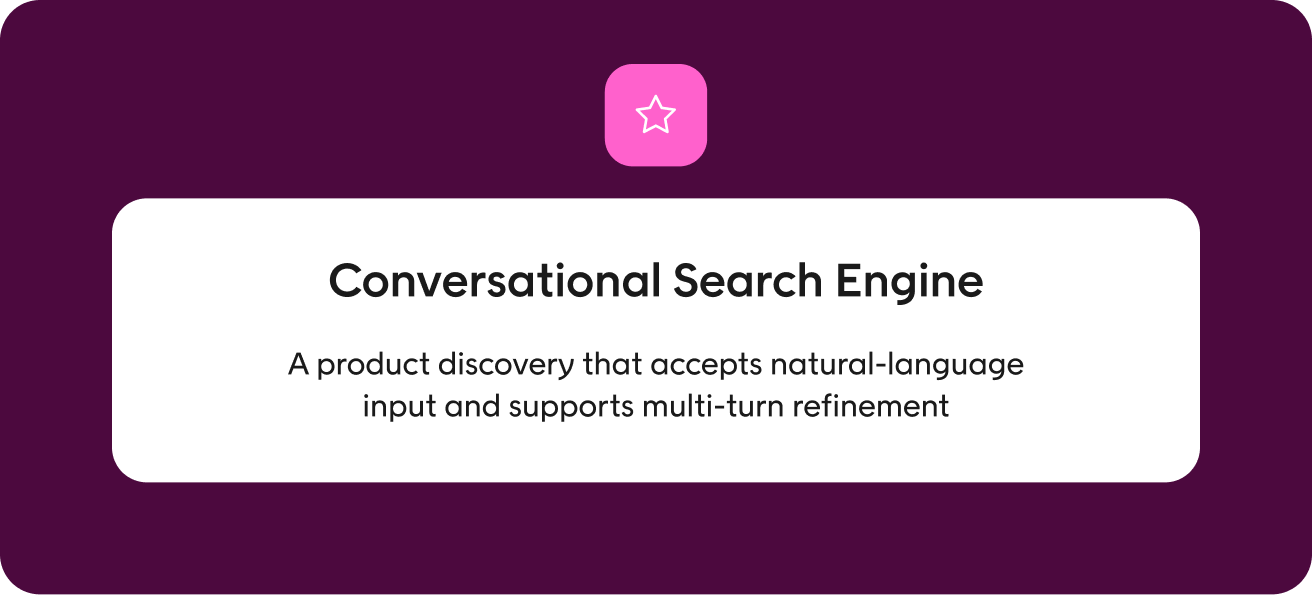
A conversational search engine is product discovery that accepts natural-language input and supports multi-turn refinement. Three capabilities separate it from conventional site search:
- It parses a full request instead of matching keywords, pulling out the constraints buried inside a sentence.
- It holds context across turns, so “something warmer” or “in navy instead” modifies the previous request rather than starting a new one.
- It can ask a clarifying question when user intent is genuinely unclear, instead of guessing or returning everything.
What a conversational search engine isn’t
It isn’t a customer service chatbot. They handle orders, shipping, and returns. Conversational search finds products.
It also isn’t a general AI shopping assistant like ChatGPT or Perplexity. Those run across the open web, outside your control. A conversational search engine runs on your catalog, on your site.
And finally, it’s not necessarily a chat window. Plenty of strong implementations are just a search bar that handles long, constrained queries properly, with refinement as editable filter chips.
How conversational search compares to keyword and natural-language search
Treating this as a binary is the common mistake. There are four models, and they sit on a spectrum.
| Keyword search | Natural-language search | Conversational search | AI shopping assistant | |
| Typical input | “winter coat” | “warm wool coat under €300” | the same, then “actually make it waterproof” | “what coat should I buy for a Nordic winter” |
| How intent is resolved | Term matching against an index | Constraints extracted and matched against product attributes | Constraints extracted and carried across turns | Researched across multiple retailers |
| Multi-turn context | None | None | Yes | Yes |
| Where it runs | Your site | Your site | Your site | Third-party platform |
| Retailer control | Full | Full | Full | None |
| Typical use case | Known-category browse | Constrained single query | Narrowing a considered purchase | Pre-purchase research |
Most retailers should solve the second column before worrying about the third. Natural-language search delivers most of the value at far lower delivery risk because it changes what your existing search bar understands rather than how shoppers have to use it.
Both middle columns are e-commerce product discovery you own outright, which is the practical reason to start there.
Why shoppers started searching in sentences
Three forces changed how people phrase a search, and none of them are reversing.
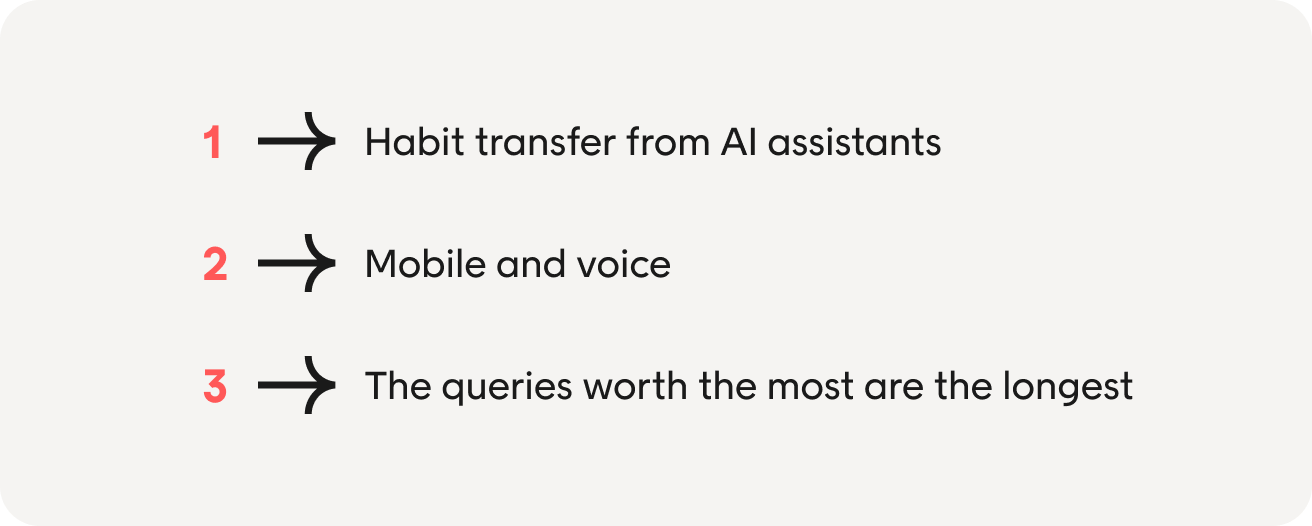
- Habit transfer from AI assistants. 50% of consumers already use AI-powered search, and one in five Americans has used an AI platform to search for products while shopping. Once describing a need in full starts working, people stop trimming it down to two keywords. It is the same habit behind agentic AI in retail.
- Mobile and voice. Typing keywords on a phone is tedious. Speaking a sentence is not, and voice queries are conversational by default.
- The queries worth the most are the longest. “Coat” is a browse. “Waterproof knee-length coat I can cycle in, under €250, in stock in medium” is a shopper close to buying who has told you exactly how to close them.
Short keyword queries haven’t disappeared, and they’ll stay the majority in most catalogs for a while yet. The shift is in the high-intent tail, which is where revenue concentrates and where e-commerce search personalization pays back hardest.
How conversational search works underneath the interface
The artificial intelligence layer gets all the attention, but a conversational search system has six jobs, and none of them involve the chat window.
A sentence has to become structured constraints
Natural language processing (NLP) breaks complex sentences into parts your system can act on, so it can understand user intent instead of guessing.
| Phrase | Constraint |
| jacket | product type |
| warm, waterproof | attributes |
| for hiking | use case |
| under €200 | price ceiling |
Each constraint has to map to something your catalog actually holds.
Your product attributes set the ceiling on what a query can answer
Most vendor content skips this. A query can only be resolved using attributes that exist as structured data.
If “waterproof” only appears in marketing copy, your system can’t filter on it. If warmth isn’t modeled, “warm” is guesswork.
Conversational search raises the bar on product data because shoppers describe specific needs instead of picking categories. Sort out your product taxonomy first.
Long queries need semantic and traditional keyword matching together
Semantic matching reads meaning, so paraphrase and use-case language work. Traditional keyword matching keeps precision on brand names and model numbers.
Search technology that leans on one will fail a large share of user queries. Relevant search results need both, plus a ranking layer weighing relevance against stock, price, and context, which intelligent search covers in full.
Multi-turn context means knowing what to keep and what to drop
Traditional search engines treat every query as a new, independent action. A conversational search engine reads each turn against previous interactions, so when a user asks for something warmer, it modifies the last request instead of replacing it.
“In navy” adds a constraint.
“Actually, show me boots” discards most of them.
One misstep and the whole experience feels broken.
The system must never invent a product
Any search technology using large language models (LLMs) has to stay grounded in your real catalog. It must not describe products that don’t exist, invent attributes, or claim stock it hasn’t checked.
In retail, accuracy beats fluency. A confidently wrong answer about stock is worse than no answer.
A no-match query still needs a useful answer
Constrained queries often have no perfect match, and returning nothing is the one unacceptable outcome. Three responses give accurate answers without a dead end:
- Relax the least important constraint and say which one.
- Offer the closest alternatives.
- Ask one follow-up question.
Zero-result queries are demand intelligence. Capture them, because they tell you what your assortment is missing.
Get these six right, and the interface barely matters. Get them wrong, and you’ll have a road of hard challenges ahead.
When conversational search helps and when it doesn’t
Conversational search in e-commerce is worth real money in some journeys and actively slows others down, so it pays to know which is which before you build anything.
Where conversational product discovery earns its place
Five patterns account for most of the value.
| Scenario | Why it works |
| Considered purchases with several constraints | Furniture, outerwear, electronics, and sporting goods all ask shoppers to balance size, specs, budget, and use case at once |
| Large or hard-to-navigate catalogs | When filtering takes seven clicks, one sentence is more intuitive and far faster |
| Unfamiliar categories | Shoppers who don’t know the vocabulary can’t use filters well, but they can describe the outcome they want and still get relevant results |
| Gift and occasion shopping | “Something for a friend who cooks a lot, around €50” is unanswerable by filters and natural in conversation |
| Fit and compatibility questions | Will it fit this space, work with this device, or suit this climate |
Conversational search handles complex queries better than traditional search, and it helps users compare options while they are still choosing. Those longer queries also carry far more intent signals than a two-word search, which makes them valuable long after the session ends.
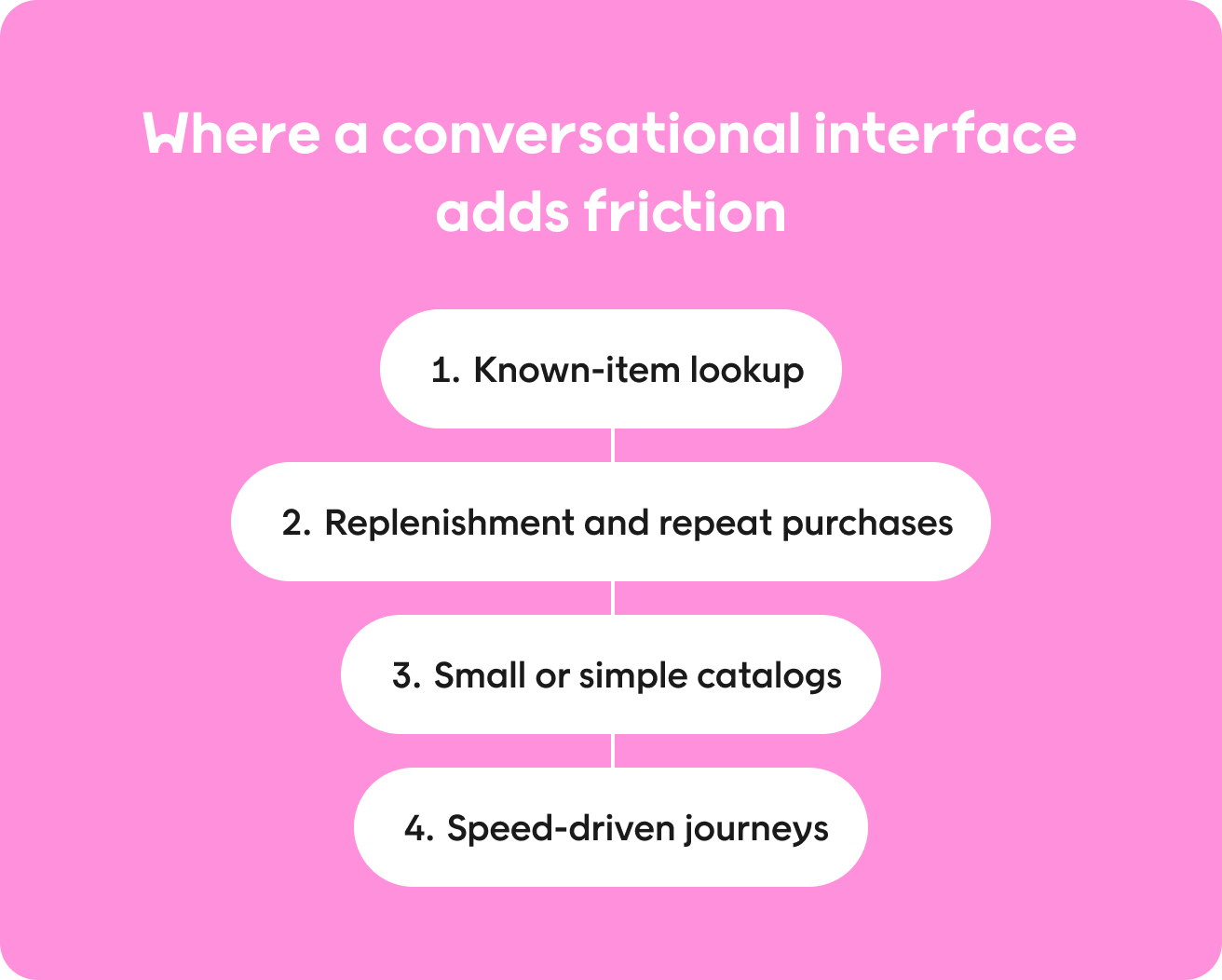
Where a conversational interface adds friction
Four journeys get worse, not better.
- Known-item lookup. Someone searching a specific SKU wants the product page instantly, not a dialogue.
- Replenishment and repeat purchases. The fastest route is a reorder or a well-placed product recommendation, not a conversation.
- Small or simple catalogs. If good filters and clear site navigation narrow the range in two clicks, conversation is overhead.
- Speed-driven journeys. Every extra turn is a chance to abandon, so conversation has to reduce total effort rather than add a step.
Make conversational search one available route in your search experience, not the required one. Forcing every visitor to your website through a dialogue is a downgrade for most of your customers.
Designing conversational search that people actually use
Six design choices decide whether shoppers use conversational search or quietly go back to browsing.
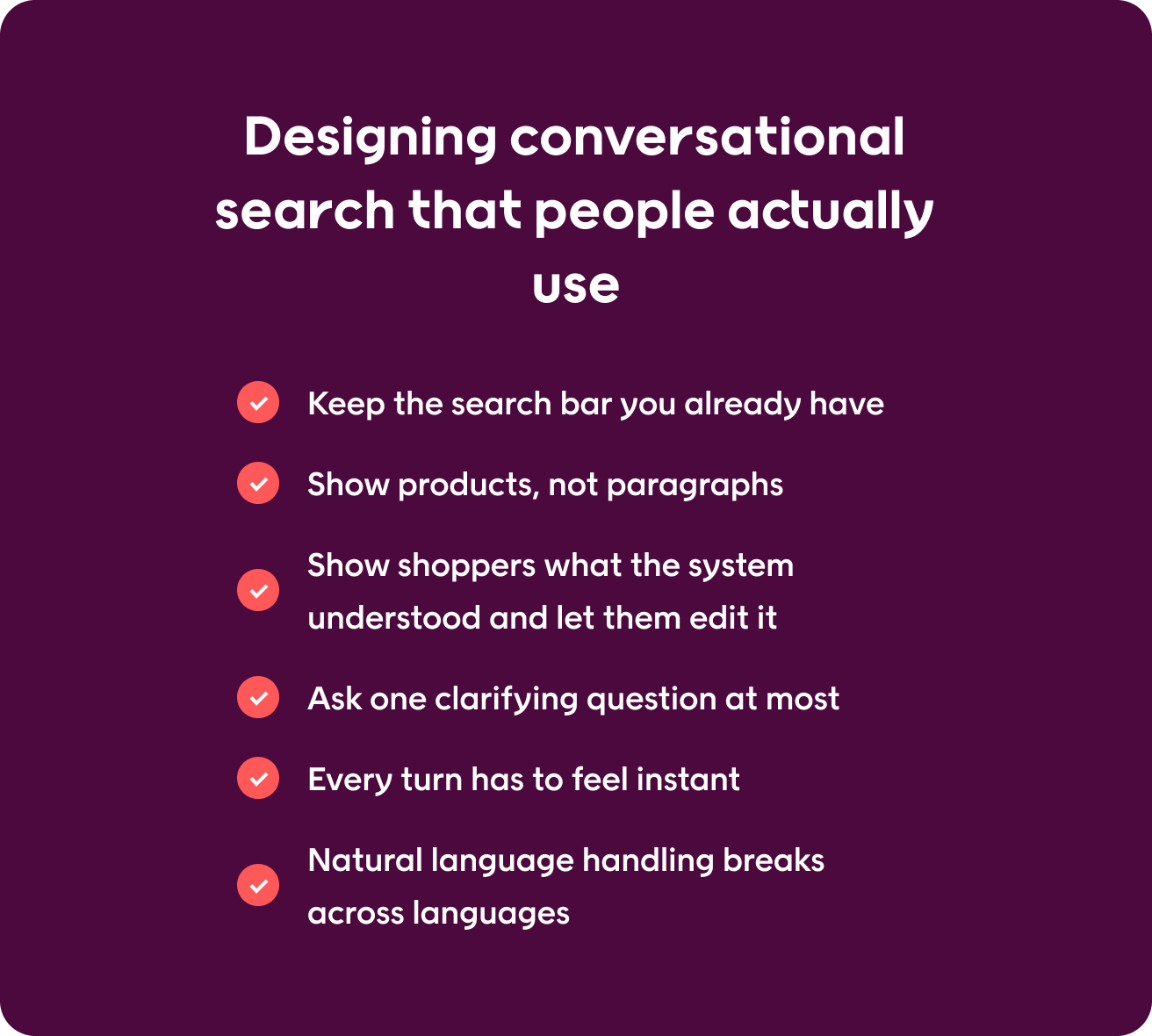
Keep the search bar you already have
Don’t replace a familiar search bar with a chat window. Let the field you already have accept long queries instead.
Most shoppers will never notice anything changed. Their sentences simply start working, which is the opposite of how traditional chatbots announce themselves. The best search platforms stay invisible.
Show products, not paragraphs
The output of conversational search should be results. A short line of framing text is fine, and direct AI-generated answers can help, but a wall of prose describing products the shopper can’t see is not.
People buy from product grids. Generate responses that point at products rather than replace them.
Show shoppers what the system understood and let them edit it
Display the extracted constraints as removable chips. For example, “waterproof, under €200, and size M.” This does three things:
- It confirms the system understood the request.
- It lets users correct a misread without retyping everything.
- It teaches them what your search can handle.
It also makes personalized product discovery feel less like a black box because the reasoning is visible.
Ask one clarifying question at most
And only when the ambiguity genuinely blocks a useful answer. Interrogating a shopper before showing anything is the most common way these projects fail.
Show results first, then let people refine.
Every turn has to feel instant
Conversational search competes with instant filters, so information retrieval has to be quick enough that nobody notices it. If a turn takes several seconds, shoppers revert to browsing, and the ability to refine stops mattering.
For reference, Voyado Elevate returns results within 60 milliseconds using a product scanner built for large volumes. That is the standard the interaction has to meet.
Natural language handling breaks across languages
Compound words, morphology, and local product vocabulary vary enormously. A system that performs well in English can fail badly in Nordic or German-language markets without proper dictionary and synonym support.
If you trade in six markets, you need natural language search that works in six markets, which keeps discovery accessible everywhere you sell.
Shoppers won’t think about any of this if you get it right. They’ll just find things.
The operational work that starts after launch
Three things get harder once shoppers start searching in sentences, and none of them show up in a demo.
Merchandisers still need to control what shows up first
Campaigns, launches, exclusivity deals, and margin priorities don’t stop mattering because a shopper phrased a request as a sentence.
Your team needs merchandising controls that work in conversational contexts too, plus visibility into what surfaced and why. Without that, you have less control over results than you did before, which is a hard trade to justify.
Agentic merchandising is where this is heading, with the system handling routine adjustments while your team sets the rules.
Your usual search metrics won’t tell you if it’s working
Click-through rate and zero-result rate were built for one-shot queries. Conversational sessions need their own measures.
Track these to monitor performance:
- Constraint resolution rate, or how often every stated constraint is satisfied
- Turns to result
- Refinement rate and abandonment by turn
- Zero-result rate on natural-language queries
- Conversion against conventional search on comparable intent
Read the query logs by hand as well. Conversational queries are the most explicit statement of what your customers need that your brand will ever receive, which makes them relevant information for merchandising, assortment planning, and decision-making about product gaps.
Every conversational query has a cost attached
Language-model inference costs money per query in a way keyword search does not, and at scale that adds up.
It’s another reason to focus conversational handling where it earns its keep instead of switching it on across your whole website.
Plan for the running cost and the reporting work before launch, not after.
A path to conversational discovery in four stages
You don’t need a platform decision to start. You need four stages, in order.
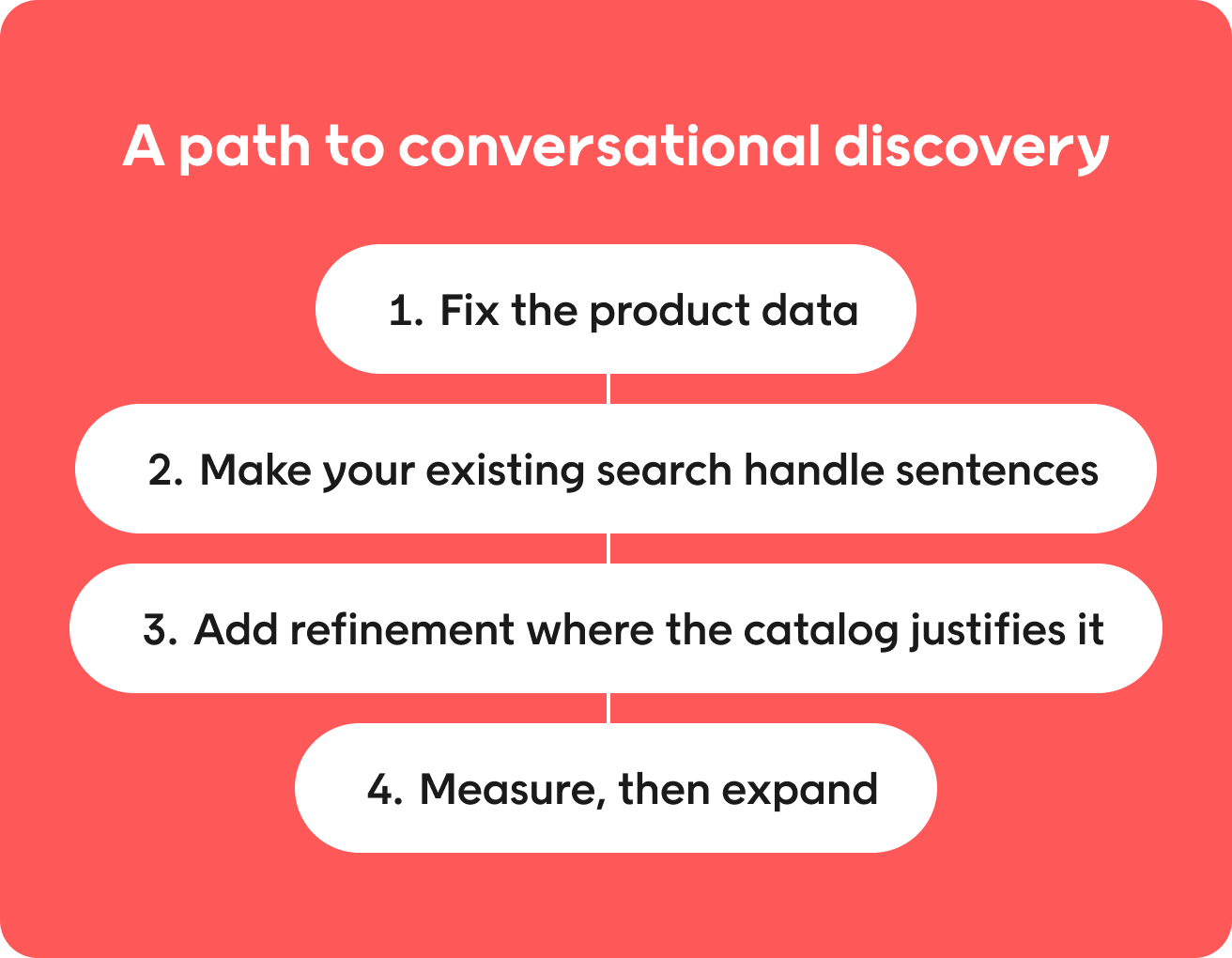
Stage 1: Fix the product data
Audit attribute completeness by category and close the gaps shoppers are already asking about. Pull your top zero-result queries, because many of them are attribute requests in disguise, and sort out your product taxonomy before anything else.
Stage 2: Make your existing search handle sentences
Upgrade query understanding so long, constrained queries resolve properly in the site search you already have. Highest return, lowest risk, and invisible to customers except that things start working.
Stage 3: Add refinement where the catalog justifies it
Introduce visible, editable constraints and multi-turn narrowing in your most considered categories first, not across the entire website. Watch how users interact with it before you widen the rollout.
Stage 4: Measure, then expand
Compare conversion and constraint resolution against conventional search on comparable queries. Expand into the categories where the numbers support it, and leave the rest alone.
Most retailers will get the majority of the value from the first two stages. That isn’t a reason to skip the last two. It is a reason not to start there.
How Voyado Elevate handles natural-language product discovery
By now, you know the interface was never the hard part. Here’s how Voyado Elevate handles the part that is.
Elevate reads the whole sentence, not the pieces
Elevate’s site search pairs advanced language models with retail-specific knowledge, so “warm waterproof jacket for hiking under €200” arrives as five constraints rather than six keywords. Semantic query analysis interprets the intent, then resolves it against enriched product data covering price, real-time stock, lifecycle, and variants.
The shopper who just told you exactly what they wanted gets shown exactly that.
Shoppers stop rephrasing until something works
Elevate goes past basic keyword matching, measuring and responding to real intent, and connecting products in more meaningful ways. Autocomplete does the work earlier still, suggesting phrases, products, content, and recent searches before anyone finishes typing.
You’ll see it in your logs as fewer repeat searches inside a single session.
60 milliseconds, so nobody drifts back to browsing
An AI-powered product scanner built for large volumes returns results within 60 milliseconds.
That number is the whole reason refinement works. A shopper will adjust a request three times if every turn is instant and abandon it after one if it isn’t.
It handles German compound nouns and Nordic morphology, not just English
Local language support covers a wide range of languages with extensive dictionaries for words and synonyms, and the engine adapts as you add products, entities, and attributes.
If your natural language processing works in English but falls apart on “regnjakke” or “Wanderjacke,” you don’t have a conversational search system. You have one that works in a single market.
Nothing dead-ends, and merchandisers keep control
Elevate captures user queries with no exact match instead of serving an empty page, and facets reorder as shoppers narrow, so site navigation keeps pulling its weight.
Editorial merchandising still applies. Your team can boost products, bury them, or pin them to a fixed position, build product sets and slices, manage synonyms, and publish across markets. The campaign you planned still runs, whether the shopper typed two words or twenty.
A returning customer isn’t treated like a stranger
Elevate shares identification and behavioral signals with Voyado Engage, so personalized product discovery draws on purchase history and loyalty context instead of session behavior alone.
Someone who has bought the same running shoe three times shouldn’t have to tell you their size again, and your customer loyalty platform already knows it.
If your team keeps getting asked what your conversational AI strategy is, the honest answer is that it starts with the engine, not the chat window.
Book a demo, and we’ll show you what Elevate does with the sentences your shoppers are already typing.
Final thoughts
Conversational search is a real shift, just not the one most vendors sell. Shoppers describe what they want in full sentences now and expect that to work. The retailers who win will fix the product discovery platform underneath rather than the interface on top.
Start by reading your own search logs. The sentences are already there. The question is what happens when your site receives them.
FAQs
What is conversational search?
Product discovery that accepts full natural-language requests and remembers context across turns. Shoppers describe what they need, see results, and adjust. It’s sometimes called conversational commerce search.
What is the difference between conversational search and natural language search?
Natural language search understands one complete sentence. Conversational search remembers previous turns, so “show me warmer options” changes the last request instead of starting over.
Is conversational search just a chatbot?
No. Traditional chatbots handle orders, shipping, and returns. Conversational search finds products. Many good examples have no chat window at all.
Does conversational search work for every retailer?
No. It helps with considered purchases, large catalogs, unfamiliar categories, and gift shopping. It gets in the way for known-item lookup, replenishment, and small catalogs.
What do I need before implementing conversational search?
Structured product data. A query can only be resolved with attributes that already exist as structured fields, so fix that before anything else.
How do I measure whether conversational search is working?
Track constraint resolution rate, turns to result, refinement rate, abandonment by turn, and conversion against conventional search. Read the query logs by hand too.
How does Voyado Elevate support conversational and natural-language discovery?
Elevate uses language models plus retail-specific knowledge to read intent and match it against enriched product data. Results return in 60 milliseconds, many languages are supported, no-match queries are captured, and merchandisers keep control.