TL;DR
More shoppers now open a chat with an AI shopping assistant before they open a search bar. They ask a real question: “Which dress works for a summer wedding?” “Which coat is warm enough for a Nordic winter?” The assistant researches, compares, and hands back a shortlist.
That changes where discovery starts. It doesn’t change what closes the sale. You still need accurate product data, a machine-readable catalog, and an on-site experience shoppers actually convert on.
Voyado Elevate is the product discovery platform that turns that same product intelligence into real-time relevance for human shoppers and AI shopping assistant journeys alike. This article will cover what’s changing, what isn’t, and what e-commerce leaders like you should do about it.
What is an AI shopping assistant?
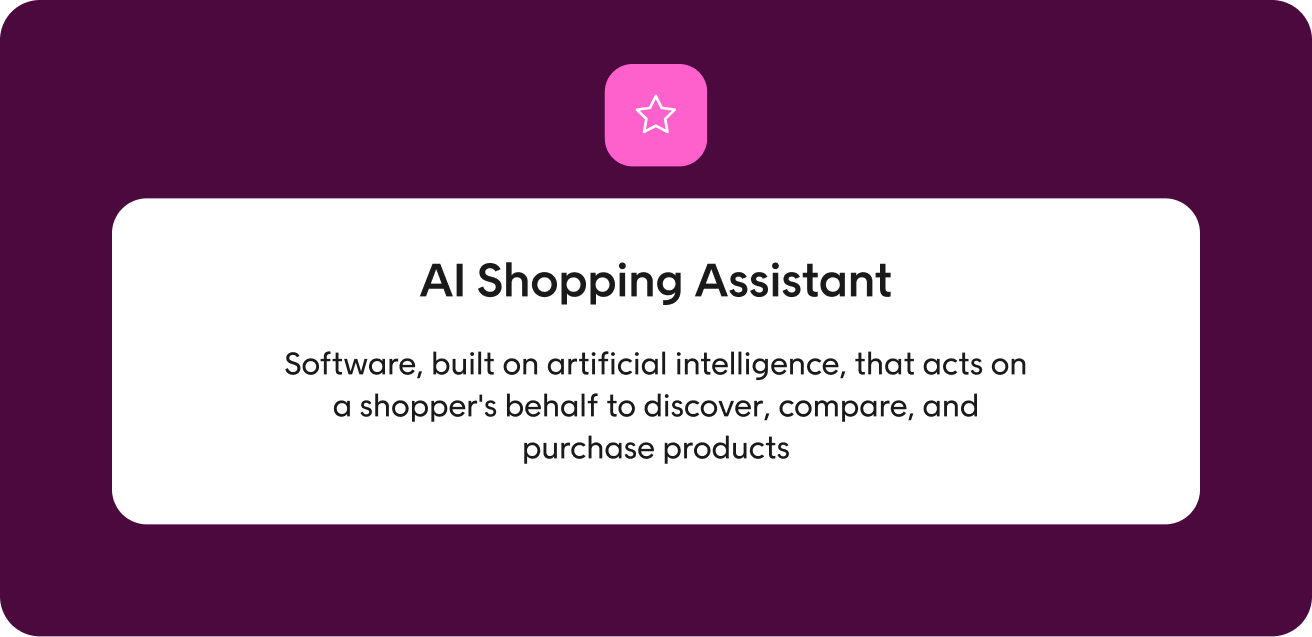
An AI shopping assistant is software, built on artificial intelligence, that acts on a shopper’s behalf to discover, compare, and purchase products. The shopper describes what they need in their own words, and natural language processing turns that into a real recommendation.
Depending on the tool, it can also:
- Hold on to user preferences across a conversation and give personalized responses
- Summarize customer reviews before a shopper ever reaches your site
- Support visual search, letting someone upload a photo instead of typing
Where it still falls short
AI assistants struggle with emotionally charged customer issues, the kind that need a person, not a script. And any assistant handling customer data has to answer for compliance with data regulations, especially across borders.
Assistants, agents, and chatbots aren’t the same thing
A lot of content out there uses these three words interchangeably. They shouldn’t be.
| Chatbot | AI shopping assistant | AI shopping agent | |
| What it does | Answers questions inside a scripted, narrow flow | Understands natural language, researches, and recommends | Plans a sequence and calls APIs to reach a goal |
| Does it act? | No, purely informational | Sometimes, hands off to complete the purchase | Yes: checkout, reorder, order management, returns |
| Feels like | A predefined script | A human-like experience that understands intent | A generative AI system working within user-set limits |
The line between an AI shopping assistant and an AI shopping agent is blurring fast. For now, treat them as points on a spectrum, not fixed boxes.
Where AI shopping assistants live
Three places, and each is a different problem for your business.
- General assistants: ChatGPT, Perplexity, Google’s AI Mode, and Gemini. Open-web discovery, entirely outside your control.
- Marketplace assistants: Amazon’s Rufus and similar tools, one of several shopping agents built into a walled garden you don’t own.
- On-site assistants: Conversational or AI-driven discovery built into your own site search. Fully within your control, though it takes real integration across multiple platforms and existing systems to get right.
Most of the anxiety in the market is about the first two. Most of what you can act on, including the importance of site search, sits in the third.
What’s actually changing in product discovery
Five things are genuinely different now, and none of them are solved by adding a chat window.
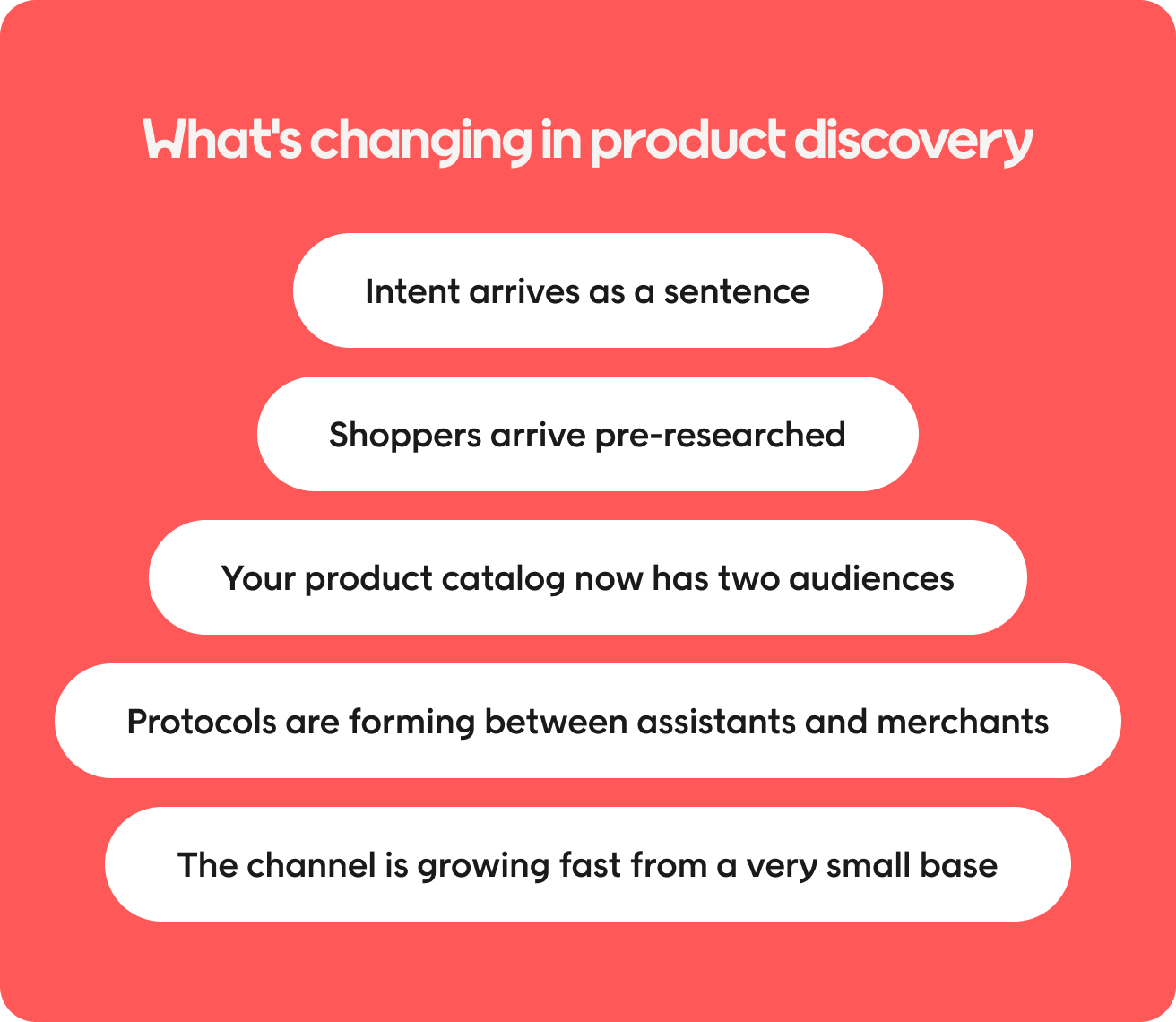
1. Intent arrives as a sentence, not a keyword
Traditional product search handles short queries like “black coat.” An AI shopping assistant gets full sentences instead: “black wool coat under €300 that ships by Friday and works for commuting,” price, material, color, delivery window, and use case, all at once.
A keyword-matching engine can’t parse conversational queries like that. A discovery engine that understands product data, stock, and delivery information can, and it returns relevant results instead of 400 unranked products.
What this means for you: on-site search now needs to handle a real sentence, or shoppers will just go ask an assistant instead. That’s why e-commerce product discovery is becoming table stakes, not a nice-to-have.
2. Shoppers arrive pre-researched and further down the buying journey
If an assistant has already compared five products, the shopper landing on your product page isn’t browsing. They’ve made most of their purchasing decisions already. They’re just confirming product details such as fit, stock, and delivery.
This raises the value of accurate product data and lowers the value of top-of-funnel content for that visit. Your product pages need to answer questions the moment someone lands. Your recommendations should support the shopper’s goal, not reopen a decision that’s already been made.
3. Your product catalog now has two audiences
Product data used to be read by people and search engine crawlers. Now AI shopping agents read it too, building structured queries against your product catalog. Clean, structured product data isn’t optional anymore. It decides whether you show up at all.
Incomplete attributes, inconsistent naming, and thin product details were always a conversion problem. Now they’re a visibility issue too. An assistant can’t recommend what it can’t confidently interpret.
The fix: Structured data markup (JSON-LD, Schema.org) covering things like –
- Price
- Availability
- Shipping
- Product attributes
That’s what makes a catalog machine-readable. Guidance shifts often, so check what’s current before you publish.
4. Protocols are forming between assistants and merchants
Standards are emerging to let assistants plug into a retailer’s existing systems for discovery, checkout, and post-purchase workflows, whether that’s conversational commerce over voice or chat:
- OpenAI’s Agentic Commerce Protocol (ACP)
- Google’s Universal Commerce Protocol (UCP)
- Agent Payments Protocol (AP2), for payments
Most assume deep integration and real-time data on price, stock, and availability, which is exactly where a lot of e-commerce stacks fall short today. That’s one of the key challenges. Nobody should rebuild their stack around a protocol that’s twelve months old.
What holds up regardless of which one wins is clean product data and a discovery layer that serves any front end. That’s the bigger idea behind agentic AI in retail – being ready for whichever standard sticks, not betting early.
5. The channel is growing fast from a very small base
AI-assisted shopping is still new, but it’s growing quickly. Recent research shows:
- AI-referred traffic to retail sites grew 138% year over year as of May 2026, according to Adobe Analytics.
- 62% of consumers have used AI to compare brands, models, prices, or reviews while shopping, according to McKinsey’s ConsumerWise survey.
- Only 5% of European retailers experimenting with AI are seeing clear, scalable ROI, according to Voyado’s State of AI in Retail report.
- Over a third of consumers already use AI to explore options and find new products, according to Circana, and commerce leaders report similar gains in product discovery and customer satisfaction.
Shoppers are growing comfortable with AI-powered shopping experiences fast, and an AI-powered shopping assistant is becoming a normal first stop rather than a novelty. This raises customer expectations everywhere, which often shows up as improved customer engagement for retailers who are ready.
The growth is real. The actual share of transactions still trails search, email, and direct traffic by a wide margin. This isn’t an emergency or a fad. It’s a channel worth building for on your normal planning cycle.
What AI doesn’t change about winning customers
AI shopping assistants are changing a lot about how shoppers find products. Not everything, though.
- Relevance still decides conversion. An assistant can send someone to your site, but only your site closes the sale, and only a consistent customer experience earns brand trust once they’re there.
- Product data quality is still the foundation. It was the constraint before assistants existed. It’s a bigger one now.
- Margin, stock, and product lifecycle still shape what surfaces. An assistant optimizes purely for the shopper. You still have to optimize for the business.
- Loyalty is still yours to build. An assistant brokers a transaction. It doesn’t build brand trust or generate more revenue for you the second time around unless you’ve captured that customer directly.
That last point carries real weight. The more shopping happens through an assistant instead of directly with you, the more valuable a direct, identified relationship becomes.
A solid customer loyalty platform is how you keep that relationship once an assistant has done its job and moved on.
What e-commerce leaders should do now
Almost everything above comes down to one thing. Get your product data ready for two audiences at once, human shoppers and AI shopping agents.
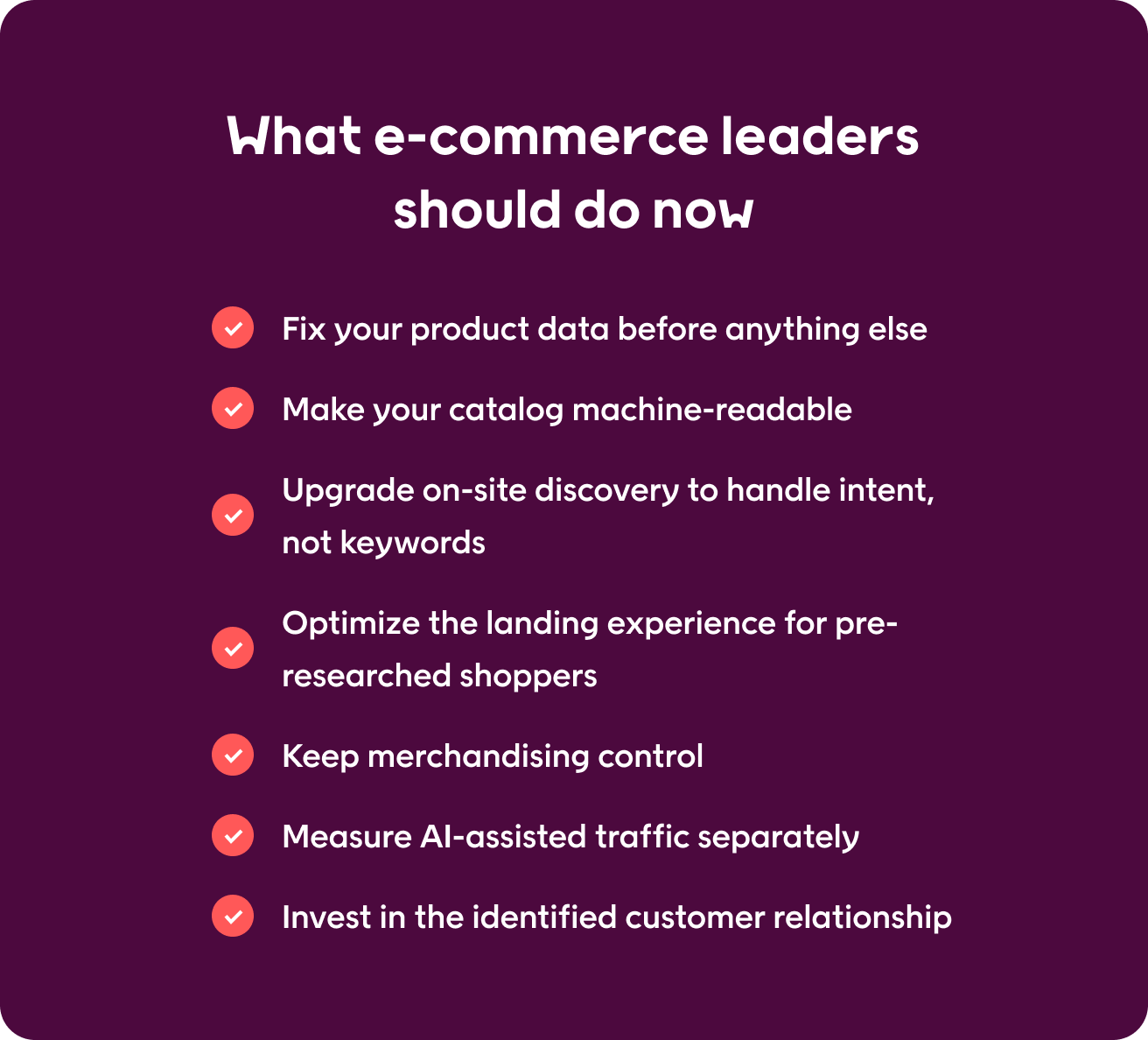
Fix your product data before anything else
Start with the basics.
- Audit attribute completeness: material, fit, dimensions, use case, care, compatibility
- Standardize naming across your catalog
- Make sure price, stock, and delivery data are accurate everywhere they show up
- Build this on your own data and customer data, not a patchwork of spreadsheet exports
Why it matters
On-site search, assistant visibility, and everything else in this article depend on getting this right.
Make your catalog machine-readable
A few concrete steps make this happen.
- Implement and validate structured data across your product pages
- Treat it as infrastructure, not an SEO checkbox
- Give someone ownership so it doesn’t quietly go stale
Why it matters
Without this, an AI shopping assistant can’t confidently recommend a product it can’t interpret, no matter how good it actually is.
Upgrade on-site discovery to handle intent, not keywords
This is what it should look like:
- Move from keyword matching to intent-aware ranking
- Weigh attributes, behavior, stock, and margin together
- Handle long, constrained product search queries
- Hold context across a session instead of resetting with every click
- Eliminate zero-result dead ends
Why it matters
This is what real personalized product discovery is for, and it’s how you meet expectations shoppers now bring with them.
Optimize the landing experience for pre-researched shoppers
A few things make this land well.
- Assume the visitor already has a shortlist in mind
- Surface availability, delivery date, returns, and sizing right away
- Use product recommendations for relevant items and complementary items, not alternatives that reopen a decision already made
Why it matters
Recommendations that feel tailored, not generic, save shoppers time and keep the visit from feeling time-consuming.
Keep merchandising control
This means two things.
- Keep shaping campaigns, launches, brand priorities, and margin targets yourself
- Let agentic merchandising take over the routine decision-making instead of manual merchandising and rigid business rules
Why it matters
It keeps up with complex, multi-criteria searches, and it gives your team time back for strategy.
Measure AI-assisted traffic separately
Start by separating the data.
- Track referral traffic from AI assistants on its own
- Look at conversion rates, average order value, and return rate separately from your general traffic
Why it matters
These shoppers show higher intent and shorter sessions. Personalized recommendations from AI assistants can meaningfully lift conversion rates, and the gains can be dramatic, but only if you separate the traffic to see it.
Invest in the identified customer relationship
Get your customers to identify themselves early, through sign-up, login, or your loyalty program.
Why it matters
You can reach them directly next time, with no assistant standing in between. That’s really the whole AI shopping assistant strategy for e-commerce leaders. Fix the data first, then let it work for every channel that touches it.
How Voyado Elevate serves both human and AI-assisted discovery
Voyado built Elevate to be the discovery layer, not a competing shopping assistant. The key benefits land the same way, whether the shopper is a person or an AI shopping agent acting for them.
| Pillar | What it means |
| Retail product intelligence | AI that understands retail nuances: pricing, stock, margin, lifecycles, context, and trends |
| Commerce efficiency | Automates optimization and cuts manual merchandising effort |
| Integrated experience | Connects search, recommendations, marketing, and loyalty into one journey |
A product discovery platform built for retail, not a generic search tool
Voyado Elevate turns shopper intent and product data into real-time action. It shows the most relevant products based on customer intent, not a generic model borrowed from another industry.
If you want to increase conversion and automate the decisions that protect your margin, this is built for exactly that.
Generic AI tools miss the retail-specific things that actually drive relevance and profitability. Things like:
- Pricing
- Stock
- Margin
- Lifecycles
- Shifting trends
Retail product intelligence: the same asset both audiences need
The same product intelligence that helps Elevate show the right item to a human shopper also makes your catalog easy for an AI-assisted journey to interpret. That means complete attributes, accurate stock, real product relationships, and demand signals built from predictive analytics.
You don’t need one strategy for people and one for machines. You need one product data foundation good enough for both.
Agentic merchandising: relevance that adapts without manual rules
Elevate optimizes search results, recommendations, and listings automatically, balancing what customers want with what the business needs. That frees your merchandisers from hand-maintaining rulebooks so they can spend their time on brand, campaigns, and editorial direction instead.
Shoppers who arrive through an assistant expect even more from the moment they land, and adaptive relevance is what helps you keep up with them.
An integrated experience: discovery connected to loyalty and marketing
Elevate connects merchandising, personalization, marketing, and loyalty into one consistent experience. Silos hurt customer experience, and they cost you the personalized shopping experiences that build loyalty and more revenue.
A shopper who arrives through an assistant can be recognized, converted, and welcomed into a Voyado Engage relationship, turning a one-off visit into a repeat one.
Does your team keep getting asked what your AI shopping strategy is?
Book a demo to see how Voyado Elevate turns your product data and shopper intent into relevance for every kind of shopper.
Final thoughts
AI shopping assistants change where people start looking for products. They don’t change what actually makes a sale happen. You still need accurate product data, search that understands what someone wants, and a good experience once they land on your site.
You can’t control how ChatGPT or Gemini ranks your products. But you can control whether your catalog is easy for machines to read, whether your search keeps up with what people expect now, and whether a first visit turns into a loyalty relationship.
None of this is new. It’s just harder to ignore than it used to be.
What is an AI shopping assistant?
An AI shopping assistant is software that acts on a shopper’s behalf to discover, compare, and sometimes purchase products based on natural-language requests instead of filters.
What's the difference between an AI shopping assistant and an AI shopping agent?
An assistant researches and recommends, then usually hands the shopper to the retailer to finish the purchase. An agent is goal-directed and can execute the transaction itself (checkout, reorder, or returns) within limits the user sets.
How do AI shopping assistants change e-commerce product discovery?
They shift intent from short keywords to full natural-language requests, send you shoppers who are already pre-researched, and add a second audience for your product data: machines parsing the catalog alongside the humans reading it.
How do retailers stay visible to AI shopping assistants?
It comes down to product data: complete attributes, accurate price and stock information, and structured data markup that makes your catalog explicitly machine-readable.
Should retailers try implementing AI shopping assistants themselves?
For most retailers, no, not as a first move. Implementing AI shopping assistants, or bolting on a third-party solution, won’t fix weak product data sitting underneath it. The better investment is the discovery layer itself.
Is there a single best AI for shopping?
Not really. General assistants, marketplace assistants, and on-site assistants each solve a different problem, and retailers only fully control the last one.
How does artificial intelligence improve customer experience in e-commerce?
Artificial intelligence improves customer experience in e-commerce by matching relevant products to intent faster, answering questions immediately, and adapting recommendations as customer behaviour and customer intent shift in real time.
What role does generative AI play in AI-powered shopping assistants?
Generative AI is what lets AI-powered shopping assistants hold a natural conversation instead of following a script, interpreting nuance and context the way a person would.
Does AI-assisted shopping make loyalty less important?
The opposite. The more discovery happens through an assistant instead of directly with you, the more valuable a direct, identified relationship becomes.
How does Voyado Elevate fit into AI-assisted shopping?
Elevate is the product discovery platform built for retail. It turns product data and shopper intent into real-time relevance across search, recommendations, and listings, one foundation serving both human and machine-assisted discovery.