TL;DR
Voyado is the retail decision layer that bridges today’s stack to the agentic era, coordinating engagement, discovery, and loyalty in real time.
- The core difference: in agentic commerce vs. traditional e-commerce, AI agents act on live context in real time, while traditional systems scale decisions you already made.
- Five contrasts to know: decision speed, personalization mechanism, channel coordination, AI role, and the improvement loop.
- What changes for shoppers: discovery re-ranks in real time, the purchase moment protects margin, and post-purchase support stays consistent across channels.
- Best for: retailers running omnichannel journeys who lose conversions when segments and product rules lag behind live intent.
- What you need to get ready: unified customer context, identity resolution, consent, and point-of-sale (POS)-linked loyalty, with no rip-and-replace to start.
- Proof point: agentic incentives match the offer to context, protecting margin instead of training shoppers to wait for blanket discounts.
Your merchandising rules and campaign segments respond days after a shopper’s intent shifts. The real question in agentic commerce vs. traditional e-commerce is that lag: do your systems act while intent is live, or after the moment has passed?
Here’s the mechanism behind the gap. Traditional e-commerce systems scale decisions that were already made: static segments built last week, manual product rules set last quarter, and calendar-driven campaigns planned months ahead. So they can’t adapt when browsing behavior, stock levels, or purchase context change mid-session.
As your catalog grows and your channel count climbs, “personalization” quietly becomes a coordination problem. Instead of speeding customers toward the right product, it slows your team down with rebuilds, approvals, and conflicting messages.
Voyado bridges today’s stack to the agentic era. It unifies engagement, discovery, and loyalty into a retail decision layer that senses intent, decides the next best action, and executes across channels in real time. This article contrasts traditional e-commerce with agentic commerce across five dimensions: decision speed, personalization mechanisms, channel coordination, AI role, and improvement loops. Then it shows how the customer journey changes when agents replace rules.
What is agentic commerce (and what it isn’t)
Agentic commerce is AI agents that decide and execute next-best actions continuously, based on goals plus live context, rather than static rules. That’s the whole idea in one sentence.
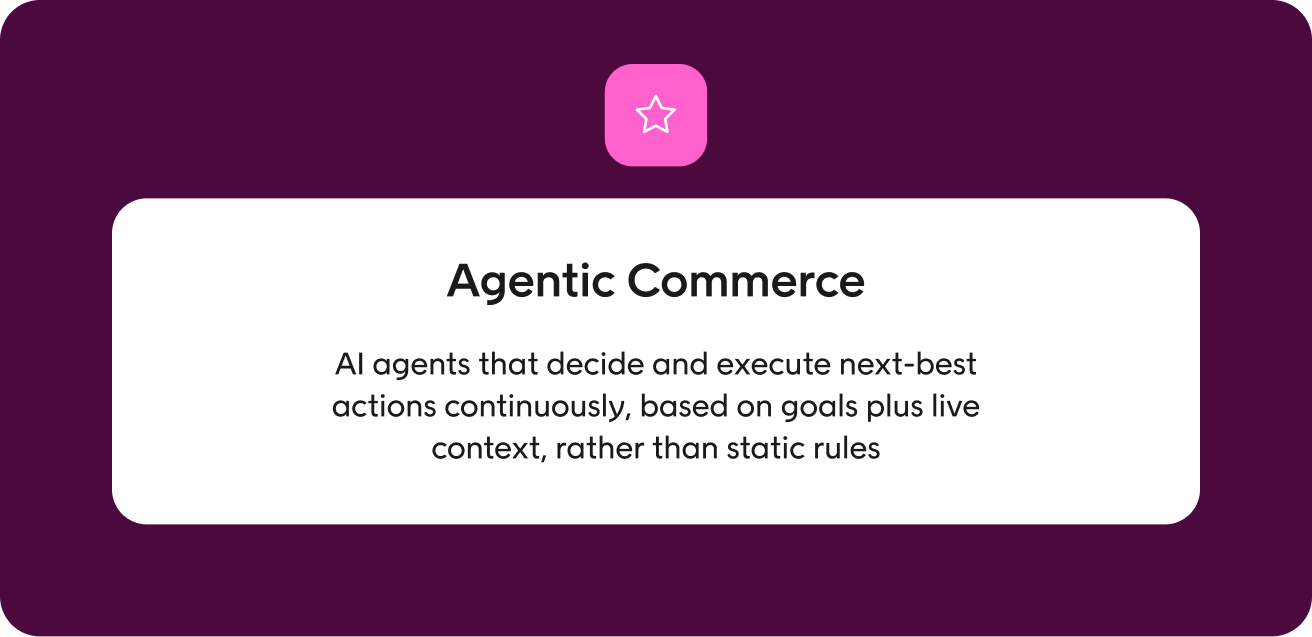
Contrast that with traditional automation. Traditional systems scale decisions already made (segments, journeys, and product rules), while agentic commerce adapts decisions in real time as browsing behavior, stock levels, or purchase context change. The decision moves from something you set in advance to something the system makes in the moment.
It also helps to say what agentic commerce is not. It’s not a chatbot. It’s not a recommendation widget. It’s not marketing automation with better targeting bolted on. Agentic commerce is autonomous decision-making that coordinates engagement, discovery, and loyalty from shared customer context.
Three pieces of commerce architecture have to be in place for it to work:
- Unified customer context: browsing, purchase history, loyalty activity, and live interactions in one place.
- Autonomous decision logic: the next best action, channel, timing, and offer or message.
- Cross-channel execution: email, SMS, onsite, paid, and in-store, driven from the same logic.
Put simply, agentic commerce is the shift from reactive coordination to proactive decision-making, where the system responds to intent signals before customers abandon or disengage.
Agentic commerce vs traditional e-commerce: side-by-side comparison
The clearest way to understand agentic commerce vs traditional e-commerce is to contrast how each system handles decision speed, personalization, channel coordination, AI role, and improvement loops.
| Dimension | Traditional e-commerce | Agentic commerce |
| Decision speed | Decided days or weeks ahead via segment builds and campaign calendars | Decided continuously in real time from live context |
| Personalization mechanism | Static segments and manual product rules that lag intent shifts | Autonomous agents that adapt next-best actions as behavior, stock, or context changes |
| Channel coordination | Channel-by-channel execution where offers conflict across email, web, paid, and in-store | Orchestrated execution from one decision logic to reduce cross-channel mismatch |
| AI role | AI analyzes what happened, so teams read dashboards instead of changing experiences live | AI decides and executes, closing the gap between signal and response |
| Improvement loop | Manual optimization cycles based on campaign reports | Closed learning loop across conversion, retention, satisfaction, deflection, return rates, and customer lifetime value (CLV) uplift |
The core difference is simple. Traditional e-commerce scales decisions that were already made, while agentic commerce uses AI agents to decide and execute next-best actions continuously, based on goals plus live context. One model reacts on a schedule. The other acts on a signal.
These architectural differences change what happens at every stage of the customer journey, from discovery to purchase to post-purchase support. See how Voyado’s retail decision layer coordinates engagement, discovery, and loyalty in real time. Book a demo.
What changes in the customer journey: Discovery, purchase, and post-purchase
Traditional personalization breaks when manual segmentation forces your team to respond days after real-time browsing and purchase signals arrive, so conversion windows close before anyone can act. The next three sections walk through where that plays out: product discovery, the purchase moment, and post-purchase support.
Product discovery
Some of the clearest agentic commerce examples start with search and browse. Traditional systems lean on static product rules and segment-based recommendations that can’t adapt when stock levels, demand, or shipping constraints change mid-session.
Agentic systems work differently. Agents adapt search results in real time and re-rank products using stock, margin, demand, availability, and shipping constraints, so shoppers hit fewer dead ends and see relevant alternatives instead.
Picture a customer searching for a product that’s out of stock. Rather than a dead end, an agentic system surfaces back-in-stock alerts, compatible alternatives, or sizing and compatibility guidance, without reaching for a blanket discount. The outcome: higher conversion on search and browse, fewer dead ends, and margin protected because you’re not defaulting to markdowns.
Purchase moment
Traditional cart recovery leans on hard-coded discount triggers that erode margin and train shoppers to wait for the next offer. It treats every hesitation the same way.
Agentic purchase support reads the context instead. Agents address real hesitation drivers (shipping promises, delivery options, and store availability) and tailor incentives to cart value, purchase history, and loyalty tier rather than firing a blanket discount.
Picture two shoppers stalling at checkout. A high-value customer hesitating on shipping cost gets expedited delivery at no extra charge, while a discount-sensitive shopper sees a time-limited offer. Both decisions happen in real time, based on shared customer context. The outcome: higher conversion at the point of purchase, protected margin, and less dependence on discounting.
Post-purchase support
Traditional post-purchase workflows rely on manual handoffs between support, fulfillment, and marketing, so “where is my order?” (WISMO) questions, returns, and exchanges create friction and pile up support load.
Agentic post-purchase support handles WISMO, returns, and exchanges consistently across email, SMS, chat, and in-store, improving service quality while reducing that load. Ask “where is my order?” and the shopper gets proactive tracking updates, a delivery-promise confirmation, and alternative pickup options, no support ticket required. The outcome: better retention, lower support load, and higher satisfaction and repeat rates.
The highest leverage comes when engagement, product discovery, and loyalty share the same customer context, so recommendations and rewards don’t diverge. This unified approach is what separates agentic commerce from traditional automation.
How agentic commerce works: The retail decision layer
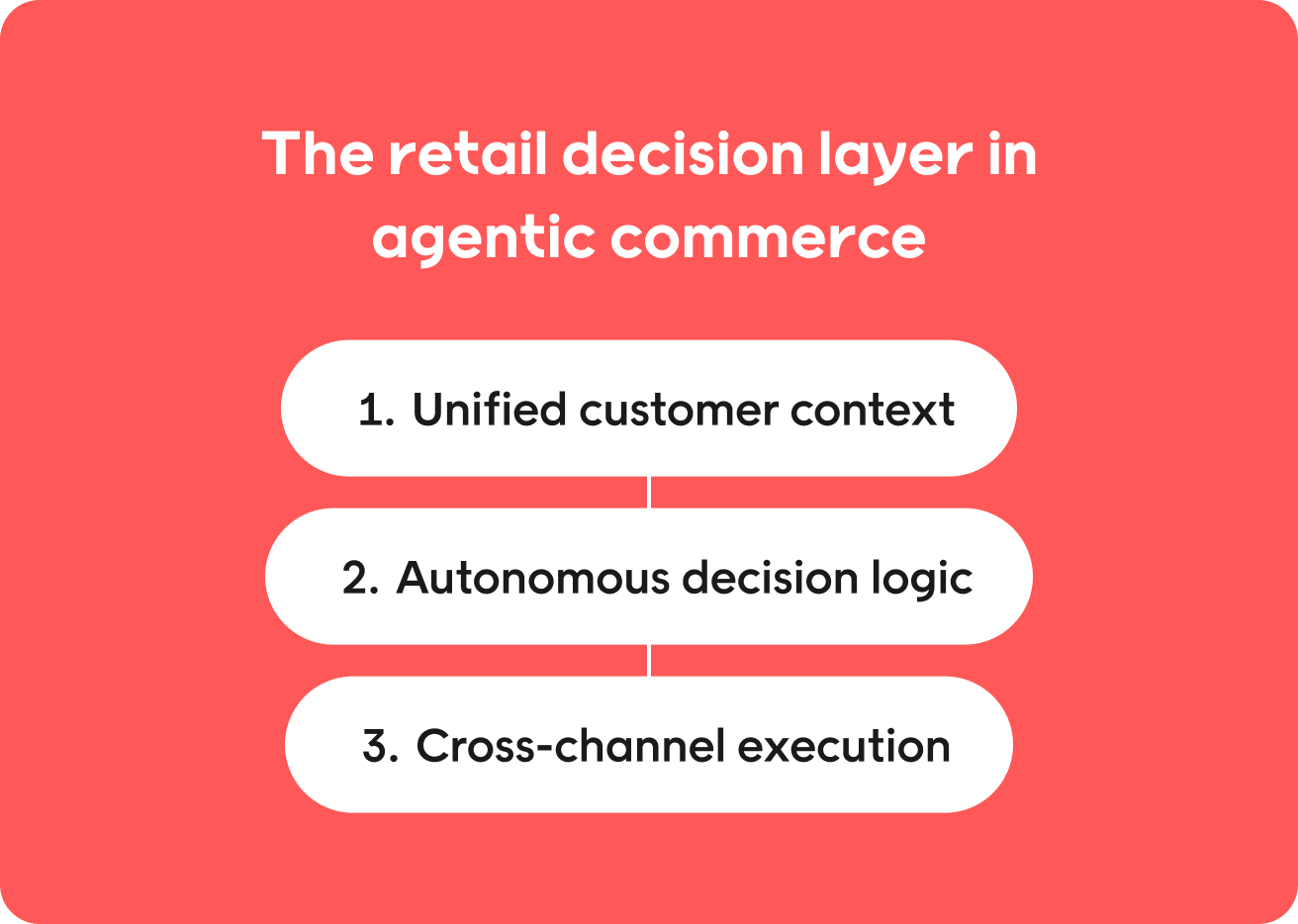
An agentic commerce platform needs a retail decision layer that unifies customer context, autonomous decision logic, and cross-channel execution, not just better segmentation or smarter recommendations. Here’s what each part does:
- Unified customer context. Agentic systems use browsing behavior, search behavior, purchase history, preferences, loyalty activity, and live interactions as decision inputs across channels, not siloed segment snapshots that lag behind intent shifts.
- Autonomous decision logic. Agents choose the next best action, best channel, timing, and offer or message dynamically, rather than relying on hard-coded segments and journeys that need manual updates whenever behavior changes.
- Cross-channel execution. Agentic actions orchestrate email, SMS, onsite messaging, paid media, and in-store touchpoints from the same decision logic, reducing the cross-channel mismatch where offers and messages conflict.
Autonomy without limits worries every experienced buyer, and it should. Guardrails like approval thresholds, escalation rules, and privacy boundaries keep autonomous actions aligned with brand and compliance requirements, so agents don’t overstep permissions or violate consent.
This is where Voyado stands apart. Voyado acts as a retail decision layer that coordinates next-best actions across engagement, discovery, loyalty, and retail media in one suite. All of it runs on retail-trained AI that reads product signals and loyalty behavior alongside browsing data, so the system responds to intent earlier.
This unified approach eliminates the coordination problem that traditional e-commerce creates when engagement, discovery, and loyalty operate in separate silos.
Agentic commerce readiness: What retailers need to prepare
Good news first: agentic commerce doesn’t require a platform rip-and-replace. It does, though, require unified customer context, identity resolution, and consent management that traditional e-commerce stacks often lack. Here’s what to put in place:
- Unified customer profiles. Agentic systems need browsing behavior, purchase history, loyalty activity, and live interactions in one profile, not scattered across email platforms, e-commerce databases, and POS systems that don’t sync in real time.
- Identity resolution across channels. Agents can’t coordinate email, web, paid, and in-store actions if they can’t recognize the same customer across touchpoints. Identity resolution and consent management become foundational, not optional.
- Retail-trained AI that interprets product signals. Agentic commerce needs AI that understands stock levels, margin, demand, availability, and shipping constraints alongside customer behavior, so agents adapt search results, recommendations, and offers without manual product rules.
Don’t stop at digital. In-store execution requires POS-linked loyalty so agents can recognize customers, apply benefits at checkout, and coordinate store staff workflows, not just online touchpoints.
This is exactly the bridge Voyado is built to be. Voyado supports connected execution across email and SMS, onsite search and recommendations, advertising environments, in-store touchpoints, and digital wallets from a unified context, so you don’t need to rebuild your stack to adopt agentic commerce.
Measuring agentic commerce impact: Retail KPIs and experiment design
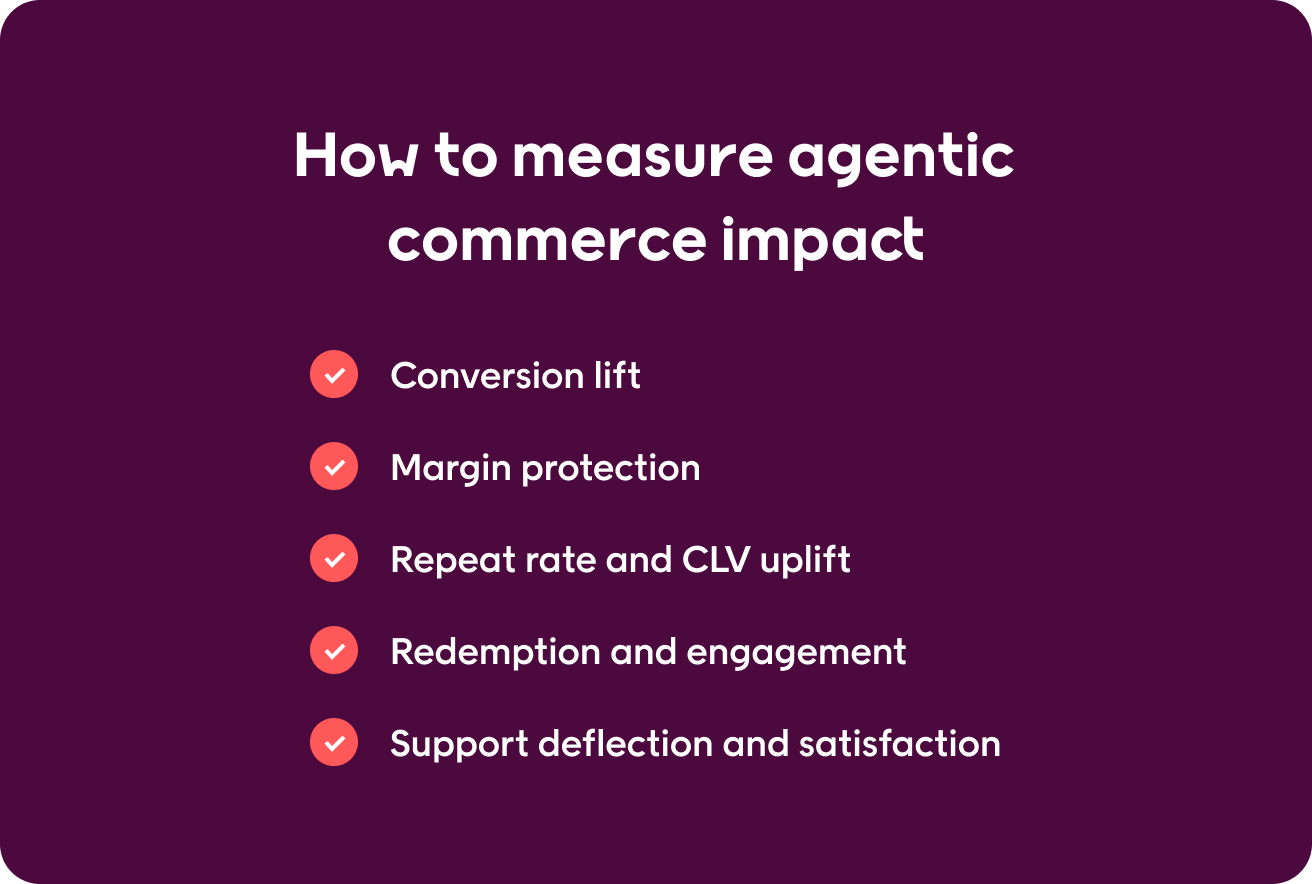
Traditional e-commerce teams measure campaign performance with open rate, click rate, and conversion rate. Agentic commerce asks a harder question: how good are decisions across engagement, discovery, and loyalty? Track these five KPIs to answer it:
- Conversion lift. Compare conversion rates on search, browse, and cart for customers exposed to agentic recommendations vs. static product rules.
- Margin protection. Measure average discount depth and margin per transaction to show agentic incentives protect margin vs. blanket cart-recovery discounts.
- Repeat rate and CLV uplift. Track repeat purchase rate and CLV for customers in agentic journeys vs traditional segment-based campaigns.
- Redemption and engagement. Measure loyalty point redemption, reward engagement, and program participation to prove agentic offers drive higher activation.
- Support deflection and satisfaction. Track WISMO ticket volume, return rate, and customer satisfaction (CSAT) to prove agentic post-purchase support reduces friction.
The cleanest way to measure impact is an A/B test: one cohort receives agentic next-best actions, and the control cohort receives traditional segment-based journeys. Then you compare the five KPIs above.
Agentic commerce improves over time via a closed learning loop that evaluates conversion, retention, satisfaction, deflection, return rates, and CLV uplift, so measurement becomes continuous, not campaign-by-campaign.

FAQs
What is agentic commerce?
Agentic commerce is AI agents that decide and execute next-best actions continuously, based on goals plus live context, not static rules. That contrasts with traditional automation, which scales decisions already made through segments, journeys, and product rules. To run it, you need a retail decision layer that unifies customer context, autonomous decision logic, and cross-channel execution.
What are agentic commerce examples?
The clearest agentic commerce examples show up when something goes wrong in a shopper’s journey. A customer searches for a product that’s out of stock: traditional systems show “out of stock” and end the journey, while agentic systems surface back-in-stock alerts, compatible alternatives, or sizing and compatibility guidance without forcing blanket discounts. Three common examples:
- Product discovery: agents adapt search results in real time and re-rank using stock, margin, demand, availability, and shipping constraints.
- Purchase moment: agents address hesitation drivers like shipping promises, delivery options, and store availability without blanket discounts, tailoring incentives to context to protect margin.
- Post-purchase support: agents handle WISMO, returns, and exchanges consistently across channels to improve service while reducing support load.
These examples show how agentic commerce closes the gap between customer action and system response, turning reaction lag into proactive revenue.
What is an agentic commerce platform?
An agentic commerce platform unifies customer context, autonomous decision logic, and cross-channel execution, not just better targeting or smarter recommendations like traditional marketing automation or personalization engines. The three architectural requirements are:
- Unified customer context across browsing, purchase, loyalty, and live interactions.
- Autonomous decision logic for the next best action, channel, timing, and offer.
- Cross-channel execution from one shared decision logic.
Voyado delivers this as a retail decision layer that coordinates next-best actions across engagement, discovery, loyalty, and retail media in one suite, bridging today’s stack to the agentic era.
How does agentic commerce work?
Agentic commerce works in a three-step decision flow. First, agents sense intent from browsing behavior, search behavior, purchase history, preferences, loyalty activity, and live interactions. Second, agents decide the next best action, channel, timing, and offer or message based on goals plus live context. Third, agents execute across channels (email, SMS, onsite messaging, paid media, and in-store) from the same decision logic, then feed the results back into the learning loop.
What do retailers need to adopt agentic commerce?
Retailers need unified customer profiles, cross-channel identity resolution, consent management, retail-trained AI that interprets product signals, and POS-linked loyalty for in-store execution. Unified profiles and identity resolution let agents recognize the same customer everywhere, while retail-trained AI reads stock, margin, and demand alongside behavior. POS-linked loyalty extends the same decisions into the store. Reassuringly, adoption does not require a full stack rip-and-replace.
How do you measure agentic commerce impact?
You measure agentic commerce impact with five retail KPIs: conversion lift, margin protection, repeat rate and CLV uplift, redemption and engagement, and support deflection and satisfaction. In agentic commerce vs. traditional e-commerce, decision quality matters more than campaign metrics. The cleanest method is an A/B test that gives one cohort agentic next-best actions and a control cohort traditional segment-based journeys, then compares those KPIs. Because a closed learning loop evaluates results continuously, measurement becomes ongoing rather than campaign by campaign.