TL;DR
An e-commerce CRM connects customer data, purchase history, loyalty activity, and marketing channels. The best e-commerce CRM software should also connect online and in-store customer behavior, reduce manual work, and support more relevant customer journeys.
This guide uses a five-part scorecard to compare 15 current e-commerce CRM platforms across identity resolution, POS integration, native loyalty, agentic AI, and multi-market governance. It also explains how to evaluate your options and plan a lower-risk rollout.
Disconnected systems split customer data across your online store, POS, loyalty program, service tools, and marketing platforms. This creates duplicate profiles, consent gaps, generic campaigns, and manual work for e-commerce teams.
The right e-commerce CRM changes this. Strong CRM solutions centralize customer data, while built-in marketing automation can trigger cart-recovery and follow-up journeys based on customer behavior.
Voyado’s Retail Radar found that 73% of market revenue came from customers engaged with loyalty and retention communications.
This guide compares 15 platforms using a practical scorecard and explains how to plan your CRM integration.
How to evaluate CRM software for e-commerce
The best CRM software for e-commerce should make daily work easier while helping you build stronger customer relationships across online and in-store channels.
Use these five questions to compare the best CRM tools for e-commerce. This guide to the best CRM software for retail can also help you narrow your shortlist.
1. Does customer relationship management start with one profile?
E-commerce CRMs handle high volumes of behavioral and transaction data. They should connect purchase history, browsing, loyalty, service, and POS records in one profile.
Look for identity stitching across email, phone, device ID, customer ID, and transaction ID. Without it, one person may appear as several e-commerce customers. Consent gaps can also enter marketing campaigns.
The right CRM should centralize customer data so customer interactions, CRM data, and consent remain dependable throughout the customer lifecycle.
2. Does CRM integration connect online and in-store activity?
A good CRM integration should sync customer behavior, orders, returns, associate interactions, and inventory management data quickly enough for your team to act.
Check how the CRM connects with your e-commerce platform, payment system, POS, and marketing tools. Ask which records move, how often they update, and what happens when a sync fails.
Platforms without suitable connectors may need custom middleware. This can delay campaign activation and create more technical work.
Are marketing automation and loyalty built in?
Native loyalty keeps points, tiers, rewards, purchase history, and customer profiles in one system.
This lets you trigger email and SMS campaigns when someone earns a reward, changes tier, shops in store, or becomes inactive. Automated follow-ups can also help recover abandoned carts and encourage repeat purchases.
A bolt-on customer loyalty platform can still work. Ask how balances, returns, consent, rewards, and customer profiles stay in sync.
Not quite. The approvals sentence is duplicated, and the governance section can be tightened.
Do AI and automation have guardrails?
Agentic AI should propose next-best actions, such as building segments, triggering journeys, or flagging KPI changes, while waiting for team approval before execution.
Black-box AI can act without showing its reasoning or giving teams enough control. Ask about approvals, permissions, confidence signals, and audit history before automating customer-facing decisions.
Useful automation tools support workflow automation with human review. Automated workflows can reduce manual follow-up, while CRM systems can automate tasks and save sales teams time.
Can the CRM support every market?
Omnichannel retailers need consent management, data residency controls, multiple languages, user roles, and brand permissions across regions.
Without these governance features, compliance risk increases, and international expansion slows. Strong governance helps central and local teams work across brands, countries, and physical stores without weakening control.
E-commerce CRM platforms at a glance
Use this table to compare each platform’s omnichannel retail fit, ideal customer, and pricing model.
| Platform | Score | Best fit | Pricing model |
| Voyado | 5.0 | Midmarket and enterprise omnichannel retail | Fixed platform fee plus usage |
| Klaviyo | 3.5 | E-commerce-first brands | Active profiles and messaging |
| Salesforce Marketing Cloud Engagement | 3.0 | Large, multi-brand enterprises | Enterprise editions plus usage |
| HubSpot Smart CRM | 3.0 | Small and midmarket businesses | Free and paid tiers |
| Gorgias | 2.5 | E-commerce customer support teams | Ticket and AI usage |
| Omnisend | 2.5 | Small and growing online stores | Contacts and sends |
| Brevo | 2.5 | Small businesses needing affordable messaging | Sends, users, and features |
| ActiveCampaign | 2.5 | Smaller teams needing flexible automation | Contacts and feature tiers |
| Zoho CRM | 3.0 | Budget-aware sales and marketing teams | Per-user tiers |
| Yotpo Loyalty & Referrals | 2.5 | Brands focused on retention | Order-volume tiers |
| Antavo | 3.5 | Complex enterprise loyalty programs | Customer-activity pricing |
| LoyaltyLion | 3.0 | Shopify-led loyalty programs | Monthly order volume |
| Ometria | 3.5 | Retail-focused marketing teams | Custom pricing |
| Optimove | 3.5 | Data-rich retention teams | Custom pricing |
| Braze | 3.5 | Mobile and digital-first enterprises | Active-user and usage pricing |
An integration can work well. But you need to know who maintains it, what data it shares, and the delay it creates.
How we scored the tools
Each platform can earn up to five points:
- 1 point for native identity resolution
- 1 point for native POS integration
- 1 point for native loyalty
- 1 point for agentic AI with approval controls
- 1 point for multi-market governance
A partial capability or one provided through an integration earns 0.5 points. A missing capability earns no points.
The 15 best CRM tools for e-commerce
1. Voyado
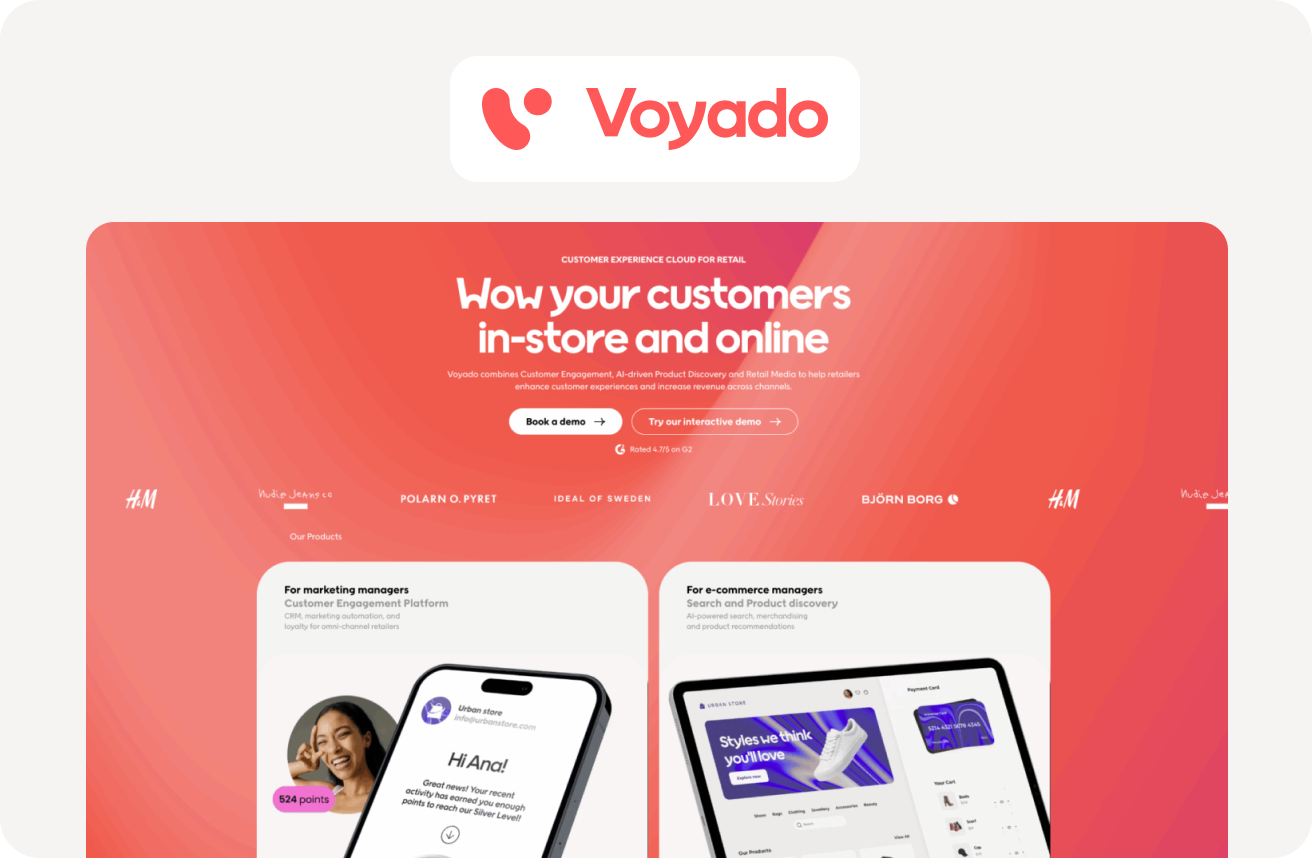
Voyado connects customer data, marketing automation, loyalty, and agentic AI in one retail-focused platform. Teams can use online and in-store activity without moving information between disconnected tools.
Here is how Voyado meets the five scorecard criteria:
- Identity resolution: Connects anonymous and known activity in one first-party profile.
- POS integration: Adds store purchases and interactions to the same profile as online behavior.
- Native loyalty: Keeps points, tiers, rewards, and purchase history inside the platform.
- Agentic AI: Suggests segments, automations, and next actions with approval controls.
- Multi-market governance: Supports roles, brands, languages, and regional execution within one structure.
Score: 5.0
Best fit: Midmarket and enterprise omnichannel retailers.
Pricing: Fixed platform fee plus usage-based pricing.
Key features: Unified profiles, POS integration, native loyalty, multi-market support, and retail-trained AI.
Watch out: Onboarding requires technical support to connect source systems.
2. Klaviyo
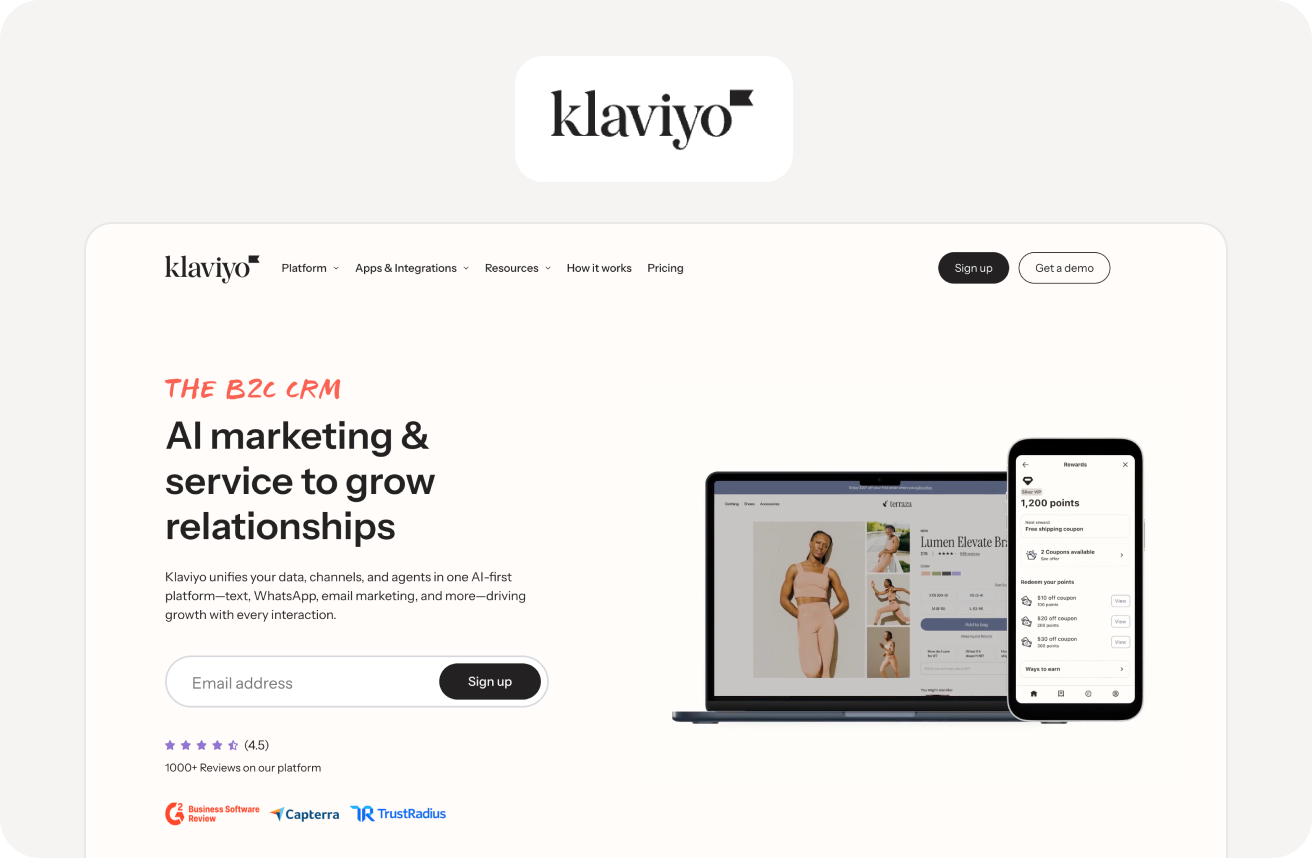
Klaviyo is a B2C e-commerce CRM for customer profiles, marketing automation, analytics, service, email, and SMS marketing. Its Shopify and WooCommerce integrations help brands activate behavioral and transaction data across welcome, abandoned-cart, post-purchase, and win-back journeys.
Klaviyo also offers AI agents with approval controls. Advanced loyalty and multi-market store operations may require additional tools.
Score: 3.5
Best fit: E-commerce-first brands that need deep automation around an online store.
Pricing: Free and paid tiers based on profiles and messages.
Key features: Store integrations, product feeds, customer segments, e-commerce analytics, and AI agents.
Watch out: Advanced in-store loyalty and POS use cases depend on integrations.
3. Salesforce Marketing Cloud Engagement
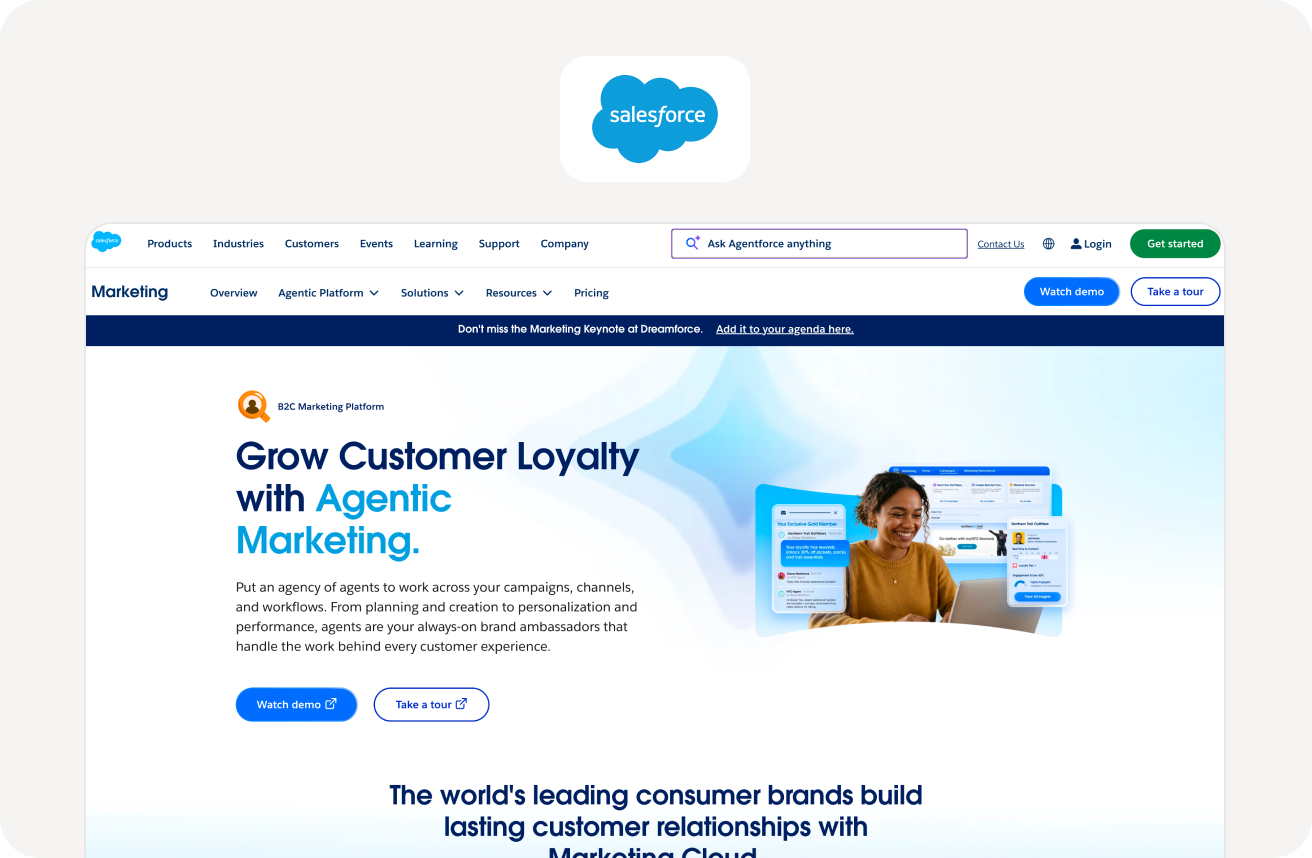
Salesforce Marketing Cloud Engagement supports email, mobile, web, advertising, and complex customer journeys at enterprise scale. Its governance suits retailers with several brands or regions, but identity resolution, loyalty, POS data, and agentic features may involve other Salesforce products.
Score: 3.0
Best fit: Enterprise and multi-brand retailers already using Salesforce.
Pricing: Enterprise editions plus contact and usage costs.
Key features: Cross-channel journeys, detailed permissions, advanced analytics, and broad integrations.
Watch out: The complete setup may require several products and implementation partners.
4. HubSpot Smart CRM
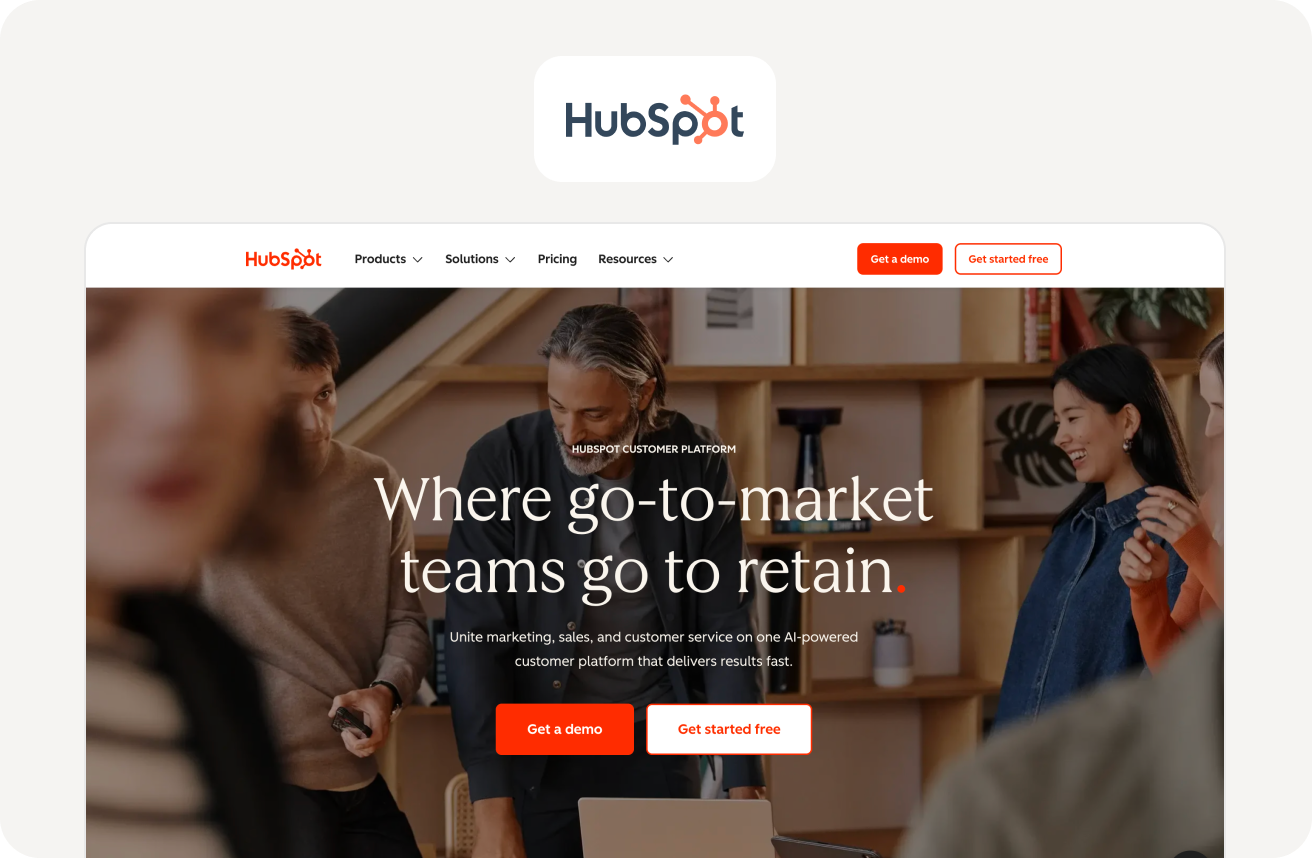
HubSpot Smart CRM connects digital marketing, sales, service, content, and commerce around one record. It gives teams shared contact management, customer communications, reporting, and sales pipeline activity without a large initial implementation.
Its app marketplace supports an e-commerce business, but retail loyalty and POS events require CRM integration.
Score: 3.0
Best fit: Small and midmarket businesses that need an accessible CRM.
Pricing: Free tools plus tiered seats, marketing contacts, and usage credits.
Key features: Contact management, sales process tools, reporting, and automation.
Watch out: Omnichannel retail depth depends on integrations.
5. Gorgias
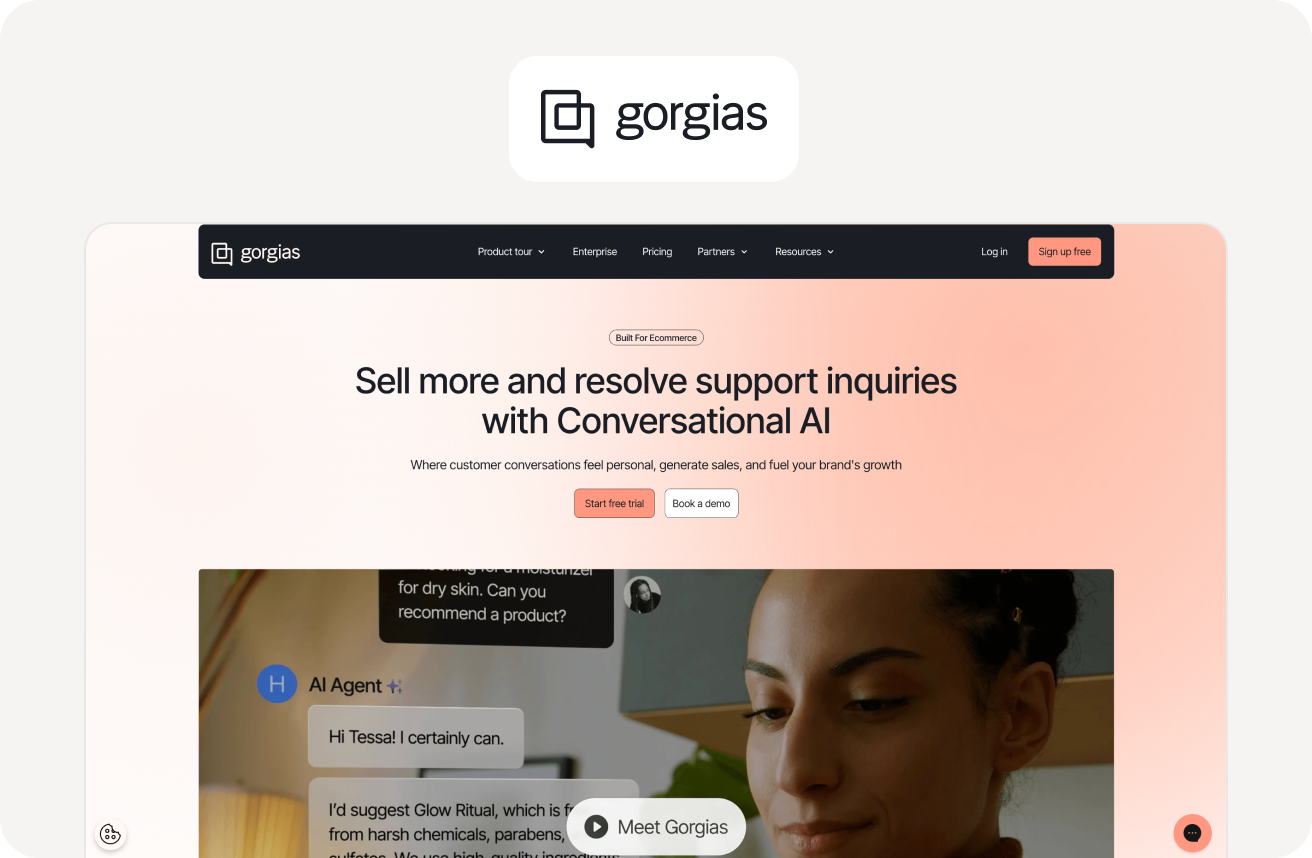
Gorgias combines e-commerce support with order context, helping agents answer questions and complete common tasks from one inbox. Its AI agent can automate selected customer interactions, with rules controlling when people step in.
It improves service but does not replace e-commerce CRM software for loyalty or marketing activation.
Score: 2.5
Best fit: DTC and e-commerce brands that want faster order support.
Pricing: Ticket-based plans with additional AI usage charges.
Key features: Commerce-aware support, order actions, automated responses, and handoffs.
Watch out: It is not a complete marketing automation platform.
6. Omnisend
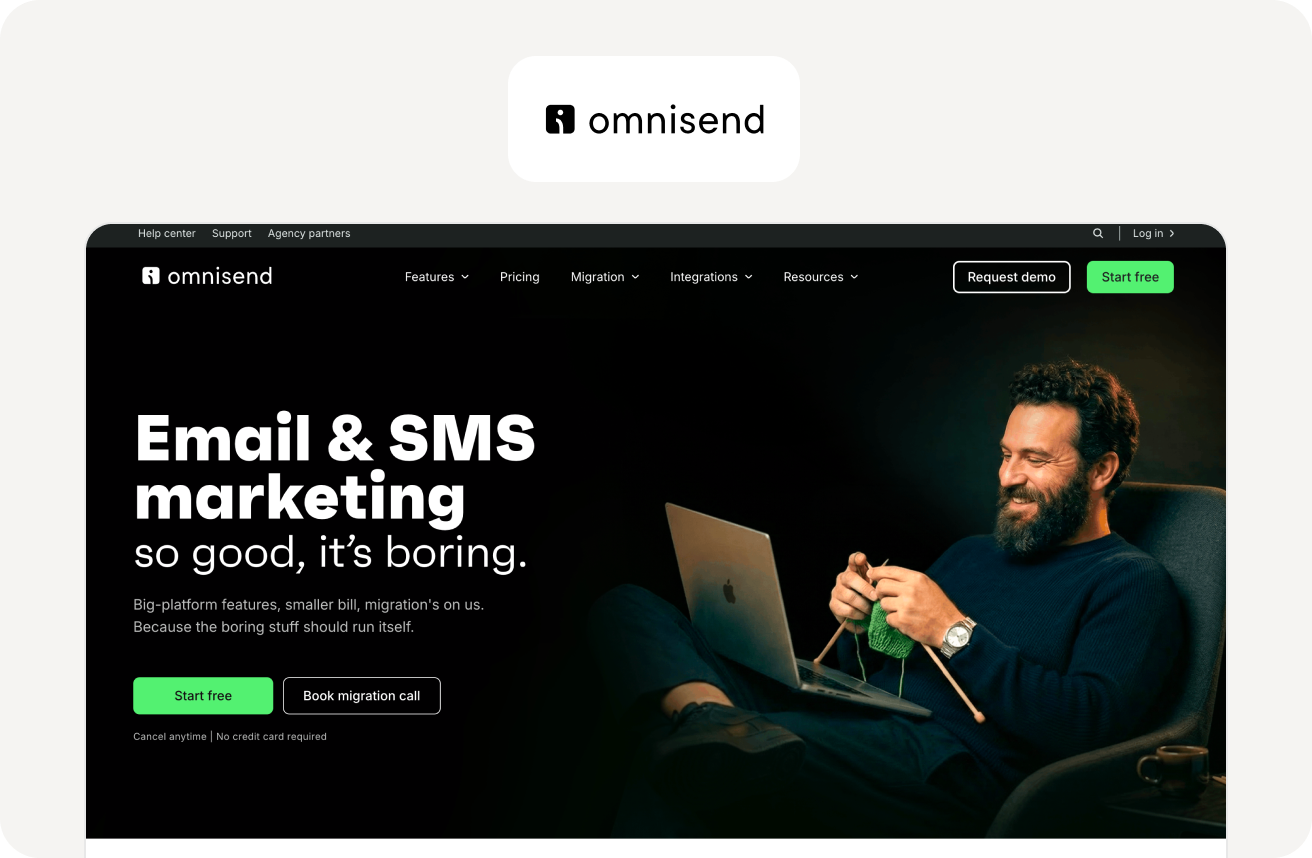
Omnisend syncs products, orders, profiles, and customer behavior from an online store. Ready-made workflows help small e-commerce businesses launch welcome, abandoned-cart, post-purchase, and win-back email and SMS campaigns.
Its strength is accessible messaging rather than complex identity resolution or omnichannel loyalty.
Score: 2.5
Best fit: Small and growing e-commerce stores.
Pricing: Free and paid plans based on contacts and sends.
Key features: Templates, product data, cart triggers, and email and SMS marketing.
Watch out: POS, native loyalty, and multi-market governance are limited.
7. Brevo
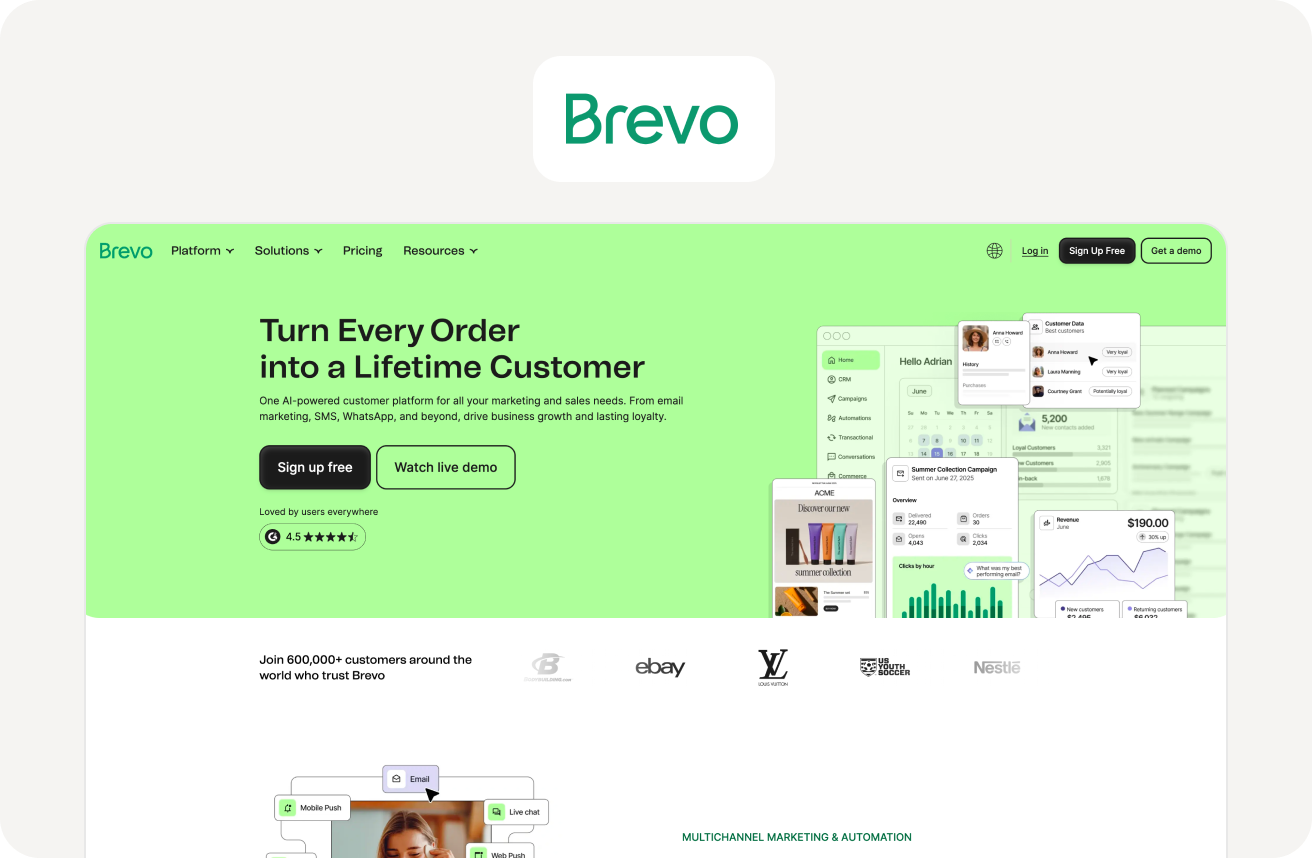
Brevo combines email, SMS, WhatsApp, marketing automation, and contact management. E-commerce integrations add order and product activity, helping smaller teams coordinate their digital marketing efforts across several channels.
Score: 2.5
Best fit: Small businesses that need affordable multichannel messaging.
Pricing: Free and paid plans based on sends, users, and features.
Key features: Messaging, automation, contact management, and transactional communications.
Watch out: Identity resolution, native loyalty, POS data, and complex marketing strategy needs are limited.
8. ActiveCampaign
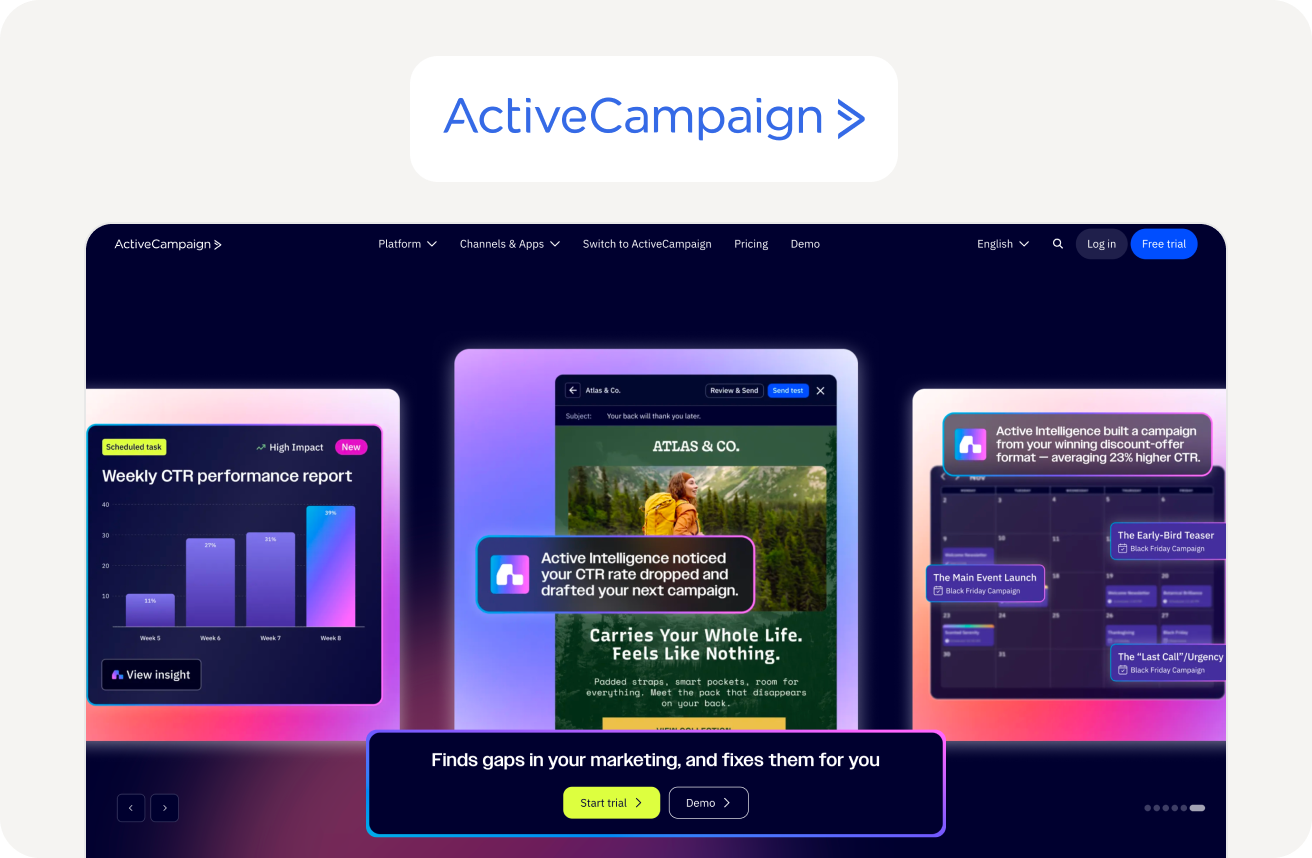
ActiveCampaign combines marketing automation, contact management, sales CRM, and e-commerce integrations. Its workflow automation can respond to purchases and site visits, reduce manual follow-up, and help sales teams move opportunities through the sales pipeline.
Score: 2.5
Best fit: Smaller marketing and sales teams that need flexible automation tools.
Pricing: Tiers based on contacts, users, and features.
Key features: Customer journeys, sales automation, and CRM integration.
Watch out: POS, inventory management, and loyalty are not native strengths.
9. Zoho CRM
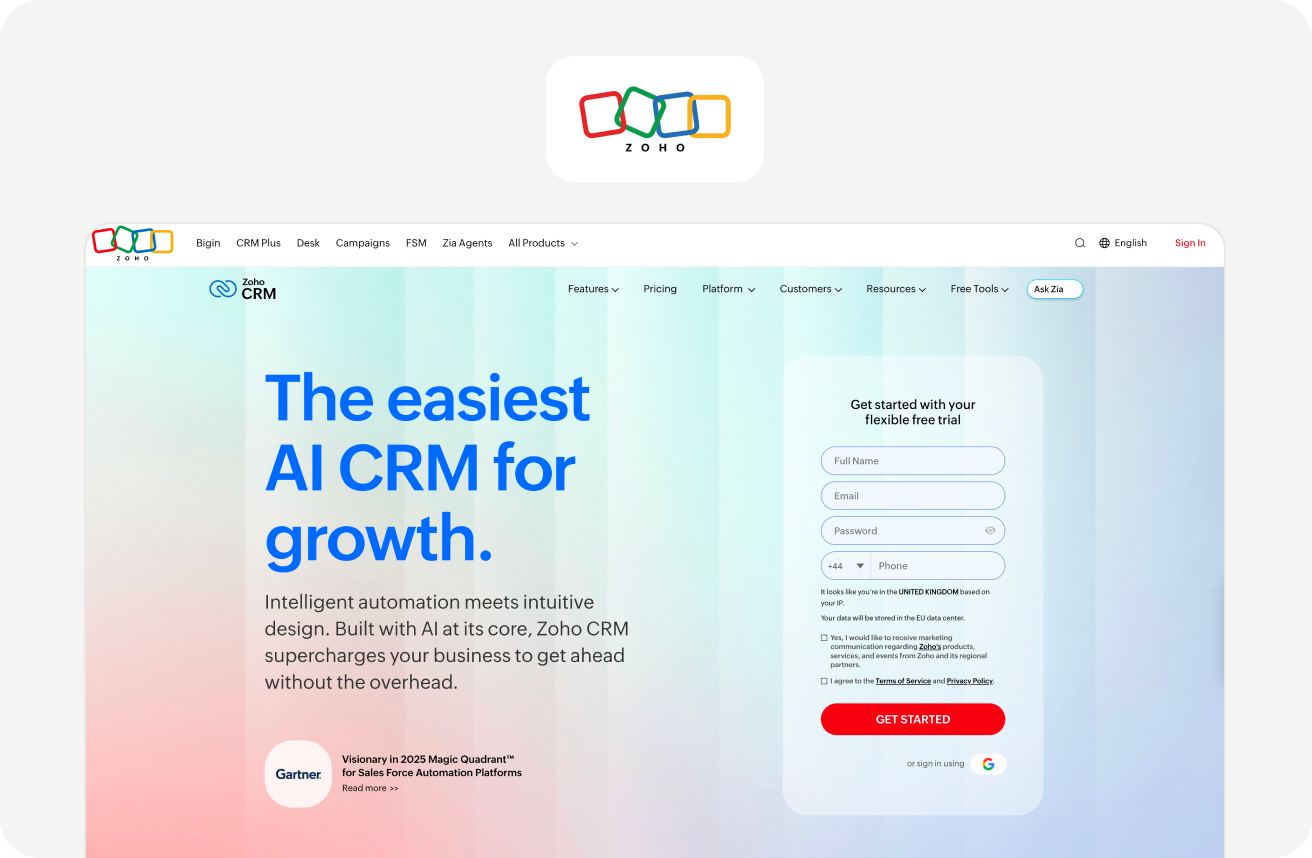
Zoho CRM supports sales pipeline management, customer interactions, marketing, and automation. Teams can customize records and connect other Zoho apps for service, advanced analytics, campaigns, or inventory management.
Its flexibility suits budget-aware teams, but retail identity resolution, loyalty, and POS activation require added tools.
Score: 3.0
Best fit: Budget-aware marketing and sales teams.
Pricing: Per-user tiers, with other Zoho products sold separately.
Key features: Custom workflows, reporting, sales automation, and a broad business suite.
Watch out: A stronger retail setup requires extra loyalty and POS tools.
10. Yotpo Loyalty & Referrals
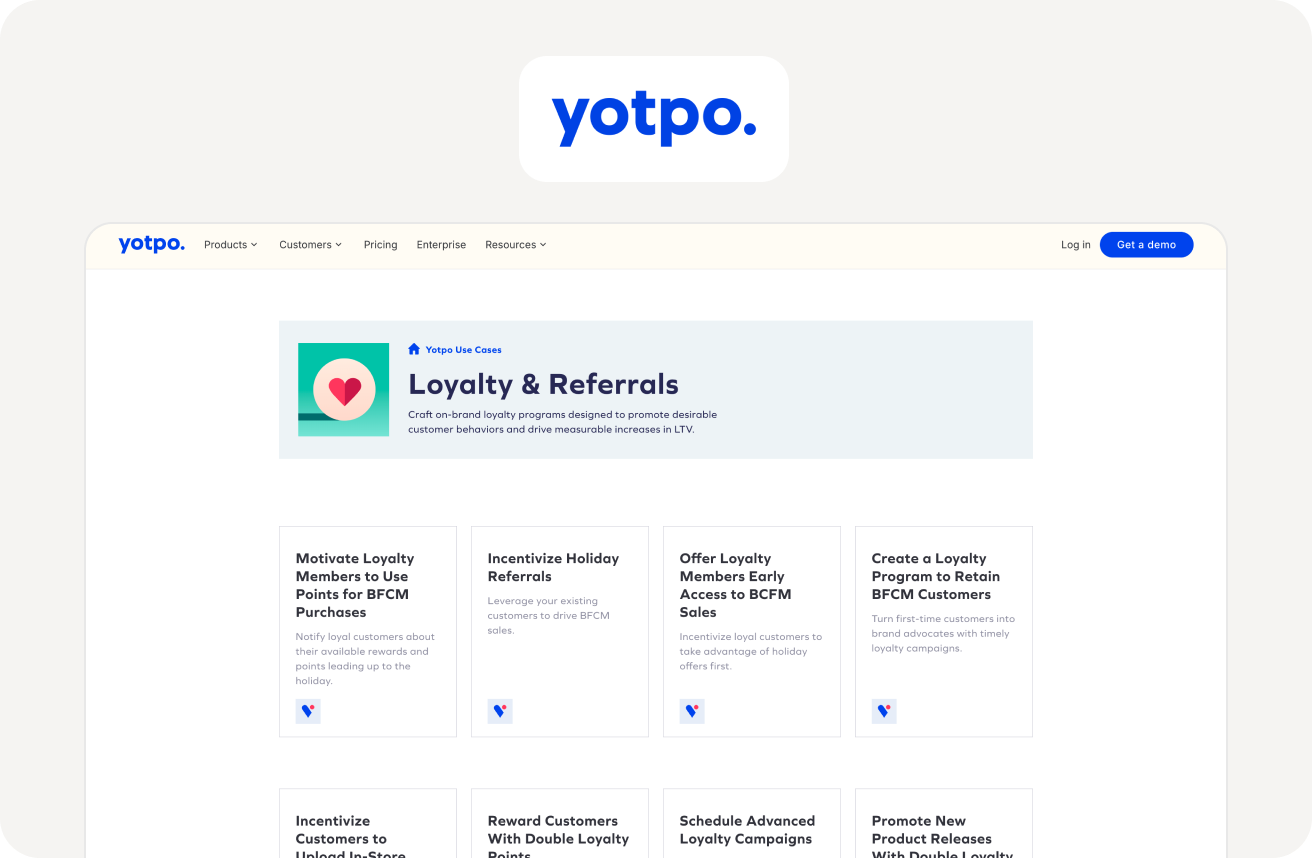
Yotpo Loyalty & Referrals supports points, rewards, referrals, VIP tiers, and loyalty campaigns. Shopify POS and marketing integrations make it useful when loyalty is the main gap in an existing tech stack.
It is a specialist loyalty product rather than a complete e-commerce CRM system.
Score: 2.5
Best fit: E-commerce brands that want loyalty close to their store platform.
Pricing: Free and paid plans based on features and order volume.
Key features: Points, referrals, VIP tiers, rewards, and Shopify POS support.
Watch out: Identity resolution, customer data, and campaign orchestration require connected platforms.
11. Antavo
Antavo supports enterprise loyalty across online and physical channels. Its rule engine manages points, tiers, rewards, challenges, and market-specific benefits, while APIs connect with CRM software, POS systems, apps, and marketing tools.
Score: 3.5
Best fit: Global brands with complex loyalty requirements.
Pricing: Custom pricing based on customer activity and program scope.
Key features: Loyalty rules, APIs, rewards, and multi-market controls.
Watch out: It does not replace broader CRM solutions or messaging platforms.
12. LoyaltyLion
LoyaltyLion helps e-commerce stores run points, rewards, referrals, VIP tiers, and loyalty campaigns. Its Shopify and Shopify POS connections can feed loyalty activity into customer segments and connected marketing platforms.
Score: 3.0
Best fit: Shopify-led brands adding loyalty.
Pricing: Plans based on monthly order volume.
Key features: Shopify loyalty, referrals, VIP tiers, and POS support.
Watch out: It is not a complete customer relationship management system or customer data platform.
13. Ometria
Ometria combines retail identity resolution, customer profiles, predictive insight, and cross-channel orchestration. It helps marketers identify high-value and lapsing shoppers, while POS and loyalty data support lifecycle campaigns and stronger customer relationships.
Score: 3.5
Best fit: Retail brands that want customer insights and cross-channel activation.
Pricing: Custom pricing.
Key features: Identity resolution, predictive models, segmentation, and targeted campaigns.
Watch out: Loyalty rules and rewards may require another platform.
14. Optimove
Optimove combines a customer data platform with AI decisioning and multichannel marketing tools. It uses engagement data and CRM data to recommend actions across customer segments.
Customer lifetime value analysis can reveal buying patterns linked to churn risk, but the platform needs clean data and meaningful campaign volume.
Score: 3.5
Best fit: Online retailers with mature customer retention programs.
Pricing: Custom platform pricing.
Key features: Predictive models, next-action decisions, orchestration, and experimentation.
Watch out: Smaller teams may not use enough of its depth.
15. Braze
Braze activates customer behavior across email, SMS, push, WhatsApp, apps, and websites. Its real-time event handling helps teams respond to product views, transactions, inactivity, and engagement data across the entire customer journey.
Braze supports stronger customer relationships through messaging and testing, but loyalty rewards and POS workflows depend on connected systems.
Score: 3.5
Best fit: Digital-first brands with strong technical and data teams.
Pricing: Custom pricing based on active users, channels, and usage.
Key features: Real-time activation, cross-channel messaging, testing, and personalization.
Watch out: Loyalty and physical store workflows require integrations.
The right platform depends on the gaps in your existing tech stack. Use the scorecard to identify which CRM platforms meet your priorities, then validate integrations, data quality, and governance during vendor demos.
Once you have a shortlist, you then have to plan a rollout that delivers value without disrupting daily operations.
How to implement an e-commerce CRM system
A phased rollout lets your team test important journeys before the new CRM carries every campaign.
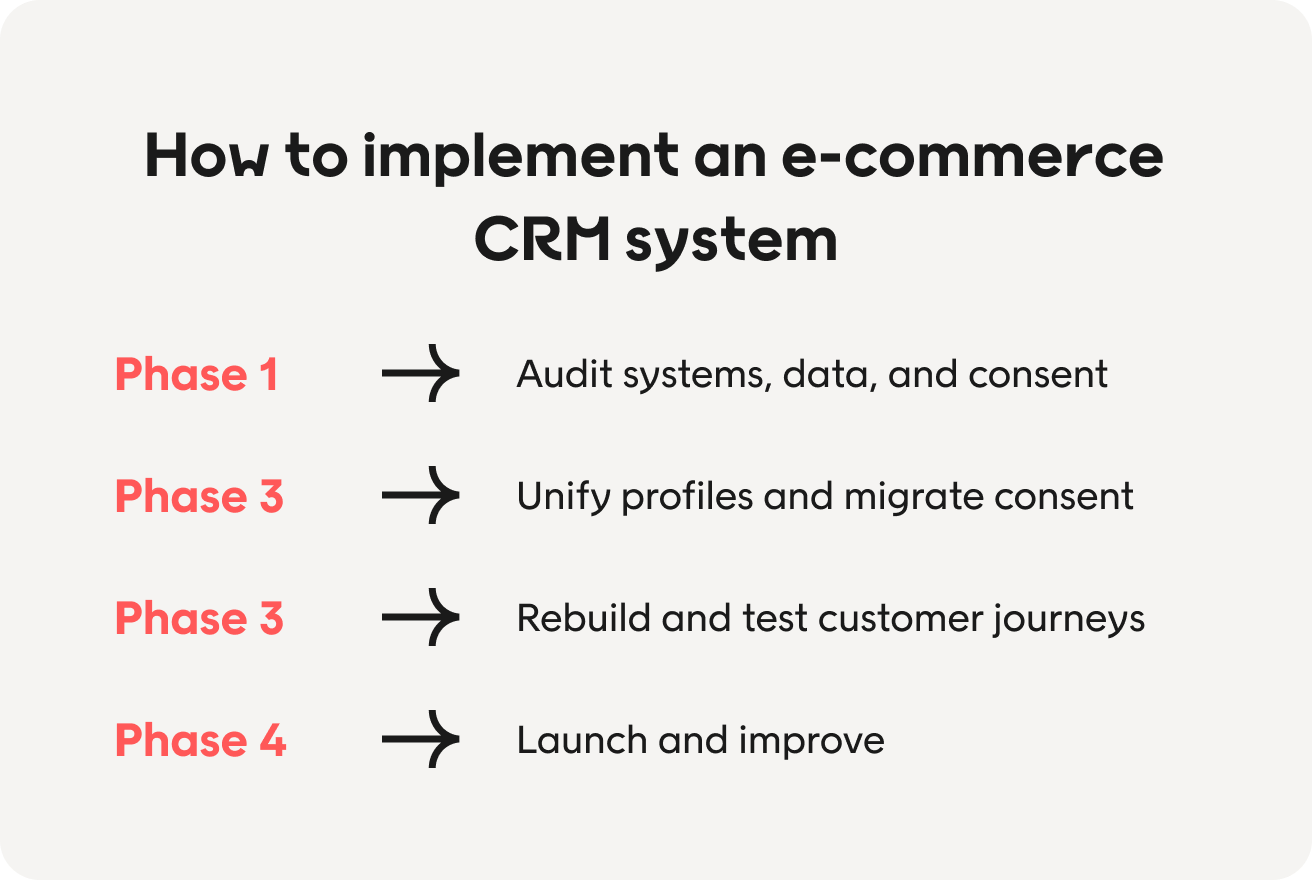
A clear omnichannel orchestration plan connects data, decisions, and actions. Your wider omnichannel retail strategy should decide which markets, channels, and customer journeys move first.
Phase 1: Audit systems, data, and consent
Map your e-commerce platform, POS, loyalty, web behavior, payment tools, service systems, and paid channels.
Find duplicate records, consent gaps, and missing identity keys. The CRM manager should define campaign needs while the IT lead maps systems and data flows.
Phase 2: Unify profiles and migrate consent
Use email, phone, customer ID, and transaction ID as primary identity keys. Then migrate consent records and preference center settings.
Test shared emails, changed phone numbers, returns, duplicate profiles, consent mismatches, and broken automations before moving on.
Phase 3: Rebuild and test customer journeys
Recreate priority marketing campaigns in the new CRM. Start with welcome, abandoned-cart, post-purchase, loyalty, and win-back journeys.
Add omnichannel triggers such as a POS purchase, wallet interaction, or store visit. Run A/B tests with a small audience before full activation.
Phase 4: Launch and improve
Launch unified customer journeys in planned groups. Track repeat purchases, customer retention, customer satisfaction, campaign ROI, consent health, and profile quality.
Use performance data to improve timing, offers, and marketing efforts. Keep IT involved until the data flows are stable.
| Phase | CRM manager | IT lead | E-commerce lead |
| Audit | Defines fields, audiences, and campaign needs | Maps systems, security, and owners | Confirms store and trading priorities |
| Identity | Approves profile and consent rules | Builds migration logic and monitoring | Validates customer and order events |
| Testing | Builds segments, messages, and exclusions | Tests delivery, permissions, and failures | Reviews triggers, offers, and site impact |
| Go-live | Runs campaigns and tracks customer KPIs | Monitors reliability and data quality | Tracks conversion and revenue |
How connected loyalty supports customer lifetime value
Connected loyalty helps customers earn and use value across stores, email, SMS, wallets, and online journeys without feeling the gaps between systems.
A native customer loyalty platform makes loyalty activity available inside customer profiles and campaigns. This is part of why omnichannel is important when customers move between an e-commerce website and physical stores.
| Use case | Touchpoints activated | CLV impact |
| Earn on a store visit | Store, wallet, email | Identifies repeat customers and creates a reason to return |
| Use points through a digital wallet | Wallet, e-commerce site, store | Makes rewards easier to find and redeem |
| Associate-triggered upsell | Store, email, SMS | Connects store advice with a relevant follow-up |
| Post-purchase tier upgrade | POS, website, email, wallet | Recognizes progress and encourages repeat purchases |
| Win-back before points expire | Email, SMS, wallet, store | Creates a timely reason to return |
LAKRIDS BY BÜLOW connected loyalty with online and in-store customer data through Voyado. The retailer achieved an 8% increase in purchase frequency, showing how connected journeys can support customer retention.
Why choose Voyado for CRM and e-commerce?
The best e-commerce CRM should make omnichannel work easier. Voyado brings customer data, loyalty, marketing automation, and retail-trained AI into one platform.
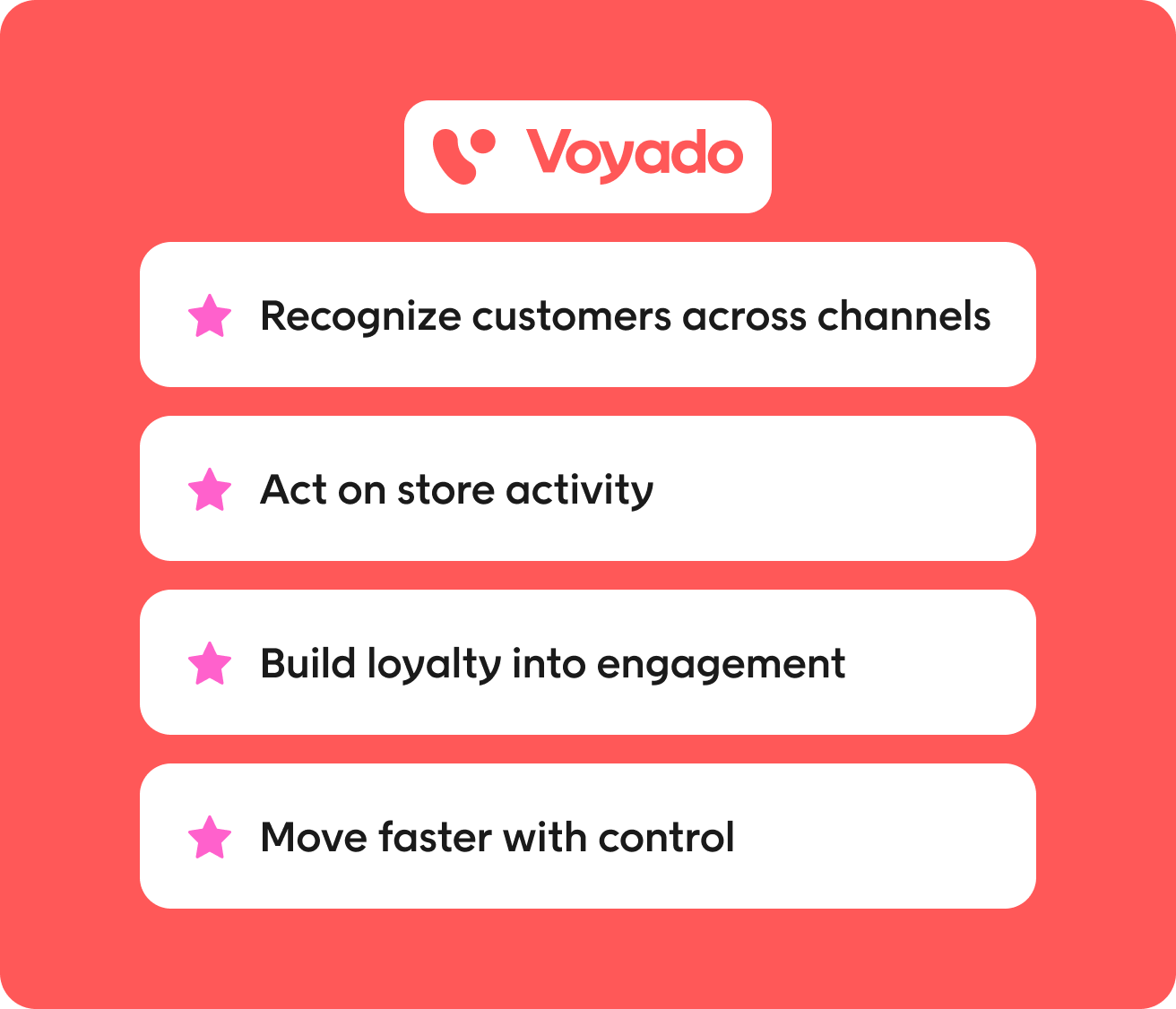
Recognize customers across channels
Voyado connects online behavior, store transactions, loyalty activity, and consent in one profile. This supports accurate segmentation with less manual cleanup.
Act on store activity
POS integration lets teams use store purchases and interactions in automated journeys instead of treating each channel separately.
Build loyalty into engagement
Points, tiers, rewards, and purchase history sit alongside customer data. Teams can use these signals to encourage repeat purchases without connecting separate CRM tools.
Move faster with control
Voyado’s agentic AI can suggest segments, propose automations, and flag KPI changes. Approval controls and multi-market governance keep central and regional teams in control.
The wider Voyado product suite connects customer engagement with online merchandising, helping teams improve campaigns and product discovery with shared customer and product signals.
This means less time connecting systems and more time improving the customer experience.

FAQs
What is the best CRM for e-commerce business growth?
The best CRM for e-commerce business growth depends on company size, omnichannel maturity, and loyalty needs. The best CRM for small e-commerce business teams may prioritize quick setup, while larger retailers often need unified profiles, POS integration, and native loyalty.
How much does an e-commerce CRM cost?
Small-business e-commerce CRM software costs about $50 to $500 per month. Midmarket platforms range from $1,000 to $5,000, while enterprise solutions can exceed $10,000. Contact-based pricing scales with database size, while revenue-based pricing follows GMV.
What should CRM and e-commerce integration include?
Most e-commerce CRM tools connect with Shopify, Magento, WooCommerce, and BigCommerce. A CRM for an e-commerce site should sync customer, order, consent, POS, and loyalty data without custom middleware. That connector depth is central to effective CRM and e-commerce integration.
What’s the difference between a CRM and a CDP?
A CRM system for e-commerce activates campaigns, customer journeys, and loyalty. A CDP unifies data through identity resolution, segmentation, and audience sync. Modern e-commerce CRMs such as Voyado can do both.
How long does CRM migration take?
Allow two to four weeks for discovery, four to six weeks for identity and consent mapping, and four to eight weeks for journey testing. A phased rollout reduces risk before ongoing optimization.
Do I need a separate loyalty platform if I have a CRM?
Not if your CRM includes loyalty rules, rewards, POS connections, and customer data. Voyado offers native loyalty. Yotpo and Antavo add specialist loyalty to platforms such as Klaviyo or HubSpot, but these integrations can create data silos.
How does Voyado compare to Klaviyo or Salesforce?
Klaviyo is great for email and SMS, but it lacks built-in loyalty and has limited omnichannel capabilities. Salesforce is powerful but complex and often requires heavy IT support.
Voyado is purpose-built as one of the most complete ecommerce CRM solutions, combining automation, loyalty, personalization, and multi-market tools in one system.