
TL;DR
The biggest difference between Constructor.io alternatives is how much of the work falls on your team. Some platforms rank products toward a business goal on their own and include onboarding and training. Others rely on your developers to build the search and on merchandisers to write the ranking rules, which can leave a small e-commerce team maintaining more than it expected.
To build a shortlist, check what merchandisers can change themselves, how much the ranking does on its own, how setup works, and what training and support are included.
Search for Constructor.io alternatives, and every vendor’s site lists the same features, from natural language processing to AI shopping agents. The challenge is that a feature list doesn’t show what a platform is like to run, and most e-commerce teams live with their choice for years.
Platforms differ most in practical things, such as who does the setup and how much of the ranking people have to manage themselves. This guide compares 14 alternatives on those points using each vendor’s own documentation, so you have the insights and context to build a shortlist before you talk to sales.
Why retailers are evaluating Constructor.io alternatives
Constructor.io is built for enterprise e-commerce, with an API-first approach that gives retailers control over how they implement search on their site. This can suit teams with access to technical support, but retailers with limited developer resources may prefer a platform that takes less technical work to set up and maintain.
Some reviewers say it takes time and training to learn Constructor, and that its extensive documentation can be difficult to navigate when they need answers. Getting Constructor search results to meet their expectations can take extra work, too, including fine-tuning rankings and adding rules when initial recommendations fall short.
For retailers already dealing with other e-commerce challenges, that extra time and effort may be a reason to consider alternatives.
What to look for in a Constructor.io alternative
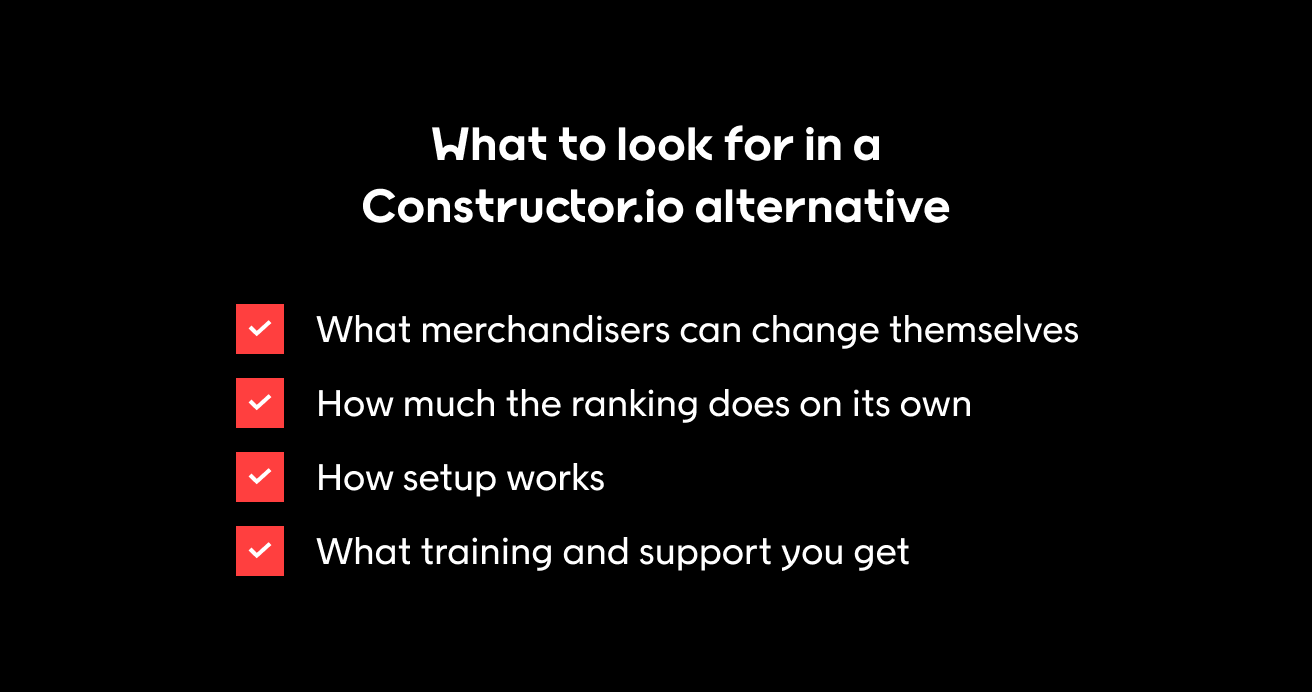
The biggest differences between Constructor alternatives are in how much work falls on your team, both during setup and once you’re live. Compare them on these four points:
- What merchandisers can change themselves. Your team should be able to make everyday searchandising changes without code, such as pinning a product to the top of a category or boosting a brand. Ask to see how it works in a demo.
- How much the ranking does on its own. Some platforms let you choose a goal, such as profit, and rank products toward it automatically. Others need a merchandiser to write a rule for each case and keep those rules up to date.
- How setup works. Some vendors have a ready-made connector for platforms such as Shopify or BigCommerce. Where there isn’t one for your platform, ask whether the vendor’s team or a partner agency handles the integration.
- What training and support you get. Ask whether onboarding and training are included, and how you reach support once you’re live.
14 best Constructor.io alternatives for retail product discovery
These Constructor competitors all help shoppers discover products, but they ask different things from the e-commerce teams running them.
1. Voyado
Voyado is a product discovery solution built specifically for retail, covering site search, product recommendations, and algorithmic merchandising. It suits retailers who want ranking that works toward a commercial goal, with merchandisers in charge of it day to day.
- What merchandisers can change themselves: In Voyado, merchandisers boost or bury products, pin them to set positions, and manage synonyms. The system does the ranking, but your merchandisers get ultimate control, overriding it wherever they want to.
- How much the ranking does on its own: A merchandiser picks a goal for each market, such as revenue or profit, and Voyado scores every product against it automatically using shopper behavior and sales data. Stock levels also feed the ranking, so nobody has to write a rule for them. After using Voyado’s AI to automatically optimize product exposure for profit, Bygghemma saw profit rise by 6.2% on average.
- How setup works: Shopify stores can use Voyado’s app, which needs no custom development. Other platforms connect through Elevate’s APIs.
- What training and support you get: Product discovery users get free access to Voyado Academy, with self-paced online courses and certifications matched to their role. A help center covers user guides and developer documentation, and you can send requests to Voyado’s support team.
Voyado also improves the product data it searches. It uses LLMs to enrich product information and analyzes product images for color, so a shopper searching for a shade can find it when the description doesn’t name it.
For retailers selling in several countries, one market in Voyado can hold more than one language and currency, and each market gets its own goal and merchandising. H&M, which sells in more than 80 markets, cut zero-result searches by 50% after moving its search and ranking to Voyado.
Voyado also offers its marketing automation and loyalty platform for retailers who want both from one vendor.
2. Algolia
Algolia is an AI-driven search and discovery platform for enterprise businesses across many industries, with a set of tools for e-commerce. It suits retailers that have developers to build the search experience and want merchandisers to manage it afterward.
- What merchandisers can change themselves: Once the search is built, business teams use Algolia’s Merchandising Studio to pin and boost products and run campaigns on their own.
- How much the ranking does on its own: Algolia’s Dynamic Re-Ranking uses AI to spot trends in what shoppers click and buy for each search to create machine learning-enhanced results without anyone writing a rule. Retailers can also add their own data as ranking signals, such as profit margin or excess inventory, and set them up without code. Neither feature is included on every plan.
- How setup works: Your developers build the search, using Algolia’s prebuilt integrations for platforms such as Shopify and Magento where they fit. Its onboarding packages add workshops and check-ins with an Algolia expert while your team builds.
- What training and support you get: Algolia Academy offers self-paced courses and certifications for both business users and engineers. Hands-on onboarding is a paid package of 25 to 80 hours, with merchandiser training in the larger ones. Support response times depend on your plan.
For more platforms like it, see our list of top Algolia competitors.
3. Bloomreach

Bloomreach is a cloud-based e-commerce experience platform that includes a search product. It suits large retailers that use Bloomreach for marketing already, or plan to.
- What merchandisers can change themselves: Merchandisers build ranking rules in the Bloomreach dashboard. Its more advanced ranking tool, Ranking Studio, needs a separate permission from an admin.
- How much the ranking does on its own: Bloomreach’s ranking algorithm learns from shopper behavior such as clicks and purchases, and can optimize for outcomes like revenue per visit. In Ranking Studio, retailers can also add their own numeric data as a signal, with margin as one example, and the model learns how much weight to give it. Ranking Studio is a Premium-tier feature.
- How setup works: Bloomreach lists a Shopify integration and 175 others. Each language needs its own product feed, which adds setup work for retailers selling in several languages.
- What training and support you get: Bloomreach Academy has on-demand courses on search, some of them free. They include a self-paced foundations path that covers merchandising and A/B testing, and an integration course for technical staff.
4. Coveo
Coveo is enterprise search software for e-commerce, customer service, digital workplaces, and websites. It suits large retailers that run many brands or markets from one setup.
- What merchandisers can change themselves: In the Coveo Merchandising Hub, merchandisers create boost rules based on product attributes such as brand or price. A rule can apply to every search or to specific ones, and can be scheduled ahead of time. An admin first has to map the product data the rules use.
- How much the ranking does on its own: Coveo’s machine learning ranks products by each shopper’s intent, adjusting as they browse during a session. An admin sets up and activates these models. Margin and stock are handled separately, through rules a merchandiser writes.
- How setup works: Coveo has connectors for platforms such as SAP and Salesforce. Its training includes a course on implementing Coveo’s commerce search.
- What training and support you get: Coveo’s Level Up+ platform has self-paced courses and learning paths for customers and partners. You can open support cases through its Coveo Connect portal, which also has a user community.
5. Nosto
Nosto is an e-commerce platform that combines semantic search and real-time personalization. It suits brands that already personalize other parts of their site and want search to work the same way.
- What merchandisers can change themselves: Merchandisers write rules that pin products or move them up and down the results. They can preview the results for any search before a rule goes live, and A/B test one set of rules against another.
- How much the ranking does on its own: Nosto’s semantic search works out what the shopper is looking for. The ranking is then shaped by rules that a merchandiser combines and weights. Rules can personalize results to each shopper or use product data such as margin and inventory level.
- How setup works: Teams can adjust the search design in Nosto’s own code editor or build it themselves with the API. It works with Shopify and a range of other e-commerce platforms.
- What training and support you get: Nosto lists guided onboarding, regular check-ins with a customer success manager, and round-the-clock help by live chat or email. Customers also get access to Nosto Academy.
6. Dynamic Yield

Dynamic Yield is an enterprise customer experience optimization and search personalization platform acquired by Mastercard, with tools such as A/B testing and audience segmentation alongside search. It suits retailers whose main aim is personalizing and testing the whole site, with search as one part of that.
- What merchandisers can change themselves: Teams build search “experiences” that can target specific queries, audiences, or dates. Within each one, they boost or bury products by attributes from the product feed, pin products to set positions, and preview the results before going live. Each experience can hold several variations for A/B testing.
- How much the ranking does on its own: Semantic search matches results to what the shopper means. Everything beyond that is configured by the team: they add boosts for personalization, for feed attributes such as margin and inventory status, or for a custom algorithm based on profitability or stock levels, and set the strength of each with a slider. By default, search returns out-of-stock products unless a filter rule removes them.
- How setup works: Search runs through an API, so developers complete the implementation before campaigns can be created. A dedicated onboarding manager leads the project, which includes an on-site workshop for the team.
- What training and support you get: Customers get a dedicated customer success manager with quarterly business reviews. Training sessions run on-site or remotely, and there’s an academy with certifications.
7. Athos Commerce
Athos Commerce is a discovery platform for e-commerce offering search, merchandising, recommendations, and product feed management. It suits mid-sized retailers on mainstream commerce platforms who want merchandisers running search without developer help.
- What merchandisers can change themselves: Merchandisers work in a visual interface without code, where they set boost rules, pin products, schedule campaigns, and run A/B tests. Athos’s own line is that developers set it up once and the merchandising team owns it from there.
- How much the ranking does on its own: Athos reranks products for each shopper using their history and what they’re doing in the current session. Its AI also suggests promotions based on past performance, which the team approves or overrides. Margin and stock are handled by boost rules a merchandiser sets.
- How setup works: Athos integrates with platforms such as Shopify and BigCommerce. Onboarding covers the platform integration, catalog configuration, and a guided setup of the first campaigns and rules.
- What training and support you get: You have the option of sending a support request online or using a help center.
8. Netcore Unbxd
Netcore Unbxd is an e-commerce search and product discovery platform for retailers and marketplaces that also offers email marketing and customer engagement tools. It suits retailers that want to load their catalog and test results in a sandbox before committing.
- What merchandisers can change themselves: Merchandisers use a visual dashboard without code to boost, bury, filter, and slot products, including by dragging and dropping them into position. Rules can cover every search or a single query, and a preview shows the result before it’s published. A/B testing is built in.
- How much the ranking does on its own: Netcore Unbxd’s ranking models reorder products for each search using more than 200 signals, including clicks, purchases, seasonality, and inventory. They also adjust to what a shopper does during the session. For margin, the vendor’s examples use rules, such as boosting high-margin products.
- How setup works: Setup runs through a self-serve onboarding console in five steps. A sandbox is available for testing before going live.
- What training and support you get: Netcore Unbxd publishes its documentation openly, including the step-by-step onboarding guide, and takes support requests through its contact form.
9. FactFinder
FactFinder is a product discovery platform for European B2C and B2B commerce brands. It suits sellers with large or technical ranges, since it handles product codes and customer-specific prices as well as everyday search terms.
- What merchandisers can change themselves: In FactFinder’s cockpit, merchandisers set ranking rules by margin, stock, brand, or season, and pin products to specific positions for a launch or promotion. They can also run campaigns with banners and redirects, and A/B test one ranking rule against another.
- How much the ranking does on its own: FactFinder’s Atlas AI adjusts rankings using what shoppers click and buy, both during a visit and across all shoppers. Margin and stock are handled by the ranking rules merchandisers set. FactFinder says a small team can leave routine ranking adjustments to the AI and step in when needed.
- How setup works: Ready-made connectors for Shopify, Shopware, OXID, and Magento bring product data into FactFinder. Your developers or agency then build search into the storefront using its APIs or ready-made front-end components, with FactFinder’s specialists available to help with the integration.
- What training and support you get: A FactFinder consultant works with your team directly and gets to know your catalog. They help configure the platform and work on specific problems, such as searches that return poor results or preparing for peak trading.
10. Clerk.io
Clerk.io is an e-commerce personalization platform that combines search, recommendations, email, and chat. It suits small and mid-sized shops that want the vendor to handle setup, since Clerk.io’s team will do the implementation for stores on a platform it already integrates with.
- What merchandisers can change themselves: Merchandisers set rules that promote specific brands or products across the whole site or within particular categories. A campaign set up for search can also apply to recommendations and email.
- How much the ranking does on its own: Clerk.io sorts search results by what its AI calculates is most likely to sell, based on live sales data. For margin and stock, merchandisers add rules.
- How setup works: Clerk.io’s team can do the setup in a five-step process led by a customer success manager, which is offered for its 15-plus ready-made integrations, including Shopify and Magento. Or the store sets it up itself using Clerk.io’s guides, which is also the route for platforms connected through the API.
- What training and support you get: A customer success manager guides the assisted setup through to go-live. After that, there’s a help center with guides, and support by email and phone.
11. Google AI Commerce Search
AI Commerce Search is a fully managed Google Cloud product that provides Google-quality search and recommendations for e-commerce sites. It suits large retailers that already run on Google Cloud and have engineers to build with it.
-
- What merchandisers can change themselves: A Merchandising console lets business users launch promotions, boost or bury results, and reroute results when items are out of stock. They can also test new strategies from the console.
- How much the ranking does on its own: Google’s models personalize results to each person and focus the top of the results on products more likely to convert. Recommendations can be set to optimize for a goal such as conversion rate or revenue per session.
- How setup works: The service is fully managed, with product and shopper data loaded through Google Cloud tools such as BigQuery. Google points retailers to its partners for integrating it into their systems.
- What training and support you get: Support comes through Google Cloud’s general support packages, which differ in coverage, with options such as 24/7 coverage and a technical support manager. Bugs and requests go in as support tickets, and there are community channels for questions.
12. Doofinder
Doofinder is an AI search and discovery platform for e-commerce stores, which also includes product recommendations and a shopping assistant. It suits smaller shops with no developers.
- What merchandisers can change themselves: In the admin panel, merchandisers set boosting rules that promote products by data in the product feed, such as availability or brand. A rule can apply to every search or to a single search term.
- How much the ranking does on its own: Doofinder’s AI works out what a shopper means and personalizes the results to them. An automatic boost also promotes products that have sold well recently. Anything based on the store’s own priorities is added through boosting rules.
- How setup works: Doofinder uses a single script or a one-click plug-in. It works with Shopify, WooCommerce, Magento, PrestaShop, BigCommerce, and more than 30 other platforms, plus an API for custom-built stores.
- What training and support you get: Support is included in every plan, with human experts for complex issues and an AI helper for everyday questions. Doofinder also has an academy with a certification and a help center.
13. Luigi’s Box
Luigi’s Box combines AI-powered site search, product recommendations, and product listing tools for e-commerce. It suits teams that want margin and stock reflected in the ranking without writing rules.
- What merchandisers can change themselves: Merchandisers can boost products, pin them to a set position, and add banners. For a specific search, they can also pin or demote individual products.
- How much the ranking does on its own: The ranking adjusts itself based on shopper behavior. It also uses data from the product feed: products with a higher margin value get a stronger ranking signal while staying relevant to the search, and availability is ranked in tiers so in-stock items come first. Its analytics also show what customers search for and where sales opportunities are being missed.
- How setup works: Luigi’s Box integrates with platforms including Shopify, WooCommerce, Magento, and Shopware. Stores can work with its team for a guided setup or do the integration themselves, and there’s a free trial.
- What training and support you get: Luigi’s Box has an academy and a help center, and support is available by email and phone.
14. Relewise
Relewise is a personalization engine for B2C and B2B e-commerce that covers search and recommendations. It suits retailers with a custom-built storefront, since it’s designed to connect to any front end through its API.
- What merchandisers can change themselves: Merchandisers set rules to boost, bury, filter, or pin products across search results and category pages. Boosts can use a fixed value or be driven by data such as margin or stock.
- How much the ranking does on its own: Relewise’s engine learns continuously from clicks, cart additions, purchases or even what users are doing in the current session and adapts each shopper’s results. Margin and campaign priorities are added through rules.
- How setup works: Relewise connects through its API to stores on platforms such as Shopify and Salesforce, or to a custom setup. It has a six-step process run with its team.
- What training and support you get: Support is by email and phone, and customers can also reach the team in a shared Slack workspace.
Constructor vs. Algolia vs. Voyado: side-by-side comparison
Algolia is often compared with Constructor, while Voyado is a close match in how it approaches product ranking. Here’s how the three approach search rankings and merchandising, as well as what you can expect from setup and ongoing management.
| Constructor | Algolia | Voyado | |
| Multi-market support | It offers language-specific processing for 34 languages. | It searches content in any language, with language-specific handling for 67. | It supports 31 languages. One market can hold several languages and currencies. |
| Inventory and margin-aware ranking | Ranking can optimize for profit, and product availability feeds into it. | Profit margin and excess inventory can be added as ranking signals on some plans. | Profit is one of the goals a merchandiser can pick, and stock levels feed the ranking. |
| Merchandising automation | Ranking learns from shopper behavior and optimizes for the chosen metric. | Products gaining popularity are promoted automatically on some plans. | Every product is scored against the market’s goal automatically, and merchandisers override where they want. |
| Variant handling | Each size and color combination is stored as a variation of an item. Results show one entry per item, using its best-matching variation. | Developers store one record per size or color and group them so results show one entry per design. | A built-in model separates a product’s colors from its sizes. Results show one entry per color, with price and stock held per size. |
| What merchandisers can change | Merchandisers add rules to boost or bury products and can fix them in set positions. They can also run A/B tests. | Business teams pin and boost products and run campaigns in Merchandising Studio. | Merchandisers boost or bury products and pin them to positions. |
| How setup works | It connects through APIs. A free two-to-four-week trial on your own data is available before signing. | Developers build the search, using prebuilt integrations for platforms such as Shopify. | Shopify stores use an app that needs no custom development. Other platforms connect through APIs. |
| Training and support | Customers have a success manager and standard support during business hours. An emergency team covers critical issues around the clock. | The academy is self-paced and hands-on onboarding is a paid package. Support levels depend on the plan. | Users get a free academy with courses matched to their role. There’s also a help center and a support request form. |
What sets Voyado Product Discovery apart from Constructor.io
Like Constructor, Voyado lets retailers choose the business goal behind product rankings. Merchandisers can set a goal for each market, such as revenue or profit, and Voyado scores products accordingly. They can also override rankings to give specific products priority.
The main difference is how the platforms handle languages. Both learn from what shoppers click and buy to decide which products rank highest. Constructor requires a separate index for each language, and each index learns only from shoppers using that language, so the data is split between them.
Voyado supports multiple languages and currencies within one market and learns from all of that market’s shoppers together. For example, a retailer selling in Switzerland in German and French has one product discovery market learning from every Swiss shopper, while Constructor requires two indexes that each learn from part of them.
“We can basically just lean back and watch how the Voyado algorithms and automation ensure that the best-selling products instantly receive the highest ranking after setting it up.”
– Petter Forsman, Digital Visual Merchandiser & Art Director at MQ
FAQs
What is Constructor.io?
Constructor.io is an AI search and product discovery platform built for enterprise e-commerce. It powers site search and category pages along with product recommendations, and its ranking learns from shopper behavior to optimize for a business metric such as revenue per visitor. Features include autocomplete suggestions as shoppers type and Attribute Enrichment, which fills in product data automatically. Merchandisers get dashboards and reports for tracking how search is performing.
What are the best Constructor io alternatives for retail search?
Voyado product discovery is the closest match for retailers who want ranking that works toward a business goal and sells in several languages. Algolia suits teams whose developers want to build their own discovery experience, Bloomreach and Nosto suit retailers who want search alongside marketing or personalization, and Doofinder and Luigi’s Box suit smaller e-commerce teams that want a fast setup.
How much does Constructor.io cost, and how does pricing compare to alternatives?
Constructor. io pricing isn’t published online, so you’ll need a quote from the Constructor team. Some alternatives are more open. FactFinder bases its pricing on the number of shopper searches, in volume tiers agreed upfront, and vendors such as Doofinder and Luigi’s Box have public pricing pages.
How does Voyado compare to Constructor.io for e-commerce search?
Both let you choose the business goal that rankings support. They differ in how they handle languages: Constructor io enterprise search needs a separate index for each one, while Voyado holds several languages in one market and learns from all of that market’s shoppers together. Voyado users also get free training through Voyado Academy.
Constructor.io vs. Algolia: which is better for retail product discovery?
Constructor is built only for commerce and ranks products toward a metric you choose, such as revenue per visitor. Algolia is a general-purpose search technology that developers build on. It promotes products as they gain popularity and lets you add your own signals, such as margin, on some plans. Constructor e-commerce fits retailers who want commerce-specific ranking out of the box, and Algolia fits teams that want more control over the build.
How hard is it to migrate from Constructor.io to another platform?
Any move means connecting your product catalog and shopper tracking to the new platform, then rebuilding your merchandising rules there. Ask each vendor who does that work and how long it usually takes. Ranking that learns from behavior also needs data to start from, so ask what the platform can use from day one. Voyado, for example, can load your order history so its ranking has sales data from the start.
What should e-commerce leaders look for when evaluating a Constructor.io alternative?
Compare what merchandisers can change themselves, how much the ranking does on its own, how setup works, and what training and support you get. Vendor sites answer some of these, and a demo with your own product catalog will help you understand the rest.