TL;DR
Voyado Customer Engagement gives UK and EU retailers the retail CRM layer Shopify is missing when segmentation, loyalty, and store data have to work together.
Shopify plus a few apps is enough when you run one storefront, sell mostly online, and only need simple email segments. You’ve outgrown it when e-commerce, point of sale (POS), and loyalty data sit in separate tools, and a shopper who bought in-store still gets an online reminder.
Instead of replacing your storefront, add Voyado on top of Shopify. Voyado customers see an average 8% increase in purchase frequency. When you compare options, remember that most roundups treat CRM software, helpdesks, and email marketing tools as interchangeable, even though each solves a different job.
On Saturday, a shopper buys a wool coat in your Manchester store. On Monday, your Shopify CRM setup sends them a “still thinking about it?” reminder, because your stores run on a separate POS and your Shopify customer list never saw the store purchase.
Orders sit in Shopify, store sales in your POS, and points in a loyalty app, so your customer information is split three ways. Segments stay thin, loyalty balances drift, and triggers fire on partial data.
So, do you need a real CRM? Treat this guide as a fit test for UK and EU retailers, and you’ll get an honest answer either way.
Is Shopify a CRM? The honest answer
Used as a Shopify CRM, Shopify handles basic customer management well. Once you need unified profiles, real-time segmentation, loyalty, and cross-channel journeys, you need full customer relationship management (CRM) built for retail.
Separate e-commerce, POS, and loyalty tools each hold part of the story. Triggers run on stale data. Voyado fixes this as a retail CRM layer on top of Shopify, with one live profile, native loyalty, and consistent journeys.
What Shopify does well for customer management
Shopify gives you a fair baseline. As an e-commerce platform, Shopify stores customer profiles, orders, tags, and segments, and covers basic contact management. Shopify Flow, Shopify Email, and the app ecosystem build on that Shopify customer data from one admin.
If your stores run Shopify POS, in-store orders land on the same customer record too. That closes part of the online-and-in-store gap on its own.
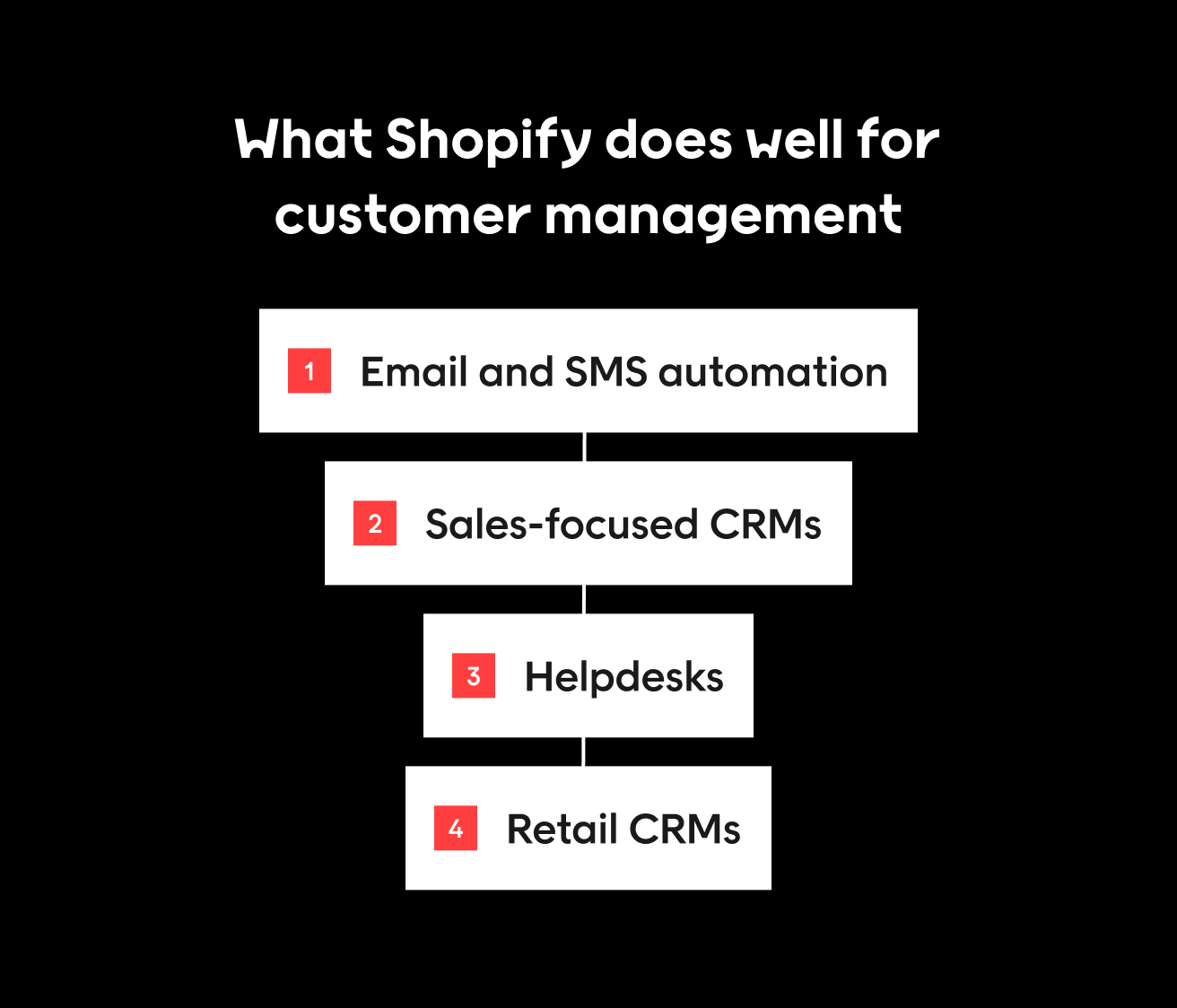
These CRM tools fill specific gaps, and each solves a different job:
- Email and SMS automation: Klaviyo, Shopify’s official CRM partner, plus ActiveCampaign, Drip, and Omnisend suit online stores that need tagging, personalization, and fast flows like abandoned cart.
- Sales-focused CRMs: Salesforce Sales Cloud, Zoho CRM, and Agile CRM help sales teams manage deals, automate sales, and track pipelines. That fits wholesale more than retail shoppers.
- Helpdesks: Gorgias and similar customer service tools handle support conversations.
- Retail CRMs: Voyado Customer Engagement combines unified customer profiles, native loyalty, and omnichannel journeys for retailers with physical stores and several markets. This guide focuses on that category.
Where Shopify is not a retail CRM
The missing pieces sit between systems. A retail CRM needs identity resolution, store data, loyalty logic, advanced journeys, and consistent consent. A traditional CRM built around the sales process doesn’t prioritise those.
With a separate POS, contact-only setups produce mismatched offers. With Shopify POS, store orders reach Shopify, but loyalty rules, cross-channel suppression, and multi-market journeys still sit in separate apps.
UK and EU shoppers also need first-party capture that meets the General Data Protection Regulation (GDPR), with profiles updating in real time.
Native Shopify vs. app CRM vs. retail CRM: what each covers
Here’s how native Shopify, a Shopify app CRM, and a dedicated retail CRM compare on five CRM features retailers rely on.
| Capability | Native Shopify | Shopify app CRM | Dedicated retail CRM |
| Profile depth | Orders and contacts, incl. Shopify POS | Contacts plus tags and events | One live online and in-store profile |
| Segmentation | Order and profile filters | Email-led behavior segments | Real-time, cross-channel segments |
| Automation | Basic flows | Fast email and SMS flows | Omnichannel journeys with exclusions |
| Loyalty | Separate apps | Separate apps or add-ons | Native points, tiers, and rewards |
| Market operations | Commerce settings per market | Varies by tool | Build once, scale across markets |
With Voyado, that last column rests on one customer profile, native loyalty, and multi-market efficiency.
When Shopify Plus apps are still enough
If your priorities are email marketing, basic tagging, and simple retention, Shopify Plus apps can support a growing online business. Klaviyo, ActiveCampaign, and affordable CRM options like Brevo fit until loyalty, POS, and multi-market coordination reach your roadmap.
Many of these tools start on a free plan, and HubSpot offers a free CRM. Check CRM pricing as your list grows, since paid plans usually scale with your contact count.
When you need a dedicated retail CRM
You need one when a single live profile must cover every customer interaction online and in-store, plus loyalty and consent. Voyado adds that layer on top of Shopify, and Voyado customers see an average 8% increase in purchase frequency.
To decide, run three checks:
- Get the connection timeline for e-commerce, POS, and loyalty in writing.
- Agree a date for your first live journey.
- Measure the share of orders linked to known customers in your own data.
What 1 mistimed cart reminder really costs
A shopper abandons a £120 pair of boots online, then buys them in-store at full price. That evening, your cart reminder arrives with a £10 discount code. If they return and rebuy online, you lose £10 in margin, and trust takes a hit either way.
The fix: POS data updates the live profile and suppresses the reminder before it sends. That’s the job of a retail CRM layer like Voyado on top of Shopify.
7 signs you have outgrown Shopify plus a few apps
An app-built Shopify CRM stops being enough at a predictable point. If you manage between 500,000 and two million contacts, three or more signs mean you need a retail CRM now. With a smaller list, Shopify Plus apps may be fine for today.
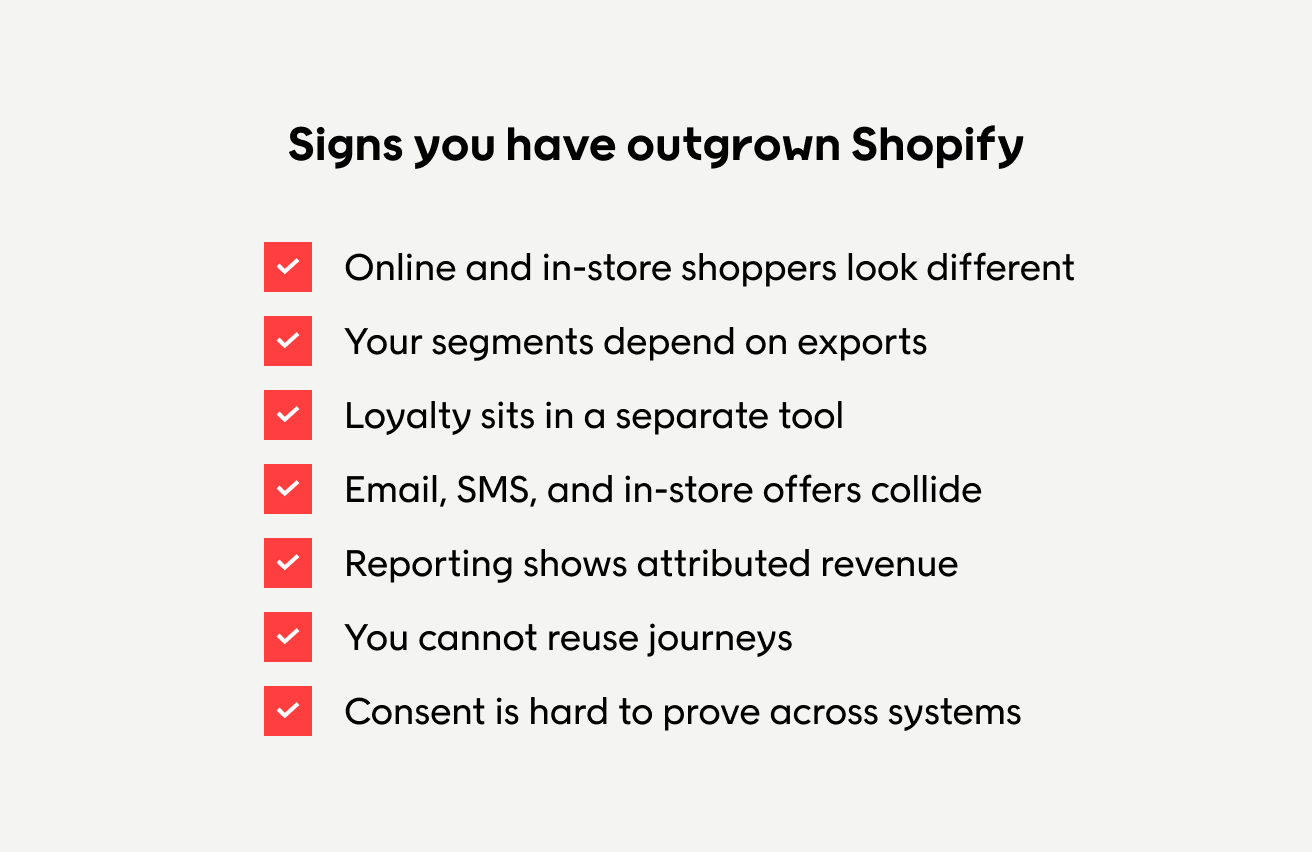
Each sign reflects e-commerce teams’ Shopify CRM integration challenges, and most trace back to existing tools that were never connected.
When Shopify can’t tell who your customer is
The profile layer usually breaks before the campaign layer, so check identity first.
1. Online and in-store shoppers still look like different people
Your POS and Shopify records share no customer ID. Guest checkout often creates duplicates, and manual data entry in stores adds more. Check today: what share of your orders links to a known customer? If you can’t answer, your segments can’t be reliable.
LAKRIDS BY BÜLOW tackled this with Voyado’s POS integration, and almost 50% of its in-store customers now identify as loyalty members.
2. Your segments depend on exports or nightly syncs
Delayed data weakens replenishment, win-back, and suppression. A shopper buys in-store at 11 am and still gets a cart reminder that evening. When you segment customers on real-time updates, triggers fire while intent is fresh.
When your channels start working against each other
Here, your stack creates friction instead of repeat purchases. Email, SMS, push, and in-store should run as one customer journey, so your marketing efforts reinforce each other.
3. Loyalty sits in a separate tool with separate rules
Disconnected points, tiers, and rewards create inconsistent targeting and redemptions. A member sees one balance online and another in-store. Evaluate loyalty as part of CRM—Voyado runs native points, tiers, and rewards where every interaction counts.
4. Email, SMS, and in-store offers collide
Fragmented suppression rules mean you over-message the same shopper. A 15% SMS code lands right after a 20% store voucher. Native omnichannel activation coordinates journeys without stitching platforms together with integration tools.
5. Reporting shows attributed revenue, not repeat purchase lift
Last-click revenue attribution can look healthy while retention stalls. Holdout groups and time to next purchase prove incrementality better. Track purchase frequency too, since it shows whether customers come back sooner.
When every new market means a rebuild
These signs appear when your setup must scale across stores and countries with shared audiences and KPIs.
6. You cannot reuse journeys across markets without rebuilding them
Every new market means a rebuild. Languages, £ and € pricing, and local send times live in separate apps, so your Dublin welcome journey starts from scratch.
7. Consent is hard to prove across systems
Consent, suppression, and deletion requests get risky across several tools. Your UK GDPR, EU GDPR, and Privacy and Electronic Communications Regulations (PECR) checks need one answer. Tie targeting to consented first-party data, and check where each tool stores it.
What the best CRM for Shopify should do for retail teams
Choosing a Shopify CRM works better with a scorecard than a ranking. Most best CRM for Shopify listicles mix sales-focused CRM platforms, marketing hubs, and helpdesks without shared retail criteria. Judge any CRM for Shopify on these retail jobs rather than sales workflows:
- One unified profile across e-commerce, POS, and loyalty
- Real-time, behavior-based segmentation
- Native omnichannel activation
- Built-in or tightly integrated loyalty
- GDPR-compliant first-party data capture
- Multi-store and multi-region scalability
Then run three checks: a written connection timeline, a date for your first live journey, and a known-customer match rate measured on your own data. Any CRM for e-commerce with Shopify integration should pass all three. Voyado is built only for retail, so these are the jobs Voyado Customer Engagement is designed around.
Start with 1 live customer profile
Your minimum viable profile covers six inputs. Shopify orders, POS sales history, loyalty status, browsing, returns, and consent should all update in near real time. Sync nightly, and Friday’s return still triggers Saturday’s cross-sell.
Voyado unifies every interaction, channel, and purchase in one profile, with consent status attached, so customer data management happens in one place.
Choose Shopify customer segmentation and journeys that react to behavior
Event-based segments react while the shopper is still interested. Browse, cart, purchase, and store triggers power the flows that automate follow-ups: abandoned cart, order confirmation, replenishment, and win-back. Exclusions matter too, such as suppressing in-store buyers from cart reminders.
With Voyado, AI-powered product affinity targets groups by how closely customers’ purchases relate to a product, category, or brand. Bonnie can also build segments from a plain-language request. Fashion brand Blutsgeschwister used this kind of segmentation to grow loyalty without relying on discounts.
Put Shopify marketing automation and loyalty in the same workflow
Built-in or separate platform? Built-in, when you can. Points, tiers, and earn-and-redeem should share profile and trigger logic with lifecycle messaging, so a tier upgrade fires a journey and store purchases earn points.
Voyado builds loyalty into the CRM rather than integrating it from a third-party tool, so loyalty data flows into every campaign and customer profile.
Plan for multi-store and multi-market scale from day 1
Supporting multiple Shopify stores isn’t the same as running CRM well across UK and EU markets. You’ll need £ and € pricing, language variants, and GDPR consent and hosting handled in one place.
Decide early which audiences are shared, which assortments are local, and which marketing teams own which campaigns. Multi-market efficiency is one of the three things Voyado Customer Engagement is built around.
How to pressure-test a Shopify CRM integration
A Shopify CRM connection should prove itself before you sign. Test every “seamless” and “real-time” claim, and ask whether you’re getting a native Shopify integration from the Shopify App Store or a custom API integration.
Either way, profiles must update when behavior happens rather than overnight. Your yardstick is the three checks above.
Enterprise suites like Salesforce CRM are powerful and flexible, with the tradeoff of heavier IT support and often longer time to value, since a third-party CRM integration with Shopify often runs through a connector app.
Ask each vendor for pricing and contract terms in writing. For all Shopify CRM integrations, the real test: does your Saturday in-store buyer still get Monday’s online reminder?
What a CRM with Shopify must sync in real time
A CRM with Shopify should sync these objects, with stated latency for each in writing:
- Customers, including guest and merged records
- Orders and line items
- Returns and refunds
- Store IDs for POS transactions
- Loyalty events and tier changes
- Consent states per channel
- Sync direction, and which system wins when records conflict
- How much order history the first data migration brings in
Consent needs GDPR-compliant handling, so confirm where UK and EU shopper data is hosted. Check your Shopify plan too: some connectors can’t read customer details on Shopify’s Basic plan. For comparison, Voyado’s Shopify app sends both online and Shopify POS orders to Voyado for segmentation.
Test guest checkout, refunds, and order edits before go-live
- Guest checkout: A guest order matches the existing in-store profile without creating a duplicate.
- Order edits: Edited orders update line items and stop journeys for removed products.
- Refunds: A refund adjusts points and removes the shopper from cross-sells.
- Recovery: A failed sync raises an alert, then missed events replay without duplicate messages.
Set acceptance criteria for the first 30 days
- Data quality: Core fields are populated and deduplicated.
- Match rate: You know what share of orders link to known customers, and it’s rising.
- Journey launch: Your first journey goes live on the agreed date.
- Suppression accuracy: In-store buyers get no online reminder for the same item.
Then track purchase frequency against a holdout group.
Common e-commerce teams Shopify CRM integration challenges
- Unclear ownership: Name one owner for data mapping and one for journeys.
- Missing historical imports: Plan the data migration so past orders and loyalty balances load before launch.
- Channel consent mismatches: Map every consent source to one status per channel.
- Weak POS data: Capture a customer ID at checkout through loyalty, email, or phone.
If these blockers span separate CRM systems and point tools, a retail CRM layer like Voyado on top of Shopify removes them.
Built-in loyalty or a separate app? What changes in retention
Your Shopify CRM decides whether loyalty and journeys share one profile. If in-store and online activity don’t meet on one profile, loyalty can’t drive repeat purchase, so judge retention impact over feature count.
Few comparisons connect loyalty to CRM journeys, yet loyalty grows Shopify customer retention and can increase sales without leaning on paid acquisition. With Voyado, one live profile and native loyalty mean every interaction counts, in-store or online.
Why loyalty breaks when profiles do not match
Points and tiers drift when they update in a different system from messaging. A shopper earns 200 points in your Bristol store, then opens an email showing last month’s tier.
Real-time updates fix this, and Voyado’s native loyalty unifies online and in-store data, so the email shows the same tier as the store.
When a separate loyalty platform still makes sense
A separate tool works when identity, redemptions, and consent sync cleanly. Compare profile consistency, POS recognition, ownership, and total cost. Test identity matching, connection speed, and GDPR consent syncing and hosting.
Voyado prices as a fixed platform fee plus volume-based channel pricing. If a separate platform passes every test, keeping it is a valid tradeoff.
How to measure repeat purchase without training shoppers to wait for discounts
Track purchase frequency, time to next purchase, and reward redemption lift alongside coupon usage. A holdout group is a random slice of customers who don’t get the journey, so comparing them shows the lift you caused.
Start with replenishment and win-back flows. With Voyado, built-in analytics tools for customer lifetime value (CLV) show what drives repeat purchases, and LAKRIDS BY BÜLOW shows how to build loyalty without leaning on discounts.
How to improve Shopify customer retention with live journeys
A Shopify CRM has to run journeys beyond a contact list. Without a live, unified profile, an in-store buyer still gets an online reminder.
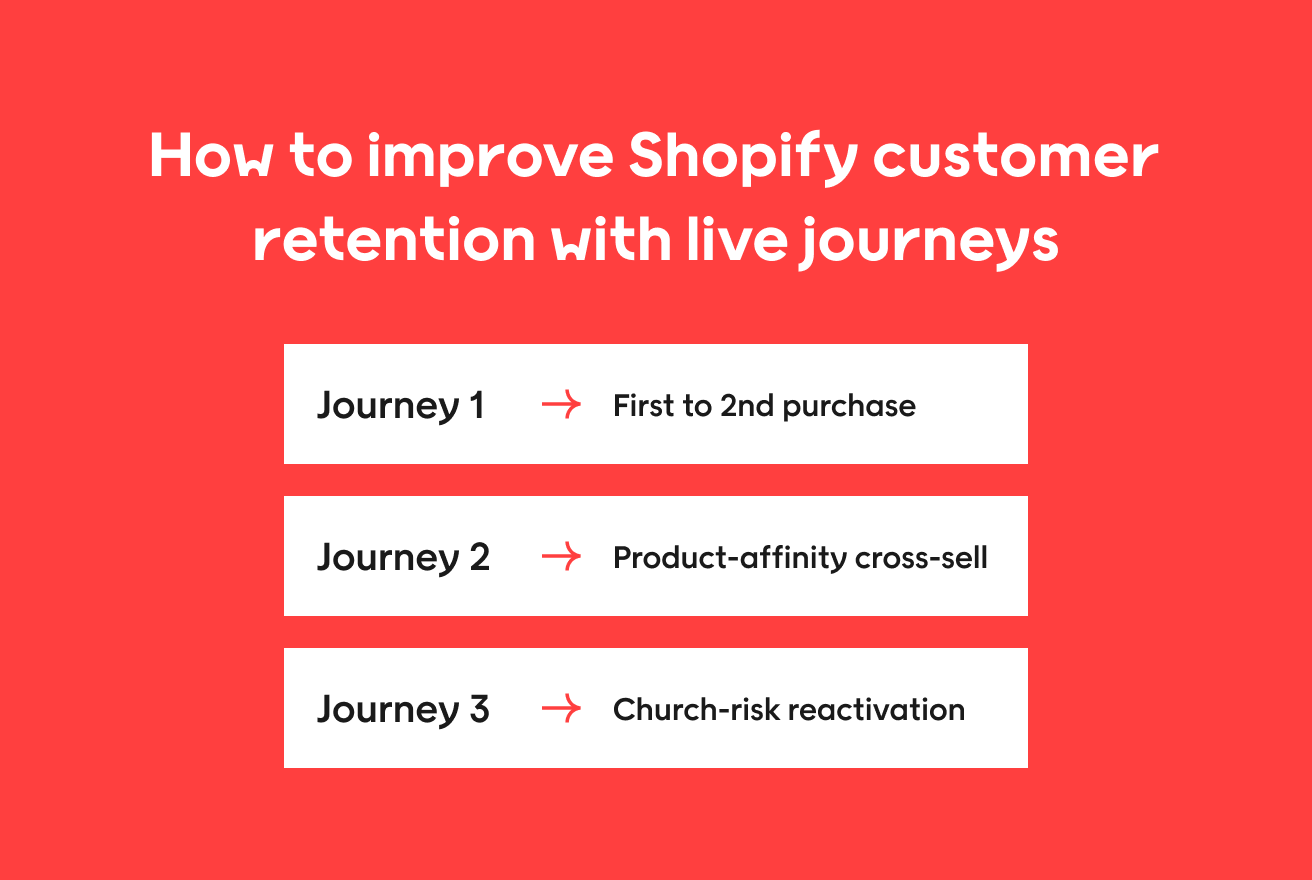
The three journeys below improve customer retention by acting on one profile. Voyado runs them on top of Shopify, using the consent stored on each profile.
Journey 1: first to 2nd purchase
Enter shoppers after a first order in either channel, and exclude anyone who reordered or has an open return. Send emails, SMS, and app pushes by consent, with complementary or replenishment items. Lead with loyalty enrollment, holding incentives until the buyer goes quiet.
Data for the 2nd-purchase journey
- Order history and category bought
- Channel consent under GDPR
- Store activity
KPIs for the 2nd-purchase journey
- Second purchase rate
- Time to next purchase
- Holdout lift
Attributed revenue flatters flows that catch customers who’d return regardless.
Journey 2: product-affinity cross-sell
Enter shoppers a set delay after a qualifying purchase, and exclude owned, out-of-stock, or recently returned items. Running shoes lead to care kit and sock suggestions. With Voyado, AI-powered product affinity finds the customers closest to each product, ready for email or app push.
Data for the cross-sell journey
- Item-level order data
- Browsing interest
- Local assortment from inventory management, so you skip what the nearest store can’t supply
- Return behavior
KPIs for the cross-sell journey
- Repeat order value
- Cross-sell rate
- Margin impact by segment
Click-through rate (CTR) alone can reward low-margin or high-return items, so compare segments to see which cross-sells boost sales and margin.
Journey 3: churn-risk reactivation
Enter customers with high churn risk or a lapsed window, and exclude open service issues, recent unsubscribes, and invalid consent. Predictive analytics flag the higher-value, higher-risk customers to prioritize. Use SMS for responders and email for everyone else.
The service-issue exclusion matters: a win-back offer to someone with an open complaint undercuts your customer service efforts.
Data for the reactivation journey
- Recency and frequency
- Product interest
- Loyalty status
- Channel response history
A VIP-tier member gets a different win-back than a one-time buyer. Bonnie, the AI agent Voyado trained on retail behavior, can suggest the next step from the customer context on that profile.
KPIs for the reactivation journey
- Reactivation rate
- Purchase frequency
- Unsubscribes by audience
What UK and EU teams should check on consent, markets, and hosting
Most Shopify CRM comparisons stop at “GDPR-compliant” and skip the procurement questions UK and EU teams face. You’ll need first-party capture, real-time profiles so consent changes apply immediately, and shared audiences and KPIs across regions. Software supports compliance, but you remain legally responsible.
Consent syncing under GDPR and PECR
Capture opt-in by channel. Treat email, SMS, and in-store signups separately, with proof of source, timestamp, and wording. Keep one real-time consent status per channel across Shopify, POS, and CRM.
Confirm your legal basis with your legal team. Voyado keeps consent status on each customer profile, and you should ask every vendor:
- Where is proof of consent stored?
- How fast does an opt-out reach every channel?
- Can store staff see consent status?
Market-by-market sending without duplicating work
Language, currency, assortment, and send-time rules belong in one shared model. Otherwise, your Munich team rebuilds what your UK team launched, swapping £ for € by hand. With Voyado, Bonnie can localize a campaign for each market, so your teams adapt one build instead of starting over.
Data residency, subprocessors, and deletion requests
Your legal and IT teams will ask:
- Where is customer data hosted?
- Which subprocessors touch it?
- How do UK and EU transfers work?
- How do deletion requests reach Shopify, POS, and CRM?
A single profile makes deletion and access requests easier to handle in one place. Request the subprocessor list and data processing agreement in writing. Voyado, for example, hosts Customer Engagement data in the EU and publishes its sub-processor list.
Where Voyado Customer Engagement fits on top of Shopify
In your Shopify CRM stack, Shopify stays your commerce engine. Voyado Customer Engagement, built on the agentic OS for retail, fills segmentation, loyalty, and store-data gaps.
It installs as an app from the Shopify App Store, keeps email, SMS, and postal consents in sync with Shopify, and connects to Shopify POS so store staff can sign shoppers up to your loyalty program. Most customers see value in weeks, not months.
Voyado customers have seen 27% higher conversion, 215% more transactions, 115% higher revenue, and an average 8% increase in purchase frequency. Treat these cross-customer results as figures to validate, not Shopify-specific promises.
A retail CRM layer that uses 1 profile across channels
Voyado unifies every interaction, channel, and purchase in one customer profile. Online, in-store, and loyalty data meet in one place, so campaigns reflect how customers actually shop. You can segment customers by behavior, CLV, and purchase history from that same profile.
Shopify marketing automation with Bonnie and human approval
Bonnie is the AI agent Voyado trained on real retail consumer behavior. Bonnie powers campaigns that react to what shoppers do across email, SMS, and the other channels you run.
- Data: Bonnie works with the data in your Voyado account, within each user’s permissions.
- Actions: Bonnie answers questions about your data, builds segments from plain-language requests, and drafts automation workflows such as win-back flows.
- Approvals: Drafts stay drafts until your team reviews and activates them.
Loyalty, Product Discovery, and CRM on the same agentic OS
Voyado Customer Engagement and Voyado Product Discovery share one agentic OS. Merchandising, stock, and CRM usually live apart, but when these two share data, the shopper browsing your site and the customer in your CRM are the same person.
Native loyalty then makes every interaction count, supporting retention over paid acquisition.
4 results to prove with your own Shopify data
Test known-customer rate, repeat purchase, conversion, and time to value first. Use this checklist on your own Shopify and POS data:
- Measure the share of orders linked to known customers.
- Launch your first journey on the date you agreed.
- Compare purchase frequency with the 8% average using a holdout.
- Benchmark conversion, transactions, and revenue against the 27%, 215%, and 115% figures.
Final thoughts
Your Shopify CRM decision comes down to scope. If you sell mostly online with basic segmentation, Shopify Plus apps or a marketing CRM works for now. Once in-store data, loyalty, and multiple markets enter, a dedicated retail CRM layer is the right call.
In any demo, check three things:
- Unified profiles that update in real time
- Native loyalty with shared points across stores, online, and markets
- GDPR-compliant consent and first-party data handling
Hold the test steady: a written connection timeline, an agreed first-journey date, and a match rate measured on your own data. Voyado Customer Engagement adds that layer without replacing your storefront.
FAQs
Can Shopify be used as a CRM?
Yes, for the basics—no, for full omnichannel retail. A Shopify CRM setup covers basic customer relationship management, such as customer records and simple marketing.
But native segments can’t see behavior in a separate POS, so in-store buyers still get online reminders. Voyado adds unified profiles, loyalty, and cross-channel automation on top of Shopify.
How do we tell whether Shopify plus a few apps is enough for segmentation and loyalty, or whether we need a dedicated retail CRM?
Use thresholds: an app-built Shopify CRM is enough until you hit three or more of the seven signs above. Segmentation, loyalty, and consent in separate tools create conflicting offers. Then run the three checks: a connection timeline in writing, an agreed first-journey date, and a match rate measured on your own data.
How can we check whether a CRM can match Shopify customers with our in-store shoppers so our team can build segments using purchases from both channels?
Ask the CRM vendor to match your Shopify customers with in-store shoppers live, testing identity rules, guest checkout, POS IDs, refunds, and suppression accuracy. Get object scope and sync latency in writing. Then compare the share of orders linked to known customers before and after the test.
Should we choose a Shopify CRM with built-in loyalty or keep a separate loyalty platform if we need shared points and rewards across stores, online, and multiple markets?
Choose the Shopify CRM option where loyalty and journeys share one view, comparing profile consistency, ownership, redemption logic, and total cost rather than a list of CRM features. Voyado runs native points, tiers, and rewards on the same profile. A separate platform must prove it reads the same profile, rules, audiences, and KPIs in every market.
What should we check about GDPR consent syncing and customer data hosting when connecting Shopify and our store systems to a CRM for UK and EU customers?
Before connecting Shopify and your store systems to a CRM, check consent capture and proof, suppression, deletion, subprocessors, and UK GDPR and EU GDPR transfers. Software supports compliant processes, but you remain legally responsible. As cookie-based targeting declines, consented first-party data becomes the basis of Shopify CRM targeting.