TL;DR
- AI merchandising uses machine learning to rank products across search, category pages, and recommendations, so you set business goals instead of hand-tuning sort orders and boosts.
- Manual rules can’t keep up across tens or hundreds of thousands of stock-keeping units (SKUs), so trending products surface a day late and out-of-stock items hold prime positions.
- Voyado ranks on goals, weighing stock, margin, and shopper intent in real time, with overrides reserved for campaigns.
- Voyado customers see an average 15-20% conversion uplift, and H&M cut zero-hit search by 50% after adding richer signals.
- This guide shows how to cut the repetitive work, score tools on your own catalog, check data readiness, and prove lift.
Monday starts with a re-sort. You adjust category pages, nudge search boosts, and check what sold out, while market trends, stock, and shopper intent keep moving.
Reacting by hand takes at least 24 hours. Hand-maintained rules break quietly, and limited screen real estate makes every wrong slot costly.
This is a practical buyer’s guide to AI merchandising for UK and EU retailers.
It focuses on the digital shelf, so assortment planning and dynamic pricing sit outside its scope.
Why manual merchandising breaks at scale
Trending products surface a day late. Out-of-stock items hold prime positions. That’s a data-speed problem, not an effort problem.
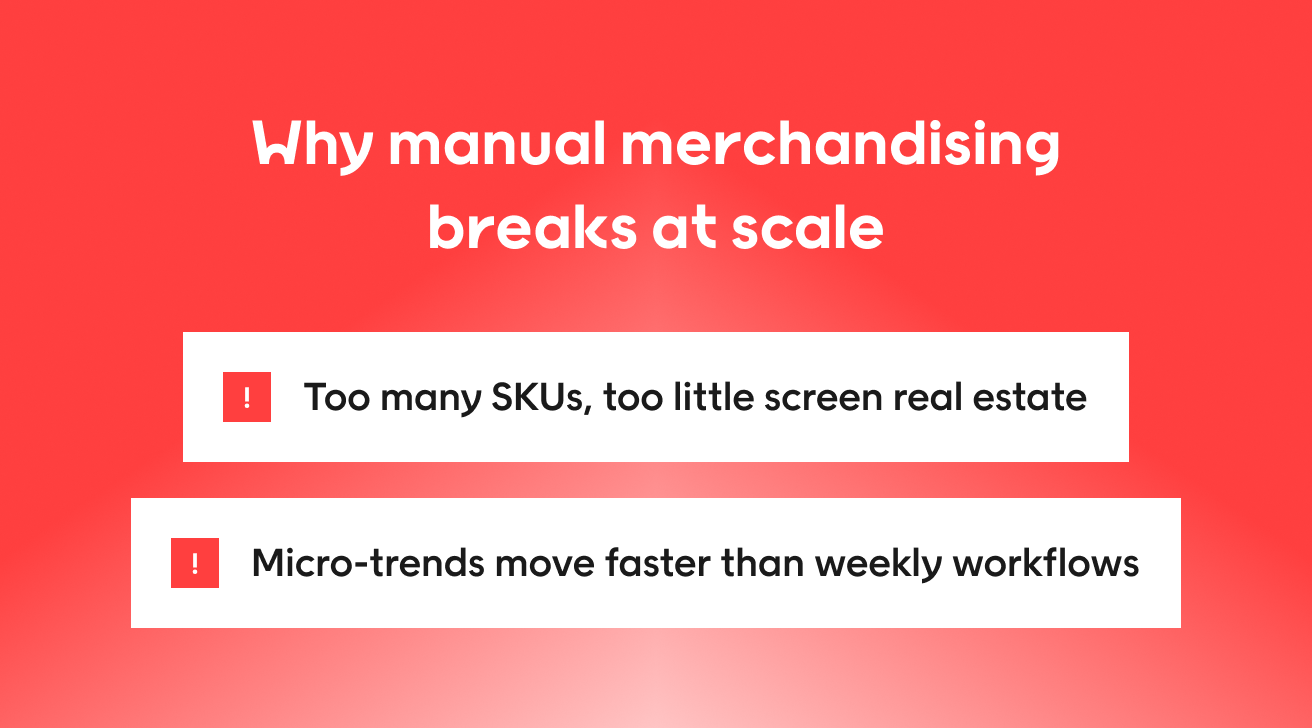
Manual merchandising processes can’t analyze customer and product data fast enough across tens or hundreds of thousands of SKUs. AI merchandising replaces that effort with continuous decision-making based on real-time data.
Too many SKUs, too little screen real estate
In brick-and-mortar stores, space planning decides what earns shelf space. Online, ranking does that job.
Most products in a large catalog never get seen, because shoppers only scan the first rows. That makes every product placement decision count.
Take an illustrative sold-out €89 rain jacket sitting in slot one of your outerwear page. Every shopper who taps it hits a dead end until your next weekly review.
Micro-trends move faster than weekly workflows
Weekly workflows treat demand as if it holds still. By the time your boost goes live, the spike has often passed.
Competitor activity moves just as fast. A drop in competitor pricing can shift demand overnight.
Picture an illustrative UK heatwave in June. Searches for linen shirts and sandals jump overnight, well ahead of normal seasonal patterns.
What AI merchandising actually automates
AI merchandising uses artificial intelligence and machine learning models to decide which products appear on your digital shelf, in what order, and for whom. It covers search results, category pages, and recommendations, replacing the weekly sort-order and boost tuning you do by hand.
Basic automated merchandising systems speed up the rules you already have. Agentic merchandising goes further, replacing those rules with real-time decisions based on shopper intent, stock, trends, and business priorities.
Using AI for merchandising across all three surfaces improves your digital merchandising while reducing manual work.
Category pages and collection sorting
The weekly re-sort is a snapshot that starts aging the moment you publish it. Continuous ranking promotes trending products as interest builds and demotes them as it fades.
Best sellers, newness, sell-through, and stock availability all shape what stays visible. Sold-out items move down, and restocked items return without a manual check.
New arrivals are the hardest case for static rules. A style launched this morning has no sales history, so a best-seller sort buries it. Treating newness as a signal gives new products a fair trial.
Voyado Product Discovery handles this through algorithmic merchandising. Algorithms do the heavy lifting, and merchandisers step in where needed.
Search boosts and bury rules
Every boost and bury rule is a guess frozen when you wrote it. Boost “trainers” for a UK spring campaign, and the rule keeps firing long after shoppers start searching for “sandals.”
Ranking that adjusts to real-time intent and conversion signals keeps search relevance current without that upkeep. It also covers the fixes teams often patch by hand in site search: synonyms, typos, and queries that return zero results.
A query typed into the search bar, like “wool coat women,” should favor styles that turn into full baskets, not just popular thumbnails.
Recommendations that adapt without constant retuning
Automated recommendations still go stale when someone retunes them by hand every season. Connected customer profiles, loyalty signals, and on-site behavior let them adapt instead.
The same logic drives cross-sell and upsell, such as “complete the look” pairings or a close alternative when a size sells out. AI product recommendations put the right product in front of the right shopper, and you keep override control.
Manual rules vs automated merchandising vs agentic merchandising
AI merchandising covers two approaches, automated and agentic. Add manual rules, and you get three models that differ in one way: who makes the ranking decision.
Automation speeds up the steps. Intelligence makes the decisions.
| Criteria | Manual rules | Automated merchandising | Agentic merchandising |
| Inputs | Judgment, weekly reports | Predefined rules | Live intent, stock, trends, priorities |
| Decisions | By hand | Rules you write | AI, against your goals |
| Human control | Full, but slow | High, heavy upkeep | Goals and overrides |
| Best-fit use cases | Small catalogs | Stable demand | Large, multi-market catalogs |
Traditional merchandising with manual rules gives you full control but breaks at scale. Automation speeds up those rules, but you still repair boosts weekly.
Agentic merchandising replaces the rules with goal-led decisions. Merchandising teams set the goals and step in for campaigns and exceptions.
Why retail context changes AI in merchandising results
AI merchandising is only as good as the retail context behind it. Retail-trained AI ranks with built-in inventory awareness and margin balance.
It also draws on product intelligence: attributes, compatibility, inventory levels, margin logic, and supply chain lead times. Without that context, merchandising AI treats your catalog as a list rather than a living assortment.
Variants, newness, and product life cycles are ranking signals
Static rules can’t track the signals that make retail different. Treat each size and color as a separate product, and one sweater takes up six slots on your knitwear page.
Rank on sales history alone, and last season’s best seller outranks this week’s new arrivals.
Voyado builds this retail knowledge in rather than learning it over time, so variants, seasonality, and newness shape ranking from day one.
What H&M’s 50% zero-hit reduction tells you
H&M reduced zero-hit search by 50% after adding richer signals to search and ranking. Those included purchases, add-to-bag behavior, revenue performance, newness, stock, and intent.
Treat it as a discovery result driven by better signals, not merchandising automation alone.
How merchandising AI balances stock, margin, and campaigns
AI merchandising earns its place when a single ranking decision must weigh stock, margin, and campaign goals at once. That’s where inventory management and merchandising decisions overlap.
Retail-trained AI checks what’s in stock, what each product contributes in margin, and what the shopper likely wants. It then optimizes for basket value instead of clicks.
An inventory-aware ranking example for fashion
Here’s an illustrative example, not a customer result. Your best-selling €79 midi dress is down to EU sizes 34 and 46.
Without stock-aware ranking, the dress keeps its top slot and most shoppers hit a dead end at the size selector. With it, the dress drops in search, category pages, and recommendations before that happens.
When replenishment lands, it climbs back automatically. Voyado knows how variants relate and lets stock levels drive visibility, which matters most for fashion retailers with deep size ranges.
Campaign priorities without broken relevance
Stack enough banners and forced top slots, and campaign products bury the items shoppers came for.
A better approach treats campaign priorities as weighted business priorities inside rankings. Campaign products rise for shoppers they fit, your launch still gets its promotional lift, and relevance stays intact.
How customer data and personalization improve ranking
AI merchandising can’t fix rankings that don’t know who’s shopping. Connected profiles, loyalty signals, purchases from physical stores, and in-session behavior close that gap.
The strongest AI merchandising tools combine customer and product data in one view. Voyado Product Discovery and Customer Engagement share one data layer, so site shoppers and CRM customers match up. British brand Pour Moi pairs smarter search with personalization this way.
What AI for merchandising can still do for anonymous shoppers
Anonymous traffic isn’t a blind spot. Product intelligence and shared behavior from other shoppers’ clicks, searches, and purchases still sharpen ranking without login or opt-in.
That also helps new or low-data products get found. Confirm which signals need consent under the General Data Protection Regulation (GDPR) and UK GDPR with your privacy team.
When loyalty and lifecycle signals should change the shelf
Lifecycle stages (never purchased, first-time, recurring, win-back, defecting, lost) signal when the product mix should change. So do purchase personas, from top tier to dormant.
For example, a top-tier member who spends £400 a year sees new arrivals first. A win-back customer sees best sellers under €50. Your loyalty program and purchase history drive those signals.
How merchandisers keep control with guardrails and overrides
AI merchandising takes the weekly hand-tuning off your plate, not the wheel. Your job shifts to shaping merchandising strategies: setting goals, defining guardrails, and handling exceptions.
Goals drive the repetitive work with consistent execution across every page.
Set goals, then let AI do the repetitive part
Define the outcome first: conversion, margin, or stock clearance. AI then handles page-by-page sorting and favors basket value over clicks.
A clearance goal lifts aging stock in relevant results without pushing it on shoppers it doesn’t fit. Beauty retailer Kicks took this route to remove the heavy lifting of online merchandising.
When to pin, boost, bury, or step in manually
Keep manual editorial merchandising tools for moments that need a human call, such as visual merchandising on a launch page:
- Pin: lock a hero product to the top for a launch.
- Boost: lift promotion products while ranking still weighs relevance.
- Bury: lower items during brand-sensitive moments, such as a product recall.
Pinning is still a powerful tool. Voyado lets merchandisers pin, boost, bury, and publish campaigns across markets. In an assistive setup, AI recommends, you approve, and you override only when the business calls for it.
What to ask when evaluating AI merchandising software
AI merchandising vendors should prove in a demo that they cut weekly tuning instead of adding rules to maintain.
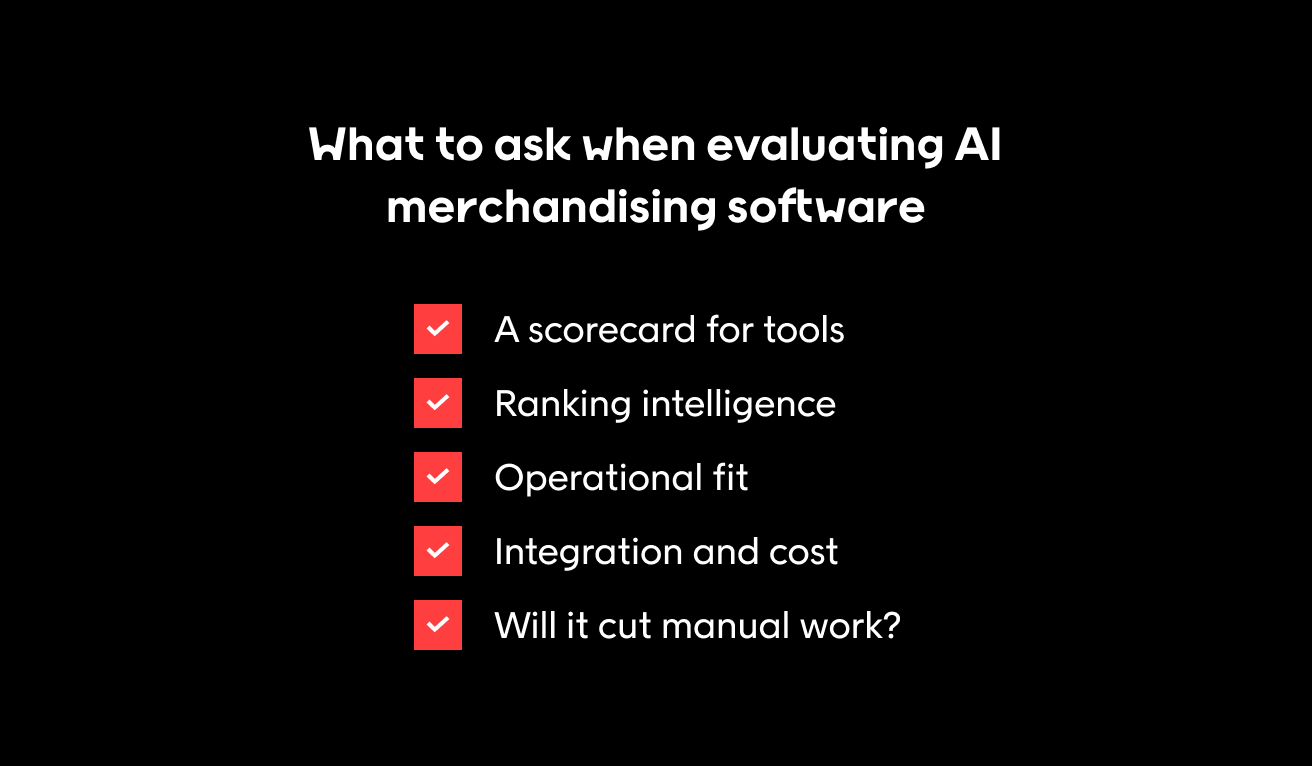
AI tools built only for retail merchandising should answer with your data, not slides. If you’re still building a shortlist, start with this comparison of AI-powered site search and product discovery platforms.
A short scorecard for AI merchandising tools
Score each vendor from one to five:
| Criterion | What to test on your own catalog | Score (1–5) |
| Ranking intelligence | Variants, low-stock items, and new arrivals rank correctly, and margin targets change live rankings | |
| Operational fit | Merchandisers can override without rebuilding logic, and rankings adapt by market | |
| Explainability | The vendor explains rankings and ties changes to conversion, AOV, and repeat purchase | |
| Integration and cost | Feeds, owners, and channels are mapped, and pricing fits your scale |
Ranking intelligence
Test three things: a style with many size and color variants, a low-stock product, and a new arrival. Watch where each one lands in search and category results.
Then ask the vendor to raise the margin target on a live category, such as sofas priced €400–€1,200, and show how rankings change. If you adjust prices often, run it again after a price change.
Operational fit
Ask the vendor to pin a product live and show the rest of the page still ranking on its own. You shouldn’t need to rebuild every existing boost to migrate.
Then ask them to explain a live merchandising decision: why one product sits in slot one and another in slot ten.
Integration and cost
Ownership, feeds, and channels- in other words, your operating model- often decide total cost of ownership more than license price. Map them early:
- Which feeds does ranking need, and who owns each one?
- Which channels are covered?
- Are attributes, inventory, margin logic, and lead times available?
Check which integrations a vendor supports before you commit. Voyado charges a fixed platform fee plus volume-based pricing on monthly sessions and catalog size, so request a quote for UK and EU rates.
Will it cut manual work or just move it?
Ask for proof of hours saved, not reports generated, from a retailer like yours.
UK fashion brand Never Fully Dressed, for example, saw search conversion rise 39%, and overall conversion rise 16% after moving to Voyado Product Discovery. Voyado also offers a free audit that runs this comparison on your own data.
How to scale merchandising optimization across UK and EU markets
AI merchandising removes the need for separate hand-tuned rules in every market. Each new language, currency, and regional assortment multiplies brittle rules, and each market reacts to market changes at its own pace.
With one agentic setup, you set shared goals, AI handles local ranking, and merchandising optimization becomes one strategy instead of a stack of rulebooks.
Will every market get the same rankings?
No. One strategy serves every store: protect margin, lift conversion, and grow average order value (AOV). Local demand, language, and regional stock then reorder products in each.
For example, a raincoat leads in Manchester while a lighter jacket leads in Madrid. Voyado uses algorithmic merchandising to align rankings and campaigns across markets without forcing identical orders.
Consent and privacy questions to ask early
Ask these before any contract, and confirm the answers with your legal and privacy teams:
- Which signals work for anonymous shoppers without opt-in?
- Which signals depend on consent under GDPR and UK GDPR?
- How does the vendor handle data minimization and retention?
- How is consent tracked across markets and channels?
What AI merchandising software needs on day 1
AI merchandising pays off fastest when your data is ready on day one. Stale or thin data leaves any merchandising system with the same gaps your rules have today.
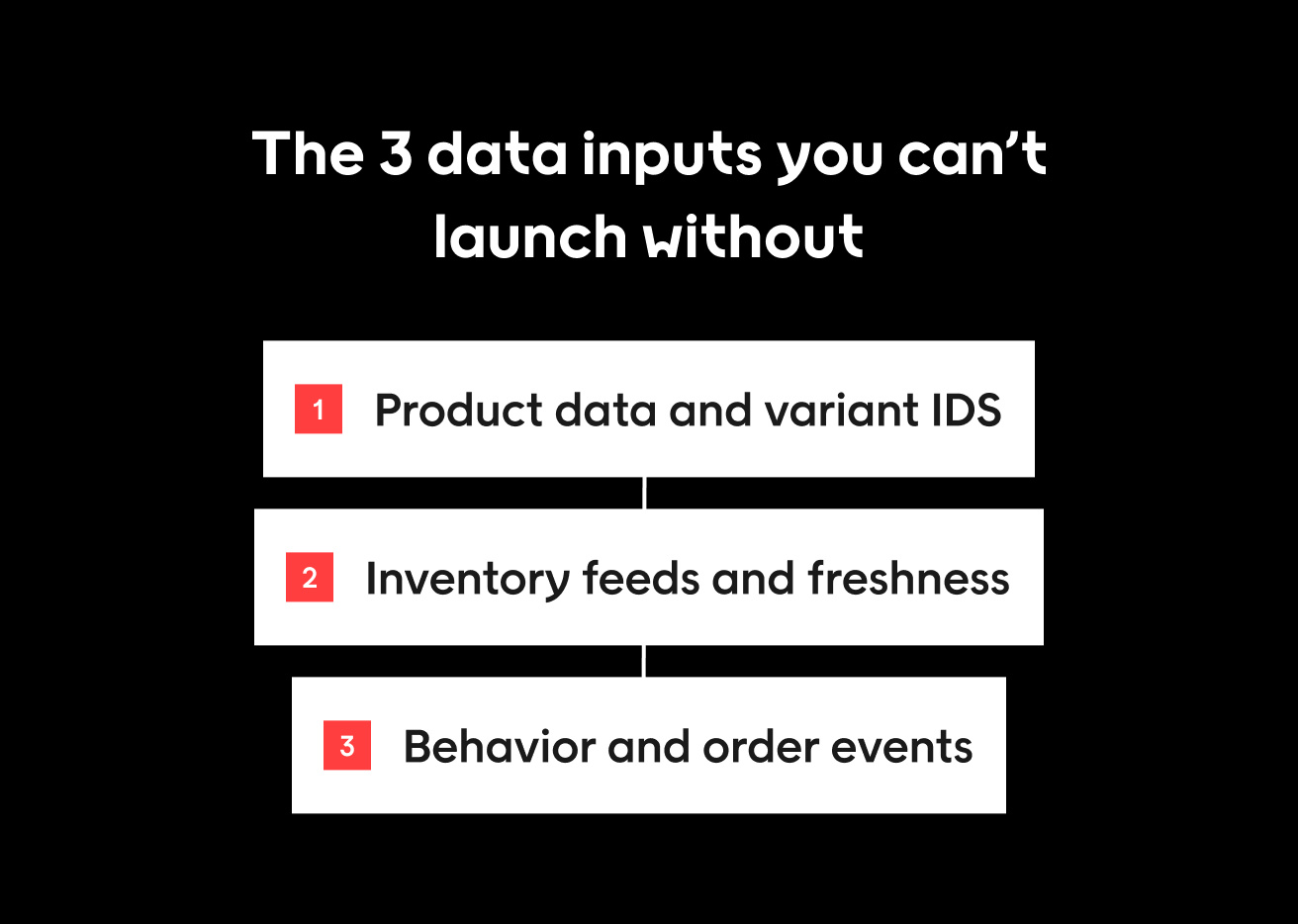
The 3 data inputs you can’t launch without
1. Product data and variant IDs
Ranking starts with structured attributes, clean taxonomy, and sizes and colors tied to a parent through consistent variant IDs. Where attributes are thin, Voyado extracts color, pattern, material, and occasion from product images.
Quick check: pick 20 random products and confirm every variant points to the right parent.
2. Inventory feeds and freshness
Stale stock data erodes trust fast. Make feed frequency a day-one requirement for each market, so a jacket sold out in Dublin can still rank in Berlin. If you sell in stores too, include store stock for click-and-collect.
3. Behavior and order events
Clicks show interest. Add-to-bag events, purchases, and revenue show what actually sells, and they feed the predictive analytics behind trend detection.
What can wait until phase two?
Loyalty signals, purchase personas, lifecycle segments, and demand forecasting inputs add depth, but they can wait. Starting with AI recommending changes for you to approve lowers the risk further.
Settle one thing before day one: who maintains each feed.
How to measure ROI from e-commerce merchandising software
AI merchandising only pays off if you can prove it. Research from Voyado and Retail Economics found that 95% of retailers use AI, yet only 5% see ROI. Judge any e-commerce merchandising software on business outcomes, not clicks.
Track six key performance indicators: conversion rate, AOV, repeat purchase rate, revenue per session, margin, and merchandiser hours. If clearance is a goal, watch sell-through and inventory turns too.
Metrics that tie to CLV, not just clicks
A high click-through rate can hide weak basket value. Judge ranking changes on measures tied to customer lifetime value (CLV):
- Revenue per session, which shows whether traffic turns into money.
- AOV, which shows whether ranking builds bigger baskets.
- Repeat purchase rate, which shows whether shoppers come back.
How to A/B test AI merchandising in your first 90 days
Run an A/B test that changes only ranking. Hold campaigns, pricing, and promotions constant so any lift belongs to ranking.
Log weekly time spent on boosts and sort orders before and during the test so you measure savings, not assume them.
Why automated merchandising underdelivers (and how to spot it early)
When AI merchandising underperforms, the cause usually sits in the data, goals, or rules around it, not the model itself.
Great click rate, weak basket value
A model that rewards clicks promotes cheap, popular, low-margin items. Your engagement dashboard looks healthy while margin and AOV slide.
In an illustrative case, clicks on £9.99 basics climb while average basket value falls from £62 to £48. Measure conversion, AOV, and repeat purchase rate, not CTR alone.
Stale feeds, thin attributes, and rule sprawl
- Stale stock and price feeds keep sold-out or mispriced items in prime slots.
- Thin product attributes leave the AI guessing what each item is.
- Rule sprawl moves work from one rules engine to another.
How Voyado Product Discovery handles AI merchandising
AI merchandising works best when it starts with retail context, and that’s where Voyado fits. As the agentic OS for retail, Voyado ranks products on shopper intent, stock, and business goals, with AI agents working from the same retail context.
Voyado works with 500+ retail brands across 100 markets, and customers see an average 15-20% conversion uplift.
Agentic discovery, which lets shoppers search in natural language, has delivered double the add-to-cart rates and 50% higher engagement.
Key takeaways: from weekly tuning to setting goals
AI merchandising should cut repetitive tuning, not add rules to maintain. The key benefits are time back for your team and rankings that keep pace with stock and demand.
Most retailers already use AI, but only 5% see ROI, so choose a partner who can prove lift.
Start with the free product discovery audit for a side-by-side comparison using your own data.
FAQs
Will merchandisers be replaced by AI?
No, AI merchandising won’t replace merchandising teams. It takes over the weekly sort-order and boost grind, while you keep strategy, campaigns, and exceptions.
How can AI help merchandising?
AI merchandising takes over the jobs you’d otherwise do by hand:
- Automating search, category sorting, and recommendations.
- Promoting and demoting products on real-time data, not after a 24+ hour lag.
- Ranking around inventory, so sold-out items drop and restocked ones return.
How can I tell whether an AI merchandising tool will actually cut the time we spend adjusting sort orders and boosts, rather than give us more rules to maintain?
Ask for proof of hours saved, goal-based controls, and a demo showing how often merchandisers still intervene. Voyado customers see an average 15-20% conversion uplift, and H&M cut zero-hit search by 50%.
Can AI handle day-to-day product ranking around stock and margin while letting our merchandisers override it for campaigns?
Yes. Retail-trained AI balances relevance with margin, demotes low-stock items, and optimizes for basket value. Campaign priorities sit inside the rankings, so a pinned launch doesn’t break relevance elsewhere.
What would moving from our current sorting rules to AI merchandising involve, and would we need to rebuild all our boosts?
No, not all of them. Start with your product data feed, test on one surface such as a single category, and let AI recommend changes before you switch on full automation.
Can one AI merchandising setup replace manual tuning across our UK and EU stores without applying the same rankings to every language and market?
Yes. You share goals across stores while each market ranks locally on language, regional stock, and consent.