TL;DR
Search relevance is how well on-site search returns buyable products that match what shoppers mean, and when it fails, shoppers get junk or zero results and leave. You fix search relevance by feeding intent, stock, variants, seasons, and market context into ranking instead of endless manual synonym lists. H&M cut zero-hit search by 50%, and Voyado customers see an average 15-20% conversion uplift.
A shopper types “wedding guest outfit” into your website’s search bar, sees zero results or sold-out dresses, and leaves. Search matched her words, but stock, variants, seasons, and local assortment never reached ranking. UK and EU teams patch the gap with synonyms and manual rules.
Most guides define search relevance and stop. This article shows how to improve it systematically and put more relevant results in front of shoppers.
What search relevance means in ecommerce
Search relevance means showing e-commerce shoppers buyable products that match what they mean, not just exact matches for what they typed. Keyword-only search can’t, because it lacks retail context.
The difference between matching terms and meeting intent
A literal match can surface a sold-out jumpsuit: textually right, commercially wrong. Semantic search reads the meaning behind a query, so you meet shoppers at their intent, not their search terms.
How search engine relevance differs from SEO relevance
This guide covers search engine relevance in your own store’s search bar, not Google rankings or SEO.
Why irrelevant results lose revenue before the product page
Searchers are your highest-value traffic, so a dead end sends their budget to a rival UK retailer.
The moment of intent is the moment of risk
Search exits cost more than browsing exits because the shopper already asked to buy. The results page should be a destination, not a dead end.
The hidden costs beyond zero results
Reformulations, backtracking, and popularity-only sorting all leak revenue. Zero-result tracking misses them, so search performance looks healthier than it is. Retail-aware ranking helped H&M halve zero-hit search.
Why keyword matching fails on real shopper intent
Keyword matching hunts for exact matches and ignores retail context, turning synonym lists into manual firefighting.
Natural language, typos, and long-tail queries
UK shoppers type “trainers,” catalogs say “sneakers,” and someone types “trianers.” Semantic search connects all three to the same product. Each miss is a sales leak.
The “wedding guest outfit” problem
Picture this: a literal matcher leads with an out-of-stock dress, while an intent-led page presents in-stock, occasion-ready pieces. Voyado builds occasion, season, and stock context into ranking.
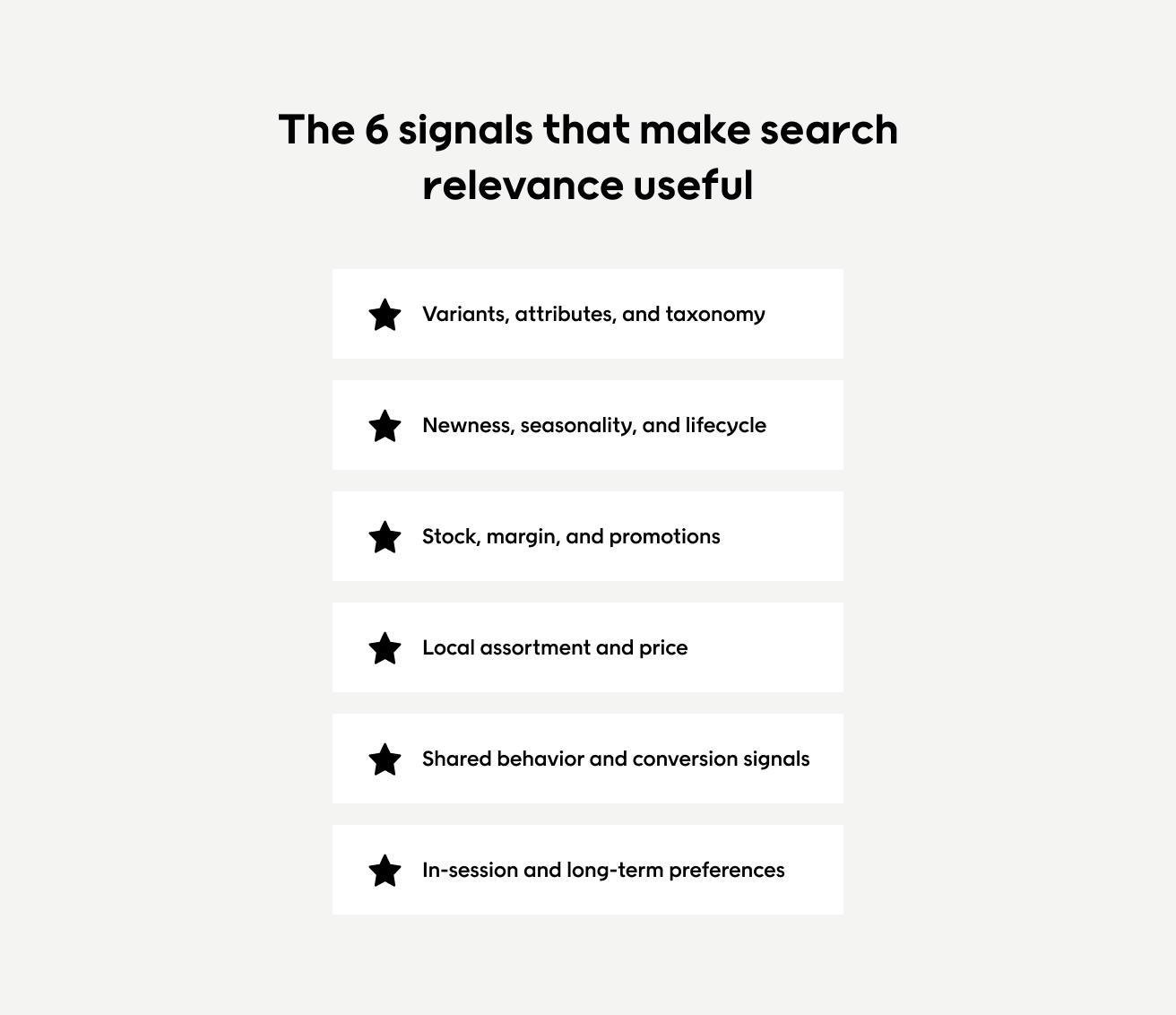
The 6 signals that make search relevance useful
Relevant results that convert draw on three aspects of context: product, commerce, and shopper.
| Context | Signals | Example |
| Product | Variants and attributes; newness and seasonality | Linen in May, velvet in December |
| Commerce | Stock, margin, and promotions; local assortment and price | A UK-stocked coat unavailable in Germany |
| Shopper | Shared behavior; in-session and long-term preferences | Best sellers for new visitors |
Product context
Voyado Product AI enriches product attributes via structured knowledge graphs.
1. Variants, attributes, and taxonomy
A dress missing your size isn’t shoppable. Clean titles, attributes, and product taxonomy decide what search can find.
2. Newness, seasonality, and lifecycle
“Wedding guest outfit” means linen in May, velvet in December. Release date matters too, so new arrivals surface while they’re fresh.
Commerce context
Weigh inventory, margin, and availability over popularity.
3. Stock, margin, and promotions
Out-of-stock items ranked first waste high-intent traffic.
4. Local assortment and price
A coat in stock in your UK store may be unavailable in Germany.
Shopper context
New and returning shoppers expect different results, depending on how each user interacts with your site.
5. Shared behavior and conversion signals
Machine learning turns shared user behavior into ranking signals. Voyado Community AI learns from every click, search, and purchase.
6. In-session and long-term preferences
Voyado Personal AI tailors ranking to user preferences in real time.
How to separate product data issues from search engine relevance issues
If your product data is clean but results are still poor, the problem is search engine relevance, not data. Start with zero-result, top, low-converting, and high-exit queries in Google Analytics or your search reports.
Symptoms of weak product data
- Missing attributes hide products.
- Messy taxonomy misfiles items across departments.
- Thin descriptions and titles starve matching.
- Inconsistent filters vary by category.
Symptoms of weak ranking logic
Run five top queries. Focus on stale best sellers, unavailable items first, and identical results for every user.
When both are causing the problem
Many retailers have both weak product data and weak ranking logic, so synonyms alone stall.
How stock, variants, and availability should shape ranking
A £95 blazer ranked first but sold out in size 12 fails the shopper who needs it.
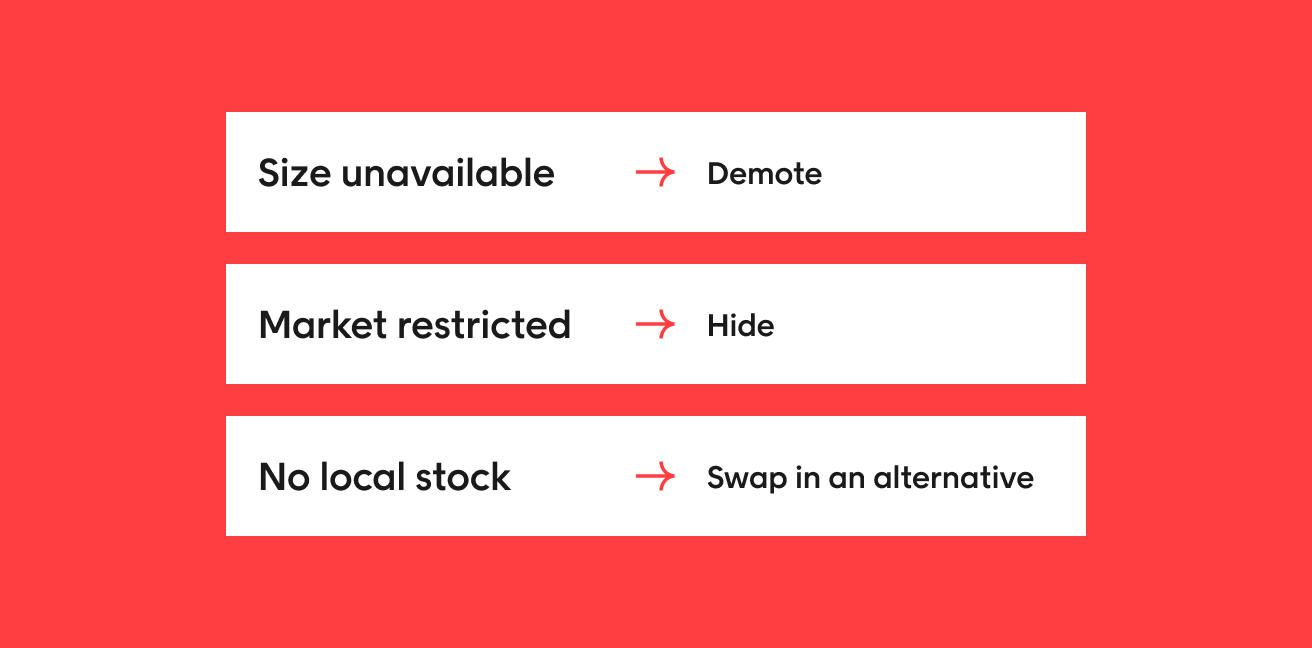
Don’t rank unavailable products like they are buyable
| Trigger | Action |
| Size unavailable | Demote |
| Market restricted | Hide |
| No local stock | Swap in an alternative |
Voyado adds real-time stock and localization to every search.
Treat variants as related choices, not duplicate clutter
One tile with selectable sizes and colors beats six near-duplicates. Shoppers can complete their choice in one place.
How personalization changes relevance for new and returning shoppers
First-time visitors and loyal customers can mean different things for the same query, which is where e-commerce search personalization earns its place.
What anonymous shoppers can still get
Shared user behavior and in-session signals still help, like best sellers for new visitors.
What known shoppers should get
Once shoppers register an account, consented purchase history and user preferences can refine ranking. GDPR and UK GDPR rules govern what you can use.
How autocomplete, facets, and visual suggestions improve discovery
Relevance starts in the search bar, before shoppers press enter.
Autocomplete that saves time
Autocomplete suggests queries instantly, before shoppers finish typing. It also steers typos and vague terms toward queries your catalog can answer.
Filters that narrow without frustration
In faceted search, consistent facets for size, color, brand, and occasion build trust across categories.
Visual suggestions that surface alternatives
Visual search in ecommerce helps shoppers who can’t name the term discover alternatives.
How to balance shopper intent with merchandising goals
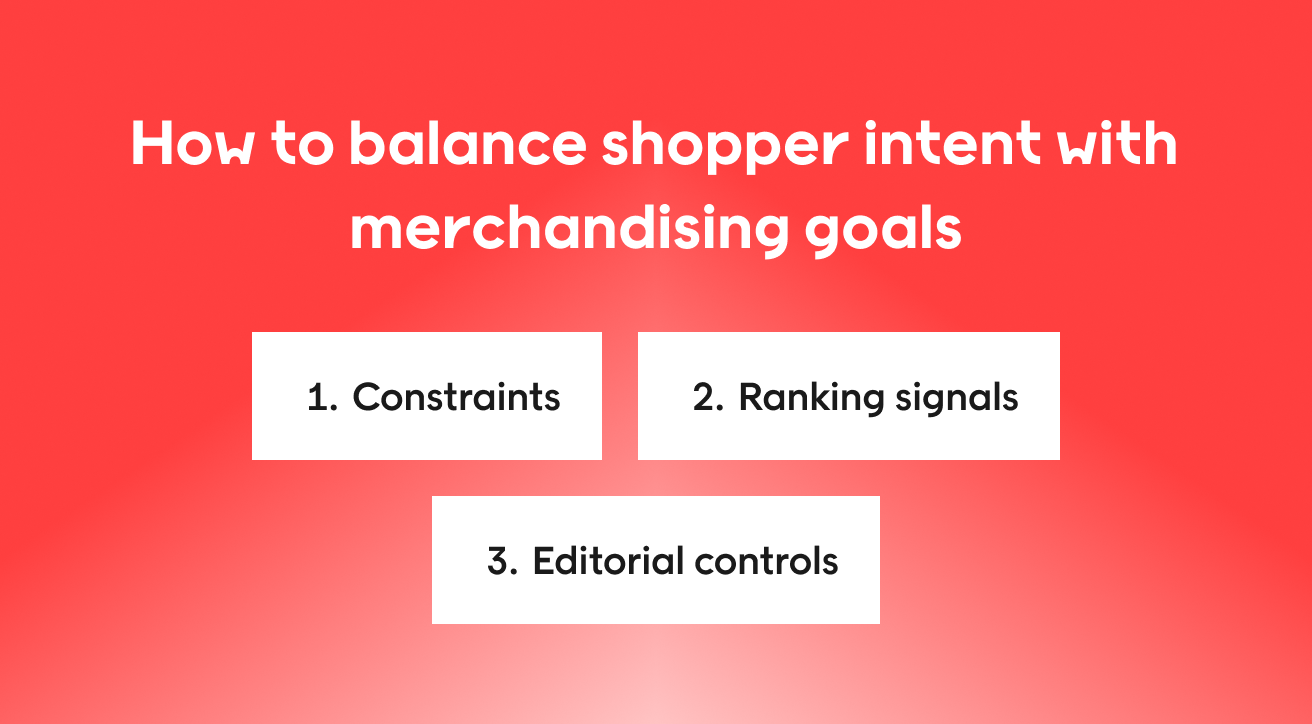
Relevance and commercial goals share one page. Apply controls in this order:
- Constraints, like stock and market availability
- Ranking signals, like intent and behavior
- Editorial controls, like pins and boosts
Where boosts, pins, and campaigns help
Create searchandising pins and boosts for “gift,” “sale,” or “wedding” to guide relevance while algorithms do the heavy lifting.
Where sponsored products should not hijack relevance
Voyado Retail Media runs inside search, browse, and recommendations, keeping sponsored products relevant.
What good search engine relevance looks like across UK and EU markets
A query that works in London can fail in Stockholm or Berlin.
Language, spelling, and market vocabulary
Translated UK synonym lists miss local phrasing. Agentic discovery and conversational search let shoppers describe products in their own words, as they would in conversations with a sales assistant.
Localization, currency, and local stock
Assortments, currency (£, €, kronor), stock, and delivery services differ, so geo-aware ranking keeps results buyable.
GDPR and UK GDPR guardrails for personalization
Not every signal needs personal data:
- No personal data needed: query, stock, and market
- Consent needed: browsing and purchase history
Confirm your setup with your legal or privacy team. Voyado Customer Engagement manages consent alongside Voyado Product Discovery.
The 2 metrics that prove relevance are getting better
Track search performance by pairing human judgments and normalized discounted cumulative gain (NDCG) with sales outcomes.
-
Core query quality metrics
Start with zero-result rate, then low-converting queries, exits, and reformulations.
-
Business impact metrics
Add-to-cart rate, conversion, and revenue per search session show whether fixes pay off. Track all three in Google Analytics and look for gains like the 4.5% increase in revenue from search that Obs and Obs Bygg, part of Coop Norway, saw with Voyado.
Why NDCG needs a plain-English scorecard
NDCG scores whether the most relevant results rank near the top. Review broad, long-tail, and typo queries too.
A 4-step workflow to diagnose bad queries systematically
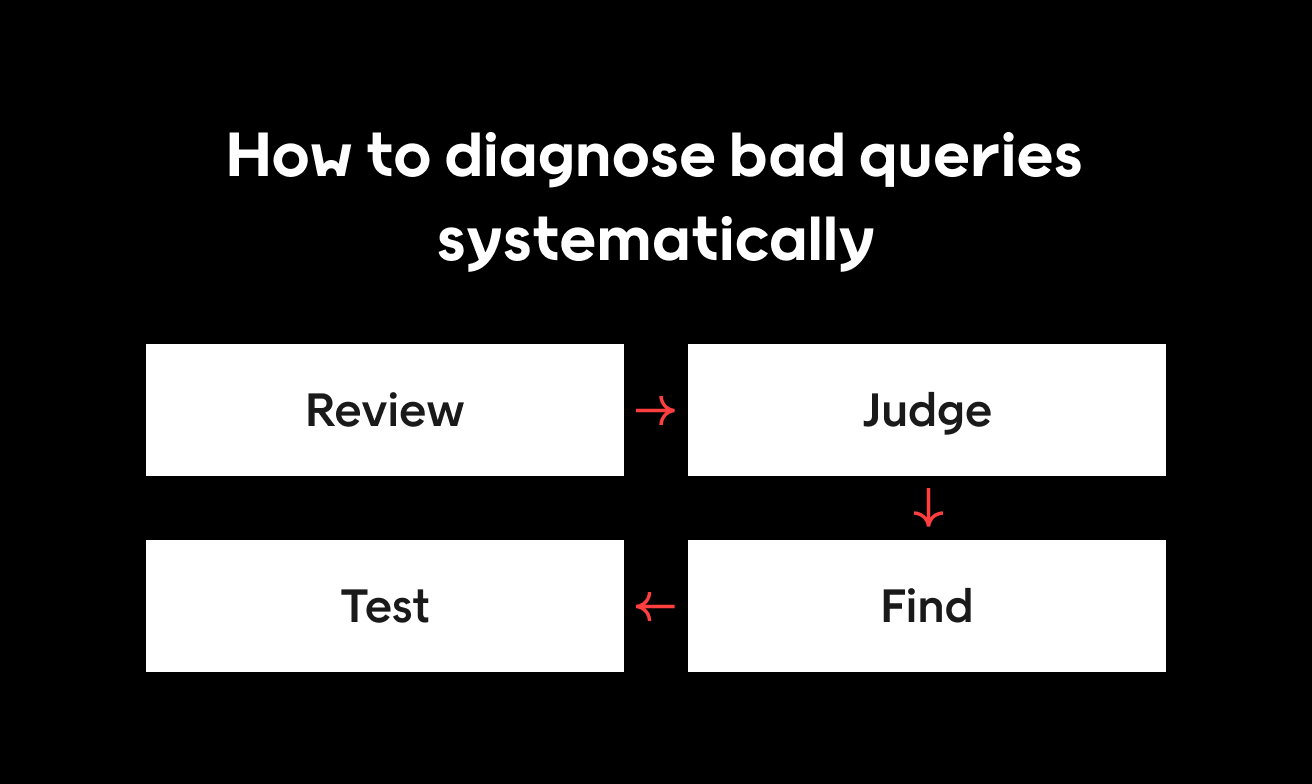
Swap firefighting for a loop that helps you identify opportunities: review, judge, trace, and test. Document each query in a worksheet like this:
| Query | Class | Scores (1-5) | Root cause | Lift |
| “wedding guest outfit” | Intent-led | 2, 1, 3 | No local stock | Zero-result rate |
Step 1: Review high-intent query types
Classify queries into four types:
- Exact-product: “Barbour Beaufort”
- Category: “rain jackets”
- Attribute: “linen trousers”
- Intent-led: “wedding”
Step 2: Judge results like a shopper
Score relevance, buyability, and clarity the way a user would, not by click data alone.
Step 3: Find leaks in data, rules, and ranking
Link each failure to one root cause: missing attributes, weak synonyms, brittle rules, or poor ranking.
Step 4: Test fixes and measure the lift
Implement one fix at a time, A/B test ranking and layouts, then log the lift.
When more rules stop helping, and a new approach is needed
Each synonym, pin, or boost fixes one query until the next phrasing breaks.
Signs your team is stuck in search firefighting
- Rule lists only grow, and nobody can manage them.
- Zero-hit terms keep returning.
- Market rollouts stall on per-locale rebuilds.
- Merchandisers fix queries instead of running campaigns.
What to look for in a replacement
- Enriched product data ends manual tagging.
- Real-time ranking tracks stock and behavior.
- Personalization uses machine learning instead of per-segment rules.
- Localization handles every market.
- Merchandiser control lets you step in where needed.
Why retail context turns good search into true discovery
Retail context is essential: it makes results work for shoppers and shelves.
What built-in retail context changes
Voyado runs one intelligence engine across Product AI, Community AI, and Personal AI.
Why agentic discovery still depends on relevance basics
Voyado grounds agentic discovery in accurate attributes and stock, and the sale stays on your own web store.
The proof that context scales better than manual tuning
Voyado powers 5 million searches daily across 500+ retail brands, with an average 15-20% conversion uplift.
Final thoughts
Treat search relevance as a system you build, track, and test. Ranking that reads intent, stock, and market context serves more relevant results by default. It closes the leaks manual rules leave: zero-result queries and sold-out items ranked first.
Voyado audits product discovery for omnichannel retailers with broad catalogs, multiple markets, and 1M+ monthly sessions.
FAQs
What does "relevance" mean?
Search relevance is how closely on-site search results match what a shopper means, beyond exact matches on typed keywords.
What is an example of relevance?
A good “wedding guest outfit” page shows in-stock, local styles first. Sold-out items up top bury relevant search results.
How can we tell whether irrelevant search results come from poor product data or the search engine itself?
Search relevance problems split two ways. Patchy attributes mean product data, while clean data ranked badly means ranking logic.
What should we measure to see how much irrelevant search results are costing us in lost sales?
Track zero-result rate, reformulations, search exits, add-to-cart rate, conversion, and revenue per search session to see where search performance leaks revenue.
When does adding more search rules and synonyms stop being a sensible fix, and when should we consider replacing our search tool?
Rule sprawl, slow market updates, and recurring bad queries mean patching has peaked, and retail-aware ranking lifts search relevance further.
Why do searches work well on our UK site but return irrelevant products in other European markets?
Vocabulary, assortment, price, and stock differ by market. Voyado combines geo-aware ranking, localization, and real-time stock.