TL;DR
- Shopify recommended products cover the basics, but native recs are hard to control, so shoppers often see the same generic best-seller block, find no next step, and leave.
- Ranking by intent and stock lifts results without another app: Voyado Product Discovery customers average a 15–20% conversion uplift, and richer ranking signals helped H&M cut zero-hit searches by 50%.
A shopper opens a product page in your Shopify store and sees the same generic best-seller block as everyone else. Shopify-recommended products offer no relevant next step, so they leave before adding to cart.
eMarketer projected mobile would make up 69.9% of global retail e-commerce sales in 2024, so every wasted slot on a small screen costs online store sales.
The cause is static logic that ignores customer behavior, local stock, and margin. Retailers on Shopify Plus with large catalogs across several markets feel it most.
Here’s how UK and EU stores can push native recs further, and when Voyado Product Discovery lifts average order value (AOV) without stacking apps or hurting the customer experience.
How Shopify recommended products work natively
Shopify recommended products come from three parts: a recommendations section in your theme, automatic logic, and manual picks in Shopify’s free Search & Discovery app. They help customers discover related and complementary items, but they don’t factor in real-time intent, stock strategy, or margin.
What your theme and Search & Discovery give you for free
Many themes, including Shopify’s free Dawn theme, let you add product recommendations to the product page without a developer. Shopify supports two recommendation intents:
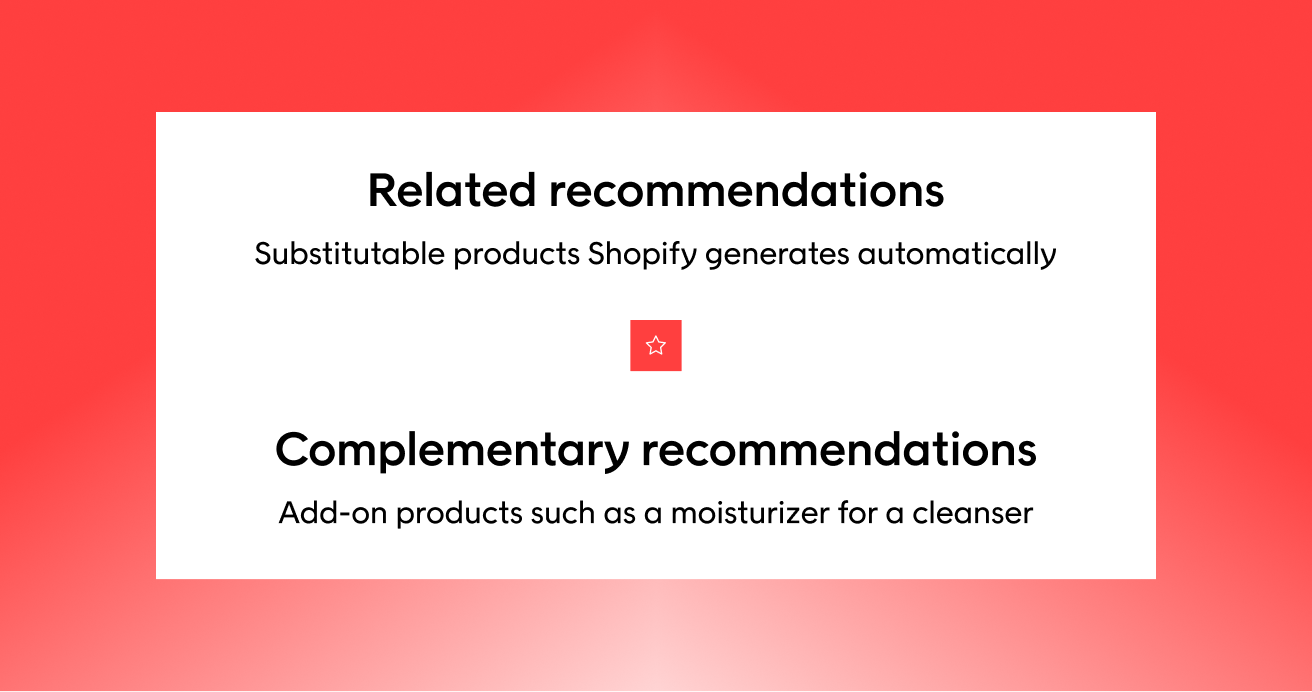
- Related recommendations: substitutable products Shopify generates automatically, using purchase history first, then product descriptions (on English storefronts only), then related collections.
- Complementary recommendations: add-on products such as a moisturizer for a cleanser. Shopify doesn’t generate these, so you manually set them in Search & Discovery.
You can add up to 10 related and 10 complementary picks per product and show them ahead of, or instead of, the generated list.
You can’t edit the generated list itself, and custom logic needs Liquid or an app.
Shopify related products, frequently bought together, and cross-sell modules do different jobs
A common mistake with Shopify recommended products is asking one widget to do every job. Generic blocks ignore intent and produce poor suggestions, so give each module its own logic.
Use related products to keep discovery moving
Related products answer “not this one, then what?” with credible alternatives that share similar attributes, so customers browse on instead of hitting a dead end.
Use frequently bought together to drive add-ons
Shopify frequently bought together modules show items customers frequently purchase together, like a belt with chinos. You get bigger baskets with no markdown required.
Many apps add discounts or bundle offers to add-on products, but a relevant pairing can sell without one.
Use upsell and cross-sell logic at the right moment
Place a Shopify upsell or Shopify cross-sell on the product page, cart page, checkout, or post-purchase. Checkout placements typically need Shopify Plus.
In the cart, add-ons that close the gap to a free-delivery threshold offer customers a reason to add more. Rank add-ons by stock and margin, not price alone.
Voyado’s product recommendations base cart suggestions on what the shopper has already added, using up-to-date stock levels.
How to exclude the current product from Shopify product recommendations
If a viewed product, or a near-duplicate, shows up in its own Shopify recommended products, check your setup first.
Native recs already hide items that are sold out, priced at zero, gift cards, unpublished, or already in the cart.
So the problem is more likely to come from manual picks, an app, custom theme code, or colorways set up as separate products. Set exclusion rules once, in the ranking logic, so search, browse, and product pages agree. Theme code only changes what’s displayed.
Exclude the current product without removing useful variants
Size variants of a linen shirt are one item, but another colorway is a valid alternative.
If your store lists each colorway as its own product, near-identical items can show up as new options. Voyado’s retail knowledge includes how variants such as size and color relate, so product suggestions stay useful.
Filter out cart items, unavailable SKUs, and blocked categories
- Cart items: don’t pitch what the shopper already chose. Native recs handle this, so check that apps and custom sections do too.
- Unavailable stock keeping units (SKUs): recommend only the correct items in the shopper’s size, not just products with some stock left.
- Blocked categories: exclusion rules keep restricted ranges, such as samples or clearance lines, out of view.
Where Shopify recommended products hit a ceiling
Shopify recommended products suit a simple online store, then cap AOV as your assortment, UK and EU markets, and merchandising goals grow. Larger catalogs feel it first. These signs show you’ve outgrown them.
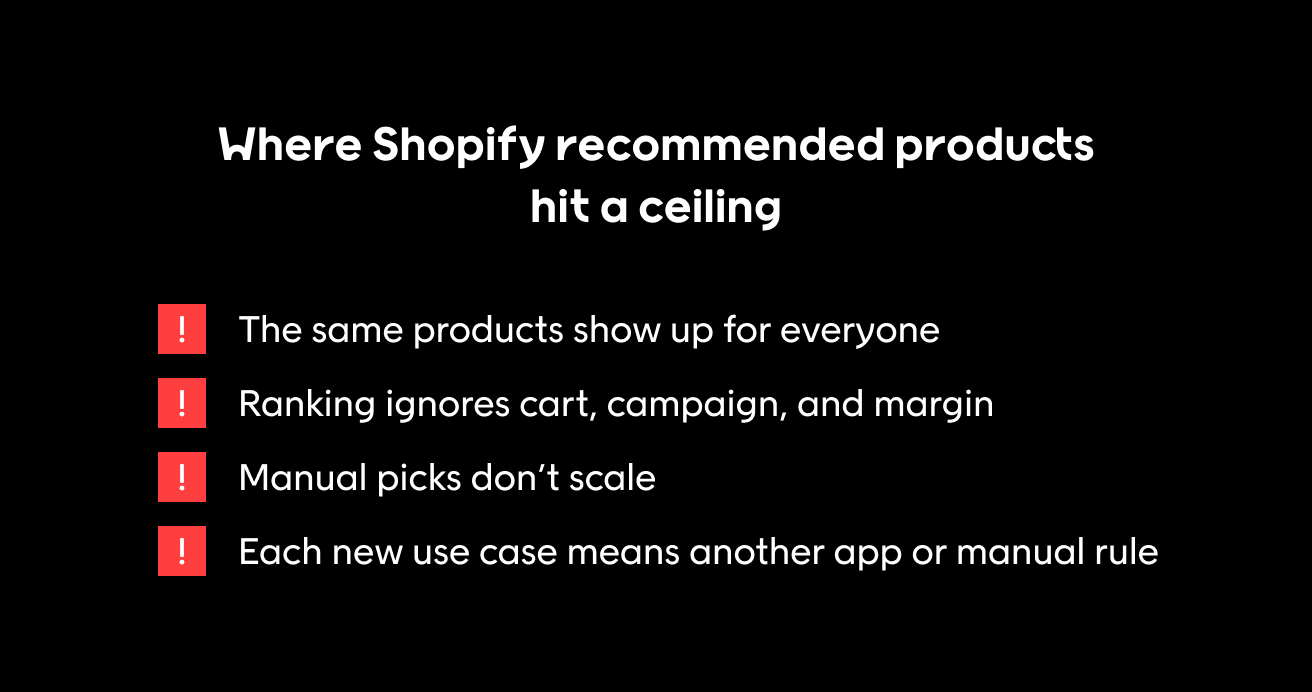
The same products show up for everyone
Generic modules ignore intent. A Manchester shopper browsing raincoats should see relevant products for that category and market, not global best sellers.
Ranking ignores cart, campaign, and margin
Shopify’s related recommendations use purchase history, descriptions, and collections. Cart contents, live campaigns, and margin aren’t among those inputs, so merchandisers fix the gaps by hand.
Manual picks don’t scale
In one Shopify Community thread, a merchant with more than 20,000 unique products found the generated recs didn’t make sense, and choosing every pick by hand wasn’t possible at that size.
Bulk edit in Search & Discovery lets you assign picks to multiple products at once, but they’re still manual lists of up to 10 products.
Each new use case means another app or manual rule
The hidden cost is team hours and rule drift. Voyado Product Discovery is one retail-native engine for AI site search, merchandising, and recommendations lifts AOV without that stack, instead of a separate product recommender for each job.
What the Shopify AI recommendations algorithm misses
An AI label on Shopify recommended products won’t fix a generic block when the logic only reads the current page.
Personalized recommendations on Shopify should respond to the session, the shopper, and where each product is in its lifecycle, which takes a more targeted strategy than a one-size-fits-all widget.
Session signals matter before a shopper logs in
Recent views, searches, and cart activity show how customers browse, which makes recs relevant for anonymous sessions. Voyado’s recommendations use real-time data to read each visitor’s intent across the customer’s journey.
Richer ranking signals beat clicks alone
Ranking on clicks alone misses stock, newness, and revenue performance.
H&M added signals such as purchases, add-to-bag behavior, revenue performance, newness, and stock availability to search and ranking with Voyado, and cut zero-hit searches by 50%. That’s a site search result, but it shows what richer signals do for ranking.
New arrivals and seasonality need context before clicks
Shopify’s related logic leans on purchase history, so new items with no sales get missed.
Voyado has retail knowledge built in, including what newness, seasons, and lifecycles mean for ranking, rather than learning it over time. A UK fall knitwear drop doesn’t have to wait for sales data to rank.
Why search, product pages, and email should share one ranking
Disconnected tools can make Shopify recommended products contradict search results and email picks, weakening the customer experience. With Voyado, one Shopify recommendation engine for search, merchandising, and recommendations keeps a shared ranking context, so relevant suggestions on one page aren’t contradicted on the next.
One ranking across every touchpoint: an example
- Product page: similar products that keep discovery moving.
- Cart: complementary items based on what’s already in the cart.
- Email: recommendations drawn from the same customer behavior data, which Voyado’s Connected Recommendations link with on-site messages.
How store and loyalty data sharpen recommendations
Voyado Customer Engagement unifies online and in-store data in one profile, and loyalty data flows into every campaign.
When Customer Engagement and Product Discovery share data, order history, loyalty points, and tier data can turn generic picks into personalized product recommendations. Capture UK and EU consent before you activate that data.
How to localize recommendations for UK and EU storefronts
Shopify recommended products need market-by-market rules, because stock, assortment, pricing, and language differ, down to free-delivery thresholds such as £50 in the UK and €60 in Germany. Relevant products differ by market, so one global block won’t serve every storefront.
Use local stock and assortment, not global best sellers
Each storefront should recommend only what’s launched and in stock locally, so a UK shopper never sees an EU-only item.
Shopify’s related logic reads product descriptions only on English storefronts, so German or French storefronts lean on purchase history and collections.
Voyado’s Shopify app syncs your Shopify store catalog and maps markets, locales, and product attributes without custom development.
Set margin and campaign rules by market
A clearance push in the Netherlands shouldn’t override UK margin goals. Set ranking and campaign rules per storefront so revenue grows without eroding profit in either market.
Voyado’s algorithmic merchandising aligns rankings, promotions, and campaigns across markets, and merchandisers can take over where needed.
What UK and EU consent teams should check before turning on behavioral recommendations?
Before you turn on behavioral Shopify recommended products, ask: do we have the right to use this data for recommendations?
Browsing- and cart-based recs rely on tracking, so cookie rules, the EU General Data Protection Regulation (GDPR), and UK GDPR come first.
If you also sell to shoppers in California, check how the California Consumer Privacy Act (CCPA) opt-out applies to your tracking.
What data usually needs consent
Contextual recs from page, category, and stock usually skip individual tracking. Behavior-based personalized recommendations use tracking identifiers, so check cookie rules separately.
What to document for profiling, retention, and processors
- Profiling rationale: why you use behavioral data.
- Retention windows: how long session data stays.
- Processor responsibilities: who handles what across tools.
Fewer tools mean fewer processors to document. Legal specialists should review your final approach.
How to keep recommendations useful when consent is limited
Stock, attributes, category, and market logic still drive relevance for anonymous sessions, and ranking on stock needs no personal data.
How to choose the best product recommendation app for Shopify (and count the real cost)
Judge Shopify recommended products by total cost of ownership (TCO), beyond the subscription price.
Many apps offer a free plan, which keeps entry costs low, but hidden costs include catalog sync, event tracking, latency, localization, support, and rule maintenance. Confirm UK and EU pricing and currency terms directly.
App Store ratings help, but 5 stars across a handful of total reviews says little about how an app handles a large catalog.
A Built for Shopify badge is a more useful signal. It means the app meets Shopify’s performance, design, and integration standards, including limits on how much it slows your storefront.
Native vs app vs platform, side by side
Here’s how the three options compare.
| Criteria | Shopify native | Shopify product recommendation app | Unified discovery platform |
| Control and merchandising | Auto-generated related, manual complementary picks | Rules per widget | Stock- and performance-aware ranking with overrides |
| Localization and stock awareness | Limited market-level control | Varies by app | Rules per storefront |
| Implementation and ongoing cost | No extra fee, theme work | Monthly fee plus rule upkeep | Platform fee, fewer apps |
When a Shopify upsell app or Shopify product recommendation app is enough
A Shopify upsell app is often enough for a smaller catalog, a single-market store, or a narrow cart add-on flow. Frequently bought together modules deliver quick AOV wins there.
If an app offers a free trial, run it against the scorecard below before you move off the free plan.
When one discovery platform beats another app
Voyado is the agentic OS for retail, built for mid-market and enterprise retailers with larger catalogs and multiple storefronts. It works with 500+ retail brands across 100 markets, including H&M Group and Pour Moi.
One platform for search, merchandising, and recommendations reduces app stacking, keeps ranking consistent, and helps increase conversions across the store.
Product Discovery customers see an average 15–20% conversion uplift, and UK fashion brand Never Fully Dressed saw search conversion rise 39% and overall conversion 16% after the move.
Pricing is a fixed platform fee plus volume-based pricing tied to monthly sessions and catalog size, with a tailored proposal rather than list prices.
How to test whether recommendations lift AOV without hurting margin or conversion
Test Shopify recommended products before switching them on, because the attributed revenue on an app’s analytics page can hide cannibalization or eroded profit.
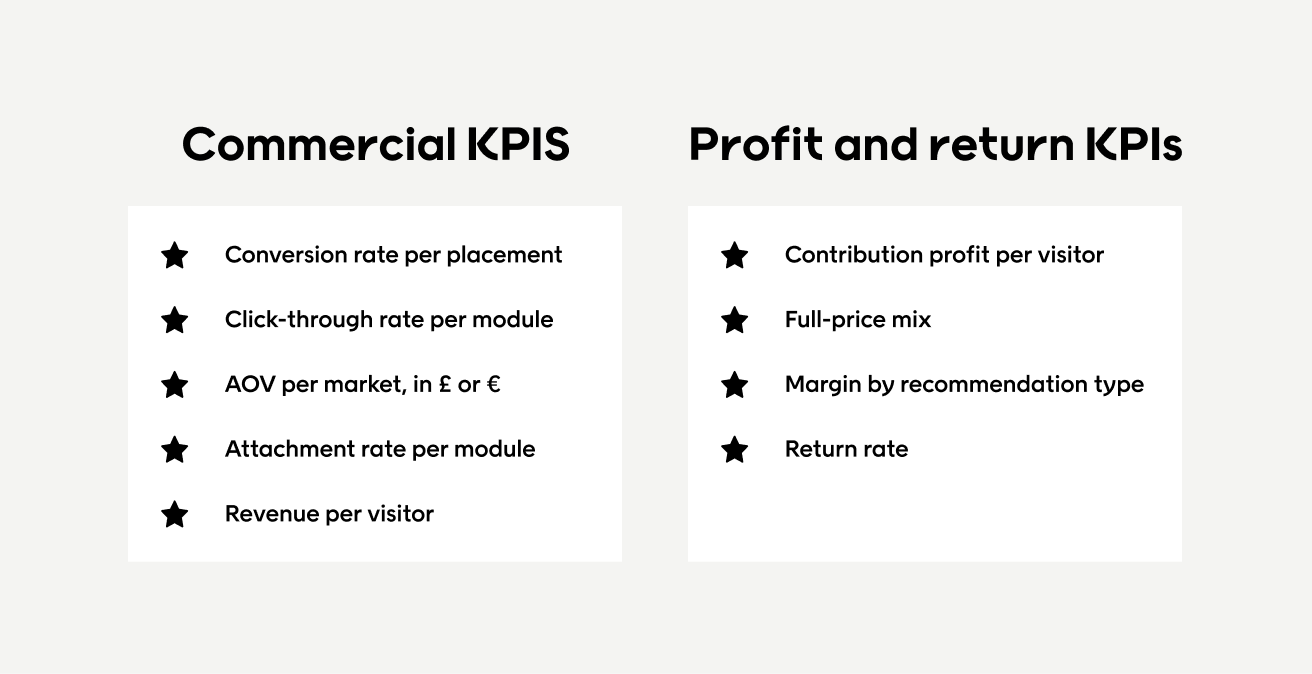
Track recommendations by placement as well as sitewide.
Use a scorecard that separates revenue from profit
Recs can lift revenue while eroding margin or driving returns, so keep two KPI sets. A module can show more revenue on paper while profit falls.
Commercial KPIs
- Conversion rate per placement
- Click-through rate per module
- AOV per market, in £ or €
- Attachment rate per module
- Revenue per visitor
Profit and returns KPIs
- Contribution profit per visitor
- Full-price mix
- Margin by recommendation type
- Return rate
Measure incremental lift, not just last-click attribution
Use a holdout or A/B test to check conversion and cannibalization, comparing shoppers who see recs with other customers who don’t. Static rules go stale, so re-test regularly.
Final thoughts
Shopify recommended products cover the basics, but retailers who need control, localization, and consistent ranking should step up to increase online store sales without adding another app.
Watch for three triggers: ranking that ignores stock, campaigns, and margin; rules that can’t vary by UK and EU storefront; and recs that disagree across touchpoints.
Start with the evaluation scorecard above. Running a larger catalog? Get a product discovery audit using your own data.
FAQs
How to add upsells in Shopify?
Start with the native Shopify recommended products section in your theme, then add complementary picks in Search & Discovery as a Shopify upsell on the product page and cart page.
When is it worth replacing Shopify's native recommendations with one platform for search, merchandising, and recommendations rather than adding another app?
Consolidate once markets, catalog size, rule maintenance, or ranking inconsistencies multiply across disconnected tools. Voyado Product Discovery then keeps one ranking for recommended products across search, browse, and product pages.
Which Shopify recommendation tools let our merchandising team prioritize margin and local stock, with different rules for each UK and EU storefront?
Shopify recommendation tools that fit need margin-aware sorting, stock-aware ranking, and storefront-specific rules for each UK and EU market. Voyado Product Discovery handles this with algorithmic merchandising across markets.
How do we test whether a recommendation tool increases AOV without hurting conversion or just shifting sales between products?
Run an A/B test or holdout with recommended products as the test variable. Compare AOV, click-through rate, and conversion against the holdout, then check contribution profit per visitor, returns, and incrementality.
What would switching from Shopify's native recommendations involve, and can we trial a replacement without rebuilding our theme or slowing down the site?
A trial swaps your Shopify recommended products for Voyado in one placement or market. Voyado’s Shopify app handles catalog sync, then you work through event tracking, theme placement, latency checks, and rollout scope.