TL;DR
A shopper types “what should I wear to a winter wedding,” hits a zero-result or irrelevant page, and leaves because traditional search matches exact keywords, not user intent. Natural language search closes that gap by reading shopper intent and mapping it to retail context, including occasions, seasons, variants, real-time stock, and local assortment, so full questions return available, relevant products instead of dead ends. Voyado powers 5 million searches daily across 500+ retail brands, and customers see an average 15-20% conversion uplift.
A shopper in Manchester types “what should I wear to a winter wedding” into a fashion retailer’s search box. The page comes back empty, or full of summer dresses, so they close the tab.
Every unmatched intent like that is lost revenue, even though it never shows up as a line in your sales report.
Most site search matches the individual words a shopper types, not the overall meaning.
A full question carries an occasion, a season, and a level of formality. Without retail context (occasions, seasons, variants, stock, and local assortment), those words have no product attributes to map to.
So the engine guesses, and shoppers get irrelevant results. It matches “winter” to thermal socks and “wedding” to nothing at all, or it returns an empty page.
In practice, shoppers rarely rephrase. They leave, often for a competitor that understood them the first time.
Teams report the gap widening as more shoppers search conversationally, with budgets, occasions, and exclusions in one line. A £120 basket can disappear in a single search.
This article covers what natural language search is, where it breaks, and what UK and EU retailers should check before rollout.
What is natural language search in e-commerce?
When a shopper types “what should I wear to a winter wedding,” natural language search uses natural language understanding to read the intent, while keyword search only matches the search term. That’s the short answer to “what is natural language search” for e-commerce teams.
AI is only as good as its context, and for Voyado, that context is retail.
Three queries keyword search gets wrong
It interprets human language, so it understands the meaning behind whatever the user types instead of hunting for exact words. Three everyday queries show the gap:
- “Something smart for a winter wedding”: keyword search returns smartwatches.
- “Birthday present for my sister under €50”: keyword search looks for products named “sister.”
- “Rug for a small, dark hallway”: keyword search returns every rug, or none.
In practice, semantic analysis lifts relevance by matching intent, and natural language support cuts failed searches by returning contextually relevant results. Each natural language query carries key concepts: a need, a budget, or a space to fill.
Why shoppers type full questions in 2026
A brief history helps explain the timing. In December 1993, the same year the first web search engines appeared, the MIT Artificial Intelligence Lab put START online, a system that answered plain-English questions about the kind of facts you’d look up in an online encyclopedia. Keyword search won the web because it was easier to build.
For years, language systems relied on hand-written rules from computational linguistics. Statistical NLP and machine learning algorithms improved on that, but they needed large amounts of training data. Deep learning and today’s foundation models are what finally made natural language understanding accurate enough for a retail search box.
Shoppers changed too. Years of typing complex questions into a web search engine or an AI chatbot have reset expectations. So has asking virtual assistants out loud, where speech recognition turns a spoken question into text.
Shoppers who once typed “black dress” now type full natural language searches. Those queries carry budgets, occasions, and exclusions: “party dress for New Year’s Eve, no wool, under £100.” A zero-result page here loses a shopper ready to buy.
To spot this behavior, analyze your search logs for zero-result queries, low-converting queries, and high-exit search pages.
What a natural language search engine should return
So what should a natural language search engine return? Relevant search results made of available products, plus useful refinements, not a generic dump. Facets for size, color, brand, price, occasion, fit, fabric, and room type let shoppers refine in place.
Voyado adds built-in retail knowledge of variants, seasons, and stock levels, so results fit the shopper and the shelf.
Natural language search vs keyword, semantic, and conversational search
Run “what should I wear to a winter wedding” through four search types, and natural language search is the one that reads the whole request. Traditional keyword search matches the exact terms typed, relying solely on overlap between the search query and product text.
Semantic search in e-commerce matches related terms and meaning, even when no words overlap. Conversational discovery adds follow-up questions to narrow the choice.
| Search type | How it works | Best at | Example query |
| Keyword search | Matches typed terms, synonyms, typos | SKUs, brands, product names | “40218-BLK” |
| Semantic search | Matches related meaning | Loosely worded needs | “serum for dull winter skin” |
| Natural language search | Reads intent, constraints, exclusions | Full questions | “linen sofa for a small flat under €900” |
| Conversational discovery | Asks follow-up questions | Open-ended needs | “help me pick a wedding guest look” |
Natural language search is an input style. It doesn’t automatically mean a chatbot or a generated answer. Natural language processing (NLP) search is the technology underneath, turning everyday phrasing and unstructured text into structured data: attributes and filters.
Where keyword search still wins: SKUs, brands, and product names
Keyword search is the right tool for exact SKU, brand, and product-name lookups.
It’s also more capable than its reputation suggests: modern lexical search handles synonyms, typo tolerance, and stemming (reducing words to their root form), so “trainers” finds sneakers and “cashmire” finds cashmere. It stops at complex queries and occasion-led questions, where no single term carries the meaning.
Where semantic search in ecommerce goes further
Semantic search uses machine learning to connect related meaning beyond literal word overlap. “Winter wedding guest outfit” can surface a velvet midi dress, and “breathable fabric for summer” can surface linen shirts that never use the word “breathable.”
In Voyado Product Discovery, Product AI enriches product data through structured knowledge graphs, so catalogs with basic details can still map to occasions.
Natural language search isn’t a chatbot: how conversational discovery differs
Conversational and agentic discovery ask follow-up questions, such as “What’s the dress code?” Intent-aware search can stay a standard, user-friendly search box, allowing users to type a full question and get results in one step.
Agentic discovery is a capability within Voyado Product Discovery that guides shoppers through conversation and keeps the sale on the retailer’s own storefront.
Voyado customers using agentic discovery see 2x add-to-cart rates, 50% higher engagement, and 85% interaction. It works across multiple languages, which matters for multi-market UK and EU retailers.
How a natural language query becomes results that convert
Natural language search turns a shopper’s search query into product signals. Take “a waterproof jacket for a spring commute under £150.” A keyword engine looks for exact matches on every word and finds little. Intent matching breaks the natural language query into parts:
- Product type (jacket): limits retrieval to outerwear.
- Feature (waterproof): filters for water-resistance attributes.
- Season (spring): boosts lighter weights and new-season styles.
- Use case (commute): favors reflective details, packable fits, and pockets.
- Budget (under £150): becomes a price filter.
- Local availability: ranks jackets in stock online or at the shopper’s nearest store.
How NLP search interprets constraints, intent, and entities
NLP technology has its own vocabulary, but each term has a retail equivalent.
Part-of-speech tagging and dependency parsing, two common NLP tasks, work out that “navy” describes the suit. Word sense disambiguation decides whether “smart” means formal or connected.
Take “navy linen suit for a summer wedding, under €300, not double-breasted”:
- Named entity recognition turns entities into product attributes: navy, linen, suit.
- Constraints become filters: under €300, not double-breasted.
- Intent becomes occasion or use case: summer wedding.
Enriched product attributes give “linen” and “summer wedding” something to land on.
Retrieve, rank, refine: what happens after the query is understood
Understanding the query is step one. Then information retrieval takes over in three steps:
- Retrieve: pull every product that could satisfy the request.
- Rank: weigh multiple criteria, starting with relevance, then margin, inventory, and availability.
- Refine: offer consistent facets so shoppers narrow results in place.
Community AI and Personal AI, both part of Voyado Product Discovery, use machine learning on clicks and purchases, so ranking improves with every session.
What happens when the query is ambiguous, conflicting, or unavailable
No search reads every intent perfectly, so plan for the edge cases:
- Negation (“not leather”): exclude the attribute instead of matching the word.
- Conflict (“silk dress under €20”): show a clarification prompt or the closest catalog-grounded results.
- Not carried or out of stock: fall back to the closest in-stock alternatives or nearby store stock.
Hybrid retrieval, which combines keyword and semantic matching, covers most gaps and delivers results even when one method misses.
Why a natural language search engine needs retail context to work
Natural language search can parse “what should I wear to a winter wedding” perfectly and still dead-end if every result is sold out. A natural language search engine becomes discovery only when grounded in retail context: variants, newness, stock, campaigns, and localization. Voyado customer H&M’s 50% zero-hit reduction reflects that grounding.
Retail product intelligence beats generic language understanding
Natural language understanding knows what a shopper said. Retail intelligence knows which products fit, based on how size, color, fit, seasons, and product lifecycles relate.
“Winter wedding” maps to a season (autumn/winter), an occasion (formal event), and newness (current-season arrivals), implicit assumptions no shopper types out.
Tools built on general-purpose artificial intelligence learn retail data as they go and get there with time and traffic. Voyado builds retail knowledge in from the start. Guided facets (occasion, fit, fabric, skin type, room type) help shoppers refine.
Stock, variants, and localization change what relevance means
The right result is in stock, in the shopper’s size, and relevant to their market, currency, and assortment. A wool coat sold in London may not be listed in the Netherlands, and a £180 price means little to someone paying in euros.
An unavailable match is a dead-end click.
With real-time indexing and local store stock relevance, stock levels change what shoppers see.
Personalization should refine results, not override intent
The rule: personalization reorders relevant results that satisfy the query. It never swaps in unrelated favorites. Linking product, customer, order, and behavioral data across web, email, and stores makes that reordering accurate.
In the UK and EU, use identifiable data only with clear consent or another lawful basis. Segment-based results, loyalty tiers that shape assortments, and Personal AI work inside the shopper’s intent.
Voyado brings AI search, personalization, and loyalty data together as the agentic OS for retail.
Where natural language searches break without the right data and controls
Natural language search fails the winter wedding shopper for operational reasons: thin product data, missing rules, and stale stock. Most dead-end natural language searches point to fixes your merchandising and e-commerce teams own.
Use search analytics to prioritize, starting with top queries, then zero-result, low-converting, and high-exit queries.
Basic catalogs cannot support occasion-led queries on their own
Brand, color, and size can’t answer complex queries about weddings, commutes, skin concerns, or room types. The merchandising task is to add facets for occasion, fit, fabric, skin type, and room type.
Product AI enriches attributes through knowledge graphs, so tagging isn’t fully manual. Keep filters consistent across categories, since a “formal” facet on dresses but not suits erodes trust.
Merchandising rules still matter on high-intent searches
High-intent words like “gift,” “sale,” and “wedding” still need human judgment:
- Pin: place a £45 gift set at the top for “gift for her.”
- Boost: lift full-price occasionwear on “wedding.”
- Bury: push low-margin accessories down on “gift.”
- Exclude: hide out-of-stock sizes from “sale” results.
Ranking should balance relevance with margin, inventory, promotions, and priorities. Algorithms do the heavy lifting, and merchandisers take over where needed.
Exact SKU searches, negation, and zero-hit fallbacks
Exact keyword matches stay right for SKU and product-code searches. Negation such as “not leather” works by excluding the attribute. When nothing fits, fallbacks relax filters, offer close alternatives, or show the nearest available options.
Test these three this week:
- SKU (“40218-BLK”): mixed jackets before, the exact product first after.
- Negation (“boots not leather”): leather boots before, rubber and synthetic pairs after.
- Unavailable (“red wool scarf”): zero results before, in-stock red scarves and nearby store stock after.
How to measure natural language searching in your search data
Natural language search earns its place only if the winter wedding shopper stops hitting dead ends, and your data shows whether that’s happening. Start with search analytics on real user queries, then confirm changes with A/B testing.
One caveat: H&M’s 50% zero-hit reduction came from richer signals (purchases, add-to-bag behavior, revenue, newness, stock, and intent), not natural language search alone.
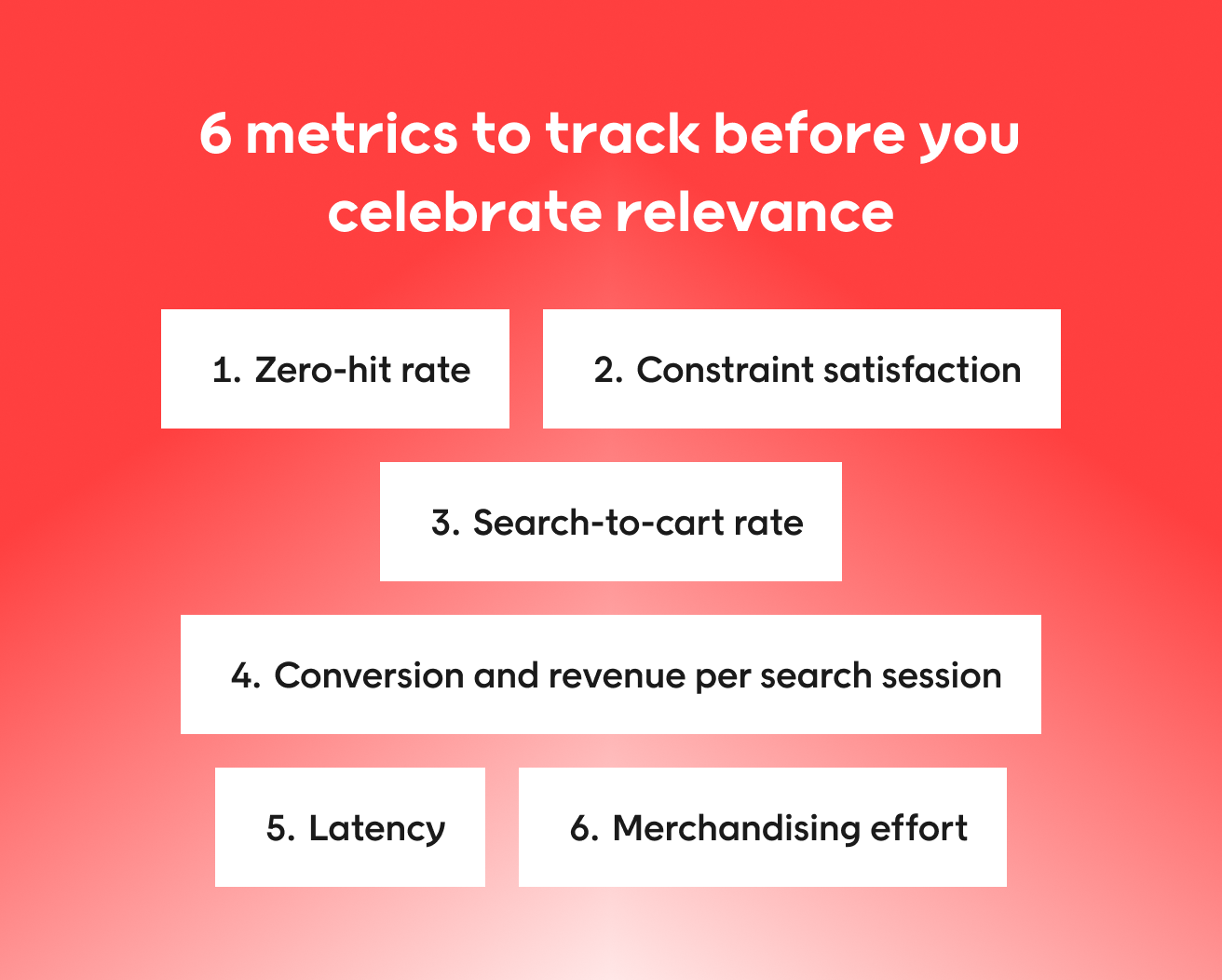
Track 6 metrics before you celebrate relevance
Clicks alone don’t prove relevance. A shopper can click three products and still buy nothing. Filter for full-question search sessions, then track these six metrics.
1. Zero-hit rate: are full questions finding anything?
Measure the share of full-question user queries returning no search results. Each one is lost revenue from a shopper who told you exactly what they wanted.
2. Constraint satisfaction: do results respect every constraint?
Audit 50 sample queries by hand, not by clicks. Check whether search results meet every stated constraint: price, material, size, and occasion. Richer product attributes raise this score.
3. Search-to-cart rate: do searches lead to baskets?
Track the share of search sessions that reach add-to-cart. Agentic discovery’s 2x add-to-cart rates work as a directional benchmark, not a guarantee for your store.
4. Conversion and revenue per search session: does search pay?
Compare searchers with non-searchers, and before and after rollout. Voyado customers see an average 15 to 20% conversion uplift, with ranking tuned to margin, inventory, and availability.
5. Latency: is the page fast enough?
Treat latency as a guardrail. Accurate results lose value on a slow page.
6. Merchandising effort: is manual tuning shrinking?
Log manual tuning hours on synonym lists and rewritten rules after rollout. They should fall over time, not grow.
Use query clusters and A/B tests to find what to fix first
- Cluster long-tail questions by user intent, such as occasion, gift, and season.
- Rank clusters by exit rate and low conversion, in this order: top queries, zero-result queries, then high-exit pages.
- Run one controlled A/B test per cluster.
Start with the winter wedding cluster. If it’s leaking, you’ve found your first test.
What UK and EU retailers should check before rollout
Natural language search fixes the winter wedding dead end only when local language, consent, and catalog groundwork are ready.
Localization is more than translation
Machine translation of a query isn’t enough when vocabulary, assortment, currency, and season differ. “Under £100” in the UK and “under €100” in Germany or France mean different assortments.
A winter wedding outfit means velvet in Edinburgh and a light jacket over a midi dress in Seville. Add a check of how shoppers phrase things in their native language, such as “jumper” versus “pullover,” to your pre-rollout list.
Consent and GDPR change how you use customer context
Interpreting a query in the moment doesn’t need an identifiable profile. Identifiable personalization does, and under GDPR and UK GDPR it needs a lawful basis, such as consent. Check your readiness:
- Consent capture at signup and checkout
- Data minimization in search logs
- Retention limits for query data
- Safe handling of sensitive free text, like skin conditions
This is readiness guidance, not legal advice.
How to add natural language search to Shopify and other storefronts
If you’re asking how to add natural language search to Shopify or another storefront, start with readiness. Check product attributes, inventory feeds, storefront integration, localization, and testing. Facets let shoppers refine in place, and the sale stays on your own storefront.
Catalog: is there enough attribute data to match intent?
Does your catalog go beyond brand, color, and size to occasion, fit, fabric, material, or room type? Natural language support can’t invent meaning from thin data. Audit attribute coverage first, then fill gaps with attribute enrichment.
Inventory: do stock feeds reach search fast enough?
Stock feeds and storefront integration must update in real time so sold-out products stay off the page. Stale feeds cost trust and sales. Confirm local store stock and market availability flow into search.
Markets: does the same question work everywhere?
Stress test one intent, like a winter wedding outfit, in every UK and EU market, because strong English results don’t prove search can understand user intent in every language. Review zero-result and low-converting queries per market and validate with A/B tests.
Final thoughts
Natural language search works when discovery respects user intent. Smarter parsing alone won’t fix full-question searches. Intent, availability, and business priorities do.
Keep three takeaways close: build the loop from intent to product, rank on real-time stock and margin, and let analytics show what to fix first. H&M’s 50% zero-hit reduction came from exactly that kind of richer signal.
Your next step is to pull your top full-question queries and log what they return, or start with a free product discovery audit.
FAQs
What is a natural language search?
A natural language search is a query typed the way people talk, and the technology behind it reads intent instead of relying solely on literal terms. Shoppers type “outfit for a wedding,” not “dress.” Because semantic search matches intent, they find relevant results faster.
Can you explain NLP in a simple way?
Natural language processing (NLP) is the branch of computer science and artificial intelligence that interprets everyday human language. Its real-world applications range from virtual assistants and machine translation to site search, where it reads “winter wedding” as a season (winter), a formality level (dressy), and an occasion (wedding). Without retail context, natural language search returns matched words instead of the right products.
How can we tell from our search data whether shoppers asking full questions get poor results and leave without buying?
Filter your data for full-question queries (the natural language search segment) and check four metrics in priority order. Start with zero-hit rate, then high-exit search pages, search-to-cart rate, and revenue per search session. Each zero-hit query is a revenue leak, and H&M cut zero-hit search by 50% after adding richer signals into search and ranking.
When shoppers search for things like 'what should I wear to a winter wedding,' can better synonyms fix the results, or do we need natural language search?
Better synonyms fix wording, but they can’t combine occasion, season, formality, availability, and budget into one intent. Natural language search does that job. Real-time indexing keeps out-of-stock items out, and because AI is only as good as its context, Voyado grounds it in retail.
Can natural language search match products to occasions if our catalog only has basic details like brand, color, and size?
Natural language search can match products to occasions with basic catalog data, but thin data limits how reliably it does. Guided facets for occasion, fit, fabric, skin type, and room type help most. Product AI knowledge-graph enrichment fills attribute gaps, so your team doesn’t tag every item by hand.
If natural language search works in English, what should we check before assuming it will understand how shoppers ask questions in our other European markets?
Before assuming natural language search works across multiple languages, check native language vocabulary, assortment, currency (€ and £), seasonality, and consent rules in each market. Machine translation alone doesn’t create local relevance or compliant personalization. Local store stock relevance helps, and merchandisers should take over where local nuance demands it.