
TL;DR
Agentic merchandising automates search, sorting, and product visibility using AI. It reacts to shopper intent, stock, trends, and business priorities in real time, without relying on manual rules.
AI handles the heavy lifting, while your team stays in control of brand, campaigns, and editorial direction. Voyado brings this together by optimizing search, listings, and recommendations with human control built in.
Why merchandising needs a faster, more adaptive approach
Your merchandising team is managing more than ever: larger catalogs, more channels, faster campaigns, and higher expectations across your e-commerce business.
The issue is speed.
Customer behavior shifts quickly, inventory changes constantly, and manual merchandising rules can’t keep up. Even strong merchandising operations fall behind real-time demand, which can lead to lost sales.
Agentic merchandising offers a simpler way forward. Instead of fixed rules, agentic AI uses real-time data and intelligent agents to adjust search, sorting, and product visibility automatically.
Your team still sets the strategy. The agentic merchandising agent handles repetitive tasks and supports day-to-day merchandising decisions.
That’s also how Voyado’s product discovery engine is built. It connects search, recommendations, and merchandising into a single system to drive better business outcomes.
You’re not replacing your merchandising approach. You’re making it faster, with less manual work.
So what is agentic merchandising?
What agentic merchandising actually means
Agentic merchandising uses AI to decide how products appear across search, category pages, and recommendations, based on real-time signals and business goals.
It’s not just about analysis. It’s about action. The system observes what’s happening, makes merchandising decisions, and adjusts product visibility automatically.
This builds on what online merchandising is and moves it closer to how agentic AI in retail works in practice, making real-time decisions across commerce.
From manual rules to adaptive optimization
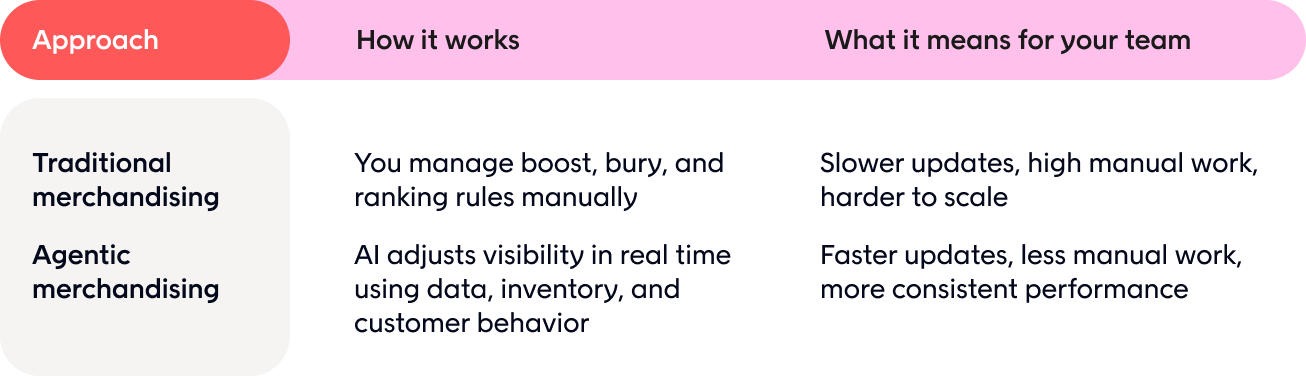
With agentic AI merchandising, your team spends less time maintaining rules while search, listings, and recommendations stay aligned.
What makes merchandising “agentic”
Observe: Tracks shopper signals, product data, and real-time behavior
Decide: Prioritizes what matters based on business goals
Act: Adjusts rankings, sorting, and product visibility
Learn: Improves over time using performance and outcomes
This observe-and-decide act loop is what defines agentic systems, similar to how agentic AI in CX and modern e-commerce AI agents operate.
Why this is different from classic automation
- Fixed rules vs. adaptive decisions based on real-time data
- Manual updates vs. systems that adjust automatically within set parameters
- Limited scenarios vs. context-aware responses to customer interactions and market dynamics
Agentic merchandising gives you automation that can operate autonomously while still allowing human oversight where it matters.
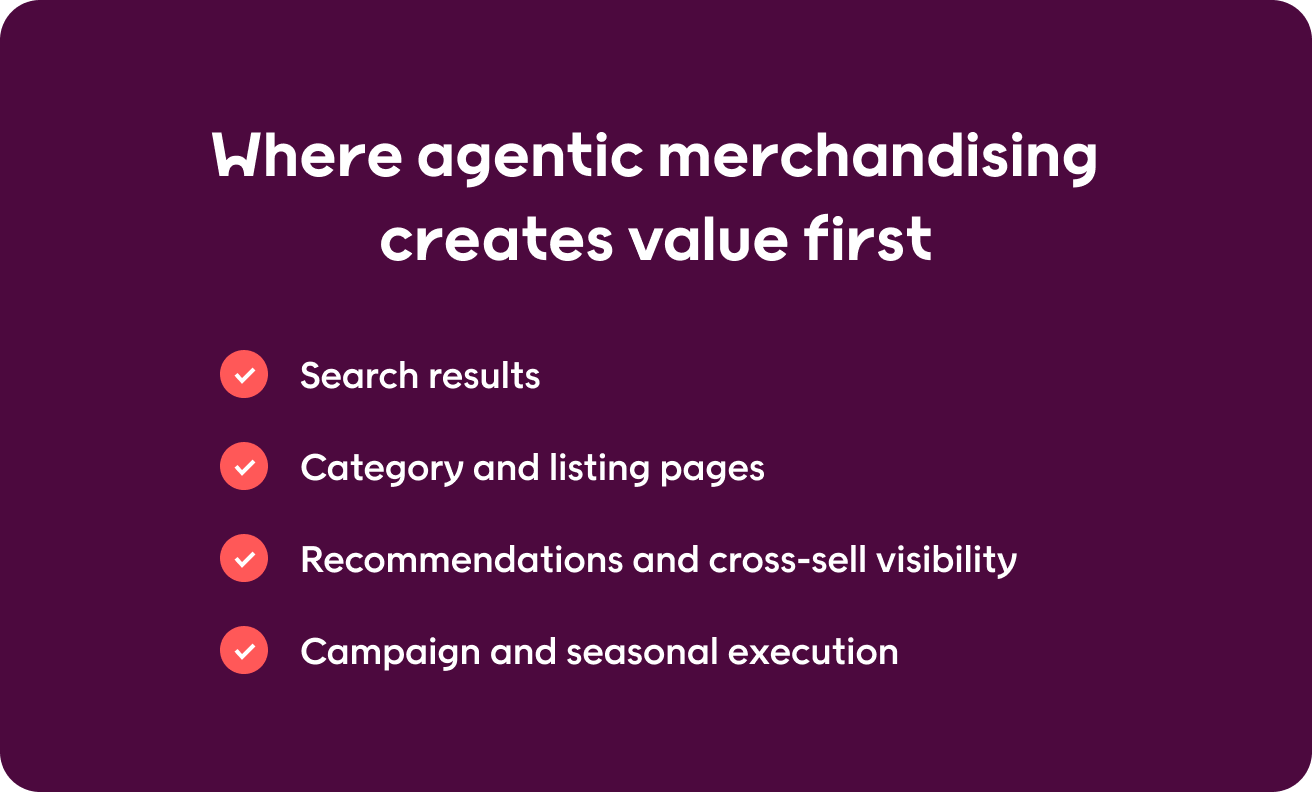
Where agentic merchandising creates value first
Agentic merchandising works best where speed and visibility matter most. These are the areas where small improvements in merchandising decisions can drive measurable gains in sales, customer experiences, and overall performance across your e-commerce business.
Search results
Search is where intent is clearest. Shoppers tell you exactly what they want through queries and customer interactions.
Agentic merchandising:
- adjusts rankings based on real-time data, customer behavior, and inventory
- uses predictive algorithms to respond to customer questions and intent
- prioritizes products based on pricing and inventory, not just static rules
- supports promotion optimization and targeted discounts in search results
Instead of reacting late, your system responds instantly to what shoppers are doing right now.
Many of the best AI agents in retail already operate in this way, using intelligent agents to improve relevance and reduce lost sales.
Search becomes a high-impact entry point for agentic commerce.
Category and listing pages
Category pages shape how shoppers browse, compare, and discover products across your store.
Agentic merchandising:
- continuously updates sorting based on market dynamics, consumer behavior, and performance
- surfaces products aligned with promotional strategies and business priorities
- adapts to external factors like stock levels and demand shifts
- helps merchandising teams maintain optimal stock levels and sell through
Instead of fixed sorting rules, listings evolve with how customers actually shop.
This is where strong online merchandising strategies become easier to execute without adding operational complexity.
Recommendations and cross-sell visibility
Recommendations connect discovery across your entire business, not just one page.
With agentic merchandising, you can:
- align recommendations with merchandising decisions and campaign goals
- use historical data and real-time data to improve relevance
- support pricing decisions and promotion alignment across touchpoints
- increase sales velocity by connecting products across the merchandising life cycle
Instead of working in silos, recommendations become part of a unified agentic workflow.
This is also where agentic AI for marketing plays a role, connecting merchandising with broader promotional execution.
Campaign and seasonal execution
Campaigns are where speed and control matter most, especially during peak retail moments.
Agentic merchandising can:
- reduce manual work by automating repetitive tasks in campaign setup
- adjust visibility as performance changes, without constant human intervention
- help scale campaigns across markets with consistent merchandising logic
- support merchandising operations with AI assistants that can operate autonomously
Your team focuses on storytelling and brand, while AI handles execution.
Tools like editorial merchandising come into their own here, giving you control over how campaigns are presented, while agentic systems handle the heavy lifting behind the scenes.
Each of these areas builds on the same idea: faster decisions, better visibility, and less manual effort.
Now let’s look at what kind of signals an agentic merchandising system actually uses to make those decisions.
What signals an agentic merchandising system use
Agentic merchandising works by combining different types of data and turning them into real merchandising decisions. Instead of static rules, agentic systems continuously adjust product visibility based on what’s happening across your business.
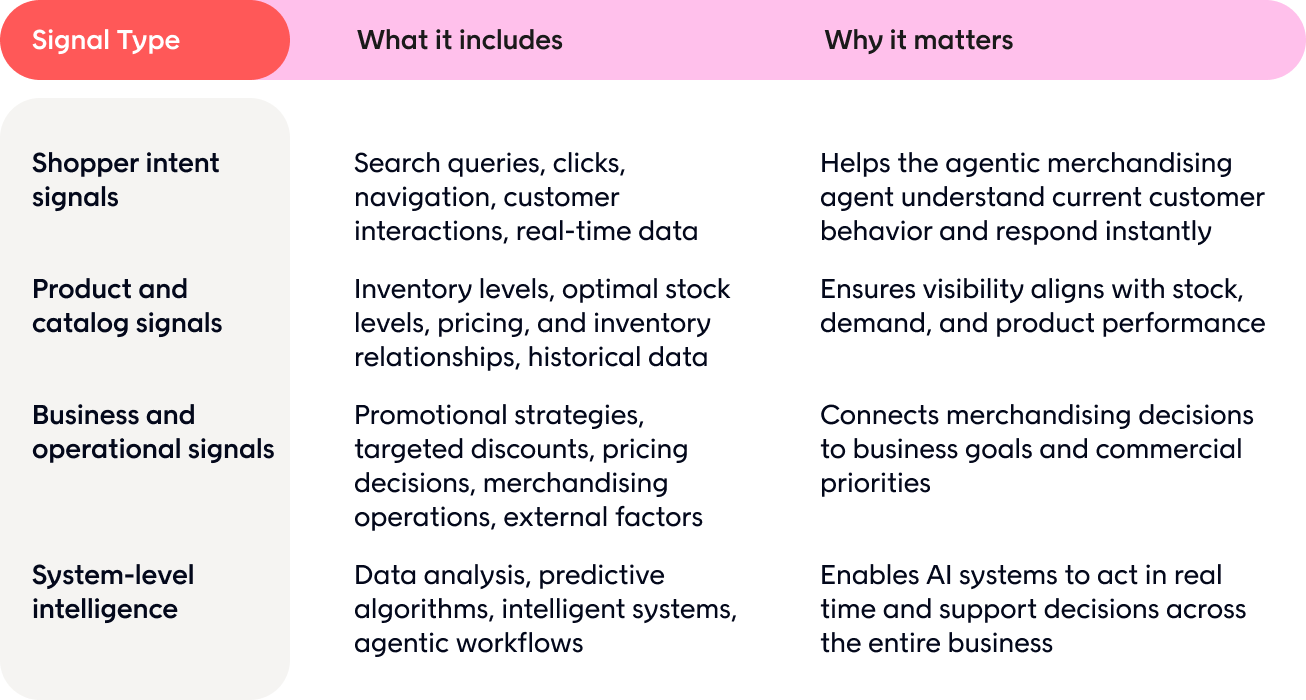
This is what allows an AI merchandising agent to move beyond rules and operate as part of a broader agentic merchandising operations platform.
Now, you’re not just reacting to data but instead using it to drive better outcomes with less effort.
So what does this mean for your team day to day?
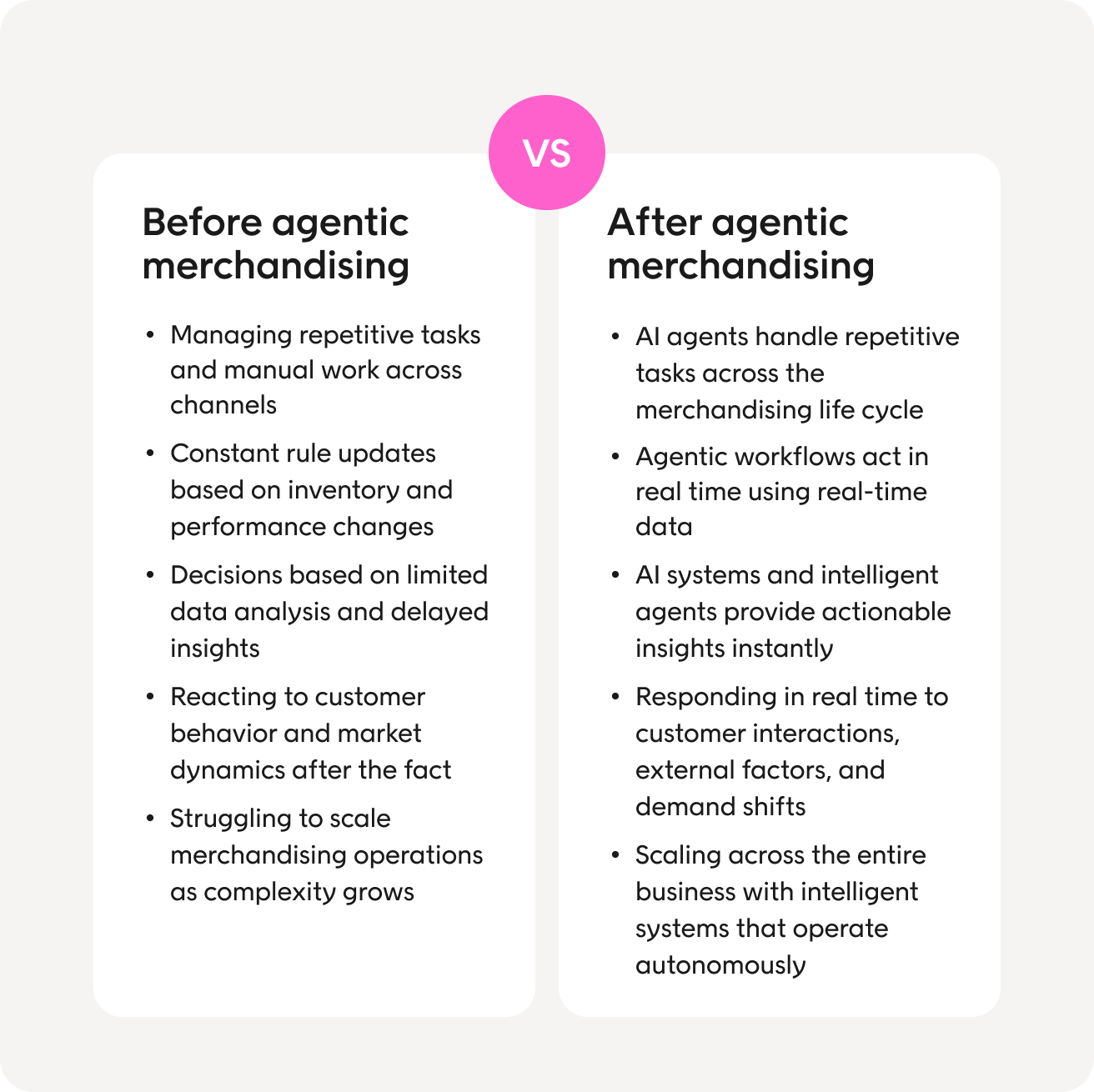
How agentic merchandising changes the merchandiser’s role
Agentic merchandising doesn’t replace your team. It changes how work gets done across your entire business.
Before vs. after: How the role evolves
What your team focuses on instead
Your team shifts toward higher-impact work, setting pricing decisions, shaping promotional strategies and targeted discounts, and guiding retail merchandising priorities and brand direction.
They also define set parameters and guardrails for agentic systems while applying human oversight and human intervention where it matters most.
This shift helps merchandising teams improve performance, increase sales velocity, and reduce lost sales without adding operational complexity.
A step-by-step framework for adopting agentic merchandising
You don’t need to transform everything at once. The goal is to introduce agentic AI in a way that fits your existing setup and delivers measurable gains early.
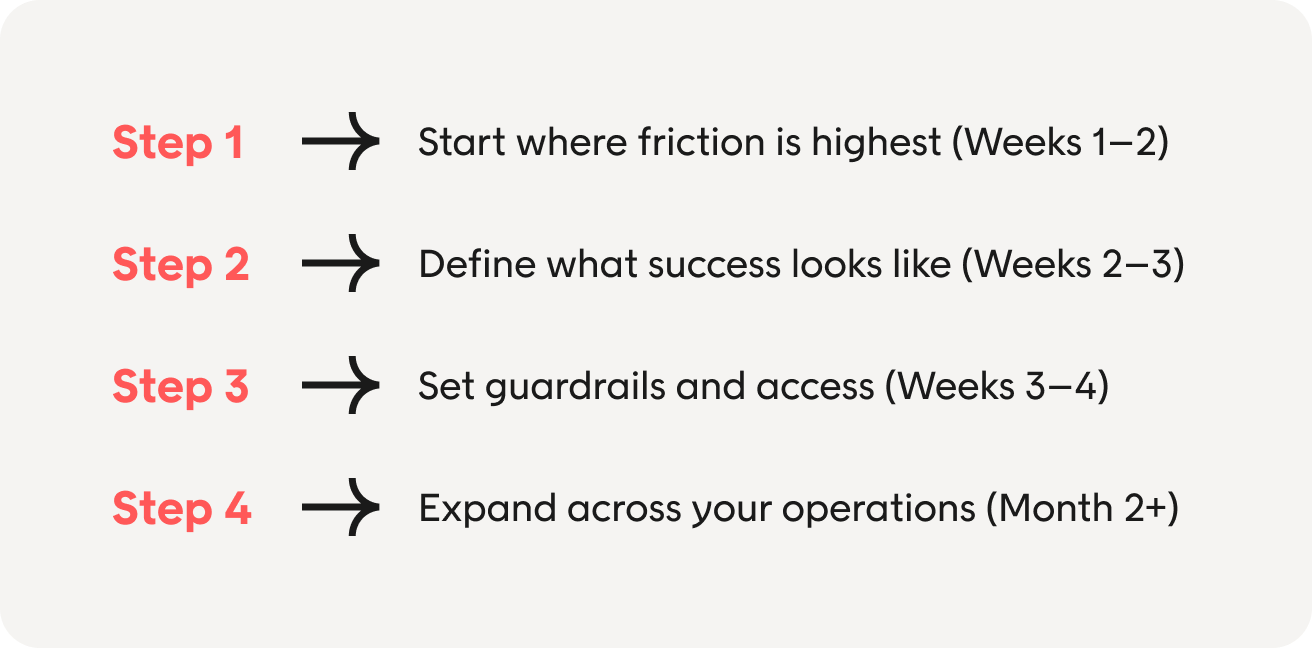
Step 1: Start where friction is highest (Weeks 1–2)
Look for areas where manual work slows your team down or creates risk.
- Search results that don’t reflect real demand
- Category pages that rely on outdated sorting
- Promotions that require constant updates
- Gaps between pricing and inventory that impact visibility
These are often the points where lost sales happen and where agentic systems can deliver quick impact.
Step 2: Define what success looks like (Weeks 2–3)
Agentic systems need clear direction. You set the goals; the system executes.
- Improve sales velocity across key categories
- Increase sell-through for priority products
- Align pricing with visibility and promotions
- Improve consistency in customer experiences
This keeps your approach grounded in business outcomes, not just automation.
Step 3: Set guardrails and access (Weeks 3–4)
This is what keeps control in your hands.
- Define rules for pricing, price changes, and promotional limits
- Set role-based access so teams can manage what matters to them
- Protect sensitive data while still enabling intelligent systems to operate
- Control how AI agents and AI assistants interact with different parts of your setup
This ensures the system can operate autonomously without overstepping.
Step 4: Expand across your operations (Month 2+)
Once you see results, you can scale with confidence.
- Extend into more categories, markets, and channels
- Connect merchandising decisions with supply chain signals like inventory flow and purchase orders
- Use AI-driven systems to support decisions across the entire business
- Introduce new tools that reduce friction and support long-term growth
This is where agentic commerce starts to take shape, not as a single feature, but as a capability across your operations.
It moved from theory into day-to-day execution. Your next step is choosing a setup that can support this without adding complexity.
How Voyado approaches agentic merchandising
Voyado approaches agentic merchandising as part of a unified product discovery system. It’s not a separate tool. It’s how search, listings, and recommendations work together using Agentic AI and AI agents across your e-commerce experience.
Optimization across search, listings, and recommendations
Voyado does not treat merchandising as a standalone ranking layer.
Search, category pages, and recommendations are connected, so product visibility stays consistent across the full journey. When something changes in search, it can immediately influence listings and recommendations without extra work.
This creates a more connected flow where merchandising decisions apply across channels, helping improve customer experiences and overall performance.
Product intelligence built for retail complexity
Retail merchandising is shaped by more than just clicks.
Voyado uses product intelligence to structure decisions using signals like stock levels, product trends, and the product lifecycle. This helps you balance pricing and inventory, support promotions, and respond to changing demand.
Instead of relying on static rules, merchandising decisions are guided by data that reflects how your products are actually performing.
Human editorial control on top of AI automation
Automation works best when your team stays in control.
With Voyado, merchandisers can still:
- Boost, bury, or pin products
- Create curated product sets for campaigns
- Shape editorial placements across channels
- Publish consistently across markets
Agentic AI handles execution, but human oversight stays in place. Your team defines priorities, sets direction, and steps in when needed.
Strong fit for fashion and beauty discovery
This approach becomes especially valuable in fashion and beauty, where product discovery is visual, and context matters more than exact keywords.
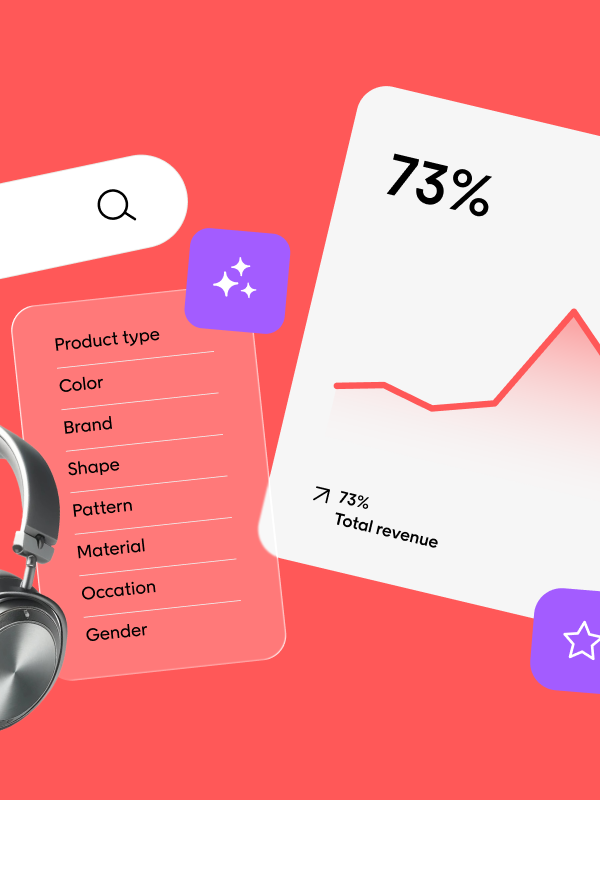
Voyado’s visual intelligence can identify attributes like color, pattern, material, and style directly from product images. This improves how products appear in search and navigation, even when product data is incomplete.
You see this in practice with fashion retailers that rely on strong visual merchandising and curated product presentation. Brands like By Malene Birger, for example, depend on how products look and feel in context, not just how they are labeled.
This is where agentic merchandising makes a difference. It connects visual signals with behavior and context, helping deliver more relevant shopping experiences without relying on manual tagging.
By bringing agentic merchandising into real workflows by combining AI-powered execution with human control, your team can move faster, stay consistent, and keep product discovery aligned across your entire business.
Final thoughts
Agentic merchandising is not about removing merchandisers from the process. It’s about giving your team a faster, smarter way to manage search, sorting, and product visibility in day-to-day reality.
As this becomes the next evolution of retail, forward-thinking retailers are already shifting toward systems that reduce manual work, improve consistency, and support better decisions across the entire experience.
Instead of managing endless rules, your team can focus on strategy, campaigns, and customer experience, while an agentic merchandising assistant helps handle execution, reducing errors and keeping everything aligned in real time.
Voyado is built for this next era. It brings together AI-powered optimization with human control across search, listings, and recommendations, so you can move faster without losing control.
What to do next
- Start with one high-impact area, like search or category pages, and identify where manual work is slowing you down.
- Define clear goals for visibility, sell-through, or campaign performance so your system can support better decisions.
- Set simple guardrails to keep control over pricing, promotions, and brand priorities as you introduce agentic merchandising.
Ready to bring agentic merchandising into product discovery? Explore how Voyado helps retailers stay in control and book a demo.
FAQs
What is agentic merchandising?
Agentic merchandising uses agentic AI and intelligent agents to automate merchandising decisions across search, listings, and recommendations. It helps merchandising teams respond to customer behavior in real time and improve customer experiences across e-commerce.
How is agentic merchandising different from traditional e-commerce merchandising?
Traditional retail merchandising relies on manual work and fixed rules. Agentic systems use real-time data, predictive algorithms, and agentic workflows to act automatically, reducing errors and improving performance without constant updates.
What does an agentic merchandising agent do?
An agentic merchandising agent observes signals, supports decisions, and adjusts product visibility across the merchandising life cycle. It helps handle repetitive tasks, align pricing and inventory, and improve sales velocity across your entire business.
How does agentic merchandising affect search and sort order?
Agentic merchandising updates search and sorting dynamically using customer interactions, market dynamics, and external factors. This improves relevance, supports promotion optimization, and helps reduce lost sales by adapting to real demand.
Can merchandisers still control product visibility with agentic AI?
Yes. Agentic AI operates within set parameters and includes human oversight and human intervention where needed. Merchandising teams still control pricing decisions, targeted discounts, and promotional strategies.
What data does agentic merchandising need?
Agentic merchandising uses data from customer behavior, historical data, pricing and inventory, and supply chain signals like purchase orders. It can also handle sensitive data securely through role-based access while supporting better business outcomes.
How does Voyado support agentic merchandising for retail?
Voyado supports agentic merchandising by connecting search, listings, and recommendations into one AI powered system. It uses agentic AI and intelligent agents to adjust product visibility in real time, while keeping human oversight in place so merchandising teams stay in control of strategy and execution.