TL;DR
Every vendor now says they offer intelligent search (or smart search), AI-powered search, or semantic search, and it all sounds the same. It isn’t. Intelligent search is a stack of layers, from query understanding and retrieval to ranking, business signals, personalization, and merchandiser control, and most vendors are strong in a few of these and thin everywhere else.
This guide breaks down each layer so you can tell which is which, whether you’re an e-commerce manager, a search product manager, or anyone else sizing up vendors for your business. Get this wrong, and you end up paying for “AI-powered” while your shoppers still can’t find what you sell.
Why intelligent search stopped being a useful term
Ten years ago, “intelligent search” meant something specific: smarter than basic search. Now every vendor claims AI search, AI-powered search, semantic search, or smart search, and the words have converged even as the systems behind them have pulled apart.
That’s a real problem when you’re evaluating vendors. Two platforms can make identical claims and still deliver very different search results on your catalog. Neither a feature matrix nor a polished demo will show you the gap.
You can remedy this when you learn the layers, then ask every search tool vendor about each one directly.
The 7 layers that make up intelligent search
Intelligent search (or smart search) is really a pipeline. A query moves through several stages before a shopper sees a result, and each one can make or break the search experience.
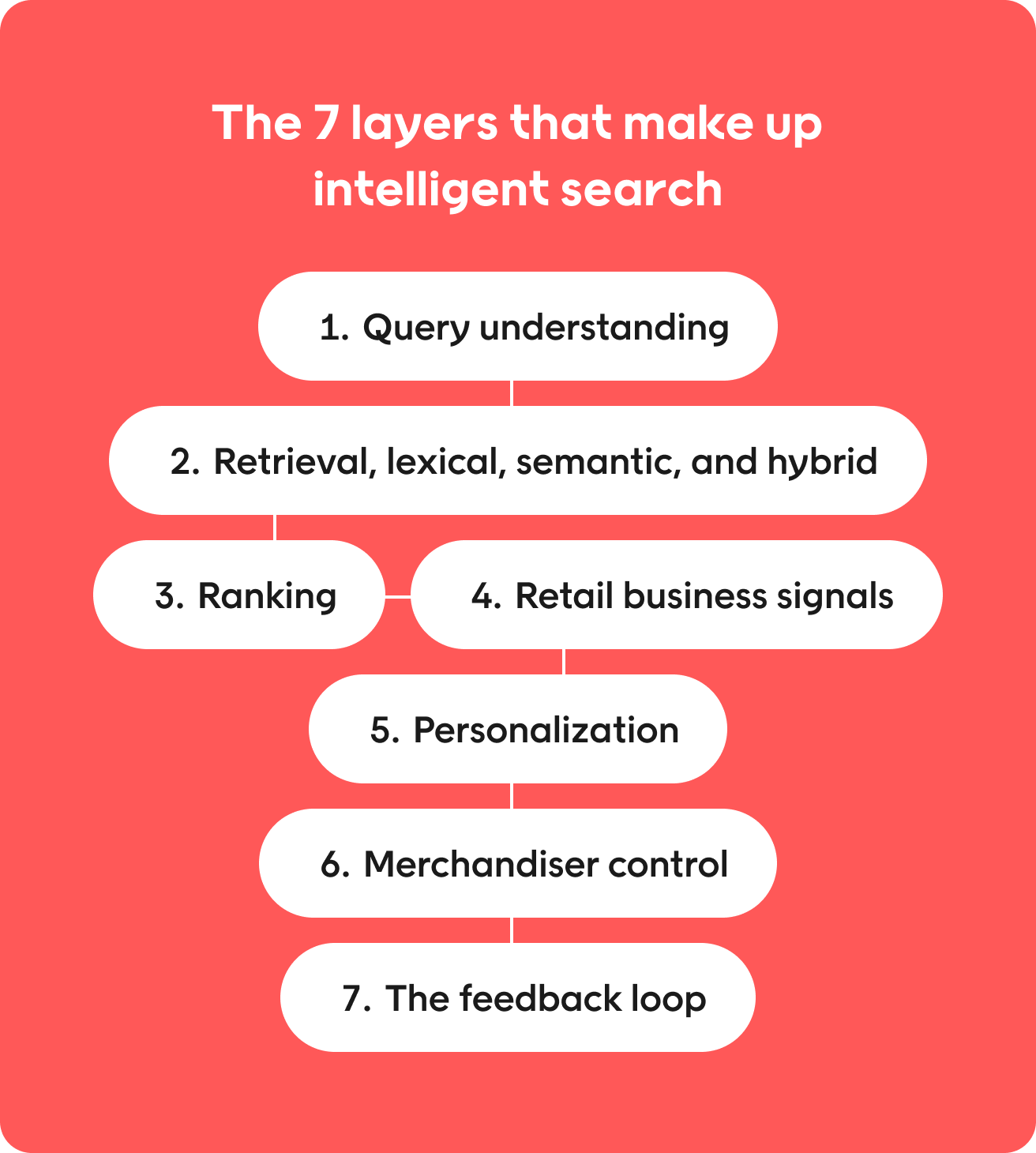
The pipeline:
- Query understanding
- Retrieval
- Ranking
- Business signals
- Personalization
- Merchandiser control
- Feedback loop
Most vendors are strong in two or three of these and thin everywhere else. That’s why “AI-powered search” tells you almost nothing on its own. Here’s what each layer does, where it breaks, and how to test it.
Layer 1: Query understanding
Before anything gets retrieved, AI search engines have to work out what a shopper means.
What it does
Natural language processing helps a search tool understand natural language queries. It corrects spelling, expands synonyms, and pulls out attributes, so “size 10, waterproof, Nike” reads as a size, a feature, and a brand. It also classifies user intent, whether that’s a broad browse, a specific lookup, or one of the complex queries that stacks several constraints together. Many systems now handle conversational queries, and a few accept images, though text still matters most for most catalogues.
Where it breaks down
- Aggressive stemming mangles brand and model names
- Compound words trip up Nordic and German-language markets
- Synonym lists get built once, then abandoned
How to test it
Run misspelled brands, compound words in every language you sell in, and complex user queries against your real catalog, not the vendor’s demo.
Get this layer wrong, and every layer after it inherits the mistake, which is precisely why the importance of site search starts before a single product is ever retrieved.
Layer 2: Retrieval, lexical, semantic, and hybrid
Retrieval pulls candidate products out of your catalog before ranking gets involved. It’s the layer vendors mention most and the easiest to misunderstand.
| Retrieval type | What it does | Best at | Weak point |
| Lexical | Matches query words against your catalogue’s index | SKUs, model numbers, brand names | Fails when a shopper’s words don’t match yours |
| Semantic (often called AI search) | Turns queries and products into vectors using artificial intelligence techniques like natural language understanding and semantic analysis | Descriptive, paraphrased queries like “something warm for a winter commute” | Precision, it happily returns things that are close but not quite right |
| Hybrid | Combines both and reconciles the results | The standard approach in 2026, almost every vendor claims to do it | How well they blend and reconcile the two sets matters more than whether they do it at all |
Semantic search doesn’t replace lexical search. Any vendor implying otherwise is overselling.
Some platforms now add retrieval-augmented generation on top, with generative AI answering follow-up questions using your live product data. It’s useful, but it sits on top of retrieval. It doesn’t replace the need to get retrieval right first.
How to test it
Search a specific model number and a vague, descriptive phrase in the same session, and compare the search results. Weak systems are visibly good at one and poor at the other.
Layer 3: Ranking, where most of the value actually lives
Retrieval decides which products are candidates. Ranking decides which ones a shopper actually sees, and that’s where almost all perceived search quality comes from. It’s also the layer vendors talk about least.
What feeds it
- Textual relevance score
- Behavioral signals: clicks, searches, purchases, cart adds, favourites
- Product performance
- Business signals layered on top
Learning to rank means the machine learning model trains on what shoppers actually engaged with, not a fixed formula a developer wrote once. Done well, shoppers spend less time sifting through irrelevant results and more time looking at relevant results, which lifts customer satisfaction.
It matters commercially too. Shoppers who use site search convert at roughly double the rate of those who don’t, and the same behavioral signals feed product recommendations elsewhere on your site.
Where it breaks down
- Ranking driven only by popularity buries new products and entrenches bestsellers
- Ranking that ignores stock frustrates shoppers with items they can’t buy
- Ranking nobody can inspect means nobody can explain why a product placed where it did
How to test it
Ask the vendor to explain why a specific product ranked where it did for a specific query. If nobody can give an accurate answer, your team won’t be able to either after go-live.
Layer 4: Retail business signals
Unlike traditional search engines, which treat your catalog as a collection of documents, the best result for a retail query looks different. It has to be relevant, in stock, at the right lifecycle stage, and commercially sensible to surface.
Signals that matter
- Stock levels and availability
- Price and margin
- Product newness and trending behaviour
- Lifecycle stage and seasonality
- Variant-level availability (the coat’s in stock, just not in the shopper’s size)
That variant point is easy to miss on a checklist, but it’s what separates systems built for retail from systems merely adapted to it.
How to test it
Ask what happens to a top-ranked product the moment it goes out of stock in its most common size and how quickly the index reflects the change.
Getting this layer right is what makes site search genuinely useful for retail, not just a generic tool bolted onto a product discovery platform.
Layer 5: Personalization
Personalization adjusts search results for the shopper based on user behavior and history. Connect it to a customer loyalty platform, and it can factor in loyalty tier and CRM context too.
It helps most for returning, identified shoppers and adds little for a first-time visitor running a narrow query. Over-personalize, and you trap shoppers in a filter bubble of what they’ve already seen.
The real question
What data can this layer actually reach? Session behavior only, or purchase history and cross-channel engagement too? That depends on whether search is connected to your customer data or sitting off on its own.
Search built around personalized product discovery needs that connection to be real, not a checkbox on a slide.
Layer 6: Merchandiser control
The layer buyers underrate during evaluation and complain about it within six months of going live.
Automation without control doesn’t work in retail. Campaigns, launches, brand priorities, and editorial direction all need to shape what surfaces.
Merchandisers need
- Boost, bury, and pin
- Curated product sets
- Page-level merchandising
- Visibility into what the algorithm is doing, with the ability to adjust it
The right model has AI handling routine optimization, while merchandisers keep control of strategy. Not a black box. Not a rules engine that demands constant manual upkeep.
How to test it
Ask a merchandiser, not a developer, to make a change during the demo. If it needs a support ticket, that’s your answer.
This is also where merchandising, agentic merchandising, and what some vendors call searchandising overlap. You have three names for one idea, and a human hand still on the wheel.
Layer 7: The feedback loop
Smart search for your e-commerce should keep getting better with use.
What that requires
- Behavioral signals captured reliably
- Relevance measured continuously
- AI models retrained or adapted as your catalog and shoppers change
Where it breaks down
Systems that learn only from clicks reward whatever’s already visible, entrenching the same bestsellers forever. Just as common are systems where nothing changes unless a human tunes them.
No-results handling belongs here too. A query with no exact match should be captured, not dead-ended. Every zero-result search is a lost sale and free intelligence about what shoppers actually want.
The unglamorous layer: infrastructure
Short, but it decides whether any of your search features matter in practice.
What to check
- Latency: lag loses shoppers, no matter how relevant the search results are
- Index freshness: how fast a price or stock change shows up
- Catalogue scale: some retail catalogues involve massive datasets, hundreds of thousands of products
- Multi-market and multi-language support
Sub-100-millisecond response is the expectation for large catalogs. Voyado Elevate returns results within 60 milliseconds, with stock and pricing updates delivered through APIs, so the index stays close to real time.
Map a vendor to these seven layers, and you’ve stopped comparing feature lists. You’re comparing whether they’ve solved retail search or just search.
What vendors say versus what to ask
Every vendor deck leans on the same handful of phrases. Here’s what to ask instead of nodding along.
| The claim | What to ask instead |
| “AI-powered search” | Which layer is the AI actually in, query understanding, retrieval, or ranking? Show me. |
| “Semantic search” | Is it hybrid? How do you reconcile semantic and lexical results when they disagree? |
| “Understands intent” | Run these five real queries from our search logs against our catalogue. |
| “Self-learning” | What signals does it learn from, how often does it update, and what stops it from entrenching today’s bestsellers? |
| “Fully automated merchandising” | Show a merchandiser making a change; no developer required. |
| “Enterprise scale” | What’s p95 latency at our catalogue size, and how fast does a stock change hit the index? |
| “Personalized results” | Which data sources does personalization actually reach: session only, or purchase and loyalty history too? |
| “Retail-ready” | How does ranking handle margin, lifecycle, and variant-level stock? |
Print this out and bring it to the next demo.
How to evaluate intelligent search properly
Here are four things you should check for and work through before you sign anything. Applies whether you’re evaluating search alone or a full e-commerce product discovery platform.
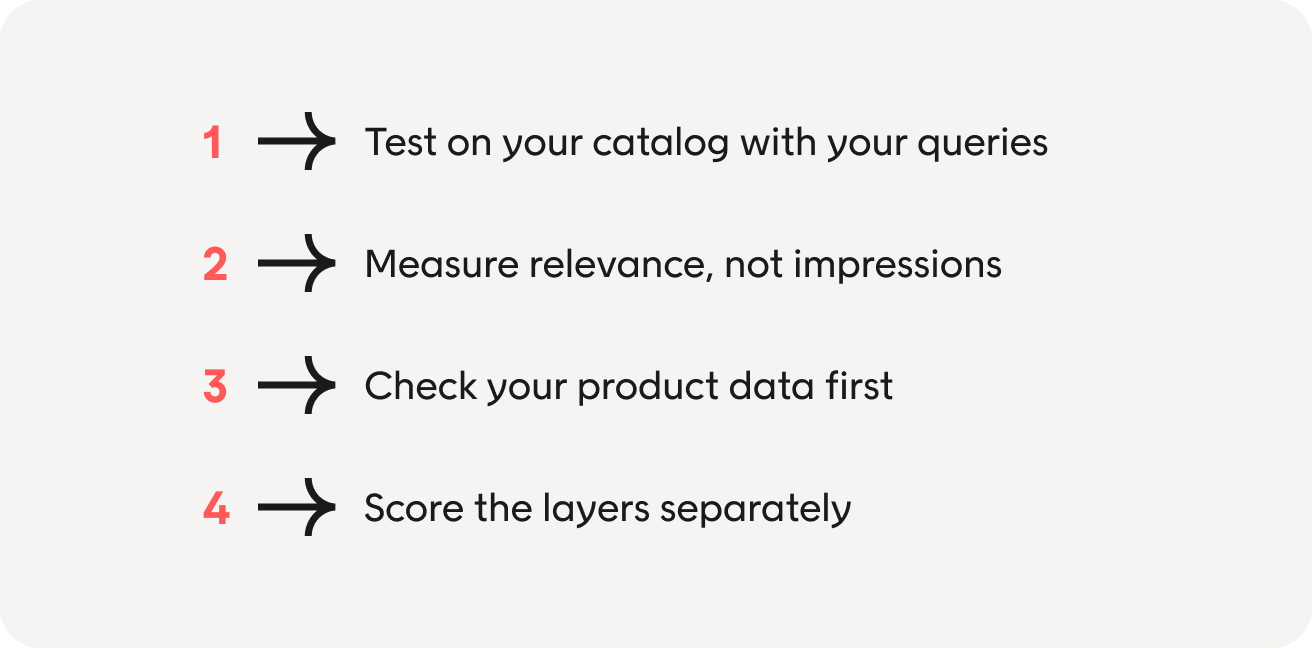
1. Test on your catalog with your queries
Pull two lists from your own search logs.
- Your top 100 queries
- Your top 50 zero-result queries
Those two lists are the real test, not a vendor’s demo. Their catalogue is clean, small, and tuned. Yours isn’t. Type them into the search bar yourself and see what actually comes back.
2. Measure relevance, not impressions
Vanity metrics won’t tell you if AI-powered site search is actually working. Track what reflects real customer experience.
- Search exit rate
- Zero-result rate
- Search-to-click
- Search-to-conversion
- Revenue per search
Establish your baseline before you evaluate anything. Without one, you have no way to prove increased revenue once you switch.
3. Check your product data first
It’s blunt, but true. No AI-powered search engine can rank on attributes your catalog doesn’t contain. Check that these are complete and consistent:
- Material
- Fit
- Dimensions
- Use case
If any are missing or inconsistent, that’s a product data problem, not a search vendor problem. Fix it first, or even the best migration will disappoint.
4. Score the layers separately
Score each vendor on the seven layers, not on one overall impression.
- Weight layers by what your catalogue and shoppers actually need
- A fashion retailer with heavy variant complexity should weight business signals differently than an electronics retailer built around precise model-number queries
As agentic AI in retail becomes the norm, that’s your advantage over anyone hoping you’ll just take their word for it.
How Voyado Elevate approaches intelligent search
Here’s what the seven layers look like when they’re actually built for retail.
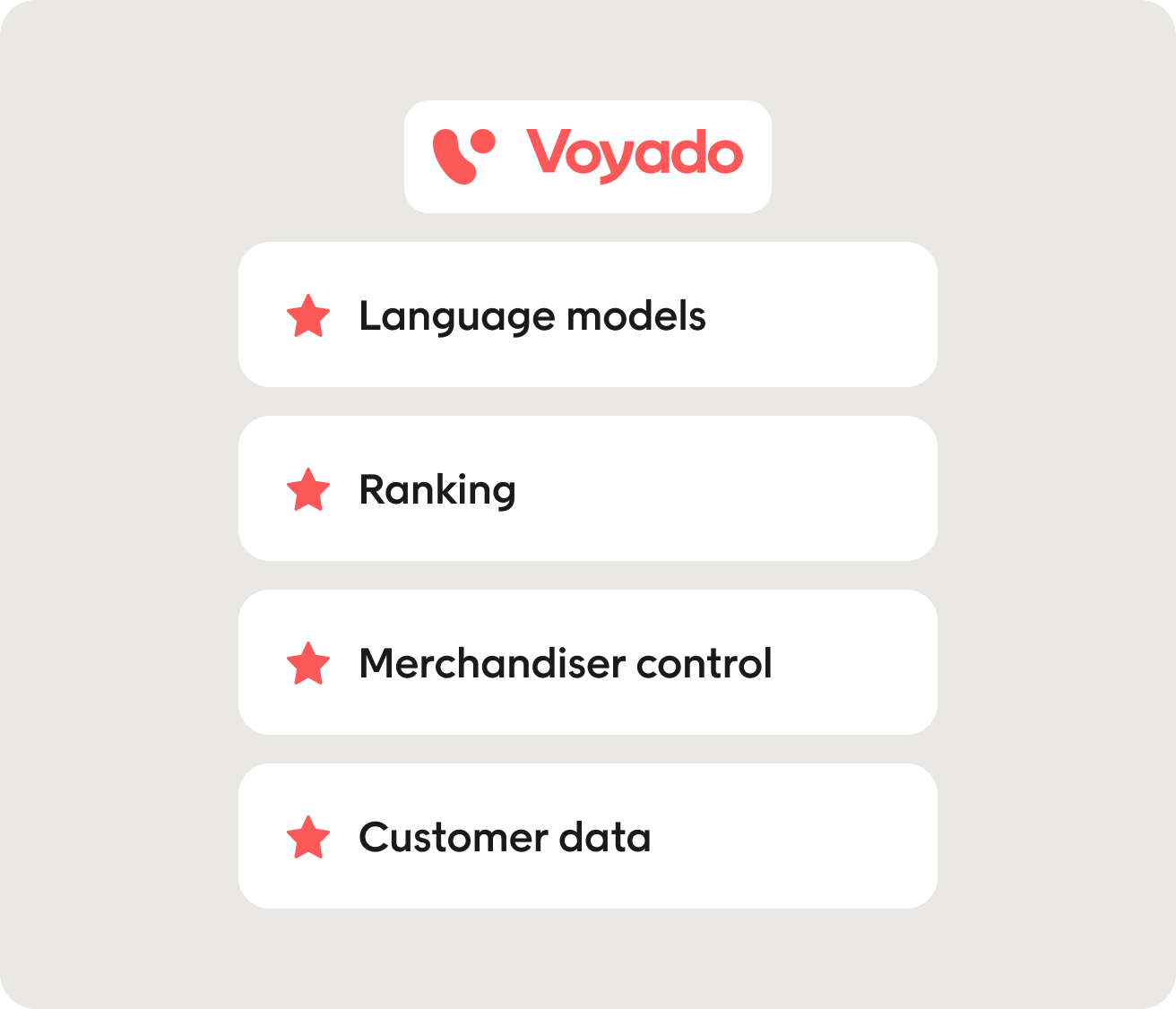
Language models combined with retail-specific knowledge
Elevate combines advanced language models with retail-specific knowledge, so it reads a query the way a good store assistant would, not just a list of keyword matches. Semantic analysis reads intent, then matches it against enriched product data.
A shopper types something vague and still lands on relevant results because site search understands your catalog, not just language. Generic AI search for e-commerce understands words. Retail search has to understand pricing, stock, margin, lifecycle, and trends too. Elevate does both.
Ranking driven by retail signals, not popularity alone
Elevate ranks on product lifecycle, not just on what already sells.
Factored in:
- Stock levels
- Product newness
- Trending behaviour
New arrivals and seasonal stock get real visibility instead of hiding behind bestsellers. Your team can push exposure toward profit, conversion, or revenue, whatever the month calls for, and see exactly why a product ranked where it did. Dashboard insights and configurable algorithms replace the black box.
This is Layers 3 and 4, built for retail, ranking that accounts for margin and lifecycle, not just relevance.
Merchandiser control, kept
Editorial merchandising keeps your team in control while AI handles the routine work.
Your team can:
- Boost, bury, and pin products
- Drag and drop page merchandising
- Build product sets and slices
- Run search reports and manage synonyms
- Publish across markets
When a campaign launches, a merchandiser makes the change directly, no developer, no ticket. That’s merchandising, or what we’ve called agentic merchandising throughout this guide, AI doing the routine work while people keep the judgement calls.
Built for large catalogs and multiple markets
A product scanner built for large volumes powers Elevate’s site search, returning results within 60 milliseconds, so lag never costs you a shopper. Local language dictionaries cover a wide range of markets, and the engine continues to learn as products, attributes, and trends change.
Connected to customer data, not isolated from it
Elevate shares identification, contact data, and behavioral signals with Voyado Engage, so personalization reaches beyond session behavior into purchase history and loyalty tier.
A returning shopper sees results shaped by what they’ve actually bought, not just what they clicked five minutes ago.
The same intelligence also powers product recommendations and email, creating one consistent experience everywhere. Personalized product discovery only works if that connection is real. This is what makes it real.
If you’re still comparing vendors on claims instead of results, book a demo and bring your own catalog and query logs. Testing on real data is the only way to see the difference these layers actually make.
Final thoughts
Intelligent search is a stack, not a single feature. See the seven layers, and vendor claims get easy to evaluate. You stop asking if a platform has AI and start asking which layer it’s actually in.
For retail, the deciding layer is rarely the language model. It’s whether the system understands stock, margin, lifecycle, and variants, and whether merchandisers can still steer the outcome, the same instinct that makes you trust Google over a clunky search bar.
Test intelligent search on your own catalog and queries, and score the layers separately. The differences show up in minutes once you know where to look, whether you’re comparing search tools, Voyado, or anything else.
FAQs
What is intelligent search in e-commerce?
Intelligent search (or smart search) works out what a shopper means and ranks products accordingly. It combines query understanding, retrieval, ranking, business signals, personalization, merchandiser control, and a feedback loop that keeps improving. It usually works alongside site navigation and filters, not instead of them.
What's the difference between semantic search and keyword search?
Keyword (lexical) search matches words in a query against your catalog, precise for SKUs, model numbers, and brand names. Semantic search matches on meaning using vector representations, better for descriptive queries but less precise. Most strong systems combine both in a hybrid approach.
Is AI-powered site search the same as intelligent search?
Vendors use AI-powered search, AI site search, and intelligent site search interchangeably. In practice, “AI-powered” doesn’t say which AI features work or which layer the AI is actually in, so ask vendors to be specific. See our top e-commerce search solutions roundup to compare platforms.
Which part of a search system has the biggest impact on conversion?
Ranking. Retrieval decides which products are candidates; ranking decides what shoppers actually see. For retail, ranking that factors in stock, margin, and lifecycle usually beats upgrading retrieval alone for accurate, relevant results.
How do I test whether a search vendor's claims are real?
Test with your own top 100 queries and top 50 zero-result queries, not the vendor’s demo data. Search for a model number and a vague phrase in the same session, ask why a product ranked where it did, and ask a merchandiser to make a change unaided. If they can’t answer, their AI-powered search engine claims aren’t worth much.
Do I need to fix my product data before upgrading search?
Typically, yes. No search engine can rank on structured data your catalog doesn’t contain. Missing or inconsistent material, fit, or dimensions is a product data problem, and it’ll cap any new platform’s results.
How is Voyado Elevate different from generic AI search tools?
Elevate combines advanced language models with retail-specific knowledge, ranking on stock, newness, and trending, with exposure adjustable toward profit, conversion, or revenue. Merchandisers keep boost, bury, pin, and editorial control throughout. Generic search tools, even the best AI search engines, understand language. Elevate understands products.