
TL;DR
The biggest difference between AI-powered site search platforms for retail is how much of the ranking the AI handles. On some platforms, you set a goal such as profit, and the AI ranks products toward it using sales and stock data. On others, merchandisers write a rule for each boost, which can leave sold-out or low-margin products at the top until someone updates it.
To build a shortlist, ask each vendor how margin and stock get into the ranking, and how much setup a new market or language needs.
Traditional retail site search relies heavily on static, exact-match keywords that can lead to inaccurate results and use up valuable resources to maintain. When shoppers can’t easily find what they’re looking for, they abandon your site and take any potential revenue with them.
AI-powered site search aims to solve this by getting every shopper to a product they want to buy, and by taking the upkeep off your team. The more capable platforms go a step further and rank those products around your commercial goals. This guide gives you a framework for evaluating AI search platforms and compares 15 popular tools so you can find the right fit for your business.
What is AI-powered site search for retail?
AI-powered site search helps shoppers find the right products by understanding what they’re trying to buy, then automatically deciding which products to show first.
Unlike traditional search, which simply matches words in a search query to product names or descriptions, AI search uses natural language processing. Shoppers can use conversational language, such as “date night dress,” and still get relevant results.
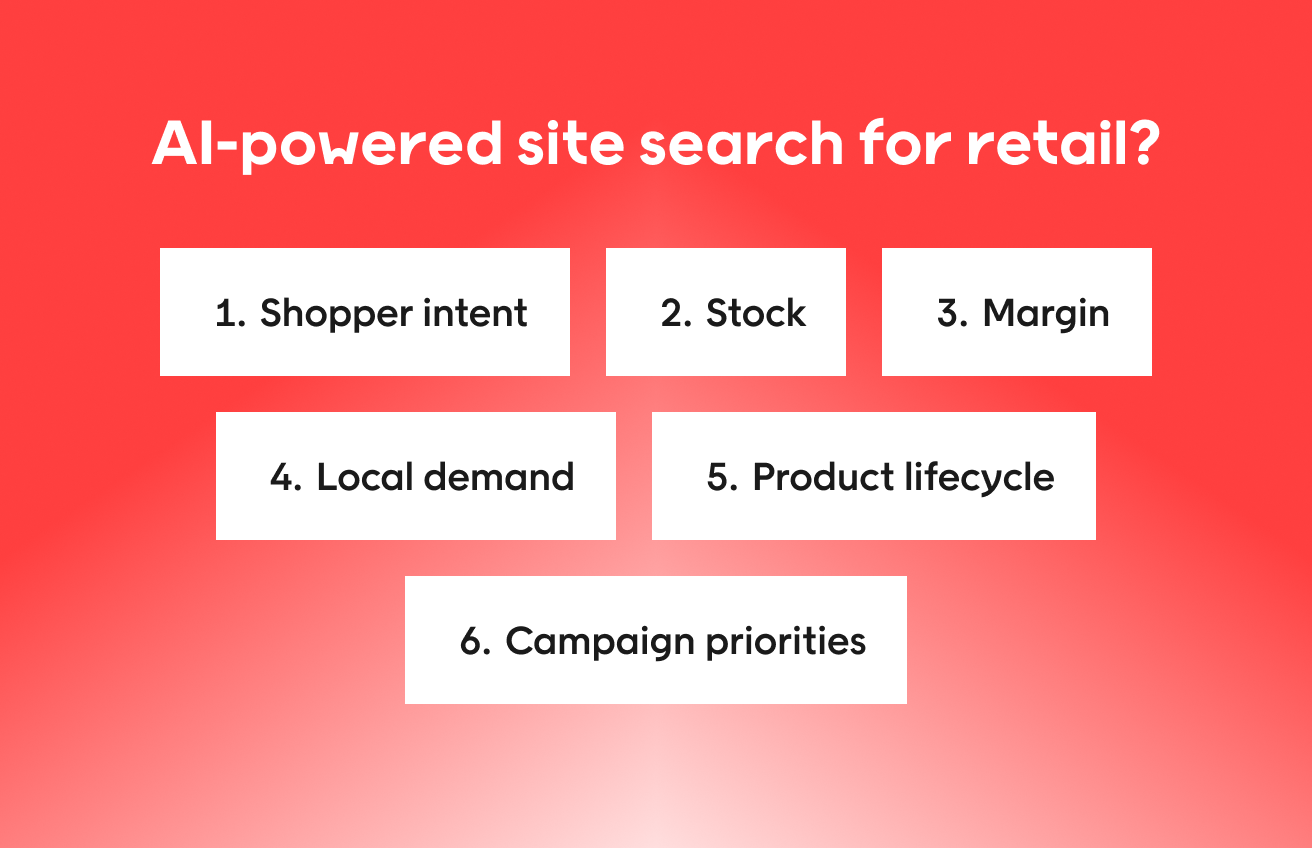
AI search engines also take other factors into account to find the right items. These factors might include:
- Shopper intent. What the shopper is looking for and how specific their request is
- Stock. Which products are available
- Margin. Which products make more financial sense for the retailer to sell
- Local demand. What shoppers in a particular area are buying
- Product lifecycle. Whether a product is new, being promoted, or being phased out
- Campaign priorities. Which products the retailer wants to feature
In some AI search engines, a merchandiser still has to tell the engine how to use these factors. For example, a rule might say “bury out-of-stock items,” and it will need to be rewritten whenever stock changes.
Agentic merchandising hands that job to the AI. You set a commercial goal, such as profit or conversion, and the agentic AI continuously reranks products toward that goal. Merchandisers step in only for the exceptions, like pinning a campaign product to the top of a results page.
Why traditional site search fails retailers
Traditional search engines cause problems in e-commerce because they rely on matching keywords rather than understanding user intent.
Shoppers often use different words from the ones in your product data. Someone might search for “trainers” when your catalog says “sneakers,” or describe what they need, such as “waterproof lightweight jacket.”
A keyword engine looks for those exact words in product titles and descriptions. If it doesn’t find them, it returns no results, even when you stock a suitable product. Customers expect a fast, intuitive search experience, so this can impact customer satisfaction.
Basic search also creates operational problems. Manually managing things like synonyms and redirect rules takes longer with every product and market you add. Each synonym or redirect fixes one search term, so merchandisers have to find the searches that fail and correct them one at a time.
AI-powered site search can reduce this work by interpreting the intent behind a query and matching it to relevant products, even when shoppers use different words from your catalog. Some platforms now even add AI shopping assistants, which let shoppers describe what they need in a conversation instead of typing a search.
How to evaluate AI site search for retail
AI site search platforms can sound similar when you compare their broad features. To evaluate them properly, you need to consider how they specifically handle ranking and what your team can control. Keep these questions in mind as you go through sales calls or demos.
1. Does it understand how your products are structured?
Choose a platform that treats each size and color of a product as something a shopper can search for. If a dress comes in five colors and the engine only reads the main listing, which shows the blue one, a search for “red dress” can miss it or show it with the blue photo.
The same goes for products that depend on each other, like a charger that only fits certain laptops. Ask the vendor to demo searches like these using your own product data.
2. Does it work across your markets?
Each market needs its own ranking, based on what’s in stock and selling there. With one ranking for every country, your Swedish best seller might get the top position in Germany even when the German warehouse has none.
Ask how a new market is added and what it shares with the others. On some platforms, every language is a separate setup, so each rule has to be written again for each one.
3. How do margin and stock reach the ranking?
On some platforms, the AI handles margin and stock itself, either by ranking toward a goal you pick, such as profit, or by using margin data you supply. On others, a merchandiser sets each boost manually.
The less your team has to write rules for this, the longer the ranking stays right. A rule that boosts a high-margin product may keep boosting it after it sells out if no one on the team notices. Ask which applies and what data you’d need to provide, plus whether the platform updates stock through real-time indexing or on a schedule.
4. What can merchandisers do without a developer?
Choose a platform that lets merchandisers adjust search results themselves, without asking a developer. If every change needs a developer, a product you want at the top of search results for a sale may not be there when the sale starts.
Merchandisers also need to preview a change before it goes live, so a mistake doesn’t reach shoppers. Ask whether you can preview changes and schedule them to start with a campaign.
5. How does it connect to your other systems?
The ranking is only as current as the stock and margin data the platform receives. If stock updates arrive hours late, shoppers find products they can’t buy.
Ask how often stock updates come in from your order management system (OMS) and where margin data will come from.
E-commerce site search software comparison table
| Platform | Best for | What the AI does | What merchandisers control | Multi-market support |
| Voyado | Retailers selling in several markets | Ranks toward a goal you set, such as profit | Set the goal, then override by hand | 31 languages, goal and rules set per market |
| Constructor | Large retailers with big catalogs | Ranks toward a goal you set, such as profit | Set the goal, then override by hand | 34 languages |
| Bloomreach | Large retailers already using Bloomreach for email and SMS | Ranks using margin and stock data you supply | Supply the data, then override by hand | 38 languages, separate setup for each |
| Netcore Unbxd | Retailers with hands-on merchandising teams | Ranks by shopper behavior and stock | Write the rules for margin | 10 languages, rules by region |
| FactFinder | B2B sellers and retailers with complex catalogs | Ranks by shopper behavior | Write the rules for margin and stock | 43 languages, settings shared across them |
| Nosto | Retailers that also want onsite personalization | Ranks by shopper behavior | Write the rules for margin and stock | 27 languages, rules by market |
| Athos Commerce | Mid-sized retailers on Shopify or BigCommerce | Ranks by shopper behavior | Write the rules for margin and stock | 31 languages, rules by region |
| Algolia | Retailers with developers building custom search | Ranks using margin and stock data you supply | Supply the data, then override by hand | Any language |
| Coveo | Large retailers with many brands | Ranks by shopper behavior | Write the rules for margin and stock | 50+ languages and markets in one setup |
| Google AI Commerce Search | Large retailers with engineers on Google Cloud | Ranks toward a revenue goal | Set the goal, then override by hand | One language per catalog |
| Lucidworks | Large retailers that also need internal search | Ranks using factors that include margin | Override the AI by hand | 70+ languages |
| Luigi’s Box | Small and mid-sized retailers | Ranks using margin and stock data you supply | Supply the data, then override by hand | 11 languages |
| Doofinder | Small retailers that want a fast setup | Ranks by shopper behavior | Write the rules for stock | 30+ languages, separate setup for each |
| Clerk.io | Small and mid-sized retailers that also want email | Ranks by shopper behavior | Write the rules for margin and stock | 50+ languages, separate setup for each |
| Relewise | Retailers with custom storefronts | Ranks by shopper behavior | Write the rules for margin and stock | No fixed language list, rules by market |
Ready to shortlist? Book a demo to see Voyado in action with retail-trained AI.
15 best AI site search and product discovery platforms for retail
The profiles below look at each platform’s capabilities in more detail, specifically how they handle ranking, search in different markets, and how much control merchandisers have.
1. Voyado
Voyado is an agentic OS built for retail. It pairs customer loyalty and e-commerce marketing automation with a product discovery engine, which powers site search and AI for product recommendations. It suits retailers selling in several markets who want the ranking to follow a commercial goal without writing a rule for every search.
- Margin and stock ranking: You choose a goal for each market, such as revenue or profit, and Voyado ranks products toward it. Each product’s score is recalculated as new sales and shopper behavior data comes in. The ranking also takes into account stock levels and where a product is in its lifecycle.
- Merchandising controls: Merchandisers can boost or bury products, pin them to top positions, and build product sets for campaign pages. Retailers who also use Voyado’s marketing tools can aim a boost at a specific customer audience.
- Markets and languages: Voyado supports 31 languages. Each market has its own products and its own ranking goal, so the results reflect what shoppers there buy. One market can serve several languages and currencies.
- Product data: Voyado uses large language models to fill in product details, and it analyzes product images for color. A shopper can find a particular shade of green even when the description doesn’t name it.
- Speed: Query response times below 100 milliseconds are essential for user engagement, and Voyado returns results within 60 milliseconds.
H&M moved search and ranking to Voyado and cut searches with no results by 50%.
“As our business grew, we needed a more intelligent approach to search, ranking, and discovery. We found Voyado to be the best fit for us.”
– Lars Gezelius, Acting Global Head of Digital at H&M.
2. Constructor
Constructor is a product discovery software platform built specifically for e-commerce, covering search and category pages for B2C and B2B sellers. It suits large retailers with big catalogs whose e-commerce team works toward one clear KPI.
- Margin and stock ranking: You choose the metric the ranking model optimizes for, with revenue per visitor, average order value, profit and conversions among the options.
- Merchandising controls: Merchandisers can add rules to boost or bury products, or fix a product in a set position.
- Markets and languages: Constructor offers language-specific processing for 34 languages.
3. Bloomreach

Bloomreach offers AI site search for online stores alongside marketing automation features. It suits larger retailers that already use Bloomreach for email and SMS marketing.
- Margin and stock ranking: Ranking Studio lets retailers add margin as a ranking signal, and the model decides how much weight to give it, but it’s only available on the Premium tier.
- Merchandising controls: Merchandisers can build ranking rules in the Discovery dashboard.
- Markets and languages: Bloomreach supports 38 languages, but each language needs its own catalog and product feed.
4. Netcore Unbxd
Netcore Unbxd is a search and merchandising platform for retail that includes visual search. It suits retailers whose merchandisers want direct control over search rules alongside AI ranking.
- Margin and stock ranking: The AI ranking is designed to improve conversions and takes inventory into account. Merchandisers can add rules to boost or demote products by margin.
- Merchandising controls: The visual workbench lets business teams boost, bury, filter, place, and sort products without code. A rule can cover the whole site or a single search.
- Markets and languages: Rules can be targeted by region, and search is covered in 10 languages.
5. FactFinder
FactFinder is a product discovery platform aimed at European B2B sellers and retailers with complex catalogs. It suits companies with large or technical product ranges where shoppers search by product code as often as by name.
- Margin and stock ranking: Merchandisers can rank search and category results using factors such as margin, stock, brand, and season. Out-of-stock products can be pushed down using the availability data in the product feed.
- Merchandising controls: Merchandisers set business rules and run campaigns. For a launch or promotion, they can pin products to specific positions.
- Markets and languages: FactFinder’s search understands 43 languages. Each language version runs as its own channel, and channels can share settings such as ranking rules.
6. Nosto
Nosto is a personalization platform for e-commerce brands that added search alongside its recommendations and content personalization tools. It suits brands that want search and on-site personalization from one vendor.
- Margin and stock ranking: Merchandisers can use rules to give more weight to product attributes such as margin and inventory level. You can apply rules globally or to specific searches.
- Merchandising controls: Merchandisers can preview a rule before it goes live and schedule it for a set period, such as a sale. The same rule can apply to category pages as well as search.
- Markets and languages: Nosto supports 27 languages, and you can adapt rules by market or region.
7. Athos Commerce
Athos Commerce pairs site search with a tool for managing the product data retailers send to marketplaces. It suits mid-sized retailers on platforms such as Shopify and BigCommerce.
- Margin and stock ranking: Merchandisers set boost rules based on stock count and margin.
- Merchandising controls: A visual, no-code interface covers boost rules, pinning, scheduling, and A/B tests. AI recommends promotions, and merchants approve or override them.
- Markets and languages: Athos supports search in 31 languages, and campaigns can be targeted by location.
8. Algolia
Algolia is a search platform used across many industries, with tools for e-commerce search and product recommendations. It suits teams with in-house developers who want to build a custom search experience.
- Margin and stock ranking: Retailers can add signals such as profit margin or excess inventory to search ranking without writing code, but this is only available on higher tiers.
- Merchandising controls: The underlying platform is designed for developers, but Merchandising Studio gives business teams a way to manage campaigns without code.
- Markets and languages: Algolia searches content in any language, with extra language-specific features like plural matching or splitting compound words for 67 of them.
9. Coveo
Coveo is an enterprise site search company covering commerce, customer service, website, and workplace search. It suits enterprises running many brands and markets from one environment.
- Margin and stock ranking: Merchandisers create rules to boost products based on factors such as margin and stock.
- Merchandising controls: Merchandisers can create rules for all searches or for specific ones. Rules can also be scheduled ahead of time and targeted by locale.
- Markets and languages: Coveo supports more than 50 languages and markets.
10. Google AI Commerce Search (formerly Vertex AI Search for Commerce)
AI Commerce Search is Google Cloud’s managed search and recommendations service for e-commerce. It suits large retailers with engineers already working on Google Cloud.
- Margin and stock ranking: Google lets retailers optimize recommendations for goals such as conversion rate or revenue per session.
- Merchandising controls: A Merchandising console lets business users launch promotions and boost or bury results. It can also reroute results when items are out of stock.
- Markets and languages: Each catalog holds one language, and shoppers have to search in that language. A retailer with heavy traffic in a second language will need to set up a second project for it.
11. Lucidworks
Lucidworks is an enterprise search platform covering commerce and knowledge management for B2C and B2B companies. It suits enterprises that want one search platform for both their online store and internal knowledge.
- Margin and stock ranking: The AI ranks products, and Commerce Studio shows which factors shaped each position, with margin and conversion rate among them. Merchandisers can override the AI’s ranking at any point.
- Merchandising controls: Merchandisers arrange products by drag and drop and write rules without code. Changes can be previewed and A/B tested before they go live.
- Markets and languages: Search supports more than 70 languages, with spelling suggestions and word-form matching for most of them.
12. Luigi’s Box
Luigi’s Box is a search and product listing suite for e-commerce. It suits small and mid-sized European shops, especially those selling in central European languages.
- Margin and stock ranking: You can add a numeric margin value to your product feed so higher-margin products receive a stronger ranking signal. Products are also ranked by availability.
- Merchandising controls: Merchandisers can apply a boost to any product and pin or demote products for specific queries.
- Markets and languages: 11 query languages are supported, including Czech, Polish, Hungarian, and Slovak.
13. Doofinder
Doofinder is a plug-in site search tool for e-commerce that also offers category merchandising. It suits smaller shops that want a quick-to-install search solution. Doofinder puts installation at about five minutes.
- Margin and stock ranking: Boosting rules promote products by fields such as availability and brand. On Magento, Doofinder indexes profit margin so rules can prioritize higher-margin products. A separate automatic boost rewards products that have sold well recently.
- Merchandising controls: Boosting is set in the admin panel, and a rule can apply to every search or only to a specific term.
- Markets and languages: Doofinder supports more than 30 languages. Each language gets its own search engine within a store, with its own rules.
14. Clerk.io
Clerk.io is an e-commerce personalization platform that combines search, recommendations, email, and chat tools. It suits small and mid-sized shops that want search and email from one vendor.
- Margin and stock ranking: A merchandising campaign can boost your highest-margin items and push out-of-stock items to the bottom of search results.
- Merchandising controls: A merchandising campaign set up for search can also apply to recommendations and email. It can run on a single store or across the whole account.
- Markets and languages: Clerk.io supports more than 50 languages. Languages need to be set up separately.
15. Relewise
Relewise is a personalization platform for B2C and B2B e-commerce that covers search and recommendations. It suits retailers with custom storefronts and developer teams.
- Margin and stock ranking: Merchandisers can use fixed rules or data-driven rules based on factors such as margin and stock. Results can also change based on product availability.
- Merchandising controls: Boost, bury, filter, and pin rules apply across search results and category pages.
- Markets and languages: Rules can boost or bury products by market or customer type.
Once you’ve chosen an AI search tool for your site, having an implementation plan in place will help you roll it out as smoothly as possible.
How to roll out AI search and measure the results
Rolling out AI in stages helps you spot any quality or operational issues early before they impact your sitewide search results. Here’s how to approach it:
1. Get four kinds of data ready
The quality of your product and stock data affects what the search engine can find and which products it shows. Before launch, check where each type of data comes from and how it reaches the search platform.
- Product attributes: Check that details such as size, color, brand, and compatibility are complete and consistently formatted in your product information management (PIM) system. Missing or inconsistent attributes can cause products to disappear from filtered results.
- Stock levels: Confirm how often inventory updates from your OMS. Delayed updates can leave sold-out products in search results.
- Margin figures: Find out where margin data is stored, often in your enterprise resource planning (ERP) or finance system, and how it will reach the search platform if you want to use margin in product ranking.
- Shopper behavior: Make sure the platform can track searches and purchases. These events help you measure search performance and, where supported, inform how results are ranked.
2. Start with a pilot
Record your baseline for search conversion rate, no-results rate, average order value, and merchandising hours before the pilot starts. Then test the new search on one market or product category before switching the whole site. Choose an area with enough search traffic to measure results and a mix of products that will test the platform’s capabilities.
Run the old and new search side by side so you can compare performance over the same period. Fix problems with product data or ranking before expanding the rollout.
3. Test for four common problems before launch
Run these checks during the pilot and fix any issues before expanding to other categories or markets.
- Synonyms: Test common alternatives to your product names, including terms from your existing synonym list. A search for “trainers,” for example, should find relevant products listed as “sneakers.”
- Searches in other languages: Test each language you sell in, including cases where shoppers use an English product name in a search written in another language.
- Attribute mapping: Check that product attributes connect to the right filters and use consistent values. If one system labels a color “navy” and another calls it “dark blue,” the platform may treat them as separate options.
- Stock updates: Change a product’s availability and measure how long the change takes to appear in search results. Use this to check whether inventory updates are frequent enough for your business.
4. Measure performance before and after launch
Compare your baseline with results from the new search. Use an A/B test where possible, with similar groups of shoppers using the old and new search during the same period.
Check whether the platform’s dashboard shows these search performance metrics:
- Search conversion rate: The percentage of shoppers who use search and then purchase. This shows whether search is helping shoppers find products they want to buy. In Voyado’s Inside e-commerce report, 68% of e-commerce leaders name conversion as their top priority for 2026.
- No-results rate: The percentage of searches that return no products. A high rate can point to missing products or gaps in your synonyms.
- Average order value (AOV): The average amount shoppers spend per order. This helps you see whether changes to search ranking affect basket value. If raising it is a priority, an AI sales agent in e-commerce can suggest bundles and add-ons at the point of purchase.
- Merchandising hours: The time your team spends maintaining search rules and adjusting product rankings each week. Track whether the new platform reduces manual work.
Compare the results before expanding the rollout. Look at all four measures together: for example, a higher AOV is less encouraging if search conversion falls sharply.
Just make sure that the test ran long enough to rule out normal swings in demand. Run it for at least two full weeks, so it covers weekdays and weekends more than once, and avoid judging it on a week with a major sale.
Let AI handle search rankings with Voyado
Voyado’s product discovery is AI-powered site search built only for retail. You pick a goal for each market, such as profit, and Voyado ranks products toward it using sales and stock data. Your merchandisers step in for campaigns and leave the day-to-day ranking to the AI.
FAQs
What is AI-powered site search?
AI-powered site search uses machine learning and natural language processing to work out what a shopper means, then ranks the products that match. The best AI search engines also take factors like availability and product margins into account to keep results relevant to what shoppers want while supporting commercial goals.
How is AI site search different from generic or free search tools?
Generic and free search tools match the words in a search to the words in your product data. Some add semantic search, but they don’t know which products are in stock or which earn you more. AI site search built for e-commerce businesses can use that information when it ranks products for search relevance, and it gives merchandisers a way to adjust results manually.
How do I evaluate AI site search platforms for a retail catalog?
Compare platforms on whether they can understand your product structure, whether each market gets its own ranking, how margin and stock reach the ranking, what merchandisers can change without a developer, and how the platform connects to your other systems. Ask each vendor to demo with your own product data, so you see how it handles your specific needs.
What ROI can retailers expect from AI-powered site search?
The return depends on how well your current search performs. Before you switch, measure your conversion rate from search and the share of searches that return no results. Then run an A/B test against the new platform. Track the hours your merchandisers spend on search each week too, since time saved is part of the return.
How long does it take to implement AI site search?
It depends on how ready your product and stock data is. Connecting product details from your PIM and stock from your OMS takes most of the time. E-commerce businesses on a platform with a ready-made plug-in get there sooner than those with a custom storefront. Allow time for a pilot on one market or category before the full switch, so you can check that common user queries return relevant results. After launch, search analytics show which searches still fail, so plan for ongoing optimization.
Can AI site search support multiple markets and languages?
Yes. Most platforms support between 10 and 70 languages. Some rank each market on its own stock and sales from one setup, and others need a separate catalog for every language.
What data do I need to get started?
You need structured data for your products, including titles and descriptions, plus attributes such as size and color. You also need a stock feed that stays up to date. Platforms that rank by margin need a margin figure for each product. User behavior data, such as clicks and purchases, builds up once the search is live.