TL;DR
For e-commerce retailers, semantic search can make product search more useful by interpreting what shoppers mean, but understanding its limitations is essential.
The first step is getting clear on the terminology, as semantic search, vector search, and neural search are often used interchangeably even though they mean different things. Semantic search, or matching on meaning, is the end goal, while vector search technique to get there. Neural search is the bigger system that uses vector search with more intelligence on top.
Semantic search is genuinely good at understanding paraphrasing or description: “something to keep my coffee hot on the train” will find travel mugs even if the product text never uses those words. However, it’s not good at finding model numbers or exact brand matches, where keyword search (exact word matches) works better.
In e-commerce search, just understanding language isn’t enough. A search engine also has to decide which relevant products should appear first for a particular shopper at a particular moment. Voyad’s Elevate combines semantic product understanding with retail intelligence, including product lifecycle data and visitor behavior.
Getting the terms straight
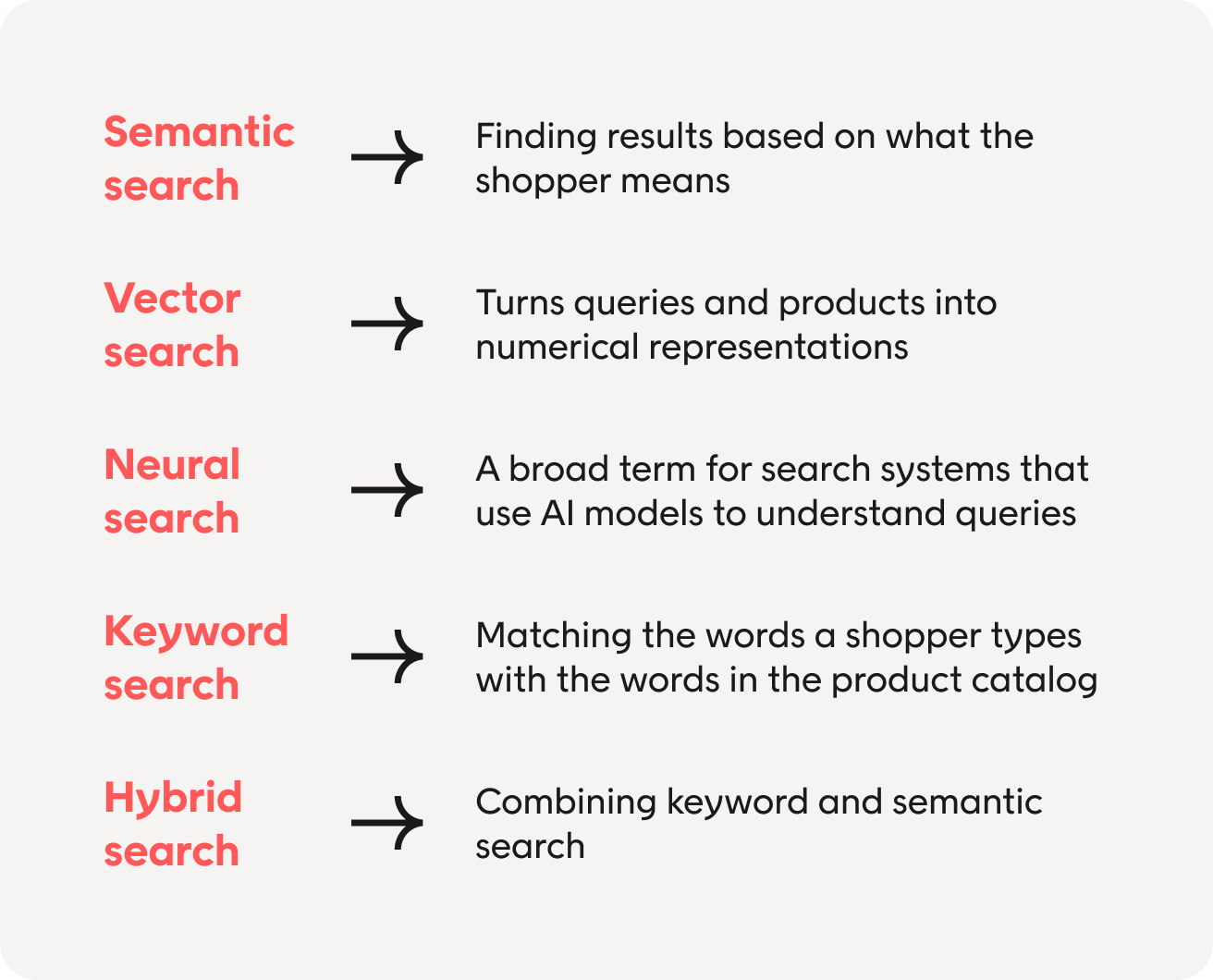
An e-commerce platform might tell you they offer “AI search”, but it’s important to know exactly what they mean. Here are five common site search types and the idea behind them, so when you ask for clarification you know exactly what the vendor is talking about.
| Term | What it means | What it isn’t |
| Semantic search | Finding results based on what the shopper means, rather than just the exact words they use. | It isn’t a specific technology. It describes the outcome you’re trying to achieve. |
| Vector search | A common way to support semantic search. It turns queries and products into numerical representations so the system can find similar ones. | It isn’t the same thing as semantic search. It’s one method that can help achieve it. |
| Neural search | A broad term for search systems that use AI models to understand queries, find results, or decide how to rank them. | It isn’t one specific, clearly defined search method. |
| Keyword search | Matching the words a shopper types with the words in the product catalog. | It isn’t outdated. It’s still important for exact searches like brand names, SKUs, and model numbers. |
| Hybrid search | Combining keyword and semantic search to use the strengths of both. | It isn’t a completely separate search technology. It’s an approach that combines different methods. |
With these definitions under your belt, it’s easier to compare e-commerce product discovery solutions and what different providers offer.
How semantic search works
Knowing how semantic search works in practice helps you see what it’s good at and where it has limitations.
Semantic search turns a user’s search query into something the search engine can compare
When you type in a query, a semantic search system sends that text to an embedding model (a neural network trained on lots of text). The embedding model turns the text into a vector, or a long string of numbers. The vector is a mathematical summary of the text’s meaning.
Every item in your catalog, including the product description and attributes, has already been turned into a vector and is stored in a vector index. The semantic search engine then searches the vector index for product vectors that are most similar to the query vector.
That’s how a search for “something warm for winter walking” can return an “insulated quilted parka”, even though the two share none of the same words. Their vectors are similar because the embedding model has learned from the language it was trained on that concepts like insulation and quilting are closely related to warmth and winter clothing.
The benefits of semantic search for shoppers and retailers
Semantic search in e-commerce makes it easier for shoppers to search using everyday language. They don’t need to know the exact words used in a product catalog. Someone looking for an “outfit for a summer wedding” can describe what they need instead of searching for a specific product type.
It also recognizes that people may use different words to describe similar things. A shopper might search for a “warm jacket”, while the product description says “insulated parka”. Traditional keyword search often needs retailers to manually account for these variations, while semantic search can understand more of these connections automatically.
Depending on the search system, semantic search may also work across languages, helping shoppers find relevant products even when their search terms don’t exactly match the language in the catalog.
Semantic search doesn’t check every item in the catalog
A large product catalog can contain thousands or even millions of products. Checking a search query against every single product would be too slow. Instead, the search system uses a method to quickly find the products that are most likely to be similar.
This means it may occasionally miss a product that would have been a slightly closer match, but it can return relevant search results quickly enough for shoppers to use.
What semantic search models don’t know?
Semantic search models learn from language, so they can understand relationships between words and concepts. But they don’t automatically know everything that makes a product relevant in an e-commerce store.
For example, a product might closely match what a shopper is looking for, but the model doesn’t know whether it’s currently available. That information has to come from elsewhere in the search system.
Where semantic search fails
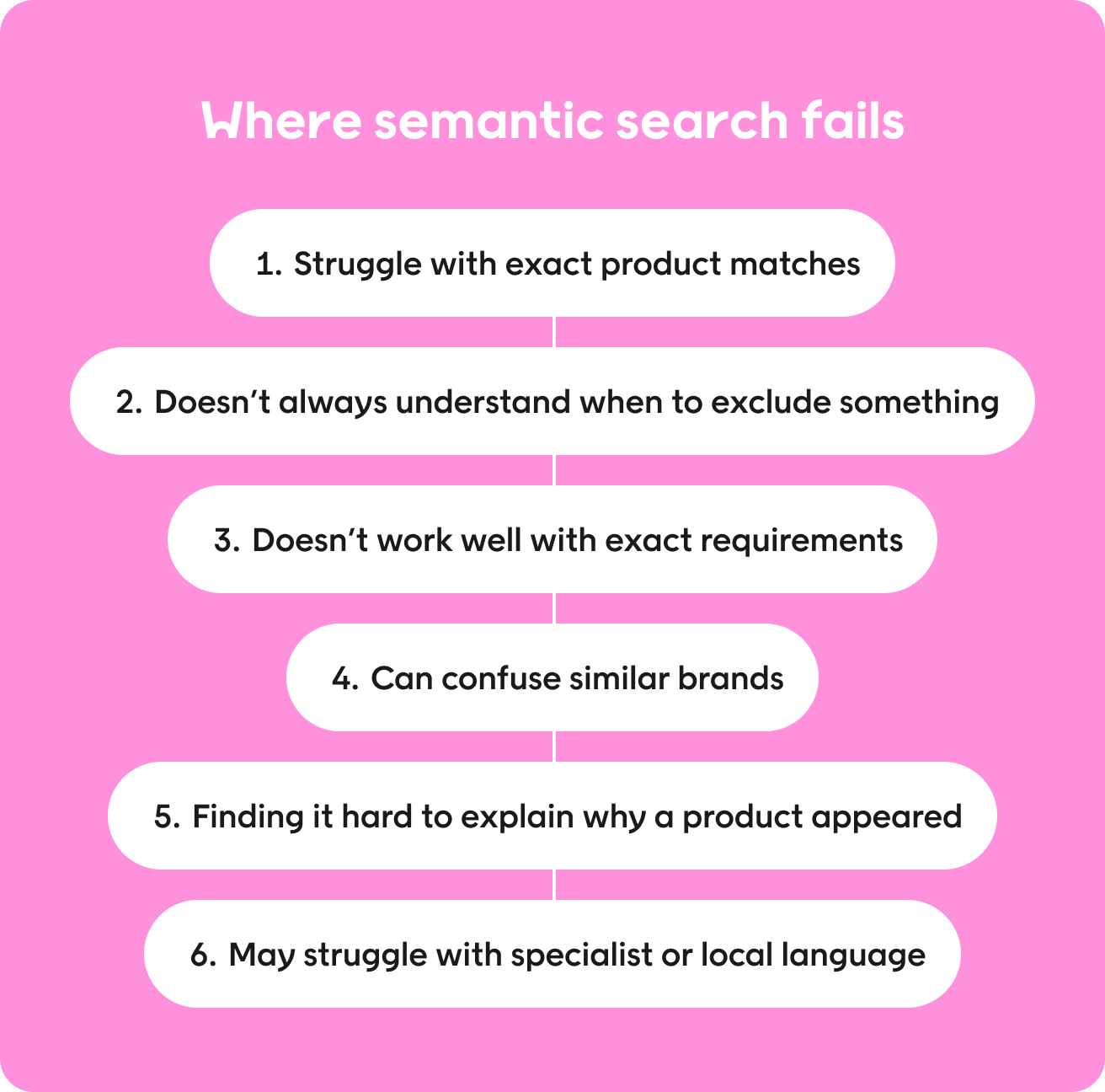
Semantic search is a popular choice in e-commerce thanks to how well it copes with natural language queries and cuts dead-end searches. But, like any search method, it has its limitations. Here are the main ones to be aware of.
It can struggle with exact product matches
Semantic search can return things that are only nearly right since it fetches results based on vector similarity. This might be ok when a shopper searches for “red dress”, but not when they’re looking for a specific printer cartridge or searching with a SKU rather than keywords.
Keyword search (also called lexical retrieval) handles these exact searches more reliably. This is one of the main reasons retailers combine keyword and semantic search.
It doesn’t always understand when shoppers want to exclude something
If a shopper includes phrases like “without a hood”, semantic search can return results with hoods anyway, as the vectors for “without a hood” and “hood” are similar.
To handle this properly, the search system would need to identify “without a hood” as an exclusion. It can then use the product’s attributes to filter out hooded jackets while semantic search finds jackets that match the rest of the query.
It doesn’t work well with exact requirements
Just as shoppers sometimes search for exact items, they may also search for exact requirements like price ceilings or dimensions. If searching for “under €200” produces results at €240 because the search engine sees that the vectors are similar, the search results won’t be useful to the customer.
It can confuse similar brands
Semantic search groups semantically similar items together even if they’re from competing brands. If someone searches for “Adidas running shoes”, the search engine might also surface results for running shoes from Nike, because both brands sell products that are described in similar ways. Without extra rules to treat the requested brand as an exact requirement, the system treats them as near‑matches.
It can be hard to explain why a product appeared
With keyword search, it’s easy to see why a result appeared: the product contained the words the shopper searched for. But because semantic search relies on vectors rather than words, the connection between a search query and a product can be much harder to understand.
If the system offers no way to inspect or override ranking decisions, the team loses control of the result page. That makes it hard to fix irrelevant results or make sure products appear when they should.
It may struggle with specialist or local language
General-purpose models are trained on general language. Retail vocabulary, brand names, local terminology, and category jargon may be underrepresented — and compound-word languages such as Swedish and German are a well-known weak point. Ask vendors specifically about non-English performance.
Why hybrid search is the practical answer for retail
The way shoppers search online is varied. Someone looking for a specific product might type its exact name or model number, while another shopper might describe what they need in their own words. Others may search for a broad product category or add specific requirements such as a brand, size, or price. These different types of searches all happen in the same search bar, but they don’t all need the same approach to return useful results.
A hybrid search approach offers a solution by using two methods and combining the results. Keyword search (lexical) helps with exact searches, and semantic search helps when shoppers describe what they want. However, you need to be clear on what happens when the keyword and semantic search disagree on what the results should be. If keyword search thinks Product A is the best result, but semantic search thinks Product B is better, how does the system decide what the shopper sees?
That decision is made in the ranking stage. Think of the type of search as the backstage crew that gathers a shortlist of candidate products, and ranking as the director who chooses which of those candidates the shopper sees and in what order. Most of what shoppers experience as “good search” comes from this ranking layer, or how it balances relevance with business priorities like stock and margin, rather than the method used to find the search results.
When comparing search platforms that offer hybrid search, ask what factors influence the final ranking and how much control you have over them.
Semantic search alone can’t give you retail context
Retail search also needs to consider information that has nothing to do with the words a shopper uses or the meaning of a product description. For example, a search engine might find a product that’s a perfect match for the shopper’s intent, but that result isn’t useful if the product has been discontinued. But no search method can account for factors like stock levels, price, newness, or trends unless that information is available to the system.
This is where retail-specific search systems differ from general-purpose search infrastructure. They combine an understanding of what the shopper wants with the product and business data to decide which products to show first.
What to ask vendors about semantic search
Vendors often keep explanations of their search systems quite high level during demos or sales calls, but that can make it hard to tell whether the system will work well with your catalog and the way your shoppers search. Keep these questions handy to get all the information you need.
| Question to ask | Why it matters |
| Is your search hybrid, and what happens when keyword and semantic search return different results? | This affects whether the search system can return useful results for both exact searches and more descriptive queries. |
| How does the system handle exact model numbers and SKUs? | This helps prevent shoppers from being shown the wrong product when they know exactly what they need. |
| How does it handle exclusions and exact requirements, such as “without a hood” or “under €200”? | This helps ensure shoppers aren’t shown products that fail to meet requirements they’ve clearly specified. |
| Which non-English languages do you support, and how do you handle compound words? | This affects whether shoppers can find relevant products when searching in their own language. |
| Can our team see why a product ranked where it did and change the results if needed? | This gives your team a way to identify and fix poor results instead of leaving them unchanged. |
| How do product and retail data influence what appears first? | This helps ensure shoppers see products that are relevant to buy, rather than just products that closely match their search terms. |
| How quickly does search respond at our catalog size, and how quickly are product changes reflected? | This helps prevent slow searches or outdated results from frustrating shoppers and causing them to leave. |
| What ongoing work and costs does the system require? | This helps you understand whether the solution will remain practical and affordable to maintain over time. |
Finally, test any solution using your own product catalog and real shopper queries. Search quality is highly dependent on your data, and generic demos may not expose the edge cases that could cost you revenue.
The realities of running semantic search
The cost and effort involved in running semantic search can grow as the catalog changes and search traffic increases. It’s worth understanding what the system needs to keep performing well over time.
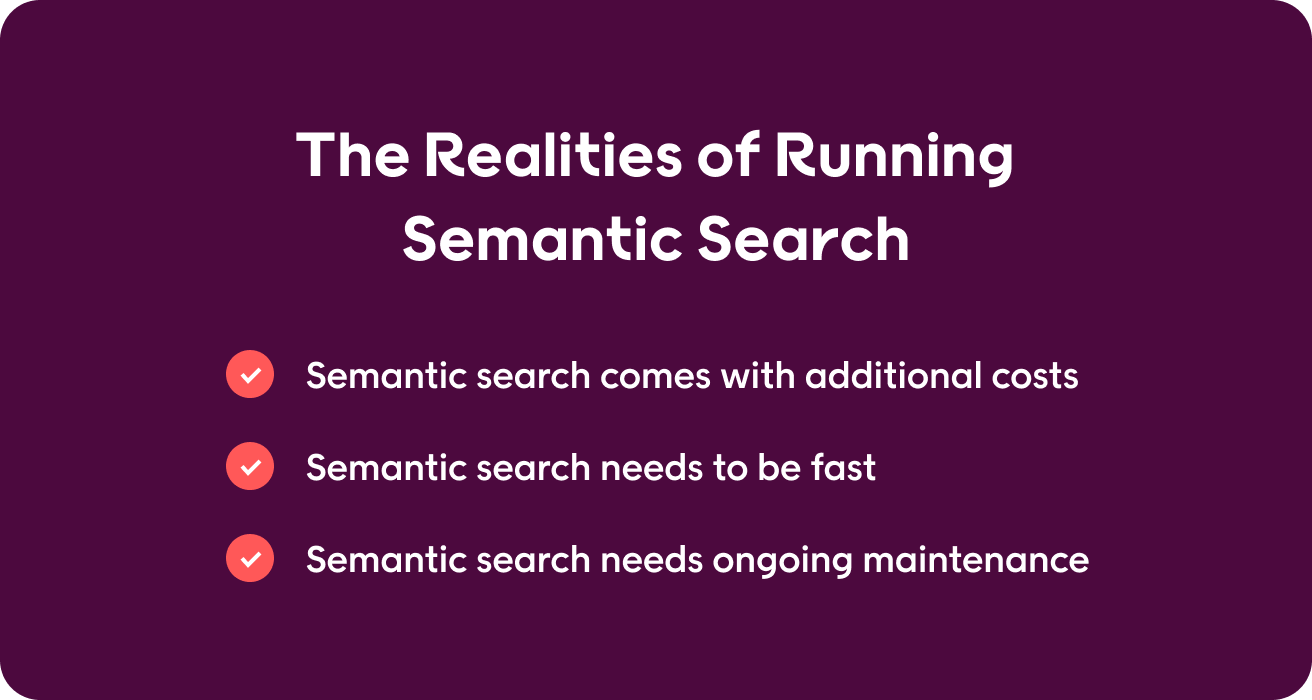
Semantic search comes with additional costs
For semantic search to work, every product description has to be turned into a vector and stored. That means:
- Up‑front and ongoing costs. You pay to create these fingerprints for your whole catalog, and again every time you update products or change the model.
- Higher running costs for semantic search vs keyword search. Vector search needs more computing power per query, and many providers charge per search operation and per gigabyte of stored vectors.
When comparing providers to implement semantic search, ask what’s included in the price and what impacts cost increases.
Semantic search needs to be fast
Shoppers expect search to be instant. If results take too long to appear, people may bounce. This is particularly important when evaluating semantic search because performance can change as catalogs and search traffic grow.
Make sure to ask vendors about documented speeds. Voyado’s Elevate returns results in 60 milliseconds using a product scanner built for high volume.
Semantic search needs ongoing maintenance
A semantic search system won’t necessarily keep performing at the same level without ongoing attention. If you don’t keep an eye on it, the quality of results shoppers see could drop without you noticing it.
Keeping the system up to date can involve:
- Updating product vectors. Product information needs to be processed again when the catalog changes or the underlying model is updated.
- Testing search quality. Regularly test the system using real shopper queries to identify weak results and fix them.
Before choosing a solution, find out who’s responsible for this work and how often it needs to happen. Some providers manage more of the ongoing maintenance than others, which can affect the time and resources your team needs to commit.
How Voyado combines semantic understanding with retail intelligence
Voyado’s Product Discovery Engine brings together site search, product recommendations, and merchandising to help retailers deliver relevant product discovery experiences. It uses semantic understanding to interpret what shoppers are looking for and combines it with product and retail data when deciding which results to show.
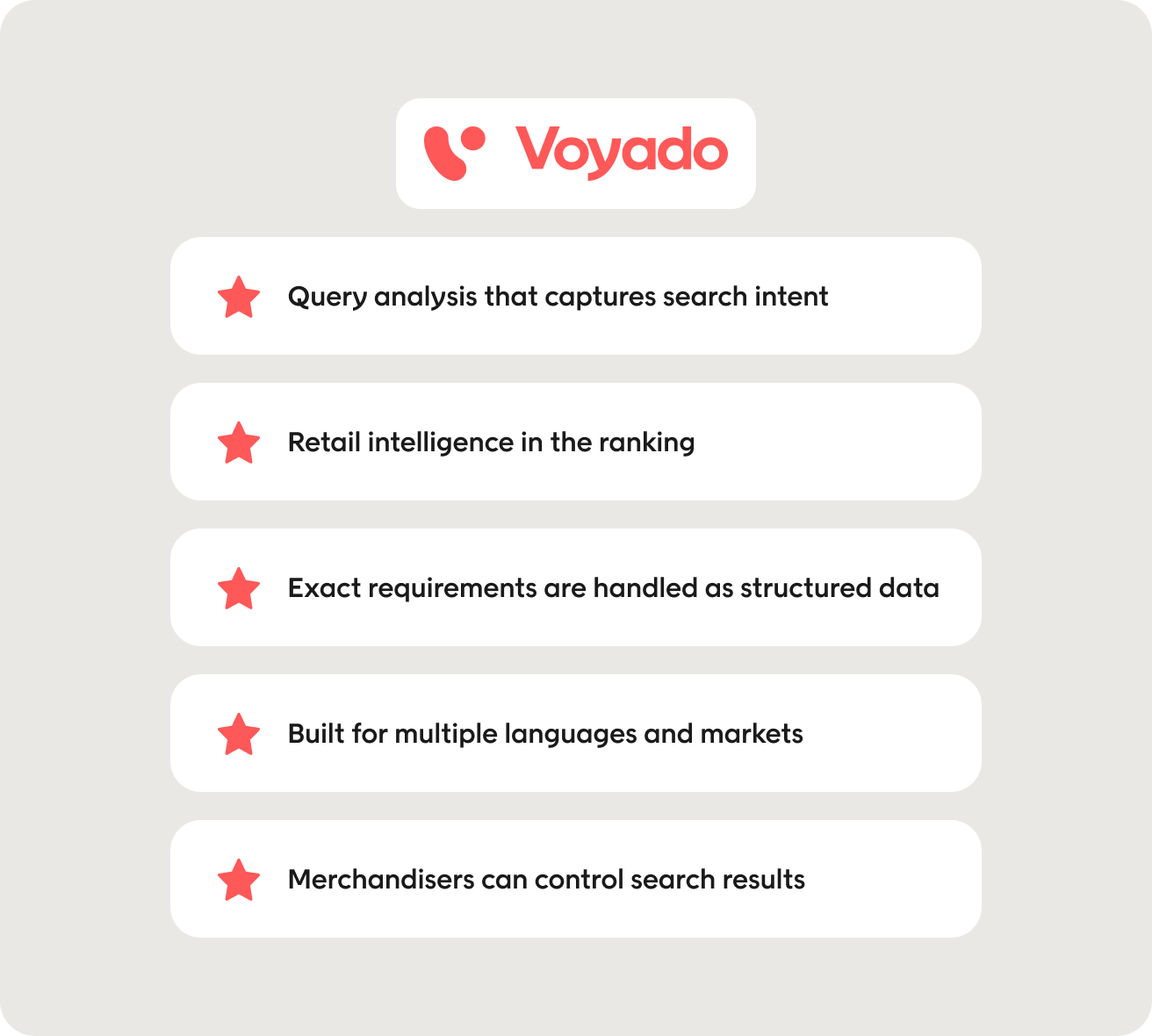
Query analysis that captures search intent
Voyado analyzes search queries to identify what shoppers are looking for. Its query analysis includes natural language processing, concept understanding, spelling correction, lemmatization, and pluralization handling.
Semantic analysis can recognize details within a query, including product type, color, material, price, and occasion. Free-text matching also helps relevant products appear for broader or less standard search terms, while synonym handling connects related phrases. For example, a search for “Christmas” can also include products associated with the holiday season.
Retail intelligence in the ranking
Voyado uses product lifecycle data, sales performance, and visitor behavior when ranking search results. These signals help determine which products appear first based on the current catalog and how shoppers interact with it.
Exact requirements are handled as structured data
Voyado can process numeric and unit-based requirements using structured product data. Automatic unit conversion means a table listed as 75 cm can also match searches for “0.75 m” or “750 mm”. Range facets can also position products correctly when measurements are listed using different units.
Built for multiple languages and markets
Voyado supports local languages with dictionaries for words and synonyms. The search engine can also adapt as products, entities, and attributes are added to the catalog. This helps retailers support the terminology and search behavior of shoppers across different markets.
Merchandisers can control search results
Voyado gives merchandising teams tools to adjust search results, including boosting, burying, and pinning products. Teams can also manage synonyms and use search reports to see what shoppers are searching for and identify results that may need attention. These controls let teams respond when search results need adjusting and shape the experience shoppers see.
Voyado also offers agentic merchandising capabilities that can automatically adjust product visibility using current shopper and product signals. Merchandising teams can set the rules and keep control over how products are presented.
If you’re evaluating semantic search for your business for the first time or looking for Algolia alternatives, test providers using your own catalog and query logs, including model numbers and the languages your shoppers use.
Book a demo to see how Voyado combines semantic understanding with retail product intelligence.
Final thoughts
Semantic search is popular for a reason. It solves genuine problems with traditional search engines, helping shoppers find products when they describe what they need rather than using the exact words in a product catalog.
But shoppers also search for exact products or set specific requirements, and expect the results to reflect what’s available to buy. Building a good search experience means bringing these different needs together, from keyword and semantic search to the product data and ranking logic that determine what shoppers ultimately see.
That’s why retailers should look beyond whether a provider simply offers semantic search. Test how the system performs with the searches your own customers make, using your catalog and the languages you support. Those tests will tell you far more than a polished demo.
Semantic search is one part of a wider approach to personalized product discovery and e-commerce search. If you’re comparing providers, see our guide to the top e-commerce search solutions for a closer look at your options.
FAQs
What is semantic search?
Semantic search returns search results based on what a user’s query means, rather than just the exact words they use. It aims to understand contextual meaning so it can return more relevant results.
What is the difference between semantic search, neural search, and vector search in e-commerce?
Semantic search is the goal: matching results based on meaning. Vector search is a common way of doing this by comparing numerical representations of both the query and product information. Neural search is a broader term for search systems that use AI to understand queries or rank results.
Is semantic search better than keyword search?
Not always. Semantic search works well when shoppers describe what they want in their own words or use different terms from those in the product catalog. Traditional keyword search, also called lexical search, works better for exact keyword matches, such as SKUs or model numbers. Most retail search systems use both.
What is hybrid search?
Hybrid search combines lexical search and semantic search. This lets the search engine handle exact searches while also understanding the semantic meaning behind more descriptive queries. It’s useful in retail because shoppers don’t all search in the same way.
Where does semantic search fail in ecommerce?
Semantic search can struggle when shoppers need exact matches or set strict requirements. For example, it may have difficulty with product codes, exclusions such as “without a hood”, or a specific price limit. It can also be harder to explain why one product appears above another.
Does semantic search understand stock and price?
No. Semantic search can understand language and user intent, but it doesn’t automatically know the current status of a product. Information such as availability and price has to be added elsewhere in the search system.
How does Voyado approach semantic search?
Voyado combines natural language processing (NLP) with semantic analysis to understand what shoppers are looking for and what products offer. It can identify product details such as color, material, and occasion, then uses retail data such as sales performance and visitor behavior to help determine the most relevant results.