TL;DR
Agentic commerce uses AI agents to understand intent, make decisions, and act autonomously across the shopping journey. For e-commerce and merchandising teams, that means moving beyond static rules toward product discovery that can react to changes in demand, stock, margin, and shopper behavior in real time. This article explains how agentic commerce works, why it matters for retail, what you need in place to use it well, and how to stay in control as more decisions become automated.
You’re probably already using AI in your e-commerce experience, from product recommendations to generative AI and smarter search. What’s changing now is the level of autonomy. AI agents are starting to research, compare prices, make decisions, and eventually complete purchases on a user’s behalf, while merchant agents optimize what shoppers see using product data, stock, margin, and consumer intent. McKinsey estimates that agentic commerce could mediate $3 trillion to $5 trillion in global consumer spending by 2030.
What is agentic commerce?
Agentic commerce uses AI agents to understand a goal, reason through available information, decide what to do next, and take action with a degree of autonomy.
The traditional model still depends heavily on human decision-making. You browse an e-commerce site, compare options, and move through the checkout flow yourself. With agentic shopping, some of those shopping tasks can be delegated.
You might tell an agent:
Find me a waterproof black jacket under €200 that will arrive before Friday.
The agent can interpret those preferences and constraints, search available options, compare products, and narrow the choice. As agentic capabilities develop, it may also complete purchases, track the order, or manage returns with minimal direct user input.
This is how agentic commerce differs from traditional commerce: the agent can move from understanding intent to taking action on the user’s behalf.
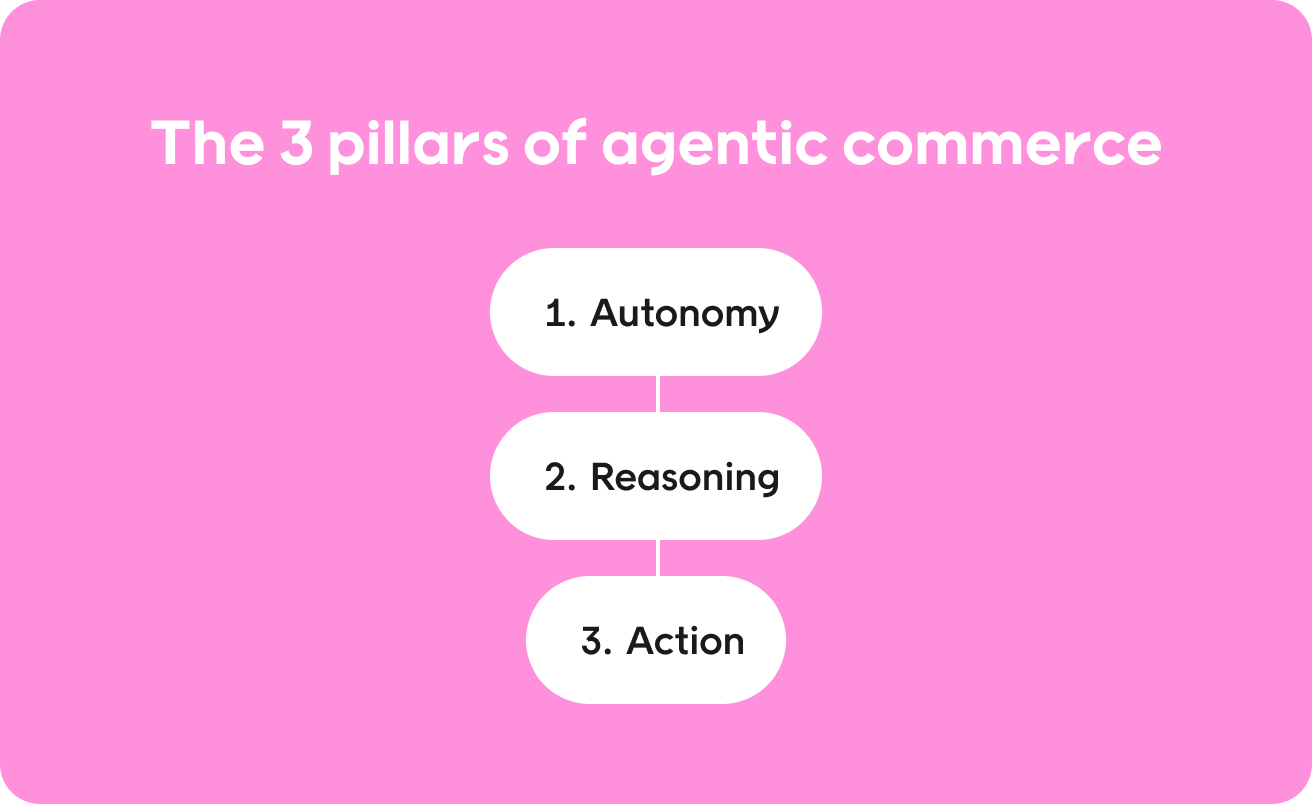
The 3 pillars of agentic commerce
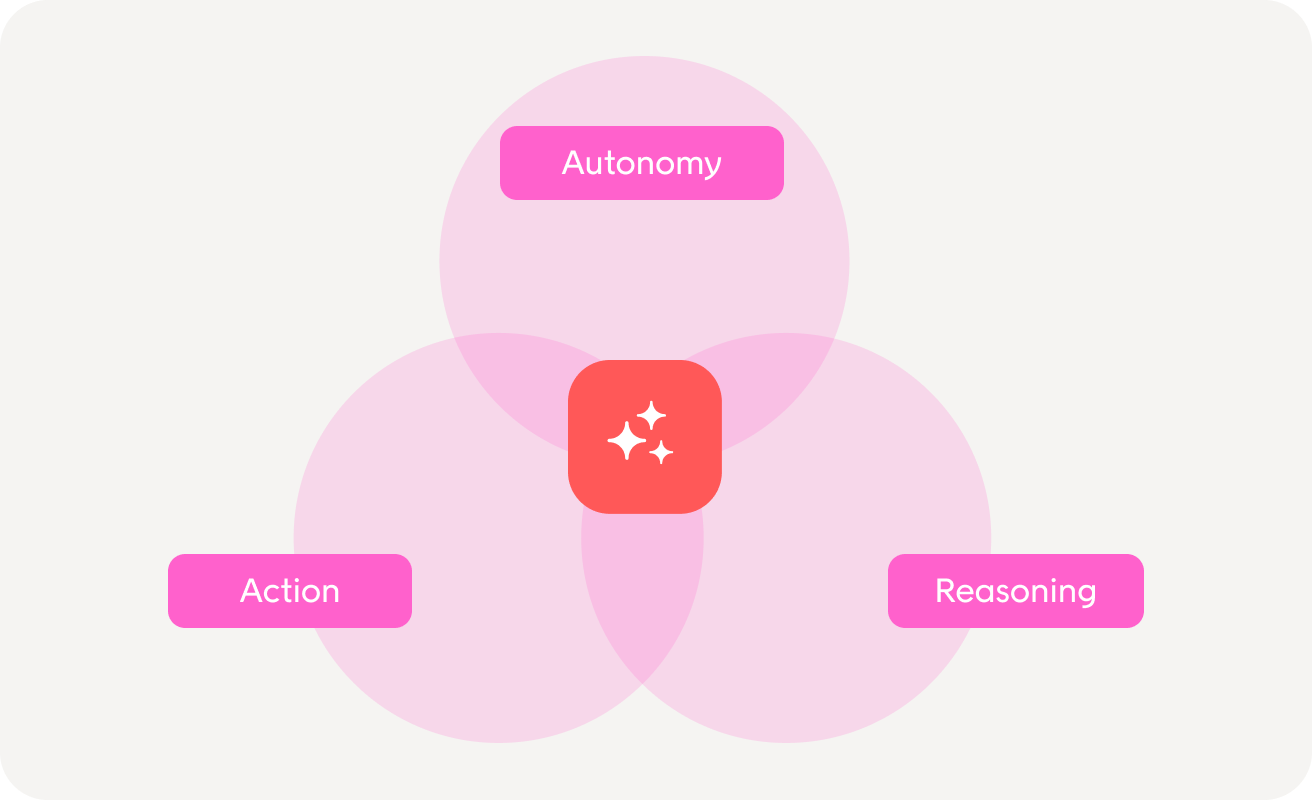
The defining feature of agentic AI is the ability to combine autonomy, reasoning, and action.
1. Autonomy
AI agents act without needing a person to approve every routine step.
That doesn’t mean handing them unlimited control. It means deciding where they can act autonomously and where you still want a human involved.
2. Reasoning
Agents interpret context rather than following a single fixed rule.
In retail, that context could include consumer intent, browsing behavior, real-time inventory, margin, seasonal demand, and product relationships.
3. Action
This is where agentic AI agents go beyond traditional AI.
Traditional AI might tell your merchandiser that a product is losing relevance. An agent can actually adjust the ranking.
Agentic commerce delegates workflow execution to AI agents rather than stopping at a recommendation.
How agentic commerce differs from current AI
Agentic AI commerce changes the role AI systems can play in digital commerce.
| Approach | What happens | Who acts? |
| Rule-based personalization | A predefined rule or segment decides what appears | Your team creates and updates the rules |
| Generative AI | AI creates content, product descriptions, or responds to a prompt | A human usually directs the task |
| AI copilot | AI recommends what someone should do | A human reviews and acts |
| Agentic commerce | AI observes, reasons, decides, and takes action within guardrails | The agent can act autonomously |
The underlying technologies can include artificial intelligence, large language models, natural language processing, structured data, product intelligence, and APIs.
Modern agents can use those technologies to perform tasks and respond as conditions change.
Gartner predicts that 33% of enterprise software applications will include agentic AI by 2028, up from less than 1% in 2024.
How agentic commerce works in retail discovery
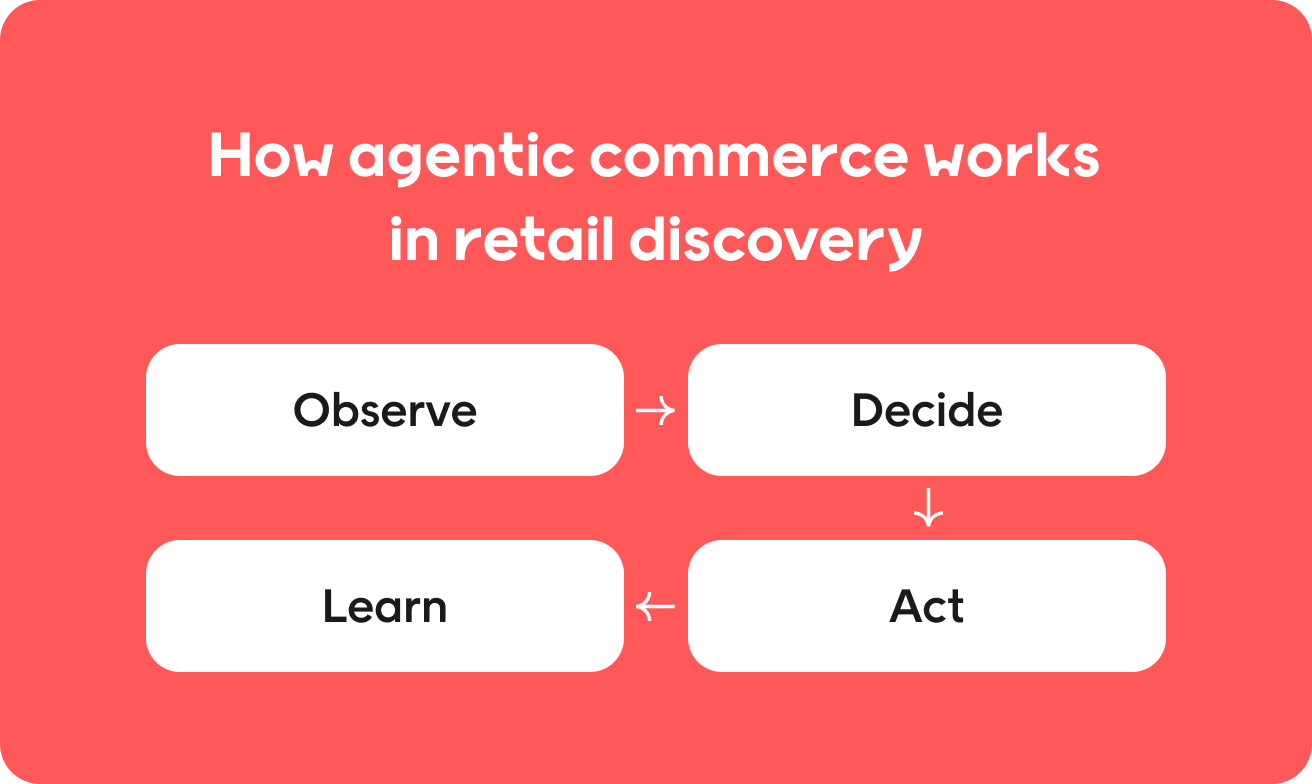
For an e-commerce team, the easiest way to understand how agentic commerce works is as a continuous loop:
Observe → Decide → Act → Learn
For retail teams, agentic AI matters most when it can turn changing signals into action without waiting for constant manual input.
Observe: intent signals and product intelligence
An agent first needs enough context about the shopper and available products.
That could include:
- Search queries, browsing behavior, and cart activity
- Purchase history and customer preferences
- Inventory, pricing, margin, local demand, and seasonal trends
Agentic commerce relies on good inputs.
Businesses must ensure their product data is clean and structured for AI agents. If the underlying structured data says little about fit, materials, compatibility, seasonality, or variants, even a very capable agent has limited context.
Voyado combines shopper intent with retail product intelligence, enabling its product discovery engine to understand products, context, and relationships rather than simply matching keywords.
Decide: ranking and recommendation logic
Next, the agent decides what deserves attention.
Say someone searches for running shoes.
The most popular pair may seem like the obvious first result. But what if their size is nearly sold out? What if another pair matches the query equally well, has healthier stock, and better fits what this shopper has been browsing for?
Good decision-making means balancing relevance with commercial reality. The agent can weigh shopper intent, availability, margin, demand, and business rules before deciding what should surface.
Act: real-time adjustments across discovery touchpoints
Once a decision is made, AI agents act while it still matters.
An agent might rerank site search, adjust category order through site navigation, or change product recommendations for the shopper in front of you.
A stock change that happened five minutes ago can affect what gets shown now. Your team doesn’t have to discover the problem the next morning and fix it manually.
Learn: continuous improvement from outcomes
Agents also need to know whether their decisions worked.
Did the shopper engage with the product? Did they buy? Did margin improve? Did fewer searches lead nowhere?
Those outcomes feed the next decision.
Static rules don’t do that on their own. They keep doing what you asked them to do until someone notices that something has changed.
Why agentic commerce matters for e-commerce leaders
The benefits of agentic commerce are most evident in the product discovery problems you already deal with.
Conversion lift: relevance at the moment of intent
Imagine someone searches for a product you technically carry.
Your search knows it’s relevant, so it puts it first.
Unfortunately, it’s out of stock.
That is a perfectly logical search result and a terrible consumer experience.
An agent can consider relevance and real-time availability before deciding what deserves the top spot. That helps shoppers reach relevant products faster.
An IBM and National Retail Federation study published in 2026 found that 45% of consumers already use AI for help during their buying journey.
Changing online shopping behavior means discovery increasingly needs to work for not just humans but also for AI systems interpreting intent.
Margin protection: balancing sell-through and profitability
The highest-converting product isn’t always the one you most want to push.
You might be trying to protect margin, clear seasonal stock, avoid promoting something that’s nearly sold out, or give a high-value range more visibility.
Agentic commerce offers a way to weigh those trade-offs in the moment. So the question becomes less “What will get the click?” and more “What’s the best outcome for this shopper and the business?”
Operational efficiency: from manual tuning to autonomous optimization
Some merchandising decisions deserve human attention. Moving a product up two positions because another size sold out probably isn’t one of them.
Agentic merchandising can take on more routine ranking, recommendation, and listing adjustments while your team focuses on assortment, campaigns, commercial planning, and the brand experience.
Competitive pressure: the shift is already underway
The agentic commerce era isn’t only changing what happens inside your own site. The agentic commerce protocol provides AI agents and merchant systems with a shared framework for secure, structured interactions throughout the buying journey.
Shopping agents are appearing on the consumer side too.
A personal shopper powered by AI could eventually handle an end-to-end flow:
Intent → search → compare prices → choose → pay → track
Some agents may also handle recurring purchases, subscription management, mobile shopping tasks, or returns.
That changes how consumers interact with retailers. An agent may interact directly with merchant systems rather than scanning several e-commerce sites as a person would. For that model to scale, merchant agents and shopping agents need common ways to communicate.
The Agentic Commerce Protocol, developed by OpenAI and Stripe, creates an open framework for agent interactions with commerce systems.
Google and Shopify’s Universal Commerce Protocol tackles a similar interoperability problem across discovery, checkout, orders, and post-purchase activity.
These protocols enable agents to exchange structured information and complete purchases without relying on a traditional checkout page at every step.
The same agentic model is also beginning to appear beyond consumer retail. AI agents can automate low-risk purchasing decisions, support supply chains, manage inventory, and autonomously perform tasks that once required manual input.
The retail discovery readiness playbook
You don’t need to rebuild your entire e-commerce stack, but your discovery layer needs to give agents useful data.
Intent signal infrastructure
Start with the signals you already have.
Search queries. Browsing. Cart activity. Purchase history. Loyalty information. Channel preference.
Then ask:
Can your discovery systems actually use this information while the shopper is still shopping?
Real-time data is what turns context into proactive assistance.
Catalog quality and enrichment
Agents need to understand the products they’re working with.
Useful product details can include:
- Size, fit, materials, and variants
- Compatibility and seasonality
- Lifecycle, price, availability, and margin
If the catalog is huge, don’t try to enrich everything at once.
Start with bestsellers, seasonal ranges, and commercially important products.
The goal is structured information that your own systems and external AI agents can interpret reliably.
Inventory and margin integration
An agent can’t make a good decision using yesterday’s stock data.
Real-time inventory, regional availability, pricing, and margin should be available to the discovery layer where relevant.
Agentic commerce also requires exposing appropriate real-time data through APIs. AI agents must interact with different merchant systems, so interoperability becomes more important as purchasing decisions cross system boundaries.
Experimentation and measurement frameworks
Don’t go from manual merchandising to full autonomy in one move.
Start with a category, market, or use case where you already know something is going wrong. Maybe out-of-stock products rank too highly, or one category needs constant manual tuning.
Set a baseline, keep a control or holdout group, and give the agent clear boundaries. Then measure the incremental effect before expanding autonomy.
Governance and control for autonomous merchandising
Agentic commerce works best when autonomy is clearly defined.
Approval thresholds and escalation rules
A low-risk stock-based ranking adjustment might happen automatically.
A major change to a launch campaign might require approval.
Businesses should implement governance that defines the decision-making authority of AI agents based on financial impact, risk, brand sensitivity, or the type of action involved.
That lets AI agents act autonomously on routine decisions while people stay involved where judgment matters.
Price floors, stock protection, and margin constraints
Your agents also need commercial constraints.
Those might include:
- Margin or price floors
- Stock protection rules
- Product or category exclusions
Don’t let an agent chase one metric at any cost. If its only instruction is to boost sales, it lacks the context to optimize for the business outcome you actually want.
Brand compliance and regulatory boundaries
Trust and security are essential elements in agentic commerce, especially as agents move from recommendations toward autonomous transactions.
Users need assurance that their financial data is secure. Ethical considerations also include data privacy, consent, and potential bias in decisions.
That means autonomous shopping requires rigorous security measures and trust protocols.
Google’s Agent Payments Protocol, or AP2, provides a shared framework for secure agent-led payments and proof of user authorization.
Protocols such as ACP, UCP, and AP2 can support secure, automated decision-making, clearer audit trails, transaction transparency, and fraud detection.
The principle is simple: autonomy operates inside defined boundaries.
Measuring agentic commerce impact
Judge agentic commerce by whether discovery and commercial performance improve, not by how much AI you deploy.
Discovery success metrics
Start with whether shoppers are actually finding useful products.
Track:
- Discovery success rate
- Zero-result rate
- Time-to-product
These metrics show whether agentic optimization reduces dead ends and helps shoppers find relevant products faster.
Conversion and revenue metrics
Conversion rate, AOV, and margin per session are useful starting points.
Segment them by category, market, intent, and customer type too. A high-intent search behaves very differently from casual browsing, and a repeat buyer behaves differently from someone you’ve never seen before.
You want to know where agentic commerce shifts performance, not just whether one site-wide number moved.
Operational efficiency metrics
Also measure what your team no longer has to do.
Track manual merchandising hours, rule updates, seasonal adjustments, out-of-stock exposure, and irrelevant recommendations.
That tells you whether the system is creating genuine commerce efficiency rather than simply adding another AI platform your team has to manage.
How to get started with agentic commerce
You can start preparing for agentic commerce without making it a huge transformation project.
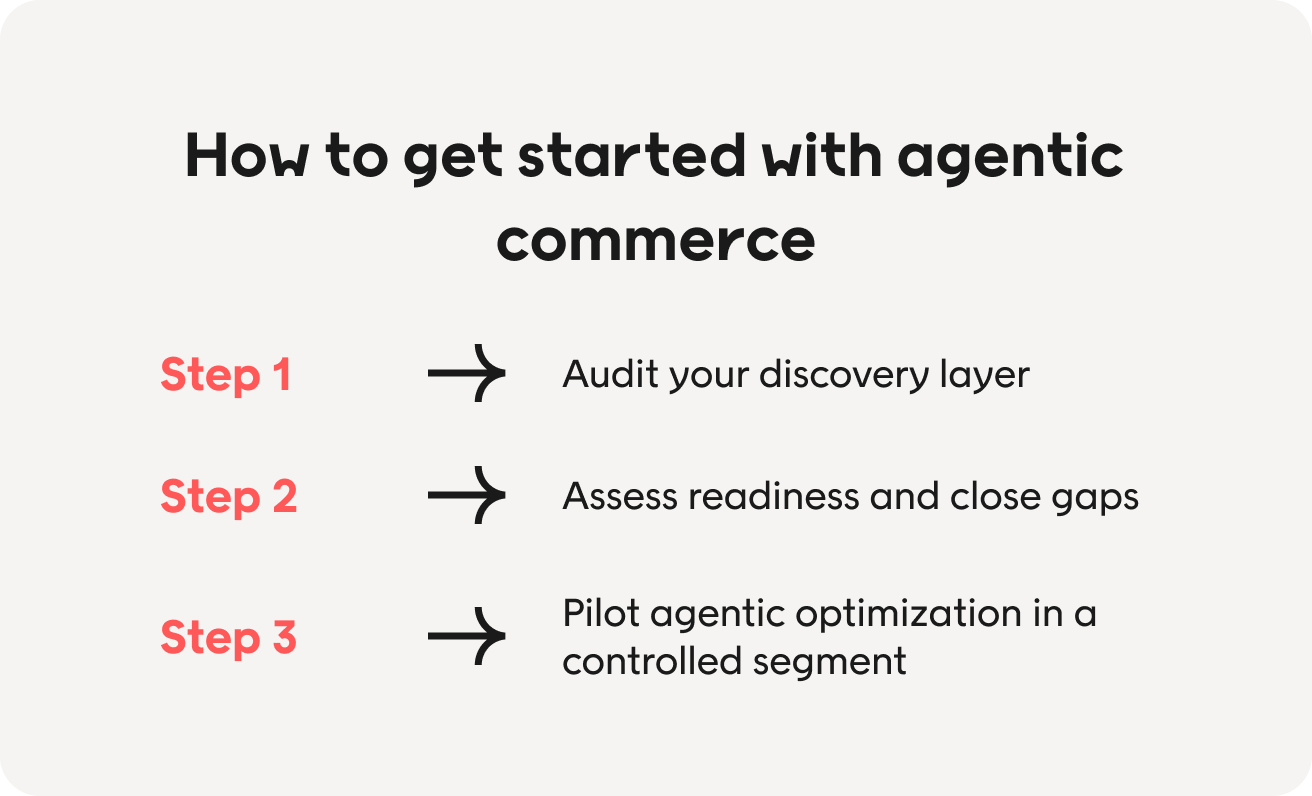
Step 1: Audit your discovery layer
Look for searches that go nowhere, out-of-stock products taking prime positions, irrelevant recommendations, or categories your team is constantly fixing.
Establish your baseline before changing anything.
Step 2: Assess readiness and close gaps
Is your product data structured well enough? Is inventory current? Can you connect shopper intent with product intelligence and commercial information?
Fix the highest-impact gaps first.
Step 3: Pilot agentic optimization in a controlled segment
Choose one category, market, or customer segment with clear success criteria.
Set the guardrails. Establish your control. Run the test.
Then give the agent more room only when the results show it can make better decisions than the static process it replaces.
The goal isn’t to hand over your entire discovery experience at once. Prove where agentic commerce can make better decisions, reduce manual work, and improve the shopper experience without losing control. Start with one problem, measure the outcome, and then expand.

FAQs
What is agentic commerce?
The simplest definition of agentic commerce is the use of autonomous AI agents to understand intent, make decisions, and execute commerce workflows within defined constraints.
How is agentic commerce different from chatbots or personalization?
Chatbots primarily provide conversational interfaces, whereas traditional personalization typically follows predefined rules or segments. Agentic commerce gives AI systems greater autonomy to make decisions and take action as conditions change.
What does agentic commerce mean for retail and e-commerce?
Agentic commerce shifts product discovery from reactive manual tuning toward continuous, intent-aware optimization. Agents can account for product data, demand, stock, margin, and commercial goals when deciding what should happen next.
How do I prepare my product catalog for agentic commerce?
Start with accurate, structured product data covering attributes such as size, fit, materials, compatibility, variants, availability, and margin. Clean data makes it easier for AI agents to understand which products are relevant and sellable.
How do I measure the impact of agentic commerce?
Track discovery success rate, zero-result rate, time-to-product, conversion, AOV, margin per session, and operational effort. Use controlled experiments or holdout groups to attribute incremental lift to agentic optimization with greater confidence.