TL;DR
Yesterday, a shopper bought a jacket in-store. Today, your cart email asks if they forgot it.
- Demographic segmentation doesn’t predict buying, so behavioral segmentation groups customers based on what they do.
- Web, app, email, and store customer data sit apart, so rules run on stale exports.
- Live inventory suppression plus lifecycle, recency-frequency-monetary (RFM), and product affinity segments trigger the next action in the customer journey.
- Voyado reports 27% higher conversion, 215% more transactions, and 115% higher revenue, plus an 8% average purchase frequency lift for Customer Engagement customers. These are platform-level results, not one segment’s.
- Voyado Customer Engagement builds segments on one live purchase-and-browse profile.
Your cart email just reached a shopper who bought the item in-store yesterday. Demographics can’t stop that when web, email, and point-of-sale (POS) customer interactions never meet.
Without a unified profile, segments lag behind the shopper. Behavioral data that updates instantly keeps them in step with real customer behavior across channels.
Here’s a practical UK and EU guide to behavioral segmentation, often searched as “behavioral segmentation.”
What behavioral segmentation means for omnichannel retail
Behavioral segmentation looks different in omnichannel retail, where browsing, buying, and returns happen across site, app, and store. It works when targeted marketing follows that behavior on one live profile.
What is behavioral segmentation?
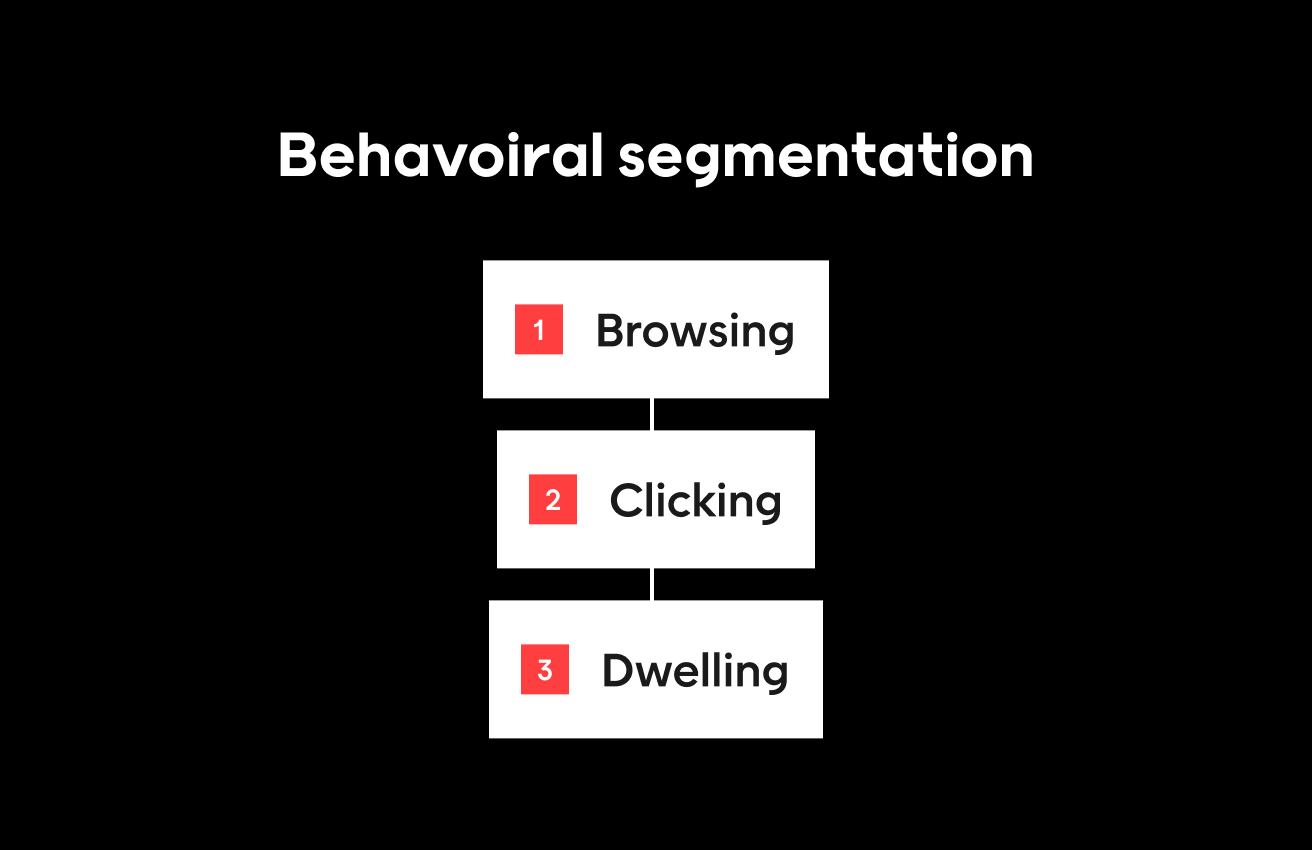
Behavioral segmentation divides customers into groups based on specific behaviors, such as what they browse, buy, return, and engage with, instead of age or postcode.
Browsing, clicking, and dwelling reveal hidden intent and often the underlying motivations behind a purchase.
How a segment changes when a shopper acts
A store purchase moves the shopper from browser to first buyer, and a back-in-stock signup turns an anonymous visitor into an identified segment, both on the same live profile.
Why more channels raise the cost of a bad send
More channels raise the cost of bad timing, because one late send can contradict what the shopper just did in-store. That’s why behavioral segmentation matters for omnichannel customer experiences.
Why demographics miss what shoppers are about to do
Behavioral segmentation swaps static traits for live signals showing what shoppers will do next. Here’s how it compares with demographic, geographic, and psychographic segmentation.
| Segmentation type | What it groups shoppers by | Retail example |
| Demographic | Age, gender, income | Women aged 25 to 34 |
| Geographic | Country, region, postcode | Shoppers in Greater Manchester |
| Psychographic | Values, lifestyle, attitudes | Sustainability-minded shoppers |
| Behavioral | Browsing, purchases, returns, engagement | Viewed outerwear three times this week |
Same age, very different intent
Two 34-year-old Londoners share a postcode, but one just bought in-store while one is still comparing online. Demographics can’t tell these different customers apart, so both get the same message.
Behavior shifts faster than personas
A shopper can move from browsing to buying in a single session. Segments should follow that consumer behavior mid-session, not wait for the next refresh.
Psychographic data from customer surveys explains underlying motivations, but it can’t keep up with that pace.
The behavioral segmentation variables that matter most
Behavioral segmentation variables are the data points you collect. Data collection only pays off once those signals land in one live cross-channel profile.
Purchase signals
Purchase history (recency, frequency, monetary value, discount use, and returns) sets the action for each segment. Recent-High-Monetary means “strong repeat,” and Aging-High-Monetary means “slipping away.”
Browse and discovery signals
Category views, search refinements, add-to-cart, and dwell show intent, even from anonymous visitors. Together they reveal behavior patterns across the buying journey.
Loyalty and lifecycle signals
These signals show where customer loyalty is building or fading. A first purchase triggers onboarding for new customers, churn risk triggers win-back, and every store or online interaction earns points.
The 6 types of behavioral segmentation retailers actually use
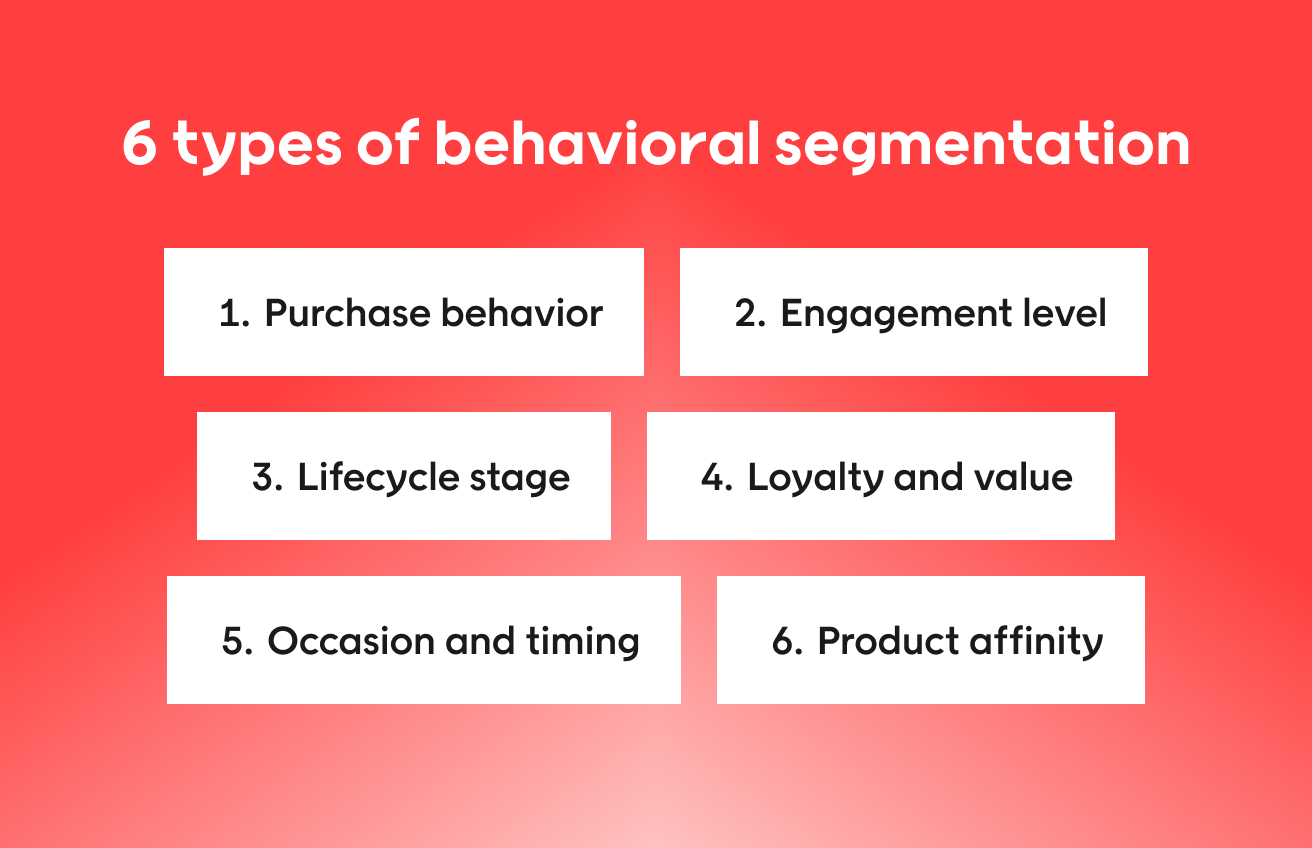
Behavioral segmentation guides list four, six, or eight types, so this framework maps each to one action you can run in marketing campaigns.
Fashion brand Blutsgeschwister combined segmentation and automation in Voyado and lifted conversion rates by 69%.
Each type at a glance: signal, rule, action
| Type | Variable | Action |
| Purchase behavior | Repeat buys | Cross-sell |
| Engagement level | Verified clicks | Re-engage |
| Lifecycle stage | Days since order | Win back |
| Loyalty and value | Customer lifetime value (CLV) | Retain |
| Occasion and timing | Season | Timed offer |
| Product affinity | Category fans | Targeted product |
1. Purchase behavior
Start by splitting heavy or light users based on how often they buy. Cross-sell single-category buyers, and skip the 20% off for a £90 full-price regular.
2. Engagement level
Engaged customers click, browse deeply, and come back. Light users need fewer, more relevant sends.
Trust verified clicks over inflated opens, and follow up deep browsers by email or SMS.
3. Lifecycle stage
Route new shoppers to onboarding and lapsed or former customers to win-back. Each journey stage gets its own message, and Voyado’s agentic AI can run retention automatically.
4. Loyalty and value
Give your most loyal customers early access, and flag high-value customers whose visits are slowing before they churn.
5. Occasion and timing
Black Week, late-August back-to-school, and payday should trigger changes to offers and featured items.
Target customers when they’re most likely to buy, such as when product usage suggests a refill is due.
6. Product affinity and benefits sought
Group shoppers by the categories they return to and the key benefits they buy for: price, quality, or convenience. Then lead with the part of your unique value proposition each group cares about.
Voyado’s AI builds real-time affinity segments from purchase behavior with no code, so you can target category fans and exclude non-buyers.
How behavioral customer segmentation works across web, app, email, and POS
Behavioral segmentation works when web, app, email, and POS customer interactions merge into one live profile.
1 shopper, 1 profile
A loyalty ID, email, or phone number captured at checkout keeps behavioral segments from drifting. It’s how you collect behavioral data from the store, not just the site. Voyado maps every touchpoint across site, email, loyalty, and store to the same customer.
Which events need near real-time delivery
Cart and stock events need near real-time delivery, because nightly exports miss noon sellouts.
Where returns and store purchases change the segment
A store purchase should move the shopper to the post-purchase stage of the customer journey, and a return should pause any upsell tied to the returned item.
Identity resolution from anonymous browse to known customer
Segments need resolved identity across your customer base, built through behavior-triggered capture and duplicate-profile handling. Voyado connects anonymous and known visitors in one structured first-party data model from the first interaction.
When to capture identity
Ask with an on-site message at key moments in the purchasing process, such as long browse, add-to-cart, or back-in-stock signup. Collect data and consent at the same time.
How duplicate profiles break journeys
Duplicate records for existing customers cause double sends and missed suppressions, which one live profile removes.
What to do when IDs do not match cleanly
- Match deterministic IDs first.
- Fall back to probabilistic signals.
- Merge above a confidence threshold.
- Send the rest to human review.
What UK and EU consent rules mean for behavioral segments
Build privacy into data collection and the data model, following Information Commissioner’s Office (ICO) and European Data Protection Board (EDPB) guidance.

Separate permission to analyze from permission to market
Permission to analyze behavior isn’t automatically permission to email, so each Voyado profile holds consent across every channel.
Map cookie, email, SMS, and app permissions
Map each channel against UK GDPR, EU GDPR, and the Privacy and Electronic Communications Regulations (PECR).
Set retention and profiling disclosures up front
Set retention windows per segment type, explain how you segment customers in your privacy notice, and push withdrawals to every channel.
How to build behavior-based segmentation rules that stay current
Behavior-based segmentation rules update with every action, while static exports go stale.
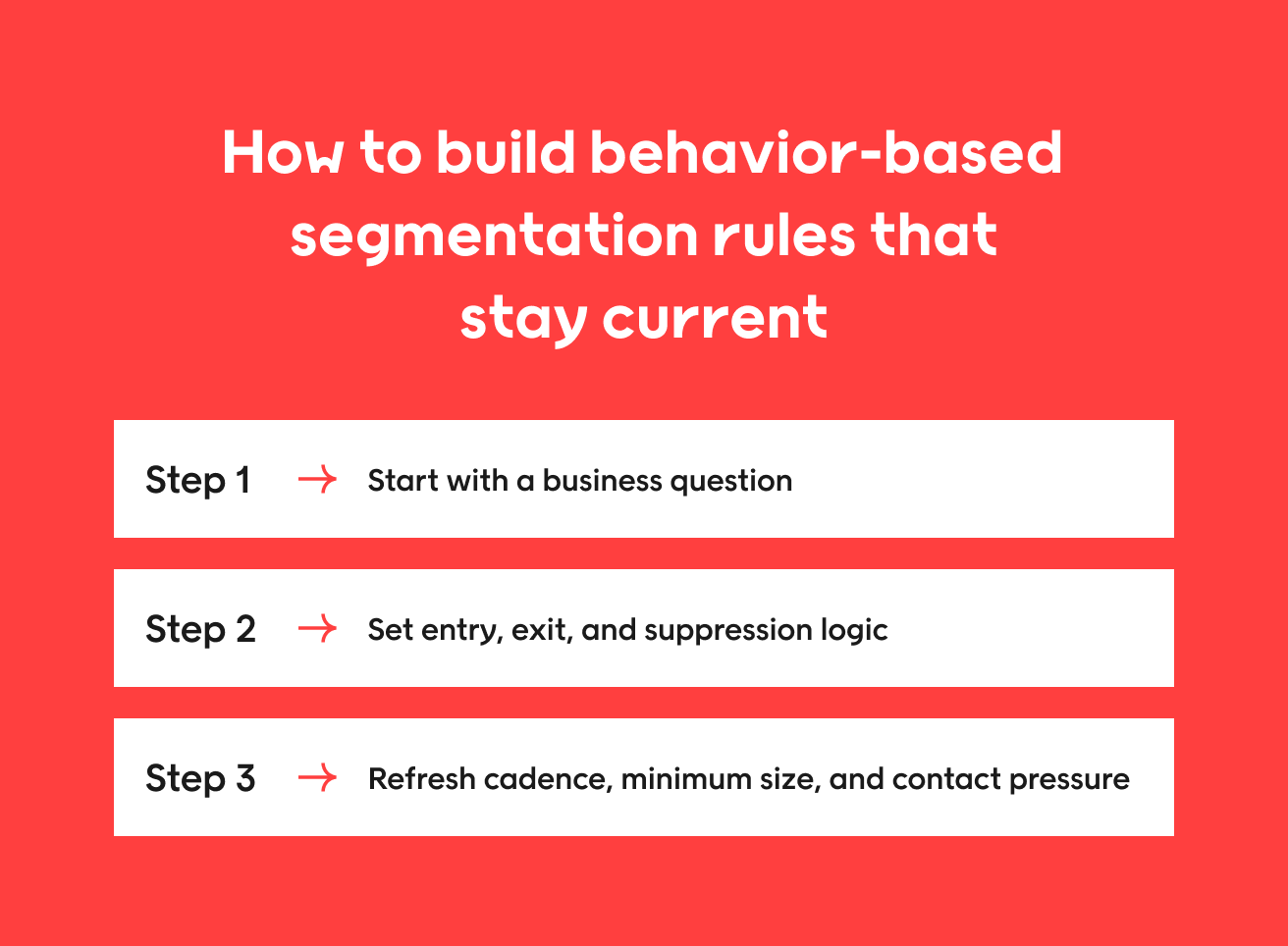
Start with a business question, not a giant segment list
Give each segment one job tied to your marketing strategy, like converting first buyers or reactivating lapsed VIPs.
Start with four to five customer groups. A long list of small ones is hard to maintain and measure.
Set entry, exit, and suppression logic
Every segment needs three controls: when shoppers enter, when they leave, and which events block or reroute a message.
Stock suppression
Block the send or swap the product when an item is unavailable.
Consent suppression
Check channel consent under UK GDPR and EU GDPR before every send (this isn’t legal advice).
Journey priority
Let service journeys override promotions so certain customers don’t get both, and rank journeys before launch.
Refresh cadence, minimum size, and contact pressure
Update triggers live, set minimum audience sizes, cap contacts, and embed holdouts so you can make informed decisions.
Why behavioral segmentation in marketing should be inventory-aware
Behavioral segmentation in marketing matches intent to what’s on the shelf, so your marketing efforts promote products shoppers can buy instead of discounting by default.
H&M shows what this looks like in practice. With Voyado, its search and ranking draw on purchases, add-to-bag behavior, stock availability, and customer intent signals, reducing zero-hit search by 50%.
Promote substitutes and go-with products instead
When the first-choice item is gone, point affinity segments at substitutes and complementary products instead. Voyado’s recommendations surface alternatives and complementary items using up-to-date stock levels.
Connect Customer Engagement and Product Discovery on shared retail context
Voyado Customer Engagement and Voyado Product Discovery run on the same agentic OS for retail, so nothing resets when a shopper moves between site and channels.
When RFM beats prediction and when prediction wins
Start with RFM segmentation based on purchase history, and add prediction where behavioral patterns hide.
Use RFM when you need speed and explainability
RFM runs on verified transactions, so it’s quick to set up and easy to explain. Voyado scores RFM from both purchases and returns.
Use predictive scores when patterns are less obvious
Prediction spots repeat-buy and churn risk in mixed cross-channel behavior. Before you scale a model, check how often its scores predicted correctly against a holdout.
Run both with a holdout
High conversion in high-intent audiences isn’t causation, so test both against a randomized holdout.
7 behavioral segmentation examples you can launch in 30 days
These behavioral segmentation examples set signal, window, entry, exit, exclusions, channel, and KPI, with illustrative thresholds.
- Week 1: pick four to five segments and write entry, exit, and suppression rules for each.
- Week 2: check that POS, stock, and consent data reach the profile before the first send.
- Week 3: launch marketing campaigns for each segment with a randomized holdout.
- Week 4: compare net revenue against the holdout, then keep, adjust, or drop each segment.
Post-purchase and repeat-buy plays
Behavioral segments move new customers toward a second purchase without waiting for a quarterly refresh.
1. 1st-to-2nd purchase accelerator
After 21 days without a second order, email a goes-with pick, and track second-purchase rate.
2. In-store purchase suppression for abandoned cart
Suppress the cart email whenever POS data shows the carted item was bought in-store.
Intent and browse plays
Behavioral segments turn browse, click, and dwell into intent signals and actionable insights before checkout.
3. Category affinity with live stock
Enter on three category views in seven days, excluding out-of-stock products.
4. Back-in-stock reactivation
Enter on alert signup with consent, exit after 14 days, and track alert-to-purchase rate.
5. Trending product lookalikes
Target shoppers adjacent to rising products, excluding anyone who already bought.
Retention and loyalty plays
Offer caps protect margin, so discounts reach only shoppers who need them. Rewarding loyal customers with benefits builds brand loyalty without eroding price.
By Malene Birger grew full-price shoppers by 109% with a Voyado onboarding automation that sent a benefit reminder instead of a discount.
6. Lapsed high-value win-back
Target £500-plus high-value customers inactive for 90 days, cap offers, and track reactivation rate.
7. Reward-near loyalty nudge
Push loyalty members within 50 points of a reward, and track redemption rate. It’s a simple way to build customer loyalty.
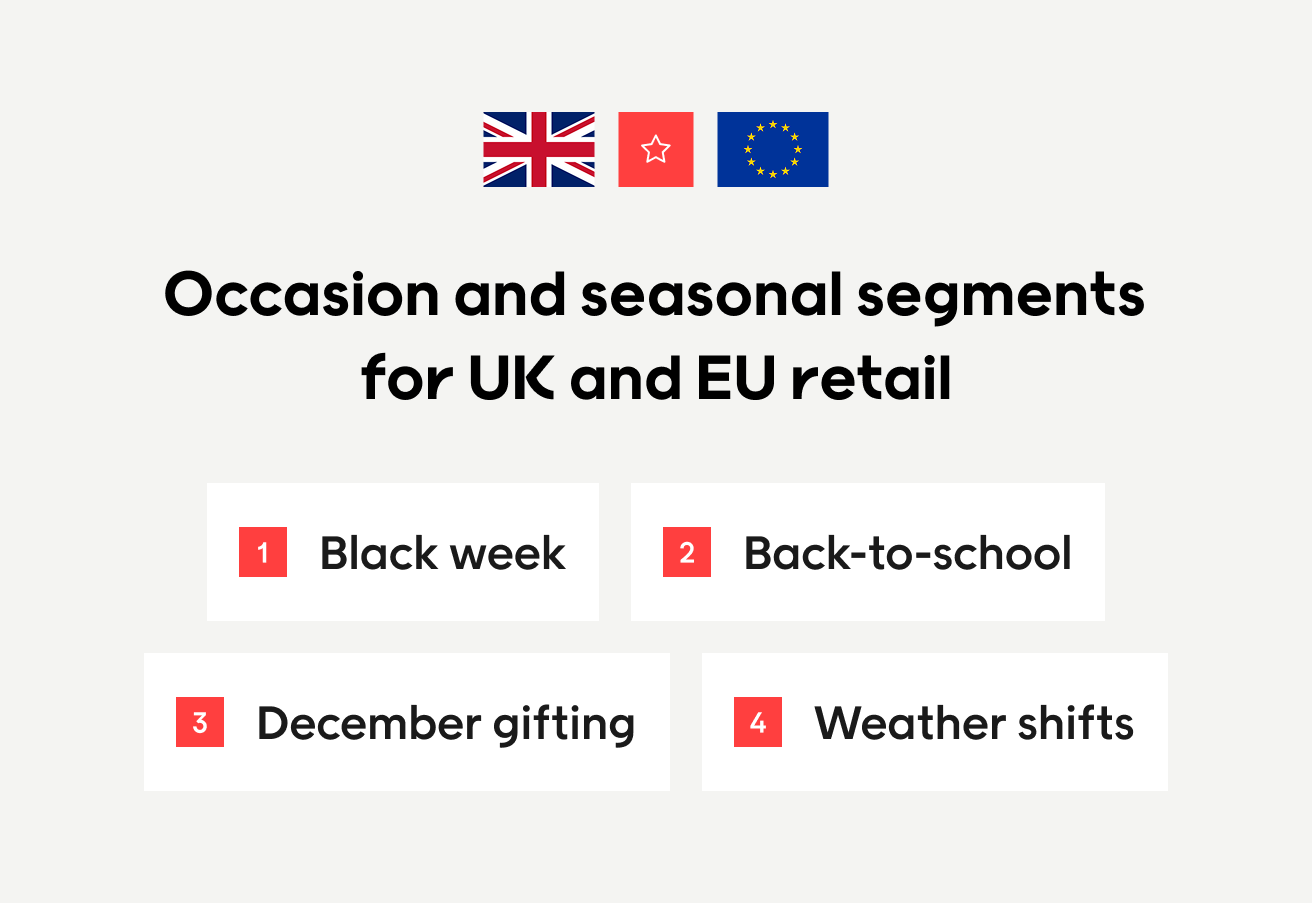
Occasion and seasonal segments for UK and EU retail
Black Week, back-to-school, and gifting stress-test behavioral segments every year.
Black Week: when stock moves faster than segments
During Black Week, a £120 coat can sell out by lunch, so suppress it live.
Back-to-school, gifting, and weather shifts
Late-August back-to-school, December gifting, and cold snaps shift demand across different groups, and affinity segments catch it early.
Change offers as shopper priorities change
The same shopper needs speed early in peak, availability mid-peak, and reward value late. Voyado’s agentic AI identifies the next best step, autonomously or with a human in the loop.
How behavioral segmentation scales across UK and EU markets
Behavioral segmentation scales when you localize one core segment for language, currency, and consent.
Reuse the core segment, localize the activation
Keep Aging-High-Monetary logic identical in the UK and Germany, and change copy and timing for each market’s customer base. Voyado lets you build journeys once and scale them across markets, with every market and language in the same view.
Normalize spend thresholds across currencies and VAT
Set £500 or €600 thresholds locally for specific segments, then normalize value-added tax (VAT) before comparing.
Check consent and channel rules market by market
Check channel eligibility per market, because SMS consent may not travel.
How to measure incremental uplift instead of vanity metrics
Opens don’t prove value, so embedded holdouts show what behavioral segments added. Conversion rates only count when you compare them with a control group.
Build a randomized holdout inside the eligible audience
Randomly hold back part of the eligible segment, so measured lift is causal. Without it, campaign results are guesses, not valuable insights.
Measure online and in-store conversion in the same window
Count e-commerce and POS conversions together, or you’ll undercount impact. Voyado’s analytics show how campaigns, sales, and your loyalty program connect.
Use net revenue or contribution margin, not just orders
Compare the test group with the holdout on net revenue.
If the test group nets £5,500 (£10,000 in orders minus £4,500 in discounts and returns) and the scaled holdout nets £4,000, the segment added £1,500. These figures are illustrative.
4 reasons behavioral market segmentation drifts
Behavioral market segmentation drifts when data arrives late or gets misread.
1. Stale exports and delayed data
A Manchester shopper spends £150 in-store, then gets a “come back” email.
2. Noisy signals like privacy-inflated opens and bot clicks
Weight purchases and verified clicks above opens, since they reflect real customer behavior.
3. Gift purchases, returns, and shared devices
Require repeated evidence of the same behavior patterns before one gift rewrites a profile.
4. Conflicting journeys and over-messaging
Set journey priorities and exit logic, then check overlaps monthly, along with unsubscribes and other customer satisfaction signals.
Can your CRM handle behavioral segmentation? 8 checks
Operational cost and activation speed decide a switch, so test each CRM with the cart scenario and ask one proof question per check.
1. Data freshness
How fast do events update segments?
2. POS and returns ingestion
Do store purchases exit the cart flow?
3. Identity resolution
How do visits, accounts, and receipts link?
4. Native loyalty
Do points work directly in segments?
5. Channel coverage
Does every channel share segment logic?
6. Market localization
How are £, €, and consent handled?
7. Approval controls and AI guardrails
Can you approve AI suggestions?
8. Reporting and history migration
How much purchase history migrates?
The one demo test that exposes a CRM’s gaps
Ask the vendor to build one live segment combining browse, POS, and consent, without developers.
How Voyado Customer Engagement turns live behavior into action
Behavioral segments need live data from every channel in one place, which is what Voyado, the agentic OS for retail, is built around.
Build segments on unified purchase and browse data
One first-party data model shows a store purchase before the next email. Voyado uses it to deliver personalized experiences from anonymous visitor to loyal customer.
Let Bonnie suggest the next best step
Bonnie, the retail-trained AI agent in Voyado, plans and activates journeys, enabling marketers to segment, create, and send with a human in the loop.
Activate email, SMS, RCS, onsite, app push, ads, digital wallet, and in-store journeys
One segment powers personalized interactions across email, SMS, digital wallet, and in-store.
Keep loyalty, analytics, and product affinity in the same retail workflow
Loyalty, CLV analytics, and affinity segments share one workflow with Product Discovery context.
Retailers using Voyado have seen 27% higher conversion, 215% more transactions, and 115% higher revenue, and Customer Engagement customers see an average 8% increase in purchase frequency.
Final thoughts
Better behavioral segmentation comes from live behavior across the customer journey on a unified profile, so cart emails stop following store purchases.
Start with four to five segments, each with a signal, window, entry, exit, exclusions, channel, action, and KPI. 
FAQs
Can you give me an example of behavioral segmentation?
Yes. One of the simplest behavioral segmentation examples targets UK shoppers who carted a coat online, minus anyone who bought it in-store. It needs one live unified profile.
What are the 6 main types of market segmentation?
The classic models are four: demographic, geographic, psychographic, and behavioral. Within behavioral, retail types include lifecycle or customer journey stage, purchase persona, RFM-style, and product affinity.
What is behavioral in target audience?
Behavioral means actions, timing, and response patterns toward a product or service, rather than reported traits or psychographic data. Browse, click, and dwell give deeper insight into hidden intent for behavior-based segments.
How do we choose between RFM segments and predictive behavioral segments when we want to target shoppers likely to buy again?
Choose predictive behavioral segments once history is deep. Until then, start with RFM, and validate both against a holdout.
What should we check to make sure a CRM can combine in-store purchases, online browsing, and returns into behavioral segments for the same shopper?
Check data freshness, POS ingestion, returns handling, and identity resolution. Voyado builds behavioral customer segmentation on one live purchase-and-browse profile.
Can our marketing team build and automatically update segments based on shopping behavior without relying on analysts or developers?
Yes, with native segmentation, automation, and approval controls. In Voyado, Bonnie builds and updates segments, with a human in the loop.
If we replace our CRM, how much purchase and engagement history can we bring across so our behavioral segments don't have to start from scratch?
It depends on transaction depth, engagement history, loyalty balances, and matching quality. Strong matching keeps existing customers’ behavioral segments from starting over.