TL;DR
Agentic AI customer retention for e-commerce shifts retailers from static lifecycle flows to signal-driven orchestration. Instead of rigid rules, AI agents read customer data, detect churn risk, and trigger next-best actions across the shopping journey.
The strongest impact appears in high-value retention moments such as loyalty programs, win-back campaigns, post-purchase journeys, and replenishment cycles that increase customer lifetime value.
Voyado’s Agentic AI supports this approach by combining retail-trained AI, insights, and omnichannel engagement in a single customer loyalty platform designed to strengthen customer retention and long-term CLV.
Why e-commerce retention strategies are changing in 2026
Customer acquisition is getting more expensive. For many retailers, real growth now comes from customer retention through loyalty and repeat purchases.
Most teams run lifecycle programs across the customer journey. But many still rely on static segments, fixed delays, and one-size-fits-all logic.
That approach struggles to keep up with modern online shopping behavior. Customers compare products quickly and expect brands to react in real time.
Retailers are shifting toward agentic commerce, where AI agents interpret customer data signals and help teams act proactively.
Instead of rigid flows, these systems can:
- Detect churn risk earlier
- Trigger the next best action automatically
- Adjust timing, message, and channel based on intent
This shift is part of the broader move toward AI in retail and more adaptive AI in customer experience strategies.
Retention is no longer just about running campaigns. It is about acting on customer signals faster.
So how does agentic AI actually help with retention in e-commerce?
What agentic AI customer retention e-commerce actually means
When people hear agentic AI, they often think of generative AI writing marketing copy. That is only a small part of the story.
In e-commerce, agentic AI analyzes signals across the entire shopping journey and helps teams act on them. AI agents interpret patterns in customer data and support next-best-action decisions.
This allows retention programs to adapt as consumer behavior changes, reacting to loyalty activity, purchase behavior, and customer engagement across channels.
From static automation to adaptive retention
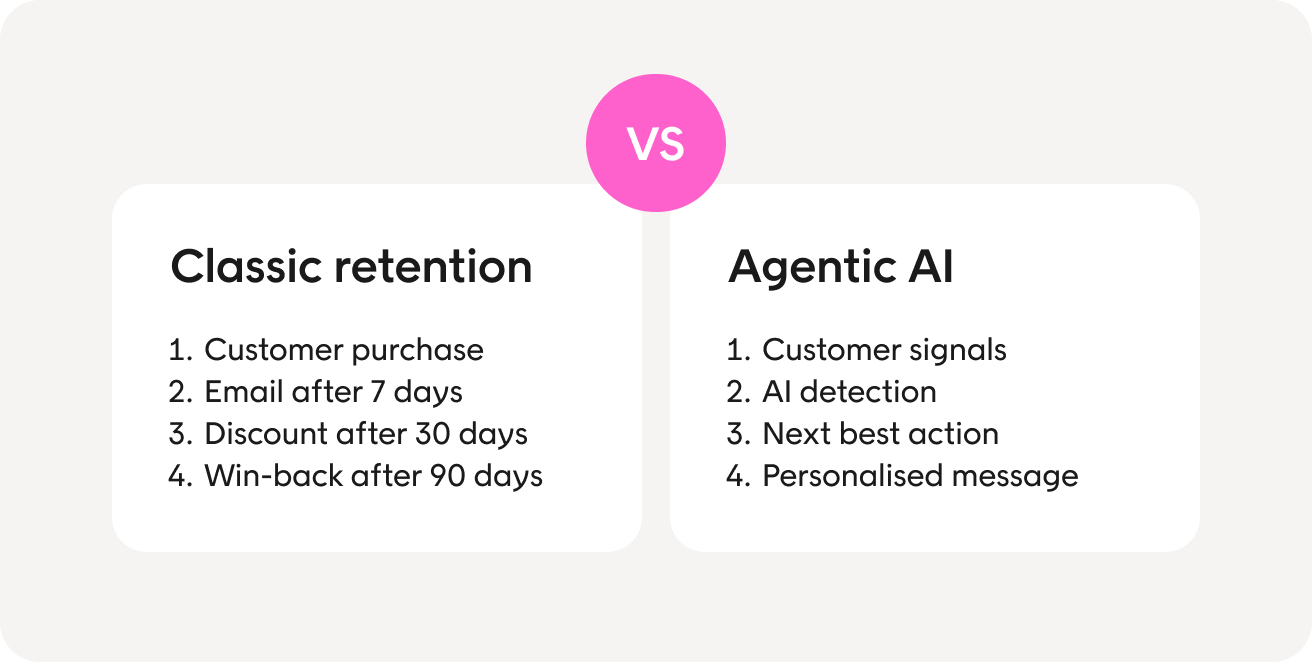
Traditional lifecycle automation still plays an important role in customer engagement. Many retailers still rely on fixed rules and predefined timing.
A classic example might look like this.
| Classic retention automation | Agentic retention approach |
| Send an email 7 days after purchase | Detect declining purchase frequency |
| Send a discount after 30 days of inactivity | Notice changes in customer interactions |
| Add customers to a win-back segment after 90 days | Combine loyalty, browsing, and product discovery signals |
| Run the same journey for every customer | Adjust the message, channel, or offer dynamically |
Classic automation waits for predefined triggers. Agentic systems respond to signals from real consumer behavior.
Platforms like Voyado connect loyalty data, behavioral signals, and engagement workflows. This helps teams respond earlier to changes in the sales funnel and customer expectations.
Automation still matters, but adaptive retention keeps retailers aligned with how people actually shop.
What signals matter most
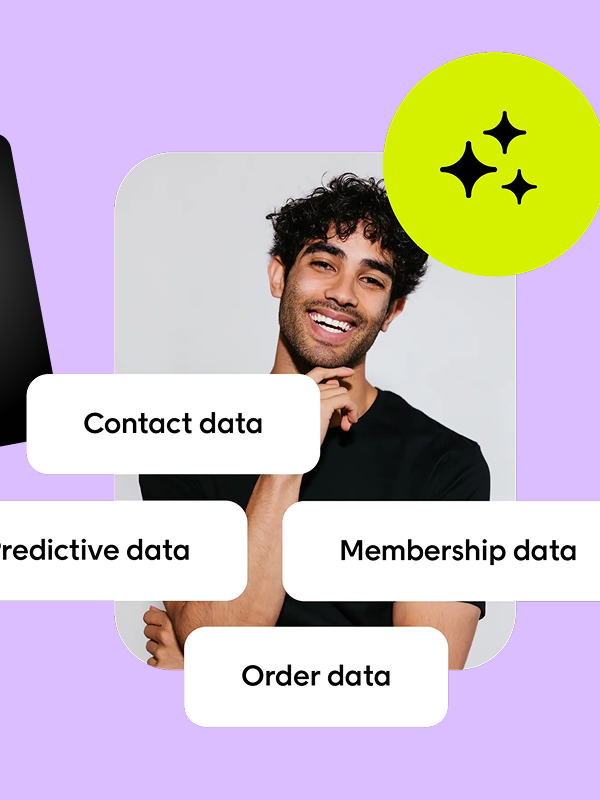
Agentic retention works by interpreting signals across the entire shopping journey. The goal is not to collect more data. It is to understand which signals indicate intent or churn risk.
| Signal | What it tells you |
| Purchase recency and frequency | Whether buying behavior is slowing down |
| Loyalty status and points activity | Whether brand loyalty is strengthening or fading |
| Browsing and product affinity | Which relevant products customers are interested in |
| Cart activity and abandonment | Whether purchase intent exists but friction appears |
| Returns or dissatisfaction signals | Early warning signs of declining customer satisfaction |
| Store visits or on-site engagement | Signals that may not appear in digital journeys alone |
When these signals connect, retailers gain real-time insights into how customers move through the shopping journey.
Insights and reports combine loyalty activity, behavioral signals, and structured data to surface patterns at scale.
Once signals are visible, teams decide how to act.
Where the agentic part starts
Agentic systems can take initiative. Instead of waiting for predefined rules, autonomous systems interpret signals and recommend actions.
In retention programs, this appears in several ways.
Next best actions
AI suggests personalized recommendations or bundle offers based on product knowledge and recent behavior.
Journey prioritization
Retention programs focus on customers showing early churn signals.
Channel and timing optimization
AI adjusts when and where engagement happens across the entire shopping journey.
Human escalation
Teams step in with human input when a signal requires attention.
Agentic AI supports marketers rather than replacing retention strategy. Teams still define the customer experience while AI interprets signals faster.
Many retailers exploring this shift start by understanding how AI for marketing translates customer signals into retention actions.
From there, the practical question becomes where agentic AI creates the most impact in the retention lifecycle.
Where agentic AI improves retention the most
The real value of agentic AI appears in moments that drive repeat purchases across the customer journey where loyalty and revenue grow.
Agentic AI customer retention for e-commerce uses AI agents to interpret customer data and respond to signals across the entire shopping journey. Instead of static automation, agentic commerce helps retailers act proactively as consumer behavior changes.
The use cases below show where retailers see the strongest impact.
Welcome and second purchase journeys
The first purchase matters. The second purchase is where customer retention begins.
Many retailers still run the same onboarding journey for every customer, even though customer expectations are higher.
Agentic AI allows retailers to adapt onboarding using signals from the shopping journey.
| Traditional onboarding | Agentic onboarding |
| Generic welcome flows | Context-aware onboarding |
| Fixed follow-up timing | AI agents adjust timing |
| Basic keyword search suggestions | Product discovery based on product knowledge |
| Generic offers | Personalized recommendations |
Instead of waiting weeks for another purchase, retailers help customers discover relevant products earlier. Many leading retailers now treat onboarding as the first stage of long-term customer engagement.
Replenishment and repeat purchase programs
Some retention opportunities are predictable. Categories like beauty, grocery, pet care, and supplements naturally drive repeat purchases. The challenge is timing.
Agentic AI analyzes consumer behavior across purchase history, on-site activity, and product discovery signals.
Signals that suggest a reorder
- purchase frequency patterns
- browsing activity on product pages
- engagement with related products
- loyalty activity tied to product categories
AI agents interpret these signals using structured data and customer data to predict reorder timing. Instead of static timers, AI-powered journeys respond to signals across the entire shopping journey and support repeat purchases.
Churn prevention and win-back
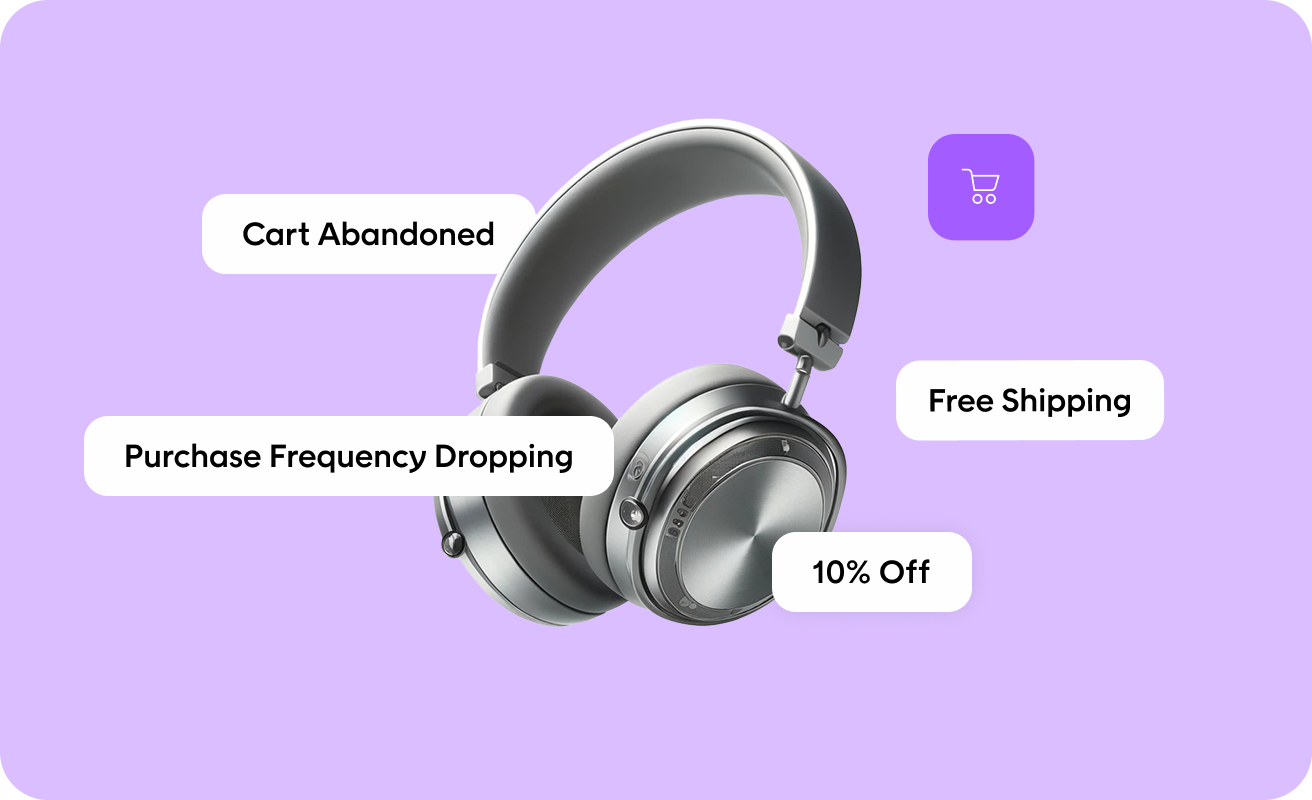
Most win-back campaigns start too late. Agentic AI helps retailers act proactively by identifying early warning signals.
Signals to monitor
- declining purchase frequency
- reduced on-site browsing
- lower response to campaigns
- rising returns or dissatisfaction
When these signals appear together, brand loyalty often weakens. AI agents help retailers respond earlier with adjusted journeys, personalized recommendations, or service recovery.
Loyalty retention and tier protection
Loyalty programs are one of the strongest drivers of customer retention, but many react only after customers disengage.
Agentic AI helps retailers detect early risk signals across the entire shopping journey.
| Loyalty signal | Retention response |
| Customer close to tier drop | Encourage one more purchase |
| Inactive loyalty points | Reintroduce rewards |
| Lower purchase frequency | Adjust personalized recommendations |
| Declining campaign engagement | Adapt omnichannel messaging |
A strong customer loyalty and retention strategy becomes more effective when loyalty signals trigger engagement actions. Platforms built for omnichannel engagement help retailers coordinate customer engagement across channels.
Post-purchase engagement that keeps customers coming back
Post-purchase engagement is often overlooked, even though it strongly influences customer satisfaction and brand perception.
Leading retailers treat this stage as part of the retention strategy.
Examples include:
- product education that builds product knowledge
- recommendations for relevant products
- feedback prompts that improve customer experience
- service recovery when issues appear
These interactions strengthen relationships with customers and increase repeat purchases.
High-value customer treatment
Not all customers contribute equally to revenue.
Agentic AI helps retailers identify high-value customers using signals from customer data and purchase behavior across the shopping journey. AI agents can adjust outreach automatically.
High-value customers may receive early product access, curated product discovery, or bundle offers that strengthen brand loyalty.
Retention is not one campaign. It is a system of connected moments that shape how customers experience brands over time.
What makes agentic retention work in retail and e-commerce
Agentic retention requires a strong foundation. Results depend on clean customer data, clear customer journey context, and defined guardrails.
Leading retailers now treat agentic commerce as part of their AI strategy. AI platforms and AI shopping agents help them understand consumer behavior and improve customer engagement.
Retailers are also preparing for a future where shopping agents and third-party agents influence how consumers discover brands online.
Clean first-party data
Agentic AI depends on reliable first-party data. Without it, AI agents and AI shopping agents cannot interpret consumer behavior or generate useful real-time insights.
Retailers need a clear view of the signals that shape purchase decisions.
Signals that power agentic retention
- purchase history and transaction data
- loyalty activity and rewards engagement
- browsing behavior across product pages
- product discovery signals during online shopping
Structured data and structured product data make signals machine-readable. Organized product information and customer data allow AI platforms to interpret the entire shopping journey.
This also prepares retailers for shopping agents that help consumers compare products and evaluate product knowledge before purchase decisions.
Customer and loyalty context in one place
Retention improves when retailers see the full context behind customer interactions, including loyalty activity, purchase behavior, and service signals.
When these signals live in one place, AI agents can interpret patterns across the entire shopping journey.
Platforms like Voyado connect customer data, loyalty context, and engagement workflows in one intelligence layer, allowing retailers to use their own AI agents inside existing marketing systems.
Clear business rules and human guardrails
Agentic AI improves decision-making, but it should not operate without boundaries.
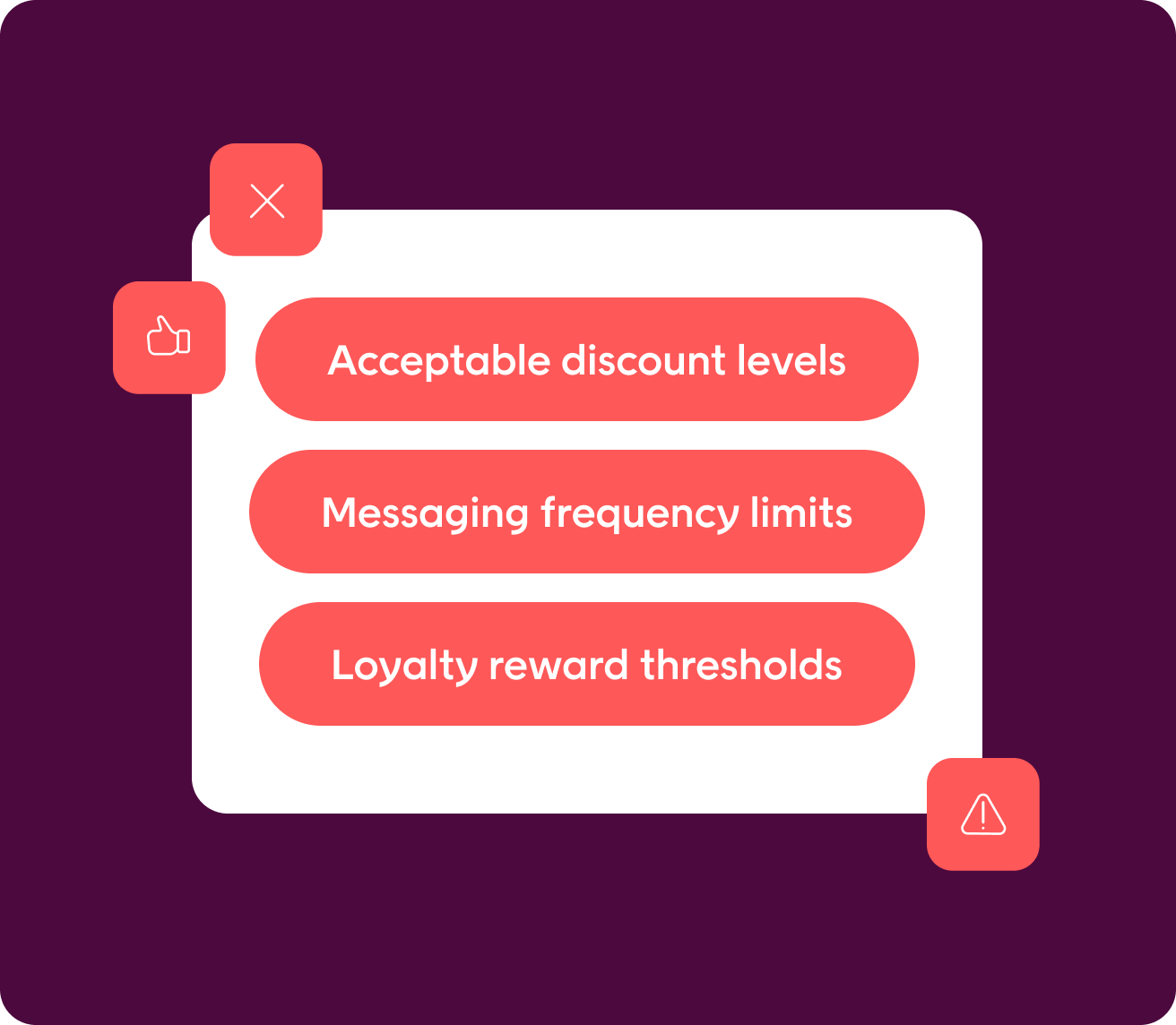
Retailers still need rules that protect margins, brand perception, and loyalty economics. AI agents and autonomous systems should operate within clear commercial guardrails.
Examples include:
- acceptable discount levels
- messaging frequency limits
- loyalty reward thresholds
Human input remains essential. Marketing teams define the AI strategy, while AI agents interpret signals and recommend actions.
This balance improves operational efficiency while protecting the customer experience.
Omnichannel activation
Retention actions should not be limited to email.
Customers move across many touchpoints during the shopping journey, including product pages on-site, loyalty programs, and AI assistants or AI shopping agents.
Agentic AI helps retailers activate customer engagement across channels so brands stay visible throughout the shopping journey.
Platforms built for omnichannel engagement coordinate email, SMS, push, apps, and social audiences to strengthen customer loyalty and retention.
Now you just need a playbook to take the next steps.
A practical framework for using agentic AI in retention
You do not need to rebuild your retention program to start using agentic AI. Start with journeys that have a clear CLV impact.
Many retailers overcomplicate this with abstract AI strategy discussions instead of asking where AI agents can improve customer engagement and repeat purchases first.
This step-by-step approach keeps the work focused and makes it easier to prove value.
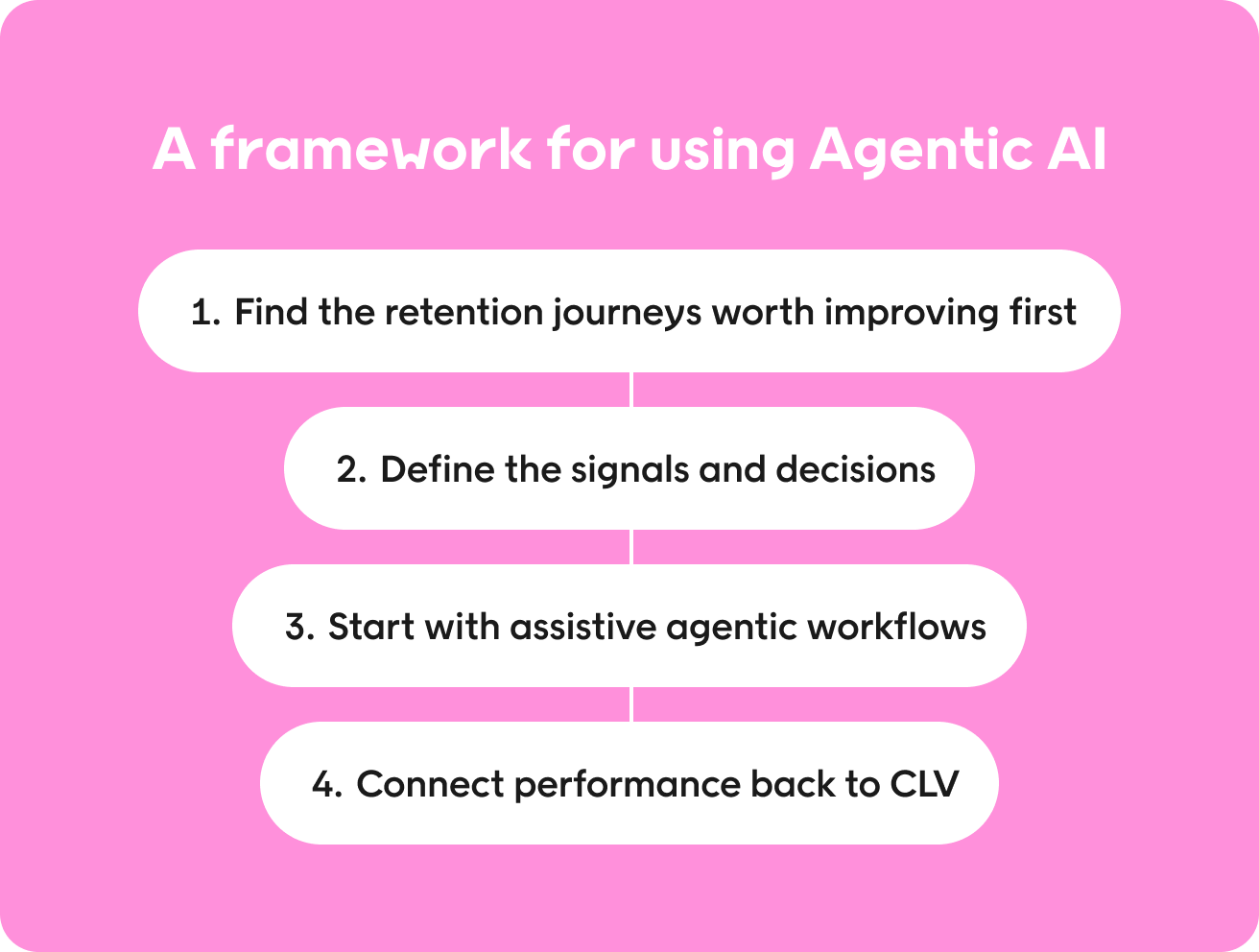
Step 1: Find the retention journeys worth improving first
Start with three to five journeys that already influence customer retention and customer lifetime value.
Don’t start everywhere at once. Pick the journeys where timing, relevance, and context have the biggest effect on whether customers come back.
A good shortlist usually includes:
- second purchase journeys
- replenishment programs
- churn prevention and win-back
- loyalty retention or tier protection
- VIP or high-value customer treatment
These journeys matter because they sit close to revenue. They also generate signals that AI agents can actually use.
If your team is unsure where to begin, use a simple filter.
| Journey | Why it is worth prioritizing |
| Second purchase | Helps turn new customers into repeat buyers |
| Replenishment | Supports predictable repeat purchases |
| Win back | Protects customer retention before churn grows |
| Loyalty retention | Strengthens customer loyalty and CLV |
| VIP treatment | Protects high-value relationships |
Start where the commercial impact is easiest to measure. That keeps the playbook grounded.
Step 2: Define the signals and decisions
Once you know which journeys matter most, the next step is to define what the system should detect and what action should follow.
Keep this simple and operational. For each journey, your team should answer three questions:
What should the system detect?
A drop in purchase frequency, lower loyalty engagement, more time between orders, or weaker on-site activity.
What decision should it support?
Whether to change the message, switch the channel, adjust the timing, or prioritize a different audience.
What action should follow?
Send a replenishment reminder, trigger a loyalty message, escalate a service issue, or recommend relevant products.
This is where first-party data becomes essential. AI agents need clean inputs to make context-aware decisions across the customer journey.
The best setups focus on the few signals that shape purchase decisions and consumer behavior.
Step 3: Start with assistive agentic workflows
Many retailers jump straight into deep automation, which often reduces trust. Start with assistive workflows instead.
Use agentic AI as an AI assistant for:
- prioritizing audiences
- spotting retention risk
- recommending next best actions
- identifying journeys that need attention
This lets teams test how AI agents perform without handing over every decision.
Assistive workflows also improve operational efficiency by reducing manual segmentation. This is especially useful for multi-brand retailers managing large customer bases.
Keeping human review in place lowers risk and helps teams capture cost savings over time.
Step 4: Connect performance back to CLV
If agentic retention is working, the results should show up in business outcomes, not just campaign metrics.
Track performance in ways that connect directly to customer lifetime value.
Focus on measures like:
| Metric | Why it matters |
| Repeat rate | Shows whether customers come back |
| Purchase frequency | Reveals how often customers buy |
| Time between orders | Helps spot stronger retention patterns |
| Loyalty engagement | Shows whether the relationship is deepening |
| Customer lifetime value | Connects retention activity to revenue |
This is the step that keeps the whole playbook honest. If a workflow improves open rates but does not improve repeat purchases, loyalty, or CLV, it is not creating enough value.
The goal is not to prove that AI exists in your stack. It is to prove that agentic commerce improves retention in ways that matter to your business.
But that only works when the strategy is implemented carefully.
Common mistakes to avoid when implementing agentic retention
Agentic AI improves retention only when it supports a clear strategy. Many retailers focus on tools instead of the retention journeys that drive customer lifetime value.
Using AI without a clear retention strategy
AI agents should support specific goals such as repeat purchase rate, customer loyalty, or churn reduction.
Treating agentic AI as a content tool only
Limiting AI to writing campaign copy misses the real value. Agentic AI should analyze signals across the entire shopping journey and help teams act proactively.
Over-automating without guardrails
AI agents need business rules around discounts, loyalty economics, and brand experience to protect margins and trust.
Ignoring loyalty and store signals
Retention should use more than campaign data. Loyalty activity, store interactions, and proprietary data reveal stronger engagement signals.
Running retention and acquisition in silos
When customer acquisition and retention operate separately, retailers miss opportunities to move traditional visitors toward loyalty and repeat purchases.
Failing to prove impact beyond opens and clicks
Real impact appears in metrics such as repeat purchase rate, loyalty participation, and customer lifetime value.
Next, measure whether agentic retention is actually improving these outcomes.
How to measure whether agentic retention is working
Agentic AI should improve outcomes that matter to the business. If results appear only in open rates or clicks, the strategy is not working.
The goal is measurable improvement across the entire shopping journey. When agentic commerce works well, retailers see stronger repeat behavior and higher loyalty participation.
More than half of retention gains often come from improving a few key journeys, not rebuilding every campaign.
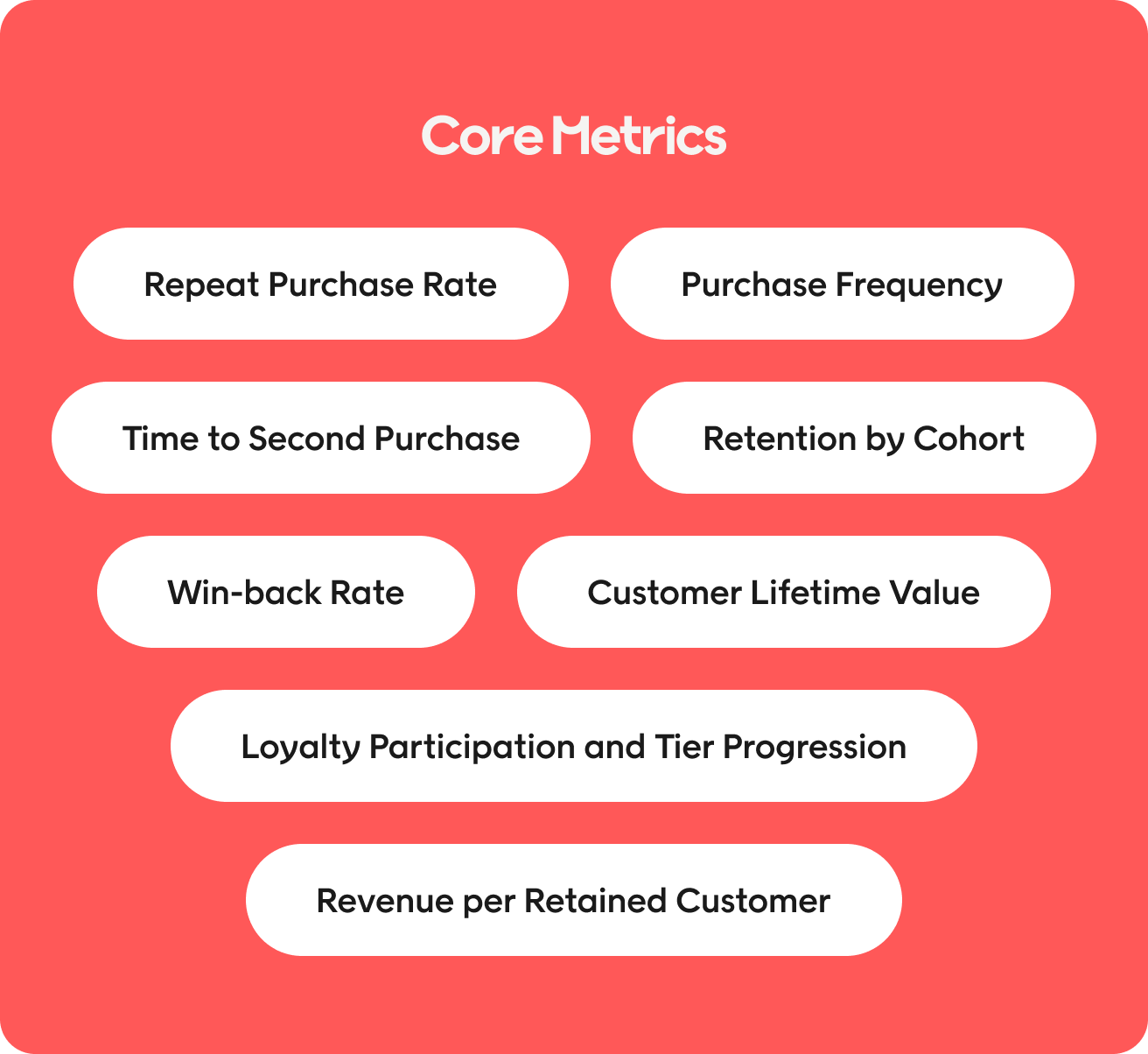
Core metrics to track
The right metrics show whether agentic AI is improving how customers engage, purchase, and return over time.
| Metric | Why it matters |
| Repeat purchase rate | Shows whether customers return after their first purchase |
| Purchase frequency | Indicates how often customers buy over time |
| Time to second purchase | Reveals how quickly new customers convert into repeat buyers |
| Retention by cohort | Helps teams see whether retention improves across customer groups |
| Win-back rate | Measures how effectively churned customers return |
| Loyalty participation and tier progression | Shows whether loyalty programs strengthen engagement |
| Customer lifetime value | Connects retention activity to long-term revenue |
| Revenue per retained customer | Reveals the commercial impact of retention strategies |
These metrics reflect the real value of retention efforts. When agentic AI performs well, retailers typically see stronger repeat purchases, improved delivery speed of relevant offers, and higher customer lifetime value across the entire shopping journey.
What to compare against
Measurement only works when there is something to compare.
Retail teams should evaluate how agentic retention performs against traditional approaches. This helps determine where AI creates significant value.
Key comparisons usually include:
| Comparison | What it reveals |
| Static automation vs. agentic journeys | Shows whether AI agents improve timing and relevance |
| Email-only vs. omnichannel journeys | Reveals how engagement changes across the entire shopping journey |
| Discount-led retention vs. loyalty-led retention | Tests whether loyalty strategies strengthen brand relationships |
| High-CLV vs. low-CLV retention strategies | Shows where retention investment generates the most impact |
These comparisons show where agentic commerce delivers a competitive edge.
As AI platforms and shopping agents shape online shopping behavior, measuring retention across the entire shopping journey becomes critical.
Retailers that track the right metrics understand how AI-driven engagement affects customer loyalty and revenue at global scale.
But turning those insights into action requires the right platform.
How Voyado supports agentic retention in e-commerce
Agentic retention works best when data, loyalty, and engagement live in the same system. If customer signals sit in separate tools, AI agents cannot interpret the entire shopping journey or act quickly.
Voyado connects customer data, loyalty signals, and engagement workflows so retailers can turn insights into actions that improve customer retention and customer lifetime value.
Loyalty-driven customer engagement
Voyado’s customer engagement platform combines omnichannel loyalty and agentic AI so retailers can run loyalty-driven engagement across the entire shopping journey.
Instead of treating loyalty as a separate program, retailers can connect loyalty signals directly to campaigns and customer interactions.
For example, AI agents can detect:
- customers close to a loyalty tier threshold
- declining loyalty participation
- slowing purchase frequency
These signals can trigger personalized recommendations, loyalty reminders, or targeted incentives that strengthen customer loyalty and brand loyalty.
Next-best actions based on real retail data
Agentic retention depends on understanding real retail signals.
Voyado’s AI layer turns customer data, loyalty activity, purchase history, and in-store behavior into next-best actions that marketing teams can use immediately.
That supports common retention journeys such as:
| Retention scenario | Example next-best action |
| Churn risk detected | Trigger retention messaging or service recovery |
| Slowing purchase frequency | Recommend relevant products |
| Loyalty disengagement | Activate loyalty incentives |
| Dormant customer returning on-site | Trigger personalized reactivation |
Because the AI models learn from real retail behavior, these decisions reflect actual consumer behavior across the entire shopping journey.
Insights, reports, and orchestration in one retail-native stack
Retention only improves when teams can see what is happening and adjust quickly.
Voyado combines engagement orchestration with analytics through insights and reports. This allows retailers to monitor customer engagement, track retention performance, and identify new opportunities across the shopping journey.
When insights, engagement, and loyalty signals live in the same environment, retailers can move faster and keep retention strategy, execution, and measurement closely connected.
Final thoughts
Retention in 2026 comes down to timing. The earlier you recognize signals that a customer is drifting, the more options you have to respond.
Agentic AI helps retailers move beyond fixed retention flows. Instead of reacting after engagement drops, teams can respond to signals across the shopping journey while the relationship is still active.
The retailers that benefit most will not simply automate more campaigns. They will focus on better decisions, clearer signals, and stronger context around how customers interact with their brand.
Voyado supports this shift by bringing loyalty, engagement, insights, and agentic AI into one retail-focused platform. This allows teams to translate signals across the shopping journey into actions that strengthen customer retention and long-term CLV.
Explore how Voyado helps retailers turn customer signals into retention actions that grow CLV by booking a demo.
FAQs
What is agentic AI customer retention for e-commerce?
Agentic AI customer retention ecommerce uses AI agents to analyze customer data and respond to signals across the shopping journey. Instead of static automation, AI systems detect behavior changes and trigger actions that support customer retention and loyalty.
How is agentic AI different from normal lifecycle automation?
Traditional lifecycle automation follows fixed rules and pre-built flows. Agentic AI analyzes real-time customer interactions and can adjust decisions, messaging, and timing across the entire customer journey.
Can agentic AI improve e-commerce customer lifetime value?
Yes. Agentic AI helps retailers increase repeat purchases, improve customer engagement, and strengthen customer loyalty. These improvements typically increase customer lifetime value over time.
What data is needed for agentic retention?
Agentic retention depends on high-quality customer data such as purchase history, loyalty activity, engagement signals, and behavioral data across channels. Structured product data and first-party data help AI systems interpret the shopping journey accurately.
How does agentic AI support loyalty programs?
Agentic AI helps retailers detect loyalty risks and opportunities earlier. It can trigger personalized offers, loyalty rewards, or service actions that protect customer satisfaction and strengthen brand loyalty.
What retention journeys should retailers start with first?
Retailers usually start with journeys that have a clear CLV impact, such as second purchase journeys, churn prevention, replenishment reminders, and loyalty reactivation.
How does Voyado support agentic retention in retail and e-commerce?
Voyado combines loyalty, customer engagement, and AI-driven decision-making in one retail-focused platform. This allows retailers to act on customer signals and run agentic retention strategies across channels.