According to Voyado’s State of AI in retail report, 95% of retailers are already experimenting with AI. They’re testing tools, exploring use cases, prompting, automating, building, and trying to understand where the technology fits. And yet, only 5% report clear, scalable ROI. That’s more of a cavern than a gap, and it suggests that the challenge for retailers is no longer access to AI, but turning AI into something that improves the way the business works.
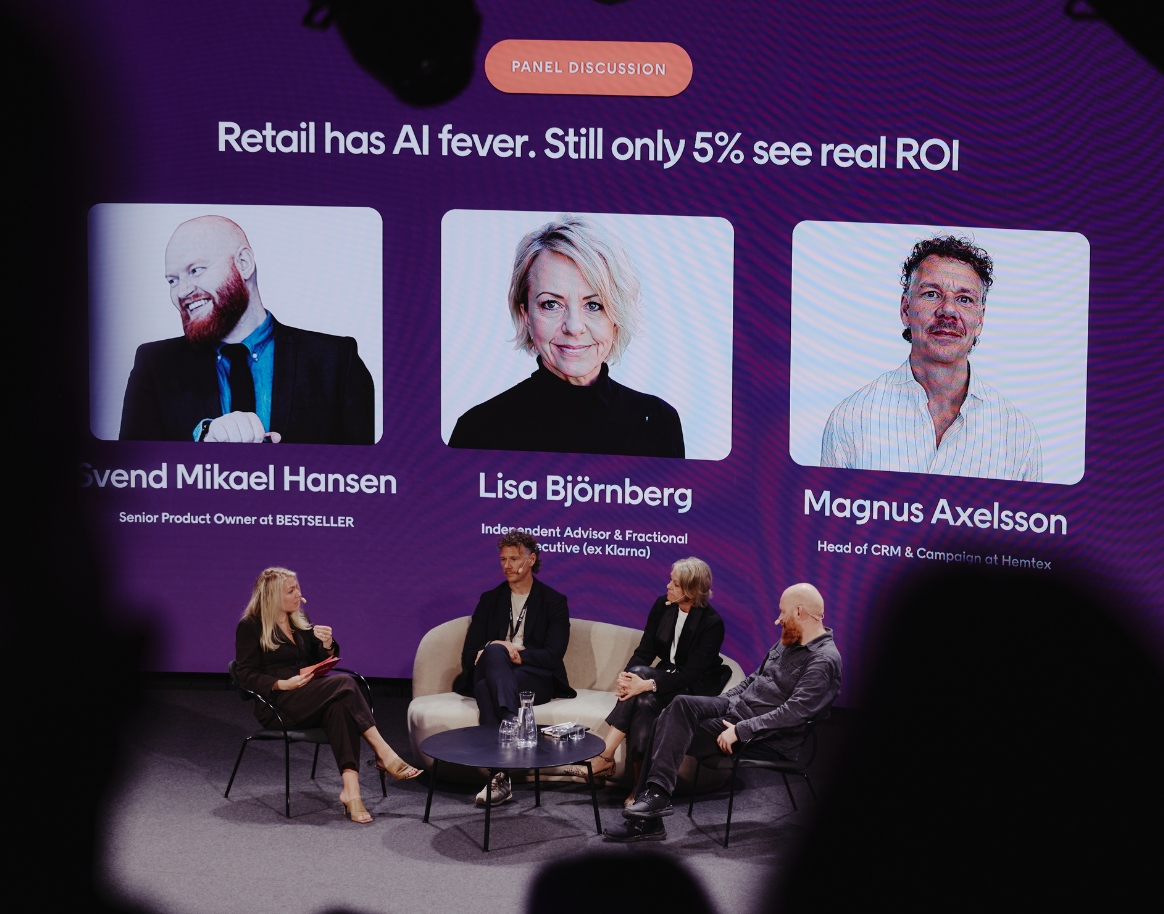
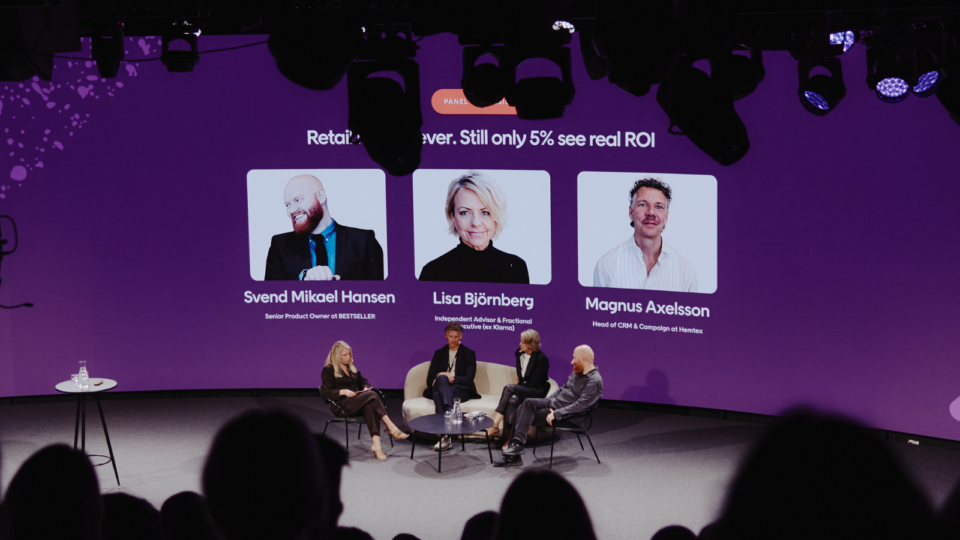
At Love Generation 2026, this was the focus of a panel discussion with Svend Mikael Hansen, Senior Product Owner at BESTSELLER, Magnus Axelsson, Head of CRM & Campaign at Hemtex, and Lisa Björnberg, an independent advisor and fractional executive with experience leading transformation across companies including Klarna and HubSpot.
The conversation picked up naturally from Jennifer Stevens’ Love Generation session on what retailers still misunderstand about AI. Jennifer explored where AI is reshaping retail, and why many of the most valuable use cases are more practical than glamorous. The panel took that one step further: once retailers know where value might be, how do they actually get there?
You can watch the full panel discussion here, but the central message was this: AI value is coming from choosing better problems, building stronger foundations, and helping people change how work gets done.
Start with one problem worth solving
When organizations first begin exploring AI, it’s tempting to chase every opportunity. A new tool appears, a team starts experimenting, someone builds a proof of concept, and another department launches a chatbot. Before long, dozens of interesting initiatives are happening across the business, with each solving a slightly different problem.
Watch out for activity theatre
Lisa Björnberg has spent the past several years helping organizations navigate AI transformation, first at Klarna, then at HubSpot, and today as an advisor working with companies across industries, and it’s a pattern she comes across regularly: “What I see is that there’s a lot of AI initiatives in organizations that are quite fragmented and scattered… I call it activity theatre.”
‘Activity theatre’ is a memorable phrase because it describes something many retailers will recognize. Lots of movements, tons of enthusiasm, but very little connection between the individual initiatives. This leads to situations where valuable ideas never make it into everyday operations because they aren’t tied to the business challenges that matter most.
Identify friction and use AI to remove it
Lisa argued that the next stage of AI maturity requires a change in focus.
Instead of spreading AI horizontally across dozens of disconnected projects, retailers should identify a small number of meaningful business problems and solve them deeply.
That might mean:
- improving customer retention
- reducing the time it takes to launch campaigns
- simplifying reporting
- enriching product information
- increasing search relevance
- etc.
The specific challenge matters less than the principle behind it. AI creates the greatest value when it starts with a business objective rather than a technology objective.
That shift in thinking feels simple, but it completely changes the conversation. Rather than asking, “Where can we use AI?” teams begin asking, “Where are we creating the most friction for customers or colleagues, and how can AI help remove it?”
Build strong foundations before you scale
If solving the right problem is the first step, having the right foundations is the second.
Throughout the panel, one message surfaced repeatedly: AI works best when it strengthens capabilities that already exist. And Magnus Axelsson offered a practical example from his work leading CRM and campaigns at Hemtex.
Long before generative AI entered the conversation, his team had already built a strong culture around customer data, testing, and measurement, with AI accelerating these disciplines rather than replacing them.
Audience creation that once required significant manual work can now happen almost instantly, and campaigns can be adapted for different customer segments in a fraction of the time, giving the team far more opportunities to test, learn, and improve.
Because the foundations were already in place, AI could slot naturally into an existing way of working. Customer data remained central. Testing remained central. Measuring outcomes remained central. AI simply allowed the team to do more of what they were already doing well.
Building AI on shaky foundations will accelerate your inefficiencies
Many organizations invest in AI before investing in the quality of their customer data, the clarity of their processes, or the way different systems connect. In those situations, AI often exacerbates inefficiency rather than removing it.
Retailers seeing stronger results tend to take the opposite approach. They invest in understanding their customers, building reliable data foundations, and creating repeatable processes. AI then becomes an accelerator rather than a workaround.
It’s also where connected technology starts to matter, with customer data, loyalty, personalization, campaigns, and product discovery becoming far more valuable when they work together rather than when they exist in separate systems. Al strengthens the connections between these capabilities, helping retailers move from insight to action more quickly and with greater confidence.
Bring your people with you
Technology rarely transforms an organization on its own. It takes buy-in from people.
That was one of the strongest messages from Svend Mikael Hansen, whose team at BESTSELLER already uses AI across areas including software development and translation. The technology has become part of everyday work, but Svend was quick to point out that the real transition has never been about choosing the right tool. It’s all about helping people feel confident enough to use it: “It’s a transition of the team that’s important. Not so much the tool itself.”
That distinction matters because AI adoption is often measured in licenses, pilots, or new platforms, with far less attention given to the human side of the change.
Do people understand where AI fits into their work? Do they trust the output? Do they know when to rely on it and when to challenge it?
Without that confidence, even the most capable technology struggles to gain traction.
At BESTSELLER, creating that confidence starts with trust. Teams are encouraged to experiment, make decisions, and learn from the outcome. The expectation isn’t that every idea will succeed, but that every experiment should teach the organization something.
One comment from Svend captured that mindset perfectly: “Nobody’s ever been fired for taking the right decision based on the information they had at hand.” And it’s a refreshing perspective in a conversation that often focuses on speed.
As AI becomes part of more everyday workflows, that kind of culture becomes increasingly valuable. The organizations seeing the greatest progress are helping people build confidence alongside their technology rollouts.
Let AI reshape the workflow
Perhaps the biggest shift in thinking came when the discussion moved beyond individual productivity.
AI can absolutely help someone write faster, analyze data more quickly, or summarize a meeting. Those gains are real, but they only tell part of the story.
The bigger opportunity appears when organizations step back and rethink the workflow itself.
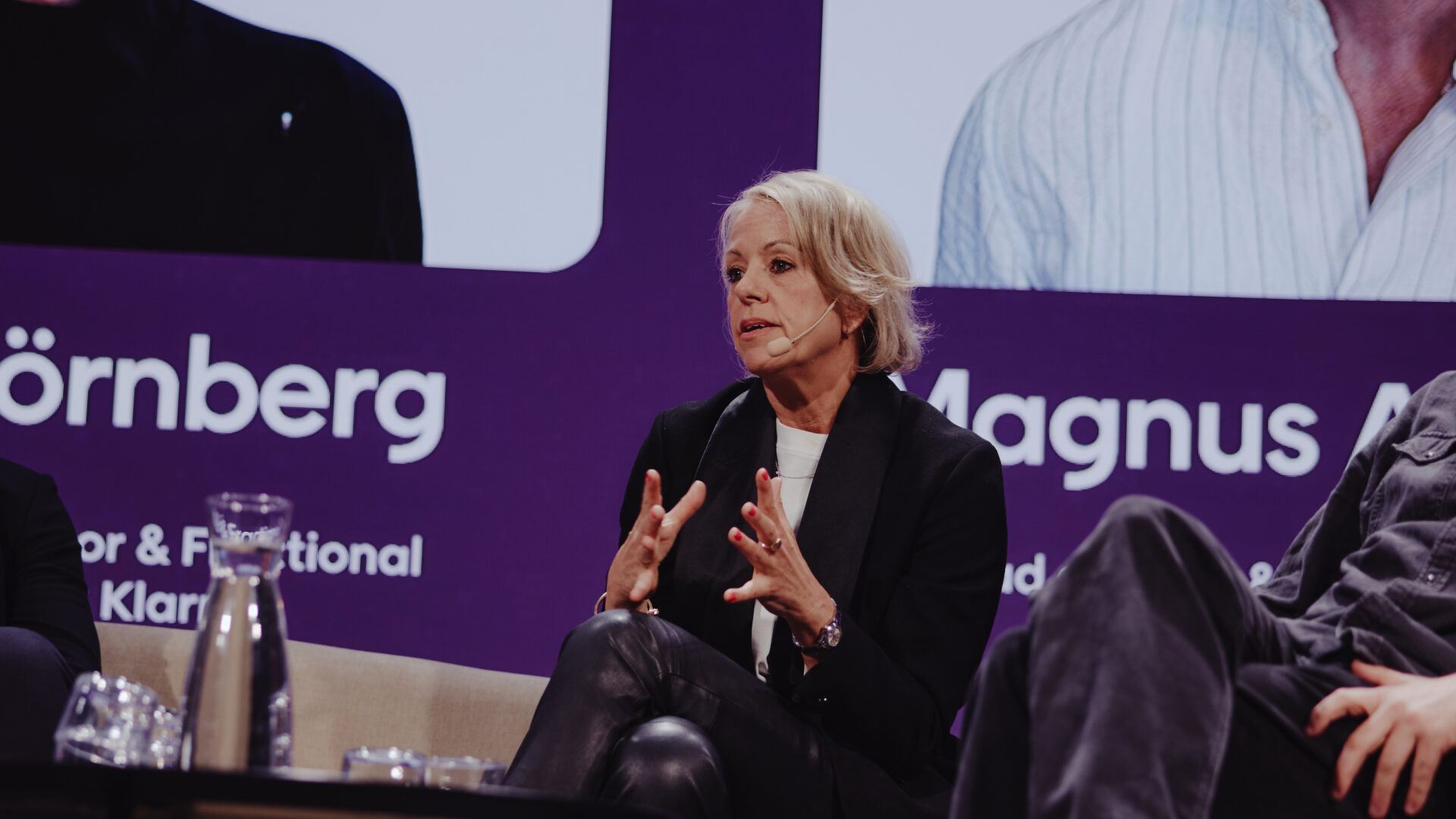
Lisa Björnberg illustrated this with an example from her time at HubSpot. Marketing teams were spending hours every week pulling together reports, moving data between systems, building presentations, and sharing updates across the organization. Rather than asking how AI could speed up each of those individual tasks, the team looked at the entire process. Then they removed it.
“We removed an entire workflow. And that’s where the magic happens,” explained Lisa.
Operational AI isn’t about completing familiar tasks a little faster. Instead, it’s about redesigning how work flows across the organization.
For retailers, those opportunities exist everywhere. Product information can be enriched automatically before products go live. Campaign audiences can be created and refined in seconds instead of hours. Search results can adapt to customer intent in real time. Merchandising teams can spend less time managing data and more time improving the shopping experience.
The common thread is friction reduction, and this is where connected platforms make the greatest difference. When customer data, product information, loyalty, search, and marketing all work together, AI becomes part of the operational fabric of the business rather than another standalone capability.
Keep learning, not just launching
One of the most encouraging themes throughout the discussion was that operationalizing AI isn’t about finding a perfect solution, but about building a better learning loop.
Magnus explained that AI has transformed the pace of experimentation at Hemtex. Tasks that once limited the team to one or two meaningful tests each month can now be completed far more quickly, making it possible to create more audience segments, test more campaign variations, and feed those results straight back into the next iteration. In this way, the tech enables greater speed, but the learning is what creates the value.
Running more experiments only matters if organizations use those experiments to make better decisions. Every test should answer a question. Every result should improve the next campaign, the next workflow, or the next customer interaction. This is where AI becomes part of a culture of continuous improvement and not just another productivity tool.
Retail has always rewarded organizations that understand their customers better than anyone else, and AI simply allows those feedback loops to happen faster, giving teams more opportunities to learn, adapt, and improve the customer experience.
Ultimately, the organizations making the strongest progress aren’t trying to automate every decision.
They’re creating better conditions for better decisions to be made.
About Author