TL;DR
- Email deliverability is whether your emails reach the inbox instead of spam folders, and it can slip even when every send reports “delivered.”
- Diagnose first: check inbox placement rates, clean list quality, and restore the engagement metrics inbox providers watch.
- Invalid point-of-sale (POS) addresses and inactive subscribers get untargeted sends, and internet service providers (ISPs) read falling engagement as falling credibility.
- Google’s published bulk sender guidance requires email authentication, one-click unsubscribe, and a spam complaint rate kept below 0.3%.
- Fix the loop between list quality, engagement, and send decisions to build a positive sender reputation and recover inbox placement across UK and EU sends.
Your email deliverability is slipping when opens slide while sends look clean and dashboards stay green. Gmail and Outlook route retail email campaigns to the Promotions tab or the spam folder as credibility drops. Invalid POS addresses and untargeted sends to disengaged contacts make the decline feed itself.
Before, you guess every time you hit send. After, with a connected data loop, you diagnose inbox placement and fix it, market by market.
What email deliverability really means for retail brands
Email deliverability refers to your ability to land messages in the recipient’s inbox, not the spam folder. For retail teams in London or Lyon, sends look clean while opens slide and revenue dips before bounces appear.
Low engagement and poor list quality, like misspelled POS addresses, lower credibility with Gmail and Outlook spam filters. List quality, engagement, and send decisions form one loop that decides inbox placement.
Delivery is not deliverability
Validity and Klaviyo both draw a clear line between the two:
- Email delivery: the receiving mail server accepted your message.
- Deliverability: the message reached a folder the subscriber sees.
So a clean delivery rate can hide poor placement. Invalid email addresses add bounces and slow ISP acceptance.
Why mailbox providers move retail emails out of sight
Inbox providers read engagement, complaints, and list quality as credibility signals, so untargeted sends to disengaged contacts deepen the slide. Irrelevant content drives unsubscribes, an early warning, while wider engagement builds ISP confidence. Segmenting for relevant content is your primary lever.
Why Promotions is annoying but spam is expensive
Count the Gmail Promotions tab as inbox placement. It only costs visibility against the Primary inbox, while spam erases the send. Subscribers who rescue mail from spam folders help build a positive sender reputation.
Internet protocol (IP) reputation quantifies credibility, often on a 0-100 scale like Validity’s Sender Score. Tracked opens alone can’t prove spam placement.
How to check email deliverability before you change anything
Check email deliverability before you change anything, because sliding opens are a problem without proof. Diagnosing first separates list problems from content problems, so you resolve deliverability issues instead of guessing.
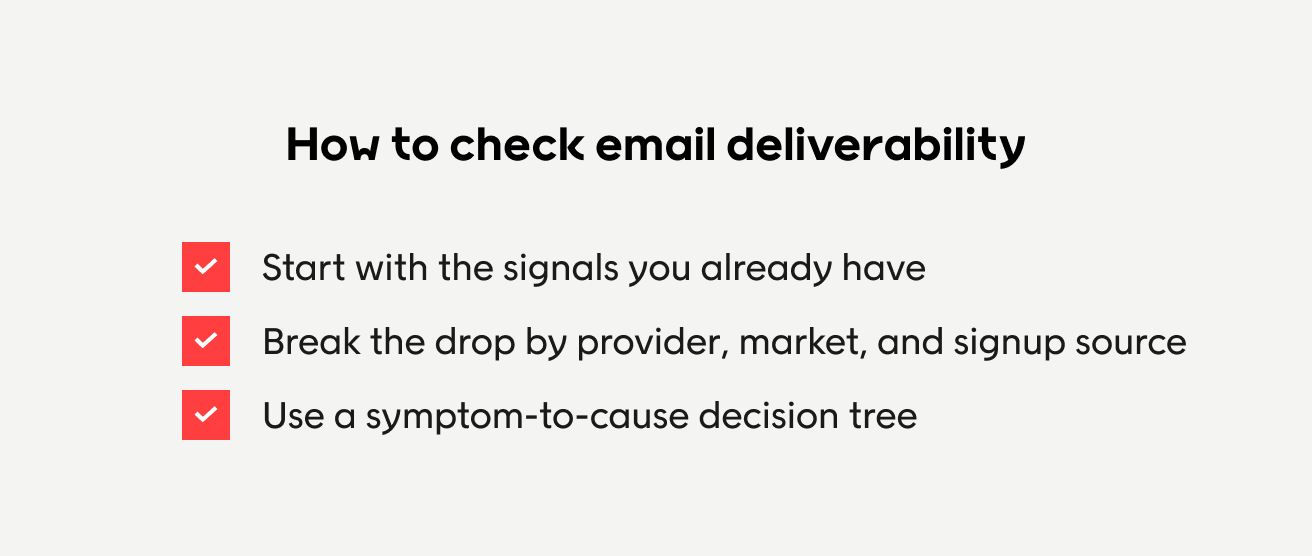
Start with the signals you already have
Review five early-warning signals in priority order:
- Open rate
- Click-through rate (CTR)
- Unsubscribes
- Complaints
- Bounces, starting with permanent delivery failures
Compare each against your own recent baseline, and treat rising unsubscribes as your earliest warning.
Break the drop by provider, market, and signup source
Global averages hide local email performance problems, so split reporting by:
- Popular mailbox providers like Gmail and Outlook
- UK and EU market
- Language
- Signup source (in-store POS versus online)
A Gmail-only drop in one market needs a different fix than a broad decline. Voyado Customer Engagement brings market, channel, and signup source into one view.
Use a symptom-to-cause decision tree
| Symptom | Likely cause |
| Falling opens, stable clicks | Post-peak email fatigue |
| Rising unsubscribes | “Same look, same offer” sends |
| Rising bounces after a POS campaign | Poor capture quality |
| Sudden drop at one provider | Authentication or sending IP reputation issues (check the 0-100 score) |
Confirm the likely cause before you touch segmentation, send time, or email infrastructure.
What an email deliverability test can and cannot tell you
An email deliverability test turns your spam-placement hunch into evidence, though one result won’t judge your whole list. IP reputation is one input among several, so treat even a free email deliverability test as directional evidence.
What can a seed list placement test show?
Seed tests send to test email addresses at each provider and show inbox, Promotions, or spam patterns, including local ones like GMX or Orange. A confirmed provider-level pattern is worth acting on.
What DNS, header, and reputation checks can show
- Domain name system (DNS) checks confirm the DNS records behind domain authentication and alignment.
- Header checks catch technical errors.
- The 0-100 IP score ranks which fixes come first.
Clean authentication won’t fix a poor sender reputation while bounced email addresses stay on your list.
What a single email deliverability test cannot prove
One test can’t equal audience-wide deliverability, so monitor email deliverability over time across placement, authentication, and engagement. Two factors mislead most.
Apple Mail Privacy Protection muddies open data
Apple Mail Privacy Protection can inflate opens, so weight clicks, unsubscribes, and conversions more heavily.
A small seed list is not your audience
A few dozen seed email addresses can’t represent 500,000-2 million contacts, so trust segment-level results. Voyado pairs a unified first-party data model with segmentation, list hygiene, and sending infrastructure to diagnose issues at scale.
4 retail email deliverability issues that show up first
Retail teams create most email deliverability issues, and spam filters simply react. Four show up first.
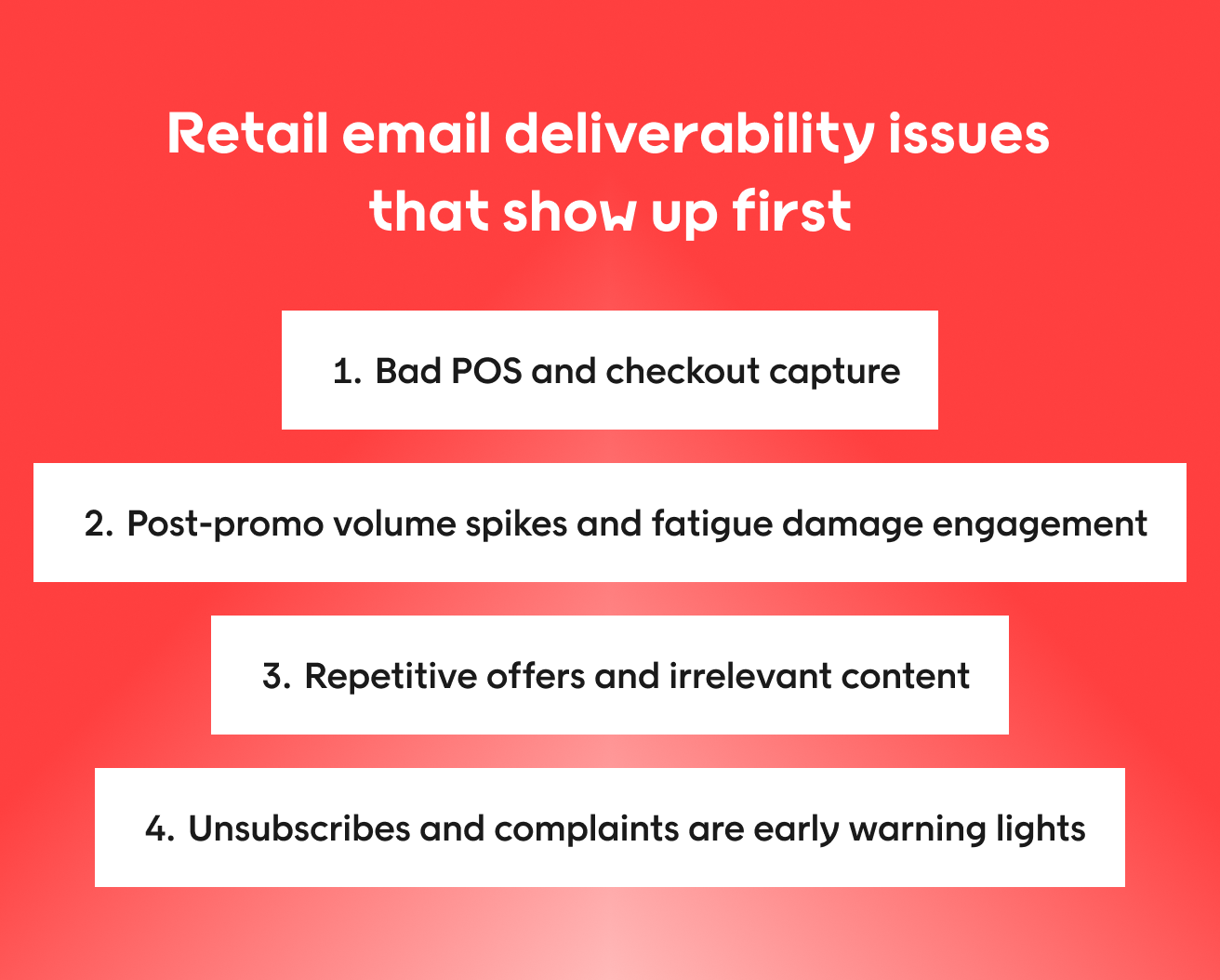
1. Bad POS and checkout capture creates silent list decay
Misspelled, outdated, and shared addresses from stores and checkout raise bounces silently because nothing visibly breaks. Old addresses can even turn into spam traps that providers use to flag senders. Voyado builds list hygiene into a retail-focused CRM foundation.
2. Post-promo volume spikes and fatigue damage engagement
Credibility often dips after Black Friday or the January sales, as back-to-back bulk emails cut opens and lift unsubscribes. Review last year’s peak timing, subject lines, and e-commerce email marketing tactics.
3. Repetitive offers and irrelevant content train people to ignore you
“Same look, same offer” campaigns depress engagement, which inbox providers read as declining relevance. Voyado makes segmentation, your primary lever, easier with no-code segments and product affinity campaigns.
4. Unsubscribes and complaints are your early warning lights
Treat rising unsubscribes and complaints as leading indicators. Left alone, complaints tell providers you’re sending spam. Catch them early, and recovery stays cheap.
Your sender reputation starts with authentication and infrastructure
Email deliverability rests on authentication protocols and sending infrastructure. But for 500,000-2 million UK or EU contacts, those fixes only hold once list quality and engagement improve.
SPF, DKIM, and DMARC need alignment, not box-checking
- Sender Policy Framework (SPF) proves the SMTP server may send for your sending domain.
- DomainKeys Identified Mail (DKIM) proves nobody altered the message.
- Domain-based Message Authentication, Reporting, and Conformance (DMARC) tells receivers what to do when checks fail.
Your visible From domain must align, and passing still won’t guarantee placement.
Shared and dedicated IPs solve different problems
| Factor | Shared IP | Dedicated IP |
| Control | Lower | Full |
| Warm-up effort | Minimal | Planned ramp |
| Reputation isolation | Shared with other senders | Yours alone |
| Volume requirement | None | Steady volume |
Each suits a different email sender, so match the choice to your volume.
What Google, Yahoo, and Microsoft expect in 2026
Google and Yahoo began enforcing bulk sender rules in February 2024, and Microsoft followed for Outlook consumer inboxes in May 2025. Their published guidance expects:
- Email authentication with SPF, DKIM, and DMARC for bulk senders, per Google, Yahoo, and Microsoft
- A spam complaint rate kept below 0.3% as reported in Google Postmaster Tools, ideally under 0.1%, per Google
- One-click unsubscribe in marketing email, per Google and Yahoo
Make leaving easy, since an unsubscribe beats a complaint. Voyado builds in list hygiene, segmentation, and sending infrastructure.
The email deliverability rate that matters for retail teams
Email marketing deliverability can’t live in one headline number, since it hides the loop forming. Track your deliverability rate across four layers, list quality included.
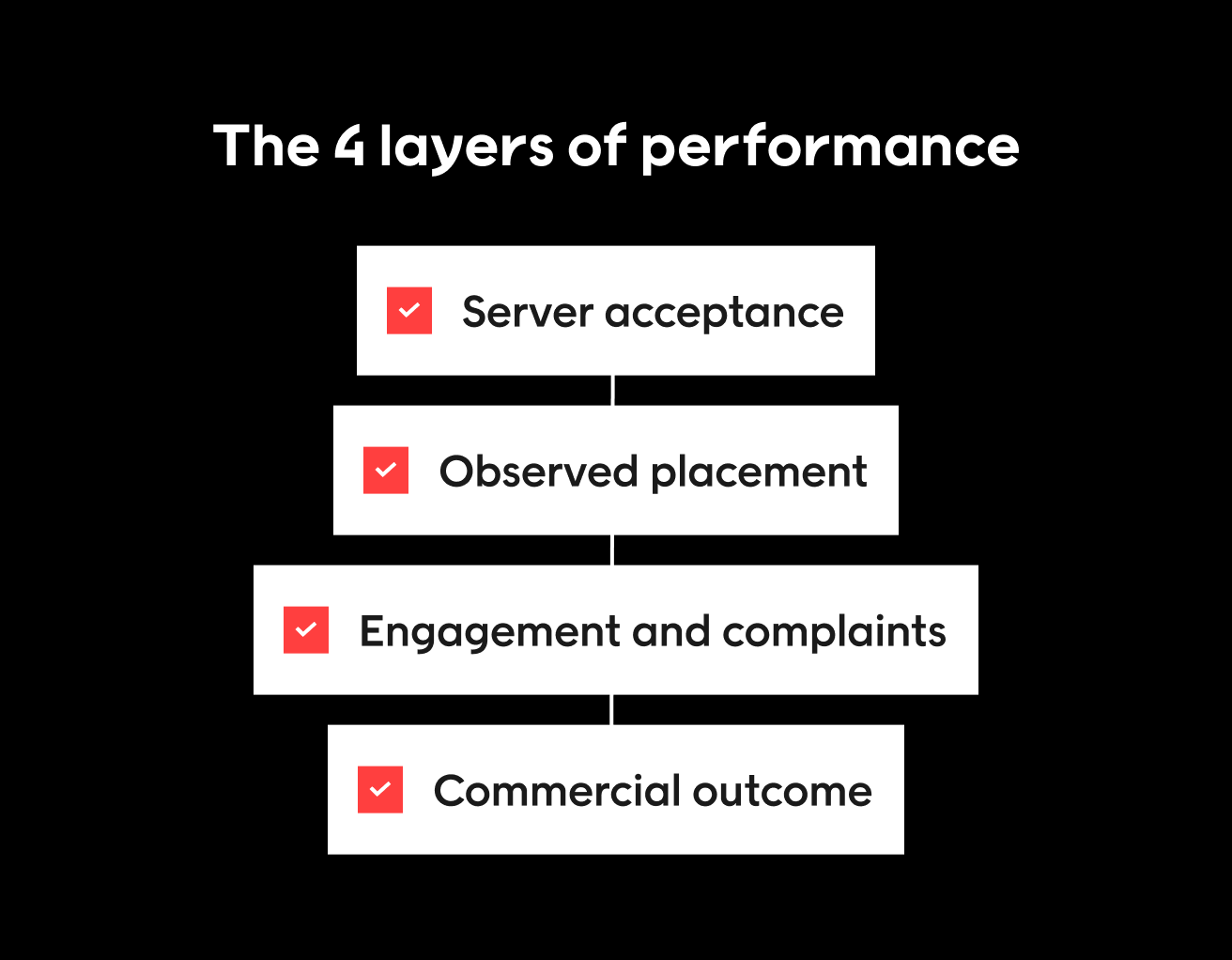
Track 4 layers of performance, not 1 headline metric
Copy this worksheet:
| Layer | Question it answers | Where to look |
| Server acceptance | Did the server take it? | Bounce reports |
| Observed placement | Where did it land? | Seed tests, provider diagnostics |
| Engagement and complaints | How do inbox providers read you? | Opens, CTR, unsubscribes, complaints |
| Commercial outcome | Did it sell? | Conversion, repeat purchase, revenue |
Connect campaigns, customer base, sales, and loyalty in one view.
1. Server acceptance
Mail servers accepting a message isn’t the same as “visible to the shopper,” and invalid POS addresses become permanent delivery failures that slow acceptance.
2. Observed placement
Seed tests and provider diagnostics show where emails land. The Promotions tab is fine, and spam is a failure, so test the providers your subscribers use.
3. Engagement and complaints
ISPs read engagement metrics like opens, clicks, unsubscribes, and complaints as reputation inputs, and irrelevant content lifts unsubscribes.
4. Commercial outcome
Tie placement to revenue, the real measure of email marketing success. Voyado customers see an average 8% increase in purchase frequency and a 27% increase in conversion [NEEDS: source link or attribution for both figures]. These are platform-wide outcomes that placement alone doesn’t explain.
Use provider-level and market-level benchmarks
Compare by provider, market, and signup source instead of one universal email deliverability rate.
Example: Gmail holds in the UK while Outlook slips in Germany. Pair that split with your 0-100 sender score in one multi-market view to see which market needs fixing.
Know where open and click data lies to you
Two things distort your engagement data:
- Apple Mail Privacy Protection inflates opens.
- Security scanners inflate clicks.
Favor click-to-open rate (CTOR) trends, complaints, and conversions, and pair them with seed-test placement.
How to improve email deliverability with segmentation and relevance
Email deliverability rarely recovers while you send emails to your whole list. Here’s how to improve email deliverability: segment for relevant content, then track opens, CTR, and unsubscribes.
Start with engaged segments before you widen reach
- Send to contacts who opened or clicked in the last 90 days.
- Add contacts engaged in the last 180 days once complaints hold steady.
- Run a reactivation campaign for inactive subscribers, then suppress non-responders.
Watch opens, CTR, and complaints at each step. Staged widening can improve sender reputation, but no sequence guarantees inbox placement.
Use product affinity and post-purchase help content
Voyado uses AI for product recommendations to build real-time product affinity segments with no code. Pair them with purchase help, like coat care guides or sizing advice, to earn the opens “same look, same offer” campaigns lose.
Add store and stock context to make campaigns worth opening
Local assortment, in-store stock, and store events give omnichannel shoppers a reason to open. Voyado adds that context from a single view of customer activity online and in store, which lifts engagement but can’t guarantee inbox placement.
3 email deliverability best practices for volume, timing, and channels
Email deliverability best practices start with volume, since overlapping sends erode engagement signals. Three habits help.
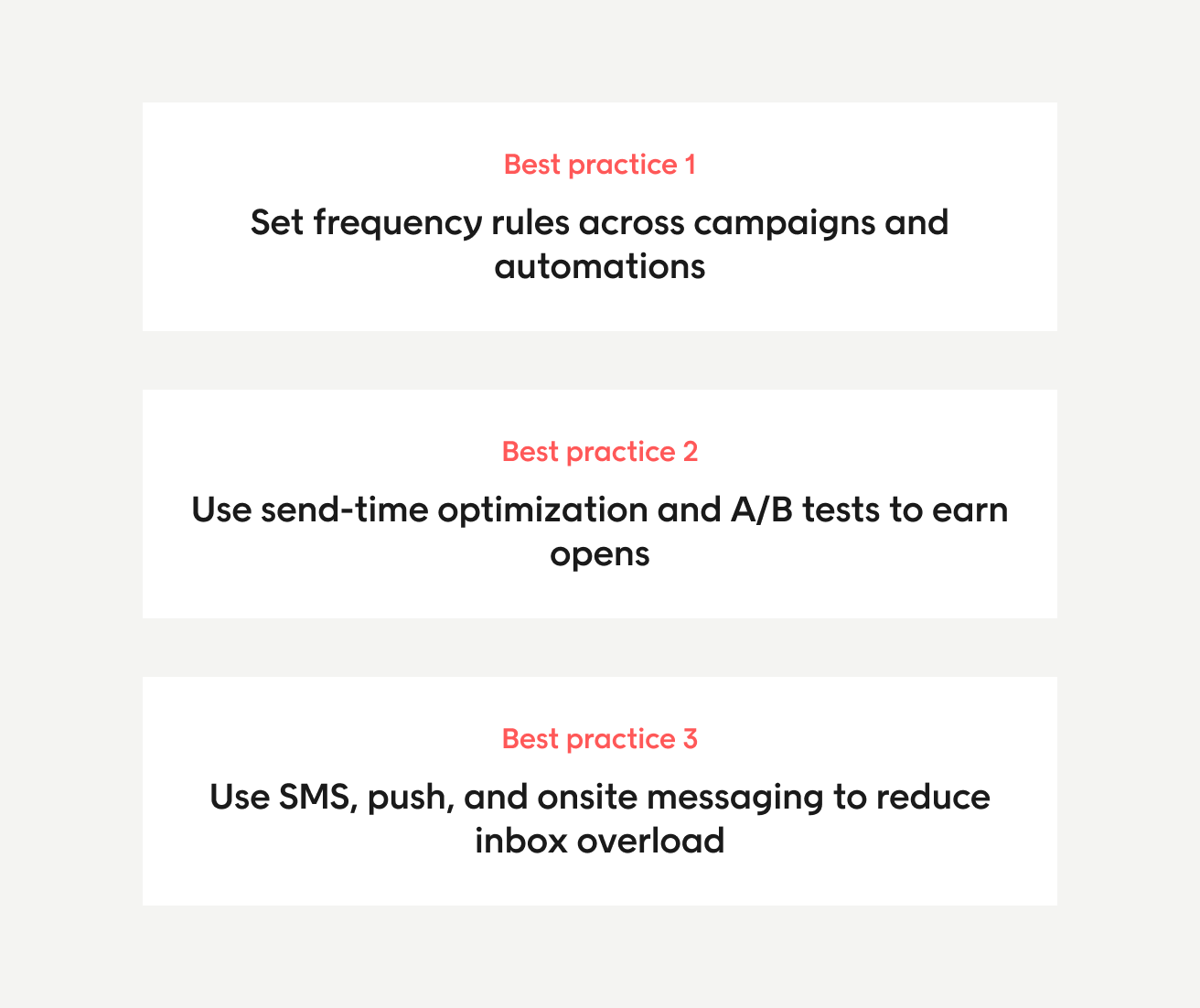
1. Set frequency rules across campaigns and automations
One Amsterdam shopper can get a promo, an abandoned cart flow, and a loyalty reminder in one week.
Following marketing automation best practices, set unified suppression and one contact-pressure cap per customer, with service messages first and promotions last. Voyado holds one cross-channel customer view, so suppression works everywhere.
2. Use send-time optimization and A/B tests to earn opens
Send-time optimization uses each subscriber’s past opens and clicks to decide when you hit send. A/B test subject lines, pre-headers, and offers as a habit.
3. Use SMS, push, and onsite messaging to reduce inbox overload
Move time-sensitive alerts and post-purchase help out of subscribers’ inboxes. Voyado covers SMS and rich communication services (RCS), app push, and onsite messaging.
Each channel needs its own UK or EU consent, and no shift bypasses an email opt-out.
A UK and EU consent checklist for deliverability work
Email deliverability is a technical discipline that sits beside legal permission. Three sets of rules decide whether your email marketing may reach a contact at all:
- The UK General Data Protection Regulation (UK GDPR)
- The Privacy and Electronic Communications Regulations (PECR)
- EU ePrivacy laws
Deliverability practice is not the same as legal permission
Cleaning addresses and earning engagement help placement but never create permission. UK GDPR and PECR govern UK sends, and EU GDPR and ePrivacy rules govern EU sends. US guidance built on the CAN-SPAM Act’s opt-out model doesn’t transfer. Confirm requirements with counsel.
What to capture at POS, checkout, and loyalty signup
Clean consent at capture breaks the loop. Store this proof for every contact:
- Consent timestamp
- Capture source (POS, checkout, or loyalty signup)
- Market
- Language
- Suppression history
Validate addresses whenever you collect customer data in-store, since invalid email addresses from POS entries drive bounces. Voyado keeps consent records attached to one profile in a unified first-party data model.
When soft opt-in may apply in the UK and EU
Soft opt-in is a limited PECR and ePrivacy exception that varies by country. A purchase or loyalty membership doesn’t automatically grant email permission. Document your basis, stay relevant, and keep unsubscribing easy.
Email deliverability tools by job to be done
Email deliverability spans DNS, placement, reputation, and lists, and no dashboard covers it all. Opens and CTR only flag symptoms of weak email performance. Euro and pound pricing often isn’t public, so confirm it before shortlisting email deliverability tools.
6 email deliverability tool categories and what each is for
No category covers every question:
1. DNS and authentication checks
These check your DNS records for SPF, DKIM, DMARC, and alignment, since misaligned mail loses ISP trust early. They can’t show placement.
2. Header and content analysis
These flag header, link, and rendering problems across email clients, often with a spam score for each email message. Use them to compare image-heavy and minimalist designs that might trigger spam filters.
They can’t predict behavior. Avoiding spam trigger words helps at the margins, but filters weigh engagement more.
3. Seed list placement tests
These estimate inbox placement rates across popular mailbox providers, including UK and EU ones. They use seed email addresses, not real subscribers’ inboxes, so results are estimates. A free email deliverability test usually falls in this category.
4. Mailbox-provider reputation data
Sources like Google Postmaster Tools show domain reputation and spam rates, and Sender Score rates each IP address 0-100, so you can rank fixes. They can’t explain causes.
5. Address validation and list hygiene
These catch invalid, risky, or stale addresses, including bad POS captures and spam traps, before bounces climb. They can’t lift engagement.
6. ESP and CRM reporting
Email service provider (ESP) and CRM reports show engagement and send history for your email campaigns. They can’t show placement. Voyado Customer Engagement builds in list hygiene, segmentation, and sending infrastructure.
Questions to ask about UK and EU data handling
- Where do you host UK and EU data?
- Will you sign a data processing agreement under UK GDPR and EU GDPR and list your sub-processors?
- What test data do you retain, and for how long?
Only consented, validated addresses belong in tests.
Who should own testing, remediation, and reporting
- Your CRM team owns hygiene, segmentation, cadence, and engagement reporting.
- Your IT team owns DNS records, domain authentication, and email infrastructure.
- Your deliverability support team owns seed testing, reputation monitoring, and escalation.
Clear owners resolve deliverability issues faster. Voyado adds guided enablement and ongoing support.
When the platform is part of the problem and how to migrate safely
“Is it our platform, or is it us?” is the first email deliverability question after a drop. Clean the list before you answer, since invalid POS addresses and low engagement affect deliverability on any platform. This playbook ends with Voyado Customer Engagement.
How to tell whether your current platform is part of the problem
| Points to the platform | Points to audience and sending |
| Weak suppression control | Stale lists |
| Limited reporting | Over-emailing |
| No provider-level visibility | Irrelevant content |
If open rate, CTR, and unsubscribes recover after list fixes, the platform isn’t your main problem.
A safe migration and ramp plan for loyalty and lifecycle sends
To switch CRMs without another loyalty drop, monitor deliverability and ramp on signals instead of a calendar.
Before cutover
- Clean the list to cut bounces and protect ISP acceptance
- Map GDPR consent for each UK and EU market
- Set up SPF, DKIM, and DMARC on the new sending domain
- Name an owner for each workstream
During parallel sending
Avoid duplicate campaigns, carry over every suppression, and keep loyalty communications steady through the domain change. Start with engaged segments, pausing if opens fall or unsubscribes rise.
After migration
Monitor Gmail and Outlook separately, expand in stages, and review after cutover. At 500,000-2 million contacts, a dedicated IP address suits steady volume, while shared pools cut warm-up effort.
How Voyado Customer Engagement helps retail teams protect deliverability
Voyado Customer Engagement runs on the agentic OS for retail and combines:
- Unified customer profiles
- Segmentation and list hygiene
- Multichannel pressure control
- Bonnie-guided automation
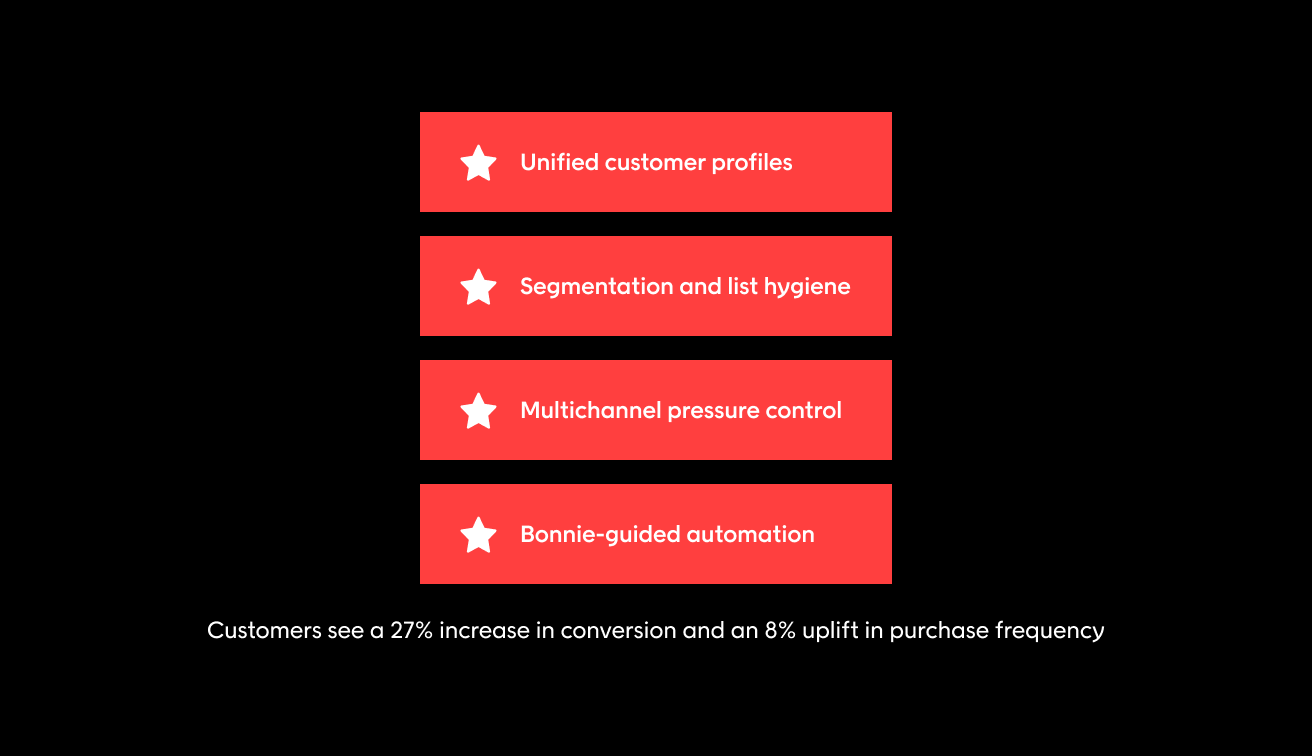
Customers see a 27% increase in conversion and an 8% uplift in purchase frequency. These are platform-wide outcomes, not deliverability benchmarks. Enablement and support start on day one.
Unified customer profiles reduce duplicate and stale sends
One first-party data model with identity resolution links anonymous and known visitors across channels and markets, so fewer stale or invalid email addresses get mailed.
Built-in segmentation and suppression support list hygiene
Voyado ties segmentation to targeting, suppression, and reactivation controls for inactive subscribers, and shifts messages to SMS or push when inboxes crowd.
Bonnie can suggest next best campaigns with human review
Bonnie, Voyado’s retail-trained AI agent, recommends what to send next and builds campaigns with human review. It plans, and your team owns inbox placement.
Final thoughts
Treat email deliverability as a loop to fix instead of a mystery, because list quality, engagement, and send decisions affect deliverability together. This week, audit:
- Bounce and invalid-address rates
- Open rate and CTR
- Unsubscribes
- Engagement spread
Voyado Customer Engagement builds in list hygiene, segmentation, sending infrastructure, and guided enablement.
FAQs
What is email deliverability?
Email deliverability refers to your ability to land email in the recipient’s inbox instead of spam folders. Email delivery only means the mail server accepted it, so clean sends with sliding opens signal a placement problem.
Which tools can show whether our retail campaigns are landing in spam across UK and EU markets, rather than just showing a drop in tracked opens?
Inbox placement needs several tool categories, since tracked opens can’t prove spam. Pair seed tests, Google Postmaster Tools, and ESP bounce and complaint reports by market.
How do we tell whether our current email platform is part of the deliverability problem or whether we need to fix our audience and sending practices first?
A deliverability problem usually starts with invalid POS addresses and untargeted repeat email campaigns. Triage in this order:
- List quality
- Consent records
- Segmentation and send strategy
- Platform controls
With 500,000 to 2 million customer contacts, how should we compare shared and dedicated IP options if our inbox placement is getting worse?
When inbox placement worsens, weigh control, isolation, warm-up effort, and risk. A dedicated IP isolates reputation but needs steady volume, while shared IPs reduce effort but spread risk. Neither rescues engagement concentrated in a small cohort.
If we switch CRM platforms, how should we handle the sending transition so our loyalty campaigns don't suffer another drop in deliverability?
Map consent, preserve suppressions, control parallel sends, and ramp on monitoring, since a lost UK or EU opt-out creates legal risk. Start with engaged loyalty segments, letting monitoring guide your email deliverability.