TL;DR
Most AI tools work well in general tasks. But retail is not a general environment. Margin, inventory management, seasonality, loyalty, and product lifecycles shape every decision. Generic models miss that context.
Retail-trained AI is built on real retail data and behavior. It supports better product discovery, stronger demand forecasting, and more relevant customer experience across channels.
That gap is already showing up in the numbers. Voyado’s State of AI in Retail report found that 95% of retailers have experimented with AI – but only 5% are seeing clear, scalable ROI. The difference comes down to how AI is used, not whether it’s used. Retailers seeing real returns draw on nearly twice as many data sources, embed AI into commercial decision-making, and back it with clear ownership and skills.
For retailers evaluating AI in retail in 2026, domain expertise decides whether automation improves results or creates more manual work. Voyado’s Agentic CX Suite uses retail AI trained specifically for the retail industry to balance shopper relevance with business goals like sell-through, margin, and long-term growth.
Why generic AI falls short in retail
You and your team may have already noticed this. Many AI tools look impressive at first. Then the outputs start creating extra work.
That’s because most AI in retail isn’t actually trained for the retail industry. It analyzes patterns, but it doesn’t understand how inventory management, margin, and customer experience connect inside real retail operations.
You’ll see the gaps quickly:
- Recommending products that are almost out of stock
- Pushing discounts when margin matters more
- Ignoring loyalty tiers when triggering targeted promotions
- Prioritizing clicks instead of profitable sales
These systems rely on general machine learning instead of retail signals like purchase history, supply chain management constraints, and merchandising priorities. Even strong predictive analytics can’t fix decisions made without the right retail context.
The result is automation that weakens pricing strategies, slows demand forecasting, and makes personalized marketing harder to trust. Instead of supporting your team, it creates more checks and manual corrections.
In our guide to agentic AI in retail, we explain how tools built on domain-specific AI retail can act on real retail signals instead of surface-level patterns.
And when that intelligence powers product discovery through a purpose-built product discovery engine, your team can protect margin, relevance, and business growth at the same time.
What “retail-trained AI” actually means
Retail-trained AI isn’t a marketing label. It describes artificial intelligence built on retail signals, retail logic, and retail outcomes. It’s what separates general automation from systems designed for real retail decisions.
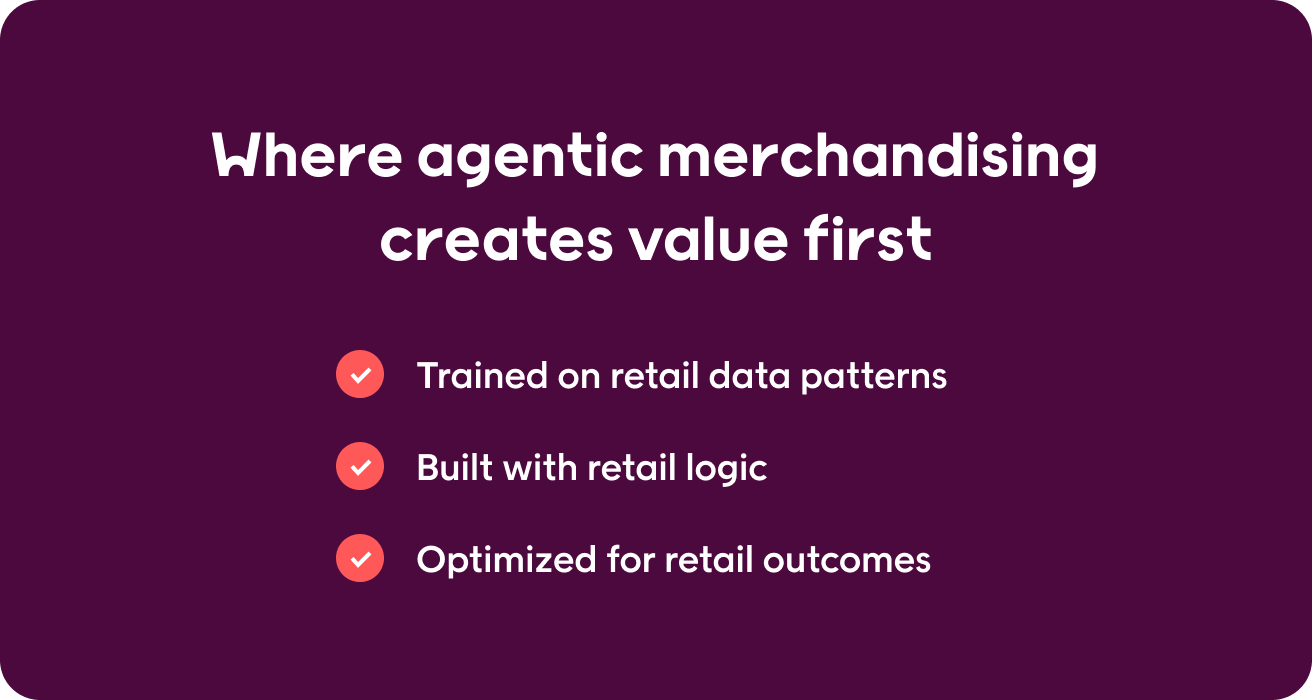
Trained on retail data patterns
Most artificial intelligence models learn from generic internet content or cross-industry transaction data. Retail-trained AI learns from purchase history, seasonal demand shifts, returns, loyalty engagement, and sales data across the retail sector.
That means it works with relevant data shaped by how customers actually shop across both digital channels and physical stores. This is what makes AI trained for retail different from general-purpose AI technology and why it’s becoming central to modern AI for retail e-commerce strategies.
Built with retail logic
Retail decisions depend on margin, inventory management, campaign priorities, and loyalty treatment. Generic systems don’t account for these trade-offs. Retail-specific AI does.
| Generic AI | Retail-trained AI |
| Ranks products by click probability | Balances shopper relevance with margin contribution |
| Suggests discounts without loyalty context | Adjusts visibility based on inventory management conditions |
| Ignores stock levels during ranking | Supports campaign priorities and targeted promotions automatically |
This shift allows retailers to improve efficiency while protecting profitability. It’s a core capability behind modern merchandising strategies powered by retail AI domain expertise.
Optimized for retail outcomes
Generic AI focuses on engagement metrics. Retail-trained AI is optimized for business impact.
It improves conversion rate, average order value, customer satisfaction, customer lifetime value, demand forecasting, and data-driven decision-making.
That’s how artificial intelligence helps retailers personalize customer experiences and support stronger business operations across the retail industry.
Where retail domain expertise makes the biggest difference
Retail-trained AI becomes most visible where everyday decisions affect margin, timing, and relevance at scale. This is where generic AI tools start to feel disconnected from how retail actually works across the retail industry.
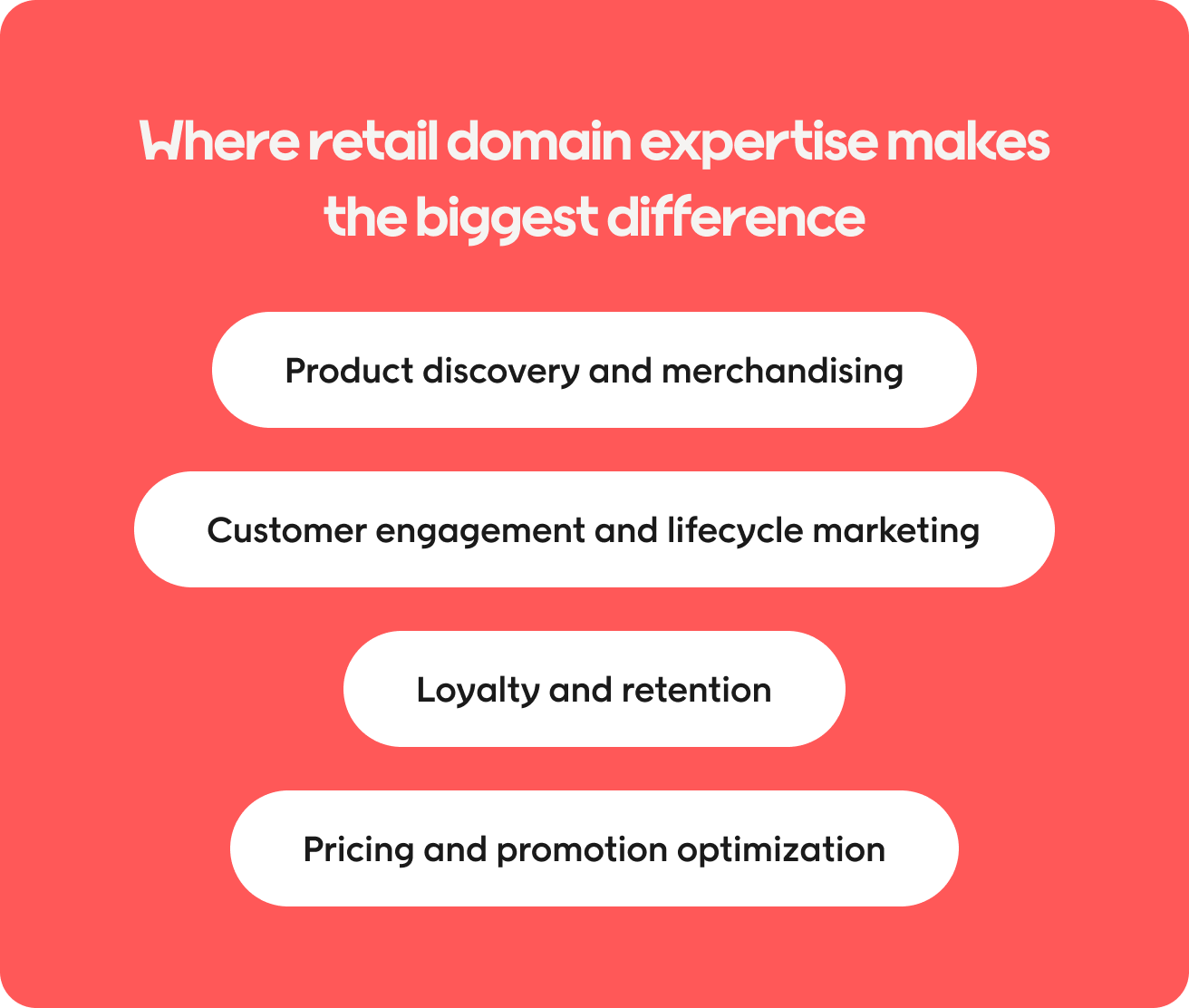
Product discovery and merchandising
Product discovery is where retail AI either protects profitability or quietly erodes it.
Generic systems rank products by engagement signals alone. Retail-trained AI balances shopper intent with inventory management, campaign priorities, and demand forecasting so visibility supports both relevance and revenue.
In practice, that means it can:
- Prioritize high-margin products when stock is healthy
- Reduce exposure on low-availability items automatically
- Support seasonal shifts without manual rule changes
Modern product recommendations perform best when they reflect retail signals instead of generic engagement patterns.
Customer engagement and lifecycle marketing
Customer engagement in the retail sector depends on timing as much as messaging.
Retail-trained AI connects purchase history, customer data, and seasonal behavior to improve customer satisfaction and personalize customer experiences across channels. Instead of reacting to isolated signals, it supports predictive analytics that guide targeted promotions and lifecycle decisions more precisely.
This is exactly where agentic AI for marketing adapts communication using retail lifecycle timing instead of generic automation logic.
Loyalty and retention
Loyalty programs follow their own rules. Generic artificial intelligence rarely understands them.
Retail-trained AI detects churn signals, redemption behavior, and tier movement early enough to trigger the right intervention without defaulting to blanket discounts. That improves customer experience while supporting data-driven decision-making across business operations and strengthening long-term retention in the retail sector.
A modern customer loyalty platform uses these signals to support retention strategies built on relevance rather than price cuts.
Pricing and promotion optimization
Pricing is where the limits of generic AI technology become most visible.
Retail-trained AI evaluates pricing strategies using sales data, inventory management conditions, and market trends at the same time. That enables retailers to make informed decisions that improve efficiency, support supply chain management priorities, and protect margin during peak campaigns across the retail industry.
How to evaluate whether your AI is actually retail-trained
Many platforms claim to support AI in retail. Fewer are built for how retailers actually make decisions. Use this checklist to evaluate whether your AI is truly retail-trained.
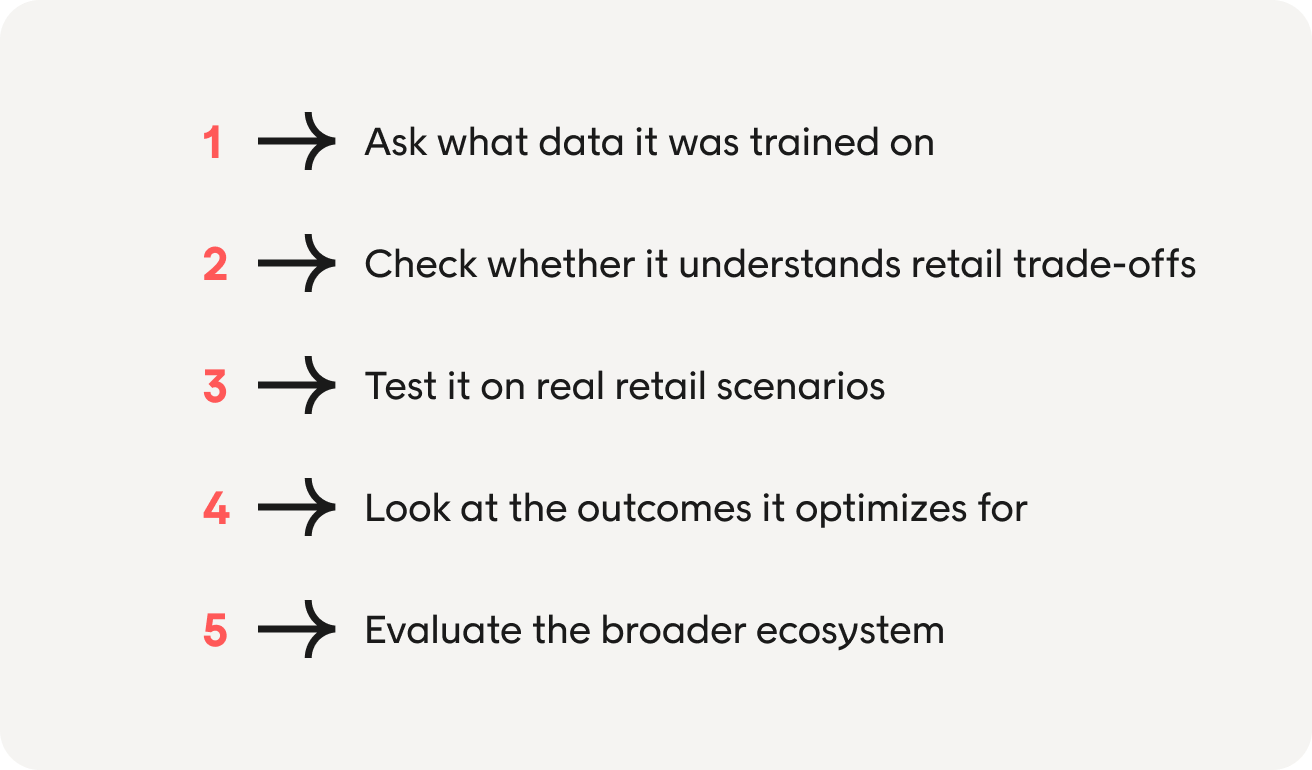
1. Ask what data it was trained on
Start with the foundation. Strong retail AI should be trained on product catalogs, inventory movement, loyalty signals, and real transaction behavior, not just third-party data layered onto a generic model. This distinction matters more than it might seem: research from Voyado’s State of AI in Retail found that only 5% of retailers are currently seeing clear, scalable ROI from AI – and those leaders draw on nearly twice as many data sources as retailers with basic capabilities. Breadth of retail-specific data isn’t a nice-to-have. It’s what separates AI that compounds results from AI that plateaus.
Look for systems that:
- Analyze vast amounts of retail signals across categories and channels
- Use relevant information from real customer behavior
- Generate valuable insights your team can act on
If the platform cannot explain what shapes its outputs, it is not retail-trained. This gap becomes clear when comparing generic tooling with the capabilities in our overview of the best AI agents in retail.
2. Check whether it understands retail trade-offs
Retail decisions always involve trade-offs. The right AI should balance relevance with profitability instead of optimizing one variable at a time.
It should support:
- Dynamic pricing based on margin and competitor pricing
- Assortment planning aligned with campaign priorities
- Automated inventory management that helps optimize inventory exposure
This is where strong data analytics creates a measurable competitive advantage across retail operations.
3. Test it on real retail scenarios
Ask the system to respond to situations your team handles every week.
For example:
- Ranking products when a bestseller is nearly out of stock
- Adapting recommendations between a loyal VIP and a first-time visitor
- Responding to campaign timing using real-time data instead of static rules
Retail-trained platforms use AI algorithms designed for context awareness, allowing teams to use AI for more informed decisions across merchandising and engagement.
4. Look at the outcomes it optimizes for
Generic platforms often optimize engagement. Retail-trained systems optimize business impact.
Look for signals like:
- Personalized recommendations that reflect intent and margin
- Support for conversion across marketing campaigns
- Improvements that help teams stay ahead instead of reacting later
This shift toward relevance over clicks is central to modern personalization in retail.
5. Evaluate the broader ecosystem
Retail-trained AI works best when it connects signals across channels instead of operating in isolation.
The strongest platforms combine:
- Supply chain functions and supply chain optimization
- Customer engagement signals across lifecycle stages
- Delivery routes and category performance insights
This improves efficiency, supports improving sustainability, and helps lower costs without sacrificing relevance.
Platforms designed around connected intelligence, like those at Voyado, help teams extend AI across retail decisions instead of limiting it to a single workflow.
How Voyado delivers retail-trained AI across the customer journey
Built entirely for retail
Voyado isn’t a generic artificial intelligence platform adapted for the retail industry. It’s the Agentic Customer Experience Suite built only for retail retailers that need measurable impact across the entire journey.
That means every capability is designed around retail logic from the start:
- Product discovery that reflects intent, margin, and availability
- Customer engagement shaped by lifecycle timing
- Loyalty decisions based on real behavior, not generic triggers
- Retail media connected to merchandising and demand forecasting
This foundation enables retailers to leverage AI across digital channels and physical stores while improving efficiency in retail operations like assortment planning and even how teams optimize store layouts.
AI trained on real retail data
Voyado’s agentic artificial intelligence learns from real retail signals, including purchase behavior, product interactions, loyalty activity, and merchandising outcomes.
Instead of relying on third-party data alone, the platform analyzes vast amounts of customer data and sales data using retail-aware AI algorithms. Capabilities like natural language processing, computer vision, and generative AI help interpret intent, behavior, and context across journeys.
This supports a continuous loop:
Observe retail signals → Decide using relevant information → Act across channels using real-time data → Learn from outcomes to improve performance
The result is AI technology that improves marketing campaigns, strengthens customer satisfaction, and helps teams make more informed decisions without adding manual complexity.
The agentic suite: three capabilities, one retail-trained foundation
Voyado connects engagement, discovery, and loyalty into one platform so teams can use AI across the full journey instead of managing disconnected AI tools.
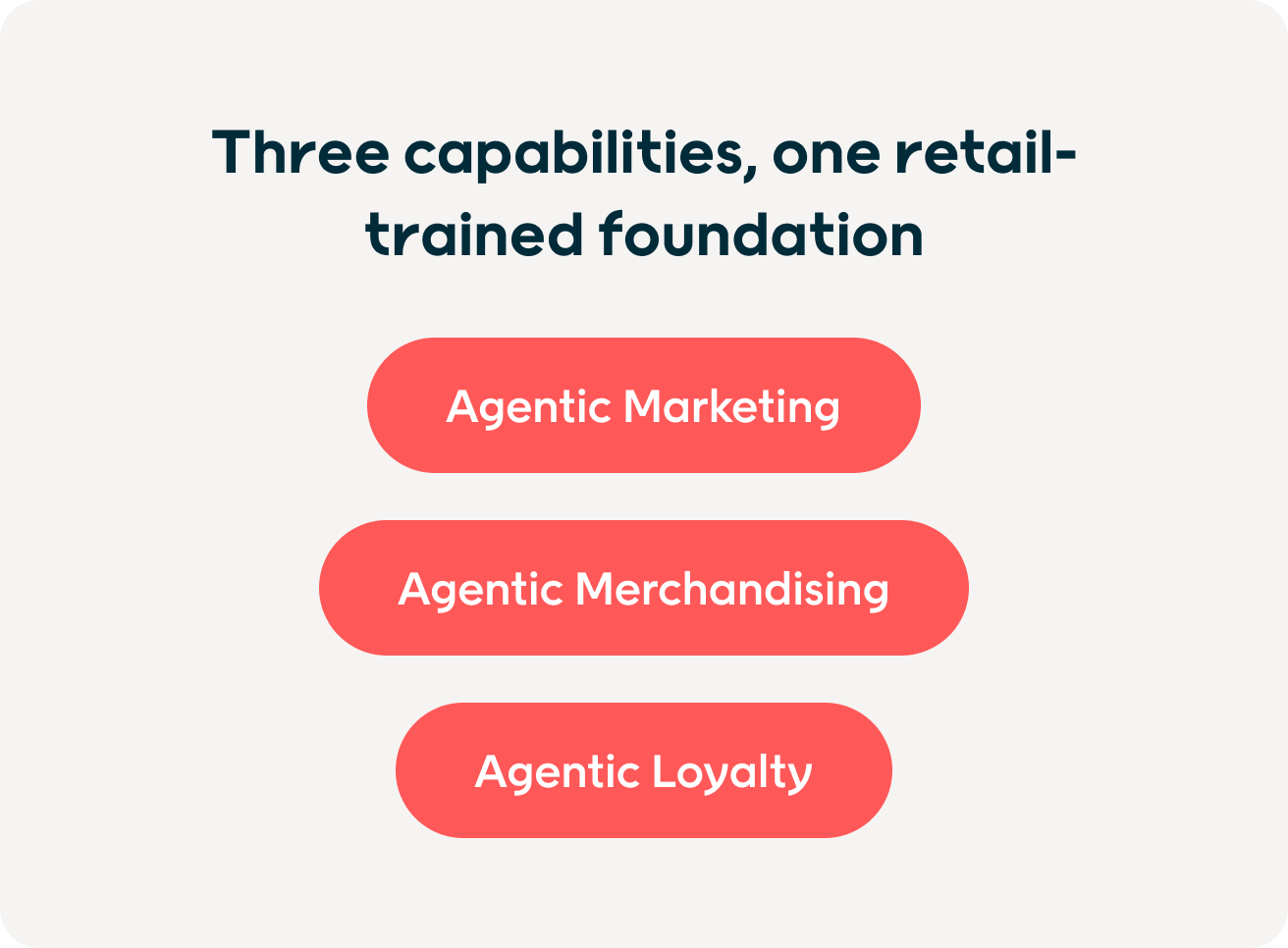
1. Agentic Marketing
Customer engagement for every touchpoint. The system adapts communication using predictive analytics and lifecycle signals to personalize customer experiences across channels. This is how agentic AI in CX improves consumer experiences in practice.
2. Agentic Merchandising
Product discovery that sells more with less effort. The platform optimizes visibility across search and category navigation using intent signals, margin priorities, and campaign timing. This approach can help transform your e-commerce with AI search and product recommendations.
3. Agentic Loyalty
Loyalty management designed for long-term business growth. The system adapts rewards and communication using loyalty behavior and customer lifetime value signals, helping teams reduce waste from blanket discounting while maintaining relevance.
Together, these capabilities give retailers a competitive edge by helping them leverage AI across the entire journey, support business operations, and stay ahead in the retail sector.
If your team is frustrated with generic AI that doesn’t understand your business, book a demo to see how Voyado’s retail-trained AI drives measurable results across product discovery, customer engagement, and loyalty.
Final thoughts
AI adoption across the retail industry is accelerating. But results don’t come from simply using AI in retail. They come from retail AI that understands margin, inventory management, loyalty behavior, and customer lifecycle decisions without constant manual correction.
If you’re evaluating your current setup, start here:
- Check what data your AI technology is analyzing data from
- Test whether your teams can use AI without adding manual merchandising work
- See whether it improves customer experience and supports sales without increasing discount pressure
Retail-trained AI is no longer optional if you want a competitive edge. In 2026, the question is no longer “Are you using AI?” It is “Does your AI actually understand retail?”
FAQs
What is retail-trained AI?
Retail-trained AI is artificial intelligence built specifically for retail. It learns from purchase behavior, inventory signals, loyalty activity, and merchandising outcomes to improve decisions across product discovery, customer engagement, and retention.
Why does domain expertise matter for AI in retail?
Retail decisions involve margin, timing, stock levels, and customer lifecycle signals. AI in retail must understand these trade-offs to improve sales, customer experience, and profitability instead of optimizing clicks alone.
How is retail-trained AI different from generic AI with retail data?
Generic AI with retail data reacts to inputs. Retail-trained AI is built around retail logic from the start. It balances relevance, inventory conditions, campaign priorities, and loyalty treatment automatically.
Where does retail-trained AI have the biggest impact?
It delivers the strongest results in product discovery, lifecycle engagement, loyalty management, and pricing decisions where context affects conversion, customer satisfaction, and long-term value.
How can I tell if my AI platform is truly retail-trained?
Check what data it learns from, what outcomes it optimizes for, and whether it adapts to stock changes, loyalty tiers, and campaign timing without manual rules.
How does Voyado use retail-trained AI?
Voyado applies retail AI across product discovery, customer engagement, and loyalty. The platform uses retail signals to decide the next best actions and improve relevance across the full customer journey.
Can generic AI tools work for retail at all?
Yes, but usually only for narrow tasks. Retail-trained AI delivers stronger results because it understands how retail operations, customer behavior, and merchandising priorities connect.
About Author