TL;DR
Most advice on how to improve your e-commerce conversion rate focuses on surface-level conversion rate optimization tactics like button colors or checkout tweaks. Those help, but they don’t address the main causes of lost sales.
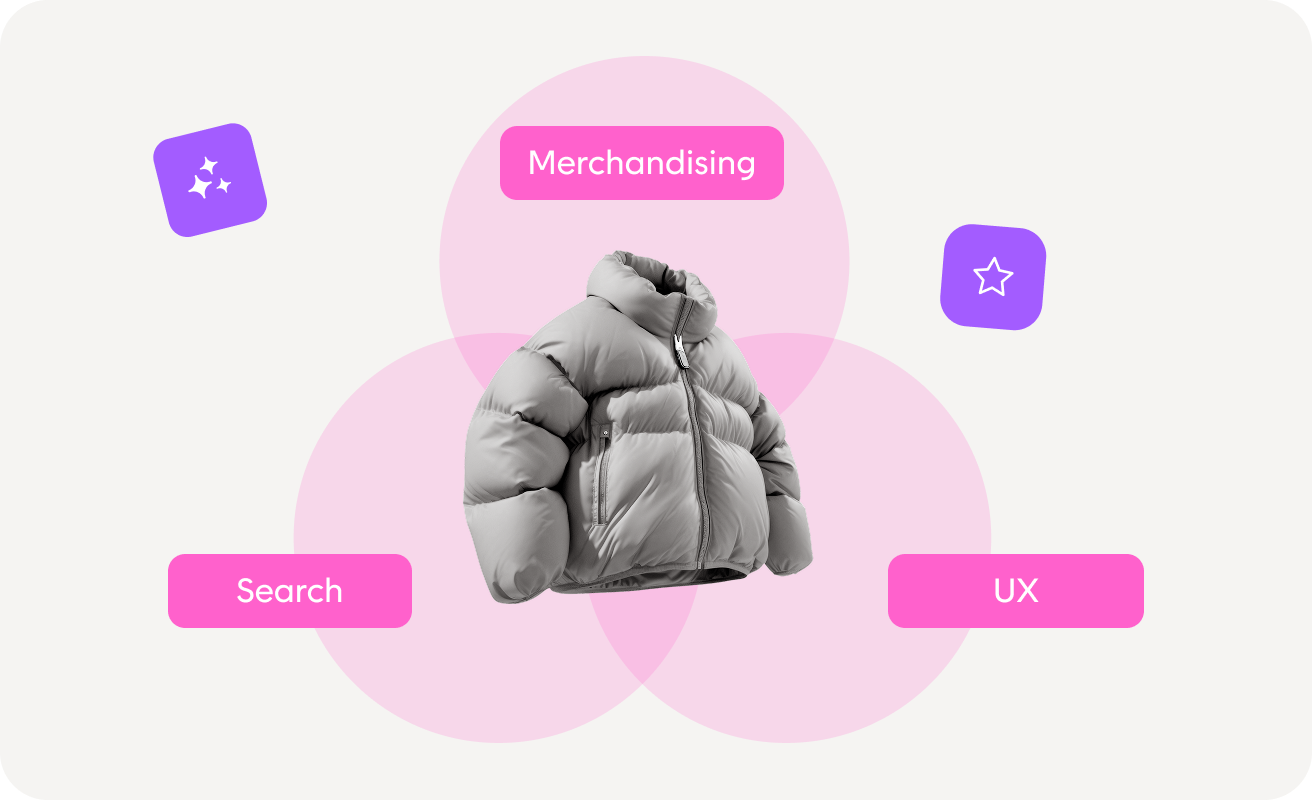
The biggest gains in e-commerce conversion come from three connected on-site levers:
- Site search
- Merchandising
- UX across product pages and the checkout flow
When shoppers find relevant results faster, see the right products earlier in the buying journey, and move through a smooth purchase process, your conversion rate and average order value increase together across your on-site experience.
You’ll learn how practical conversion rate optimization strategies your team can apply across your e-commerce site using AI-driven product discovery, personalization, and loyalty mechanics.
Voyado connects search, recommendations, merchandising, and customer engagement in one retail-built platform, so your e-commerce conversion rate optimization efforts stay aligned instead of siloed.
Why on-site experience is the biggest conversion lever most retailers underuse
Most teams invest heavily to bring more traffic to their online store through paid media, SEO, and email marketing tools. But once shoppers arrive, the experience across product pages and navigation often stays static and disconnected.
That’s where e-commerce conversion rate performance starts to slip.
Shoppers don’t leave because your products are wrong. Users drop because they can’t find what they need fast enough, compare options clearly, or move smoothly through the purchase journey. Weak site search alone can slow discovery and reduce confidence across the buying journey, which is why improving relevance is central to stronger site search experiences.
This is why conversion rate optimization strategies should focus on three connected pillars:
- Site search that reflects the real user journey behavior
- Merchandising that surfaces the right products earlier
- UX that removes friction across the customer journey
When one pillar breaks, the others suffer. Poor merchandising limits cross-sell and bundling opportunities. Weak UX increases otherwise lost sales. And inconsistent discovery keeps your average e-commerce conversion rate flat even when traffic grows.
If you want to know how to improve e-commerce conversion rates, it requires connected on-site execution, not isolated conversion rate optimization efforts.
Aligning search, merchandising, and UX helps your e-commerce website surface more relevant products, increase average order value, and support more conversions across the buying journey, especially when supported by smarter e-commerce merchandising strategies.
Search: The highest-intent moment on your site
When shoppers use site search on your e-commerce site, they’re telling you exactly what they want. Few moments influence e-commerce conversion rate performance more than this one.
If search works well, you boost conversions and average order value. If it doesn’t, users drop off, and you lose sales you would have otherwise made.
That’s why search is one of the most effective conversion rate optimization strategies for teams working to improve e-commerce conversion rate performance across the purchase process.
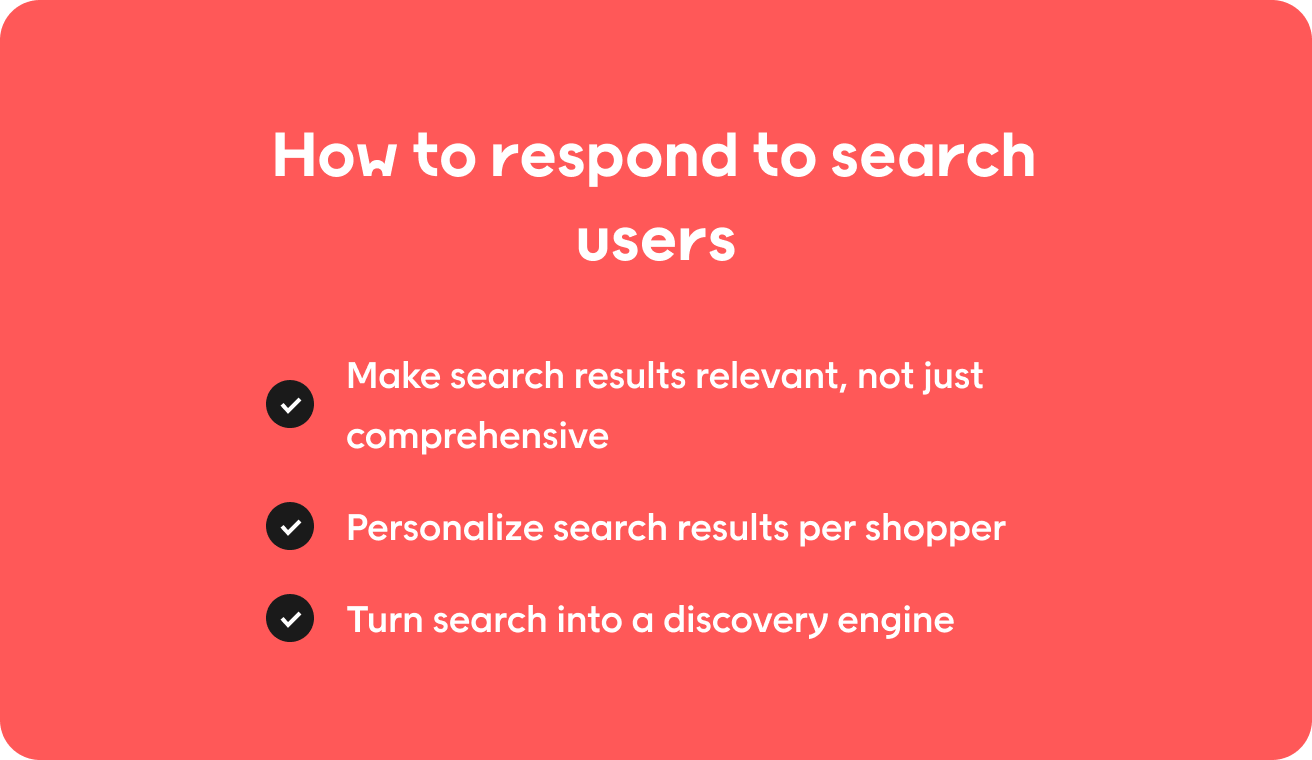
Make search results relevant, not just comprehensive
Most default search tools return too many results or the wrong ones. That slows decisions and weakens the buying journey.
Strong search improves discovery across product pages and helps potential customers move forward faster.
Modern search should support:
- Synonym handling so shoppers find products even when the wording differs
- Typo tolerance so small mistakes don’t block results
- Autosuggest that shortens the path to purchase
- Zero-results optimization that prevents lost sales
- Ranking logic based on stock levels, popularity, and intent
These improvements directly support e-commerce conversion rate optimization because they reduce friction at the exact moment shoppers are ready to act.
Many teams monitor this impact in Google Analytics to calculate conversion rate changes tied to search behavior and understand where users drop during discovery.
Solutions like Voyado help apply these signals in real time across the e-commerce website.
Personalize search results per shopper
Two shoppers can enter the same query and expect different results.
Returning customers show different user behavior than first-time visitors. Personalized ranking adapts results using browsing history, purchase signals, and preferences so the experience reflects intent instead of keywords alone.
This matters because e-commerce conversion rates measured across segments often show large performance gaps between new and returning visitors.
Personalizing discovery helps close that gap and supports stronger e-commerce conversion across the customer journey, especially when supported by systems designed for personalized product discovery.
Turn search into a discovery engine
Search shouldn’t just return products. It should guide exploration across your online store.
Smart autocomplete helps shoppers compare faster. Visual suggestions introduce relevant alternatives. Contextual recommendations surface products that increase average order value without adding friction to the checkout flow.
This turns search into a discovery layer that supports:
- More conversions from high-intent website visitors
- Stronger engagement across product pages
- Smoother movement through the customer’s journey
- Increased customer lifetime value over time
Instead of acting like a filter tool, search becomes a central driver of conversion rate optimization and a key contributor to a good e-commerce conversion rate across your entire site.
Merchandising: show the right products in the right order
Product visibility shapes what shoppers notice first and what they never see at all. If the wrong items appear at the top of category pages or recommendations feel random, improving e-commerce conversion rates becomes much harder, even when traffic quality is strong.
Better merchandising helps shoppers evaluate faster, compare confidently, and move forward through the checkout flow. That’s one of the most reliable ways to boost conversions and improve overall e-commerce conversion rate performance without increasing spend on website traffic.
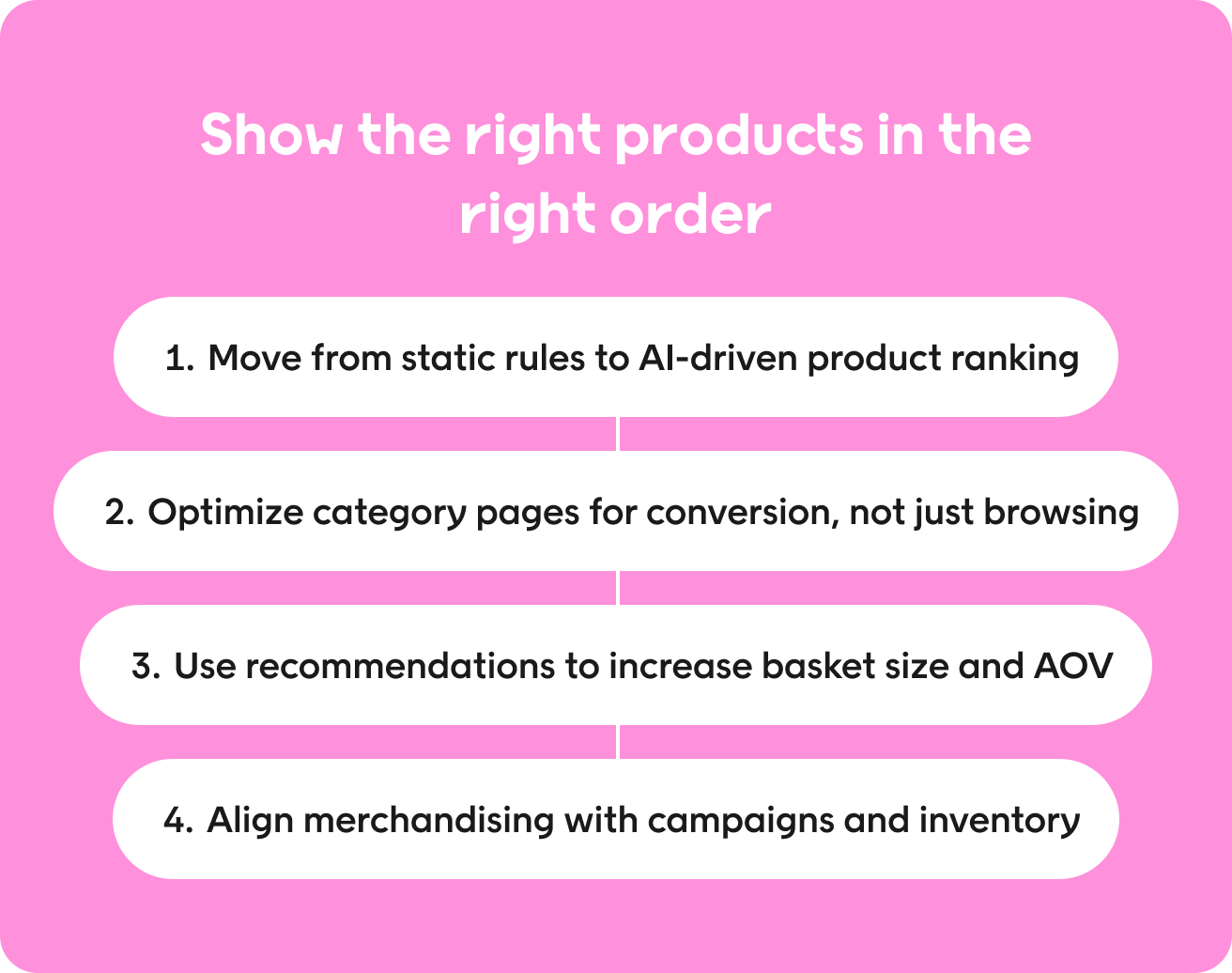
Move from static rules to AI-driven product ranking
Manual boost-and-bury rules can’t react fast enough to shifting demand, inventory changes, or campaign priorities. They often leave teams adjusting rankings after performance has already dropped.
AI-driven ranking adapts product visibility in real time using signals like intent, stock levels, and margin. That means your teams surface the products most likely to convert instead of relying on outdated assumptions, which directly supports stronger e-commerce conversion across your site.
Retailers moving in this direction reduce manual effort and improve discovery using approaches similar to modern online merchandising strategies.
What you’ll see if you’re doing this right
- High-margin and in-stock products appear earlier in category views
- Seasonal or campaign items surface without manual rule updates
- Fewer users drop between listing pages and product pages
- Merchandising decisions align with business goals automatically
Optimize category pages for conversion, not just browsing
Category pages shape how most shoppers explore your site after search or navigation. Default sorting by price or newest rarely reflects what actually drives purchase decisions.
Dynamic sorting surfaces products based on shopper context, campaign relevance, and performance signals. Smart filters help mobile users refine choices faster and move forward with confidence across the buying journey.
This is one of the most practical steps teams take when improving conversion rates and performance across their e-commerce website, especially when category logic adapts to real-time demand and campaign priorities.
What you’ll see if you’re doing this right
- Website visitors reach relevant products faster
- Fewer exits from category pages before product evaluation
- Stronger engagement across product pages
- More potential customers moving deeper into the buying journey
Use recommendations to increase basket size and AOV
Recommendations on product pages, the cart, and the checkout page are one of the most reliable ways to increase average order value and support a good e-commerce conversion rate.
Cross-sell suggestions, complete-the-look bundles, and frequently bought together modules work best when powered by real affinity data instead of static rules. They help shoppers discover relevant add-ons naturally instead of forcing decisions.
Connected recommendation logic plays a key role in improving conversion rates for e-commerce, and many e-commerce teams often struggle to scale manually. Retailers increasingly rely on retail-aware systems like product recommendations built for retail product discovery to strengthen e-commerce conversion rate optimization across the site.
What you’ll see if you’re doing this right
- More items added per transaction without relying on discounts
- Higher engagement from paying customers across the purchase process
- Stronger product relationships reflected in recommendations
- Measurable gains in average order value over time
Align merchandising with campaigns and inventory
Merchandising should reflect what your business needs to sell right now, not just what performed well last month.
Campaign badges highlight priority products. Promotional boosting increases visibility during launches. Inventory-aware ranking prevents slow-moving stock from blocking better options. Margin-conscious sorting supports profitability while still improving e-commerce conversion rate performance.
This keeps merchandising aligned with business priorities while supporting teams focused on how to improve conversion rates in e-commerce at scale across a modern website.
What you’ll see if you’re doing this right
- Campaign products surface immediately when promotions start
- Inventory pressure reduces without forcing discounts
- Shoppers encounter fewer irrelevant results during the purchase process
- More sales from products your teams actually need to move
When merchandising adapts to shopper intent, campaigns, and inventory in real time, it becomes one of the most reliable ways to improve e-commerce conversion rate performance and increase average order value without relying on heavier discounting.
UX: remove friction from discovery to checkout
Search and merchandising help shoppers find the right products. UX determines whether they complete the purchase process.
Even small issues like slow-loading pages, unclear filters, or unexpected shipping costs can reduce confidence and lower your e-commerce conversion rate. When discovery and checkout usability work together, improving e-commerce conversion rates becomes much more predictable.
Fix the mobile experience first
Most website visitors now arrive from mobile devices. If navigation feels slow or crowded on smaller screens, mobile users leave before they reach product pages or the checkout flow.
Strong mobile optimization removes that friction early in the buying journey and helps potential customers move forward faster.
Focus on:
- Faster site speed through image compression and lazy loading
- Tap-friendly filters designed for mobile devices
- Sticky CTAs that support the purchase process
- Mobile-optimized product pages with clear product images
These changes reduce drop-offs and create more conversions from the same website traffic.
Strengthen product pages
Product pages are where decisions happen. If key details are missing or hard to scan, hesitation increases and lost sales follow.
Clear product images, detailed product descriptions, delivery timelines, and visible stock availability help shoppers evaluate faster. Adding social proof like ratings, customer testimonials, and security badges strengthens trust signals across the buying journey.
Better product information also improves recommendation accuracy and supports stronger discovery across your e-commerce site.
That’s one of the reasons improving e-commerce conversion rates often depends on strengthening the connection between product data and personalization, as explored in personalization in retail strategies.
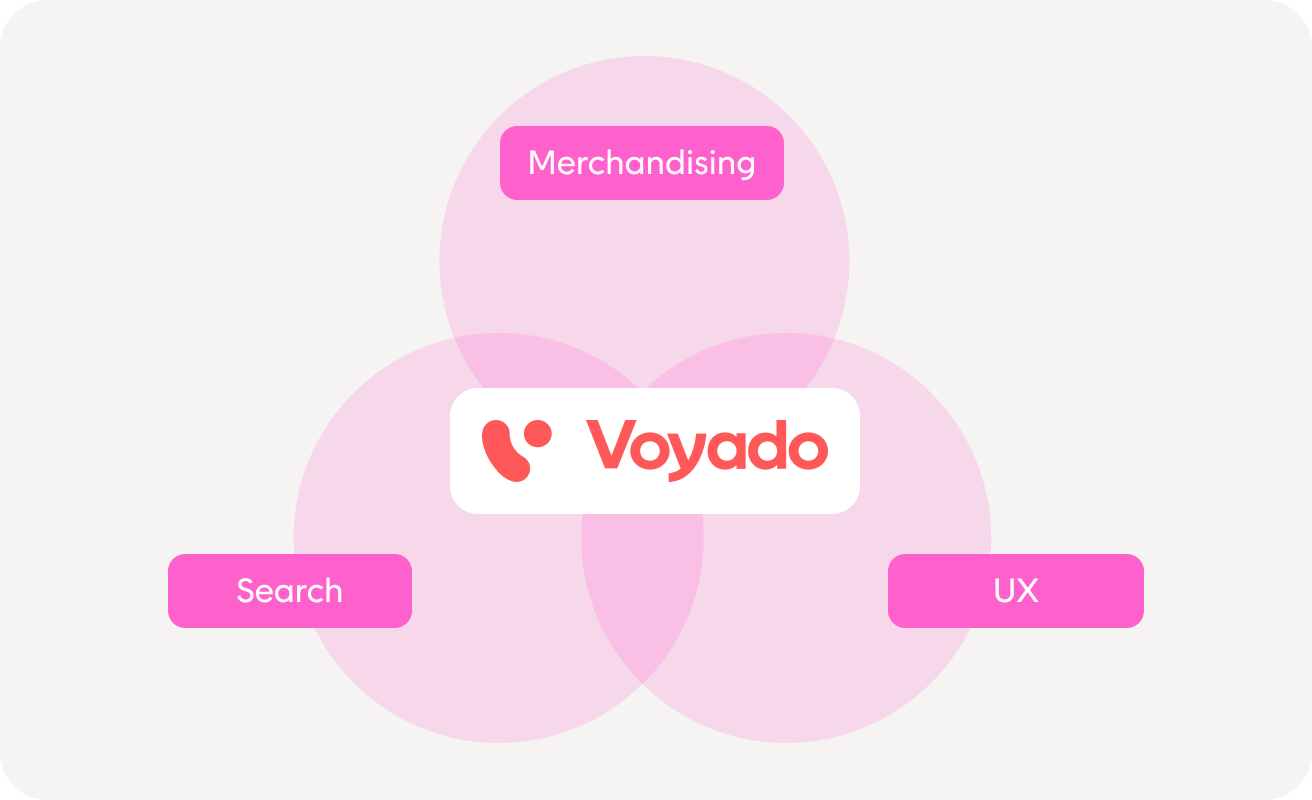
How search, merchandising, and UX work together
Search, merchandising, and UX aren’t separate projects. They form one connected framework for improving e-commerce conversion rates across your e-commerce site.
When these three pillars work together, each step in the customer journey supports the next. Shoppers find products faster. They see better options earlier. They move through the purchase process with less friction.
Step 1: Search guides shoppers to relevant starting points
Search is often the first high-intent interaction on your site. When results reflect real user behavior instead of keyword matches alone, shoppers reach the right product pages faster.
This improves engagement across landing pages and reduces the risk that visitors drop early, especially when discovery is supported by connected approaches like AI search and product recommendations working together.
Step 2: Merchandising prioritizes what drives decisions
Once shoppers enter category views, merchandising determines what they evaluate first.
Dynamic ranking surfaces products aligned with inventory, campaigns, and business priorities. That keeps assortments relevant and helps shoppers browse with more confidence.
Step 3: UX removes friction before checkout
Even strong discovery breaks down if the path to purchase feels complicated.
Clear filters, strong product pages, and transparent checkout usability help shoppers move forward without hesitation and reduce late-stage drop-off from paying customers.
Why this framework works better than isolated fixes
Conversion rates vary when search, merchandising, and UX aren’t aligned.
Connecting them creates consistent progress across the customer journey and strengthens the key performance indicators teams track when working to improve conversion rates in e-commerce across the entire site. This is why many teams rely on practical e-commerce strategy tips built around connected discovery.
When product pages answer questions quickly, shoppers move forward with confidence instead of leaving to compare elsewhere.
Simplify navigation and filtering
Shoppers expect to move through your assortment without friction. If filters are confusing or slow, visitors drop before they reach the products most relevant to them.
Clear category hierarchies, intuitive filtering, and responsive sorting help shoppers browse efficiently across the customer journey. This improves engagement for both first-time visitors and returning buyers exploring new categories.
Navigation improvements also help your digital marketing team support different entry points across landing pages and campaign traffic without forcing users to restart their search from scratch.
This type of structure makes it easier to improve conversion rates across your entire e-commerce website without major redesign work.
Reduce checkout friction
By the time shoppers reach the checkout page, intent is already strong. A complicated checkout process at this stage directly lowers conversion rate performance.
Reducing friction means:
- Offering guest checkout instead of requiring account creation
- Supporting flexible payment options such as Apple Pay
- Showing clear payment details and progress indicators
- Explaining shipping costs and return expectations early
- Reinforcing trust with visible security badges and trust signals
These improvements strengthen checkout usability and help motivated shoppers complete purchases instead of abandoning carts late in the purchase process.
Retailers that improve discovery upstream and simplify checkout typically see gains in customer lifetime value and stronger e-commerce conversion rate optimization results, especially when supported by a connected customer loyalty platform.
Quick self-check: where your e-commerce conversion rate is leaking
Most e-commerce businesses don’t have one major issue. Small gaps across search, merchandising, and UX add up across the customer journey and reduce performance across the entire e-commerce website.
Use this checklist to identify where your e-commerce site may be losing potential buyers and where e-commerce conversion rate optimization efforts will have the biggest impact.
Search
Your search experience may be limiting e-commerce conversion if:
- Results don’t reflect real user behavior
- Synonyms or typos break discovery
- Filters don’t match how shoppers browse
- Ranking ignores inventory or campaign priorities
- Visitors drop after searching instead of continuing the purchase process
These gaps make it harder for potential customers to reach the right product pages quickly.
Merchandising
Your merchandising setup may be affecting ecommerce conversion rate performance if:
- Category sorting relies on static rules
- Campaign products don’t surface during time-sensitive sales
- Recommendations don’t support average order value growth
- Visibility doesn’t adapt to stock or margin priorities
- Cross-sell logic doesn’t reflect real product relationships
Improving these areas helps e-commerce businesses create more conversions without increasing website traffic.
UX
Your UX may be reducing conversion rate performance if:
- Slow-loading pages affect site speed on mobile devices
- Filters feel difficult to use across the ecommerce site
- Product images or detailed product descriptions are missing
- Trust signals like security badges or customer testimonials aren’t visible
- Unexpected shipping costs appear late in the checkout flow
Fixing friction across these steps improves the customer experience and helps improve ecommerce conversion rate performance across the purchase process.
How Voyado helps retailers improve e-commerce conversion rate
Improving e-commerce conversion rate performance requires search, merchandising, recommendations, and engagement to work together across the same e-commerce website. That’s where a connected platform like Voyado makes a measurable difference.
Voyado Elevate: the product discovery engine that connects search, merchandising, and recommendations
Voyado Elevate brings site search, merchandising, and product recommendations into one retail-built product discovery engine.
Instead of managing separate tools, your team optimizes relevance, ranking, and visibility in one place. This supports stronger ecommerce conversion rate optimization across the purchase process and helps reduce otherwise lost sales caused by disconnected discovery logic.
Having everything connected will help you surface the right products earlier, adapt faster to user behavior, and increase average conversion rate performance across the e-commerce site.
Voyado Engage: personalized offers and loyalty mechanics that support AOV
Voyado Engage adds customer context through personalized incentives, lifecycle messaging, and loyalty-driven engagement.
Together with Elevate, it helps increase customer lifetime value and create more sales from existing website visitors without increasing acquisition spend. This makes it easier to improve conversion rates ecommerce teams track across both discovery and retention.
Connected, not siloed
Many retailers still run discovery and engagement in separate systems. That disconnect leads to weaker relevance, and visitors drop before completing the purchase process.
Voyado connects these capabilities in one platform so teams can act on shared shopper signals instead of fragmented data. If your team is looking for practical ways to improve e-commerce conversion rate performance through smarter discovery and engagement, you can book a demo to see how it works in practice.
Final thoughts
Improving e-commerce conversion rate performance rarely comes from one redesign. It comes from steady improvements across search, merchandising, and UX working together across your e-commerce site.
Retailers seeing the strongest gains today are using AI to adapt product discovery in real time. That means surfacing better products earlier, aligning visibility with business priorities, and reducing friction across the purchase process without adding complexity for shoppers.
If your team wants to improve conversion rates across your e-commerce site in a lasting way, start with the three levers in this guide: make search more relevant, make merchandising adaptive, and remove UX friction.
When these work together, conversion rate optimization becomes consistent, measurable, and easier to scale.
FAQs
What is the best way to improve e-commerce conversion rate?
The most effective way to improve e-commerce conversion rate performance is to optimize search, merchandising, and UX together. Smarter product discovery helps shoppers find relevant items faster, reduces friction in the purchase process, and increases average order value without relying on discounts.
How does site search affect conversion rate?
Site search influences conversion rate because it reflects high purchase intent. When results match user behavior and shopper context, potential customers reach the right product pages faster and are more likely to complete checkout.
What is the difference between static merchandising and AI-driven merchandising?
Static merchandising relies on manual rules that quickly become outdated. AI-driven merchandising adapts product visibility using real-time signals like inventory, demand, and shopper intent, helping e-commerce businesses boost conversions and reduce otherwise lost sales.
How do product recommendations improve AOV?
Product recommendations increase average order value by surfacing relevant add-ons during the buying journey. Cross-sell and upsell suggestions powered by product affinity data help paying customers discover more items naturally without interrupting the checkout flow.
Should I optimize search, merchandising, and UX separately?
No. Conversion rates vary when these areas are optimized in isolation. A connected approach creates a smoother customer journey and supports more conversions across your e-commerce site.
How does Voyado help improve e-commerce conversion rate?
Voyado connects search, merchandising, recommendations, and customer engagement in one platform. This makes it easier to improve e-commerce conversion rate optimization across the purchase process by aligning product visibility with shopper intent and business priorities.
What metrics should I track to measure on-site conversion improvements?
Track conversion rate, average conversion rate by device, average order value, engagement across product pages, checkout flow completion, and customer lifetime value. These key performance indicators show where most users drop and where optimization efforts create more conversions.