TL;DR
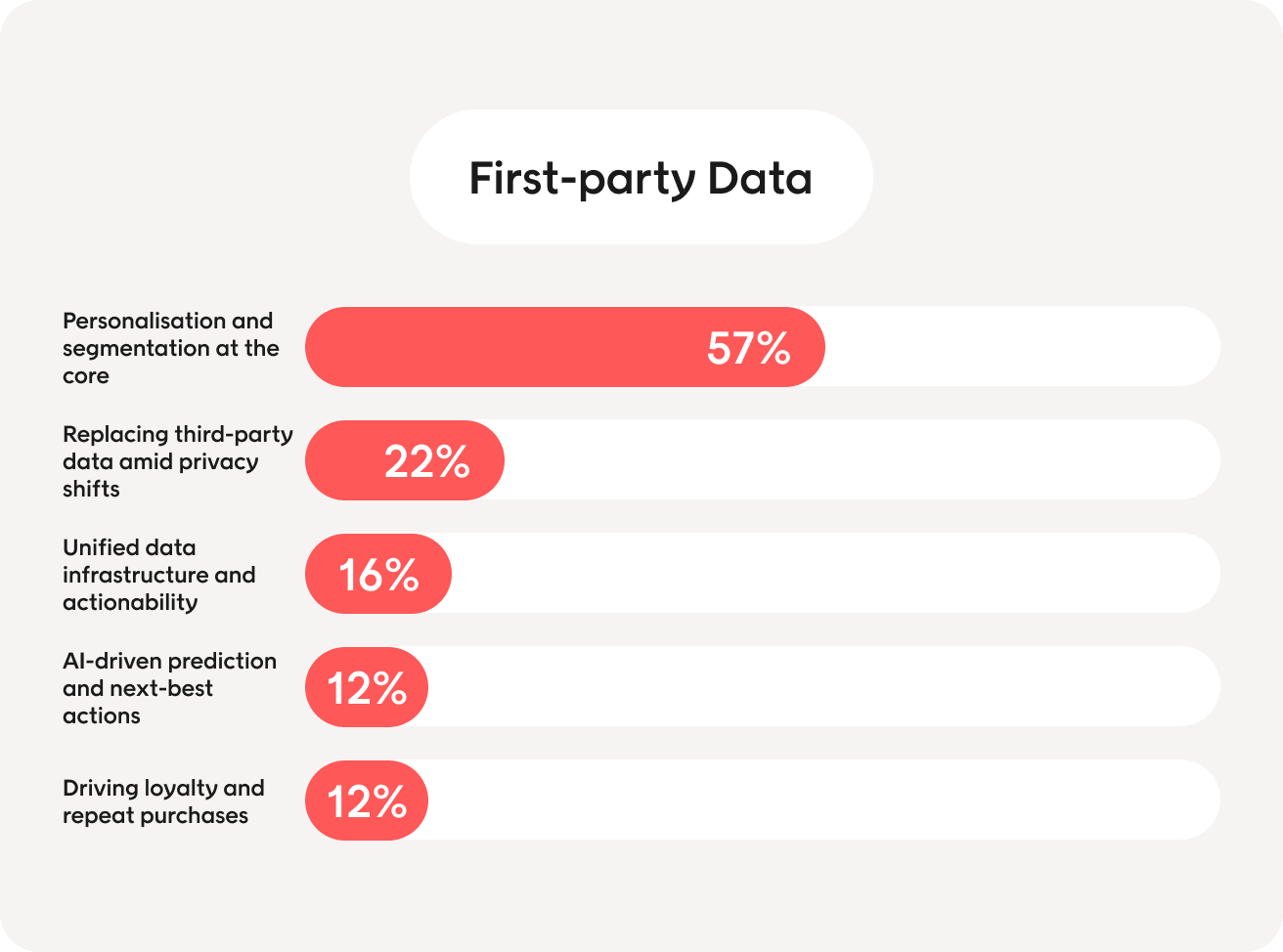
- First-party data is now central to retail growth. According to Voyado’s Inside e-commerce 2026 report, 57% of e-commerce leaders say first-party data will sit at the heart of personalization and segmentation in 2026.
- Collection isn’t enough; activation is the gap. Only 10% of leaders describe their personalization as “data-driven,” even while most collect substantial customer data.
- Retailers have unique collection advantages: Loyalty programs, post-purchase flows, preference quizzes, and value exchanges generate first-party and zero-party data at scale.
- A unified customer view is the foundation. Leaders want a “single source of truth” for customer data, without it, personalization fragments across channels.
- The cookieless future is here. 22% of e-commerce leaders are actively preparing for a world without third-party cookies.
First-party data is moving from the background to the driver’s seat. For retailers, this shift isn’t just about privacy compliance or cookie deprecation; it’s about owning the relationship with your customers and using that data to drive personalization, retention, and lifetime value.
The gap? Most retailers collect data but don’t activate it effectively. Voyado’s Inside E-commerce 2026 report found that while 57% of leaders see first-party data as central to personalization, only 10% say their personalization is truly data-driven. Meanwhile, 16% are still building unified data infrastructure.
This guide lays out a practical first-party data strategy for retail: what the data types mean, how to collect them, how to unify them into a single customer view, and how to activate them for personalization and retention.
What is a first-party data strategy?
A first-party data strategy is a planned approach to collecting, managing, and activating data that your organization gathers directly from customers through your own channels. This includes behavioral data (what customers browse and buy), transactional data (purchase history), and declared data (preferences, feedback, profile information).
Unlike third-party data, purchased from external sources and increasingly restricted by privacy regulations, first-party data is:
- Owned: You collect it directly; no intermediary controls access.
- Consented: Customers provide it through interactions with your brand.
- Accurate: It reflects real behavior and stated preferences.
- Durable: It doesn’t depend on third-party cookies or external tracking.
For retailers, a first-party data strategy connects what customers do across touchpoints- online browsing, purchases, loyalty program activity, in-store transactions- into a unified view that powers personalization at every moment.
First-, second-, third-, and zero-party data explained
Understanding the data types is essential for building a strategy that doesn’t rely on increasingly restricted sources.
First-party data
First-party data is information collected directly from your customers through your own channels. It includes:
- Website and app behavior (pages viewed, products browsed, searches, cart activity)
- Purchase history and transaction records
- Email and SMS engagement (opens, clicks, conversions)
- Loyalty program activity (points earned, rewards redeemed, tiers)
- Customer service interactions
First-party data is the foundation of retail personalization because it’s accurate, consented, and within your control.
Zero-party data
Zero-party data is information customers intentionally and proactively share, preferences, intentions, and feedback they volunteer. Examples include:
- Quiz or survey responses (style preferences, size, skin type)
- Preference center selections (favorite categories, communication preferences)
- Wishlist and save-for-later activity
- Product reviews and ratings
Zero-party data is valuable because it’s explicit. Customers tell you what they want rather than you inferring it from behavior.
Second-party data
Second-party data is another organization’s first-party data, shared through a partnership or data exchange. For example, a brand might share purchase data with a retail partner for joint marketing. Second-party data is less common in retail and typically governed by strict agreements.
Third-party data
Third-party data is collected by external providers from sources you don’t own , often aggregated across websites using cookies, device IDs, or other tracking mechanisms. This data powered much of digital advertising for years but faces growing restrictions:
- Browsers are blocking or limiting third-party cookies (Safari, Firefox, and Chrome’s evolving approach).
- Privacy regulations (GDPR, CCPA) require stricter consent.
- Signal loss makes third-party targeting less accurate.
Retailers preparing for the future are reducing reliance on third-party data and investing in first-party and zero-party collection.
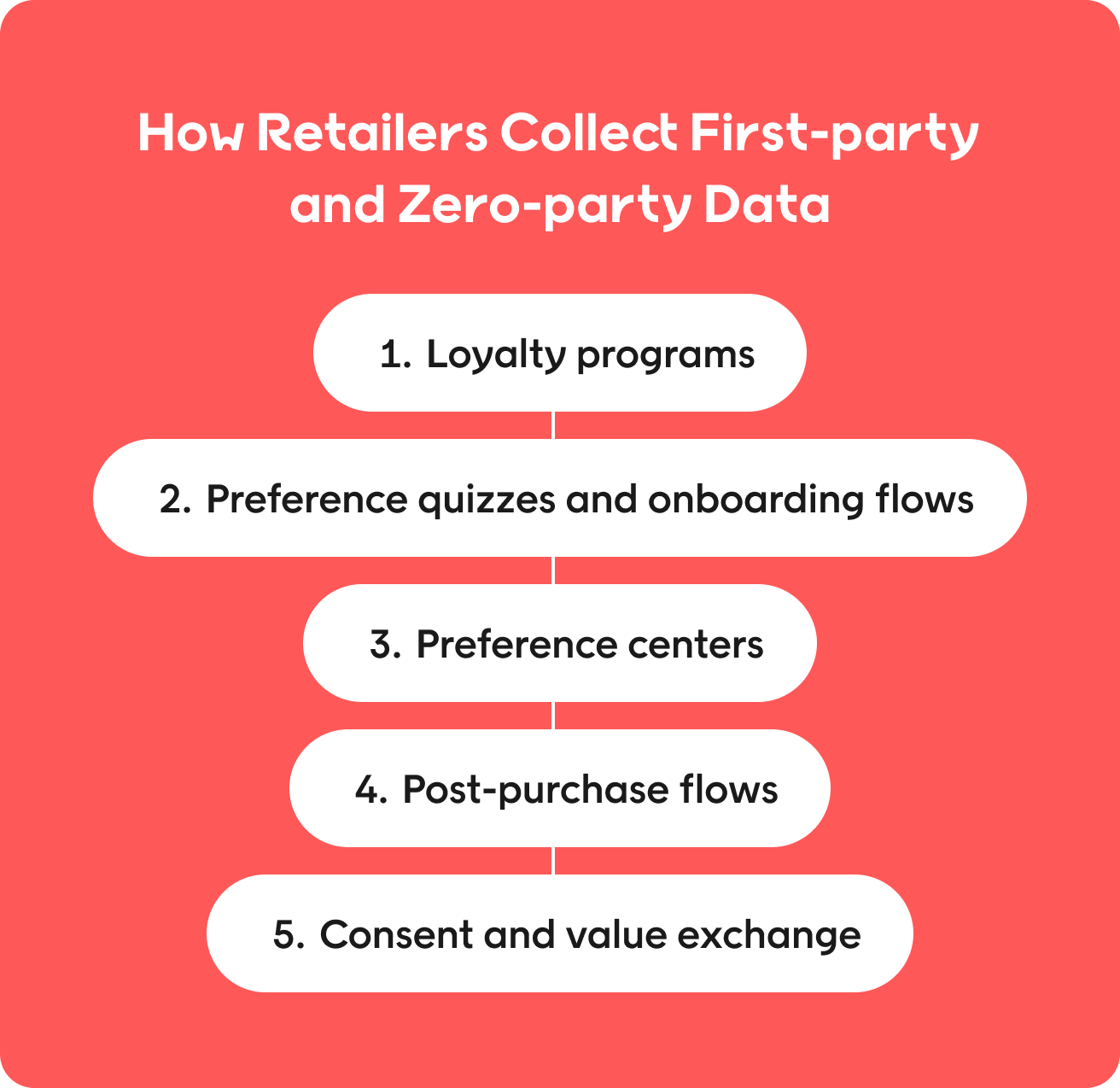
How retailers collect first-party and zero-party data
Retail has built-in advantages for first-party data collection. Unlike publishers or ad platforms, you have direct customer relationships, transactions, and loyalty programs. Here’s how to maximize collection.
Loyalty programs
Loyalty programs are the most powerful first-party data engine in retail. When customers join, you get:
- Identity (name, email, phone)
- Transaction data linked to a known profile
- Engagement signals (points activity, rewards redeemed, offers used)
- Cross-channel linking (online and in-store purchases attributed to one customer)
The key is making loyalty valuable enough that customers opt in and stay engaged. Points, exclusive access, personalized rewards, and tiered benefits all drive participation — and every interaction generates data.
Preference quizzes and onboarding flows
Quizzes collect zero-party data while creating engagement. Examples:
- A beauty retailer’s skin-type quiz that recommends products and saves preferences.
- A fashion brand’s style quiz that builds a personalized homepage.
- A home goods store’s room-design questionnaire that tailors recommendations.
The exchange is clear: customers share preferences, and you deliver more relevant experiences.
Preference centers
Give customers control over what they receive and how. A robust preference center collects:
- Communication preferences (email frequency, SMS opt-in, channels)
- Category and product interests
- Size, fit, or specification preferences
- Occasion reminders (birthdays, anniversaries)
Preference centers also reduce unsubscribes by letting customers adjust rather than leave.
Post-purchase flows
The period after purchase is high-engagement and high-intent. Use it to collect:
- Product feedback and reviews (explicit satisfaction data)
- Delivery experience ratings
- Cross-sell preferences (“Would you like recommendations in this category?”)
- Loyalty sign-up or profile completion
Post-purchase emails have high open rates; use them strategically.
Consent and value exchange
Every data request needs a clear value exchange. Customers share information when they understand the benefit: better recommendations, exclusive offers, saved preferences, faster checkout. Transparent consent builds trust and ensures compliance.
Best practices:
- Explain why you’re asking and how the data improves their experience.
- Offer immediate value (a discount, early access, or better recommendations).
- Make consent revocable and preferences editable.
Building a unified customer view
Collection is only half the equation. The other half is unification, connecting data across touchpoints into a single source of truth.
Voyado’s Inside E-commerce 2026 report found that leaders want a “single source of truth” for customer data. Without it, you end up with fragmented profiles:
- The email system knows purchase history but not in-store activity.
- The loyalty platform knows points balances but not browse behavior.
- The recommendation engine knows what someone viewed but not who they are.
The customer data platform (CDP) approach
A customer data platform ingests data from multiple sources, resolves identities, and creates unified profiles that can be activated across channels. Key capabilities include:
- Identity resolution: Linking anonymous sessions to known customers using email, phone, login, or loyalty ID.
- Profile unification: Merging duplicate records and consolidating attributes.
- Real-time updates: Ingesting events as they happen so profiles stay current.
- Activation: Pushing segments and attributes to email, SMS, onsite personalization, and advertising platforms.
For retail, a CDP purpose-built for the category one that understands transactions, products, and loyalty natively outperforms generic platforms because it speaks the language of retail data.
Identity resolution across channels
The challenge in retail is that customers interact across devices and channels: browsing on mobile, purchasing on desktop, redeeming rewards in-store. Identity resolution connects these touchpoints:
- Deterministic matching: Using known identifiers (email, phone, loyalty ID) to link sessions.
- Probabilistic matching: Using behavioral and device signals to infer identity (less reliable, used cautiously).
- Cross-device graphs: Recognizing the same customer across mobile, desktop, and app.
Strong identity resolution increases the accuracy and completeness of customer profiles, which directly improves personalization.
Activating first-party data for personalization and retention
Data collection and unification set the stage. Activation is where value is created.
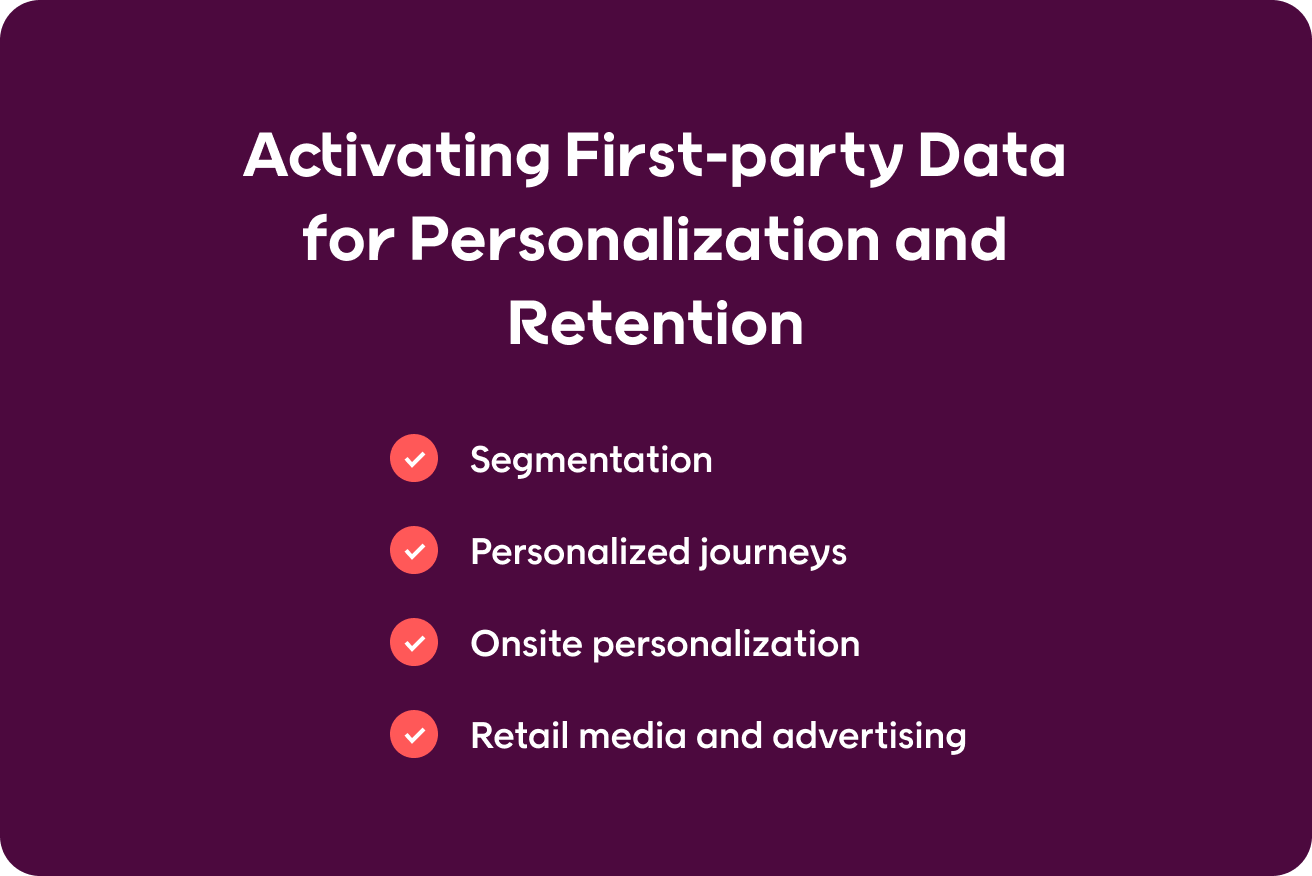
According to Voyado’s Inside E-commerce 2026 report, only 10% of e-commerce leaders describe their personalization as truly “data-driven.” The rest collect data but don’t fully leverage it. Here’s how to close the gap.
Segmentation
First-party data enables granular segmentation beyond basic demographics:
- Behavioral segments: High-intent browsers, cart abandoners, repeat purchasers, lapsed customers.
- Value-based segments: High lifetime value, discount-sensitive, full-price buyers.
- Preference segments: Category affinity, brand affinity, product preferences.
- Lifecycle segments: New subscribers, first-time buyers, loyalty members, at-risk churners.
Dynamic segments update as behavior changes; a customer who was “high-intent” last week might be “converted” today.
Personalized journeys
Use first-party data to trigger relevant communications at the right moment:
- Browse abandonment: “You viewed these products; here’s why they’re selling fast.”
- Cart abandonment: “Your cart is waiting” with the exact items and urgency cues.
- Post-purchase: Product care tips, cross-sells, review requests.
- Win-back: Re-engage lapsed customers with personalized offers based on past behavior.
- Loyalty milestones: Celebrate tier upgrades, point balances, or membership anniversaries.
When journeys are powered by real-time behavioral data, they feel relevant rather than generic.
Onsite personalization
First-party data powers more than email. Use it to personalize the site experience:
- Personalized homepage modules based on recent browse history.
- Recommendations informed by purchase history and affinity.
- Dynamic banners tailored to loyalty tier or segment.
- Search results ranked by individual relevance signals.
Retailers who personalize onsite see higher conversion and longer sessions.
Retail media and advertising
First-party data also strengthens paid channels. By syncing customer segments to advertising platforms (Meta, Google, TikTok), you can:
- Suppress existing customers from acquisition campaigns.
- Build lookalike audiences from high-value buyers.
- Retarget based on real behavior, not third-party cookies.
- Measure incrementality more accurately.
This reduces wasted spend and increases return on ad investment without relying on third-party tracking.
Preparing for the cookieless future
Third-party cookies are deprecated or limited in most browsers. Even as timelines shift, the direction is clear: the future is cookieless. Voyado’s report found 22% of e-commerce leaders are actively preparing for this shift. “Using our own customer data helps us understand people better, personalize offers, and rely less on third-party tracking that’s disappearing,” says Sina, Senior E-commerce Manager. The framing matters: this isn’t a defensive move against cookie loss. It’s a way to achieve sharper targeting and greater relevance than borrowed data ever could.
What preparation looks like:
- Invest in first-party collection: Make every touchpoint an opportunity to capture consented data.
- Build a unified data foundation: Ensure your customer data platform can resolve identities and activate segments without relying on cookies.
- Shift attribution models: Move from last-click, cookie-based attribution to incrementality testing and media mix modeling.
- Adopt privacy-first tracking: Use server-side tracking, first-party cookies, and consent management platforms.
Retailers who build robust first-party data foundations now will have a competitive advantage when cookie-based targeting becomes unreliable.

Examples of first-party data in retail
To make this concrete, here’s what first-party data looks like in practice:
| Data Type | Example | Activation Use |
| Purchase history | Customer bought running shoes three times | Recommend running accessories, target with marathon event email |
| Browse behavior | Viewed winter coats five times without purchase | Trigger “still looking?” email with coat recommendations |
| Loyalty activity | Redeemed a 20%-off reward | Suppress from discount campaigns, target with full-price new arrivals |
| Quiz response | Indicated “dry skin” preference | Personalize skincare recommendations site-wide |
| Preference center | Opted into “sale alerts” only | Respect preference in email cadence |
| In-store POS | Purchased in-store using loyalty ID | Merge into online profile, recommend online exclusives |
The common thread: each data point, when unified and activated, makes the customer experience more relevant.
Conclusion
A first-party data strategy isn’t a nice-to-have for retail; it’s the foundation for personalization, retention, and growth in 2026 and beyond. With 57% of e-commerce leaders placing first-party data at the heart of their strategy and as third-party signals fade, retailers that build unified, activated data foundations will win.
The playbook is clear: collect through loyalty programs, quizzes, preference centers, and post-purchase flows. Unify into a single customer view using identity resolution. Activate across email, SMS, onsite, and advertising channels. And prepare now for a cookieless world.
The gap between collecting data and activating it is where most retailers lose value. Closing that gap turns data into revenue.
Ready to unify your customer data and activate it across channels?
Discover how Voyado brings CRM, loyalty, and product discovery together into one connected experience: Learn more
FAQs
What is a first-party data strategy?
A first-party data strategy is a structured approach to collecting, unifying, and activating customer data gathered directly from your own channels. It includes behavioral data, transaction history, loyalty activity, and declared preferences, all owned by your organization and consented to by customers.
What is the difference between first-, second-, third-, and zero-party data?
First-party data is collected directly from customers through your channels. Zero-party data is information customers proactively share (preferences, quiz responses). Second-party data is another company’s first-party data shared via partnership. Third-party data is purchased from external aggregators and increasingly restricted by privacy regulations.
How do you collect first-party data in retail?
Retailers collect first-party data through loyalty programs, post-purchase emails, preference centers, quizzes, account sign-ups, in-store transactions linked to profiles, and consented website behavior tracking. The key is offering clear value in exchange for data.
Why is first-party data important without third-party cookies?
Third-party cookies are being blocked by browsers and restricted by privacy regulations, making external tracking unreliable. First-party data, collected directly and with consent, remains accurate, durable, and fully within your control. It’s the foundation for personalization when third-party signals disappear.
What are examples of first-party data?
Examples include purchase history, website browse behavior, email engagement, loyalty program activity, in-store transactions linked to a customer ID, quiz and survey responses, preference center selections, and customer service interactions. All of this data is collected through your owned channels.