TL;DR
Most retailers treat site search as a utility, not a revenue driver. Searchandising is the strategy of optimizing search results to align shopper intent, relevant products, and business goals. Done right, your search results page boosts sales, increases average order value, and improves customer satisfaction. This guide covers the searchandising definition, a clear example, and practical strategies, plus how a retail-native product discovery engine from Voyado turns search data into measurable revenue.
What is searchandising?
Searchandising (a portmanteau of search merchandising) is the practice of optimizing site search so your search results reflect shopper intent, merchandising goals, and real customer data.
Searchandising sits between three forces in your online store:
- Search relevance, so users see relevant results
- Merchandising and trading goals, so you promote products that support your sales goals
- Customer and behavioral data, so results adapt to how customers actually shop
It’s not just about what users search. It’s about how your business responds.
Plain site search vs searchandising
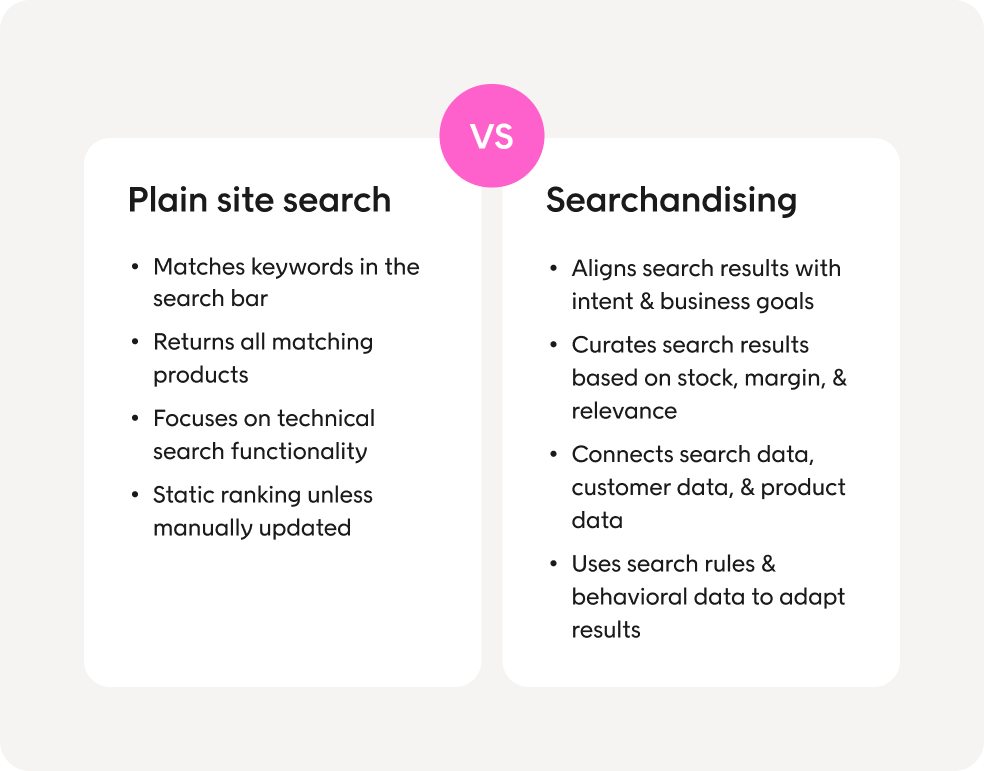
A standard site search works like a basic search engine. It looks at product pages and returns results that match search terms.
Search merchandising adds logic.
It uses business-specific rules and merchandising techniques to organize search results in a way that supports your business objectives and improves customer satisfaction.
Static merchandising vs intent-based search
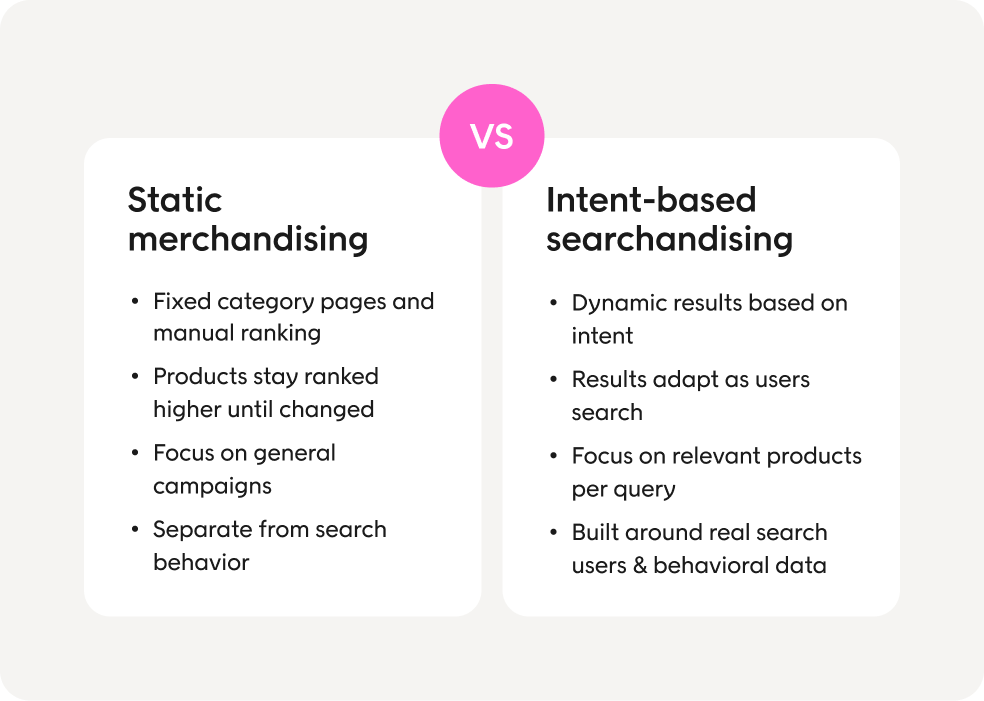
Traditional merchandising often lives on category pages. It supports campaigns, but it does not react to live intent.
Searchandising activates your merchandising strategies inside the search results page. That’s where many shoppers make decisions.
A simple searchandising example
Let’s say a customer types “black dress” into your search bar.
Plain search might return every black dress in your e-commerce store, even if some are out of stock or have low margins.
A good searchandising strategy does more:
- Shows in-stock items first
- Prioritizes high-margin product offerings
- Surfaces size-relevant products
- Promotes complementary items directly on the results page
Now your search functionality supports sales, average order value, and conversion rates. That’s effective searchandising in action.
It connects directly to broader e-commerce merchandising and modern online merchandising strategies, but it works at the exact moment of intent.
Next, let’s look at why searchandising matters so much for retail and e-commerce, and why many brands still underestimate it.
Why searchandising matters for retail and e-commerce
When someone uses your search bar, they’re not casually browsing.
They’re ready to buy.
Search users are your highest-intent audience on your site. They type clear search terms. They expect relevant results. If they don’t find them, they leave your online store fast.
That’s why searchandising is important.
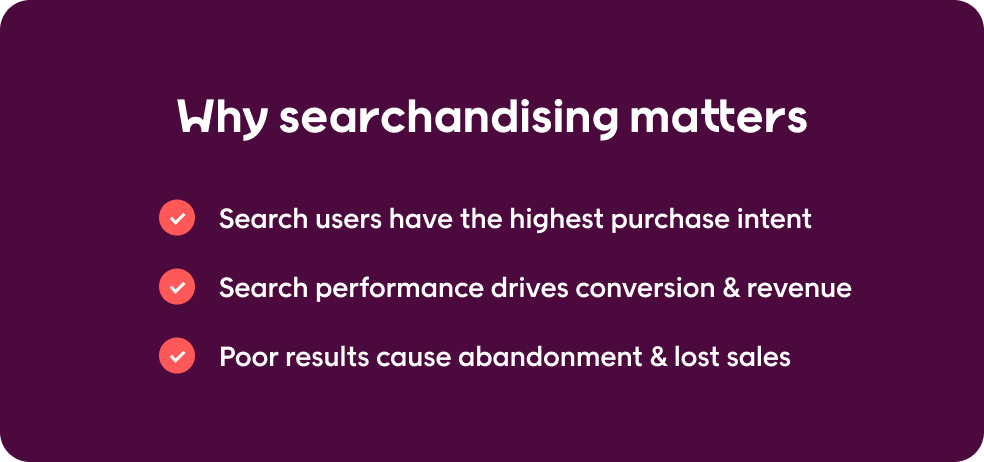
Better search performance means better revenue performance
When you improve search relevance and ranking logic, your numbers move.
Better organizing search results leads to:
- Higher conversion rates
- Stronger average order value
- Better margin mix
- More sales from the same traffic
Instead of treating search as a search engine utility, you align it with business goals and sales goals. You promote products that support campaigns, protect margin, and reflect customer preferences.
That’s how searchandising helps businesses increase revenue without increasing spend.
What happens when search is not merchandised
When search functionality runs without a strategy, predictable problems show up.
- Zero-result queries for important search terms
- Irrelevant results or out-of-stock items ranked higher
- Seasonal or campaign products are buried
- High exit rates from the search results page
Many shoppers won’t complain. They’ll just abandon the website.
For online retail brands, that means lost conversion rates and missed sales opportunities.
Search shapes the entire shopping experience
If users search and see irrelevant results, frustration builds. If they find relevant products instantly, it feels effortless. That difference affects customer satisfaction and how customers view your brand.
That’s why many brands now treat search as a performance channel, not just navigation. Modern approaches like AI search and product recommendations connect search data, behavioral data, and merchandising strategies.
When searchandising is aligned with broader online merchandising, it supports measurable growth instead of just functionality.
That’s why this isn’t just a technical fix. It’s a revenue strategy.
Let’s look at how searchandising works in practice inside your e-commerce site.
Core components of effective searchandising
Searchandising doesn’t rely on one setting.
It’s a system. When these components work together, your search becomes a performance channel inside your e-commerce site.
Relevance and ranking as the foundation
Everything starts with relevance.
If your search engine cannot understand intent, nothing else matters. Modern site search must handle semantic queries, typo tolerance, synonyms, and long-tail search terms. Many shoppers don’t type perfect product names. They type how they think.
That’s where natural language processing and intelligent search algorithms make a difference. They help match users search behavior to relevant products, even when the wording isn’t exact.
But relevance alone is not enough.
Ranking decides what appears first on the search results page. And ranking should reflect both customer intent and business goals.
Here are common ranking factors in effective searchandising:
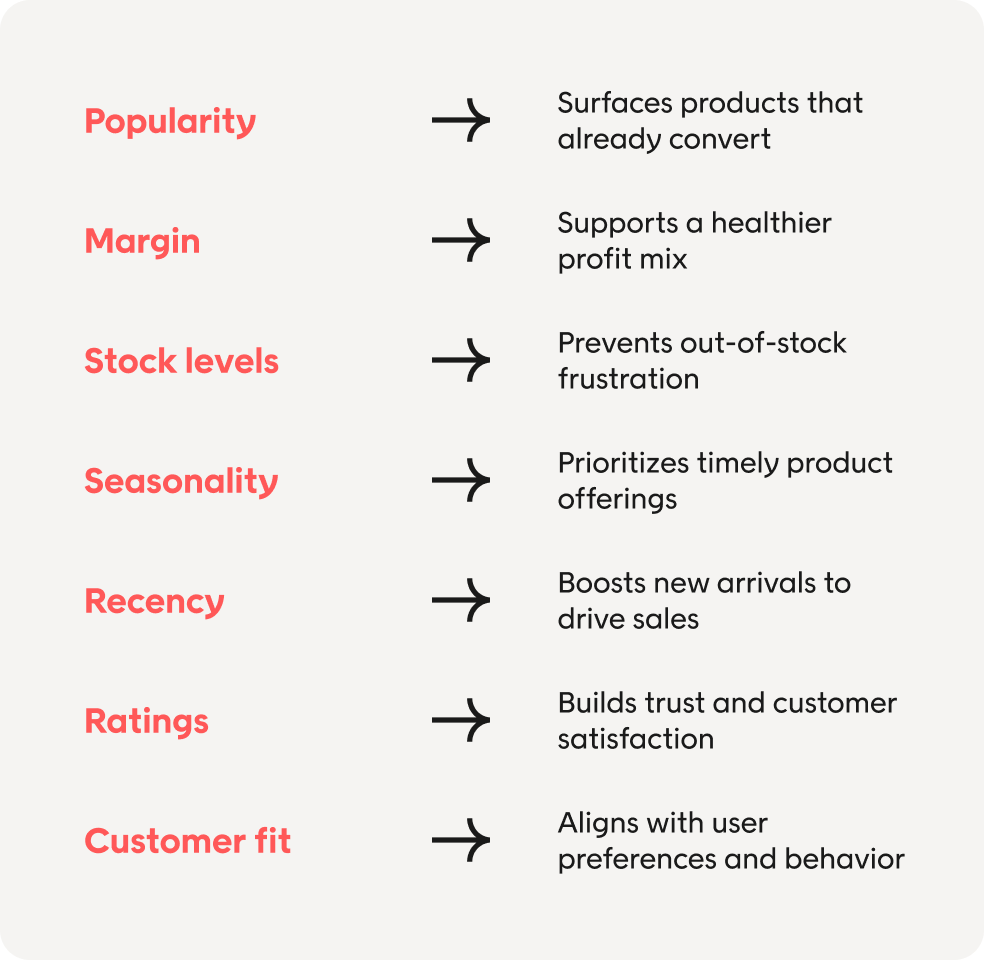
Modern engines combine relevance scores with business-specific rules. That’s how searchandising balances search relevance with merchandising strategies. It is not just keyword matching. It is organizing search results to support sales and business objectives.
Filters, facets, and guided discovery
After initial search results, refinement matters.
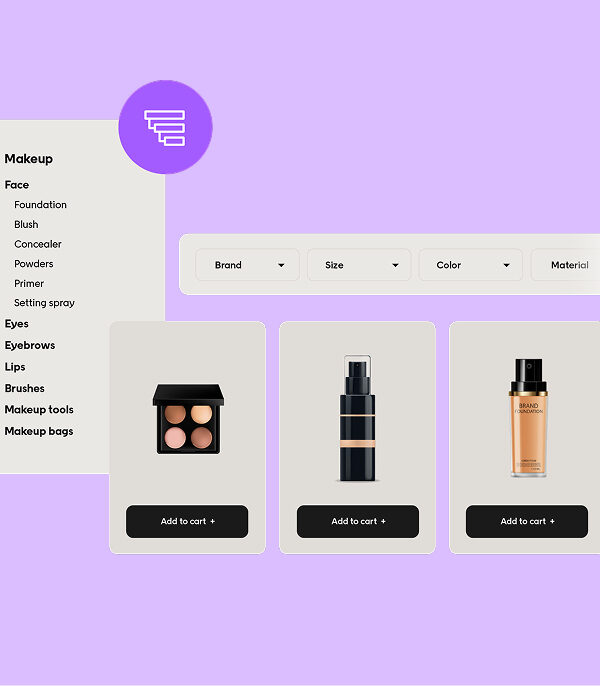
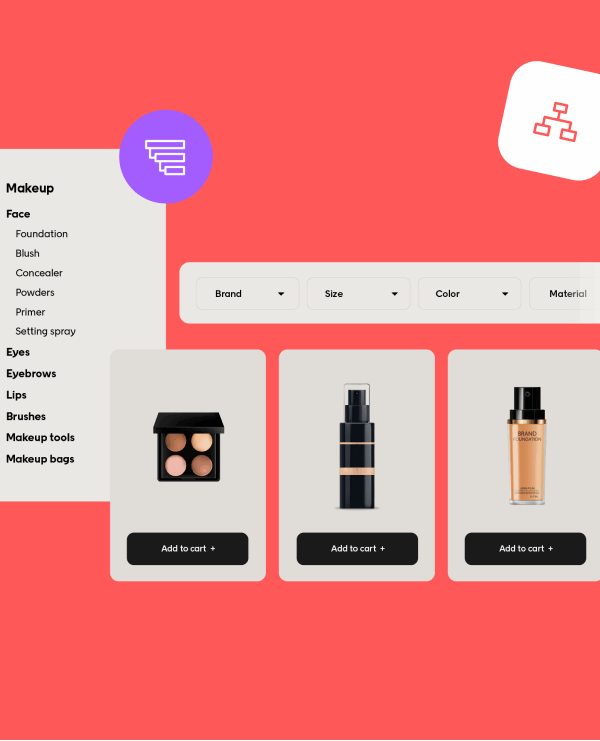
Good filters and facets reduce friction and improve the overall shopping experience. In any e-commerce store, core filters usually include size, color, brand, price, and category-specific attributes.
In some verticals, guided discovery becomes even more important. For example:
- Occasion for fashion
- Fit or fabric type
- Skin type in beauty
- Room type in homeware
Consistency across categories also matters. If filters behave differently from one part of your website to another, users lose trust.
Strong filtering supports product discovery. It helps users narrow down relevant results without starting over. That improves conversion rates and reduces exit rates from the results page.
This is where many brands underestimate the importance of site search. It is not only about what appears first. It is about how easily customers can refine.
Merchandising rules and campaigns in search
Searchandising gives you control inside search.
You can:
- Pin products for specific search terms
- Boost items tied to campaigns
- Bury low-priority products
- Exclude items that should not appear
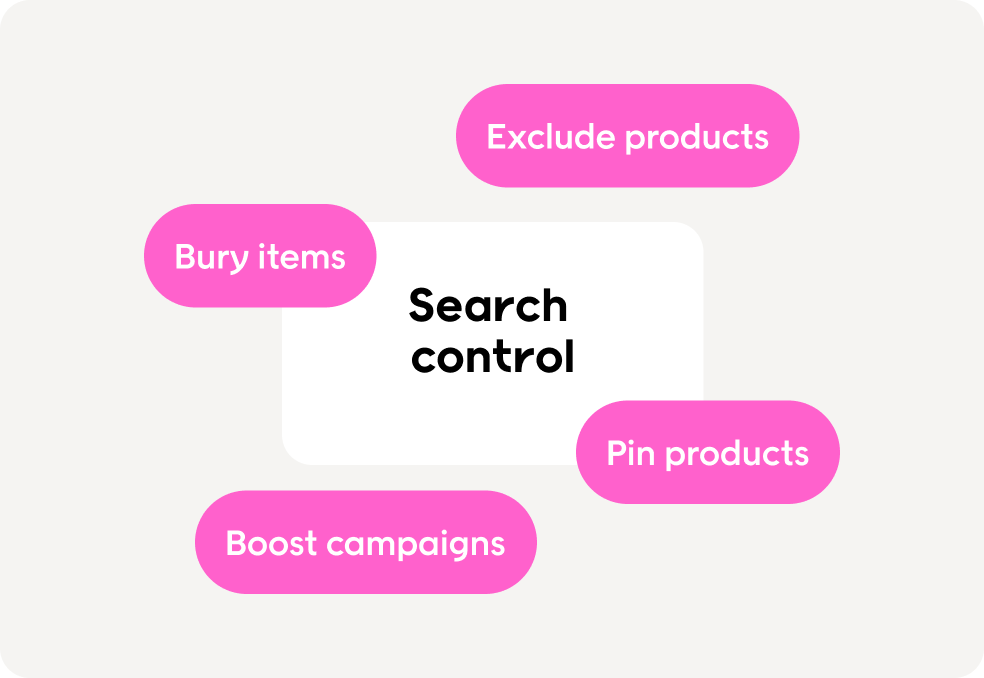
Query-level rules are powerful. For example, when someone searches “gift,” you might prioritize bundled sets. When they search “sale,” discounted items should appear first. When they type “wedding,” occasion-based products should surface.
You can also integrate promotional banners, badges, or featured products directly into the search results page. That turns search into an extension of your broader e-commerce merchandising strategy, not a separate tool.
Instead of treating search as passive navigation, you promote products intentionally based on intent.
Personalisation and segment-based searchandising
Not all users should see the same results.
Searchandising becomes more effective when it adapts to customer data.
For example:
- New customers may see the best sellers
- Returning customers may see items aligned with past browsing
- Loyalty tiers and VIP segments can see exclusive product offerings
- Geographic relevance can prioritize local stores or local stock
This is where searchandising work connects directly to customer experience.
Using behavioral data and past purchase patterns gives you a better understanding of customer preferences. That helps drive conversions and increase average order value without being intrusive.
It also supports brands that operate both online and brick-and-mortar locations. Search results can reflect local availability, which reduces friction and improves satisfaction.
Analytics, experiments, and feedback loops
Searchandising is not set-and-forget.
Search data reveals exactly how customers interact with your e-commerce website. Strong search reports typically highlight:
- Top queries
- Zero-result queries
- Low-converting queries
- High-exit search pages
These insights inform both search functionality and broader merchandising techniques.
You can also run experiments.
A/B tests on ranking strategies, layout changes, and promotional placements help businesses validate what actually drives sales. Even small adjustments to organizing search results can increase conversion rates.
Over time, search data becomes a feedback loop. It informs category pages, product pages, campaign planning, and even inventory decisions.
When treated strategically, search becomes one of the clearest windows into customer intent inside your site.
Searchandising strategies to drive more revenue
You don’t need a full rebuild to improve search merchandising. You need focused action inside your e-commerce site.
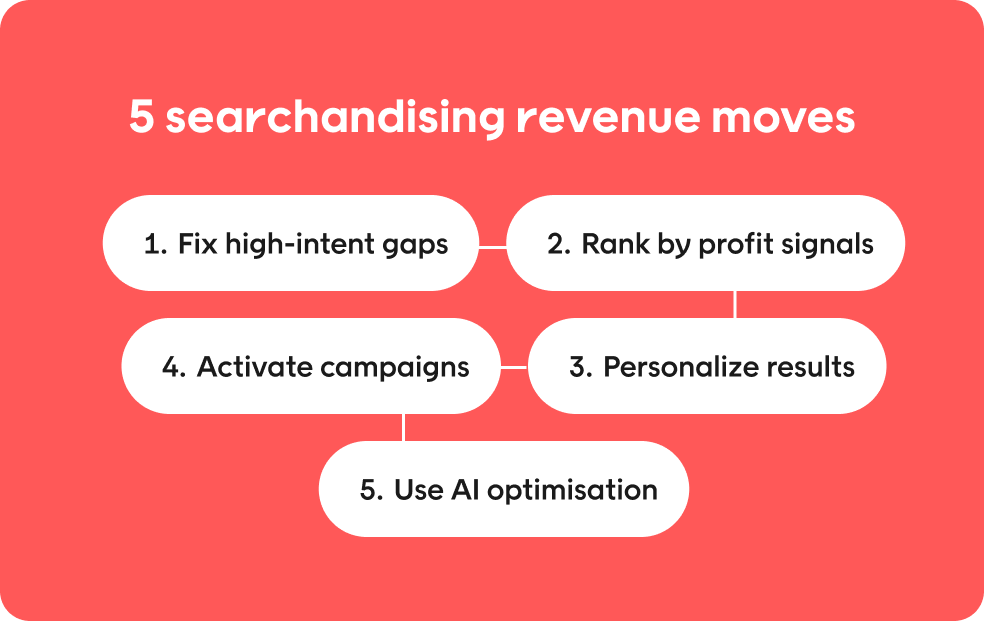
1. Fix high-intent queries with zero or poor results
Start with search data.
Review:
- Zero-result queries
- High-exit search results pages
- High-volume queries with low conversion rates
These are revenue leaks.
If many shoppers search a key term and see irrelevant results, add synonyms, improve search rules, or create curated pages. Redirect outdated search terms. Add fallback logic so similar products or related categories appear instead of dead ends.
High-intent queries should never lead to friction.
2. Align ranking with margin, inventory, and availability
Search results should support profit, not just popularity.
Boost high-margin but relevant SKUs. Bury low-rated or high-return items. Prioritize in-stock inventory, especially when local availability matters.
When ranking logic reflects margin, stock, and business goals, you protect profit and reduce frustration at the same time.
Searchandising works when search relevance and commercial priorities move together.
3. Personalize search for different customer segments
Not all customers should see identical search results.
- New visitors: show trending products and best sellers
- Returning customers: prioritize favorite brands, categories, or sizes
- Loyalty members: highlight perks, points, or early access items
Segment-based searchandising connects search to customer data and behavioral data. It improves the overall shopping experience and increases conversion rates without adding complexity for users.
4. Use search campaigns for key retail moments
Search is one of the most powerful retail touchpoints during campaigns.
Seasonal events like Black Friday, Christmas, back to school, or summer sale change search behavior fast. So do brand launches and collaborations.
Adjust ranking and merchandising rules for specific queries tied to those moments. Surface campaign products first. Add promotional banners or badges directly into the search results page.
5. Let AI and agentic optimisation do the heavy lifting
Manual search rules don’t scale.
AI can continuously learn from user behavior, adapt ranking automatically, and suggest new segments or campaigns based on search patterns. That’s where modern retail technology changes how searchandising work happens.
Solutions within the Voyado product suite treat product discovery as a performance channel.
Agentic optimization, explained in more detail on Voyado’s AI page, allows systems to monitor discovery performance and propose or execute ranking improvements with human oversight.
That means search becomes adaptive rather than reactive.
These strategies turn search from navigation into measurable growth.
But tactics alone are not the full picture. Searchandising delivers the strongest impact when it becomes part of how your retail business operates every day.
So what does this look like when applied inside a live e-commerce environment?
Searchandising examples in action
You know more about searchandising now, but how does it perform inside a real e-commerce business?
Here are three practical examples that show how brands searchandise commerce in action.
Example 1: Retailer reducing “dead-end” searches
Problem
A retailer saw high search volume for “midi dress,” but many sessions ended in frustration. Popular sizes were out of stock. Users saw irrelevant results or unavailable products ranked higher.
High intent. Low conversion.
Searchandising fix
The team adjusted the ranking logic to prioritize available sizes first. Best sellers that were in stock were boosted. Filter chips made size refinement faster on the search results page.
Instead of simply matching keywords, they used searchandising strategies to organize search results around availability and intent.
Result
Fewer zero-result or low-relevance sessions. Higher conversion rates. Fewer abandoned visits.
This type of improvement mirrors real outcomes like those achieved by Obs & Obs Bygg, who increased revenue from search by 4.5 percent by treating site search as a performance driver rather than a utility.
When you define searchandising in commercial terms, this is what it means: fewer dead ends and more completed purchases.
Example 2: Beauty retailer tying search to loyalty data
Problem
A beauty brand saw strong traffic for “foundation,” but return rates were high. Customers struggled to find the right tone or formula.
Search worked technically but failed experientially.
Searchandising fix
The retailer used customer profile data such as skin type and previous purchases to personalize search results. When returning customers searched “foundation,” relevant products aligned with past preferences appeared first.
New customers saw best sellers and highly rated options.
Searchandising meaning shifts here from ranking to relevance at the individual level.
Result
Fewer returns. Better repeat purchase rates. Improved customer satisfaction.
This reflects the same commercial pattern seen across many brands using personalization to improve product discovery and increase average order value.
Example 3: Home retailer increasing basket size
Problem
Customers searching for “sofa” rarely purchased add-ons like cushions or coffee tables. The average order stayed flat.
Search supported discovery. It did not drive growth.
Searchandising fix
The retailer used merchandising rules inside search results to promote bundles and “complete the look” recommendations. Complementary items appeared directly in the results page for sofa-related search terms.
Instead of waiting for customers to navigate deeper into the site, search became the entry point for cross-sell.
Result
Higher average order value. More complete baskets. Stronger margin mix.
This is how businesses searchandise commerce strategically. Search is not just navigation. It becomes part of online merchandising and revenue planning.
For brands evaluating how to evolve their discovery stack, understanding the difference between traditional tools and modern approaches like those outlined in top e-commerce search solutions is critical.
When searchandising is done well, it supports broader online merchandising goals and contributes directly to exceptional online shopping experiences.
These examples show that searchandising isn’t theoretical, but measurable.
The next question is how to choose a search and searchandising solution that supports both relevance and revenue without adding operational complexity.
How to choose a search and searchandising solution
Not all search engines are built for retail.
If you’re evaluating tools to searchandise commerce effectively, use this checklist.
Must-have capabilities
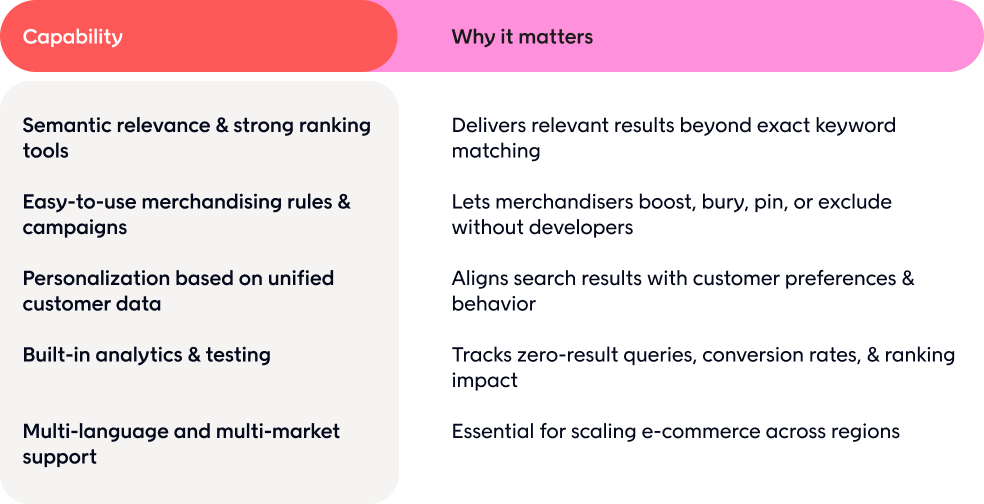
If you define searchandising as the bridge between intent and revenue, these are non-negotiable.
Retail-specific considerations
Retail complexity breaks generic tools.
Make sure your solution:
- Handles variants like size and color cleanly
- Connects to inventory, pricing, and live promotions
- Integrates with loyalty and marketing channels
- Delivers fast time to value and is usable by merchandisers, not only developers
Searchandising meaning in retail is practical. It must work inside real product catalogs with real stock constraints.
Where Voyado fits
Voyado offers a retail-native product discovery engine built specifically for modern e-commerce.
It includes:
- Site search
- Recommendations
- Merchandising tools
It connects directly to unified customer profiles and engagement channels. That allows teams to align searchandising strategies with broader customer experience and marketing efforts.
With agentic optimization through Voyado AI, teams can monitor discovery performance and act faster on insights. The broader Voyado platform connects product discovery with loyalty, segmentation, and campaign execution.
Search becomes measurable, retail-ready growth infrastructure, not just navigation. And once your searchandising setup is live, the next question is simple: is it working?
Key searchandising metrics to track
Once your search and merchandising setup is live, the next question is simple: Is it working?
Start with a focused set of KPIs. Don’t track everything. Track what proves revenue impact.
Core performance metrics
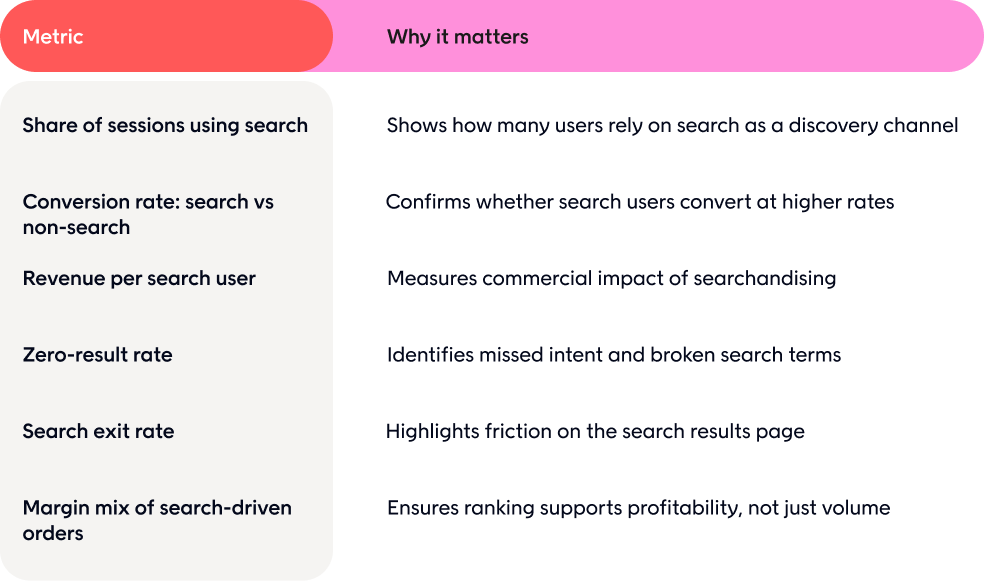
Search users typically represent your highest-intent traffic. Their performance should outperform non-search sessions. If it doesn’t, your search relevance, ranking, or merchandising rules likely need refinement.
How to approach measurement
Start with two or three core KPIs.
Measure performance before and after each initiative. If you adjust ranking rules, track conversion rates, and revenue per search. If you improve synonym handling, monitor the zero-result rate and exit rate.
Search data gives you a direct feedback loop.
When treated strategically, it informs product discovery, merchandising decisions, and broader e-commerce growth efforts.
How Voyado helps retailers turn search into a revenue driver
Searchandising only works when your tools understand retail.
Voyado is an agentic retail platform built for modern e-commerce, with a retail-native product discovery engine at its core. That foundation changes how search performs from day one.
What does that mean for your searchandising strategy?
- Strong retail relevance out of the box
- Merchandiser-friendly tools to boost, bury, and manage campaigns
- Connected customer data for meaningful personalization
- AI agents monitoring performance and supporting continuous optimization
Search is no longer isolated. It’s connected to loyalty, engagement, and merchandising across the business.
That’s how search becomes measurable growth infrastructure.
Your next steps:
- Explore how this works in practice and review the full Voyado product capabilities or dive deeper into agentic retail on the Voyado AI page.
- See how your team can turn site search into a revenue driver. Book a demo and explore what retail-native product discovery can do for your business.
FAQs about searchandising
What is searchandising in e-commerce?
Searchandising in e-commerce is the practice of optimizing search results to align shopper intent, relevant products, and business goals. It connects search relevance with merchandising rules and customer data. The searchandising meaning goes beyond keywords. It turns search into a revenue driver.
How is searchandising different from basic site search?
Basic site search returns matching products based on keywords. Searchandising layers ranking logic, merchandising rules, and personalization on top. Instead of static results, your search results page reflects margin, stock, campaigns, and customer preferences.
What is an example of searchandising?
Imagine a customer searches “black dress” and sees in-stock, high-margin, and size-relevant products ranked first. Filters are pre-applied, and best sellers are boosted. That is how retailers searchandise commerce intentionally.
Do you need AI for good searchandising?
You can start with manual search rules and merchandising tools. However, AI improves searchandising by learning from search data, adapting ranking automatically, and identifying new opportunities. It helps businesses scale optimization without constant manual updates.
How do you get started with searchandising if your current search is basic?
Start by reviewing zero-result queries and high-exit search sessions. Improve synonyms, adjust ranking, and align results with business objectives. Even small changes to organizing search results can improve conversion rates and customer satisfaction.