TL;DR
More retailers are exploring a headless e-commerce platform to support new customer experiences across web and mobile apps as digital commerce evolves beyond traditional platforms.
A headless e-commerce platform separates the presentation layer from back-end systems. That adds flexibility, but also complexity. This guide compares leading headless commerce solutions for 2026.
Whichever headless commerce solution you choose, the commerce engine is only one layer. You still need strong CX, loyalty, and product discovery across channels, which is where platforms like Voyado fit into your headless stack.
What is a headless e-commerce platform?
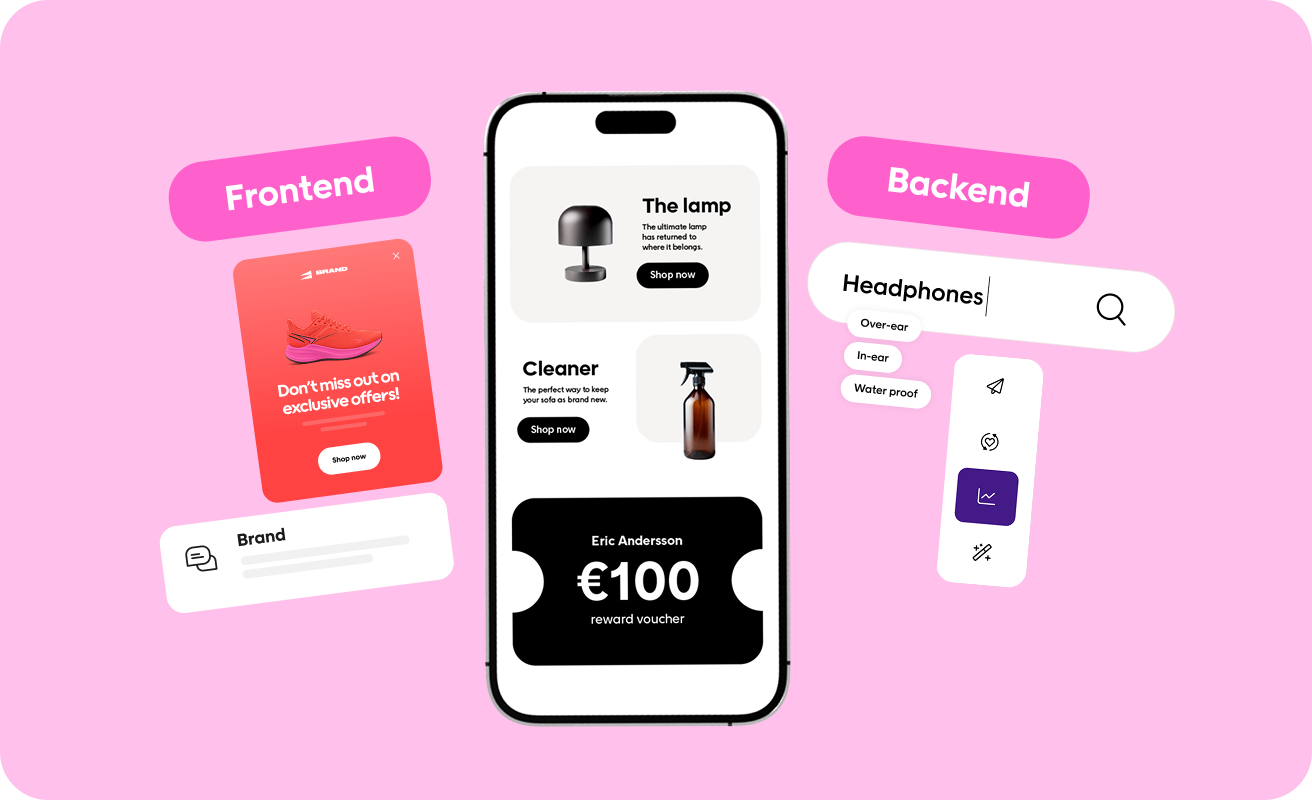
A headless e-commerce platform separates the backend from the frontend.
The commerce engine manages products, pricing, checkout, and payment gateways. Your website, mobile apps, and other customer touchpoints connect to it through application programming interfaces.
Instead of running one fixed web store, a headless commerce platform supports multiple frontends across channels.
As teams rethink their e-commerce architecture and long-term growth plans, many revisit their broader e-commerce strategy tips to clarify how the commerce layer fits into the bigger picture.
Headless commerce is one architectural choice within modern digital commerce. That’s why leaders often step back and explore wider industry perspectives, such as inside e-commerce, before committing to a platform direction.
Headless commerce vs traditional commerce
Here’s where it gets clearer.
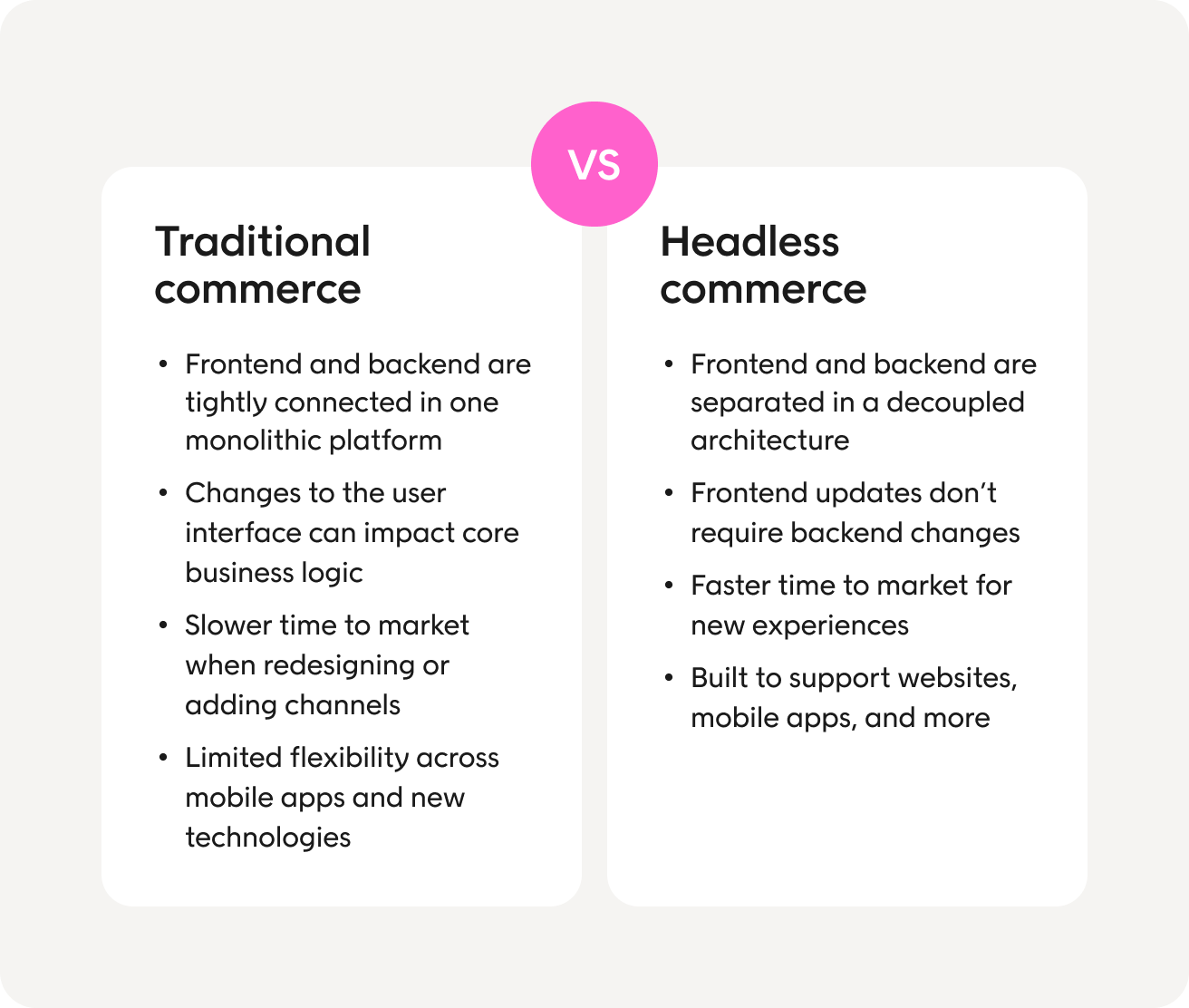
Traditional systems run inside one platform. That simplifies setup, but can slow your development team as customer expectations evolve.
Headless commerce gives you more control over the presentation layer and back-end systems, but it increases integration work across your tech stack.
Headless commerce vs composable commerce
Now let’s separate two terms that often get mixed up.
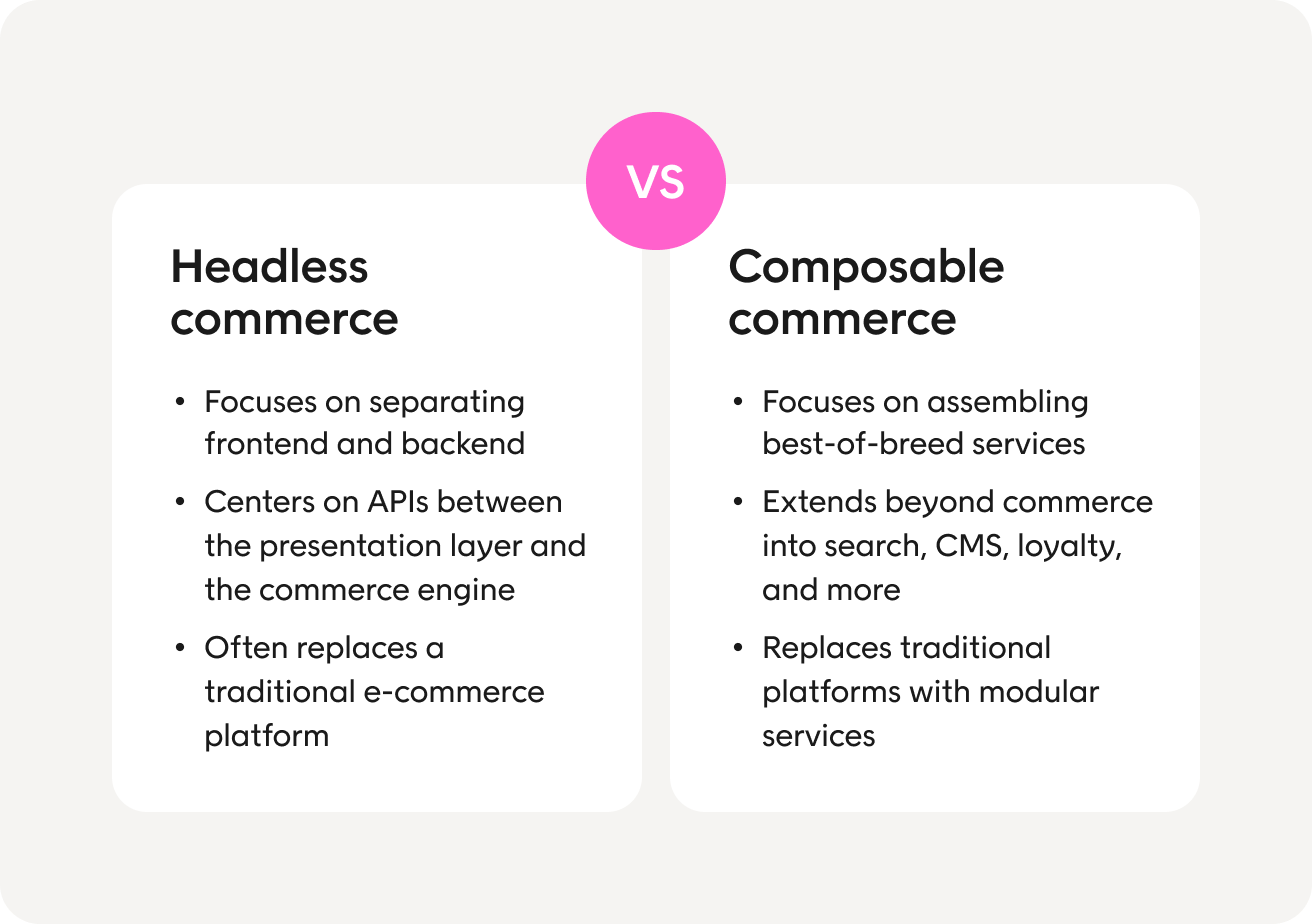
A headless commerce platform can support a composable commerce approach. Composable commerce extends further by combining specialized services such as a headless CMS, marketing automation tools, and other cloud native components.
Headless commerce focuses on architectural separation. Whether it’s the right move depends on how much complexity your team is ready to manage.
That brings us to the practical question: when do headless commerce solutions actually make sense?
When headless commerce solutions make sense (and when they don’t)
Headless commerce is an important architectural choice.
For some e-commerce businesses, it unlocks growth. For others, it adds complexity they don’t need.
Signs your current platform is holding you back
If you’re constantly fighting your e-commerce platform, that’s a signal.
Common red flags include:
- UX changes take months because frontend and backend systems are tightly linked.
- Adding mobile apps, marketplaces, or in-store screens requires heavy custom development.
- Performance issues hurt Core Web Vitals and customer experiences.
- Personalization and testing across brands or markets feel limited.
When your commerce platform slows your time to market or blocks experimentation, a headless platform can look appealing.
Many teams reach this point after revisiting their broader omnichannel e-commerce strategy and realizing their existing platform cannot support it.
Still, frustration alone is not a reason to rebuild your entire tech stack.
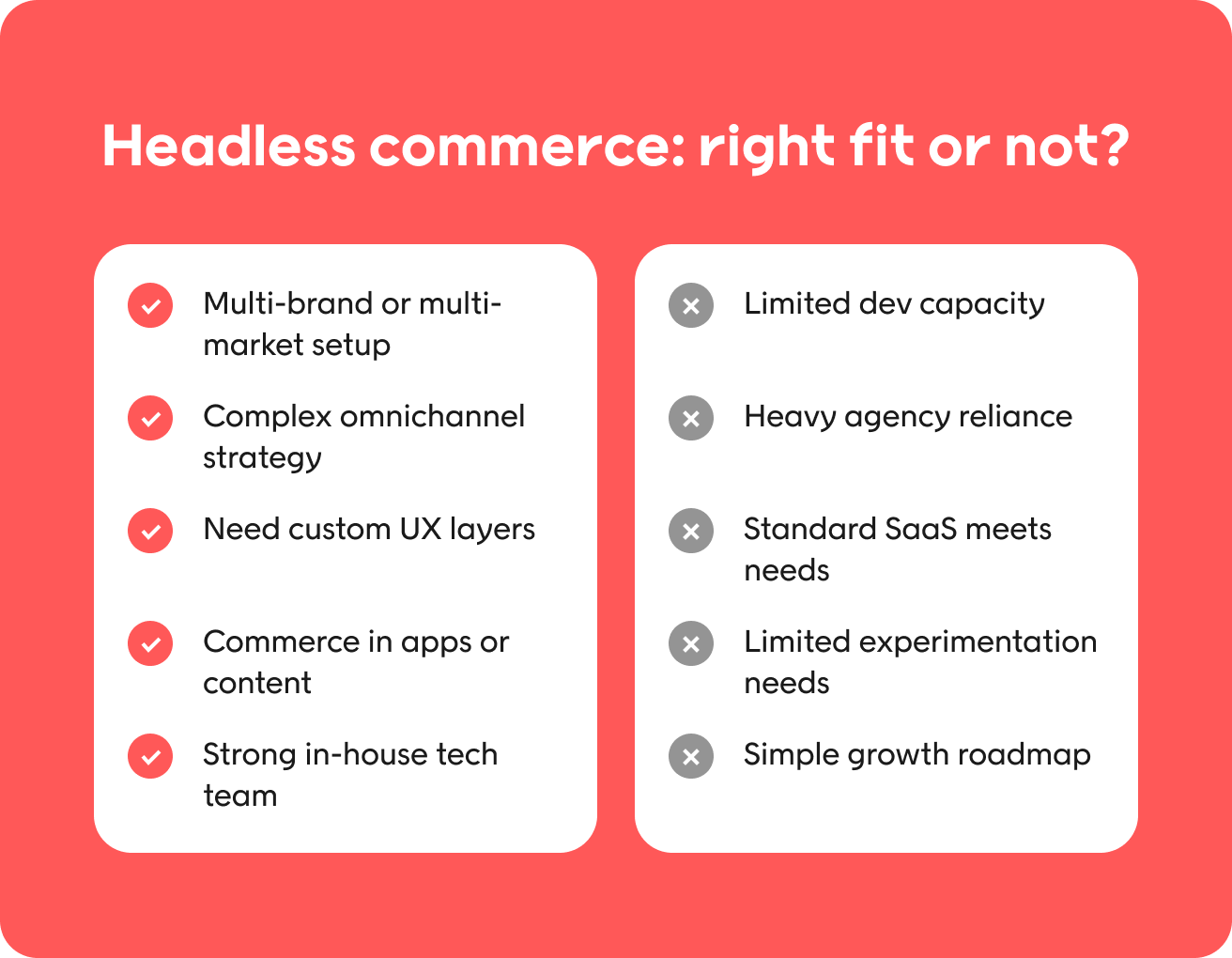
When headless e-commerce is a good fit
Headless e-commerce makes sense when your business model demands flexibility.
It’s often a strong fit for:
- Multi-brand, multi-market, or multi-channel retailers.
- E-commerce businesses with experienced product and development teams.
- Brands that want highly customized user interface layers.
- Use cases where commerce must live inside content, apps, or other non-traditional interfaces.
If your strategy requires commerce inside mobile apps, progressive web apps, or rich content experiences, a headless approach can better align your commerce capabilities with that direction.
It also supports deeper experimentation across channels, especially when paired with strong marketing for e-commerce that activates data across customer touchpoints.
Flexibility only pays off when complexity is part of your growth plan.
When headless might be overkill
Not every retailer needs a decoupled headless architecture.
Headless e-commerce may be unnecessary if:
- You lack in-house development capacity.
- You rely heavily on agencies for technical work.
- Your goals can be achieved with a modern SaaS commerce platform and strong CX tools.
Many brands reach their revenue targets by combining a traditional e-commerce platform with the right CRM for e-commerce and automation tools, rather than committing to a full headless implementation.
Headless commerce is powerful, but it’s not automatically better. Here’s how to decide which direction fits your brand.
How to choose the right headless e-commerce platform for your brand
There is no single best headless commerce platform. The right choice depends on your business model, your internal capabilities, and the kind of customer experiences you want to deliver.
Many brands explore headless commerce solutions because they promise flexibility and faster time to market. But headless commerce is not automatically better than traditional commerce. It’s a different architectural decision with different trade-offs.
Start with clarity before you shortlist vendors.
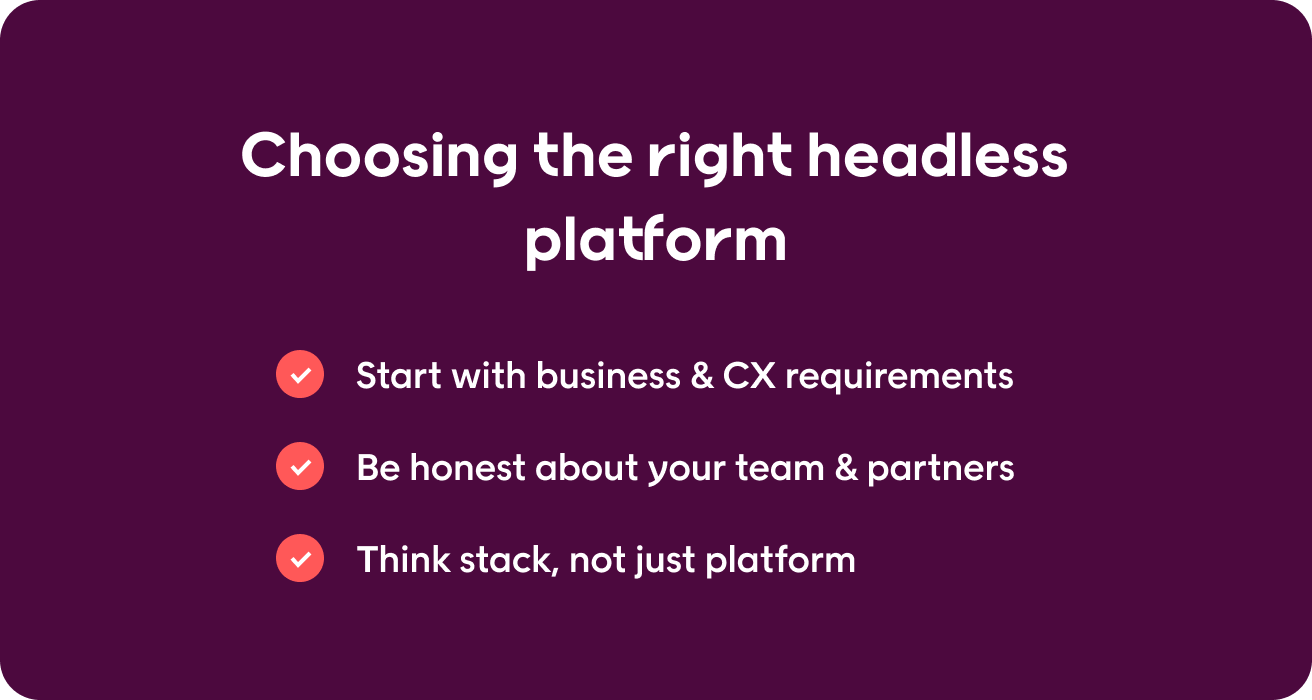
Start with business and CX requirements, not just architecture
Before comparing vendors, define what your business needs.
Clarify:
- How many brands, regions, and customer touchpoints you support
- Whether you are expanding into mobile apps or progressive web apps
- The complexity of your business logic and merchandising
- Your shipping and fulfillment options
- Whether you are moving away from traditional commerce platforms or legacy traditional systems
Headless commerce decouples the presentation layer from back-end systems through application programming interfaces. That headless architecture gives you more control over the user interface and supports composable commerce.
The benefits of headless commerce only matter if they support your long-term e-commerce architecture and CX roadmap.
If your growth depends on advanced digital commerce experiences, a headless commerce approach can create a competitive advantage.
If not, traditional platforms may still support your business functions effectively.
Be honest about your team and partners
Headless commerce increases flexibility across the commerce layer. It also increases responsibility.
To implement headless commerce successfully, you will need:
- Product leadership
- A capable development team
- DevOps ownership
- Solution architecture experience
An API first, cloud native commerce engine allows frontend and backend systems to operate independently. But headless implementation requires ongoing ownership of integrations, business logic, and API calls.
If you lack internal expertise, you will need agencies or system integrators. Without that support, headless commerce impact may include slower time to market rather than faster delivery.
Headless commerce vs traditional commerce is not about modern labels. It’s about matching architecture to capability.
Think stack, not just platform
Headless commerce is one layer in your tech stack. It’s not the entire solution.
Beyond the commerce engine, most organizations still need:
- A headless CMS
- Marketing automation tools
- A CRM or customer data layer
- Analytics and reporting
- Payment gateways
The commerce platform handles transactions. The surrounding stack shapes customer experiences beyond checkout.
Headless commerce aligns best with teams that think in systems. The right headless platform supports your presentation layer and back-end systems, but growth depends on how the full stack works together.
Once that is clear, the next step is figuring out how to choose something that fits your business.
How we evaluated these headless e-commerce platforms
This is not a formal ranking.
It’s a curated shortlist based on practical buyer criteria that matter in 2026.
The right headless e-commerce platform depends on how your business model works and how headless commerce aligns with your long-term architecture goals.
We focused on how each headless e-commerce platform performs across architecture, scalability, ecosystem strength, and real-world retail fit.
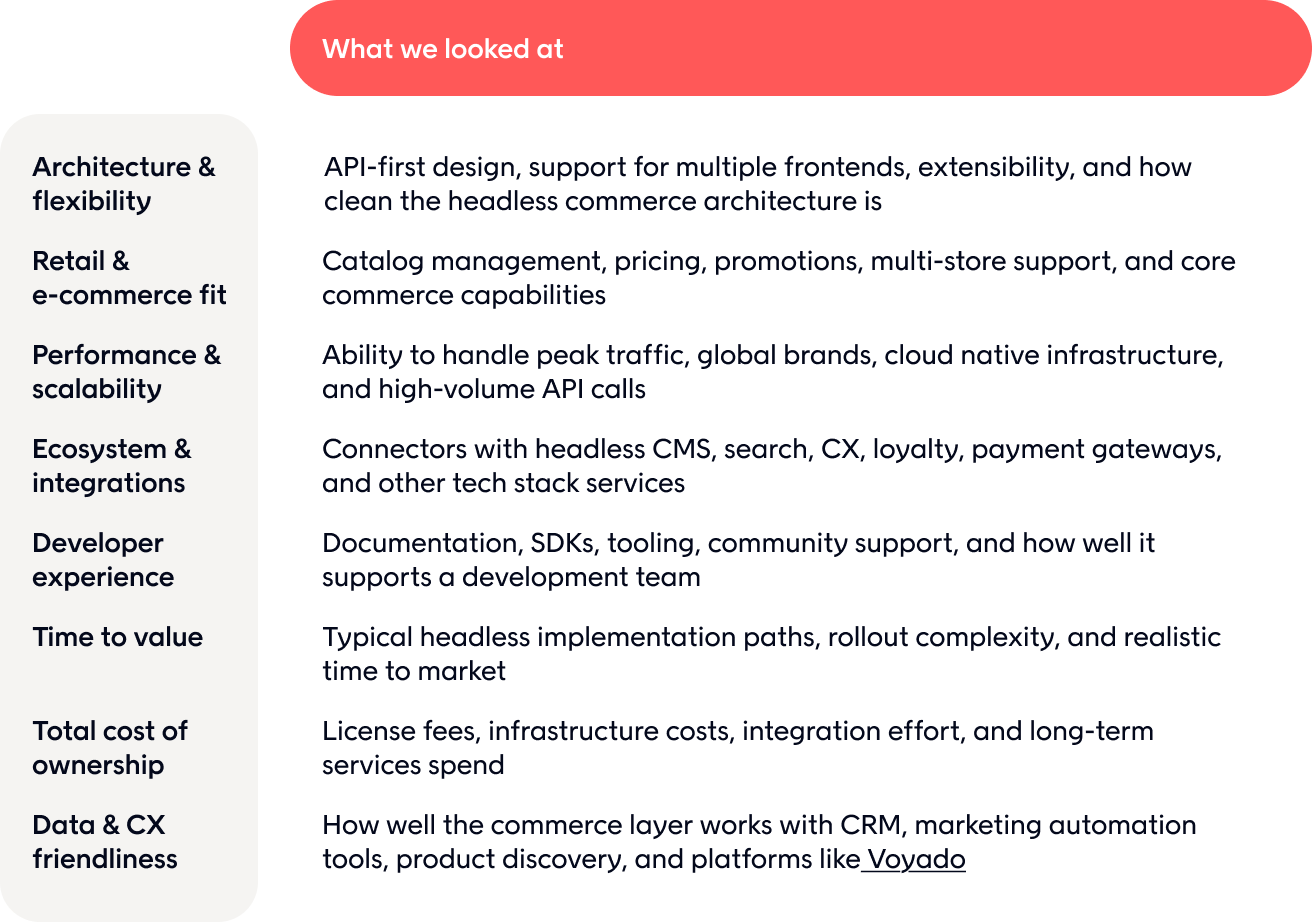
Some teams also look at how easily the platform connects to discovery and search tools, especially when evaluating options alongside resources like top e-commerce search solutions.
Each platform in the next section has a clear “best for” positioning.
Now let’s look at which headless e-commerce platform fits which type of business.
The 13 best headless e-commerce platform choices for 2026
For this overview, the list isn’t ranked. What you need is an understanding based on typical use cases, business models, and architectural strengths.
That way, you can quickly see which headless e-commerce platform fits your situation.
1. commercetools – API-first pioneer for complex, global commerce
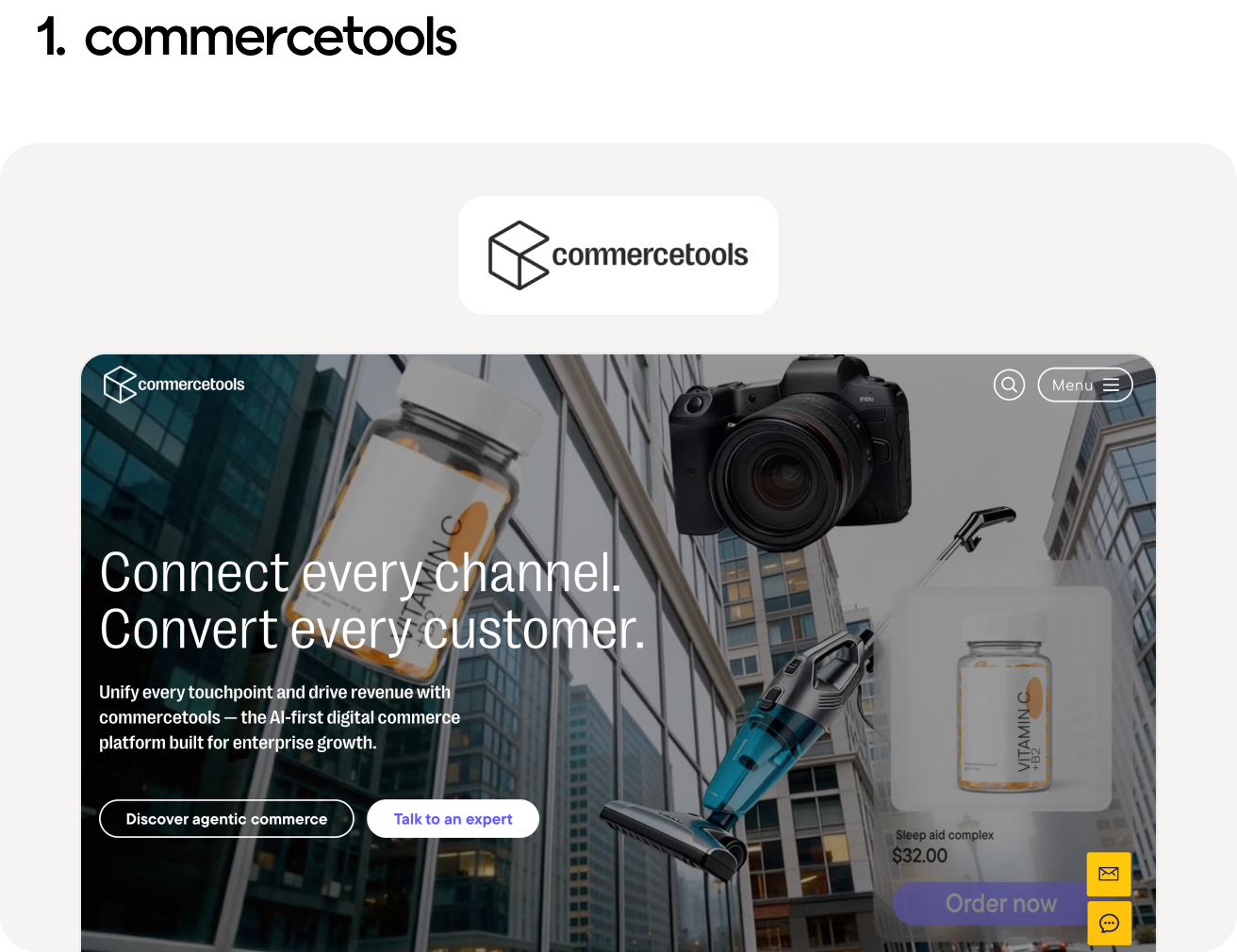
commercetools is one of the original API-first commerce platforms built around a fully decoupled architecture.
Best for
Enterprises with strong engineering teams managing multi-brand, multi-region, or high-volume setups.
Why it’s on this list
- True API-first design with flexible headless functionality.
- Cloud native infrastructure built for global scale and peak traffic.
- Strong support for complex catalogs, pricing, and shipping and fulfillment options.
- Designed so that frontend and backend operate independently, giving full control over the presentation layer.
Things to be aware of
- Requires an experienced development team.
- Implementation can be resource-heavy.
- Total cost of ownership increases with custom integrations.
Typical users include global brands with custom apps, regional storefronts, and complex business functions across markets.
commercetools offers flexibility as a competitive advantage.
But flexibility only pays off if your team can use it well.
2. Shopify (headless with Shopify Plus and Hydrogen): speed and ecosystem power
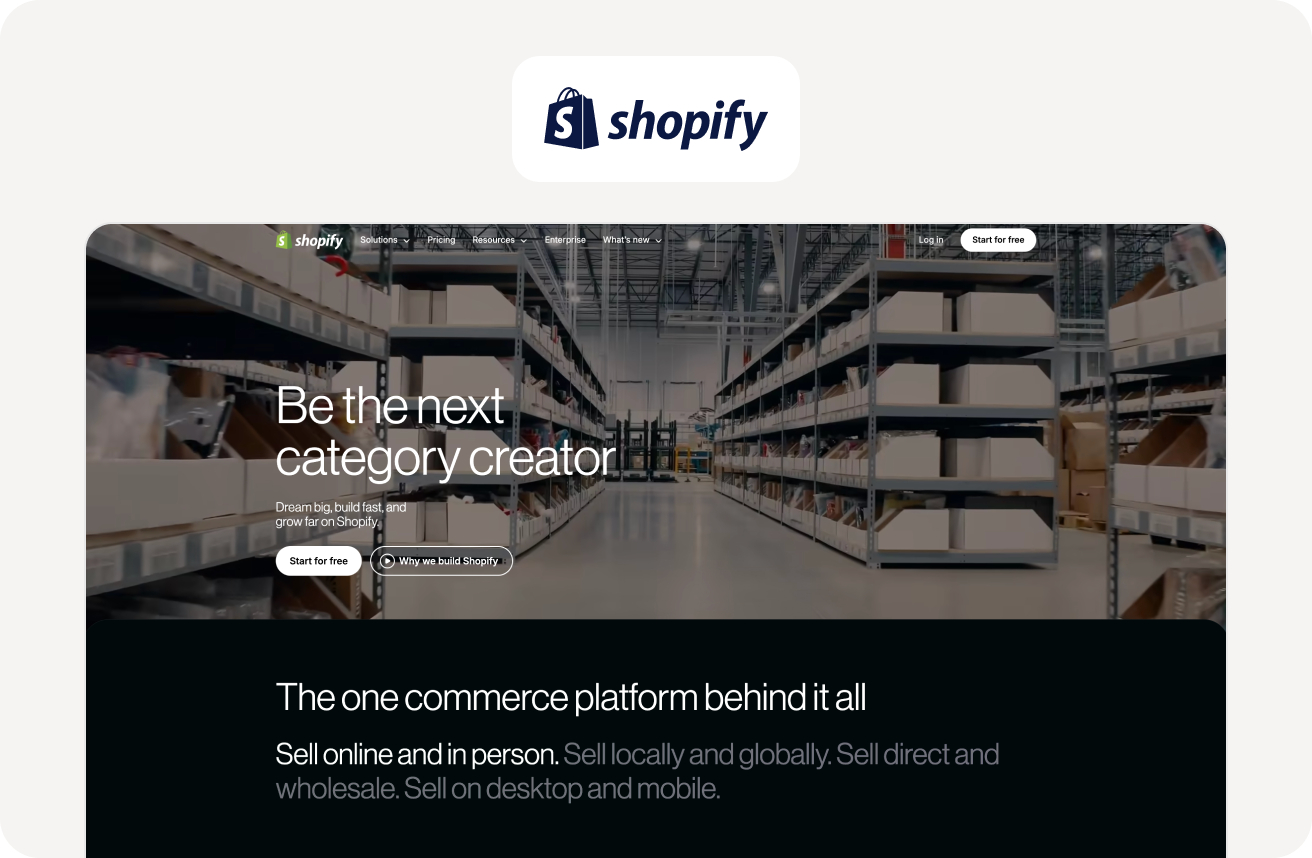
Shopify combines SaaS simplicity with headless e-commerce options through Shopify Plus and Hydrogen.
Best for
Fast-moving DTC and retail brands that want speed to market with custom storefronts.
Why it’s on this list
- Strong ecosystem and app marketplace.
- Headless website support via Hydrogen and API access.
- Built-in commerce capabilities that cover most modern commerce needs.
- Enhanced security and infrastructure are handled at the platform level.
Things to be aware of
- Deep customization can still require custom development.
- Some advanced headless commerce architecture use cases may feel constrained.
- Costs can rise with apps and add-ons.
Shopify works well when business users need autonomy while engineering teams extend the frontend.
Many retailers pair it with strong data and lifecycle tooling, such as those outlined in top CRM for e-commerce, to keep customer experiences connected across channels.
The key question is how much architectural freedom you actually need.
3. BigCommerce (headless): SaaS commerce with headless flexibility
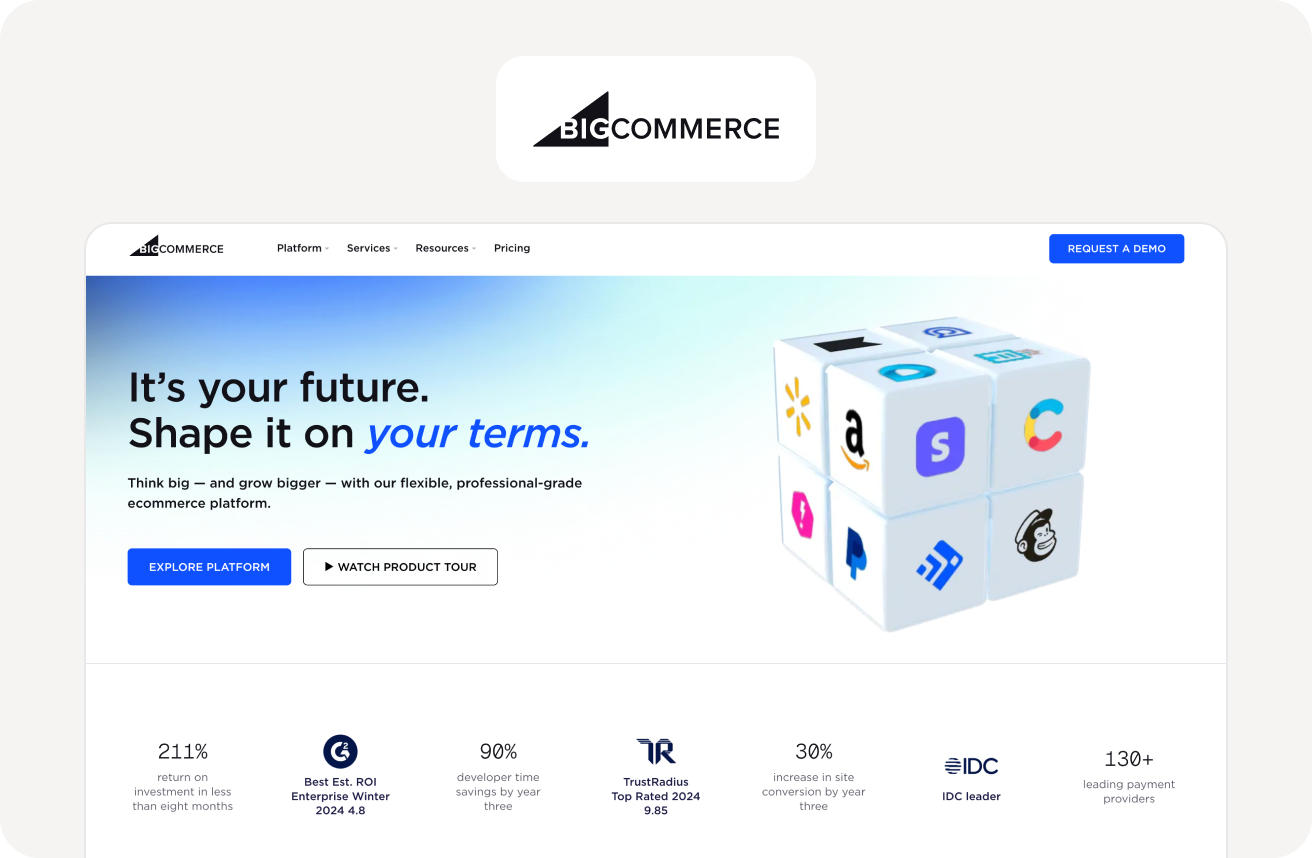
BigCommerce offers a SaaS commerce platform with headless commerce options layered on top.
Best for
Mid-market retailers that want SaaS simplicity but need some headless functionality.
Why it’s on this list
- Open APIs that support custom frontends and headless solutions.
- Solid core commerce engine for catalogs, pricing, and promotions.
- Supports multi-store and multi-channel expansion.
- Faster time to market compared to fully custom headless builds.
Things to be aware of
- Not as architecturally pure as API-first pioneers.
- Complex enterprise setups may hit limits.
- Advanced integrations can require agency support.
BigCommerce often fits retailers modernizing from traditional platforms without fully rebuilding their entire tech stack.
As frontends multiply, relevance and product discovery become more important, which is why many teams also evaluate specialized engines like site search to strengthen headless commerce performance.
BigCommerce offers a balanced entry into headless e-commerce.
Now let’s look at platforms built for deeper enterprise ecosystems.
4. Agentforce Commerce by Salesforce: enterprise headless commerce in the Salesforce ecosystem
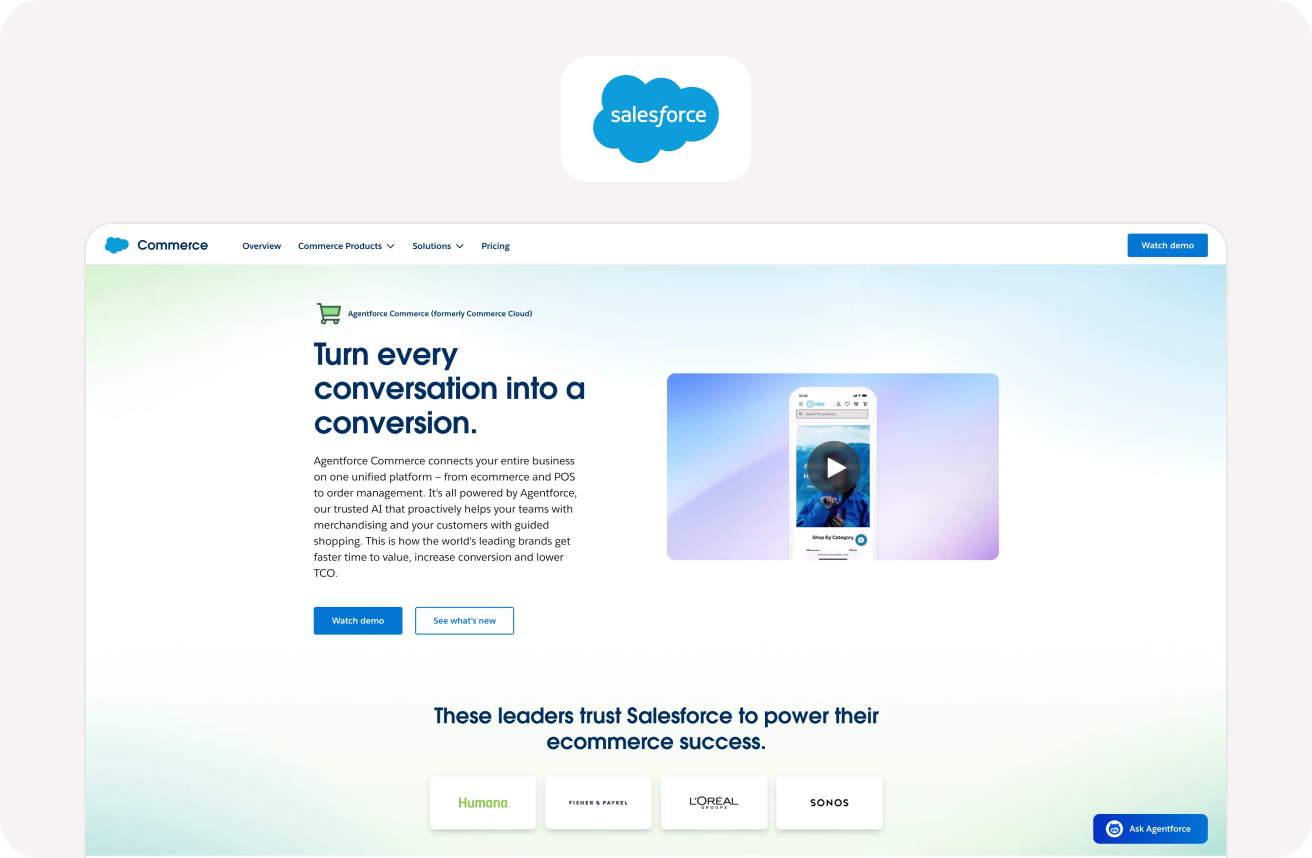
Agentforce Commerce extends Salesforce’s enterprise stack with headless commerce capabilities.
Best for
Retailers already invested in Salesforce who need enterprise-grade scale and integration.
Why it’s on this list
- Deep integration with Salesforce CRM, marketing, and service tools.
- Headless commerce architecture supported through APIs and composable services.
- Strong global scalability and cloud native infrastructure.
- Robust commerce capabilities for complex catalogs and international expansion.
Things to be aware of
- Licensing and implementation costs are significant.
- Requires experienced partners and development teams.
- Complexity can increase the total cost of ownership.
Agentforce Commerce works well when commerce must align tightly with broader customer data and marketing orchestration.
Enterprise power comes with enterprise responsibility.
5. Adobe Commerce: highly customizable headless commerce for complex catalogs
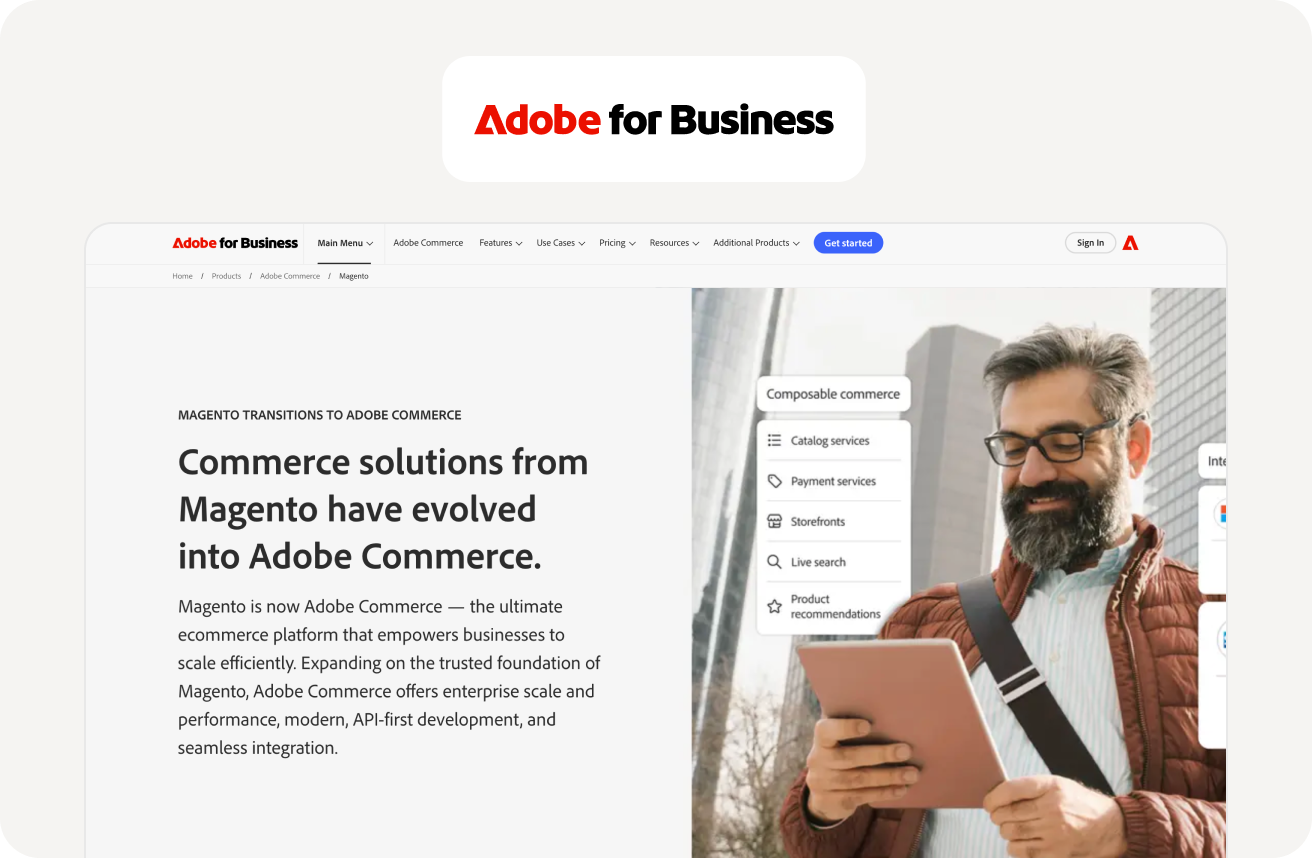
Adobe Commerce is the enterprise evolution of Magento, built for deep customization.
Best for
Organizations with strong development partners and complex pricing, catalog, or B2B requirements.
Why it’s on this list
- Flexible headless functionality with API support.
- Strong support for multi-store, multi-brand setups.
- Deep control over business logic and custom workflows.
- Integrates into the Adobe Experience Cloud ecosystem.
Things to be aware of
- Implementation can be heavy and time-intensive.
- Ongoing maintenance requires skilled engineering resources.
- Not ideal for small teams without dev capacity.
Adobe Commerce appeals to teams that want control over nearly every layer of the e-commerce architecture.
Control is powerful, but it demands commitment.
6. Elastic Path: API-first commerce for complex product structures
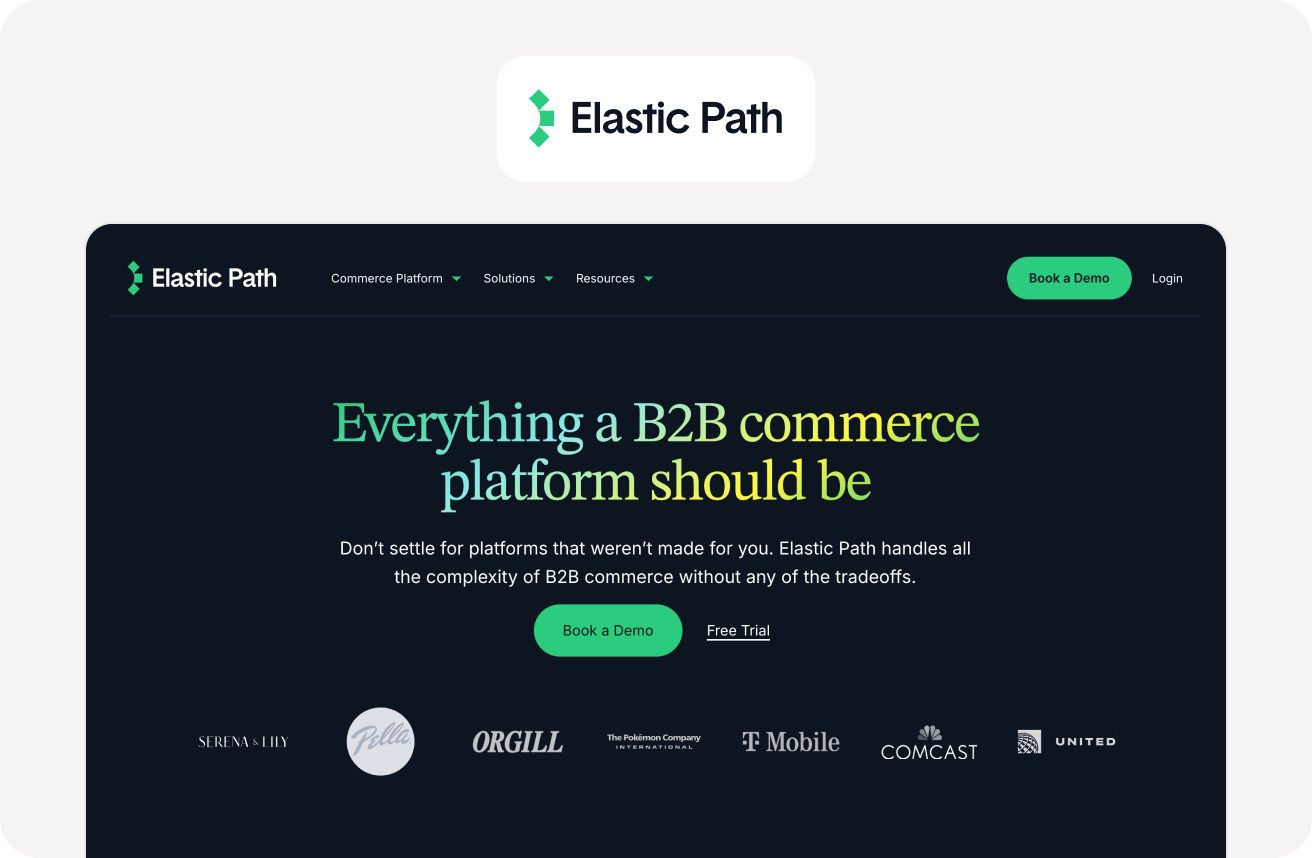
Elastic Path positions itself as an API-first commerce platform built for composable commerce.
Best for
Retailers managing complex bundles, subscriptions, or configurable products.
Why it’s on this list
- API-first and cloud native by design.
- Strong support for complex product relationships and custom pricing.
- Built to integrate across modern commerce tech stacks.
- Supports headless commerce systems where frontend and backend operate independently.
Things to be aware of
- Requires a capable development team.
- Not plug-and-play for non-technical business users.
- Implementation planning is critical.
Elastic Path fits brands treating commerce as infrastructure rather than just a storefront.
Infrastructure decisions shape everything that follows.
7. VTEX: unified headless commerce and marketplace capabilities
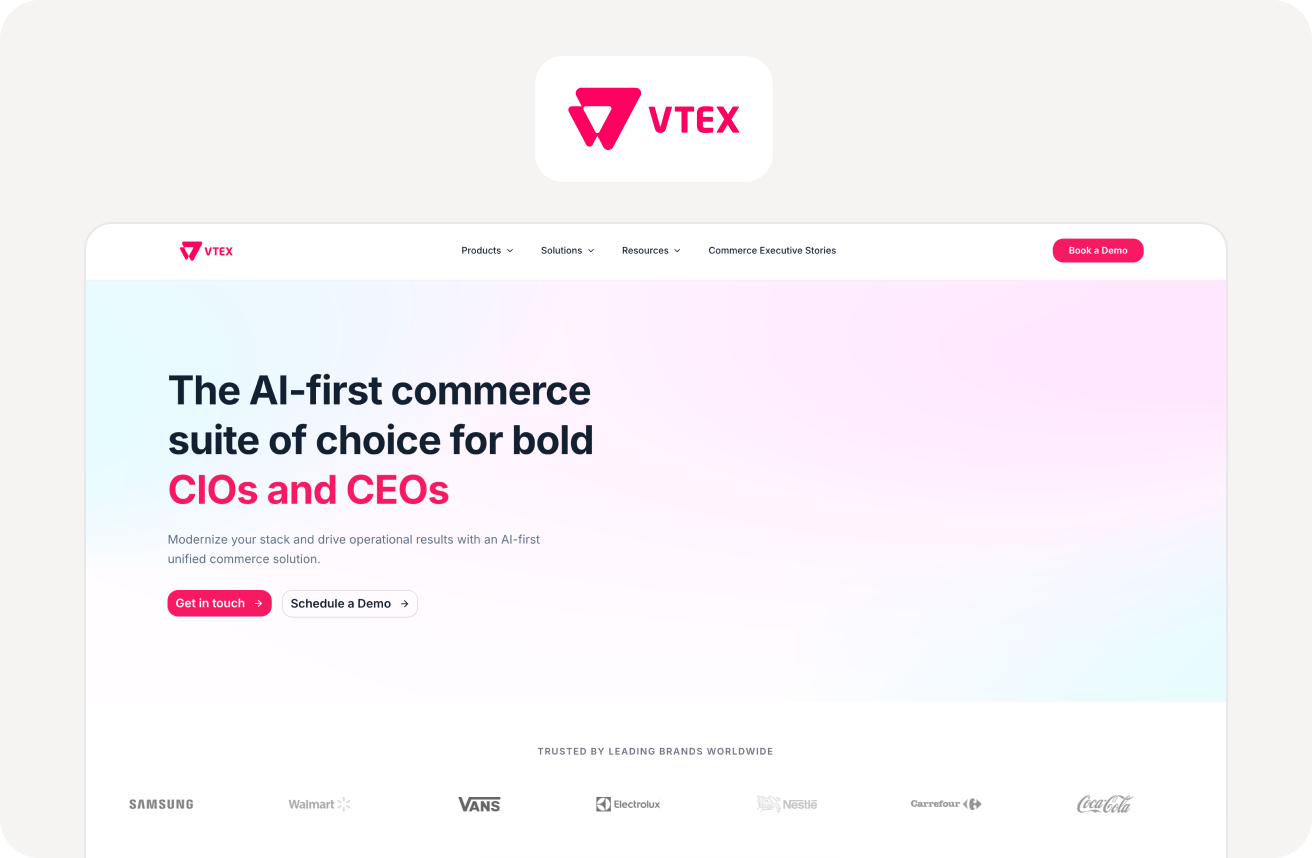
VTEX blends headless commerce with native marketplace features.
Best for
Retailers combining direct e-commerce with marketplace and omnichannel models.
Why it’s on this list
- Supports headless website builds and multi-channel experiences.
- Built-in marketplace functionality alongside the core commerce engine.
- Cloud native architecture designed for scale.
- Strong omnichannel features for store and digital integration.
Things to be aware of
- Complexity increases with marketplace configurations.
- Requires structured governance across regions.
- May be more than needed for simple DTC models.
VTEX appeals to retailers that see marketplaces as part of their growth strategy.
When channels multiply, architecture choices matter even more.
If scale and ecosystem depth are your priority, the previous group makes sense.
If scale and ecosystem depth are your priority, the previous group makes sense.
But some retailers need even more modular control or a sharper B2B focus.
8. SAP Commerce Cloud: enterprise headless commerce for SAP-driven organizations
SAP Commerce Cloud extends SAP’s enterprise ecosystem with headless commerce support.
Best for
Large enterprise retailers already operating within SAP’s ERP and business systems.
Why it’s on this list
- Strong integration with SAP back-end systems and enterprise workflows.
- Headless commerce architecture supported through APIs.
- Designed for complex pricing, catalogs, and global business functions.
- Built for high-scale, multi-region commerce environments.
Things to be aware of
- Significant implementation complexity.
- Requires experienced SAP partners and long rollout timelines.
- Total cost of ownership can be high.
SAP Commerce Cloud fits organizations where commerce must align tightly with enterprise operations.
Scale is powerful, but it demands structure.
9. Spryker: modular headless commerce for marketplace and B2B models
Spryker is a modular commerce platform built for complex marketplace and B2B scenarios.
Best for
Retailers running advanced B2B, B2C, or marketplace business models that need granular control.
Why it’s on this list
- Modular, composable commerce approach built on a flexible headless architecture.
- Strong support for marketplace logic and multi-vendor setups.
- API-first foundation designed for scalable headless commerce systems.
- Customizable business logic across multiple brands and channels.
Things to be aware of
- Requires a capable development team.
- Implementation is rarely simple.
- Overkill for straightforward DTC brands.
Spryker works when your business model itself is complex.
The right headless architecture only matters if it reflects how your business operates.
10. Commerce Layer: API-first commerce as infrastructure
Commerce Layer positions itself as commerce-as-infrastructure.
Best for
Brands managing multiple frontends across regions, languages, or apps.
Why it’s on this list
- Pure API-first commerce engine.
- Designed so that frontend and backend operate independently.
- Supports multi-market, multi-currency setups.
- Strong fit for modern commerce stacks with multiple touchpoints.
Things to be aware of
- Requires in-house engineering capability.
- Limited out-of-the-box UI components.
- Relies heavily on external services for full-stack needs.
Commerce Layer appeals to teams building highly customized frontends across markets.
Infrastructure-first thinking changes how you scale.
11. OroCommerce: B2B-first headless e-commerce platform
OroCommerce focuses on B2B commerce with headless flexibility.
Best for
B2B e-commerce with complex workflows, account hierarchies, and negotiated pricing.
Why it’s on this list
- Built specifically for B2B business users and workflows.
- Supports custom pricing, approvals, and account structures.
- API support for headless website implementations.
- Strong alignment with complex shipping and fulfillment options.
Things to be aware of
- Not optimized for pure DTC retail models.
- Customization can extend implementation timelines.
- Requires clear internal B2B processes.
OroCommerce is purpose-built for B2B depth. Different models require different engines.
12. Saleor: modern, developer-first headless commerce
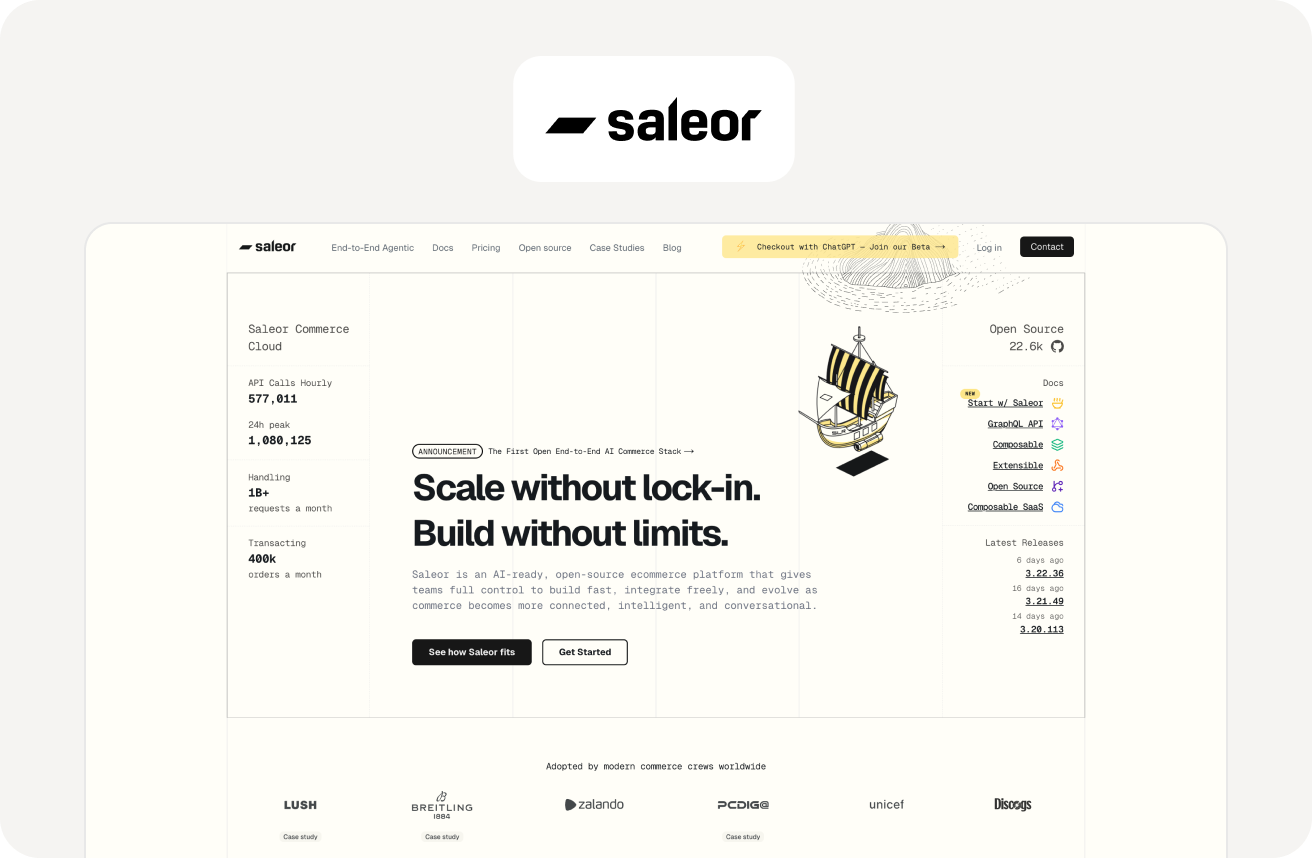
Saleor is an open-source, GraphQL-based headless commerce platform.
Best for
Development-driven teams building fully custom storefronts and apps.
Why it’s on this list
- API-first design that delivers many of the core benefits of headless commerce.
- Flexible headless functionality with full frontend control.
- Strong GraphQL-based headless architecture.
- Open-source core for customization and extensibility.
Things to be aware of
- Requires strong development expertise.
- Less turnkey than SaaS competitors.
- Operational responsibility shifts to your team.
Saleor fits teams that want full ownership of the commerce layer.
But the benefits of headless commerce only show up if your team can support it long term.
13. Medusa: open-source headless commerce for flexible builds
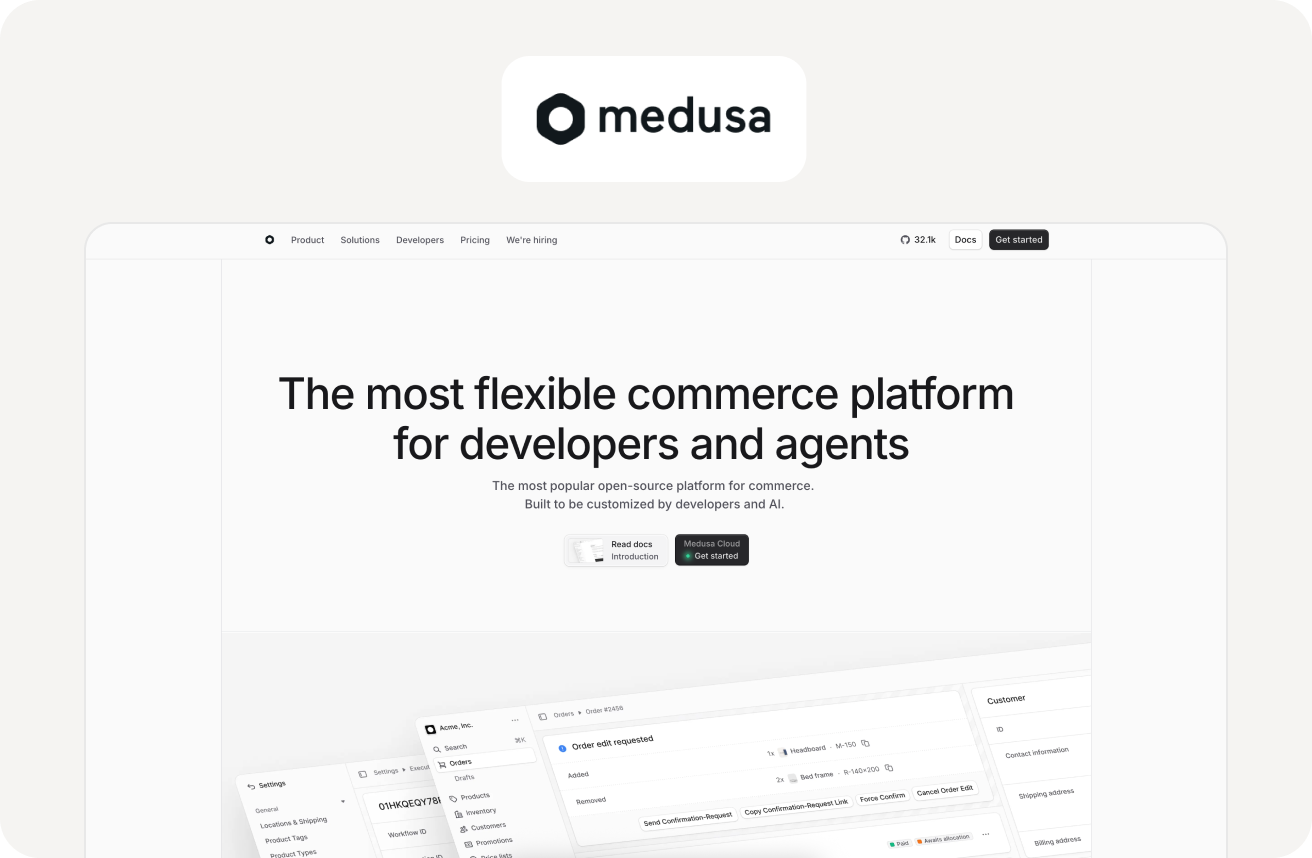
Medusa is an open-source commerce engine designed for modular builds.
Best for
Startups and scale-ups that want flexibility without enterprise licensing overhead.
Why it’s on this list
- Modular architecture with headless solutions.
- Designed to support custom frontends and apps.
- Cloud native and extensible.
- Strong fit for incremental modernization from legacy systems.
Things to be aware of
- Requires engineering ownership.
- Fewer enterprise-ready features out of the box.
- Community-driven ecosystem compared to larger vendors.
Medusa appeals to teams building commerce as infrastructure from the ground up.
At this point, you’ve seen the spectrum from enterprise ecosystems to developer-first platforms.
Whichever headless e-commerce platform you choose, you’ll still need a retail-native CX and loyalty engine to drive growth.
That is where Voyado can help.
How Voyado complements a headless e-commerce platform
Choosing a headless e-commerce platform is an architectural decision. It defines how your commerce engine runs and connects through APIs.
That flexibility enables custom experiences and new channels. But it does not unify customer data or coordinate journeys across your ecosystem.
A headless commerce engine manages transactions and infrastructure. Voyado operates above it as the CX, loyalty, and customer data engine that connects the experience layer.
The two systems serve different purposes:
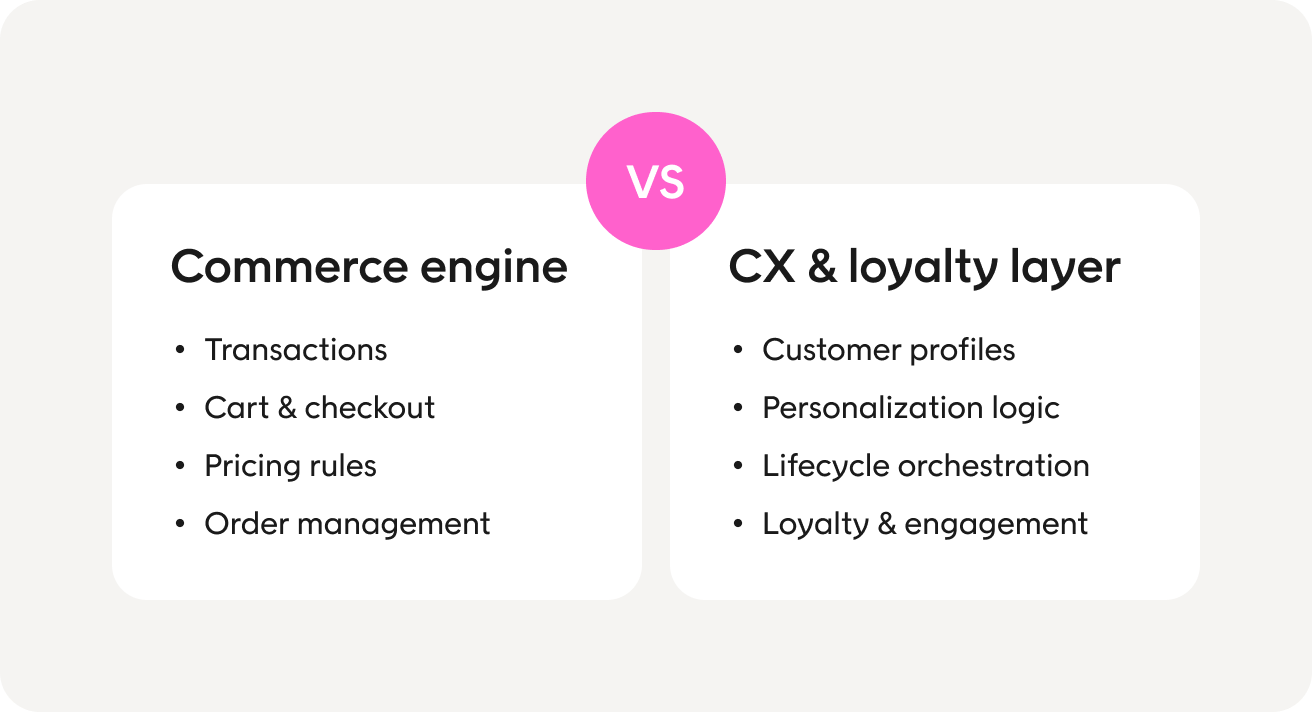
This is what a complete modern e-commerce stack could look like.
Unified customer profiles when your frontends multiply
Headless commerce often means more surfaces. You may add:
- A custom web store
- Mobile apps
- Regional storefronts
- Marketplace integrations
Each surface generates customer signals in different ways.
Without structure, those signals fragment. Personalization becomes inconsistent. Reporting loses clarity.
A strong CRM for e-commerce keeps profiles centralized across channels. No matter how many frontends you introduce, your teams operate from a single, reliable customer view.
Your presentation layer may evolve. Your customer understanding should not.
Lifecycle orchestration across channels
Headless architecture gives your team control over how experiences are built. As flexibility increases, coordination becomes more important.
Journeys now span:
- SMS
- App
- Web
- In-store touchpoints
Messages must react to real behavior, not static segments.
A structured approach to marketing for e-commerce connects behavioral signals to automation across systems. Many teams refine execution using frameworks such as e-commerce email marketing tactics to ensure communication reflects intent.
Flexibility in the frontend requires discipline in orchestration.
Product discovery in a custom frontend environment
In a headless setup, your storefront is no longer templated. That increases the importance of discovery.
Search, merchandising, and ranking logic are often external to the commerce engine. If discovery is weak, conversion suffers.
A dedicated site search layer strengthens relevance across custom builds. Teams modernizing their stack often evaluate options such as those outlined in top e-commerce search solutions to ensure discovery supports performance.
When every surface is customizable, relevance becomes a measurable growth driver.
Agentic retail and CX across the stack
As headless environments grow, signal volume increases, and static segmentation falls behind.
Voyado’s agentic retail approach uses AI agents to analyze behavior and trigger actions across journeys. These agents operate above the commerce engine and optimize customer experiences, regardless of which headless e-commerce platform manages the cart.
This lets your architecture evolve without resetting your personalization strategy.
You gain:
- Real-time behavioral decisioning
- Continuous optimization across channels
- Stronger alignment between data and action
The commerce engine supports transactions. The CX layer ensures those transactions are informed by context.
Choosing the right headless e-commerce platform sets the technical foundation. Layering the right CX and loyalty engine on top determines how much long-term value you extract from it.
Whichever headless e-commerce platform you choose, you will still need a retail-native CX and loyalty engine to drive growth.
That is where Voyado fits naturally into your stack.
If you are mapping your next phase of architecture, you can book a demo to see how Voyado integrates into modern headless e-commerce environments.
FAQs about headless e-commerce platforms
What is a headless e-commerce platform?
A headless e-commerce platform separates the presentation layer from the commerce engine. The frontend connects to back-end systems through APIs, giving teams more flexibility across web, mobile apps, and other customer touchpoints.
What is the difference between headless commerce and traditional e-commerce platforms?
Headless commerce decouples frontend and backend systems. Traditional e-commerce platforms bundle everything into one system, which can simplify setup but limit flexibility and control over the user interface.
Do all retailers need a headless commerce solution?
No. Headless commerce solutions make sense for brands with complex business models, multiple channels, or strong development teams. Many retailers can meet their goals with a modern SaaS commerce platform and strong CX tools.
How does a headless e-commerce platform affect customer experience and personalization?
A headless e-commerce platform gives more control over the presentation layer, which can improve customer experiences. But personalization depends on the tools around your commerce engine, such as CRM and marketing automation.
What other tools do I need around a headless commerce platform?
Beyond the commerce platform, most brands need a headless CMS, product discovery, CRM, marketing automation, analytics, and payment gateways. Headless commerce is one layer in a broader tech stack.