TL;DR
Want to be the team that actually stands out, not just says it does?
A retail customer experience platform helps you personalize at scale and deliver consistent experiences across every channel.
Here’s what you’ll take away:
- What a retail CX platform is and why it matters in 2025
- How leading platforms support personalization at scale for retail teams
- Which tools are best suited for omnichannel retail businesses
- Why Voyado stands out as a retail-first platform that combines CRM, loyalty, segmentation, and marketing automation to power consistent customer experiences across every channel.
You’ll focus on personalization at scale, seamless omnichannel orchestration across store and e-commerce. You’ll also learn the real-time insights that help marketing, CX, and retail teams act with confidence.
Customer expectations are shaped by every interaction
How well do you really know your customers?
You might know their name. But do you know their behavior, preferences, or timing?
That’s what decides whether they choose you or move on.
Connected and relevant experiences matter. Online. In-store. Everywhere in between. When those moments feel disjointed, customers notice. When they feel personal, customers stay.
To get there, you need a modern digital retail experience built on shared customer data. When your teams work from the same view, you can shape each step of the customer journey with intent.
That’s how you build stronger customer loyalty, drive higher engagement, and support growth without adding friction.
So where do you start? With the right tool.
And there are a few key requirements you should look for when evaluating a retail CX platform.
What to look for in a retail customer experience platform
The right platform should help your teams act faster, not juggle more tools.
These are the core capabilities that matter most for retail.
1. Unified profiles across online and in-store
You need one shared customer profile that combines e-commerce behavior, POS data, loyalty activity, and engagement history. This gives your teams a true, consistent view of each customer.
2. Built-in or deeply integrated loyalty
Loyalty should be part of the platform, not a bolt-on. Look for native support for points, tiers, rewards, and engagement triggers that connect directly to customer behavior.
3. Real-time behavioral data
The platform should react as customers browse, buy, visit stores, or use your app. Real-time signals make personalization timely and relevant.
4. Personalization at scale across channels
Email alone is not enough. You should be able to personalize across email, SMS, web, app, and in-store touchpoints using the same data and logic.
5. Predictive analytics designed for retail
Features like churn risk, customer lifetime value, likelihood to buy, and product recommendations help your teams focus on the customers and actions that matter most.
6. Omnichannel journey orchestration
Look for an automation builder that supports journeys and triggers across channels, so experiences stay connected from first interaction to repeat purchase.
7. Retail-ready integrations
Native integrations with e-commerce platforms, POS systems, and payment providers reduce setup time and keep data flowing without custom work.
8. Multi-market and multi-store support
The platform should scale with your business, with support for permissions, localization, and market-level reporting.
9. Practical usability for everyday teams
Marketers and CX teams should be able to build and adjust journeys themselves. You shouldn’t need developer help for every small change.
Strong platforms also make segmentation easy and actionable. This is where CXP segmentation to build better customer experiences becomes a core capability, not a separate project.
Up next, let’s look at the platforms that deliver on these requirements best in 2025.
9 best retail customer experience platforms in 2025
Your customers are moving freely between your physical and online store. Do you recognize, understand, and engage with them in real time?
The platforms in this list support that shift. They help you connect customer data, personalize at scale, and deliver more relevant experiences across the full customer journey.
We’ll start with a platform built specifically for retail and designed to turn insight into action.
1. Voyado: Retail-first customer experience platform for personalization at scale
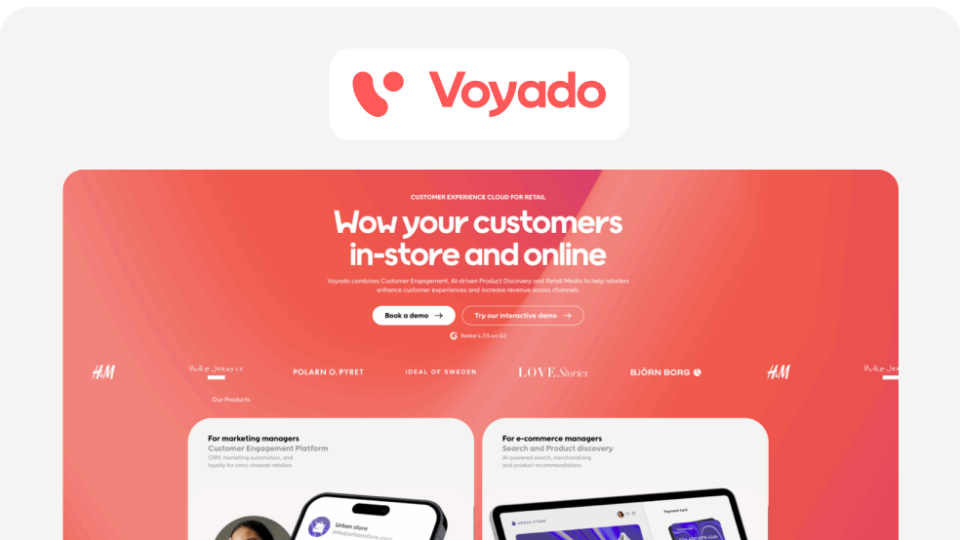
Voyado is a retail customer experience platform built specifically for omnichannel retail. It combines customer data, loyalty, segmentation, and marketing automation to personalize the whole customer journey across digital and physical touchpoints.
Best for:
Omnichannel retailers and multi-market brands focused on customer loyalty, repeat purchases, and long-term growth.
Standout CX features for retail:
- A true single view of customer that unifies purchase history, behavior, and loyalty data across store and online
- Built-in loyalty programs with points, tiers, rewards, and engagement triggers
- Real-time personalization across email, SMS, web, app, and in-store touchpoints
- Predictive analytics that support smarter segmentation, churn prevention, and next-best actions
- Journey orchestration designed for retail teams, not just marketers
Voyado is built for teams that want to turn customer data into action. That’s what makes it different from tools that stop at insight or feedback. It’s also why it’s often compared among the best omnichannel customer experience platforms for retail.
Limitations or considerations:
Voyado is designed for retailers serious about personalization and CX maturity. If you’re only sending basic newsletters, you won’t use the full value of the platform.
2. Qualtrics: Advanced analytics and voice of customer for large retailers
Qualtrics focuses on customer feedback, analytics, and experience measurement. It helps retail businesses understand customer sentiment across touchpoints.
Best for:
Large retailers with mature voice of customer programs and complex reporting needs.
Standout CX features for retail:
- Deep customer feedback and survey capabilities
- Strong analytics for customer satisfaction and experience trends
- Role-based dashboards for different teams
Limitations or considerations:
Qualtrics excels at insight, not execution. Personalization and omnichannel activation usually require additional tools.
3. Medallia – Enterprise voice of customer and journey analytics
Medallia is an experience management platform that combines feedback with journey analytics and employee experience insights.
Best for:
Enterprise retailers managing experience across multiple brands or locations.
Standout CX features for retail:
- Journey analytics to identify friction across the customer journey
- Strong voice of customer and sentiment analysis
- Employee experience data tied to CX outcomes
Limitations or considerations:
Medallia focuses on measurement and insight. It’s not designed to run personalized journeys across marketing and retail touchpoints.
4. SurveySparrow: Multichannel feedback with retail-friendly setup
SurveySparrow helps teams collect qualitative and quantitative feedback across channels with minimal setup.
Best for:
Retail teams that want flexible feedback tools without enterprise complexity.
Standout CX features for retail:
- Multichannel surveys and NPS programs
- Easy feedback collection across digital touchpoints
- Integrations to help close the feedback loop
Limitations or considerations:
SurveySparrow supports insight gathering, not personalization or journey orchestration.
5. AskNicely: NPS and frontline performance improvement
AskNicely connects customer feedback with frontline coaching to improve service consistency.
Best for:
Retailers focused on in-store service quality and employee experience.
Standout CX features for retail:
- Real-time NPS and feedback programs
- Coaching workflows for sales associates and service teams
- Clear link between feedback and performance
Limitations or considerations:
AskNicely improves service delivery but doesn’t support omnichannel personalization or marketing automation.
6. InMoment: Journey-wide experience management for multi-location retail
InMoment combines feedback, analytics, and journey insights across multiple customer touchpoints.
Best for:
Retailers operating across many locations that need journey-level insight.
Standout CX features for retail:
- Journey analytics tied to customer feedback
- Voice of customer programs across channels
- Support for large, distributed retail operations
Limitations or considerations:
InMoment focuses on understanding experiences, not activating them across channels.
7. Freshdesk: Support-centric customer experience software for retail
Freshdesk is built around customer support and service operations.
Best for:
Retail service teams handling high volumes of customer interactions.
Standout CX features for retail:
- Omnichannel support for email, chat, and social
- Ticketing and workflow automation
- Productivity tools for support teams
Limitations or considerations:
Freshdesk supports service teams well, but doesn’t cover loyalty, personalization, or retail CX orchestration.
8. UXPressia – Customer journey mapping for retail teams
UXPressia helps teams visualize and align on customer journeys.
Best for:
Retail teams planning or documenting experience improvements.
Standout CX features for retail:
- Visual customer journey mapping
- Shared workspace for CX planning
- Alignment across teams
Limitations or considerations:
UXPressia is a planning tool, not a retail customer experience solution for execution.
9. ChurnZero: Customer health and retention insights
ChurnZero focuses on customer health scoring and retention.
Best for:
Subscription or membership-led retail models.
Standout CX features for retail:
- Customer health scoring and alerts
- Retention-focused insights
- Proactive engagement workflows
Limitations or considerations:
ChurnZero isn’t designed for store and online personalization or loyalty-driven retail CX.
The key difference between these platforms is where they sit in the customer experience stack.
Some help you listen. Others help you understand. Fewer help you actually act.
Keeping that distinction in mind makes it easier to evaluate which platform fits your goals.
Voyado vs other CX platforms: What makes it different?
Meeting customer expectations requires unified customer data that supports the full customer journey across multiple channels and drives meaningful retail customer engagement.
Many CX platforms focus on surveys, service, or analytics. Voyado is a retail-focused customer experience management platform that brings customer loyalty, personalization, and engagement together.
That means your teams can finally turn customer insight into action across the retail experience.
| Capability | Voyado | Many Other CX Platforms |
| Retail-specific design | Built for omnichannel retailers from day one | Often adapted from B2B or generic CX tools |
| CRM + loyalty in one | Native CRM, loyalty, and engagement | Loyalty managed via add-ons or separate tools |
| Personalization at scale | Real-time, behavior-based, multichannel | Often limited to email or survey journeys |
| Unified data | Single view of customer across channels | Data scattered across tools and teams |
| Predictive insights | Built-in churn, CLV, product propensity models | Available as advanced add-on, if at all |
| Time to value | Retail-ready templates and automations | Often requires heavy consulting and custom work |
How this looks in practice
That difference shows up clearly in real retail results. At By Malene Birger, unifying customer data, loyalty, and marketing automation made it easier to act on customer behavior across the full customer journey, not just collect insight.
“By testing and changing, open rates have gone up hugely, the engagement has become much higher, and the sales numbers have increased,” – Laufey Lúðvíksdóttir, CRM and Loyalty Specialist at By Malene Birger.
By focusing on relevant, benefit-led journeys instead of blanket discounts, the brand increased full-price shoppers by 109 percent, strengthening long-term customer relationships.
But before you make a decision on which platform is the best fit, you need to ask yourself 6 important questions.
How to choose the right retail CX platform
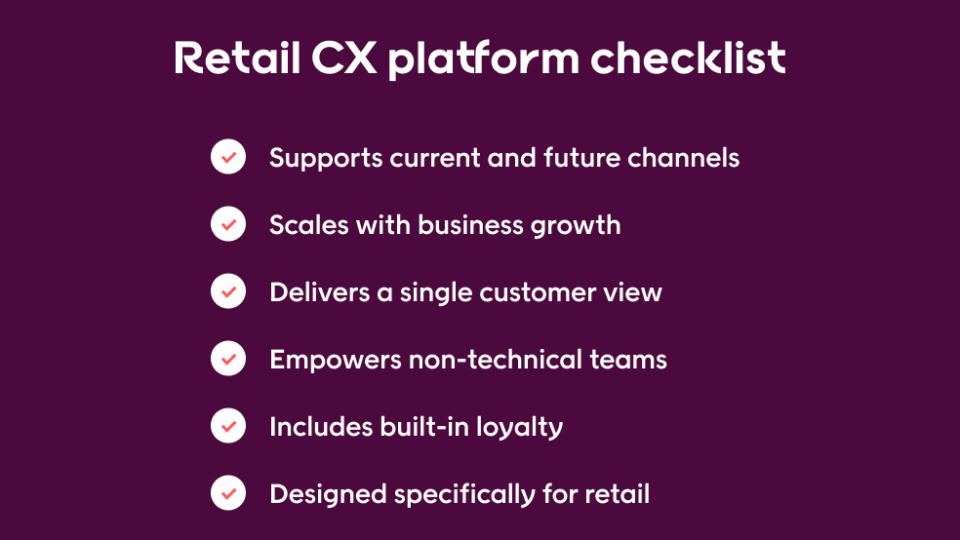
Choosing the right platform comes down to how well it supports your teams today and where your business is headed next. Use the questions below as a practical checklist when you compare tools.
1. Does it support your current channels and what comes next?
A strong retail CX platform should cover web, email, SMS, app, and in-store touchpoints from day one. Just as important, it should adapt as your digital retail experience evolves. New channels shouldn’t mean new tools or workarounds.
2. Can it scale with your growth plans?
Look beyond today’s volume. The platform should support growth across multiple locations, markets, and teams without slowing down store operations or customer interactions. Scalability matters for long-term retail success.
3. Does it give you a true single view of the customer?
Unified customer data is essential. You should be able to see customer behavior, purchase history, and engagement across physical stores and online shopping in one place. Without that, it’s hard to personalize the customer journey or build lasting customer relationships.
4. Can non-technical teams work independently?
Your marketers and CX teams should be able to build, test, and adjust journeys without relying on developers. Tools that simplify business processes improve operational efficiency and help teams act faster on customer needs.
5. Is loyalty built in or bolted on?
Customer loyalty works best when it’s connected to the rest of the experience. If loyalty lives in a separate system, personalization becomes harder, and customer information gets fragmented. A built-in loyalty program makes it easier to scale personalized experiences.
6. Does the vendor understand retail?
Retail brings unique demands, from store and online coordination to seasonal peaks. Strong retail experience and support make a real difference when customer expectations rise, and teams need to move quickly.
When customer insight, loyalty, and engagement work together, it becomes easier to deliver exceptional service and build long-term value.
Final thoughts: The best retail customer experience platform for personalization at scale
You’ve read all about the platforms, but the key takeaway is simple:
Retail success depends on how well customer data, loyalty, and engagement work together across multiple channels.
Many platforms support only part of the retail experience. Some focus on customer feedback and qualitative insight. Others support service teams or analytics.
Voyado brings CRM, loyalty, and CX together in a single retail customer experience platform built for retail use.
Now your business can deliver personalized experiences, strengthen customer relationships, and support consistent customer engagement across physical stores and digital touchpoints.
Your next steps
- Review your customer journey across online shopping and physical touchpoints to identify where personalized service matters most.
- Check whether your current tools provide a unified view of customer data and actionable insights across teams.
- Choose digital tools that improve operational efficiency and help your teams deliver exceptional service as your business grows.
If you want to see how a retail-specific CX platform can help you meet customer expectations, improve customer loyalty, and increase revenue, book a Voyado demo and explore what’s possible.
FAQs
What is a retail customer experience platform?
A retail customer experience platform helps you manage customer experiences across store and online touchpoints. It combines customer data, behaviour, and engagement to help teams improve customer retention across the full customer journey.
How is a CX platform different from a CRM in retail?
A CRM stores customer information. A retail CX platform builds on that by activating customer behaviour, qualitative feedback, and data collection across multiple channels to meet what customers expect from modern retail experiences.
What features should customer experience software for retail include?
Key features include unified customer data, omnichannel journey orchestration, loyalty support, real-time personalization, and analytics that surface meaningful trends teams can act on quickly.
Which platform is best for personalization at scale in retail?
The best platform is one designed for retail use. It should connect data, loyalty, and engagement so teams can deliver personalized experiences that build loyal customers and turn first-time buyers into your most loyal customers.
Can a retail CX platform connect online and in-store customer data?
Yes. A modern retail CX platform unifies data from e-commerce, POS, and other systems, giving teams a single view of customer behaviour across online shopping and physical stores.
About Author