TL;DR
E-commerce AI agents are changing how online stores handle product discovery, personalization, and support. Unlike traditional automation or chatbots, these AI agents observe behavior, decide what to do next, and act across the customer journey, always with human oversight. In this guide, you’ll learn what agentic really means, where different e-commerce AI agents fit, what to evaluate before you buy, and why retailers are moving toward retail-trained, suite-based solutions instead of adding yet another point tool.
What is an e-commerce AI agent? (And what it isn’t)
Before we get into tools, it’s worth slowing down for a second.
“AI agent” gets thrown around a lot, and not everything labeled AI actually acts like one.
AI agent vs. chatbot vs. automation vs. “AI features”
Here’s the cleanest way to think about the differences.
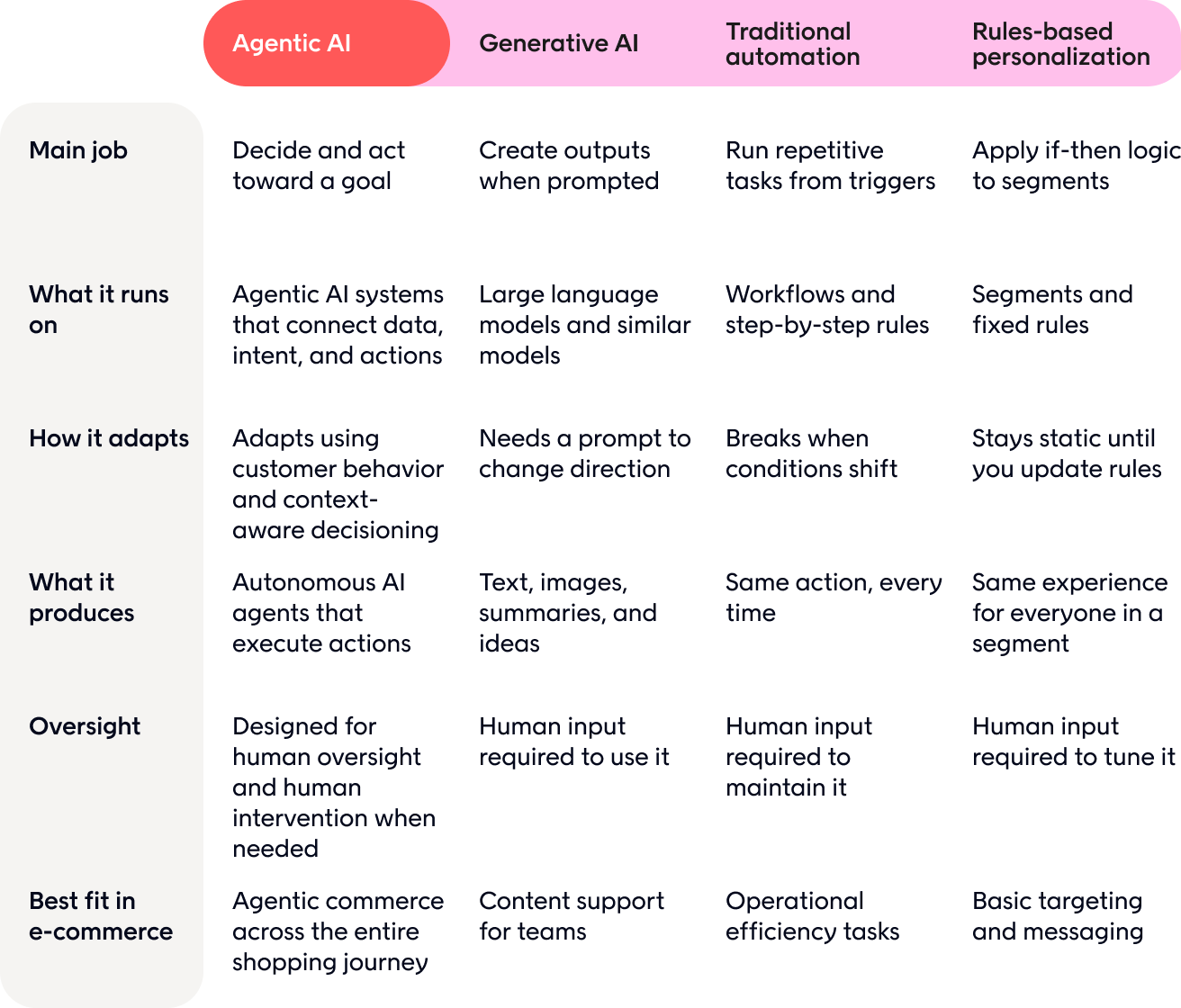
An e-commerce AI agent works in a closed loop.
It doesn’t just analyze or suggest. It observes behavior, understands intent, takes action, and improves over time. That’s the key difference.
This shift builds on years of progress in machine learning, which has already reshaped how retailers think about personalization and automation in e-commerce.
You can explore this further in Voyado’s guide on machine learning and AI in e-commerce.
And importantly, it doesn’t replace your strategy.
Your team still defines goals, guardrails, and priorities. The agent handles execution at speed and scale.
What “agentic commerce” changes in 2026
Most e-commerce teams are still working in campaigns.
You plan. You launch. You wait. Then you react.
Agentic commerce flips that model.
Instead of static rules and one-off optimizations, AI agents continuously adjust based on what’s happening right now, across channels, products, and customers.
That means a shift:
- From campaign-based execution to continuous optimization
- From manual tuning to AI-driven action with retail context
- From isolated tools to systems that connect intent, product data, and outcomes
For you and your team, this isn’t about adding more AI features.
It’s about you moving faster without losing control, and delivering experiences that actually feel relevant, not automated.
What does this look like in practice? Let’s break down where different e-commerce AI agents show up in the customer journey, and what each one is really responsible for.
Where AI agents fit in the e-commerce customer journey
E-commerce AI agents don’t live in just one moment of the journey.
They operate across it, using customer data, intent, and context to support better decisions and smoother experiences at every step.
Below is a simple way to think about where different e-commerce AI agents fit, and the kinds of actions they’re designed to take.
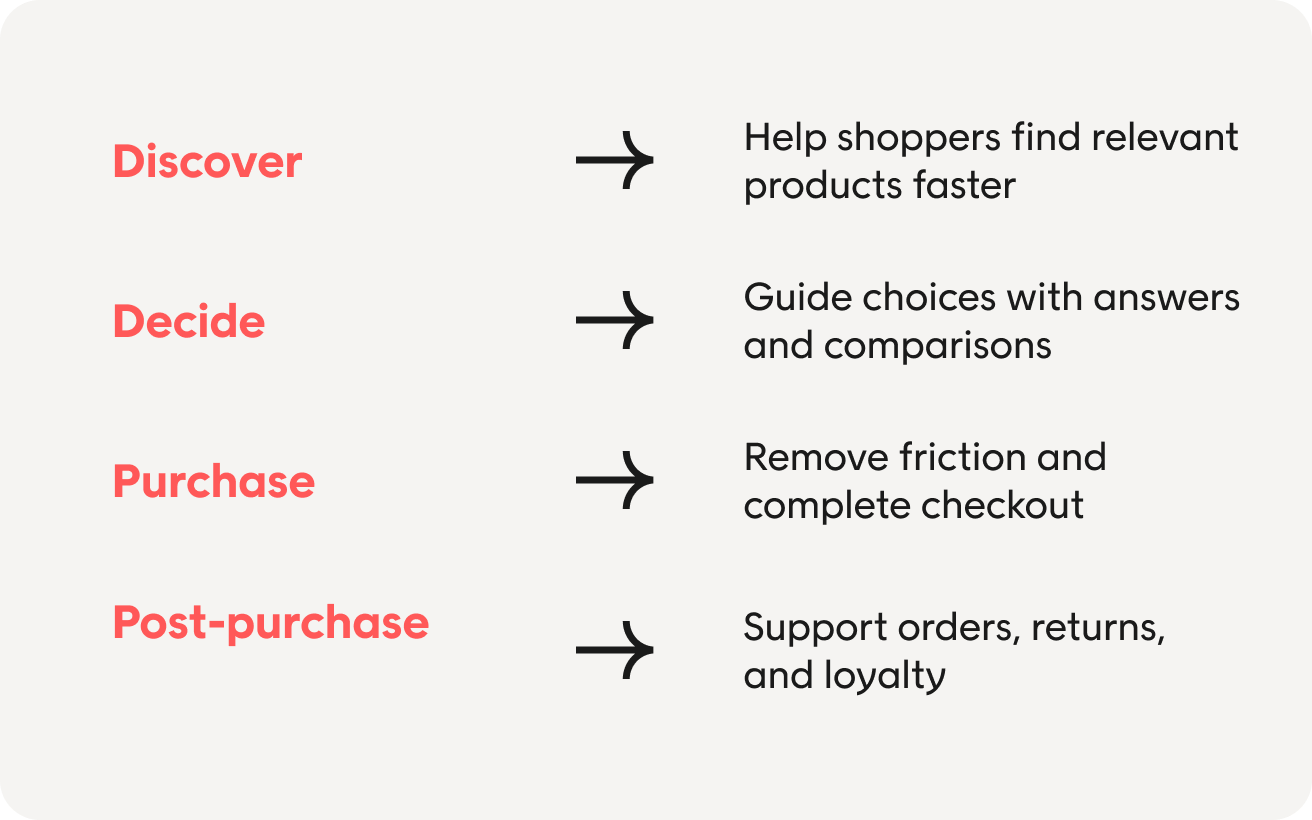
Discover (Search, navigation, recommendations, ranking)
This is often where customer experience is won or lost. If shoppers can’t find what they’re looking for, nothing else matters.
At this stage, AI agents in e-commerce focus on helping customers discover relevant products faster, without forcing your team to manually tune rules.
Typical agent actions include:
- Adapting search results based on real-time user intent and behavior
- Re-ranking products using stock levels, margin, and popularity
- Personalizing navigation and category pages for different customer segments
- Recommending products that reflect customer preferences, not just past clicks
This is where retail-trained agents stand apart from generic AI tools. They understand inventory management, product lifecycles, and seasonal demand, not just keywords.
For many e-commerce brands, this is also where AI-powered search and recommendations drive the biggest lift in customer engagement and satisfaction.
Voyado’s approach to this is covered in more detail in its guide on transforming e-commerce with AI search and product recommendations.
Decide (Product Q&A, guided selling, bundles, sizing, and fit)
Once a shopper has narrowed things down, questions start to surface.
Will this fit? Is this the right option? What should I pair it with?
Here, AI agents for e-commerce automation function more like intelligent shopping assistants than static FAQs.
Common agent actions include:
- Answering customer queries about products, availability, and fit
- Guiding shoppers through comparisons or bundles
- Acting as an AI sales assistant that helps customers choose with confidence
- Supporting human agents by resolving routine questions automatically
This reduces friction without replacing human agents. Complex or sensitive customer issues can still be handed off when human intervention is needed, while AI handles the repetitive work.
Purchase (Cart recovery, incentives, checkout help)
At checkout, small disruptions can kill conversion.
AI agents here focus on removing hesitation and helping customers complete the purchase.
Typical agent actions include:
- Triggering personalized incentives based on behavior, not blanket discounts
- Supporting chat support during checkout for last-minute questions
- Recovering carts without over-relying on ad spend
- Using business intelligence to decide when to nudge and when to stay silent
For e-commerce teams, this improves operational efficiency while protecting margins and brand voice.
Post-purchase (WISMO, returns, exchanges, loyalty nudges)
The journey doesn’t end at checkout. Post-purchase is where trust, loyalty, and long-term revenue are built.
E-commerce AI agents in this phase often handle:
- Order tracking and order status updates
- Basic customer support, like WISMO and delivery questions
- Returns and exchanges across multiple channels
- Personalized nudges tied to loyalty programs and future engagement
By resolving customer queries quickly and consistently, AI agents help scale support without sacrificing customer satisfaction and free teams to focus on higher-value interactions.
So how do you turn all of this into something actionable? Let’s look at the main types of e-commerce AI agents available today, and what each one is best suited for.
The list: 12 e-commerce AI agents for 2026
Not every tool on this list is a “pure” AI agent, and that’s intentional. Some are full agentic platforms, others offer agent-like capabilities for discovery, personalization, or support.
What they all have in common is this: they help e-commerce teams move faster, reduce manual work, and turn insight into action across the customer journey.
Below, you’ll find where each tool fits best, what it actually does, and the kind of retailer it’s designed for, so you can shortlist with confidence.
1) Voyado (Elevate + Engage): Best overall for retail-trained agentic discovery + personalization

Voyado brings product discovery, customer engagement, and loyalty together in one retail-built suite, designed to help you act on customer intent instead of managing disconnected tools.
Best for
Retailers that want retail-trained discovery plus personalization in one connected setup, not another point solution.
Where it fits in the journey
Discover, Decide, Purchase, Post-purchase.
Agentic strengths (what actions it can take)
- Improves discovery by automatically matching shopper intent with the most relevant products.
- Uses AI-driven merchandising and ranking logic to keep results and listings relevant as behavior changes.
- Extends personalization beyond onsite by unifying journeys across touchpoints using a customer data platform foundation.
Standout capabilities
- Product discovery powered by AI, built for e-commerce, with product intelligence and intent matching.
- AI-driven product recommendations that can be used onsite and in post-purchase or win-back messaging.
- Omnichannel engagement designed around unified profiles and activation across channels.
Watch-outs / limitations
- You’ll get the most value when your product and customer data is clean, connected, and governed, because the system relies on it to make good decisions.
- Like any agentic setup, you still need human-led goals and guardrails so actions stay aligned with your strategy.
Ideal retailer profile
Midmarket to enterprise omnichannel retailers that want a retail-focused way to reduce tool sprawl while improving customer experience and revenue growth.
2) Salesforce Agentforce — Best for enterprise service + CRM-led agent workflows
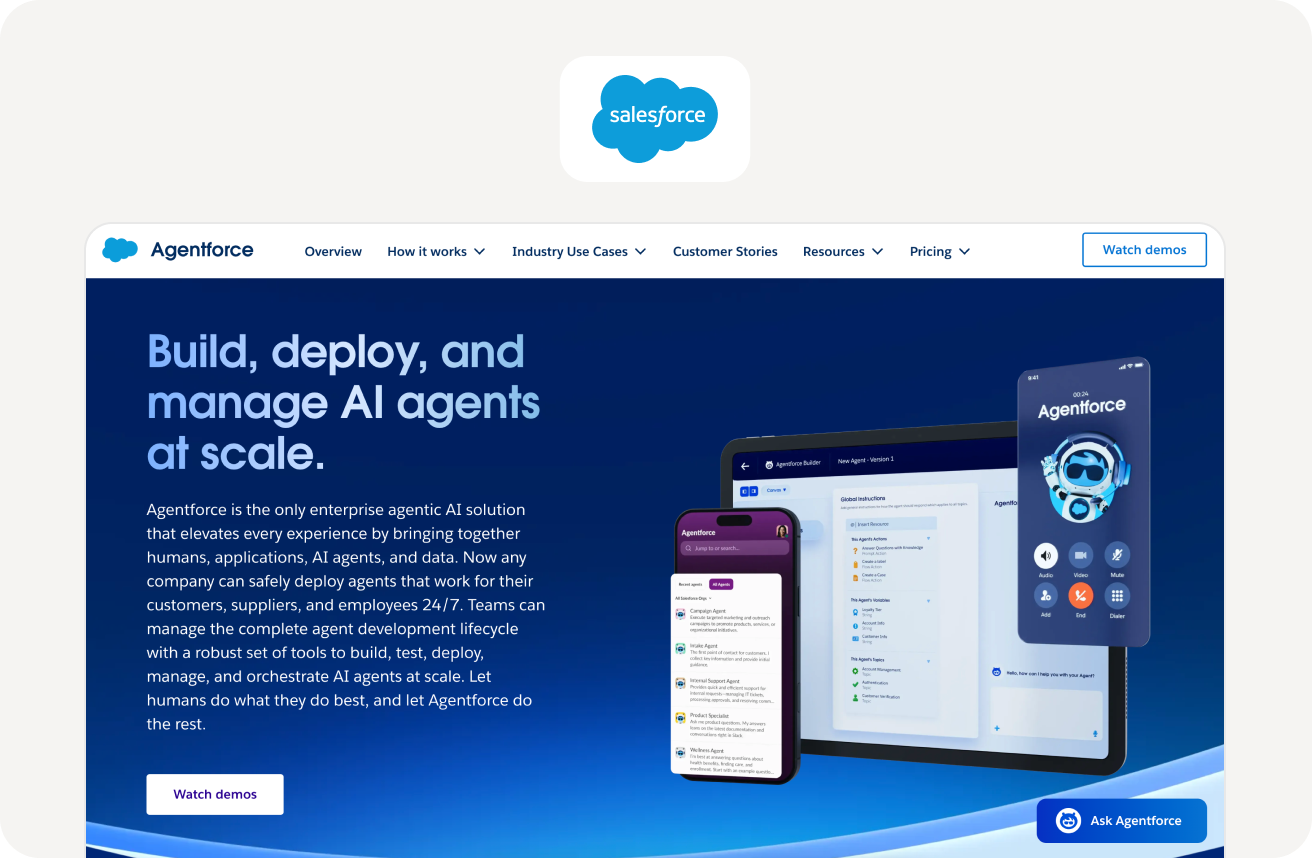
Salesforce Agentforce is Salesforce’s framework for building and managing AI agents that operate across CRM, service, and operational workflows.
Best for
Large enterprises where Salesforce already acts as the system of record for customer data and service processes.
Where it fits in the journey
Decide, Purchase, Post-purchase.
Agentic strengths (what actions it can take)
- Allows AI agents to reason over customer data and take actions across connected Salesforce systems.
- Supports supervised execution with clear handoffs to human agents when needed.
- Designed to handle complex processes like case routing, service resolution, and workflow automation.
Standout capabilities
- Strong governance, security, and lifecycle management for AI agents at enterprise scale.
- Deep integration with CRM data, service clouds, and business intelligence tools.
Watch-outs / limitations
- Less focused on product discovery or merchandising use cases.
- Value depends heavily on how embedded Salesforce already is in your tech stack.
Ideal retailer profile
Enterprise retailers prioritizing customer support, service automation, and CRM-led agent workflows over onsite personalization.
3) Adobe (AEP + Journey Optimizer + agent features) — Best for large orgs with the Adobe stack
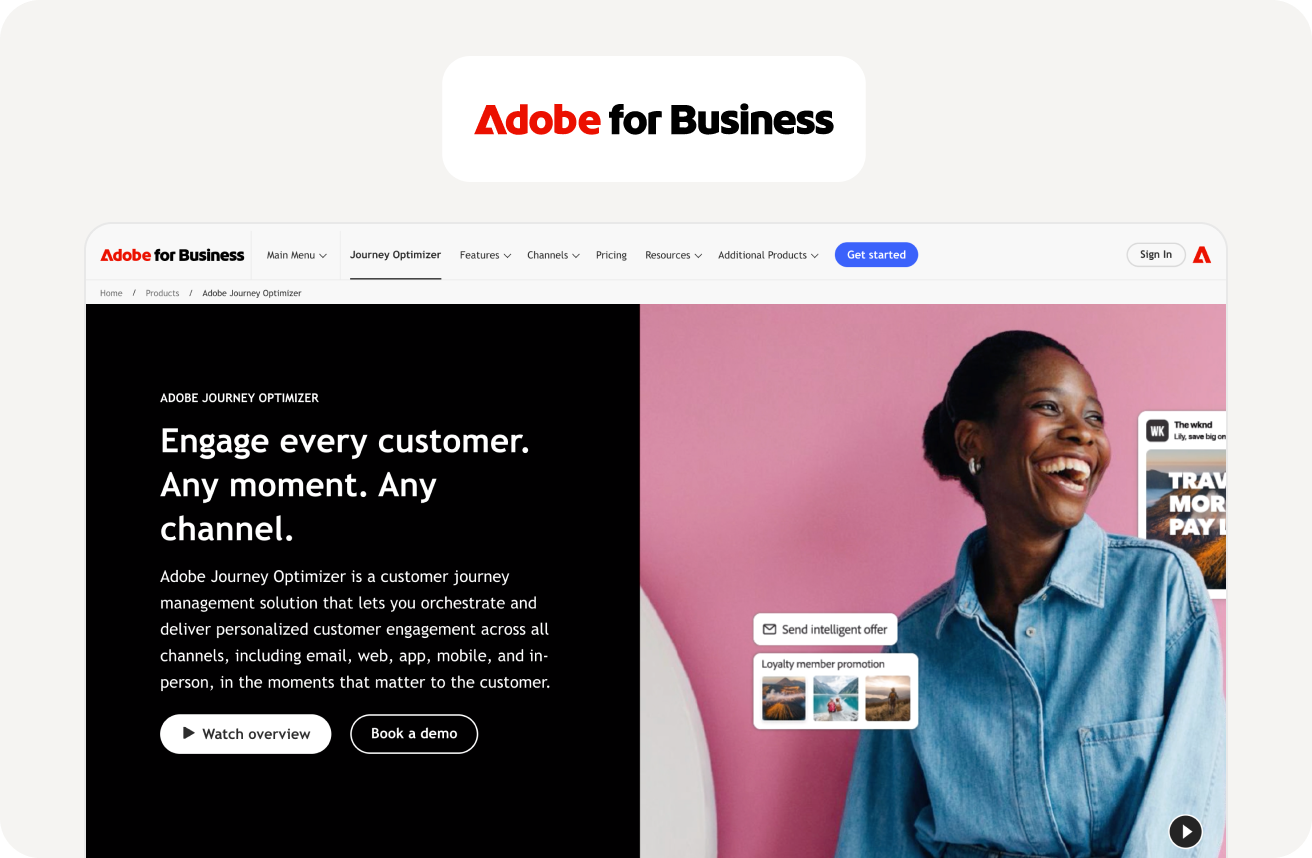
Adobe Experience Platform and Journey Optimizer bring agent-like AI capabilities into journey orchestration for teams already operating within the Adobe ecosystem.
Best for
Large organizations with mature data teams and an existing Adobe Experience Platform setup.
Where it fits in the journey
Discover, Purchase, Post-purchase.
Agentic strengths (what actions it can take)
- Uses AI to help optimize journeys, audiences, and next-best actions across channels.
- Supports conversational and assisted journey creation through agent-style interfaces.
Standout capabilities
- Real-time customer profiles and segmentation through Adobe’s CDP.
- Journey Optimizer for orchestrating personalized experiences across multiple channels.
Watch-outs / limitations
- Most “agent” functionality is assistive rather than fully autonomous.
- Time to value depends heavily on implementation effort and data readiness.
Ideal retailer profile
Enterprise e-commerce brands already invested in Adobe that want AI-assisted journey optimization rather than standalone e-commerce AI agents.
4) Bloomreach — Best for commerce personalization + search and recommendations
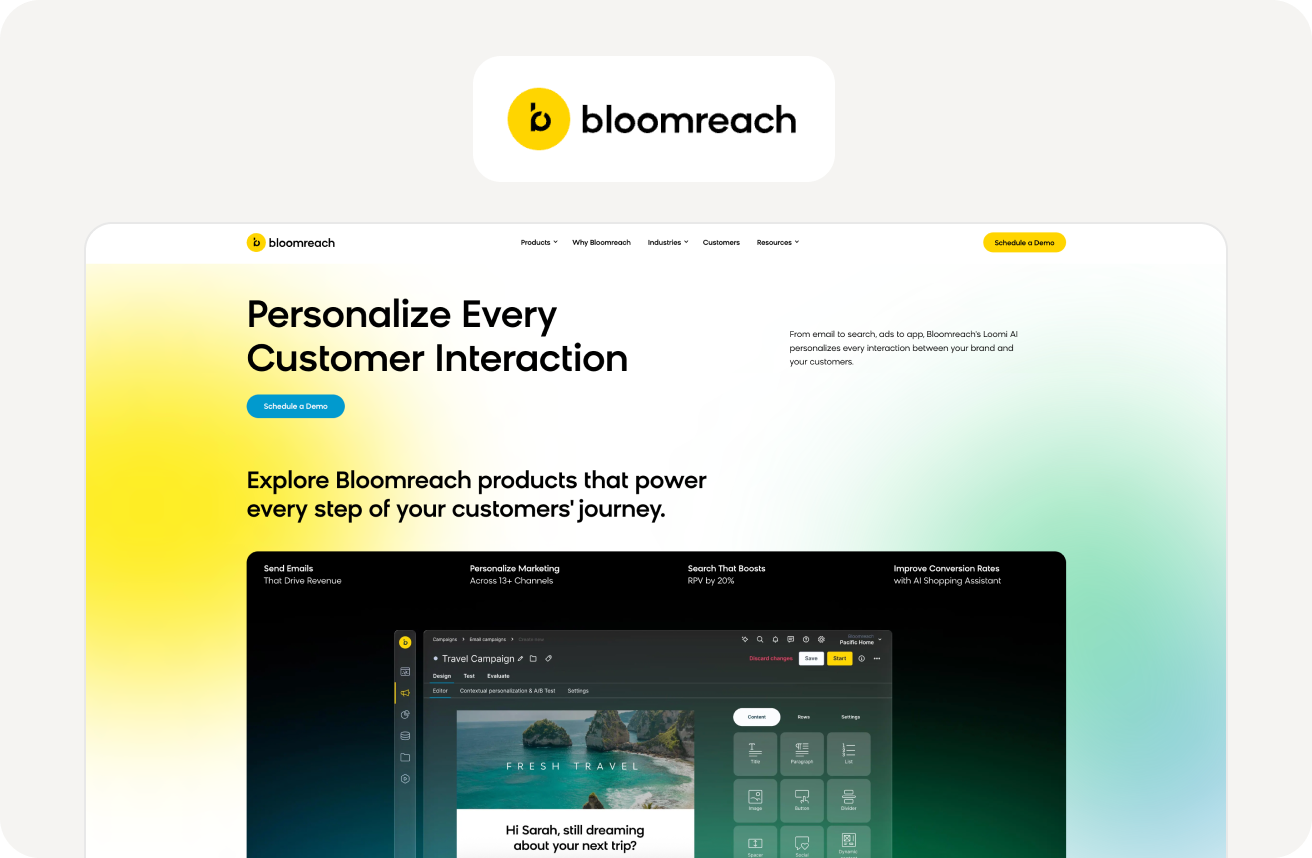
Bloomreach positions itself as a commerce-focused platform combining search, recommendations, and personalization powered by its Loomi AI.
Best for
Teams looking to improve discovery and relevance across search and product recommendations.
Where it fits in the journey
Discover, Decide.
Agentic strengths (what actions it can take)
- Continuously optimizes search results and recommendations based on customer behavior.
- Adjusts relevance using product performance and engagement signals.
Standout capabilities
- Strong search and recommendation engine designed for e-commerce brands.
- Clear focus on onsite customer experience and conversion.
Watch-outs / limitations
- Agentic behavior is mostly limited to discovery and personalization layers.
- Less coverage across post-purchase or loyalty workflows.
Ideal retailer profile
E-commerce brands that want better search and recommendations without replacing their entire engagement stack.
5) Insider — Best for omnichannel experimentation + personalization at scale
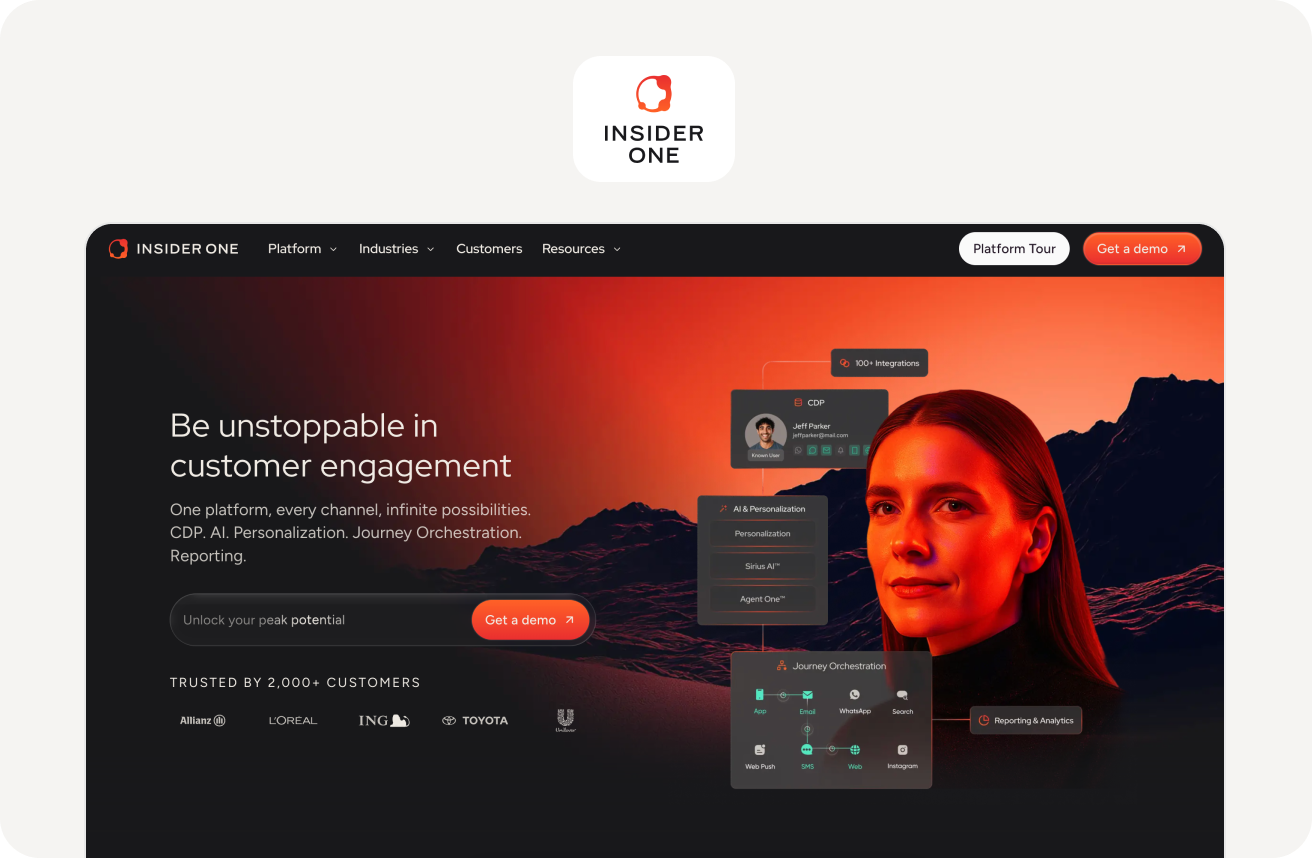
Insider is an AI-native customer engagement platform combining CDP, personalization, and orchestration across channels.
Best for
Teams running personalization and experimentation across multiple e-commerce channels.
Where it fits in the journey
Discover, Purchase, Post-purchase.
Agentic strengths (what actions it can take)
- Uses AI to segment audiences and trigger personalized experiences across channels.
- Automates decisions around messaging, timing, and content delivery.
Standout capabilities
- Unified platform for customer engagement across onsite, messaging platforms, and mobile apps.
- Strong experimentation and personalization tooling.
Watch-outs / limitations
- Agent behavior is primarily focused on engagement and messaging rather than merchandising.
- Requires careful governance to avoid over-automation.
Ideal retailer profile
Omnichannel e-commerce brands focused on scaling personalized customer engagement across multiple touchpoints.
6) Braze — Best for lifecycle messaging and AI-assisted orchestration
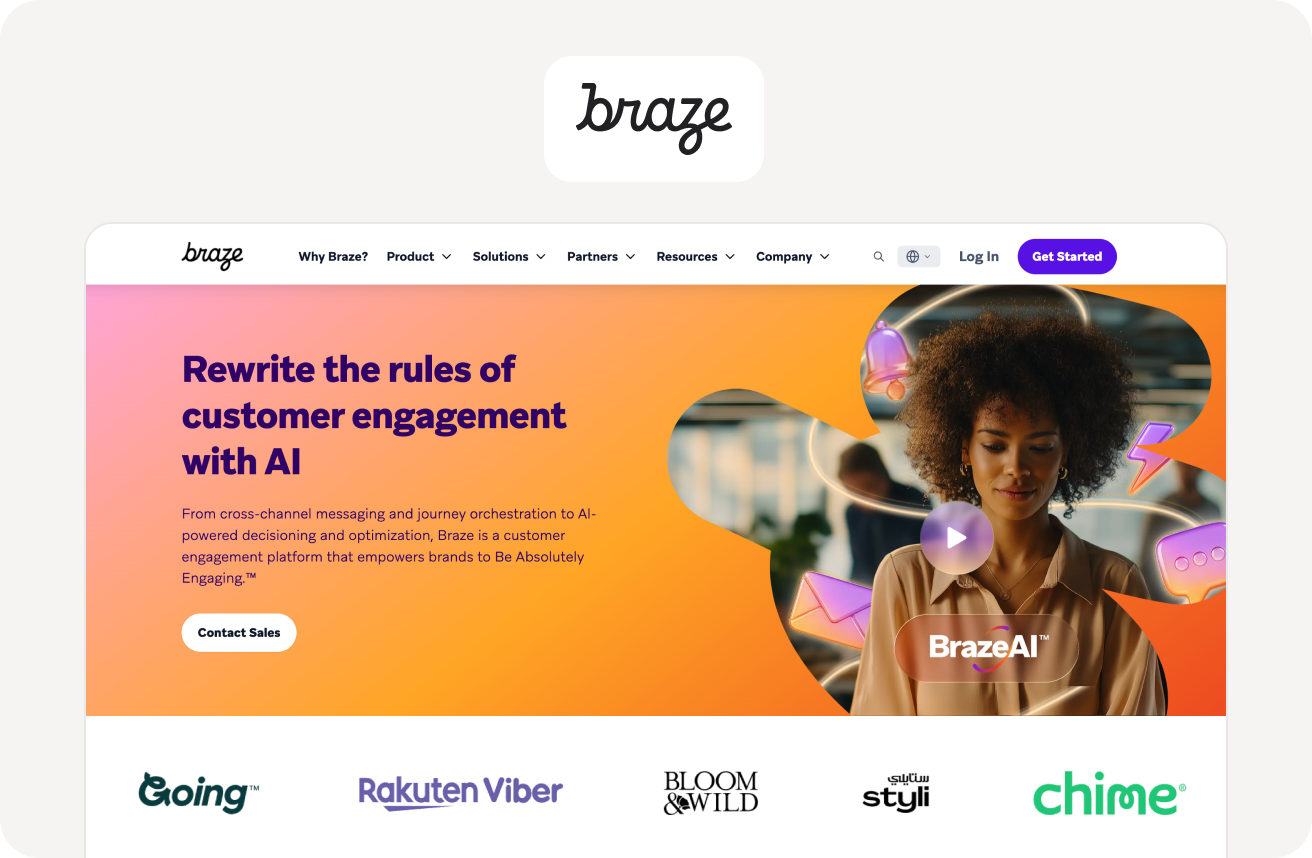
Braze focuses on lifecycle messaging and customer engagement, with AI features designed to support execution rather than replace strategy.
Best for
Retention and CRM teams scaling lifecycle and post-purchase communication.
Where it fits in the journey
Purchase, Post-purchase.
Agentic strengths (what actions it can take)
- Uses AI to support personalization, timing, and recommendations in messaging.
- Helps automate responses to customer queries and support tickets at scale.
Standout capabilities
- Strong cross-channel messaging and orchestration.
- AI assistance for content generation and optimization.
Watch-outs / limitations
- Limited role in product discovery or onsite personalization.
- Most AI functionality is assistive rather than fully autonomous.
Ideal retailer profile
Retailers prioritizing post-sale support, loyalty programs, and customer satisfaction through messaging-led engagement.
7) Klaviyo (AI) — Best for Shopify-first retention teams
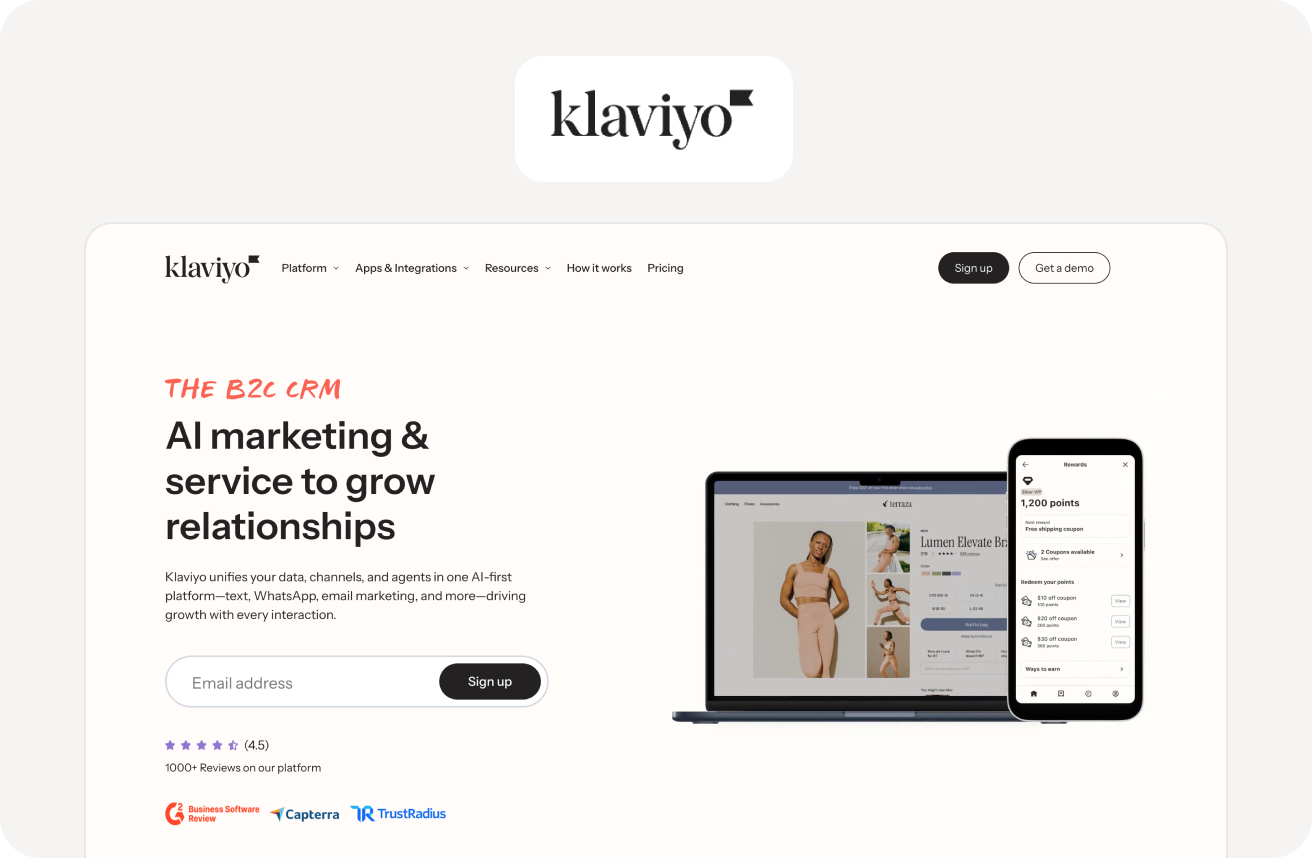
Klaviyo adds AI-powered capabilities to its email and SMS platform to help Shopify-centric teams personalize messaging and retention with less manual work.
Best for
Shopify-first e-commerce teams focused on lifecycle messaging and retention.
Where it fits in the journey
Purchase, Post-purchase.
Agentic strengths (what actions it can take)
- Uses AI systems to suggest segments, timing, and content variations.
- Supports AI-driven recommendations inside campaigns to engage customers during and after purchase.
Standout capabilities
- Tight integration with Shopify and e-commerce platforms.
- AI assistance for personalization and campaign optimization across email and SMS.
Watch-outs / limitations
- Primarily focused on messaging, not product discovery or onsite optimization.
- Agent behavior is assistive, not fully autonomous.
Ideal retailer profile
Growing e-commerce brands that want AI support for retention without investing in a broader e-commerce AI agents suite.
8) Dynamic Yield — Best for testing + personalization on enterprise sites
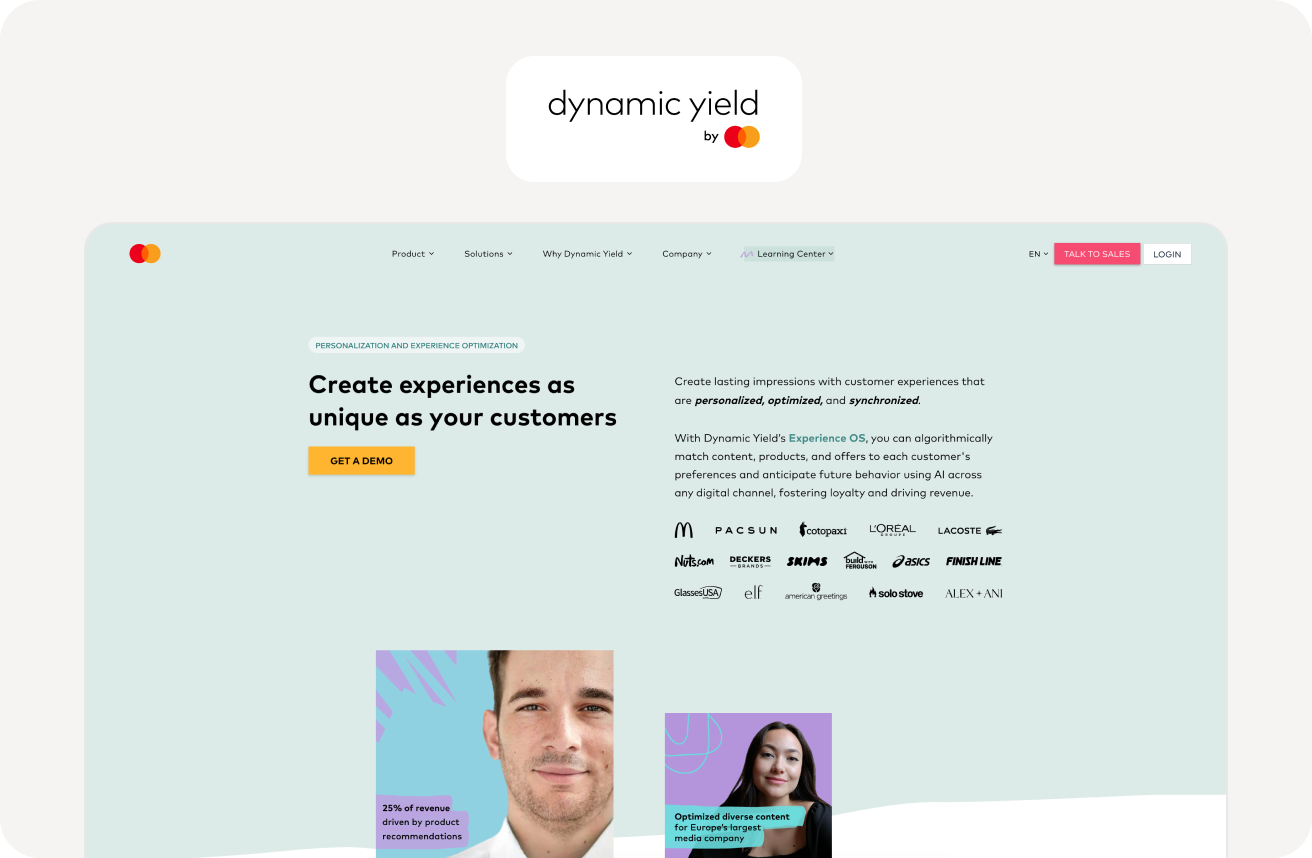
Dynamic Yield is a personalization platform focused on testing, recommendations, and experience optimization across digital storefronts.
Best for
Enterprise retailers running large-scale experimentation and personalization programs.
Where it fits in the journey
Discover, Decide, Purchase.
Agentic strengths (what actions it can take)
- Uses intelligent agents to personalize content, offers, and recommendations in real time.
- Automates experience testing and optimization across web and mobile apps.
Standout capabilities
- Strong experimentation framework combined with personalization.
- Supports tailored shopping experiences across multiple e-commerce channels.
Watch-outs / limitations
- Requires mature teams to manage testing strategy and governance.
- Limited coverage of post-purchase and support automation.
Ideal retailer profile
Large e-commerce brands optimizing conversion and engagement on high-traffic digital storefronts.
9) Nosto — Best for mid-market e-commerce personalization and merchandising
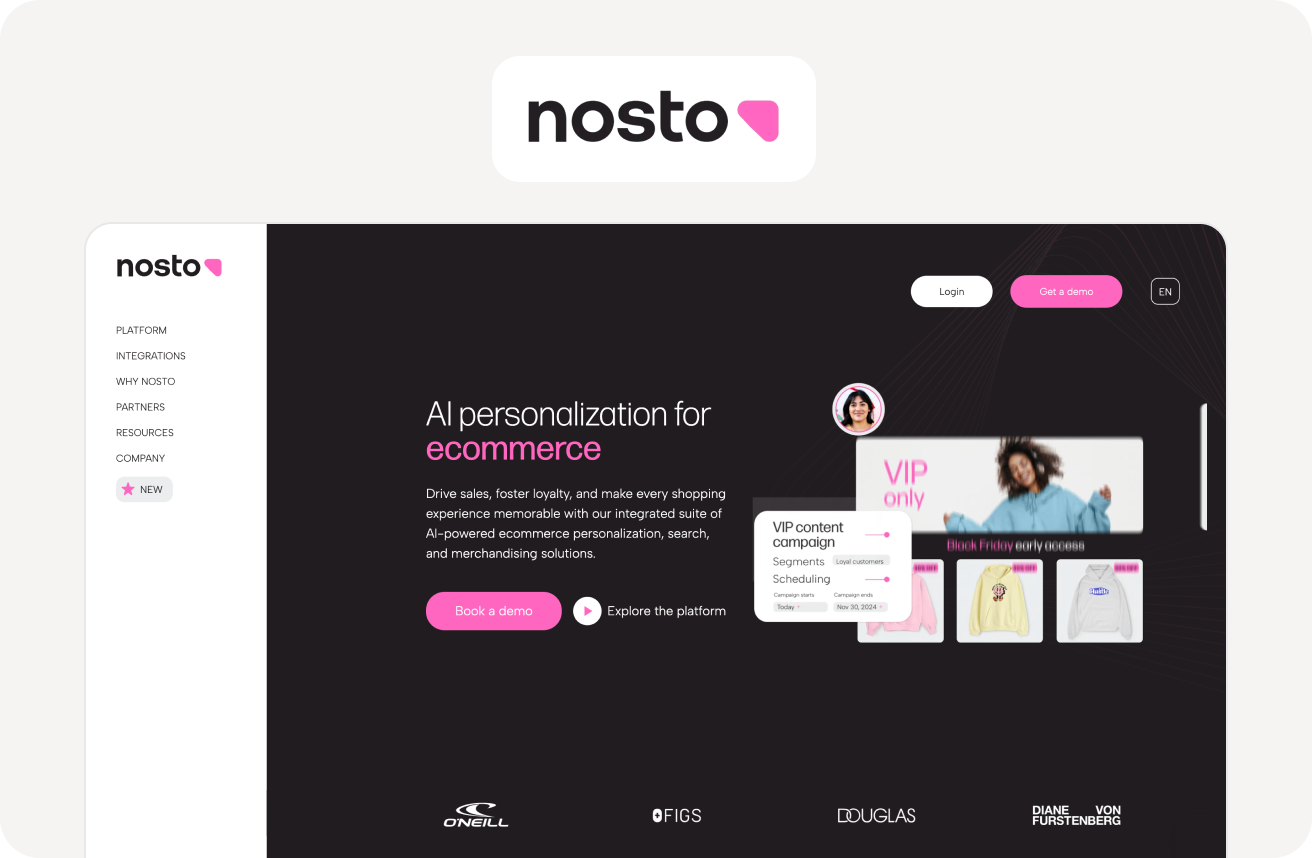
Nosto focuses on personalization, merchandising, and recommendations designed for mid-market e-commerce platforms.
Best for
Mid-market retailers looking to personalize online shopping without heavy enterprise overhead.
Where it fits in the journey
Discover, Decide.
Agentic strengths (what actions it can take)
- Personalizes recommendations and merchandising based on customer behavior.
- Automates ranking and product exposure with minimal human input.
Standout capabilities
- Merchandising-focused personalization for e-commerce platforms.
- Faster time to value compared to larger enterprise AI platforms.
Watch-outs / limitations
- Agentic behavior is mostly limited to on-site merchandising.
- Less coverage across messaging, loyalty, and post-sale support.
Ideal retailer profile
Mid-sized e-commerce brands wanting practical personalization without complex implementation.
10) Constructor — Best for e-commerce search and browse relevance
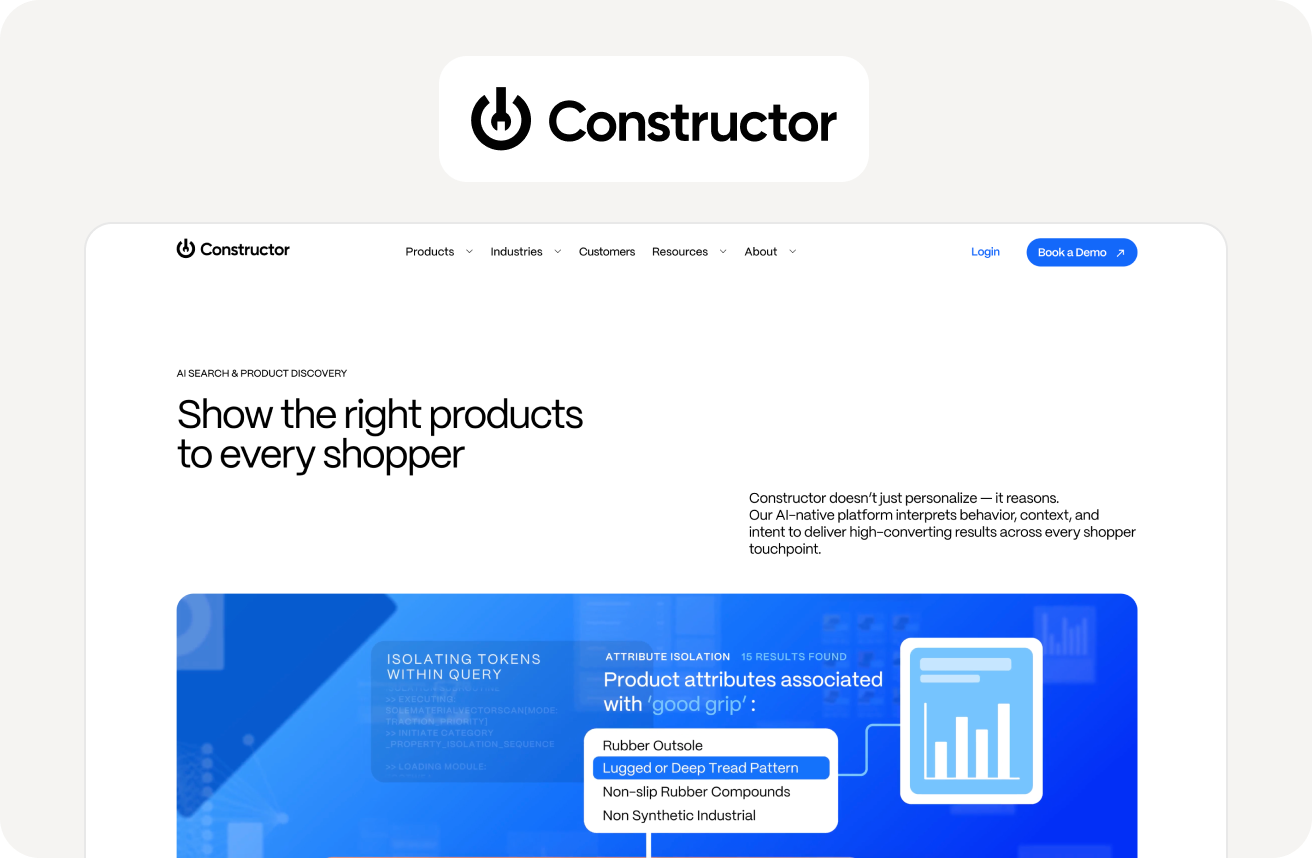
Constructor is a search and discovery platform focused on relevance, browse optimization, and merchandising control.
Best for
Retailers that see search as a core conversion lever.
Where it fits in the journey
Discover.
Agentic strengths (what actions it can take)
- Uses AI automation to continuously optimize search and category relevance.
- Learns from customer interactions to improve ranking over time.
Standout capabilities
- Strong control over relevance tuning for large catalogs.
- Designed specifically for e-commerce platforms with complex product data.
Watch-outs / limitations
- Narrow focus on search and browse.
- Limited personalization beyond discovery use cases.
Ideal retailer profile
E-commerce brands with large catalogs that need better relevance and merchandising control at scale.
11) Algolia — Best for fast, customizable search experiences
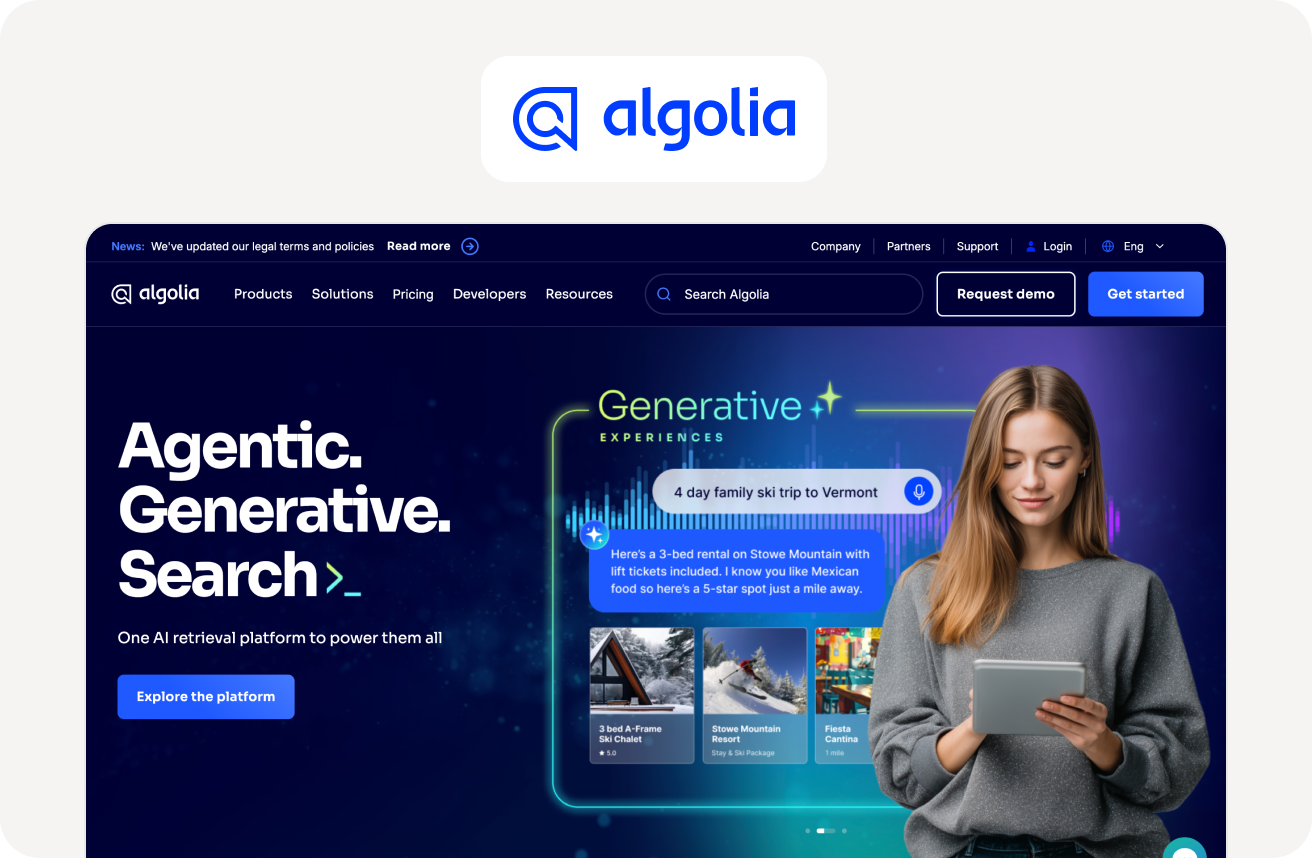
Algolia provides a highly flexible search platform used across commerce, content, and digital products.
Best for
Teams with strong developer resources that want full control over search experiences.
Where it fits in the journey
Discover.
Agentic strengths (what actions it can take)
- Uses AI systems to improve relevance, ranking, and query understanding.
- Supports fast, scalable search across e-commerce platforms.
Standout capabilities
- Extremely fast performance and customization options.
- Can act as part of a broader conversational AI platform when combined with other tools.
Watch-outs / limitations
- Requires engineering effort to unlock full value.
- Not a complete e-commerce AI agent on its own.
Ideal retailer profile
Retailers with in-house development teams building custom discovery experiences.
12) Coveo — Best for unified search and recommendations across large catalogs
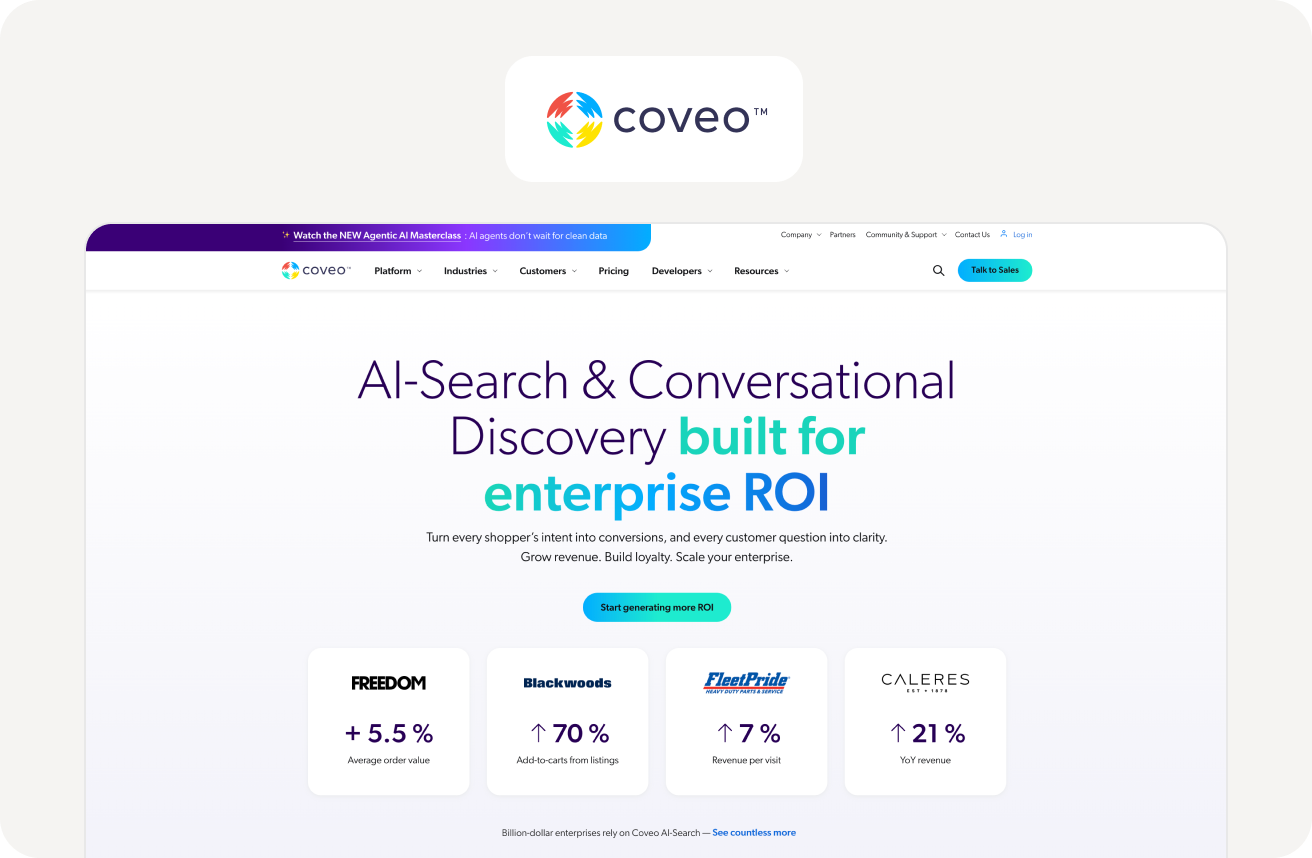
Coveo combines search, recommendations, and relevance optimization across commerce and service experiences.
Best for
Large organizations managing complex catalogs and multiple systems.
Where it fits in the journey
Discover, Decide, Post-purchase.
Agentic strengths (what actions it can take)
- Uses intelligent agents to personalize search and recommendations across channels.
- Handles support automation by connecting search to customer support use cases.
Standout capabilities
- Unified relevance across commerce and service.
- Strong handling of complex data structures and multiple systems.
Watch-outs / limitations
- Implementation complexity can be higher than mid-market tools.
- Value depends on how well data sources are unified.
Ideal retailer profile
Enterprise retailers that want consistent discovery and support experiences across large, complex e-commerce environments.
A long list of tools is useful, but it’s only the first step. What matters next is understanding how to evaluate these platforms based on your goals, data, and team setup.
How Voyado helps retailers operationalize agentic commerce
Agentic commerce only works when AI can actually do something useful inside your day-to-day operations.
That’s where Voyado focuses. Not more dashboards. Not more rules to maintain. Just fewer manual decisions and more relevant actions across discovery, marketing, and loyalty.
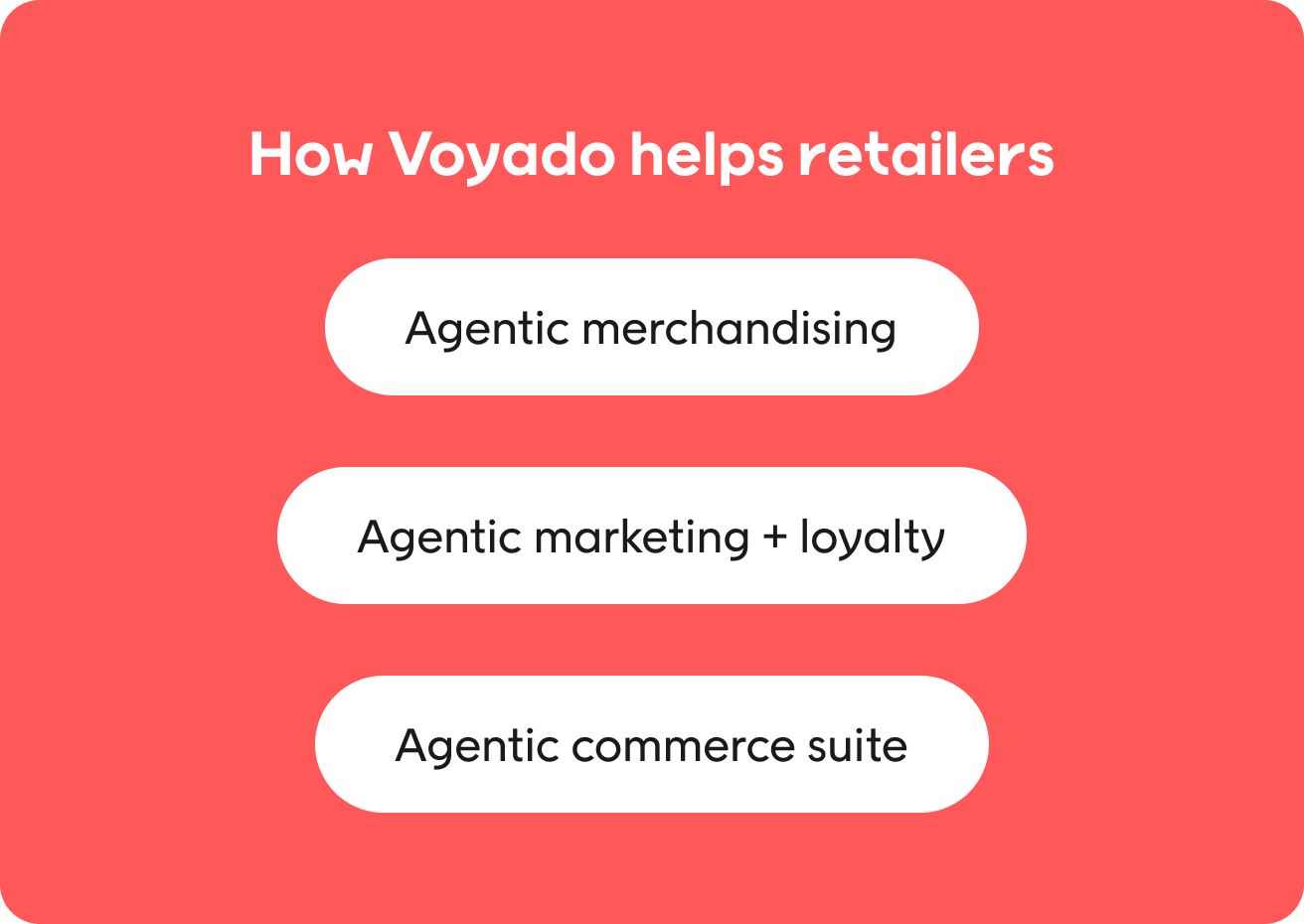
Agentic merchandising (Voyado Elevate)
Voyado Elevate helps your team move from constantly reacting to search issues toward proactive product discovery that adjusts as shopper behavior changes.
What this means for your daily work:
- Less time manually tuning rankings and filters.
- Fewer guesswork decisions about which products deserve visibility.
- Discovery that reflects inventory, margin, demand, and user intent automatically.
Instead of treating search and recommendations as static features, Elevate uses retail product intelligence and AI automation to keep your digital storefront relevant as conditions shift, with minimal human input required for routine optimization.
Agentic marketing + loyalty (Voyado Engage)
Voyado Engage connects personalization and loyalty so your team can engage customers consistently across channels, not one campaign at a time.
What this changes for your team:
- Fewer disconnected campaigns running in parallel.
- Personalization that carries across email, onsite, and loyalty touchpoints.
- Loyalty programs that actively support customer lifetime value, not just discounts.
By unifying customer data and activation, Engage helps your team deliver tailored shopping experiences that feel connected, not fragmented, while keeping control over brand voice and messaging.
Why suite beats stacks in 2026
Most e-commerce teams aren’t short on tools.
They’re short on time, clarity, and operational efficiency.
When discovery, personalization, loyalty, and messaging live in separate systems, teams spend their days:
- Jumping between platforms.
- Reconciling conflicting data.
- Manually coordinating actions across multiple channels.
A connected suite reduces that friction.
With Voyado, AI systems can observe, decide, and act across the journey without slowing your teams down or adding yet another layer of complexity.
If you want to see how this works in practice, book a demo and explore how Voyado supports agentic commerce across discovery, engagement, and loyalty.
At this point, the question isn’t whether AI agents belong in e-commerce. It’s how you choose the right approach, and how quickly your teams can turn insight into action. Let’s wrap up the key takeaways.
Final thoughts
For years, e-commerce teams have optimized in pieces, tweaking search here, launching campaigns there, and stitching results together after the fact. AI agents change that model. They move optimization from manual effort to continuous, contextual action across the customer journey.
As the market fills with AI agents e-commerce solutions, the difference isn’t who talks loudest.
It’s about which platforms can actually connect data, decisions, execution, and governance in a way teams can trust. That’s what separates experimental tools from the best AI agents for e-commerce.
Voyado stands out for retailers that want retail-trained agentic discovery and engagement working together, helping teams simplify their stack, move faster day to day, and deliver connected experiences customers actually notice.
FAQs
What are e-commerce AI agents, in simple terms?
E-commerce AI agents are AI systems that observe behavior, make decisions, and take action across the customer journey. Instead of just analyzing data, they help e-commerce teams automate tasks like discovery optimization, support automation, and personalization across multiple channels.
Are AI agents just advanced chatbots?
No. Unlike traditional chatbots, AI agents are designed for complex problem-solving. They can act across multiple systems, handle more than basic customer support, and escalate to human intervention when customer issues require it.
How do AI agents improve product discovery?
AI agents improve discovery by acting more like a personal shopper than a static rules engine. They adapt search, navigation, and recommendations based on user intent, inventory management signals, and customer preferences, helping online stores deliver more tailored shopping experiences.
What data do AI agents need to work well?
AI agents rely on connected customer data, including purchase patterns, order tracking, and order status across customer touchpoints. When AI systems can work across existing systems and e-commerce platforms, teams can make more informed decisions with minimal human input.
How long does it take to implement AI agents in e-commerce?
Implementation time depends on your data readiness and tech stack. For most e-commerce platforms, teams can start seeing value quickly when AI agents connect to existing systems and focus on a few high-impact use cases first, rather than trying to automate everything at once.
About Author