
TL;DR
Agentic AI in customer experience goes beyond chatbots and static automation. It uses AI agents that can observe customer signals, decide what should happen next, and act across channels, with built-in guardrails and human control. For retailers, this means moving from insight to action across the entire customer journey, from discovery and purchase to post-purchase support and loyalty, without adding more tools or manual work.
What is agentic AI in customer experience?
Agentic AI in customer experience is a way of using AI agents to move from insight to action, automatically and responsibly. Instead of just analyzing data or answering questions, agentic AI observes customer signals, decides what should happen next, acts across systems, and learns from the outcome.
In practice, this means customer experience AI agents don’t just react. They continuously improve how customer interactions are handled across the entire customer journey, with minimal human intervention but clear human control.
You can think of agentic AI for customer experience as a loop:
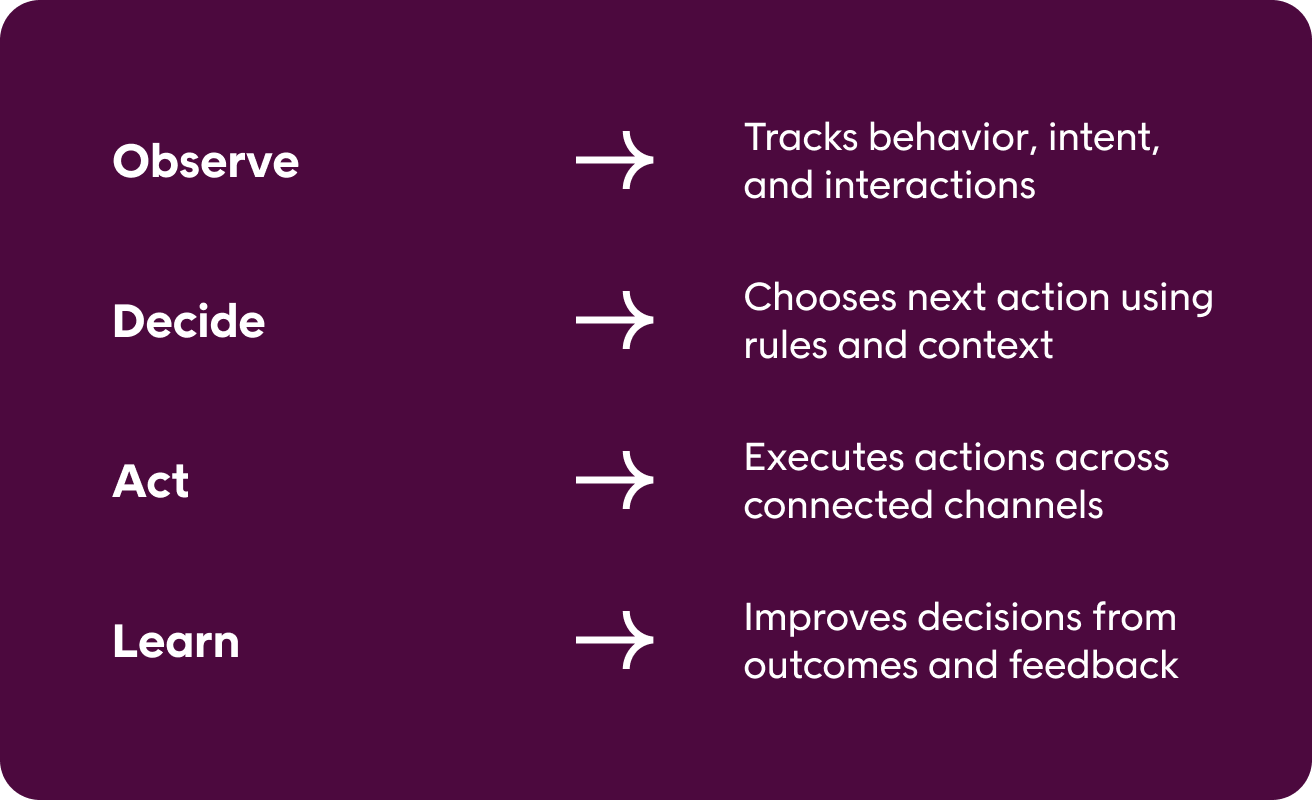
- Observe: AI agents monitor customer interaction data such as browsing behavior, purchase histories, customer queries, service intent, and past interactions.
- Decide: Using decision-making logic and AI models, the system chooses the next best action based on customer needs, expectations, and business rules.
- Act: The agent executes actions across channels, from personalized messages to service workflows, fully integrated with the existing tech stack.
- Learn: Outcomes like customer satisfaction, service quality, and operational efficiency feed back into the system, improving future decisions.
This is what makes agentic AI in CX different from traditional AI tools. It is designed to solve problems end-to-end, not just provide recommendations.
Agentic AI vs. generative AI vs. automation
Here’s how they compare:
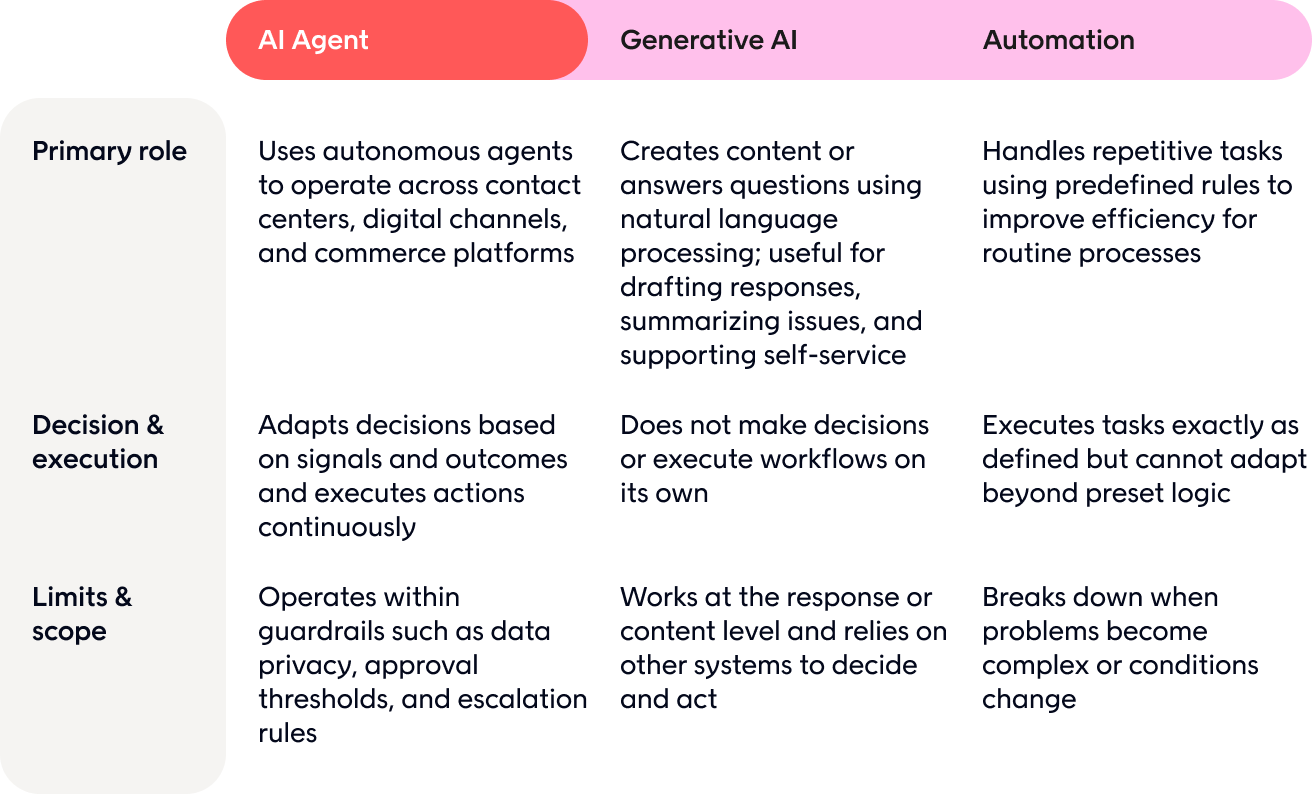
This is why agentic AI tools are increasingly seen as the next step beyond generative AI and basic automation.
Why customer experience is where agents show value first
Customer experience is always on. It spans discovery, purchase, support, and loyalty across digital channels, contact centers, and stores. The volume of customer interactions keeps growing, while customer expectations around speed and relevance continue to rise.
That creates pressure most teams can’t absorb with manual work alone.
Where traditional models fall short
- Campaign-led approaches react too slowly.
- Manual processes struggle with scale.
- Human agents and human support teams juggle routine tasks, complex tasks, and complex inquiries at the same time.
- Customer data is often fragmented across systems, making decision-making harder.
These limitations create a gap between what customers expect and what teams can realistically deliver, especially at scale.
Where agentic AI changes the equation
- AI agents handle customer queries and self service consistently.
- Complex inquiries are routed to human representatives with full context.
- Human agents are empowered to focus on higher-value customer problems instead of repetitive work.
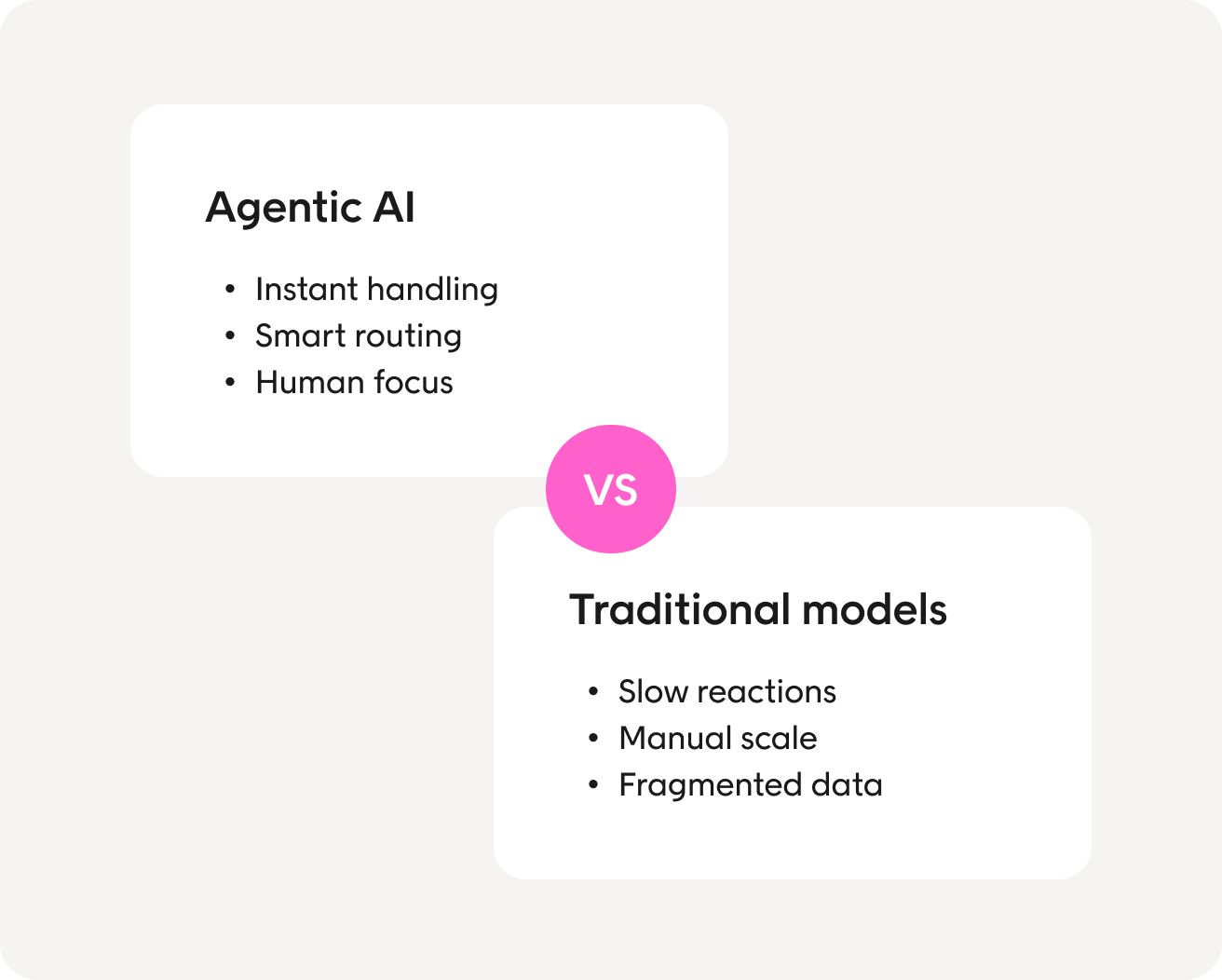
The result is faster resolutions, higher customer satisfaction, and improved operational efficiency, without compromising service quality.
What we’re seeing in customer experience is part of a bigger pattern. Retailers don’t lack insight, but turning insight into timely action has become the real challenge.
Why retailers are moving from “insights” to “action”
Retail teams are not short on data. They have customer data, dashboards, and reports that explain what happened. What’s missing is the ability to turn that insight into timely action.
The reason is rarely the insight itself. It’s the distance between insight and execution.
Customer interaction data lives across marketing tools, commerce platforms, loyalty systems, and customer support.
Each system shows part of the picture, but none owns the full customer journey. Humans are left to connect signals, interpret intent, and decide what should happen next.
That slows everything down and creates a fragmented customer experience, even when teams know what the customer needs.
At the same time, many AI tools and customer experience platforms stop at analysis. They surface patterns in customer behavior, sentiment, or purchase histories, but acting on those insights still requires manual steps, handoffs, and assumptions.
This gap shows up in practice:
- Opportunities are identified too late to matter.
- Journeys feel reactive instead of relevant.
- Teams spend time managing tools instead of improving service quality.
In an environment of rising customer expectations and increasing pressure to move faster, insight without action quickly becomes a liability.
In the agentic era, the advantage shifts to retailers that can connect data, intent, and autonomous action, without sacrificing control. That’s how insight turns into impact across the entire customer journey.
The practical retail shift: from campaign-based to always-on engagement
Traditional CX models are built around campaigns. Teams plan, launch, measure, and repeat. This works for predictable moments, but it struggles with how customers actually interact today.
Customer interactions are continuous. Needs change mid-journey. Context matters in the moment.
Orchestration alone is no longer enough. Routing messages across channels without understanding responsibility, intent, and timing does not solve the problem. It simply moves the same logic faster.
Agentic AI changes this by allowing AI agents to observe signals in real time, make data-informed decision-making possible, and act with defined guardrails.
Actions happen automatically where it makes sense, and escalate to human intervention when judgment is required.
The result is always-on engagement that adapts as customer needs change, while human teams stay in control of strategy, ethics, and service quality.
So what does this look like in practice? It starts with how agentic AI observes signals, makes decisions, and takes action across retail CX.
How agentic AI works in retail CX
Agentic AI in retail CX follows a clear operating loop. It continuously observes customer signals, decides what should happen next, takes action across systems, and learns from the outcome.
You can think of it as four connected stages:
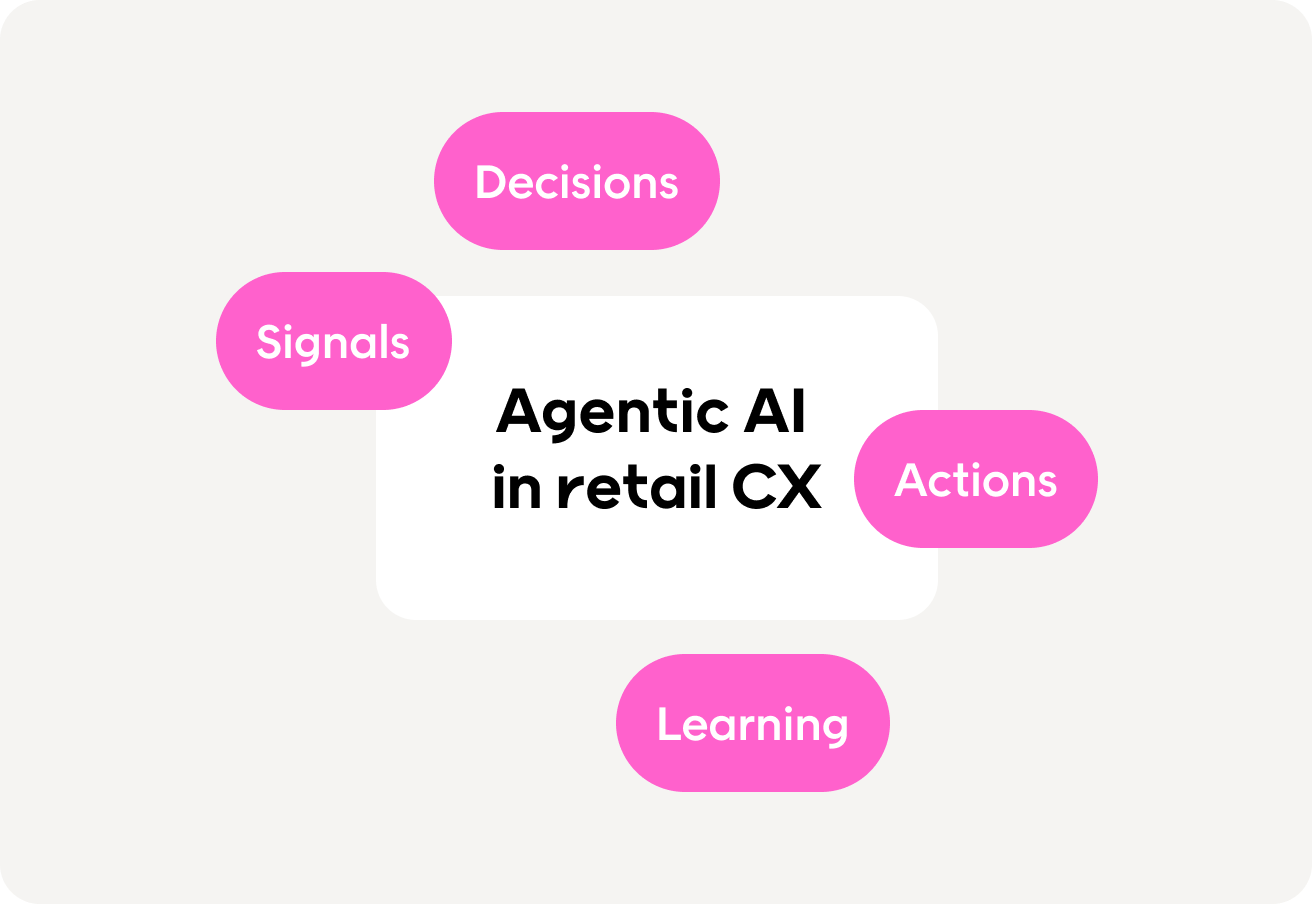
Each stage plays a distinct role. Together, they allow AI agents to support the entire customer journey, without relying on static rules or manual intervention.
Signals: what agents observe
Signals are the inputs. This is what AI agents pay attention to as customers interact with your brand.
In retail customer experience, these signals often include:
- browsing and search behavior
- purchase cadence and purchase histories
- loyalty tier and engagement level
- returns and exchanges
- customer queries and service intent
- in-store and omnichannel interactions
These signals come from across the tech stack, not a single channel. By observing customer interaction data in context, agentic AI systems build a real-time understanding of customer needs and expectations.
Decisions: what agents choose
Decisions turn signals into intent. This is where agentic AI differs from basic automation.
Based on what it observes, the AI agent decides:
- the next best action
- the best channel to use
- the right timing
- the most relevant offer or message
- the best content block or experience to show
These decisions are data-informed, not hard-coded. They account for past interactions, customer sentiment, and business rules, such as margin targets or service capacity.
This is what enables customer experience AI agents to respond appropriately, even when situations are not predictable.
Actions: what agents do, with guardrails
Actions are where insight becomes impact.
With clear guardrails in place, AI agents can:
- orchestrate journeys across email, web, and paid channels based on real behavior
- adjust product recommendations or category rankings based on demand, availability, margin, and shipping data
- tailor rewards, content, and timing to individual customers
- balance personalization with commercial goals, such as stock clearance versus full-price sell-through
These actions happen with minimal human intervention, but not without control. Approval thresholds, escalation rules, and data privacy boundaries ensure AI systems act responsibly and in line with brand and compliance requirements.
Learning: what improves over time
Every action creates an outcome. Learning closes the loop.
Agentic AI continuously evaluates results such as:
- conversion and retention
- customer satisfaction and service quality
- deflection in customer support
- return rates
- customer lifetime value uplift
These outcomes feed back into the system. Over time, AI agents refine their decision-making, improve operational efficiency, and increase their ability to serve customers consistently across touchpoints.
This learning loop is what allows agentic AI in CX to scale. The system improves through use, rather than relying on constant manual tuning by data scientists or CX teams.
Top agentic AI use cases across the retail customer journey
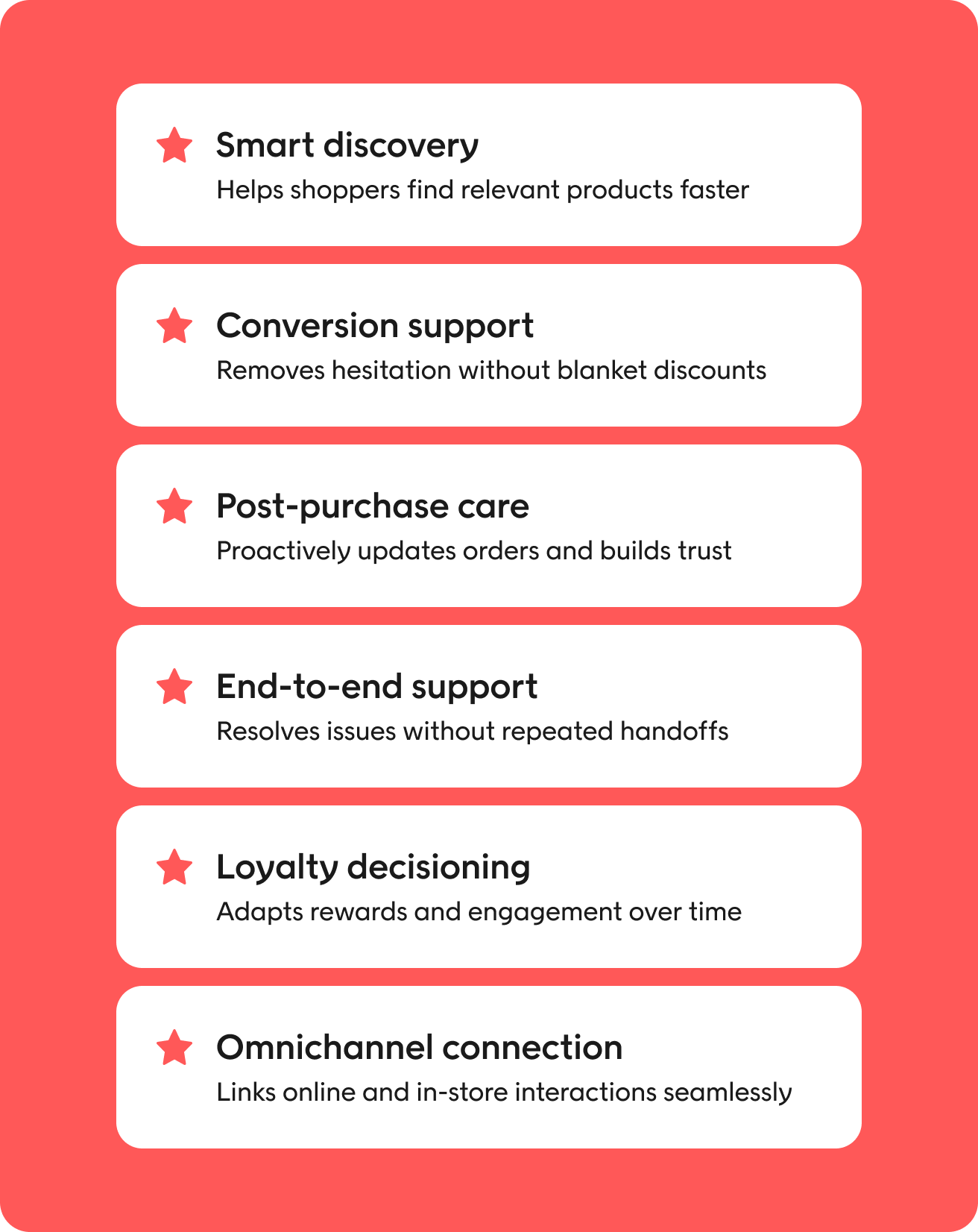
Agentic AI shows its value most clearly when you look at how it supports real customer moments. Across the retail customer journey, AI agents help teams move faster, reduce friction, and deliver more relevant experiences, without relying on blanket discounts or manual work.
Each use case below shows where agentic AI fits, what it does, and why it matters in practice.
Pre-purchase: faster discovery and fewer dead ends
Where it fits
Early exploration, search, and product discovery, when customers are still deciding.
What the agent does
AI agents support intent-aware assistance by helping customers find the right product faster. This can include sizing or compatibility guidance, surfacing relevant alternatives, or responding to changing signals during browsing.
Agents can also trigger proactive interventions, such as back-in-stock notifications or price-drop alerts, but only when they are relevant to the individual customer.
Why it matters
Customers abandon journeys when discovery feels confusing or repetitive. Agentic AI in customer experience reduces dead ends by adapting in real time, instead of forcing customers through static filters or generic recommendations.
What data it needs
Browsing and search behavior, past interactions, purchase histories, product data, availability, and customer interaction data across channels.
KPIs to watch
Search exit rate, product engagement, conversion rate, and customer satisfaction during discovery.
Purchase moment: conversion support without discount addiction
Where it fits
The point of decision, when customers are close to buying, but hesitation remains.
What the agent does
AI agents reduce friction by answering key questions in the moment. This can include shipping promises, store availability, delivery options, or relevant alternatives when an item is unavailable.
Instead of pushing blanket offers, agentic AI tailors urgency based on context, timing, and customer needs, avoiding unnecessary discounting.
Why it matters
Many retailers rely on promotions to close sales. Agentic AI for customer experience helps support conversion through relevance and reassurance, not price erosion.
What data it needs
Shipping data, inventory levels, store interactions, customer expectations, and past purchase behavior.
KPIs to watch
Conversion rate, average order value, lower cost to serve during checkout, and reduced cart abandonment.
Post-purchase: WISMO prevention and trust building
Where it fits
After the order is placed, before and after delivery.
What the agent does
AI agents proactively communicate order updates, handle delays, and guide customers on what happens next. This includes delivery notifications, delay explanations, and setup or care guidance.
Agents can also support return prevention by providing relevant information at the right time, such as care instructions, usage tips, or replenishment reminders.
Why it matters
Post-purchase silence creates uncertainty. Agentic AI in CX helps prevent “Where is my order?” queries and builds trust through proactive, relevant communication that drives measurable impact over time.
What data it needs
Order status, shipping data, product information, customer queries, and service intent signals.
KPIs to watch
Inbound support volume, faster resolutions, return rate, customer satisfaction, and retention.
Customer support: resolve needs end-to-end, not just deflect
Where it fits
Service moments across contact centers, digital support, and self-service.
What the agent does
AI agents triage incoming customer issues, answer questions, and execute actions such as checking refund status, updating addresses, or initiating exchanges.
When complexity increases, agents route cases to human support agents with full context, enabling smooth human intervention instead of handoffs that force customers to repeat themselves.
Why it matters
Deflection alone does not improve service quality. AI agents for customer support and customer experience help resolve problems end-to-end, while empowering human agents to focus on complex inquiries.
What data it needs
Customer queries, past interactions, customer sentiment, contact center operations data, and policy rules.
KPIs to watch
First contact resolution, service quality, customer satisfaction, lower costs, and increased productivity for human support teams.
Loyalty and retention: agentic CX that grows CLV
Where it fits
Ongoing engagement, loyalty programs, and win-back moments.
What the agent does
AI agents tailor rewards, content, and treatment based on individual behavior and value. Win-back journeys adapt dynamically, responding to engagement signals instead of blasting fixed messages.
This creates an AI agentic workflow for customer experience that evolves with the customer.
Why it matters
Retention depends on relevance over time. Agentic AI CX supports loyalty by aligning incentives and experiences with real customer needs.
What data it needs
Loyalty tier, engagement history, purchase cadence, and customer interaction data.
KPIs to watch
Repeat purchase rate, customer lifetime value, higher customer satisfaction, and engagement lift.
Store and omnichannel CX: connect online and in-store signals
Where it fits
Moments where customers move between digital and physical environments.
What the agent does
AI agents connect signals across email, SMS, web, in-store systems, and support tools. This reduces “who is this customer?” moments at checkout or during service interactions.
Why it matters
Disconnected experiences erode trust. Agentic AI in customer experience creates seamless transitions across channels, helping teams serve customers consistently.
What data it needs
In-store interactions, digital engagement, loyalty data, and customer journey context.
KPIs to watch
Omnichannel engagement, service resolution time, customer satisfaction, and overall experience consistency.
Agentic AI can unlock meaningful improvements across the customer journey, but only when it’s implemented with the right foundations and controls.
What makes agentic CX hard, and how to do it responsibly
Agentic AI in customer experience can unlock real value, but it also introduces new complexity. Retailers that succeed are the ones that address these challenges early, rather than layering agents onto an already fragile setup.
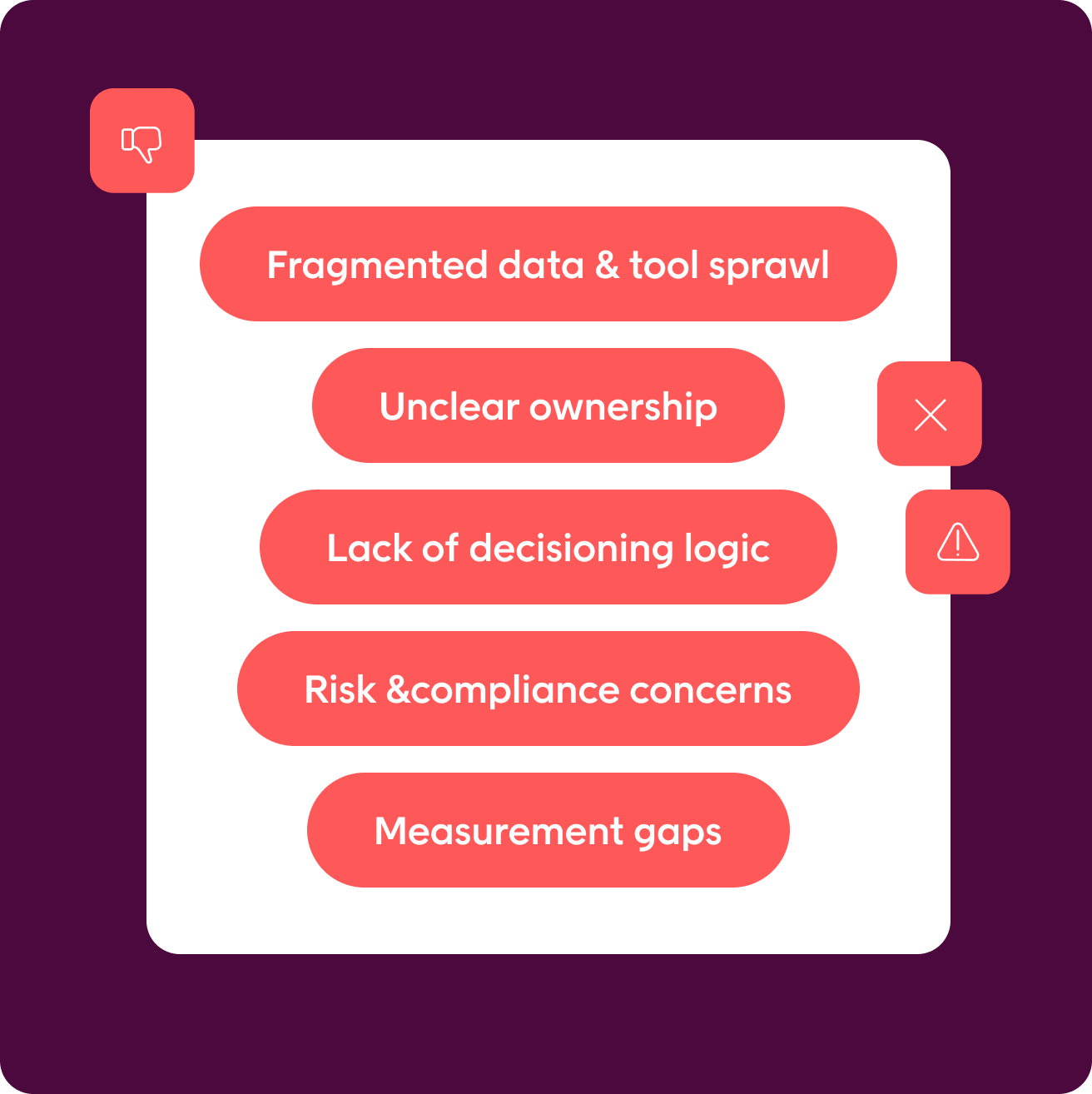
The five common blockers
Most challenges fall into a small set of patterns:
- Fragmented data and tool sprawl – Customer data is spread across systems, limiting context and consistency.
- Unclear ownership – Responsibility for CX decisions is split across CRM, ecommerce, loyalty, and support teams.
- Lack of decisioning logic – Teams have insight, but no shared answer to “what should happen next?”
- Risk and compliance concerns – Data privacy, brand safety, and regulatory requirements slow adoption.
- Measurement gaps – Attribution across touchpoints makes it hard to measure success end-to-end.
These blockers are why many initiatives stall after pilots, even when the technology works.
Guardrails: autonomy with control
Responsible agentic CX is not about removing humans from the loop. It’s about assigning roles clearly.
Humans keep strategy, brand, ethics, and commercial direction.
Agents handle complexity at speed and scale.
In practice, this means putting guardrails in place, such as:
- approval thresholds for sensitive actions
- escalation rules for complex or high-risk customer issues
- safe content boundaries aligned with brand and compliance requirements
- testing and monitoring, where agent performance is reviewed like campaigns or journeys
With these controls, agentic AI for CX can operate autonomously where it makes sense, while teams retain visibility and accountability.
Once these guardrails are in place, retailers can focus on turning agentic CX into everyday execution.
A retailer’s roadmap to adopting agentic AI in customer experience
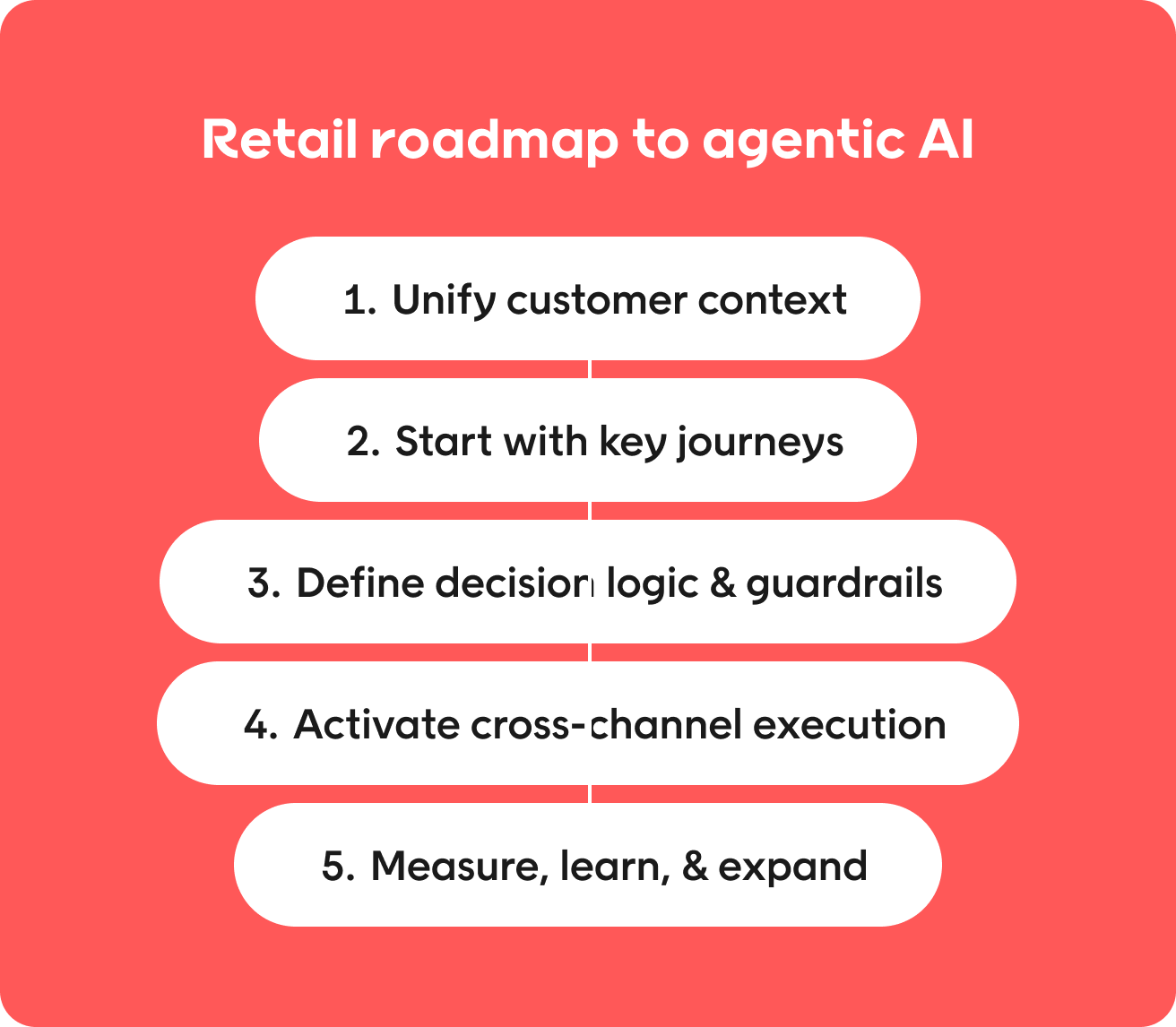
Most retailers are already partway there. They have data, tools, and some automation in place. What’s missing is a clear path from assisted decisioning to more autonomous optimization.
Think of this roadmap as a progression. You don’t need to reach full autonomy to see value. Very few retailers do. What matters is moving forward with confidence and control.
Step 1: Unify customer context
Agentic AI depends on context. That starts with a usable, shared view of the customer.
What “good enough” looks like
- Identity resolution across channels
- Purchase, engagement, and loyalty signals in one place
- A consistent customer profile teams can trust
You’re ready to move on when
Your teams stop debating which data source is “right” and start using the same customer context to make decisions.
Step 2: Start with two or three high-impact journeys
Not every journey needs agents on day one. Focus where speed, volume, and customer expectations are highest.
Common starting points include:
- post-purchase proactive updates
- lapsing customer reactivation
- service triage and resolution for top intents
You’re ready to move on when
Journeys are live, measurable, and no longer rely on manual intervention for every decision.
Step 3: Define decision logic and guardrails
This is where agentic AI becomes practical, not theoretical.
Teams need to agree on:
- what “next best action” means for your brand
- which actions agents can take automatically
- which actions require review or recommendation
You’re ready to move on when
There’s shared clarity on responsibility, and agents are trusted to act within defined boundaries.
Step 4: Activate cross-channel execution
Decisions only matter if they lead to action.
At this stage, AI agents begin executing across:
- email, SMS, and on-site experiences
- service workflows, where relevant
The goal is consistency. Customers should experience the same logic, regardless of channel.
You’re ready to move on when
Actions trigger reliably across channels without breaking journeys or creating duplicate experiences.
Step 5: Measure, learn, and expand
Agentic AI improves through use.
As feedback loops mature, teams can:
- refine decision-making based on outcomes
- expand into merchandising, loyalty, and retail media
- support more complex journeys over time
You’re ready to scale further when
You can measure impact across touchpoints and confidently explain why agents made certain decisions.
This is where some retailers approach fully autonomous optimization. Most will stay in the middle stages, using agents to handle complexity while humans retain strategic control.
Moving through this roadmap requires more than tools. It requires a platform built to connect insight, decisioning, and action.
How Voyado enables agentic CX for retailers
Agentic CX only works when insight turns into action. Voyado is built to make that shift possible.
Instead of adding more dashboards or standalone tools, Voyado unites customer engagement, loyalty, product discovery, and retail-trained AI into a single platform. This shared foundation allows teams to act faster and smarter across the entire customer journey.
The result is consistent personalization across channels and touchpoints, online and in-store, without forcing teams to stitch together tools or manage fragile handoffs.
Voyado’s agentic suite
Voyado’s agentic approach is organized around three connected capabilities. Each one is designed around responsibility and action, not isolated features.
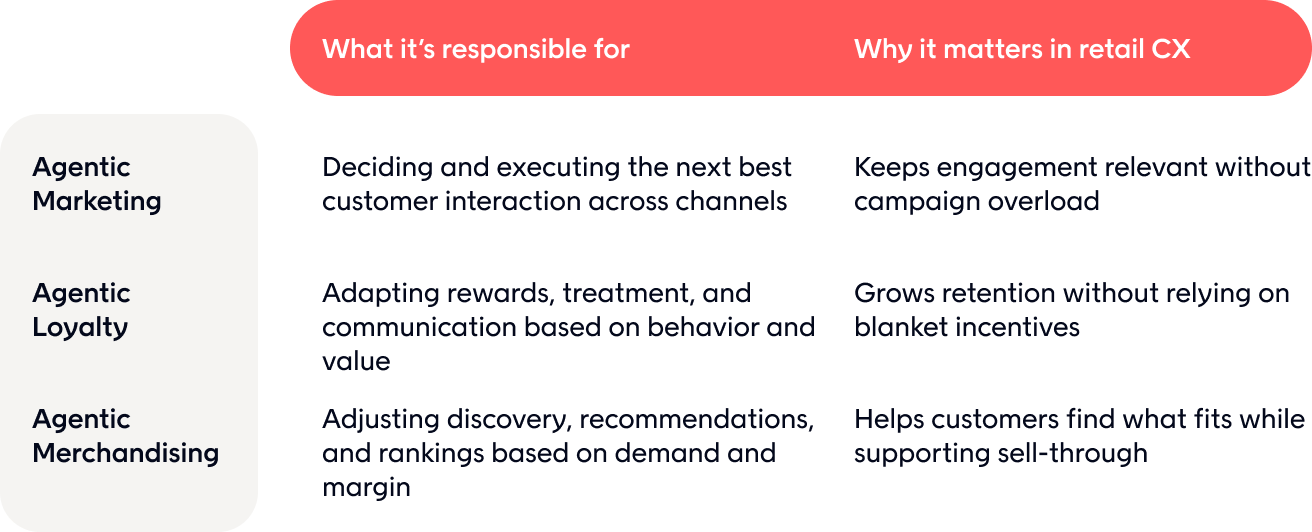
Together, these capabilities allow retailers to turn data into meaningful action, without adding operational complexity.
Why retail-trained AI matters
Generic AI tools struggle with the realities of retail.
Retail has distinct rhythms, seasonality, product lifecycles, margin and stock constraints, and loyalty mechanics. AI that isn’t trained on these patterns often applies logic that works elsewhere but misses retail-specific opportunities.
Voyado’s retail-trained AI is built with this context in mind. It understands when timing matters, how inventory affects experience, and why loyalty behavior should influence decisions.
This helps teams avoid generic automation and act with confidence in real retail moments.
Ready to move from insight to action?
If you want agentic CX without stitching together five tools, book a demo today to see how Voyado connects data, intent, and action across journeys, channels, and teams.
Summary
- Agentic AI in customer experience turns insight into action, helping retailers respond faster across the entire customer journey.
- It delivers relevance at scale, adapting decisions and experiences in real time, not through static campaigns.
- Control stays with humans, while AI agents handle complexity, volume, and timing.
- The value shows up first in CX, from discovery and conversion to post-purchase, support, and loyalty.
- Retailers don’t need full autonomy to win; meaningful impact starts well before “fully autonomous optimization.”
FAQs
What is agentic AI in customer experience?
Agentic AI in customer experience uses AI agents to observe customer signals, determine next steps, and take action across channels. Unlike analytics-only tools, agentic AI CX is designed to move from insight to execution, while keeping humans in control.
How is agentic AI different from chatbots?
Chatbots primarily answer questions or generate responses. Agentic AI for CX goes further by making decisions and executing actions. It can change journeys, trigger workflows, and adapt experiences based on outcomes, not just respond to prompts.
What are the best use cases for agentic AI in retail CX?
The strongest use cases appear across the full customer journey, including discovery support, conversion assistance, post-purchase communication, customer support resolution, and loyalty engagement. These are moments where speed, relevance, and coordination matter most.
Can agentic AI replace customer support agents?
No. Agentic AI is not designed to replace humans. AI agents for customer support and customer experience handle routine, high-volume interactions, while human agents focus on complex cases, judgment, and relationship-building.
What data do retailers need for agentic CX?
Retailers need a shared customer context that includes identity resolution, purchase histories, engagement signals, loyalty data, and cross-channel customer interaction data. This foundation supports an effective AI agentic workflow for customer experience.
How do you measure success for agentic customer experience?
Success is measured through outcomes, not activity. Common KPIs include conversion, retention, customer satisfaction, service quality, reduced support volume, and customer lifetime value. The goal is measurable impact across touchpoints.
How do you use agentic AI responsibly in CX?
Responsible use combines autonomy with control. Humans define strategy, brand rules, ethics, and commercial direction. Agents operate within guardrails such as approval thresholds, escalation rules, and monitoring to ensure accountability.
What’s the fastest way to start with agentic AI in retail?
Start with one or two high-impact journeys, such as post-purchase communication or service triage. This allows teams to test agentic AI for CX in real scenarios, prove value, and expand with confidence.