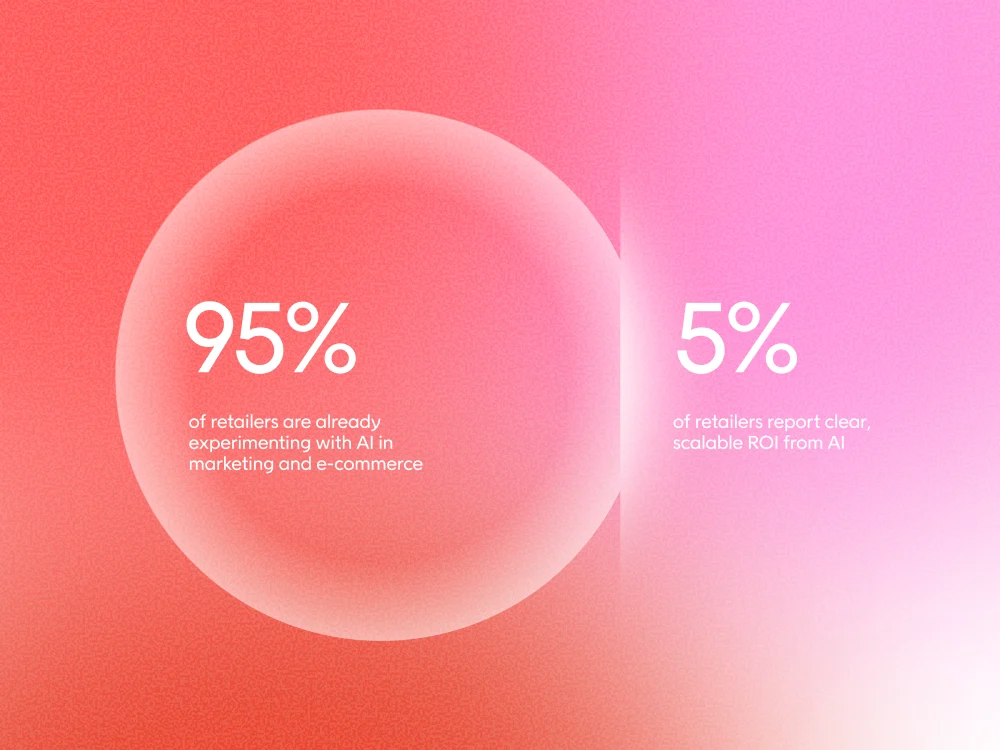
95% of retailers use AI. Only 5% see ROI. Read the report →
The maturity gap

Adoption is high. ROI is rare.

Nearly every retailer is experimenting with AI in their marketing and e-commerce. Very few are scaling it. The result is a widening gap between activity and commercial impact.
State_of_AI_in_Retail_Maturity_Gap_Experimentation_v_ROI_1x

The real AI maturity gap

The AI maturity gap doesn’t sit between retailers who use AI and those who don’t. The reality now is that it sits between the 95% who are experimenting and the 5% who have embedded AI into how their business operates.

Most retailers are already using AI in some form, testing tools, running pilots, or applying it within individual workflows. But only a small minority have moved beyond isolated use cases to integrate AI into decision-making, planning, and execution across functions.

That is where impact is created. Without integration, AI remains a layer on top of existing processes. With it, AI becomes part of the operating model, shaping how decisions are made and how performance is improved over time.
The state of AI in Retail_What we mean by AI
AI in this report

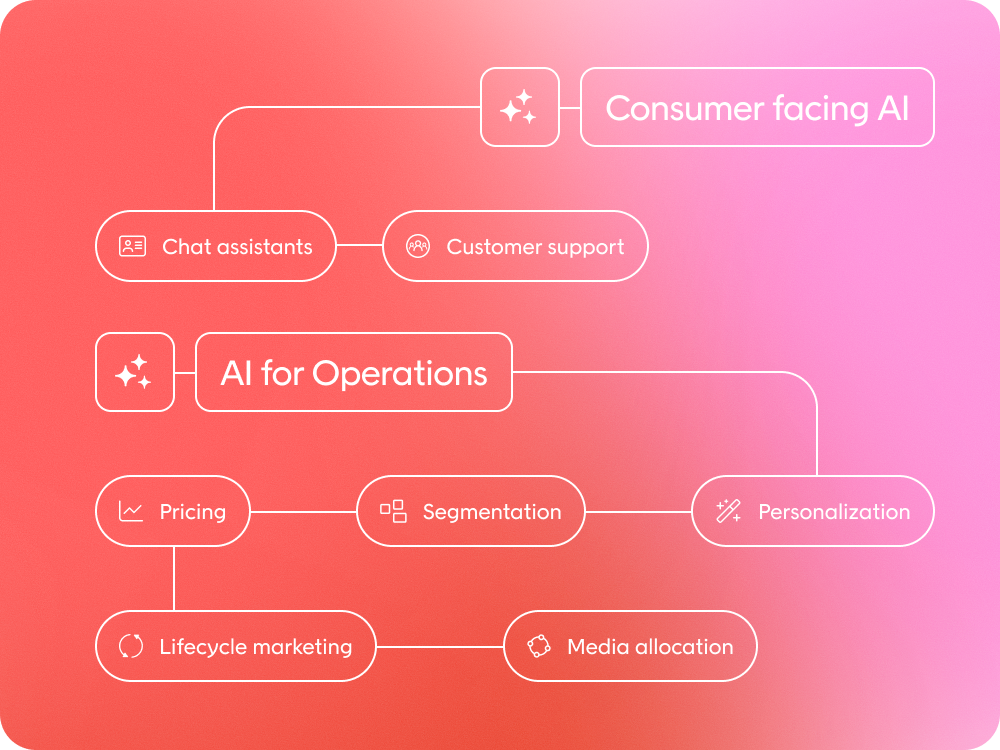
Marketing and e-commerce operations

Retailers are not adopting AI in a single step. They are progressing along a multi-year integration journey, embedding AI gradually as capabilities, confidence, and infrastructure mature.

In this report, the focus is on AI used within marketing and e-commerce operations, where commercial impact is most immediate.

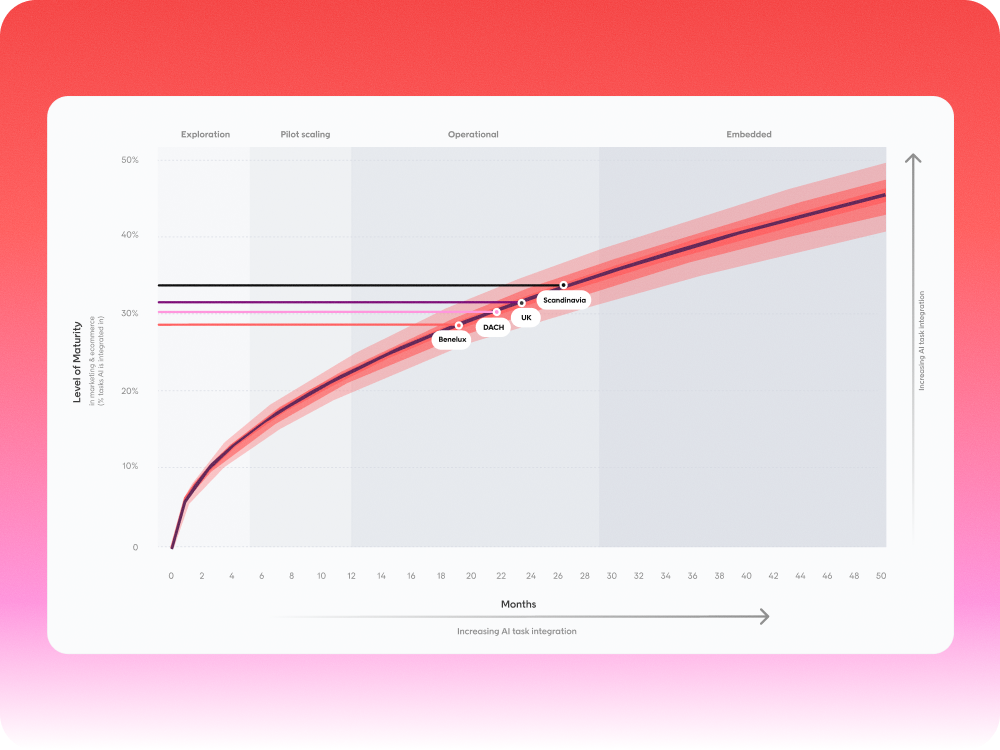
By comparing how long retailers have been working with AI and how deeply AI is integrated into day-to-day marketing and e-commerce tasks, we identified four main stages of AI adoption in retail marketing and e-commerce.

The stages of AI maturity

Where retailers sit on the adoption journey

Where retailers sit on the AI adoption journey

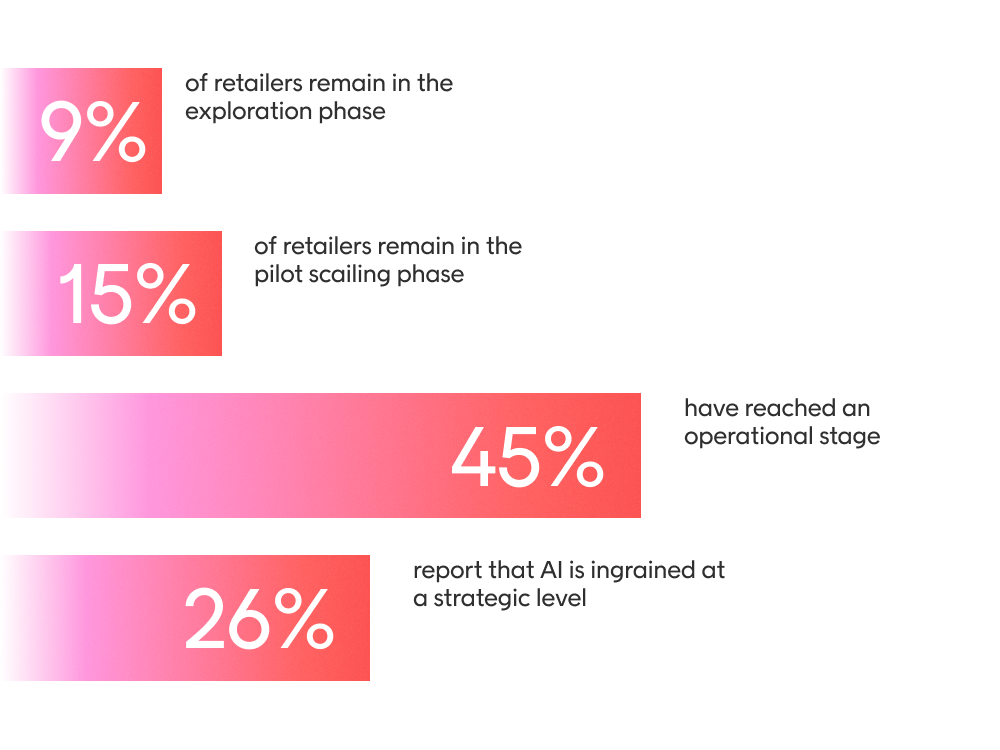
Most retailers began experimenting with AI around 2023, typically through generative tools and large language models (LLMs). Adoption accelerated quickly, with most retailers now having trialed AI in marketing and e-commerce.

But progress beyond this varies. 24% of retailers remain in exploration or pilot phases, still learning where AI creates value. By contrast, 45% have reached an operational stage, where AI is embedded in multiple workflows and influences day-to-day marketing and e-commerce decisions.

A further 26% of retailers say AI is now ingrained at a strategic level, shaping planning, prioritization, and execution across functions.

Regional variations in AI maturity_agentic AI in retail

Regional variations in AI maturity

The maturity gap is visible across all European markets, but differences between them remain relatively narrow. Across regions, AI is currently integrated into roughly 29–35% of marketing and e-commerce tasks, indicating that most retailers are still in the early stages of embedding AI into everyday operations.

Even in more advanced markets, AI is typically applied within specific workflows rather than fully integrated across the organization. This suggests that while adoption is widespread, structural integration remains limited, and no region has yet reached a truly mature state.


35%
maturity

32%
maturity

30%
maturity

29%
maturity
The State of AI in Retail_3

The real divide is structural, not geographic

The maturity gap isn’t primarily a story of regional leaders and laggards. Every market remains early in structurally embedding AI.

The real separation lies between retailers that build integrated, scalable AI capabilities and those that still operate through isolated use cases.

Next section: Diagnostics →

download_report_bg_state of AI in retail download_report_bg_state of AI in retail

Download the full report

Access the full research from Voyado and Retail Economics to discover what separates leaders from the rest.