TL;DR
Personalization at scale in 2026 means using unified customer data and simple AI decisioning to deliver personalized experiences across the full customer journey. You use real-time personalization to match each shopper with personalized recommendations, relevant content, and personalized interactions that feel natural.
This helps you scale personalization across multiple channels with less effort. You lift customer engagement, improve conversion rates, and support repeat purchases from existing customers. And because you activate first-party data with clear personalization strategies, you deliver personalized content at the right moment while protecting margin.
What if your team could meet every shopper with something that feels relevant, helpful, and perfectly timed?
That is what strong personalization at scale makes possible.
Shoppers expect simple, personalized experiences. They respond when your business understands their customer preferences and uses customer data to deliver relevant content across channels.
When you do this well, you lift customer engagement, improve conversion rates, and build a customer journey people want to return to.
This playbook shows you the practical steps to get there. You learn the foundations, the seven capabilities that make scalable personalization work, and a simple 90-day plan your team can start right away.
And before we build anything, let’s look at what “personalization at scale” actually means today.
How personalization at scale works today
Retail teams have more data, better tools, and clearer customer signals than ever before.
When you connect those pieces, you can deliver personalized experiences that feel simple for shoppers and easy for your teams to run. This is personalization at scale: relevant moments delivered with speed, accuracy, and calm.
You use customer data to understand customer behavior, learn what customers expect, and support each step of the customer journey.
The result is a set of meaningful customer experiences that lift engagement and feel consistent across multiple channels.
What personalization at scale looks like now
In practice, personalization at scale lets your team:
- React to real customer preferences in real time.
- Deliver personalized interactions that feel one-to-one.
- Support personalized experiences across store, email, SMS, app, and onsite.
- Adjust dynamic content without heavy production cycles.
What powers this?
- Unified profiles that join your signals.
- Clear personalization strategies that guide your choices.
- First-party data that helps you deliver relevant products and personalized recommendations.
- Simple decisioning tools that help you deliver tailored experiences with speed.
Further reading: If you want a deeper look at these building blocks, this guide on personalization in retail walks through the core steps.
Why personalization matters more than ever
Three shifts changed how retail teams think about personalization.
Privacy and first-party data
You own the relationship with your customer, so you rely on strong data quality and data accuracy to deliver personalized experiences responsibly.
AI support
Artificial intelligence helps your team understand customer behavior, spot patterns, and deliver personalization at exactly the right time.
Omnichannel shopping
Shoppers move between store and online without slowing down. Personalized digital experiences only work when your team can scale personalization across multiple channels.
Together, these shifts make personalization a growth lever your team can trust.
The KPIs that show personalization is working
Your personalization efforts should lift real business outcomes. Look for movement in metrics that matter to your bottom line. Use them as early guardrails:
| KPI | What it means |
| Conversion rates | Customers find relevant content and take action |
| Repeat purchases | Existing customers return more often |
| Customer engagement | Shoppers interact with your touchpoints |
| Revenue per visitor | Personalized journeys increase value |
| Customer loyalty | Customers choose your brand more consistently |
Quick pulse-check for your team
- Are customers seeing personalized experiences that fit their needs?
- Are you supporting your marketing campaigns with clear data-driven insights?
- Are your personalization tactics driving measurable business benefits?
When these signals start to take shape, your team is ready to build the foundations that keep your personalization work strong as you grow.
The foundations you need before you scale
Strong personalization depends on strong groundwork.
When your team builds clear foundations, you can deliver personalized experiences without friction, and you can scale personalization across multiple channels with confidence.
These layers make every personalization effort more reliable, more accurate, and easier to manage.
Unified profiles and consent – identity resolution, households, guests
A unified profile gives your team a full view of the customer journey. You combine store, e-commerce, loyalty, app, and service signals to understand customer behavior in one place.
What this unlocks
- Clear customer preferences
- Better personalized interactions
- More accurate personalized recommendations
- Stronger customer loyalty
Identity resolution keeps your data clean. You can link households, guests, and returning customers to keep the experience relevant. Consent stays part of the design, which protects trust and supports long-term customer retention.
If you want to see how unified profiles shape the full journey, this overview of onsite personalization improvements shows how much customer data helps your team tailor content.
Data quality and coverage – POS, e-commerce, app, service, loyalty
Your personalization strategies depend on strong data quality. You need customer data that covers the full journey so you can deliver personalized content and relevant products with confidence.
Key sources to include
- POS and store visit data
- E-commerce behavior and browsing history
- App events and mobile app engagement
- Loyalty activity, tiers, rewards
- Service interactions and feedback
When these signals come together, you avoid personalization challenges like incorrect offers, irrelevant messages, and generic customer experiences.
You also support real-time personalization with better data accuracy, which makes every step in the journey more consistent.
Governance – consent states, purpose limits, regional controls
Governance protects your team and your customers. You set rules that control how your customer data platform uses each signal so your marketing automation stays compliant and predictable.
Governance keeps your work safe through
- Clear consent states
- Purpose limits for each data use
- Regional controls for privacy and compliance
- Guardrails that support ethical personalization practices
Good governance also makes your marketing efforts easier to run. Your team can activate personalization tactics without worrying about manual checks or risky edge cases.
With these foundations in place, your team is ready to build the capabilities that turn customer data into personalized experiences at scale.
The seven capabilities of scalable personalization
Time to start building the capabilities that help your team deliver personalized experiences at scale.
These capabilities turn customer data into personalized interactions that feel timely, relevant, and simple across multiple channels.
Each one supports a different part of the customer journey, and together they create a complete personalization system your business can trust.
1. Audience strategy: Segments, micro-segments, and one-to-one
Your audience strategy shapes everything. You start with broad segments, learn from customer behavior, and refine your groups into micro-segments and one-to-one moments.
A strong audience strategy helps you
- Understand customer preferences
- Match content with each stage of the customer journey
- Deliver personalized recommendations with accuracy
- Support your marketing personalization efforts with clear rules
Micro-segments work well when you want to deliver tailored experiences without overwhelming your team.
One-to-one moments work best when you activate real-time personalization based on what customers expect.
2. Decisioning: Rules, predictions, and AI support with guardrails
Decisioning tells your system what to show, when to show it, and why it matters. You move from simple rules to predictive models, then add AI support to help you choose the next best action.
Good decisioning gives your team
- Clear logic for personalized messages
- Faster reactions to live customer interactions
- Better relevance across multiple channels
- A safe way to scale personalization without losing control
Guardrails matter. They keep your AI outputs stable, ethical, and aligned with business goals.
3. Dynamic content: Templates, feed-driven modules, and content slots
Dynamic content helps you deliver personalized digital experiences with speed. You use templates and modular content blocks, so your team can update creative once and reuse it everywhere.
Dynamic content supports
- Consistent personalized content
- Faster production cycles
- Slot-based experiences that adjust based on customer behavior
- Clear visibility into what customers see and why
This approach also reduces content bottlenecks, which supports efficient marketing and easier scaling.
4. Product discovery: Search, recommendations, bundles
Search and product discovery play a major role in customer satisfaction. When shoppers find relevant products quickly, they convert faster and return more often.
Product discovery improves when you
- Use personalized recommendations based on browsing history
- Suggest bundles and complementary items
- Adjust search results for customer preferences
- Support repeat purchases with clear cues
Recommended reading: A deeper look at search improvements is available in our guide to e-commerce search personalization.
5. Journey orchestration: Cross-channel, real-time triggers, throttling
Journey orchestration lets your team design how personalized experiences flow from one touchpoint to the next.
Strong orchestration helps you
- Connect email, SMS, onsite, app, and store
- Use real-time personalization triggers, like browse and cart events
- Control frequency and avoid fatigue
- Deliver individualized experiences that feel natural
You support your customers through each step without overwhelming them.
6. Offer management: Eligibility, caps, margin protection
Offers should feel thoughtful, not random. Good offer management protects your margin while still delivering value to your customers.
Offer management supports
- Eligibility rules
- Discount caps
- Tier-based offers and loyalty rewards
- Personalized messages that stay profitable
This lets you deliver tailored experiences without creating margin pressure.
7. Measurement: Holdouts, uplift, incrementality, fatigue limits
Measurement helps your team understand what works. You design tests once and read results across your channels.
Measurement lets you track
- Incremental revenue
- Conversion lift
- Time-to-next-purchase
- Fatigue signals
- Long-term customer loyalty
When you measure properly, you see the true business benefits of your personalization tactics.
With these seven capabilities in place, your team can build a stack that fits your goals and supports personalization at scale without adding unnecessary complexity.
Build your stack with simple landscape and fit questions
A strong personalization strategy needs a stack that supports it.
Your tools should help you unify customer data, deliver personalized experiences, and scale personalization across multiple channels without adding strain.
The goal is a setup that feels simple to run and easy to grow.
CDP plus activation vs all-in-one engagement platform
Most retailers choose between two paths.
- CDP plus activation layer
You unify customer data in a customer data platform, then push it into activation tools across email, SMS, onsite, app, and ads.
This path works well when your team needs
- deep data modeling
- flexible integrations
- custom workflows
- All-in-one engagement platform
You use one system that joins profiles, decisioning, journeys, and activation.
This path works well when your team wants
- faster setup
- simpler workflows
- built-in decisioning and dynamic content
- fewer systems to maintain
If you want to compare tools in this space, this guide to the best e-commerce personalization software is a helpful starting point.
What to insource vs buy – Data, content ops, modeling, QA
A smart split makes your work lighter. Your team keeps the strategic pieces, while automation handles the heavy lifting.
| Keep in-house | Buy or automate |
| Data governance and privacy rules | Complex data engineering |
| Brand voice and creative direction | AI-based predictions and decisioning |
| High-level personalization strategies | Dynamic content delivery |
| Performance tracking and business insights | QA automation across channels |
| Customer journey goals and KPIs | Automation tools that keep journeys running |
This mix gives your team more control over strategy while reducing the operational load that slows down personalization efforts.
A checklist of questions that shape your stack
These questions help your team choose tools that fit your goals and support your personalization strategies.
Before you commit, ask your vendor:
- Does it join store and online behavior natively?
- Can it support event-to-action latency under a few seconds?
- Are visual testing tools and holdouts built in?
- Does it offer retail-ready templates and baselines?
- Can your team understand customer behavior without heavy analysis?
- Will it help you scale personalization without adding headcount?
A retail-native engagement platform like Voyado brings profiles, decisioning, and omnichannel activation into one place. This keeps your personalization work simple and effective.
With your stack in place, the next challenge is content. Personalization only works when your team can create and adapt content at scale without slowing everything down.
Content operations at scale: How to avoid the bottleneck
Personalization only works when your team can produce and update content fast.
Strong content operations help you deliver personalized experiences without slowing campaigns, creative teams, or your customer journey.
The goal is simple: build once, adapt everywhere.
Modular templates and slot maps across site, email, app, SMS
Modular templates let your team reuse creative assets across multiple channels. Slot maps show where personalized content appears, so you can update messages in seconds instead of days.
This approach helps you
- Keep content consistent
- Test variations faster
- Support dynamic content without heavy production
- Deliver personalized messages at scale
A simple library of templates keeps your team moving.
Content feeds: Catalog, pricing, inventory, creative variants
Content feeds remove manual work. You connect your catalog, pricing, and inventory data so every personalized interaction stays accurate.
Feeds help you
- Show relevant products based on browsing history
- Adjust offers and messages in real time
- Maintain data accuracy across touchpoints
- Reduce the risk of outdated content
Creative variants also slot in through feeds, which supports efficient marketing personalization.
AI assistance with human guardrails: Copy, image variants, QA rules
AI speeds up production while your team keeps quality high. You use it to generate copy variations, adjust images, and run automated QA checks.
AI support works best when
- Your team sets tone, quality, and brand rules
- Guardrails prevent off-brand or risky outputs
- You focus AI on repetitive tasks, not creative judgment
This mix lets you deliver personalized content faster while keeping your brand safe.
Once content flows smoothly, your next step is orchestration.
This is where your team connects triggers, timing, and channels to create experiences that feel thoughtful and respectful.
Orchestration that respects people and profit
Orchestration is where your personalization strategy becomes real.
You connect triggers, timing, and channels so your team can deliver personalization that feels thoughtful and never overwhelming.
When orchestration works well, customers experience tailored moments that support their needs and help your business protect profit.
Frequency caps and priority rules across channels
Frequency caps keep your messages balanced. Priority rules make sure the right message goes out first. Together, they help your team deliver personalized experiences that feel natural instead of noisy.
Good rules help you
- Avoid message fatigue
- Reduce unsubscribes
- Keep your marketing efforts efficient
- Match what customers expect during each step of the customer journey
Clear caps also support profit by preventing unnecessary discounts and repetitive offers.
Real-time triggers that matter: Browse, add-to-cart, store visit, loyalty events
Real-time personalization works best when you focus on the right triggers. These moments show real intent and give your team a chance to support customers with timely guidance.
High-value triggers include
- Browsing history signals
- Add-to-cart events
- Store visit activity
- Loyalty milestones or tier changes
- Purchase history patterns
These triggers help your team deliver personalized content and tailored experiences at exactly the right time.
Margin-aware decisioning – who gets what offer and when
Not every customer needs a discount. Margin-aware decisioning protects your bottom line while still delivering personalized interactions.
This includes
- Eligibility rules based on customer behavior
- Offer caps to protect profit
- Tier-based rewards for loyal customers
- Logic that avoids unnecessary incentives
When you connect these rules to your customer data, you deliver personalized experiences that feel fair and sustainable.
With orchestration and timing in place, your team can start measuring what works. This is where you turn your personalization efforts into clear, measurable business results.
Measurement that proves lift and protects margin
Measurement turns your personalization efforts into clear business outcomes.
When you track the right signals, your team can see which personalized experiences drive value, where to adjust, and how to protect margin across your customer journey.
Good measurement also shows stakeholders why scalable personalization is worth the investment.
Design tests once, read everywhere – embedded holdouts
Holdouts help you understand the real impact of your work. You compare customers who received a personalized experience with those who did not. This lets you measure true uplift instead of relying on surface metrics.
Why holdouts matter
- They reveal real business benefits
- They prevent false positives
- They help you refine personalization strategies
- They show how delivering personalized experiences changes customer behavior
Holdouts are simple to run when they are built into your activation tools.
Core KPIs
These KPIs help your team understand how personalization affects growth, profit, and long-term customer loyalty.
| KPI | What it shows |
| Incremental revenue | The value created beyond standard marketing efforts |
| Conversion uplift | How personalized experiences change buying behavior |
| AOV changes | Whether personalized recommendations increase basket size |
| Time-to-next-purchase | How well you support repeat purchases |
| Unsubscribe rate | Whether your message frequency feels balanced |
| Margin after discount | Whether offers remain profitable |
Readouts by cohort and channel – avoid vanity metrics
Cohort analysis shows how different groups respond to personalized content. Channel readouts reveal which touchpoints create the strongest personalized customer experience.
Focus on signals that matter
- Behavior over clicks
- Uplift over impressions
- Repeat purchases over one-time wins
- Profitability over traffic spikes
This approach helps your team understand which personalization tactics deserve more investment and which may need adjustment.
Once you can see what works, you can scale it. A set of ready-to-run playbooks helps your team turn insights into everyday action.
12 retail playbooks that scale
These playbooks give your team simple, proven paths to deliver personalized experiences without adding complexity.
1. Replenishment half-life reminders
Useful for consumables and essentials.
Audience: Customers with predictable reorder cycles
Trigger: Expected replenishment window
Experience: Reminder with relevant products and quick actions
Success metric: Repeat purchase rate
2. Welcome-to-second-purchase accelerator
Helps new customers build a habit early.
Audience: First-time buyers
Trigger: First order delivered
Experience: Curated picks and a small value add
Success metric: Time-to-next-purchase
3. Category bridge after first order
Expands interest across your catalog.
Audience: New buyers in a single category
Trigger: First category-specific purchase
Experience: Cross-category suggestions and bundles
Success metric: Revenue per visitor
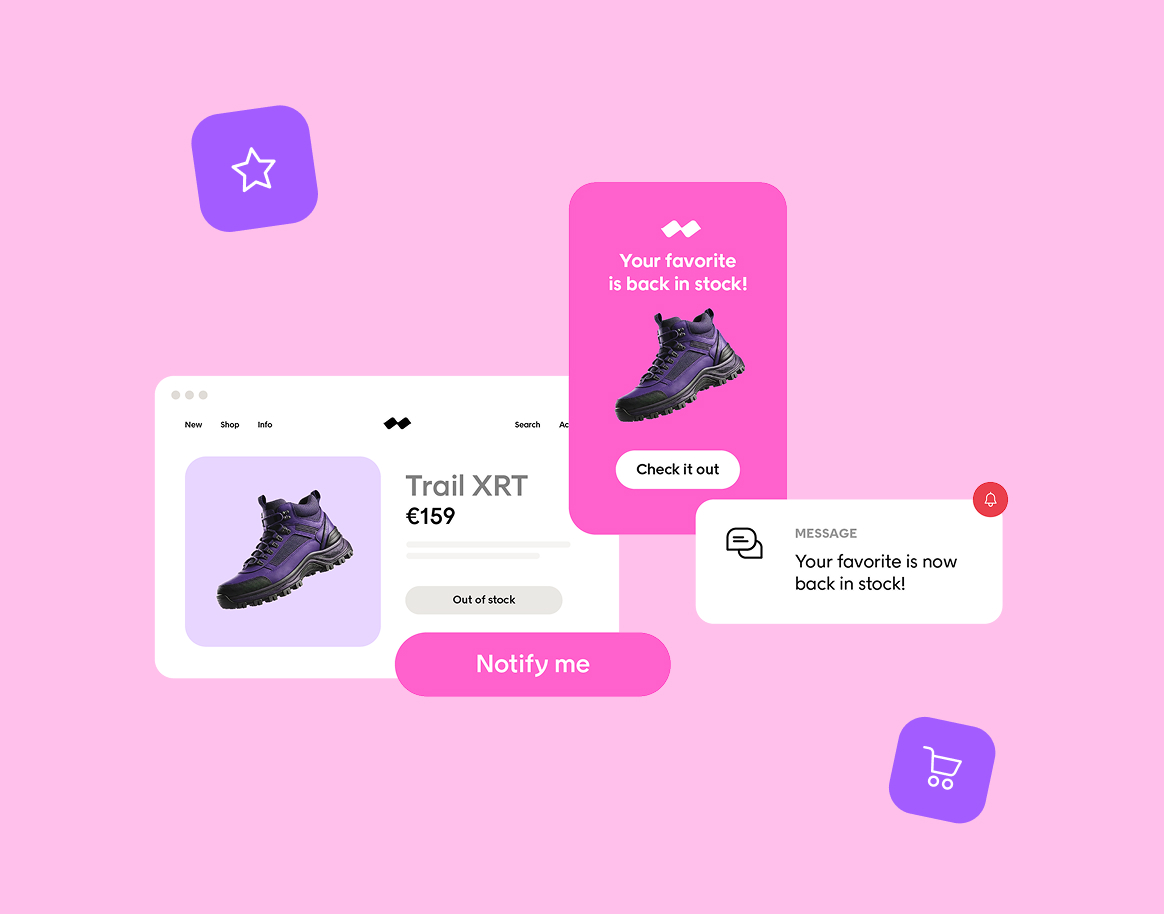
4. Back-in-stock plus “complete the look”
Reconnects high-intent browsers.
Audience: Shoppers with saved or viewed items
Trigger: Product returns to stock
Experience: Back-in-stock alert plus complementary items
Success metric: Conversion rate lift
5. Price drop for wishlisted items
Supports intent without heavy incentives.
Audience: Customers with active wishlists
Trigger: Product price decreases
Experience: Short notification with targeted offer
Success metric: Increased customer engagement
6. VIP early access with loyalty tier boosts
Rewards your most loyal customers.
Audience: High-tier loyalty segments
Trigger: New drops or seasonal launches
Experience: Early access window or limited release
Success metric: Stronger customer loyalty
7. Store visit follow-up with clienteling add-ons
Bridges store and online.
Audience: Recent store visitors
Trigger: Visit recorded or clienteling event
Experience: Personalized follow-up with related items
Success metric: Higher attachment rate
8. Abandonment journeys – cart, browse, checkout
Reduces friction across the journey.
Audience: Active browsers and shoppers
Trigger: Cart, browse, or checkout interruption
Experience: Helpful reminder with relevant products
Success metric: Recovery rate improvement
9. Post-purchase care tips with UGC
Improves satisfaction and reduces returns.
Audience: Recent buyers
Trigger: Order delivered
Experience: Care tips, styling ideas, UGC content
Success metric: Lower return rate
10. Renewal and subscription save
Supports recurring revenue.
Audience: Subscription or replenishment customers
Trigger: Renewal date approaching
Experience: Clear benefit reminder or save offer
Success metric: Retention rate
11. Seasonal cadence nudges
Keeps customers engaged throughout the year.
Audience: Seasonal segments or behavior-based cohorts
Trigger: Seasonal moment or shopping pattern
Experience: Curated picks tied to season or need
Success metric: Conversion rate lift
12. Win-back with proof-of-value
Rebuilds momentum with lapsed customers.
Audience: Customers with long inactivity
Trigger: Significant lapse window
Experience: Value-driven message with social proof
Success metric: Reactivation rate
Playbooks show what is possible. A retail-native platform brings it all together so your team can run them with ease and deliver personalization at scale.
Why Voyado for personalization at scale
Voyado gives your team one place to understand customers, make smart decisions, and deliver personalized experiences across every channel. It is built for retail, so every feature supports real customer behavior and real business goals.
Retail-native unified profiles
You join store and online signals, loyalty activity, purchase history, and service data in one profile that shows how customers move through the journey.
Omnichannel decisioning and activation
Your team delivers personalized experiences across email, SMS, onsite, app, and clienteling without switching tools or adding complexity.
Loyalty and offer governance built in
You set rules, tiers, and caps so every offer protects margin and supports long-term customer loyalty.
Real-time triggers and testing
You activate journeys in seconds and use holdouts to measure true uplift, not surface clicks.
Your next steps
- Pick three use cases that support revenue and customer experience.
- Map the signals, triggers, and content your team needs to run them.
- Start small with a 90-day plan and refine what works.
See how Voyado helps your team deliver personalization at scale and book a demo today.
FAQs
What does personalization at scale mean today?
It means using consumer data to deliver timely, relevant experiences that match customer expectations across every channel.
How is it different from simple segmentation?
Personalization at scale responds to real behavior in real time, not static groups.
Do I need a CDP to scale?
A CDP helps unify consumer data, but you can meet customer expectations with any tool that supports real-time profiles and activation.
How do I measure real lift, not just clicks?
Use holdouts and incrementality tests to see how personalization at scale changes behavior and revenue.
How do I avoid over-personalization and fatigue?
Set frequency caps and priority rules so each experience feels helpful, not overwhelming.