TL;DR
In 2026, customers move across store, app, web, email, and social in one customer journey. They expect one seamless customer experience. Most retailers still run channel-first campaigns instead of coordinating the entire journey.
Omnichannel orchestration is about connecting data, timing, and messages across all touchpoints so you deliver personalized experiences across multiple channels.
In this article, you’ll learn what omnichannel orchestration really means, how it differs from multichannel marketing, and how to move from batch-and-blast campaigns to seamless customer journeys.
What is omnichannel orchestration?
Omnichannel orchestration means deciding who gets what message, on which channel, and at what moment, based on customer behavior and context – not just your calendar.
It follows the entire journey.
Welcome → browse → add to cart → visit physical stores → purchase → repeat → churn risk.
It’s not about adding more channels. It’s about coordinating timing and communication channels so you deliver a seamless customer experience across multiple touchpoints.
If you’re still operating in multichannel retailing, you’re managing channels separately. Omnichannel orchestration connects them into one cohesive customer experience.
It connects data, context, and action so you deliver personalized experiences across channels, not isolated messages.
Omnichannel vs multichannel vs journey orchestration
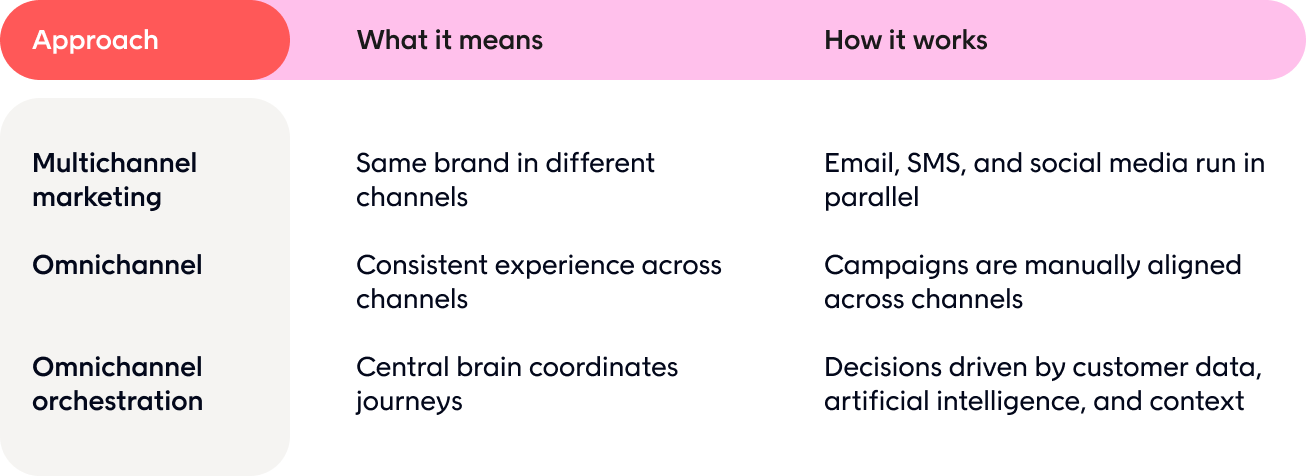
Multichannel marketing focuses on presence. Omnichannel focuses on consistency, coordination, timing, and intelligent automation across multiple channels.
You’ll also see the term journey orchestration software. That often includes service and support flows. You’ll see a focus on coordinating customer interactions across marketing, loyalty, e-commerce, in-store, and digital touchpoints.
Omnichannel orchestration connects data and channels so you can deliver consistent, personalized customer journeys at scale.
In 2026, that coordination isn’t optional.
Why omnichannel orchestration is a bigger deal in 2026
In 2026, complexity isn’t the exception. It’s the default. Customer journeys are longer, more fragmented, and shaped by stricter data privacy rules and tighter margins.
Customer journeys are more fragmented than ever
Your customer journey doesn’t stay in one place.
Customers browse in a mobile app, research on desktop, visit physical stores, and complete in-app. They discover products on social media, compare on marketplaces, and expect to transition smoothly across multiple channels.
That creates more customer interactions and more risk of inconsistency across different channels.
Without omnichannel orchestration, you get:
- Duplicate messages
- Irrelevant promotional offers
- Inconsistent pricing
- A broken omnichannel experience
With omnichannel orchestration, the experience changes:

Fragmentation is growing. Orchestration keeps the entire journey aligned.
Privacy changes make channel hacks less effective
Tracking is tighter. Data privacy expectations are higher. You can’t rely on retargeting across one channel and hope it works.
Instead, you need to analyze customer behavior using first-party customer data inside your own ecosystem. Your site. Your mobile app. Your email. Your loyalty program.
Omnichannel orchestration enables businesses to use that data intelligently. It supports personalized interactions at the right moment across multiple channels, not just reactive cross-channel campaigns.
Less tracking hacks. More intelligent automation built on trusted data.
Retail margins force smarter marketing, not more marketing
Media costs, logistics, and returns are rising. Market trends are constantly evolving. Every customer journey must drive measurable business outcomes.
Uncoordinated campaigns create waste. Overlapping discounts. Fatigue. Margin erosion.
Orchestrated journeys support:

To support this, your technology infrastructure needs strong channel integration across marketing, loyalty, and product discovery. An integrated approach like Voyado’s omnichannel capabilities, combined with a connected customer loyalty platform, helps unify execution across the entire journey.
In 2026, omnichannel orchestration isn’t about doing more marketing. It’s about making every interaction perform.
Next, let’s break down what orchestration actually requires under the hood.
Core building blocks of omnichannel orchestration
If you want successful omnichannel orchestration, you need more than good campaigns. You need a clear structure.
Use this as a practical checklist.

Unified, retail-ready customer data
Start with a unified view.
You need a single view of customer identities, consent, preferences, customer behavior, and purchase history. Not separate records per channel.
For retail, that also means:
- In-store and online purchase history
- Returns and exchanges
- Loyalty points and tiers
- Preferences across preferred channels
Without that, you can’t deliver personalized experiences across multiple channels.
A connected customer loyalty platform helps create that single source of truth so you can coordinate journeys instead of guessing.
If the data isn’t unified, orchestration won’t work.
Real-time events and triggers
Batch-only journeys are no longer enough.
Modern omnichannel orchestration reacts to real-time events across multiple touchpoints:
- Product viewed
- Category viewed
- Add to cart
- Abandoned cart
- Price drop
- Back in stock
- Store visit
- App install
These signals let you respond within seconds or minutes, not days.
Real-time journey orchestration ensures the right message reaches the right channel at the right moment, based on actual customer interactions, not a weekly send schedule.
If your flows only run on calendar-based logic, you’re not orchestrating. You’re scheduling.
Decisioning and AI
Data and triggers are not enough. You need decisioning.
That means:
- Who enters which journey
- When someone moves between journeys
- Next-best-channel and next-best-action
- Frequency caps and fatigue rules
This is where artificial intelligence and machine learning support intelligent automation. AI agents can observe signals across channels and adjust journeys without manual intervention.
Instead of static rules, you get dynamic decisioning that adapts to customer needs and customer expectations.
This is what moves omnichannel orchestration from manual setup to scalable execution.
Channel coverage across the full journey
You don’t need to own every channel inside one system. You need coordination across various channels.
For retailers, that usually includes:
- Email, SMS, app push, and in-app messages
- On-site banners and product recommendations
- Ad audiences and retail media audiences
- Direct mail or store printing in some markets
Omnichannel orchestration coordinates these communication channels so they work together. It ensures you deliver consistent messaging across multiple channels instead of running separate cross-channel campaigns.
Coverage matters. Coordination matters more.
Governance, consent, and guardrails
Consent and preferences must follow the customer across channels.
Regional data privacy rules like GDPR affect which communication channels you can use and how often. You also need frequency controls to prevent fatigue and protect customer satisfaction.
A central orchestration layer keeps track of:
- Who can be contacted
- On which channel
- How often
- Under which consent status
Without governance, scale creates risk.
With governance, orchestration enables businesses to deliver personalized experiences responsibly.
Measurement and feedback loops
If you don’t measure at the journey level, you can’t prove impact.
Track:
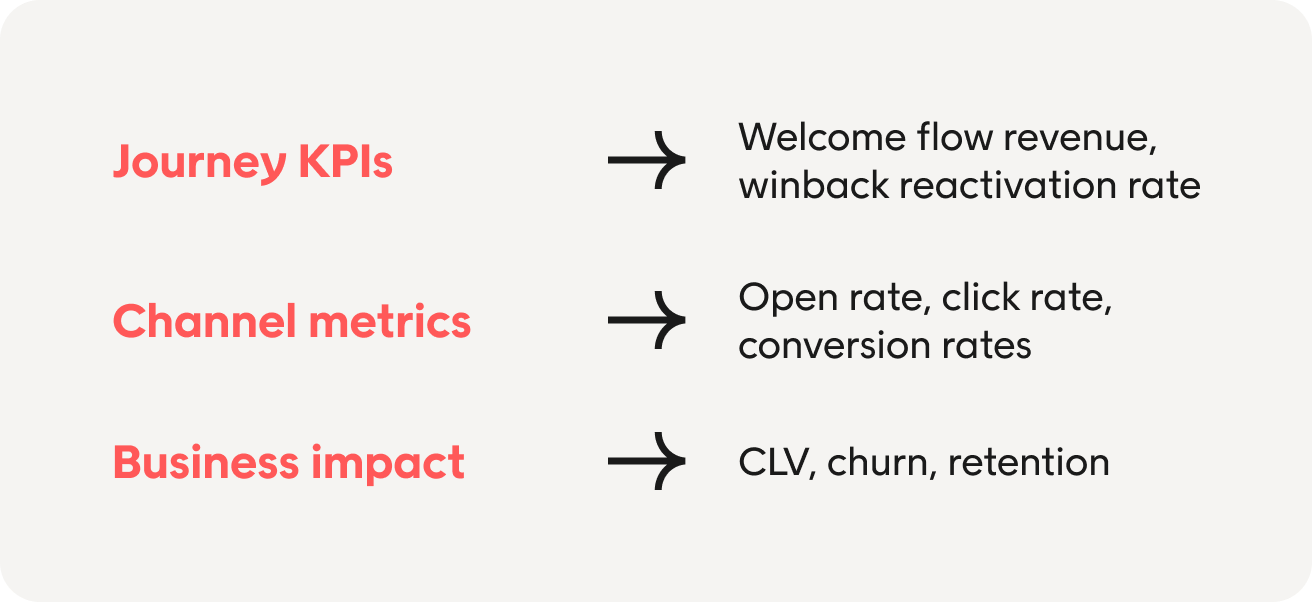
Use A/B tests and holdout groups to measure incremental lift. Connect journey performance to overall business outcomes, not just channel metrics.
If you’re evaluating measurement capabilities, these omnichannel analytics tools show how retailers compare orchestration depth.
Orchestration isn’t complete without feedback loops. Measurement turns activity into improvement.
If these building blocks aren’t in place, omnichannel orchestration stays theoretical.
With them, you can coordinate data, decisions, and channels across the entire journey at scale.
How to harmonize customer journeys with omnichannel orchestration
You don’t fix everything at once. You start with what drives revenue and customer loyalty.
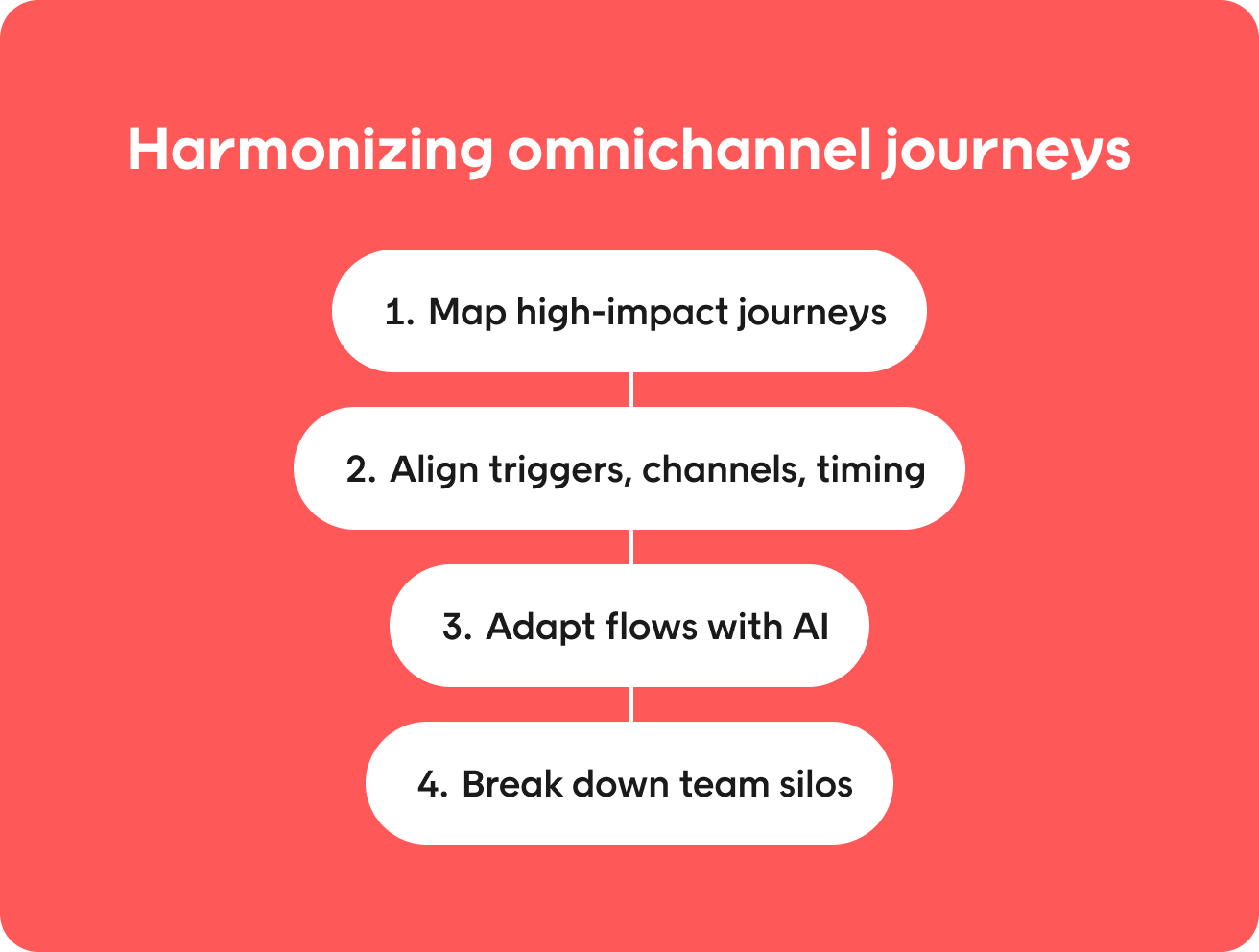
Step 1: Map the journeys that matter most
Start with 4–6 core journeys:
- Welcome and first purchase
- Browse and cart abandonment
- Post-purchase and repeat purchase
- Loyalty onboarding and reactivation
- Churn prevention
For each journey, document three things:
- Which channels are used today
- Where the gaps are
- Where duplication or fatigue happens
Example:
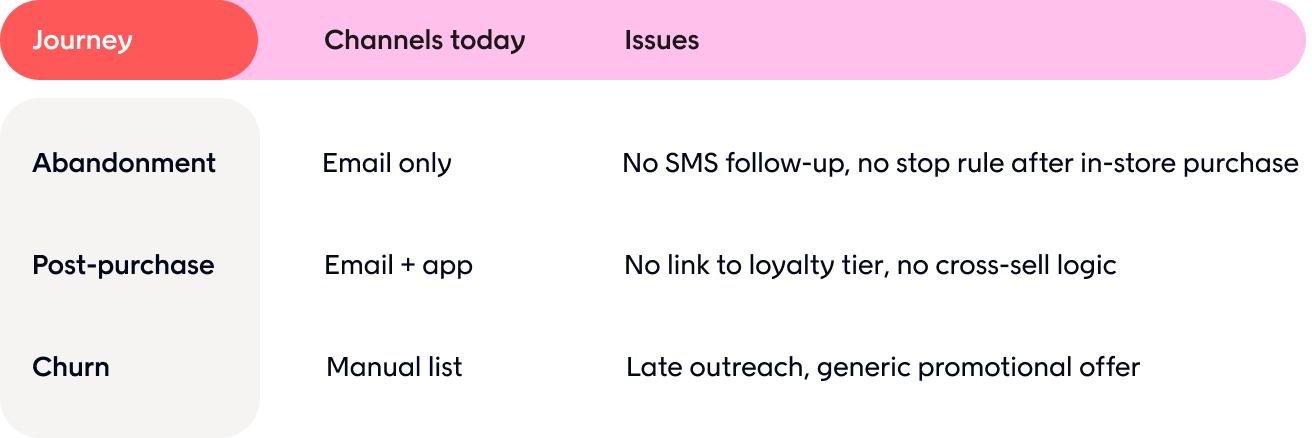
This exercise exposes where your omnichannel strategy breaks down across multiple touchpoints.
Step 2: Align triggers, channels, and timing
For each journey, define:
- Entry trigger: event, segment, or lifecycle stage
- Primary channel and supporting channels
- Timing rules and wait periods
- Pause and stop rules
Keep it simple and readable for business users.
Example logic:
If a customer clicks a back-in-stock email but does not purchase within 24 hours, send an SMS.
If they purchase in-store, stop the sequence.
This is where omnichannel orchestration moves from multichannel marketing to coordinated journey orchestration.
The goal is simple: deliver the right message in the right channel at the right moment across multiple channels.
Step 3: Use AI agents to adapt journeys in real time
Rules cover planned paths. AI handles the unexpected.
Agentic AI can:
- Detect when a customer is stuck in a journey
- Adjust the channel based on customer behavior
- Change the offer if engagement drops
- Pause communication after high-value transactions
This is intelligent automation, not guesswork.
Artificial intelligence and machine learning help you analyze customer behavior and adjust flows without manual intervention. That’s how customer journey personalization scales across large volumes.
Retail-focused platforms like Voyado use retail context to inform decisioning, so journeys reflect how today’s consumers actually move across physical stores, mobile apps, and digital channels.
Step 4: Break down silos between e-commerce, CRM, and stores
Omnichannel orchestration fails when teams plan in isolation.
You need shared:
- Audiences
- Journey logic
- KPIs and business outcomes
- Measurement and feedback loops
E-commerce, CRM, CX, and retail ops should agree on one view of the entire journey, not separate calendars.
If product recommendations are part of your journey logic, the product discovery engine must align with your orchestration rules. If loyalty drives frequency, your customer loyalty platform must feed real-time data into journey decisions.
When teams share ownership, you deliver consistent personalized experiences across channels instead of fragmented campaigns.
Small scope. Clear rules. Shared ownership. That’s how you move from intention to successful omnichannel orchestration.
Next, let’s look at what to evaluate when choosing journey orchestration software.
3 Omnichannel orchestration examples for retailers
Seeing orchestration in context makes it real.
Fashion retailer: from batch promos to mission-based journeys

Instead of multichannel marketing campaigns across different channels, the retailer coordinates customer interactions across the entire journey.
The result is personalized experiences that reflect intent, not a calendar.
Beauty retailer: loyalty-led orchestration

Customer loyalty becomes the decision engine.
Journeys adapt based on loyalty data, not guesswork. That drives customer engagement and enhances customer satisfaction without heavy discounting.
Home and lifestyle retailer: connecting inspiration to store sales

Online inspiration informs store outreach. Store activity informs digital messaging.
Customers transition smoothly across multiple channels, creating a cohesive customer experience.
Further reading suggestions:
If you want more examples of coordinated journeys, these omnichannel CX examples show how retailers structure real orchestration. And when comparing orchestration depth, reviewing leading omnichannel CX platforms highlights the key differences in channel integration and decisioning.
Across verticals, the pattern is consistent. Omnichannel orchestration connects data, timing, and channels so journeys adapt in real time.
How Voyado supports omnichannel orchestration
You’ve seen the building blocks. Unified data. Real-time triggers. Decisioning. Governance.
How do you bring that together without adding more manual work? Because orchestration only works if it’s manageable day to day. If it’s not supporting your team, it’s hindering them.
One place to coordinate journeys and channels
Journeys, consent, purchase history, loyalty data, and communication channels live in one orchestration layer.
That means one view of the customer. One place to adjust logic. One set of rules across email, SMS, app, and on-site messaging.
Instead of fixing overlaps manually, you coordinate the entire journey from a central hub.
You can explore how this works in Voyado’s omnichannel capabilities.
Retail logic built in
Retail journeys follow patterns. Welcome. Abandonment. Post-purchase. Loyalty. Winback.
Those flows are already structured around products, categories, stores, orders, returns, and loyalty tiers.
When loyalty status or in-store purchases change, journey logic adjusts automatically through the connected customer loyalty platform.
Promotions don’t overlap. Messages pause when they should. The experience stays consistent.
AI-assisted decisioning, not manual guesswork
Journey rules define structure. Artificial intelligence and machine learning refine the decisions.
Next-best-action, channel prioritization, and send-time optimization happen inside the orchestration logic. Journeys adapt as customer behavior shifts across multiple channels.
If product recommendations are part of your experience, they align with orchestration through the product discovery engine.
And if your brand is still evolving from multichannel retailing, orchestration can layer in gradually.
If you want to see how omnichannel orchestration works inside Voyado, book a demo.
FAQs
What is omnichannel orchestration in retail?
Omnichannel orchestration is the practice of coordinating the entire customer journey across channels using data, timing, and decisioning. It connects customer data, triggers, and communication channels so you deliver a consistent customer experience, not isolated campaigns.
How is omnichannel orchestration different from multichannel marketing?
Multichannel marketing runs campaigns across different channels. Omnichannel orchestration coordinates those channels around one customer journey using journey orchestration logic and intelligent automation. The focus shifts from channels to business outcomes.
Do I need a CDP for omnichannel orchestration?
You need unified customer data, whether that sits inside a CDP or within an orchestration platform. The key pillars are identity resolution, consent, and real-time signals that support customer journey personalization.
Which channels should be included in an omnichannel strategy?
Start with the channels that matter most to your customer’s needs. For most retailers, that includes email, SMS, mobile app messaging, on-site experiences, and in-store touchpoints. Over time, you can extend across multiple channels as your marketing strategy matures.
How long does it take to implement omnichannel orchestration?
It depends on your technology infrastructure and data readiness. Many retailers start with a few core journeys and expand. With the right setup and artificial intelligence support, intelligent automation can scale gradually.
Is omnichannel orchestration only for enterprise retailers?
No. Small and mid-sized retailers benefit from coordinated customer interactions just as much as enterprise brands. The goal is operational efficiency and stronger customer loyalty, not complexity.
Retail-focused platforms like Voyado are built to support omnichannel orchestration for retail and e-commerce teams of different sizes.
About Author