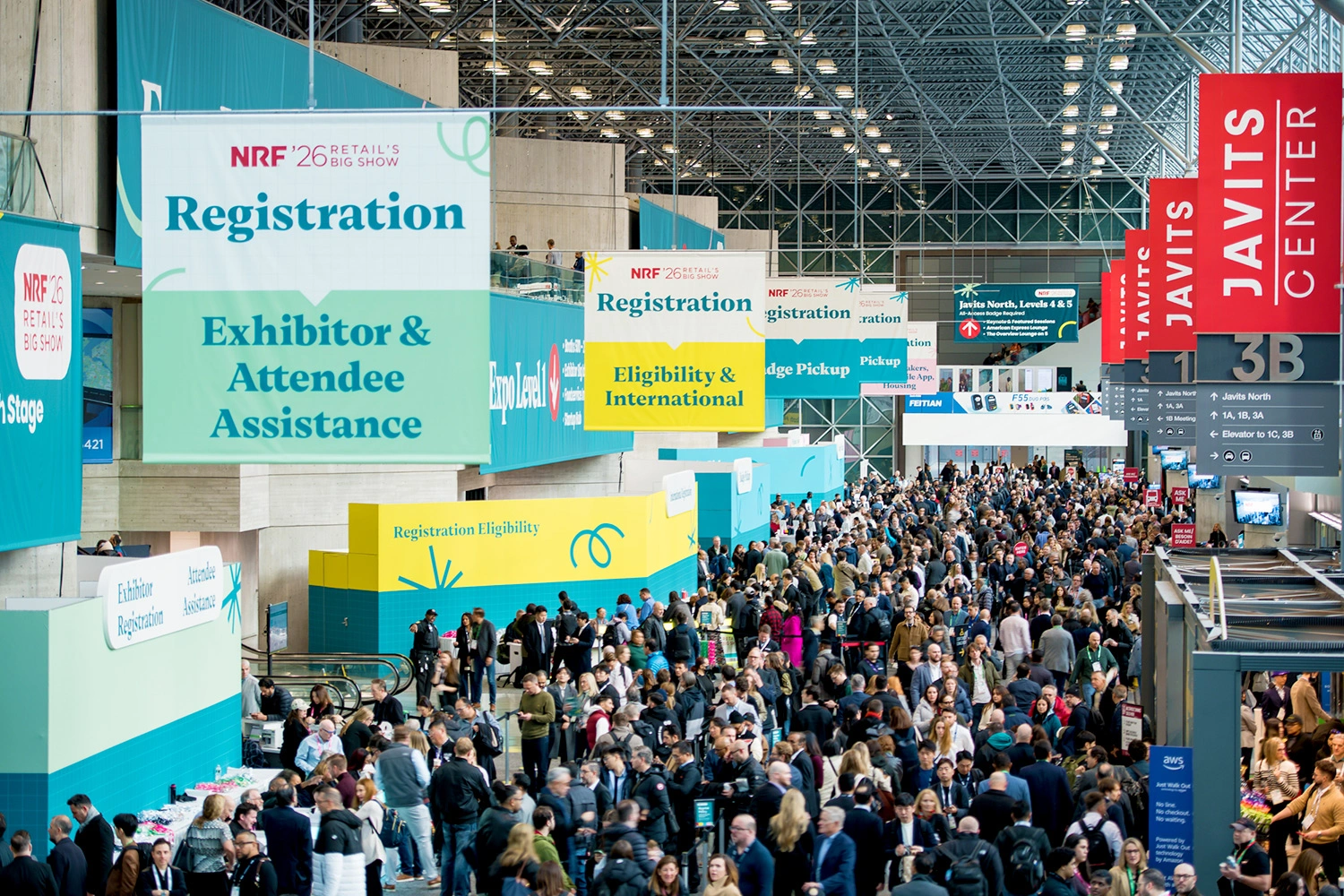
NRF 2026 highlighted how quickly retail priorities are converging around one idea: relevance at scale.
Throughout the event, conversations shifted away from optimization for its own sake toward execution that actually matters: acting on customer intent, earning trust in the moment, and building relationships that last beyond the transaction.
AI, personalization, retail media, and stores all featured prominently, but always in service of a bigger question: how retailers create value that customers recognize and return to.
These five trends capture what stood out most at NRF 2026, viewed through a lens that matters to modern retailers: customer experience, long-term value, and operational impact.
1. Agentic AI: from insight to action
At NRF 2026, AI conversations moved decisively past insight and optimization. The focus was on action: how customer intent can be recognized, interpreted, and acted on in real time, across discovery, offers, loyalty, and messaging.
This shift became concrete when Google announced the Universal Commerce Protocol, an open standard designed to let AI agents operate across the full buying journey, from discovery to checkout and post-purchase support.
It’s clear that agentic AI is becoming part of the retail infrastructure, not an experimental layer sitting on top of it.
What stood out was that success is no longer about having smarter predictions, but about making better decisions when intent is expressed. Retailers like Lowe’s illustrated this shift by using AI assistants not just to answer questions, but to make situational judgements customers can trust. In this model, relevance, speed, and confidence become as important as accuracy.
 By turning customer data into action automatically and at scale, agentic AI shifts the role of the product from something retailers operate to something that actively works on their behalf – augmenting human-led work and helping teams focus on strategy, loyalty, and long-term customer value.”
2. Retail media grows up, from experiment to strategic engine
The building blocks behind retail media were ubiquitous at NRF 2026. Conversations about marketplaces, curation, and monetization all pointed to the same underlying shift: retailers are becoming more deliberate about how they turn traffic and intent into value.
Retailers including Target, Best Buy, and Nordstrom described marketplaces as enterprise strategies rather than digital add-ons. The emphasis was on curation at scale, using first-party data, real shopping intent, and inventory awareness to expand assortment and relevance without diluting brand trust.
This is the same shift retail media now needs to make. As monetization becomes more tightly woven into the shopping journey, success depends on behaving like part of the experience rather than an overlay on top of it. The challenge for retailers is no longer whether to monetize attention, but how to do so in a way that reinforces relevance, loyalty, and long-term value.
In that context, retail media succeeds when it earns its place in the customer journey and quickly breaks trust when it doesn’t.
3. Personalization that actually grows CLV
Personalization is no longer measured by how well you use merge tags or basic segmentation. It’s being judged by impact: whether it strengthens loyalty, improves margin, and increases long-term customer value.
One of the strongest signs of this change is how customers now express what they need, with product discovery becoming more conversational and context-driven. As customer behavior changes, so does the role of personalization.
Leaders from fashion retailer Abercrombie & Fitch described how shoppers increasingly express context and timing rather than browsing categories or keywords. A customer isn’t just looking for a dress; they’re looking for the right dress for a specific occasion, whether that’s a concert next weekend, a holiday coming up, or a new phase of life.
When personalization is connected to the full customer lifecycle, it becomes a growth lever rather than a tactic. Retailers that link personalization to loyalty, retention, and margin are better positioned to grow CLV in a way that is both measurable and sustainable.

4. Omnichannelresurgence, with in-store as a strategic moment
Physical retail is being re-evaluated, not as a channel to defend, but as a moment to activate. The conversation has moved beyond footfall and fulfilment toward the role stores play in building trust, experience, and long-term customer relationships.
What stood out is how in-store behavior is increasingly treated as a signal, not an endpoint. Retailers are looking at how intent expressed in-store can inform digital journeys, and how digital context can enhance physical experiences. The store becomes part of a continuous conversation with the customer, rather than a separate environment.
This perspective was reinforced across multiple NRF sessions. At Dick’s Sporting Goods, the emphasis was placed on experience, culture, and community before technology, with digital elements designed to enhance what the brand already does well in-store.
Similarly, REI highlighted the role of its store teams as trusted guides, using human expertise and lived experience to create emotional connection in moments that matter. Even Barnes & Noble showed how localization and community-led store environments can turn physical spaces into places customers return to, not just shop in.
Across these examples, the message was consistent: omnichannel success depends on connecting human moments with systems that can recognize and respond to them.
5. Ecosystems over transactions
The final trend emerging from NRF 2026 goes beyond technology or channels altogether. It points to a broader shift in how retailers think about growth, from individual transactions to ecosystems built around long-term relevance.
Retail growth is no longer confined to single purchases or isolated touchpoints. Increasingly, value is created by expanding the role a brand plays in a customer’s life, through services, partnerships, and connected experiences that extend beyond the moment of sale.
This showed up in different ways across the show. CVS Health highlighted how existing trust can be extended into adjacent services such as healthcare and insurance. At the same time, as we’ve already outlined in trend 2, retailers described marketplaces as enterprise strategies, designed to expand relevance and assortment without diluting brand identity.
Across these examples, the focus moves away from optimizing repeat transactions and toward becoming consistently useful. Ecosystem thinking also changes how success is measured. Loyalty becomes about participation, not just points. Personalization becomes about guidance, not promotion. And technology becomes an enabler of connection, supporting relationships instead of defining them.
Designing relevance, not chasing trends
Taken together, these trends point to a retail industry becoming more deliberate about where technology adds value and where it should stay in the background.
The common thread is relevance: recognizing moments that matter to customers and responding with experiences that feel useful, consistent, and human.
The retailers that succeed in this next phase won’t be defined by how much technology they adopt, but by how well they connect insight to action across the customer lifecycle. Growth will come from trust built over time, not just attention captured in the moment.
NRF 2026 didn’t point to a single future for retail. It showed that the future is already being shaped, one decision, one interaction, and one relationship at a time.
About Author