
TL;DR
A multichannel marketing hub helps your team unify campaigns, data, and customer journeys across email, SMS, social media, stores, and online in one platform.
It goes beyond single-channel tools and traditional marketing automation by enabling real customer journey orchestration based on customer data and real-time behavior.
For retail brands, a modern multichannel marketing hub connects loyalty, campaign management, and customer engagement, enabling you to deliver consistent, personalized campaigns across every touchpoint.
What is a multichannel marketing hub (and what it’s not)
A multichannel marketing hub is a platform that lets your team design, orchestrate, and measure campaigns across multiple channels from one place using shared customer data and automation.
It connects audience segments, campaign management, and measurement across email, SMS, mobile apps, web, and social media so your customer journey doesn’t fragment between systems.
Gartner describes multichannel marketing hubs as ‘software that enables marketers to orchestrate personalized communications across common marketing channels using data and audience segments.’
(You can see how vendors are evaluated in the Gartner Magic Quadrant for Multichannel Marketing Hubs.)
For retail teams building a true omnichannel retail strategy, that orchestration layer becomes critical. It’s what turns disconnected tools into coordinated customer engagement.
Where it sits in your stack

If you’re comparing omnichannel vs. multichannel retailing, this is the operational difference. Multichannel marketing without orchestration remains channel-based. A hub shifts the focus to the full customer journey.
What it’s not
A multichannel marketing hub is not:
- Just an email tool
- Just a customer data platform
- Just another software application layered onto your stack
- A loose collection of multiple platforms
It’s the control layer that enables marketing teams to orchestrate personalized communications across channels from one unified platform.
When that layer is missing, campaigns stay siloed. When it exists, your marketing strategy becomes coordinated, measurable, and built around real customer interactions.
Why multichannel marketing is so hard in 2026
If you lead CRM or lifecycle marketing, you already feel this.
Multichannel marketing looks simple in a deck. In reality, it’s fragmented. Your customers move across channels seamlessly. Your systems do not.
Siloed tools and teams
Most retail marketing stacks evolved over time, not as one unified platform.
Email runs in one tool. SMS in another. Push notifications sit with the app team. In-store promotions are managed separately. Each channel works, but they rarely work together. So campaigns become channel-first instead of customer-first.
Instead of orchestrating one connected customer journey, marketing teams coordinate separate campaigns across channels and try to align them manually.
That makes real customer journey orchestration hard, especially when multiple platforms are involved.
Data everywhere, insight nowhere
You’re not short on data.
Website behavior, purchase history, loyalty status, social media engagement, and email metrics all exist. The issue is that customer data lives across CRM systems and disconnected software applications.
This fragmentation creates three common problems:

When customer interactions across multiple touchpoints are scattered, your marketing strategy becomes reactive. It’s hard to know which campaigns influenced which customers, and even harder to optimize in real time.
Manual execution slows iteration
Execution becomes heavy because segments are rebuilt, journeys are duplicated, and testing is limited to subject lines instead of optimizing the full flow across channels.
Coordinating marketing efforts across various channels often depends on meetings and spreadsheets instead of automation.
Without a central orchestration layer, cross-channel marketing stays operational instead of strategic.
Customer expectations keep rising
Customers expect consistency.
- Discounts should carry from email to mobile apps to the store.
- Preferences saved on mobile devices should apply online.
- Messaging across social media platforms and other common marketing channels should make sense.
They don’t think in channels. They experience your brand as one entity.
Retailers trying to scale true multichannel retailing quickly realize that disconnected systems break the experience. That’s why many are shifting toward more structured omnichannel approaches that unify engagement across touchpoints.
Some teams are beginning to explore automation and agentic AI to trigger next best action programs and optimize campaigns using real time data. But without the right foundation, AI simply adds another layer of complexity.
Multichannel marketing isn’t hard because your team lacks skill. It’s hard because fragmented systems make unified execution nearly impossible.
And that’s exactly why the architecture matters.
Key capabilities of a modern multichannel marketing hub
Once you understand the concept, the next question is simple.
What should a modern multichannel marketing hub actually enable your team to do?
Here are the capabilities that matter most in retail.

1. Unified customer profiles and audience management
Everything starts with data. But not scattered data.
A modern multichannel marketing hub brings e-commerce activity, store purchases, loyalty data, site search behavior, and campaign engagement into one unified customer profile.
Instead of juggling CRM systems and disconnected software applications, your marketing teams work from a shared data foundation. From there, segmentation becomes strategic instead of manual.
You should be able to build audience segments based on:
- Recency, frequency, and monetary value
- Category affinities
- Channel preferences
- Lifecycle stage such as new, active, lapsing, or churned
- Individual end users based on real customer interactions
For example, a customer who purchased twice in the last 60 days, browsed a new category, and prefers SMS can automatically move into a targeted replenishment journey.
For retailers operating across brands or regions, this becomes even more complex. A structured multimarket setup allows you to manage local campaigns while maintaining shared audience logic across markets.
This unified profile is what makes true customer journey orchestration possible.
2. Cross-channel campaign and journey orchestration
Once segments are unified, execution becomes coordinated.
A multichannel marketing hub allows you to design journeys across multiple channels inside one system. Instead of building isolated campaigns, you orchestrate complete customer journeys.
A typical retail journey might look like this:
New signup → Welcome email
No purchase after 5 days → SMS reminder
Purchase made → Post-purchase follow-up
30 days later → Replenishment trigger
Branching happens automatically based on:
- Behavior such as opened, clicked, browsed, or purchased
- Channel responses and preferences
- Lifecycle stage
Instead of coordinating campaigns across separate tools, everything lives inside one central control layer. A strong campaign management platform becomes essential to manage journeys, triggers, and cross-channel marketing without friction.
You move from sending campaigns to designing intentional customer journeys.
3. Consistent experiences across channels
Customers experience your brand as one entity. Not as separate systems.
A modern multichannel marketing hub acts as the brain that coordinates messaging across email, SMS, push notifications, in-app messages, web overlays, and social media platforms.
Without orchestration, this is what often happens:
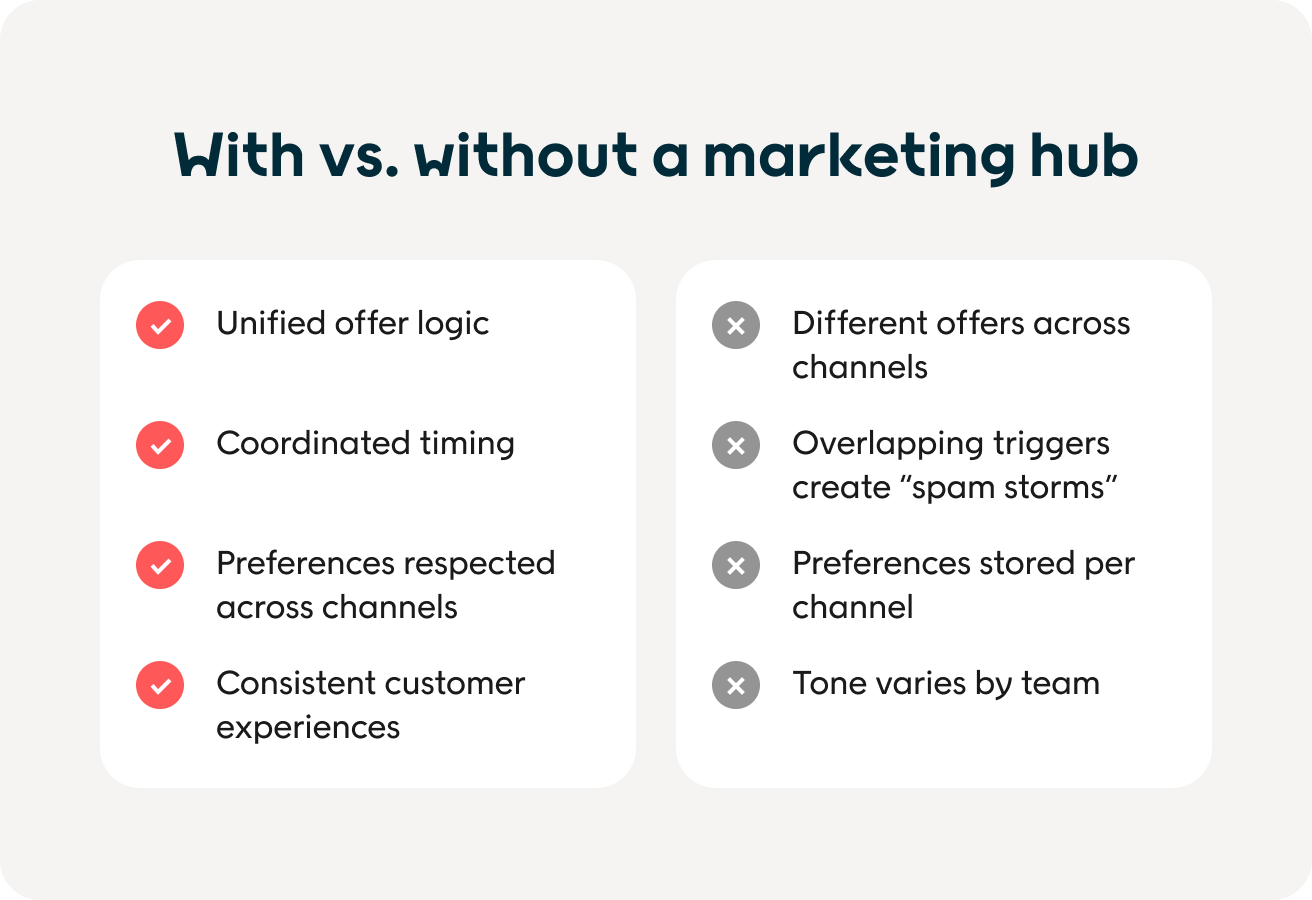
Consistency builds trust. And trust builds long-term value.
When offer logic, timing, and tone are managed centrally, your marketing efforts feel intentional rather than reactive.
4. Analytics, attribution, and insight loops
Execution without visibility leads to guesswork.
A modern multichannel marketing hub should let you analyze performance by:
- Journey or flow
- Audience segment
- Channel and device
- Campaign window versus long-term customer value
That gives you cross-channel clarity. You can see how email plus SMS plus app performs compared to email alone, and how different audience segments respond across multiple touchpoints. But reporting in retail goes beyond open rates and clicks.
You should be able to clearly answer questions like:
Which journey increased repeat purchases?
Did this campaign improve purchase frequency?
How did this impact basket size?
What incremental revenue did this flow generate over time?
These are retail KPIs. They connect marketing efforts directly to business growth.
When data, attribution, and reporting live inside the same multichannel marketing hub, insight feeds back into strategy. You are not just launching campaigns. You are continuously optimizing the full customer journey.
5. Agentic and AI-powered assistance
Modern multichannel marketing hubs are beginning to include AI-powered support that helps enable marketers move faster from insight to action.
That includes:
- Suggestions for the next best action programs
- Automated optimization of send times using real-time data
- AI agents that test journeys and recommend audience segments
You’re not trying to replace marketing teams. You’re trying to reduce manual coordination across multiple platforms and improve customer engagement at scale.
Platforms like Voyado are already exploring agentic workflows that help orchestrate personalized communications more efficiently across channels.
The direction is clear. Marketing is becoming more intelligent and less manual.
When these capabilities come together inside a multichannel marketing hub, your marketing strategy shifts from isolated campaigns to coordinated customer journey orchestration.
Here’s where things get actionable.
How to use a multichannel marketing hub to unify campaigns and customer journeys
A multichannel marketing hub only delivers value if you implement it with intent.
Here’s a practical way to roll it out so your campaigns, data, and customer journeys work together instead of against each other.
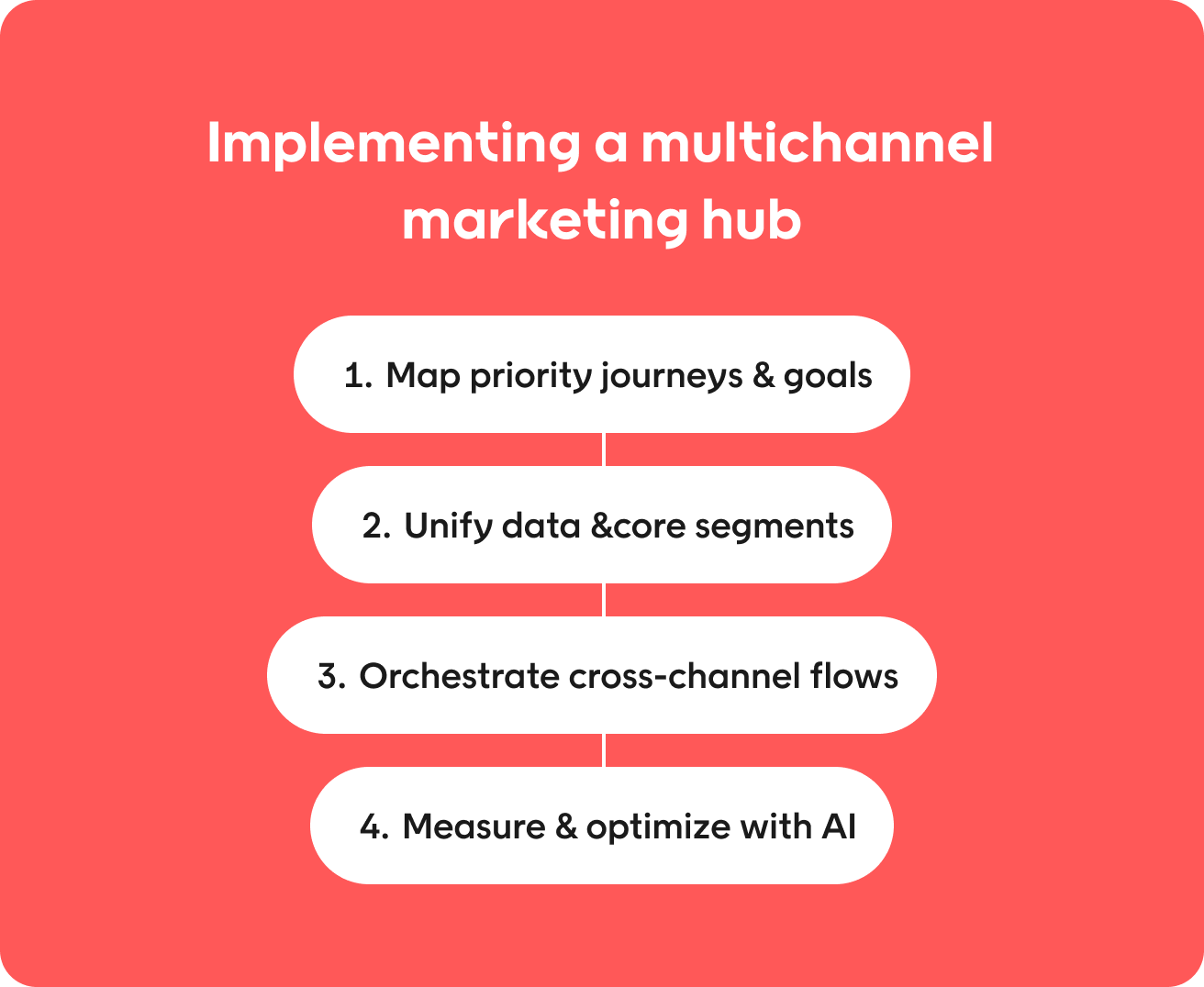
Step 1: Map your priority journeys and goals
Do not start with everything.
Organizations seeking better customer engagement should focus on three to five journeys that directly impact revenue or retention.
Common retail priorities include:
- Welcome and first purchase
- Post-purchase cross-sell and review
- Lapsing customer win-back
- High-value VIP nurturing
- Store plus e-commerce launch campaigns that combine digital and social media campaigns
For each journey, define three things clearly.
North star metric
Conversion rate, purchase frequency, basket size, store visits, or repeat rate.
Key triggers and touchpoints
What behavior starts the journey? What signals matter?
Channels involved
Email, SMS, push, in-app, web overlays, and social media platforms.
If you cannot describe the particular purpose of the journey in one sentence, refine it. Clear goals ensure the service provided to customers feels intentional and aligned with real customer needs.
Step 2: Unify data and segmentation in the hub
Your multichannel marketing hub should also function as your central customer engagement platform.
To do that, it must receive structured data from:
- E-commerce orders
- Store transactions
- Loyalty programs
- Engagement data across channels
- Responses from social media campaigns
When technology users connect these sources into one unified platform, segmentation becomes consistent instead of duplicated across multiple platforms.
Build a core segment model that reflects real behavior:
- New → Active → At-risk → Churned
- Online-only → Store-only → Omnichannel
- Interest segments based on categories
This reduces manual setup and ensures campaigns reflect actual customer interactions rather than fragmented reports.
For business-to-consumer retailers, unified segmentation plays a key role in improving customer engagement across the full customer journey.
Step 3: Orchestrate cross-channel journeys in one canvas
Now execution becomes coordinated.
Example journey:
Trigger: first purchase completed.
Day 1: Order confirmation email.
Day 3: Thank-you email with usage guidance.
Day 7: Personalized recommendations via email and in-app.
Day 14: SMS reminder or offer if no second purchase, possibly including a store locator.
Key orchestration details matter:
- Channel fallback if no email engagement
- Frequency caps at the hub level
- Consistent offer logic to avoid conflicting discounts
- Alignment across digital and store messaging
Instead of managing separate vendor product or service workflows, the hub coordinates the product or service depicted across every customer touchpoint.
This central control layer reduces friction and supports zero-downtime campaign execution across channels.
Step 4: Measure, learn, and let AI support optimization
Optimization is where the hub proves its value.
Your marketing teams should be able to:
- Compare journeys with and without SMS
- Test channel mixes per segment
- Evaluate impact on repeat rate, purchase frequency, and long-term value
Modern platforms also support technology users with AI-driven recommendations.
AI can suggest which audience segments should enter which journey, recommend send times based on historic performance, and help optimize channel mix without constant manual testing.
Marketers remain in control. AI agents simply reduce coordination overhead and speed up execution.
When evaluating any vendor product or service, look beyond claims and highest ratings. Focus on whether the service mark, capabilities, and product or service depicted truly support your specific customer journey goals. Not all solutions are built for the same particular purpose.
A multichannel marketing hub should align with your customer needs, your segmentation model, and your operational reality. That matters more than branding, registered trademarks, or marketing language.
When implemented thoughtfully, a multichannel marketing hub becomes the operational backbone that unifies campaigns, customer data, and customer journeys across your business.
At this point, the focus shifts from strategy to capability.
How to choose a multichannel marketing hub for retail in 2026
At this stage, it helps to assess platforms against a focused set of retail capabilities rather than generic marketing features. Here are the criteria that matter most.
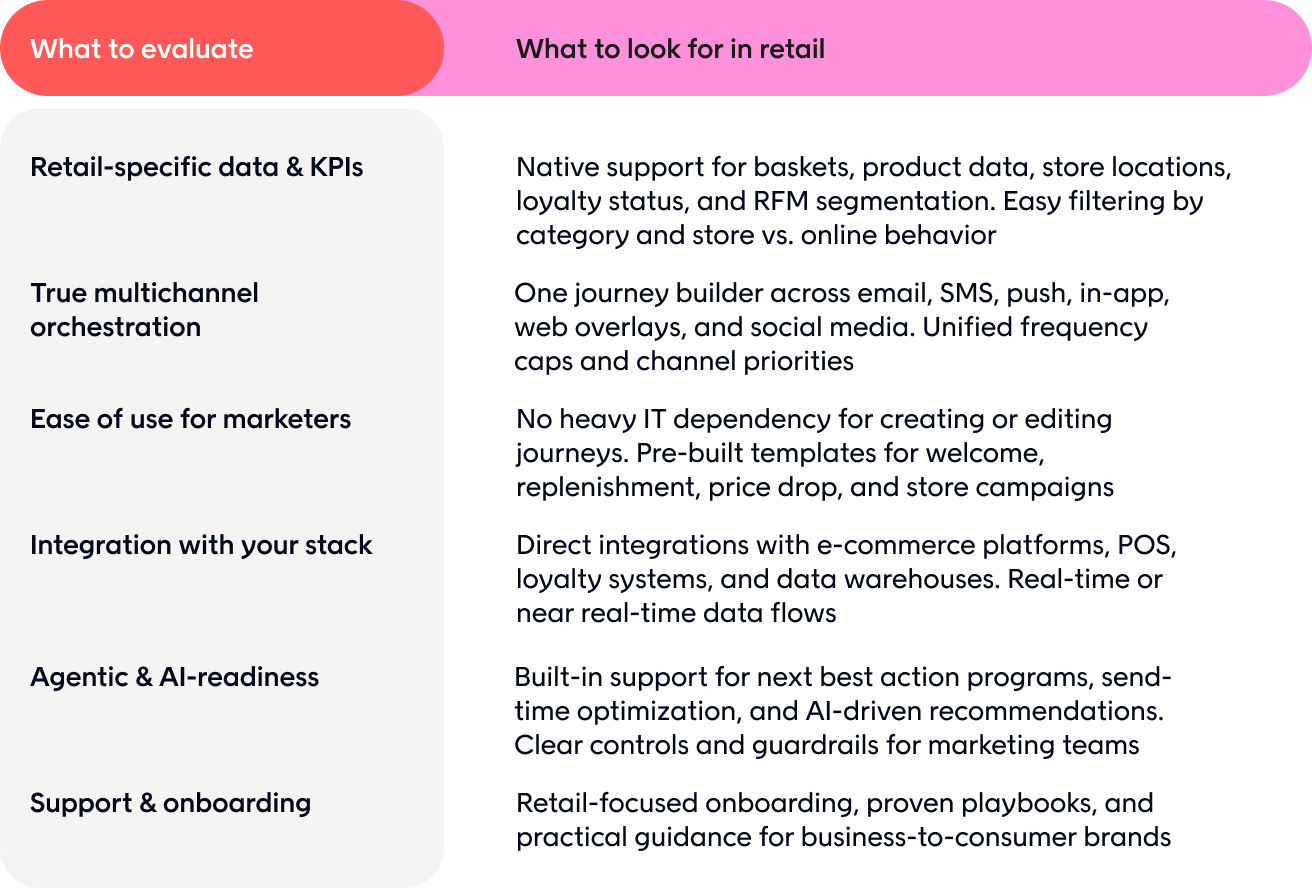
Only those vendors that support unified data, orchestration, and analytics in one platform will truly help you scale customer engagement across channels.
The right system should not just connect marketing channels. It should align with your customer needs, operational reality, and long-term growth strategy.
When a system is designed specifically for retail, these criteria stop being wishlist items and start being standard features.
How Voyado supports multichannel retail marketing hubs
When you look at what a modern multichannel marketing hub requires, it comes down to three things.
Unified data. Coordinated journeys. Retail-first logic.
Voyado is built around that foundation.
It connects customer data and loyalty insights with journey orchestration inside one retail-focused platform.
Instead of stitching together multiple platforms, marketing teams can manage segmentation, campaigns, and cross-channel engagement from one place.
That includes:
- A retail-ready campaign management platform built for lifecycle and promotional journeys
- An integrated omnichannel layer that coordinates messaging across email, SMS, app, web, and store
- Structured multimarket support for brands operating across regions or business units
Because it’s retail-native, product data, store locations, loyalty status, and purchase behavior are part of the core model, not an afterthought.
In practice, that means:
A fashion retailer can run one journey that combines email, SMS, and app push while keeping offers aligned with in-store campaigns.
A grocer can coordinate weekly leaflets, app offers, and loyalty messaging from one central hub, ensuring consistent pricing and timing across channels.
The result is not just multichannel marketing. It is coordinated customer engagement that reflects how retail actually works.
Your campaigns do not need to compete with each other. They can finally work together.
If you want to see how this could look inside your own business, book a demo and explore what a true retail-first hub can unlock for your team.
Multichannel marketing hub FAQs
What is a multichannel marketing hub?
A multichannel marketing hub is a unified platform that lets marketing teams run campaigns and customer journeys across multiple channels from one place. It connects customer data, segmentation, and activation inside a single customer engagement platform.
How is a multichannel marketing hub different from a CDP?
A CDP collects and unifies customer data. A multichannel marketing hub uses that data to execute campaigns and customer journey orchestration across marketing channels.
Multichannel vs omnichannel: Do I need both?
Multichannel marketing means using several channels. Omnichannel ensures those channels work together as one coordinated customer experience. Most retail brands need both.
Who should own a multichannel marketing hub inside a retail organisation?
CRM, loyalty, or lifecycle marketing teams usually own it. It often involves e-commerce and IT because it connects data, campaigns, and customer interactions.
When is the right time to invest in a multichannel marketing hub?
Invest when campaigns across channels feel disconnected or segmentation lives in multiple platforms. If customer engagement lacks coordination, it is time.